All posts by webadmin

NCC-C certificate holders felicitated

NCC-C certificate holders felicitated

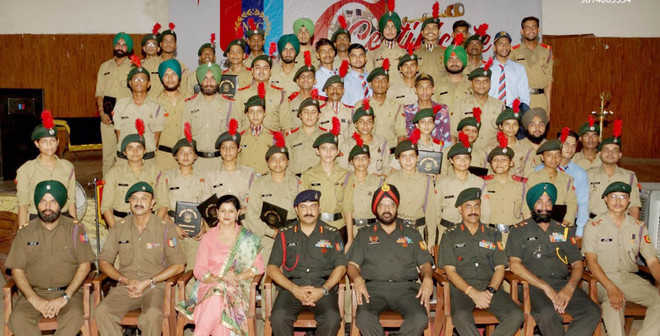
NCC candidates during a felicitation ceremony at DAV College in Jalandhar. Tribune Photo

Our Correspondent

Jalandhar, August 12

Around 150 senior division/senior wing cadets of Lyallapur Khalsa College, Doaba College, MC Polytechnic, ITI Government College (Tanda), GS Khalsa College, Daroli Kalan were honoured with the NCC certificates here on Sunday, in a facilitation ceremony organised at DAV College Jalandhar.Brig HMS Chatwal (NCC Group Headquarters, Jalandhar) was present as the Chief Guest of the ceremony. He congratulated the cadets and wished that they would join the Armed Forces through NCC special entry scheme soon.Brig HMS Chatwaal, while addressing the cadets gave information about Indian Army. He said the holder of C certificate enjoyed priority in exams such as NDA and CDS, as compared to ordinary applicants. He also said B and C certificates provided an edge to the cadets in such exams.He said for the NCC cadets, there are separate vacancies in the army. Apart from these, the hard work of the players has significance in Indian Army. The most of the work for cadets is done by the C Certificate.Throwing more light on the importance of the NCC-C certificate, Brig Chatwaal said, “If you have a C certificate of NCC, you can get a discount for higher studies in Indian universities and institutions.”


SURRENDER POLICY IN J&K : SINCERITY OF THE STATE IS WHAT MATTERS by Lt Gen Syed Ata Hasnain (Retd)

The sponsored proxy internal conflict in Jammu & Kashmir (J&K) has witnessed a plethora of methods by the state to break the resistance of the terrorist groups through measures other than military. It needs to be understood why this is necessary despite a clear advantage that the security forces (SF) enjoy in numbers and domination. All over the world it is well understood that with tight control over resources and effective operations the strength of terrorists can be brought down to a minimum but the last remnant can rarely be vanquished. A remnant strength mostly remains which takes up a frustratingly large focus without commensurate results, especially if it has local moorings.. Even marginal success by a lower strength of terrorists helps sustain the movement as is being witnessed in J&K at present. Funeral ceremonies of local terrorists act as motivation for fresh recruitment and the pipeline can be maintained such for a very long time. At intervals a new terrorist leader with a charisma a little beyond the ordinary and better organizational skills will emerge and lead the charge, giving an impetus to the movement until he too is neutralized and another upsurge of sentiment is witnessed. Little do non-military minds realize that this frustrating cycle can continue interminably. Most such minds favor a kinetic approach towards the neutralization of the last terrorist. Yet, this is never achievable because there is a finite amount of resources that the state can deploy in the fight against terror; beyond that it becomes counter-productive. In fact the returns start diminishing. Lower strength of terrorists tempts hierarchies to reduce force levels and this many times may lead to resurgence of terror activity. J&K has witnessed both the above phenomena. The Shupiyan-Kulgam belt has witnessed a resurgence of such activity due to the space made available to the terrorists after downsizing Army presence there. We also saw how the killing of Burhan Wani gave energy to local terrorism leading to resurgence with greater recruitment. Now it seems another charismatic young terrorist leader Manan Wani has emerged in South Kashmir. Manan Wani is a former research scholar from Aligarh Muslim University who was pursuing research in applied geology. He has in all probability joined the Hizbul Mijahideen (HM). Inquiries to me on social media all harp on whether Mannan Wani is the new Burhan Wani of South Kashmir.

To beat the flawed approach of attempting to neutralize the last terrorist we often have weak attempts at trying to break the will of the remnant. One of the ways is through offer of surrender for a reward. It is not easy formulating a surrender policy and it is even more difficult implementing one. Many times in the past we have resorted to such policies and each time these have come to a naught, mostly due to the misreading of the environmental reality, insincerity of the bureaucratic and police follow up and inability to take it to the last. There is no doubt that on many an occasion the exploitation of loopholes leads to financial rackets by some of the marginal elements such as over ground workers (OGWs). In 2003-4 a sincere attempt was made but the process of verification was weak and took inordinately long to inspire any desire on the part of local terrorists and their families to undergo the same. In addition there was any number of weapons available for OGWs to purchase at a marginal price and attempt to surrender these to qualify for the label of a terrorist. To beat that the State Government made it mandatory for an individual to be listed as a terrorist in the list maintained by the local intelligence authority. That had its own negative connotations. In 2006-7 an attempt was made through a surrender policy to attract back to our side some of the young men who had gone across to PoK in the Nineties. Some did manage to return on terms of this policy before it was realized that the Pakistan ISI was attempting to create a few sleeper agents through the legitimate route of the surrender policy. A near similar attempt was made in 2011-13 but again came cropper.

Thus the reported attempt at a new policy having been formulated in J&K under the current Governor’s rule, while being a welcome step, needs circumspection because of past experience. On the face it is revealed that the financial reward is substantially higher at Rs 5-6 lakh, to be placed in a fixed deposit for a lock in period during which the individual has to showcase his good behavior. Rs 5000 per month stipend for living expenses will be available during the lock in period along with some self-employment incentive under Pradhan Mantri Kaushal Vikas Yojana and Himayat.  It needs to be remembered that there are an undetermined number of surrendered terrorists in J&K; some figures put them as high as 20,000. No sincere attempt was ever made to integrate these elements into society and after an initial period during which they were to give ‘haazri’ (attendance) at local army units or police stations they simply melted into society. While on one hand it is good that the melt in effect took place, there always remains a nagging doubt about their sense of loyalty and desire to re-enter the bush. In fact for long it has been felt that with dwindling infiltration the return of surrendered terrorists always remains an option to continue fueling the separatist/terrorist movement.

What the current hierarchy of security specialists in J&K will have to ensure is that the pitfalls experienced in the last few such surrender policies are closely examined. The financial terms are indeed attractive and this will invite many fraudulent attempts to gain entry to surrender. The successful sustenance of the policy is highly dependent upon the monitoring of the surrendered individuals to ensure they do not subsequently act as OGWs. They also need a degree of security for which some separate incentives can be offered to the mohallas and villages they hail from. Self-employment is important but in J&K this is never easy as people have confidence only in government jobs and these are far and few in a system already bloated with government servants. What is needed in Jammu, Kashmir and Ladakh is start up activity with more easily available loans. Large scale consultancy is required by the J&K Government with many of India’s corporate houses to examine how ancillary support can be provided from these areas for main manufacturing. Horticulture, tourism including adventure sports, privatized higher education and other traditional methods of employment   must the core areas.

The success of a surrender policy is also largely contingent upon the degree of alienation existing in the environment. Unless more innovative methods are employed to reduce alienation a surrender policy will remain in suspense with dubious takers only. Yet, the establishment needs to be complimented for coming out with such a policy so soon after imposition of Governor’s rule.      


India shouldn’t rush into engaging with the new Imran-led Pakistan

New Delhi should let the new leader establish his bona fide intentions for combating terrorism first

It has taken the Pakistani military a full year to complete the soft coup it launched when it used a pliant judiciary to oust an elected prime minister. The military-engineered election outcome in favour of Imran Khan came virtually on the anniversary of Nawaz Sharif’s removal from office. What happened to Sharif is likely to happen to any PM that seeks to assert civilian control over a praetorian military.

AP■ The latest election has changed little in Pakistan, a country still struggling to be at peace with itself. The Pakistani military will remain the puppet master calling the shots from behind the scenes, with Imran Khan as its newest puppetIn fact, no PM has been allowed to complete a full five-year term. When a PM falls foul of the deep state, the judiciary, opposition and bureaucracy are used to smear the leader’s reputation and oust him or her. Every PM has been thrown out on charges of corruption and incompetence.

Pakistan’s Supreme Court hanged one elected PM in 1979, ousted another in 2017 and legitimised every military coup. Sharif was ousted without a trial, let alone a conviction. Turning natural justice on its head, the Supreme Court first pronounced him guilty of corrupt practices on the basis of the report of a military intelligence-associated joint investigation team and then ordered his trial postouster.

The Sharif removal anniversary last Saturday was a reminder that Prime Minister Narendra Modi’s surprise Lahore visit proved very costly for the now-jailed Sharif and for India, with the Pakistani military responding with a series of daring terrorist attacks on Indian security bases, from Pathankot to Uri and Nagrota. Modi’s visit sealed Sharif’s political fate, with the subsequent Panama Papers leak providing the perfect pretext for ousting him.

For India, this is not just a cautionary tale but a sobering lesson that policy made on the fly increases the odds of a boomerang effect. So does diplomacy seeking to befriend Pakistan’s civilian government in the hope of both offsetting Pakistani military’s implacable hostility to India and driving a wedge between civilian and military authorities. Such diplomacy has repeatedly recoiled on India. Didn’t Atal Bihari Vajpayee ride a bus to Pakistan and then publicly bewail that his “bus got hijacked and taken to the Kargil battlefield”?

The latest election has changed little in Pakistan, a country still struggling to be at peace with itself. The Pakistani military will remain the puppet master calling the shots from behind the scenes, with Imran as its newest puppet.

The military didn’t just stack the electoral odds in Imran’s favour; it did practically everything to put him in power. It took the general election to literally mean that it was to be run by the generals. The EU team found the voting “well conducted and transparent” but cited “restrictions on freedom of expression and unequal campaign opportunities.” Former Indian chief election commissioner SY Quraishi, however, gave the polls a clean chit.

It was the military’s brainchild to bring into the political mainstream the terrorists and militants assisting its belligerent India policy and Afghanistan meddling. In the election, not all the Islamists and militants fared badly. One militant group, Tehreek-i-Labbaik, garnered nearly two million votes. Even in the case of the terrorist-affiliated groups that were routed, the military has largely succeeded in its objective of mainstreaming them. The terrorists’ conversion into politicians means not just that they no longer are pariahs; their increasing political footprint in the coming years will likely extend Pakistan’s jihad culture to the polity.

The military has actually scored a double win. The next PM is a supporter of the military-backed jihadists and Islamists. Imran, long ridiculed as “Im the Dim” for his lack of intelligence, has morphed into a religious zealot who plays the blasphemy card and whose party brass includes hardcore extremists like Ijaz Shah, an ex-ISI officer and handler of Hafiz Saeed, Mullah Omar and Daniel Pearl’s murderer. Shah, now in Parliament, also helped hide Osama bin Laden.

Make no mistake: After this contrived election, Pakistan seriously risks slipping deeper into a jihadist dungeon. Its exploding population, resource pressures, a pervasive lack of jobs, high illiteracy and fast-spreading jihadism create a deadly cocktail of internal disarray. Caught in mounting debt to China, it now needs an international bailout.

Successive Indian governments have failed to develop a clear strategy to deal with this Mecca of terrorism. India’s policy pendulum on Pakistan actually swings from one extreme to the other — from vowing a decisive fight to making schmaltzy overtures. While Washington has cut off security assistance to Pakistan and periodically slaps new sanctions on Pakistan-based terrorists, India is loath to back its rhetoric with even modest diplomatic sanctions or by leveraging the Indus Waters Treaty, the world’s most generous watersharing arrangement. All talk and no action, by undermining Indian deterrence, has invited continuing cross-border terrorism.

Today, instead of rushing to engage Imran, New Delhi should let the new leader establish his bona fide intentions for combating terrorism. Tellingly, in his “victory” speech, he called Kashmir the “core” subject but evaded the central issue for India, Afghanistan, the US and Pakistan’s own future — tackling and terminating the presence of terrorist groups on Pakistani soil.


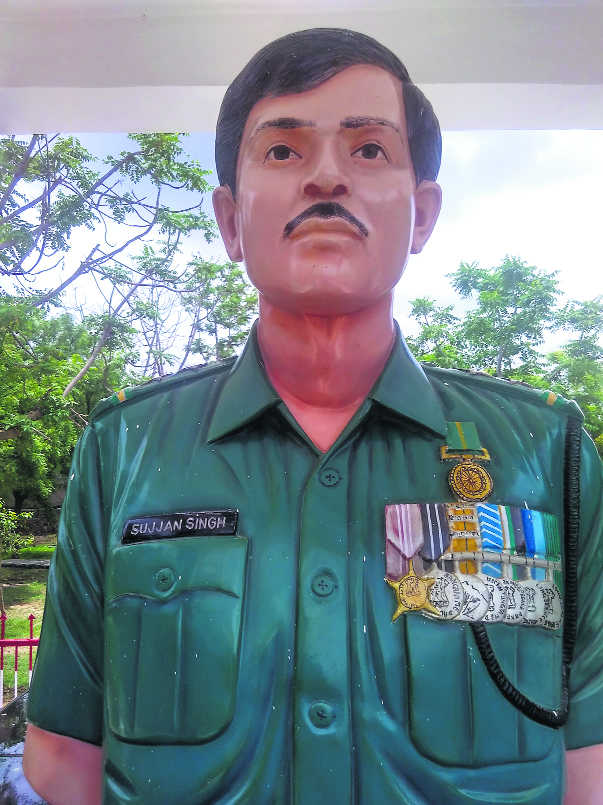
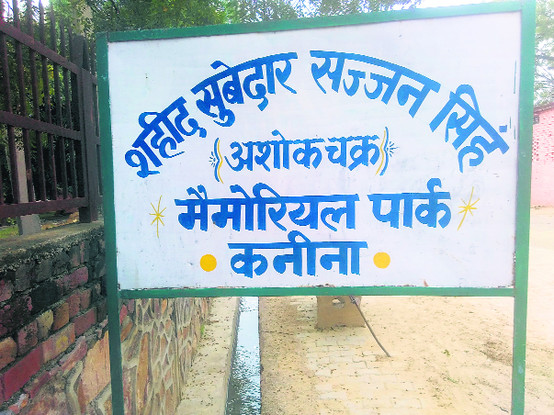
Sajjan Yadav — the hero of Ahirwal

Col Dilbag Dabas (Retd)

Sajjan Singh Yadav, a third generation soldier, was born at Kanina village in Gurgaon district of undivided Punjab on March 30, 1953. Kanina now is in Mahendragarh district. He did his matriculation from Ahir High School Kanina and got himself enrolled in 13th Battalion of Kumaon Regiment. Since there was no caste based Ahir Regiment in the Indian Army, Ahirs, besides in logistical services, were generally recruited in the Regiment of Artillery or in the Kumaon Regiment of Infantry. At present, the overall strength of Kumaon Infantry Regiment comprises almost 30 per cent of Ahirs from all over India but mainly from North and Central India, including Bihar. 13 Kumaon was inducted into Jammu and Kashmir (J&K) in 1992 when the entire Kashmir valley had become a hotbed of militancy. As part of ‘Operation Rakshak’, the battalion was deployed in Kupwara district in the Kashmir valley to flush out, eliminate or nab hiding militants. Sajjan Singh, now a Subedar, was the Platoon Commander of C Company in 13 Kumaon, the same Ahir Company which created history 32 years ago in the Battle of Rezang La during the 1962 war with China when its jawans  fought the Chinese ‘till last man-last round’ and 108 ‘Veer’ Ahirs laid down their lives defending the motherland. Subedar Sajjan Singh carried forward the legacy and valour of the Rezang La brave-hearts and performed the most conspicuous act of bravery and self sacrifice during ‘Operation Rakshak’ for which he was awarded the Ashok Chakra (AC), the highest peacetime military decoration. The summary of the fiercest encounter of 13 Kumaon in the Kashmir valley with militants, with Subedar Sajjan Singh in the lead, is available in the War Diary of 13 Kumaon.Subedar Sajjan Singh, AC, belonged to the most courageous part of the Ahirwal where almost every village has a memorial with the names of the martyrs engraved on it dating back to World War I. And military is still the love of lifetime for the Ahirs of this part. Even now, youths in large numbers from Kanina and other villages can be seen queuing up outside the recruiting office Rewari. Col Lilavat Singh Yadav, a veteran from Kanina, proudly claims, “For Ahirs of Kanina and nearby villages, right from World War I, military has not just been another profession, but a way of life, an honourable life”. The summary of encounter in War Diary of 13 Kumaon reads…On April 26, 1994, 13 Kumaon received information that a few militants were hiding in the jungles near Zalurah village, about 4 km north-west of Kupwara, along with inputs about their suspected hideouts. The Battalion immediately cordoned off the targeted area and began searching the dense forests for the terrorists. At 9 am, Subedar Sajjan Singh, as search party commander, spotted two hideouts of militants alongside a narrow and steep nullah. He began moving his party close to the hideout. When the party was about 15 metres from the hideout, militants started firing at them. The intense and accurate fire made it impossible for Subedar Sajjan Singh and his men to make any move forward.Finding the search party in a difficult position, the C Company Commander along with some jawans moved towards the militants so that their attention gets diverted. However, Subedar Sajjan Singh feared that the Company Commander and his party were heading straight into the jaws of death. Not caring about his own life, Subedar Sajjan Singh decided to save the lives of his Company Commander and the men accompanying him. He along with a sepoy frontally charged the terrorists through a hail of bullets. Although he received a burst of bullets in his stomach, he continued to charge, firing from his rifle.Though grievously wounded, Subedar Sajjan Singh pushed himself forward still firing his last magazine. In this fight, some bullets pierced his helmet and head and he fell but not before killing three militants single-handedly.(The writer is a veteran Gunner, 6 Field Regiment)


Major booked for ’09 Manipur ‘encounter’

Major booked for ’09 Manipur ‘encounter’

The case pertains to the killing of a 12-year-old boy. — iStock

New Delhi, August 2

The CBI has registered a murder case against Army Major Vijay Singh Balhara and seven others for the killing of a 12-year-old boy in Manipur in an alleged encounter in 2009, the agency said on Thursday.The Central Bureau of Investigation (CBI) named Maj Balhara in an FIR filed on Tuesday against the accused in the death of Azad Khan, a Class VII student with no criminal record. Balhara was attached with Assam Rifles and was heading a team when the alleged encounter took place.The CBI’s move comes after the Supreme Court on July 14 directed the agency to go through the records of the case, lodge necessary FIR and complete the investigation on the basis of a report submitted by the Justice Santosh Hegde Commission.Khan’s father Wahid Ali, a resident of Phoubakchao village in Manipur, had deposed before the commission that his son was killed by security personnel in a staged encounter after rounding him up from his home on March 4, 2009.Besides Balhara, Havildar Broason Thanga, then Havildar Suresh Meitei and driver Thangjapo Toithang are named along with four unidentified security persons in the CBI FIR. — IANS


China moves its troops in Doklam, Army not worried

NEW DELHI: The India army has downplayed reports about heightened activity by the People’s Liberation Army (PLA) in the Doklam plateau and attributed this more to the rotation of troops and winter stocking than a desire by China to strengthen its presence in a region where armies of the two countries were locked in an uneasy 73-day standoff last year.

Senior army officers who spoke on condition of anonymity said the Chinese had made no attempt to cross the Torsa nullah that virtually bisects the 100 sq km plateau near the trijunction of India, China, and Bhutan. They added that there had been no change in the ground situation.

The PLA, the Indian army (out of Doklam, or Doka La as India calls it) and the Royal Bhutanese Army (at Chela Post) are stocking their posts for winter. When there’s a changeover for troops, the strength of the posts is temporarily doubled with outgoing troops briefing their incoming counterparts.

The army’s explanation comes after US Congresswoman Ann Wagner said during a US Congressional hearing on Wednesday that the Chinese PLA had resumed activities in Doklam.

The army officers cited above added that, specifically, the PLA battalion guarding the Batang La-Meru La-Sincha La axis, which is part of the Doklam plateau, is being rotated with supporting logistics activity.

“As in the past year, the PLA plans to stay put in Doklam area this winter; the other two armies (India and Bhutan) are also stocking up for normal heavy snows in this mountainous region,” said one of the officers.

The Chinese PLA has around 700 troopers in the Doklam area with a back-up of heavy vehicles and large prefabricated barracks.

The Torsa Nullah, which meets Amu Chu in Chinese territory, divides the plateau in such a way that 60% is under Chinese control and the remaining with India.

Contrary to the reports, the PLA has no surface-to-air missiles or S-300 systems placed in the area as they would be sitting ducks in times of hostility with the Indian Army sitting on the dominating heights of Doklam plateau, the officers said. The Chinese do have surface-to-air missiles, but these are stationed deep within Chinese territory, in Yadong, the officers added. The Royal Bhutan Army also has a significant number of troopers at Chela Post to monitor Chinese movement despite Beijing putting pressure on Thimpu to resolve the border dispute between the two countries.

Although the Chinese PLA had been sending patrols to meet Bhutanese troops after crossing the Torsa Nullah gorge on Doklam since the previous decade, the 2017 stand-off occurred as the PLA tried to carve out a road to reach Jhampheri ridge at the point close to Indian positions in Doklam and where the Torsa Nullah was crossable on all-terrain military vehicles.

According to Indian Army officers, if the PLA had been allowed to cross the nullah at that place, the Indian positions would have been rendered vulnerable.


Myanmar Army attacks several camps of Naga rebel group NSCN-K

Myanmar Army attacks several camps of Naga rebel group NSCN-K

Photo for representational purpose only.

Bijay Sankar Bora
Tribune News Service
Guwahati, July 27
Myanmar Army has launched operation against several camps of Naga rebel group NSCN-K inside that country forcing a large number of NSCN-K cadres to flee, according to security sources.Myanmar Army launched the operation against the NSCN-K camps in Sagaing region of Myanmar, notwithstanding a ceasefire agreement between the two parties. The operation began on Wednesday.Meanwhile, Isak Sumi, the spokesperson of banned NSCN-K, has claimed that the entire NSCN-K cadre was safe in the wake of operation launched against it by the Myanmar Army.Isak Sumi says in his Facebook post: “The on-going standoff between the Myanmar Army and Naga Army has temporarily been resolved without untoward incident but Naga Army had to make a tactical withdrawal. The overall situation is still tense but the Naga Army are re-entrenched again and safe. Requesting prayer to all the loved ones”. Here he has referred to NSCN-K as Naga Army.It may be mentioned that the NSCN-K has been maintain its base in Myanmar and there it has provided logistic support and training to many other militant outfits from Northeastern region especially those from Assam and Manipur including the ULFA (Independent), NDFB (S), PLA etc. All these Myanmar-based N-E militant groups have formed a banner organization   to launch joint attacks on Indian security forces.The Government of India has been mounting diplomatic pressure against the government of Myanmar to evict N-E militants groups that have pitched their camps inside Myanmar territory.


From next year, national database for gun licence holders Arms licences to have unique ID from April 2019

From next year, national database for gun licence holders

New Delhi, July 16

Come April 2019, names of all arms licence holders — new or old — will be included in a national database and they will be issued a unique identification number (UIN), according to the Home Ministry.

The move is aimed at keeping a tab on authorised private gun holders, many of whom are often found involved in crimes and celebratory firing leading to loss of lives.

Every licensing and renewing authority will have to enter the data in the National Database of Arms Licenses system, which will generate a UIN, and with effect from April 1, 2019, any arms licence without UIN shall be considered invalid, the ministry said in a notification.

The decision has been taken by exercising powers under Section 44 of the Arms Act, 1959 (54 of 1959) by amending the Arms Rules, 2016. These rules will be called the Arms (Second Amendment) Rules, 2018.

Additionally, any existing licencee holding multiple licences — under Form III — shall on or before April 1 make an application for grant of a single licence in respect of all firearms held by him or her under his or her UIN to the licensing authority concerned.

Where the applicant applying for a licence for restricted category of arms or ammunition is also a holder of a licence for permissible category, or where the applicant applying for permissible category of arms or ammunition is also a holder of a licence for restricted category, the licensing authority concerned shall issue a new licence for restricted or permissible category of arms or ammunition under the existing UIN of the licencee, the notification said.

Separate licence books will be generated in case of each licence, separately for restricted and permissible categories of arms and ammunition with an overall ceiling of three firearms under a single UIN, it said.

Home Ministry officials said the amendments will eliminate the possibilities of issuing arms licence to persons whose antecedents are not bona fide.

Under Section 3 of the Arms Act, it is essential to obtain an arms possession licence issued by a competent licensing authority, by any person for acquisition, possession or carrying any firearms or ammunition. PTI


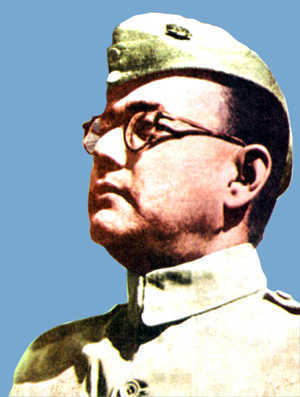
‘China occupied special place in heart of Netaji Subhas Bose’

‘China occupied special place in heart of Netaji Subhas Bose’

Neatji Subhas Chandra Bose

Kolkata, July 16

China had occupied a special place in the heart of Neatji Subhas Chandra Bose who had sent a medical mission to the country 80 years back, the Director of the Netaji Research Bureau Professor Sugata Bose has said.“Eighty years ago, Subhas Chandra Bose as Congress president had sent a medical mission to China led by Dr M Atal,” Sugata Bose, an eminent academician and the grandnephew of Netaji, said at a seminar: ‘China-India Connections in Modern History’ at Netaji Research Bureau on Sunday evening.The seminar was attended by many dignitaries from abroad.Pointing out luminaries from Bengal had always kept a special place for China, Sugata Bose also referred to Rabindranath Tagore’s visit to China in 1924.That visit paved the path for the long-standing association between China and Tagore, Visva Bharati, he said.Bose also recalled that on the day of the founding of the Peoples Republic of China in 1949, Sarat Chandra Bose had “exchanged congratulatory telegrams with Mao Zedong”.Many Chinese and Indian scholars participated in the seminar which explored Sino-Indian relations from 1850 till this date.Academician Arunabh Ghosh of Harvard University spoke about the visit of Zhou Enlai to the Indian Statistical Instiute, Kolkata, in 1956, and PC Mahalanabis’s trip to China in 1957.The participants also viewed a special exhibition titled ‘1943: One Year, One Man and a World at War’ which celebrated the 75th anniversary of Netaji’s assumption of the Supreme Command of the Indian National Army in July 1943. PTI