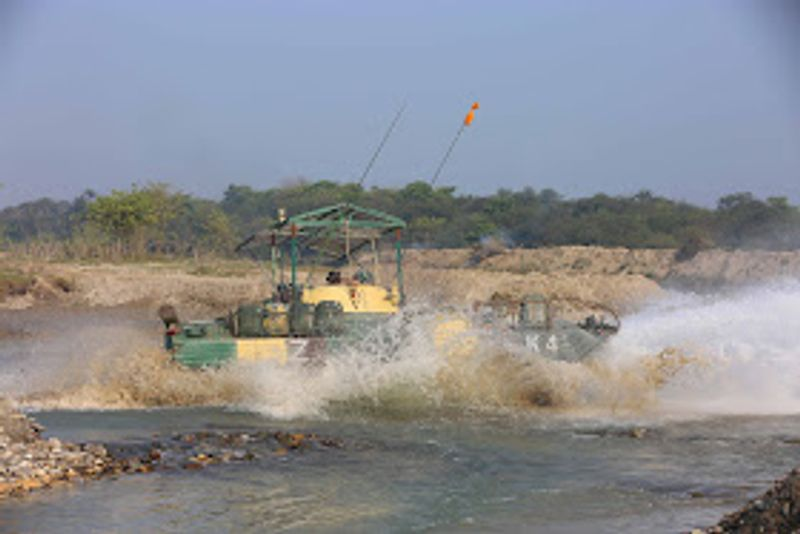
Gen Dwivedi reviews training facility in Arunachal’s Likabali
Army Chief General Upendra Dwivedi inspects a drone lab at Likabali in Siang district of Arunachal Pradesh on Thursday
he Army has accelerated the induction of drones and counter-drone systems under a new initiative called ‘eagle in the arm’, which aims to train every soldier to use a drone just as he is taught to use a weapon.
Army Chief General Upendra Dwivedi today visited one such facility — a drone lab at Likabali in Siang district of Arunachal Pradesh — where drones have been deployed and soldiers are being trained. Officials said the plan is to make each soldier capable of operating a drone, much like carrying his own rifle.
Depending on the unit’s role, drones will be used for combat, surveillance, logistics and even medical evacuation. Counter-drone measures are being inducted in parallel to create a layered system capable of neutralising enemy unmanned platforms.
To meet the training requirement, drone centres have been set up at premier academies such as the Indian Military Academy (Dehradun), Infantry School (Mhow) and Officers’ Training Academy (Chennai). The aim is to embed drone operations as a standard capability across all arms of the Army, officials said.

The Army is pursuing a dual thrust: arming soldiers with drones while simultaneously strengthening counter-drone defences. That drones are no longer niche but “essential elements of the battlefield” was evident during Operation Sindoor with Pakistan (May 7–10).
By institutionalising training, raising more drone units and aligning force structures, the Army intends to ensure that the “soldier of tomorrow” carries a drone that extends his vision, reach and power on the battlefield.
In July, Gen Dwivedi, in his address at the Kargil Vijay Diwas celebrations in Drass, had announced that every infantry battalion will have a dedicated drone platoon, while artillery regiments will be equipped with counter-drone systems and loiter munitions.
These dedicated units are being raised as ‘Divyastra’ batteries — infantry battalions equipped with drones and indigenous air defence systems. The Army has a layered air defence system that showed it prowess during Operation Sindoor.
Missing Navy official found dead near Matheran trek route
Deceased served as Master Chief, Class II, at Colaba in south Mumbai, and had joined duty four months ago
The decomposed body of a 33-year-old Navy official, who went missing during a trek at Matheran hill station near Mumbai earlier this month, has been found in a gorge, police said on Thursday.
The deceased, identified as Surajsingh Amarpalsingh Chauhan, served as Master Chief, Class II, at Colaba in south Mumbai, and had joined duty four months ago, an official said.

Chauhan had gone for Bhivpuri-Garbett trek at Matheran on September 7, and later went missing, he said.

When he did not return home and his mobile phone was also switched off, his family members approached the Cuffe Parade Police Station in south Mumbai with a missing person complaint and a case was registered.
The decomposed body was recovered on Monday after a trekker alerted Neral Police Station near Matheran in neighbouring Raigad district, the official said.

Earlier, after receiving the missing complaint, the police launched a probe and Chauhan’s location was traced to Matheran area.
Accordingly, a search was launched by police teams with the help of forest department, Sahyadri rescue team and other agencies, Neral’s assistant police inspector Shivaji Dhavale said.

However, Chauhan, a native of Rajasthan, remained untraceable for more than a week.

On Monday, a trekker, walking in the hilly terrain, found a decomposed body in a 50-foot-deep gorge behind a temple near the Pali Bhootwali dam and alerted police.
The police, along with rescue teams, rushed to the spot and the body was later sent for postmortem to the government-run J J Hospital in Mumbai, the official said.
In the CCTV footage of Bhivpuri station and nearby areas, Chauhan was seen walking alone for the trek, he said, adding no foul play was suspected.
The initial autopsy report has not mentioned the cause of death and the viscera has been preserved, the official said.
The Neral police have registered a case of accidental death and a probe is on into it, he added.
THE 1965 India-Pakistan war officially began on September 6, but Pakistan’s covert infiltration into Kashmir commenced earlier with Operation Gibraltar, launched in early August.
This operation aimed to incite a civil uprising in Kashmir and was orchestrated under the leadership of then Pakistan Foreign Minister Zulfikar Ali Bhutto. He presumed that Kashmiris were ready to revolt and would welcome Pakistani forces as liberators.
A high-level meeting to plan this operation took place on May 15 at the headquarters of Pakistan’s 12 Division in Murree. It was attended by President Ayub Khan, Chief of Army Staff Gen Muhammad Musa Khan, Chief of the General Staff Gen Malik Sher Bahadur and others. It was decided that a specialised force, codenamed Gibraltar Force, would be deployed in various sectors across the ceasefire line.
This force consisted of six main groups — Tariq, Qasim, Khalid, Salahuddin, Ghaznavi and Babur. Each group was assigned specific targets in Kashmir. The objective was to infiltrate Indian territory, sabotage communication lines and infrastructure, and trigger an uprising, creating conditions for a larger military offensive by Pakistan.
At the time of Operation Gibraltar, 12 Division’s area of responsibility covered a 640-km front. The operation had three primary objectives:
(1) Disrupt Indian military and civilian control of J&K.
(2) Encourage, assist and direct an armed revolt by the people of Kashmir against military occupation.
(3) Create conditions for an advance by the Azad Kashmir forces into the heart of ‘India-occupied’ Kashmir, followed by its eventual ‘liberation’.
The plan of the GOC (General Officer Commanding) of 12 Division, Maj Gen Akhtar Hussain Malik, envisaged two phases — first, to create a shock wave by launching attacks on selected targets and thus prepare the ground for an uprising, and second, to integrate it into the guerrilla operations.
The infiltration was scheduled to begin on August 5. That day, a Gujjar boy named Mohammad Din reported to the Indian police his encounter with suspicious armed men in the forest near Tangmarg. The 19 Division was alerted. Indian patrols intercepted and killed several infiltrators. They were identified as members of the Salahuddin group led by Major Mansha Khan. It was the first confirmed intrusion of the war.
Similar incidents occurred in other sectors. In the Rajouri area, Capt CN Singh of 2 Garhwal Rifles led a small patrol that attacked a stronger Pakistani unit. He was killed in action and posthumously awarded the Maha Vir Chakra.
On August 8, two Pakistani officers — Capt Ghulam Hussain and Capt Mohammad Sajjad of 18th Azad Kashmir battalion — were captured. The documents found on them and their interrogation revealed vital information about the Pakistani plan to infiltrate the Kashmir valley.
The Gibraltar Force groups had already crossed into India and broken into smaller units, as planned. However, contrary to Pakistani expectations, the Kashmiris did not support them. Instead, locals often reported infiltrators to the Indian authorities.
Each group had distinct goals:
n Tariq: Disrupt road traffic over Zoji La, take control up to Amarnath and Gagangir.
n Qasim: Destroy bridges on the Bandipura-Gandarbal road; coordinate with Salahuddin in Hazratbal.
n Khalid: Attack infrastructure at Handwara and Sopore; destroy Kupwara power station.
n Salahuddin: Sever road links, destroy bridges and communications, neutralise key political figures and capture the Srinagar radio station and airfield.
n Ghaznavi: Attack targets in Rajouri-Naushera, assist Salahuddin and cut off roads to Srinagar.
n Babur: Target Udhampur HQ and disrupt communications.
Indian forces inside the Valley were limited — only four J&K militia battalions and an AT (animal transport) company. Reinforcements were rushed; 4 Sikh Light Infantry and 2/9 Gurkha Rifles were sent in immediately. Additional brigades were pulled in from Leh and Jammu.
The infiltration began unravelling quickly: the Tariq group never reached its objective due to high-altitude casualties; Qasim managed some attacks but withdrew by September 4 due to no local support; Salahuddin initially withdrew after being detected. It re-entered but withdrew again by August 18 after failed attacks; Ghaznavi was the only group still active by the time the ceasefire was declared but it had a limited impact.
On August 8, the J&K government panicked and sought the imposition of martial law. However, Lt Gen Harbakhsh Singh, Western Army Commander, cautioned against such a move. He reasoned that it would validate Pakistani propaganda and demoralise Kashmiris, who might start cooperating with the raiders out of fear. His advice was accepted.
Army reinforcements arrived under challenging conditions. One aircraft carrying troops and Lt Gen Harbakhsh Singh landed in Srinagar in poor weather with no navigational aids, a feat accomplished by Wg Cdr Chandan Singh.
The Indian response was swift: On August 11, orders were issued for offensive operations; 68 Brigade (led by Brig Zoru Bakshi) and 93 Brigade (led by Brig Zora Singh) were assigned a pincer attack through the Uri-Poonch bulge; 104 Brigade targeted the Kishanganga bulge. The Siri Force was raised on August 14 under Maj Gen Umrao Singh to manage counter-infiltration inside the Valley.
On August 13, Pakistan launched renewed attacks. That morning, Maj Haq Nawaz Kiani’s group attacked 8 Kumaon at Naugam. The battalion CO, Lt Col MV Gore, was killed. Indian retaliation forced the attackers to withdraw.
Brig Manmohan Singh, then commanding 162 Brigade, was moved to take over the command of 191 Brigade; he was tasked with the recapture of posts in the 191 Brigade area that had been taken by the enemy.
By mid-August, Operation Gibraltar had largely failed. Its key assumptions — especially local support from Kashmiris — proved false. The Indian forces responded with well-coordinated reinforcements and aggressive counterattacks.
THE annals of global history often overlook a profound truth. The monumental contribution and sacrifices of Indian soldiers during the two World Wars. It is forgotten not just by the Western powers that benefited from their service but tragically by even the very nation in whose name they served professionally with quiet dignity and fortitude.
There needs to be recognition that these soldiers, notwithstanding whether they served in the British Indian Army, the Indian Legion or the Indian National Army, ultimately shed their blood for a civilisational continuum called India, even though it was unfortunately colonised at that time.
The scale of India’s contribution was staggering. During the First World War, the Indian Army expanded from about 150,000 personnel in 1914 to around 1.4 million by 1918.
By the time the Second World War culminated, this figure had swelled to an astonishing 2.5 million personnel, constituting the largest volunteer army in history.
Following the near destruction of the British Expeditionary Force in the opening months of World War I, the arrival of 28,500 Indian troops in France by September 1914 provided a critical reinforcement without which the Western Front might have collapsed. Field Marshal Auchinleck, Commander-in-Chief of India, later conceded that Britain “couldn’t have come through both wars if they hadn’t had the Indian Army”.
During the First World War, Indian Expeditionary Forces were deployed across an astonishingly broad geographical spectrum — from the Western Front to East Africa, Mesopotamia, Egypt, Gallipoli and beyond.
The pre-war Indian Army had developed considerable expertise in conducting operations across diverse terrains and climates. This versatility proved invaluable to British strategy, which required simultaneous campaigns across radically different operational environments.
The Indian Army functioned as an imperial fire brigade, deployed to critical sectors where its specialised capabilities could achieve maximum effect. Nowhere was this more evident than in the Middle East, where Indian formations constituted the overwhelming majority of British imperial forces.
On the Western Front in 1914, Indian soldiers played a crucial role in preventing a German breakthrough during the First Battle of Ypres, where they held approximately one-third of the entire British lines despite having recently arrived from garrison duty in India.
Military historians have recognised and applauded the fact that the pre-1914 Indian Army was “a leading professional force” with “high training standards both for regular warfare and for small wars”.
At the Second Battle of Ypres in 1915, Indian cavalry units conducted a critical counterattack that prevented German forces from exploiting a breach in Allied lines. In Mesopotamia, despite the disastrous surrender at Kut al-Amara, a failure attributable to British command deficiencies, Indian units subsequently demonstrated remarkable operational effectiveness during the capture of Baghdad and further advances into Persia.
The Second World War witnessed an even more dramatic demonstration of Indian military prowess across vastly different battlefields. In North Africa, Indian formations proved pivotal in both offensive and defensive operations against Field Marshal Rommel’s Afrika Korps.
The 4th Indian Infantry Division established itself as one of the most effective Allied formations in the desert campaign, contributing significantly to the victory at El Alamein. At Monte Cassino, Indian soldiers fought with extraordinary determination under appalling conditions, with the Gurkha regiments particularly distinguishing themselves in mountain combat.
The most significant contribution occurred in the Asian theatre. Following the disastrous British defeats in Malaya and Burma in 1942, Indian formations constituted the bulk of the Commonwealth forces available to defend India itself and eventually launch counteroffensives into Southeast Asia.
Indian units provided the majority of the combat power in the victories at Imphal and Kohima in 1944, described as the ‘Stalingrad of the East’. The Fourteenth Army, which contained substantial Indian components, became the largest single field army in the British imperial order of battle.
The Indian contribution extended to even include specialised capabilities and encompass broader geopolitical considerations. The Royal Indian Navy expanded significantly during the Second World War, contributing to naval operations in the Indian Ocean and protecting vital sea lanes against Japanese and German threats.
The availability of Indian manpower allowed Britain to maintain her global empire while simultaneously fighting major conflicts in Europe, a strategic luxury unavailable to other European colonial powers. France, for instance, lacked equivalent colonial military resources, contributing to her rapid defeat in 1940 and subsequent dependence on Allied support for liberation. The Netherlands also could not draw upon substantial colonial military forces, limiting its ability to contribute to Allied campaigns.
What makes the sacrifices of Indian soldiers particularly poignant, and what justifies our national remembrance, is that they did not fight merely as imperial mercenaries. They were also motivated by the promise of self-determination — a promise repeatedly made and cynically betrayed.
In 1917, Edwin Samuel Montagu, Secretary of State for India, dangled the prospect of ‘self-government’ for India in exchange for wartime loyalty. Yet, after World War I, instead of freedom, India received the repressive Rowlatt Act and the horrors of Jallianwala Bagh.
The Montagu-Chelmsford reforms of 1919 offered not ‘responsible government’ but a diluted parody of autonomy. Similarly, during World War II, the British despatched the Cripps Mission in 1942, offering Dominion status post-war, a proposal Gandhi astutely dismissed as a “post-dated cheque drawn on a failing bank”.
The yearning for independence also manifested in the actions of those who opposed the British Raj through armed struggle. The 1915 Singapore Mutiny, orchestrated under the foiled Hindu-German conspiracy, was a clear manifestation of the simmering discontent.
The Indian National Army (INA), led by Netaji Subhas Chandra Bose, and the Indian Legion in Europe were composed of soldiers who believed that Axis support could catalyse India’s liberation. They fought with the same patriotic fervour as their Allied-serving counterparts. The INA’s campaigns in Burma and the Indian Legion’s existence in Europe symbolised a desperate bid for sovereignty. History, always complex, is often convoluted.
Oxymoronically, post-Independence India has failed to adequately honour these sacrifices. While nations like Russia, France and China commemorate their war dead with grandeur, India remains curiously silent. While we decided to remain a part of the Commonwealth, we chose to forget those who had shed blood and martyred themselves for the same Commonwealth. In the narrative of the Indian freedom struggle, theirs was the inconvenient truth that was airbrushed out of history books.
As a nation that values her heritage and her future, India must establish a day of remembrance, not to glorify war but to honour sacrifice, not to celebrate an empire but to recognise the unwavering spirit of those who served with fidelity and honour in the global struggle against Nazism, fascism and Japanese expansionism in Asia. We owe them nothing less than everlasting remembrance.
Manish Tewari is Lok Sabha MP and former I&B Minister.
To commemorate the occasion, Lt Gen Mohit Wadhwa, Chief of Staff, Western Command, paid floral tributes to the fallen heroes
The Army’s Western Command celebrated its 79th Raising Day at Chandimandir today. On the occasion, Lt Gen Manoj Kumar Katiyar, General Officer Commanding-in-Chief, Western Command, complimented all ranks for their selfless services demonstrated ably during Operation Sindoor and the recent flood relief operations in Punjab, Himachal Pradesh and Jammu and Kashmir. He exhorted them to continue to uphold the finest traditions of valour and remain steadfast in service to the Nation.
To commemorate the occasion, Lt Gen Mohit Wadhwa, Chief of Staff, Western Command, paid floral tributes to the fallen heroes by laying a wreath at the Veer Smriti war memorial in Chandimandir.
The celebrations this year were juxtaposed with the commemorations of the 60th anniversary of the victory in the India-Pakistan War of 1965, which was primarily fought by the Western Command.
Western Command was raised on September 15, 1947 amid the upheaval of Partition. Initially, established as Delhi and East Punjab Command, it was responsible for the defence of Delhi and Punjab regions.
Manipur sees fresh violence a day after PM Modi’s visit
A day after Prime Minister Narendra Modi visited Manipur, tensions flared in the state’s Churachandpur district late on September 14. Residences of several Kuki-Zo leaders were targeted by unidentified miscreants.
The residence of an office-bearer of the Kuki National Organisation (KNO) was set ablaze. The miscreants also attacked residences of other tribal leaders, but were prevented from doing so by their supporters.
According to sources, the violence reportedly erupted in a protest against the arrest of two individuals accused of vandalism and damaging government property, including decorations done for commemorating Modi’s visit, on the night of September 12.
Sources told The Tribune that the authorities were on high alert in Churachandpur as security forces continue to monitor the situation to prevent further escalation.
Meanwhile, the Kuki-Zo Council (KZC), on Monday cautioned that as the conflict between the Meitei and Kuki-Zo communities had not been settled, no one from either side should cross the buffer zones under any circumstances.
The Kuki-Zo Council further warned of serious consequences if buffer zones were crossed. One of the key Kuki groups, it was also a part of the delegation that signed the peace pact with the Centre and the Manipur Government, earlier this month.
Referring to the September 4 tripartite agreement between the Centre, Manipur Government and the Kuki-Zo groups, the KZC clarified that it had not declared the reopening of NH-2, as it was a prerogative of the Centre.
“No free movement has been permitted on this route. We had only requested the Kangpokpi people to extend cooperation to the security forces, as directed by the Ministry of Home Affairs, while maintaining the safety of commuters along NH-2. As there is still no settlement between the Meitei and Kuki-Zo communities, no one from either side should cross the buffer zone,” said the notice.
“The KZC strongly condemns any attempt to twist or misrepresent our statement. Such deliberate distortion creates unnecessary confusion and mistrust at a sensitive time. We urge the Meitei public to take note of the above facts and act with utmost responsibility,” it added
Chandigarh Air Force Station to hold air show on September 26 as iconic MiG-21 set to retire
To mark iconic MIG-21 fighter jet’s end of six-decade service
The Chandigarh Air Force Station will hold an air show from 11:30 am to 12:30 pm on September 26. The show will mark iconic MIG-21 fighter jet’s end of six-decade service in the IAF, which inducted its first Russian jet in 1963.
The IAF authorities have informed senior Punjab Government and district administration officials about the set of measures to be taken for the event at the administration level. The District Magistrate, Mohali, has enforced prohibitory orders to ensure safe flying environment and keep a check on dumping of garbage as well as meat shops in the vicinity.
Indian Air Force celebrated its 90th anniversary at Sukhna Lake, Chandigarh, on October 8, 2022. Hon’ble President Draupadi Murmu was the chief guest and Defence Minister Rajnath Singh also attended the event.
On September 22, 2021, an air show was held at Sukhna Lake to commemorate Swarnim Vijay Varsh, celebrating the 50th anniversary of the victory in the 1971 Indo-Pak war.
Commemorating the 1965 War: Insights, Reflections, and Lessons for the Future
Lt Col Manoj K Channan (Retd) served in the Indian Army, Armoured Corps, 65 Armoured Regiment, 27 August 83- 07 April 2007. Operational experience in the Indian Army includes Sri Lanka – OP PAWAN, Nagaland and Manipur – OP HIFAZAT, and Bhalra – Bhaderwah, District Doda Jammu and Kashmir, including setting up of a counter-insurgency school – OP RAKSHAK. He regularly contributes to Defence and Security issues in the Financial Express online, Defence and Strategy, Fauji India Magazine and Salute Magazine. *Views are personal.
The Indo-Pak War of 1965, often called “The War of Redemption,” restored India’s military confidence after 1962 and exposed Pakistan’s miscalculations born of overconfidence and political turmoil. A recent seminar revisited the conflict’s forgotten battles, leadership lessons, and enduring strategic insights that continue to shape India’s defence posture today.
The Indo-Pak War of 1965 holds a unique place in South Asian military history. Overshadowed by the trauma of 1962 against China and the apparent victory of 1971, the 1965 conflict remains a study of bravery, misjudgment, and especially, the steadfast resilience and strengthening of the soldiers’ national will. Lt Gen Vinod Bhatia, PVSM, AVSM, SM (Retd), former Director General Military Operations, called it “The War of Redemption”.
A seminar jointly organised by the Chintan Research Foundation (CRF) and Valley of Words (VoW), led by Lt Gen (Dr) PJS Pannu, PVSM, AVSM, VSM (Retd), with support from Mr. Shishir Priyadarshi, President of CRF, and Mr. Sanjeev Chopra, Festival Director of VoW, aimed to revisit this war with rare candour.
The day-long event was addressed by distinguished veterans and thought leaders, notably Lt Gen Kamal Davar, PVSM, AVSM, Retd, of the 7th Light Cavalry, and Maj Billie Bedi, VrC, of The Scinde Horse (former head of the Aviation Research Centre and founding Director General of the National Technical Research Organisation, NTRO). Both, alongside the late Air Marshal Asthana, belong to the 23rd course of the National Defence Academy (NDA), an exceptional cohort that contributed to India’s leadership in the Defence Intelligence Agency (DIA), NTRO, and the Strategic Forces Command (SFC), as well as the key recommendations of the Kargil Review Committee Report.
The Battle of Dograi and Batapore
The seminar not only honoured the sacrifices of 1965 but also revealed forgotten episodes, overlooked tactical decisions, and the strategic contexts that influenced the war. These lessons are crucial for understanding our military history and developing future strategies.
The 7th Light Cavalry and the Spirit of Defiance
In 1965, the 7th Light Cavalry was converting to PT-76 tanks. According to Army Headquarters’ policy, the unit was not expected to be battle-ready. However, the commanding officer, Colonel Dalip Jind, showed remarkable determination. He persuaded higher authorities to let his regiment march to the concentration area with the available rolling stock, continuing training en route.
This act of defiance epitomised the ethos of the Armoured Corps: to never let institutional inertia override operational readiness. It also highlighted the vital role of leadership in shaping the course of the war. Lt Gen Kamal Davar, then a young officer in his twenties with barely three years of service, would carry this ethos into battle.
Maj Billie Bedi, of the Scinde Horse, a young and spirited individual, was pulled out of the prestigious Gunnery Instructors’ course at the Armoured Corps Centre and School (ACC&S) at his request. This was after he personally petitioned the Commandant, ACC&S, to allow him to rejoin his regiment in combat.
Both the young officers were injured while leading their tank troops against a well-entrenched enemy in coordinated defences.
PM Lal Bahadur Shastri Greets the Indian Amy Soldiers
The episode revealed a stark truth: wars are not always won by armies that are fully equipped and prepared, but by soldiers and leaders who refuse to bow to circumstances. Whether on land or air, the Indian man behind the machine was demonstrated as India created a Patton Nagar with 103 Patton Tanks.
Geopolitical Backdrop: Perceptions of Weakness and Miscalculation
The perception of a weakened India significantly influenced Pakistan’s decision to start the conflict in 1965.
The 1962 debacle against China left scars on the Indian military and political psyche.
The death of Prime Minister Jawaharlal Nehru in 1964, followed by the appointment of Prime Minister Lal During this interregnum, a man of few words, returning from a Non-Aligned Summit, reportedly conveyed to Field Marshal Ayub Khan in Rawalpindi that peaceful coexistence with India was desirable. Pakistan, however, chose aggression over accommodation.
Another key factor was the assassination of U.S. President John F. Kennedy in November 1963. Kennedy had promised to supply ten Indian Army divisions after the 1962 war to bolster India’s defences against China; his commitment concerned Ayub Khan, who saw it as shifting the balance of power. However, when Lyndon B. Johnson took office, U.S. priorities changed. Focused on Vietnam and cautious about alienating Pakistan, a vital Cold War ally in SEATO and CENTO, Johnson quietly delayed the promised arms support to India.
This lack of external support to India emboldened Ayub, who was keen on importing the latest weapons from the US. Ayub was convinced that the superiority of their weapons would probably have him having dinner at the Red Fort in Delhi within 24 hours.
However, the volte face and the Indian Army allowed Shastri to quip, We saved Ayub the travel to Delhi, we can have dinner together at Lahore.
Lal Bahadur Shastri may have been short in height and had a quiet demeanour. Still, he stood ten feet tall when his political directive to the Indian Defence Forces was clear, which enabled the Indian Military to achieve what it did.
Convinced that India remained militarily vulnerable and seeking to strengthen his hold after rigging elections against Fatima Jinnah, Ayub launched a series of operations starting on 1 January 1965. These included probes in Kutch, infiltration under Operation Gibraltar, and the offensive move of Operation Grand Slam. The gamble was intended both to exploit India’s perceived weaknesses and to rally Pakistan behind his leadership.
Indian Armour and Air Power: Numbers and Limitations
At the cusp of 1965, the balance of armour and air power was stark: –
Pakistan possessed 15 armoured regiments, bolstered by M-48 Patton tanks courtesy of its SEATO and CENTO alignments. It also had advanced aircraft such as F-86 Sabres and F-104 Starfighters.
India, by contrast, fielded 17 regiments. Its inventory included Stuart and Sherman tanks, AMX-13s, PT-76s, and four Centurion regiments. The Indian Air Force relied on Hunters and the nimble Gnats.https://9416635348ceed80b2dfbbdf02c088b3.safeframe.googlesyndication.com/safeframe/1-0-45/html/container.html
When Pakistan commenced operations in the Rann of Kutch, its armour manoeuvred with agility, exposing India’s underdeveloped road infrastructure and lack of availability of armour along the border.
The bigger issue that surfaced was not about numerical deficit but about institutional bias. The Indian Army’s emphasis on the Himalayan border and dismissive remarks by the then Chief of Army Staff at Armoured Corps Centre and & School that “the days of armour are numbered” highlighted a dangerous underestimation of the importance of mechanised forces in plains warfare.
Since then, many a time has the death knell of Armour been called out, including the Ukraine–Russia conflict and the recent OP SINDOOR.
Political Undercurrents in Pakistan
The war also coincided with political turmoil in Pakistan. Fatima Jinnah, sister of Pakistan’s founder, contested the 1965 presidential elections against Ayub Khan. Although she had clearly won the popular vote, the military regime manipulated the election, giving Ayub a fraudulent victory by a margin of 10,000 votes.
Facing a legitimacy crisis, Ayub resorted to external conflict to strengthen his power. The promise of quick gains in Kashmir was presented as a route to national glory, concealing internal divisions.
Thus, Pakistan’s military adventurism was as much about strengthening Ayub’s domestic political position as it was about changing the regional balance.
Battlefield of Dograi. Image Via History Under Your Feet Blogspot.
The Course of Battle: From Punjab to Hajipir
India responded decisively once provoked. On the night of 6/7 September 1965, formations crossed into Pakistani Punjab. 3 JAT, 15 Dogra, and 13 Punjab, supported by the Scinde Horse, advanced to the outskirts of Lahore (Bata Nagar), breaching the formidable Ichhogil Canal.
The 3rd Battalion of the Jat Regiment (3 JAT), under the unwavering command of Lt Col Desmond Hayde, with Capt Baldev Raj Varma as his adjutant, demonstrated extraordinary gallantry in the capture of Dograi. They not only seized the position once but twice, each time against heavily fortified Pakistani resistance. The assaults incurred a high toll, with significant casualties, including the grievous wounding of Capt Baldev Raj Varma, who survived, continued his career with distinction, and retired as Maj Gen Baldev Raj Varma, AVSM.
3 JAT feat at Dograi remains legendary in the annals of the Indian Army. Despite being outnumbered and fighting without adequate replenishment, 3 JAT embodied the highest traditions of courage, resilience, and determination. The eventual recapture of Dograi on the night of 22/23 September stood as a symbol of Indian resolve and an emphatic response to Pakistan’s boast of martial superiority.
Simultaneously, in the high Himalayas, Indian troops captured the Hajipir Pass and Point 13260 in Leh, both strategically valuable. Tragically, these gains were returned during post-war negotiations, reflecting political compulsions rather than military logic.
The human toll of the 1965 war was significant for both sides.
The Indian Army lost about 2862 soldiers killed in action, with around 8000 wounded and nearly 2000 taken prisoner. The Pakistan Army’s losses were higher, with estimates indicating 3800–4000 killed, 8000–9000 wounded, and approximately 2400 prisoners of war held by India.
While Pakistan’s official figures acknowledged only about 1800 killed, neutral assessments from the United States, Britain, and other observers confirm considerably higher losses.
These figures highlight the intensity of the 22-day conflict, during which neither side achieved a decisive breakthrough. Still, both paid a heavy price in blood before the United Nations ceasefire and the Soviet-brokered Tashkent Agreement of January 1966.
Battle of Doagrai – A snapshot of Awards and Casualties
7th Light Cavalry
CHIEF OF THE NAVAL STAFF FLAGS OFF INDIAN NAVY CAR RALLY FOR NATIONAL OUTREACH
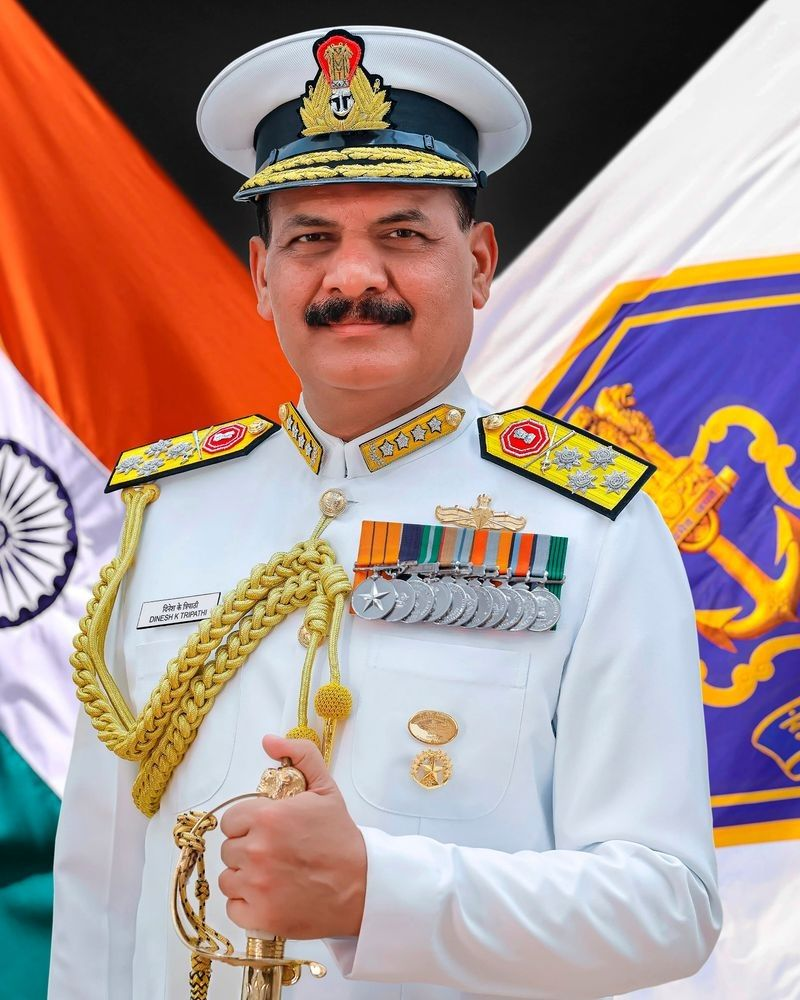
In a demonstration of the Indian Navy’s commitment to fostering deeper ties with the citizens of India, Admiral Dinesh K Tripathi, Chief of the Naval Staff, ceremonially flagged off the Indian Navy car rally on 13 September 2025, from Varunika Naval Auditorium, New Delhi. The event marks a significant milestone in the Navy’s outreach initiative aimed at strengthening the bond between maritime forces and the people of India, particularly in the culturally rich and strategically vital heartland of Uttar Pradesh.
Comprising 34 participants, including serving naval personnel and members of the Navy Welfare and Wellness Association (NWWA), the rally will cover a 1700-kilometre route over eight days, traversing the cities of Agra, Lucknow, Varanasi, and Kanpur. These locations have been carefully chosen to maximize engagement with the local populace and to honour the region’s historical and cultural significance.
The rally is anchored on five key objectives:
1. Engagement with Naval Veterans and Veer Naaris – A heartfelt initiative to express gratitude and reinforce the Navy’s enduring support for its extended family.
2. Support to NGOs Enroute – Demonstrating the Navy’s unwavering commitment to social responsibility and community welfare.
3. Promotion of Naval Awareness – Outreach activities aimed at inspiring youth and students, fostering a spirit of patriotism and maritime consciousness.
4. Showcasing NWWA’s Contribution to Skill India – Integration with local artisans to highlight the role of NWWA in empowering communities through skill development.
5. Honouring India’s Cultural Legacy – Visits to prominent heritage sites to pay tribute to the nation’s rich historical tapestry.
This rally stands as a testament to the Indian Navy’s dedication to national integration and its proactive efforts to connect with citizens beyond the coastline. By reaching deep into the heart of India, the Navy reaffirms its role not just as a maritime force, but as a pillar of national unity and pride.
Defence Ministry told to take concrete steps for jointness of forces
Prime Minister Narendra Modi with Defence Minister Rajnath Singh, Minister of State for Defence Sanjay Seth, National Security Adviser Ajit Doval, Defence Secretary Rajesh Kumar Singh, Chief of Defence Staff General Anil Chauhan, Chief of the Army Staff General Upendra Dwivedi, Chief of the Naval Staff Admiral Dinesh K. Tripathi, Chief of the Air Staff Air Chief Marshal Amar Preet Singh and other dignitaries during the Combined Commanders Conference at the Army’s Eastern Command headquarters in Kolkata. PTI
Prime Minister Narendra Modi on Monday instructed the Ministry of Defence to swiftly implement ‘concrete steps’ to achieve greater jointness among forces to meet future challenges and prevail against any eventuality.
In his first address to the top-brass since the skirmish with Pakistan in May, Modi spoke to the officers of the three armed forces at the combined commanders’ conference in Kolkata.
In line with 2025 being the ‘Year of Reforms’, Modi instructed the Ministry of Defence to swiftly implement concrete steps to achieve greater jointness, self-reliance and innovation to meet future challenges and prevail against any eventuality, the Ministry of Defence said.
The PM’s instructions have come just weeks after the Chiefs of the three armed forces differed on the issue of going ahead with ‘theatre commands’ but had expressed the need for ‘jointness’.
Modi also reviewed the security situation and operational preparedness of the armed forces. The PM complimented the forces for the success of Operation Sindoor, while he was briefed about the ‘new normal’ created by the operation. Defence Minister Rajnath Singh will address the commanders tomorrow.
Held once in two years, this CCC is the apex-level brainstorming forum of the armed forces, which brings together the nation’s top civilian and military leadership to exchange views and lay the groundwork for the future development of India’s military preparedness.
…..Over the last few weeks, Army Chief General Upendra Dwivedi has said ‘theatre commands’ were very important.
Speaking at the two-day seminar at Army War College in Mhow on August 27, Navy Chief Admiral DK Tripathi had said that the Navy was committed to ‘theatreisation’ as the ultimate goal”.
A day earlier at the same event, Air Chief Marshal AP Singh advised against creating theatre commands, saying, “We, for now, don’t need any new structure.” The IAF Chief suggested a ‘joint planning and coordination centre’ in New Delhi that would communicate decisions for execution by any force.
In military terms, jointness, is a step towards creating ‘theatre commands’ and it entails coordination in planning, operations, training, communications and acquisitions. This has to be followed by integration or need to amalgamate different sensors, systems, weapons and networks of each service and have a common commander – the theatre commander — for execution of tasks.
‘Theatre commands’ – the nomenclature — is military jargon for creating geographically defined area of operations. It would have a single military commander controlling all war-fighting assets of three armed forces like planes, copter, guns, tanks, equipment, ships, missiles and manpower. This is visualised as a self-contained formation.
For achieving jointness and integration the Chief of Defence Staff General Anil Chauhan listed 196 tasks for integration of forces, off which some 56 have been completed, so far.
State Stalwarts
DEFENCE MINISTER
Minister Rajnath Singh
ALL HUMANS ARE ONE CREATED BY GOD
HINDUS,MUSLIMS,SIKHS.ISAI SAB HAI BHAI BHAI
CHIEF PATRON ALL INDIA SANJHA MORCHA
LT GEN JASBIR SINGH DHALIWAL, DOGRA
SENIOR PATRON ALL INDIA SANJHA MORCHA
MAJOR GEN HARVIJAY SINGH, SENA MEDAL ,corps of signals
.
.
PATRON ALL INDIA SANJHA MORCHA
MAJ GEN RAMINDER GURAYA ,MADRAS REGIMENT
sanjhamorcha303@gmail.com
PRESIDENT SOUTH ALL INDIA SANJHA MORCHA
COL SS RAJAN BOMBAY SAPPERS,
PRESIDENT UTTARAKHAND ALL INDIA SANJHA MORCHA
COL B M THAPA ,BENGAL SAPPERSS
PRESIDENT HARAYANA STATE CUM COORDINATOR ESM
BRIG DALJIT THUKRAL ,BENGAL SAPPERS
PRESIDENT TRICITY
COL B S BRAR (BHUPI BRAR)
PRESIDENT CHANDIGARH ZONE
COL SHANJIT SINGH BHULLAR
.
.
PRESIDENT PANCHKULA ZONE AND ZIRAKPUR
COL SWARAN SINGH
INDIAN DEFENCE FORCES
DEFENCE FORCES INTEGRATED LOGO
INDIAN AIR FORCE
Air Officer C-in-C WESTERN AIR COMMAND
AIR MSHL S PRABHAKARAN AVSM VM
AOC-IN-C, EASTERN AIR COMMAND
Air Marshal Inderpal Singh Walia
AOC-in-C SOUTH WESTERN AIR COMMAND
Air Marshal Vikram Singh
AOC-IN-C, SOUTHERN AIR COMMAND
Air Marshal J.Chalapati
AOC-IN-C TRAINING COMMAND
AIR MARSHAL SK GHOTIA VSM
AOC-IN-C MAINTENANCE COMMAND
Air Marshal Jagdish Chandra
Flag Officer Commanding in Chief, Western Naval Command
ice Admiral R Hari Kumar, PVSM, AVSM, VSM
Flag Officer Commanding in Chief, Eastern Naval Command
Vice Admiral Sanjay Bhalla, AVSM, NM
Flag Officer Commanding in Chief, Southern Naval Command