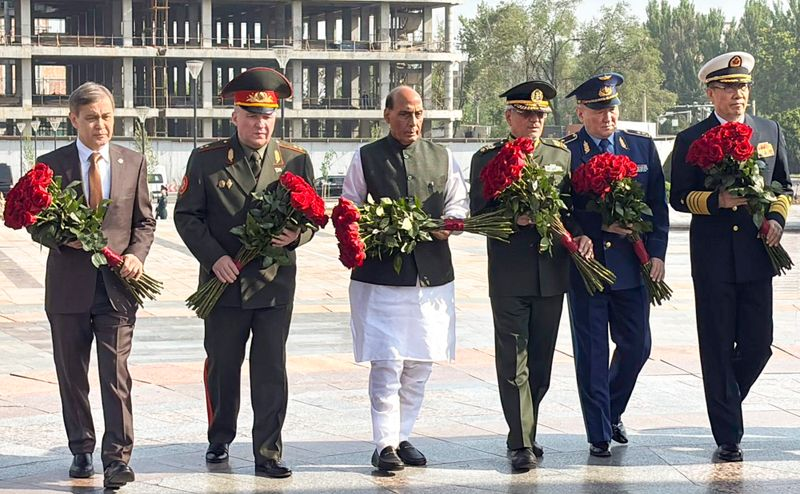
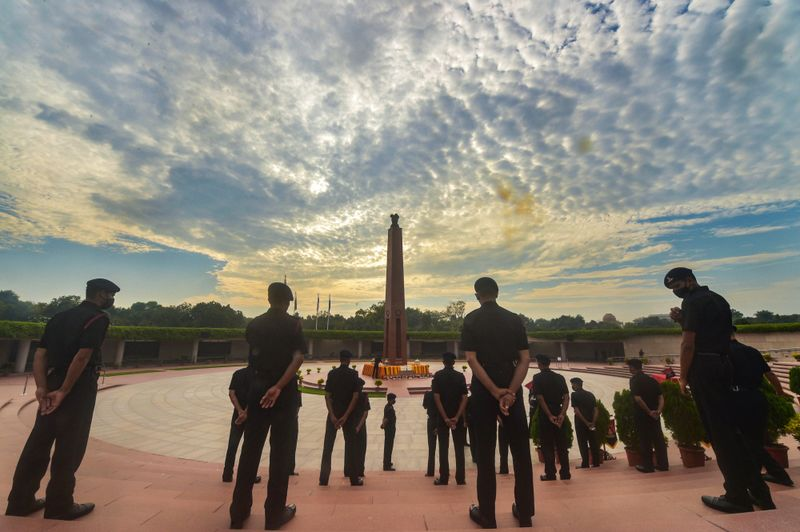
Defence Minister Rajnath Singh pays floral tribute at Victory Square during his visit to Bishkek to attend the Shanghai Cooperation Organisation (SCO) Defence Ministers’ Meeting in Kyrgyzstan. PTI
Defence Minister Rajnath Singh pays floral tribute at Victory Square during his visit to Bishkek to attend the Shanghai Cooperation Organisation (SCO) Defence Ministers’ Meeting in Kyrgyzstan. PTI
Referring to the last year’s skirmish with Pakistan, Defence Minister Rajnath Singh on Tuesday said Operation Sindoor was India’s resolve to demonstrate that “epicentres” of terrorism are no longer immune to “justifiable punishment”.
Addressing the Shanghai Cooperation Organisation (SCO) Defence Ministers’ meeting in Bishkek, Kyrgyzstan, he underlined the need to forge a unified front to tackle the “evils” of terrorism, separatism and extremism by eliminating havens and rejecting any political exceptions.
He asserted that the sight of state-sponsored cross-border terrorism which attacked the sovereignty of a nation must not be lost as there was no place for double standards. The minister, in an obivious reference to Pakistan’s abetment to terrorism, said: “SCO should not hesitate in seeking appropriate action against those who abet, shelter and provide safe havens to terrorists”. Pakistan is a member of the SCO.
Rajnath went onto add that by tackling terrorism, separatism and extremism without exception, regional security was transformed from a challenge into a cornerstone for peace and prosperity.
Describing counter-terrorism as a foundational principle of SCO, he said the organisation had condemned such acts and ideologies in a common fight against the menace.
He recalled last year’s Tianjin Declaration which brought out India’s firm and collective stance against terrorism, terming it as a testimony to the country’s zero-tolerance outlook towards terrorism and its perpetrators. “The real test of collective credibility remains in consistency. We must not forget that terrorism has no nationality and no theology. Nations must take a firm & collective stance against terrorism,” he added.
He highlighted the significant role being played by the Regional Anti-Terrorist Structure of SCO, stating that the joint statement of the Heads of State on ‘Countering Radicalisation leading to Terrorism, Separatism and Extremism’ issued during India’s Chairmanship symbolises shared commitment in this regard. He further said, in view of the present global uncertainties, SCO held a pivotal role as today’s world view appears fractured and countries are becoming increasingly inward-looking.
The Defence Minister added that it was the responsibility of SCO to ensure regional as well as global peace and stability.
UAE exits OPEC, signals major shift in global energy policy
Strategic move aims to boost flexibility in oil production amid global energy market volatility
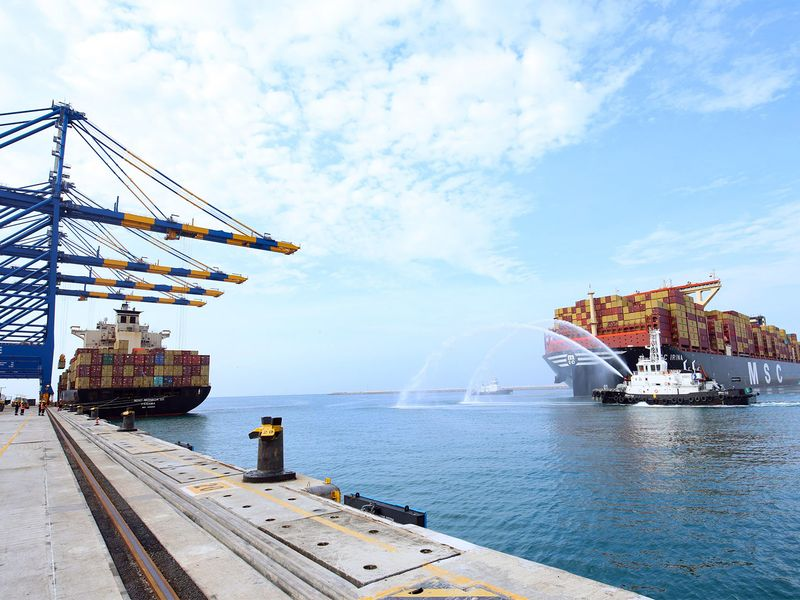
The United Arab Emirates on Tuesday announced its exit from the Organisation of the Petroleum Exporting Countries (OPEC) and the broader OPEC+ grouping from May 1, marking a significant shift in its long-term energy strategy.
In an official statement, the UAE’s Ministry of Energy and Infrastructure said the decision followed a comprehensive review of its production policy, current and future capacity, and was aligned with national economic priorities.
The move comes at a time when the UAE has been trying to leverage its own foreign policy in West Asia, diverging from some positions of OPEC’s de facto leader Saudi Arabia, as the world grapples with an energy shock caused by the ongoing US-Iran war.
The statement said the decision reflected the country’s evolving energy profile and increased focus on expanding domestic production while maintaining a “responsible, reliable and forward-looking” role in global energy markets.
The UAE emphasised that its exit did not signal a retreat from global energy cooperation. Instead, it aimed to enhance flexibility in responding to market dynamics while continuing to contribute to stability. “Our policies will be guided by responsibility and market stability, taking into account global supply and demand,” the statement said.
Acknowledging more than five decades of association, the UAE said it valued its longstanding cooperation within OPEC, which it joined in 1967 through Abu Dhabi and continued after its formation in 1971. It expressed appreciation for the role of both OPEC and OPEC+ in maintaining market balance.
The statement highlighted that global energy demand was expected to grow steadily despite short-term volatility, including disruptions in the Arabian Gulf and the Strait of Hormuz, and underscored the need for a flexible, reliable and affordable supply system.
After the exit, the UAE said it would continue investing across the energy value chain — including oil, gas, and renewables, and low-carbon solutions — and bring additional production to markets in a gradual and measured manner aligned with demand conditions.
Reaffirming its commitment to global market stability, the UAE said it would remain actively engaged with international partners while pursuing economic diversification and long-term energy transition goals.
No road, no vote: Villages in Lahaul & Spiti’s Pin valley shut gates on panchayat elections
Numberdars warn protest may extend to Assembly, Lok Sabha elections if 64-km road linking Attargu Mud to Kinnaur remains unbuilt after 25 years
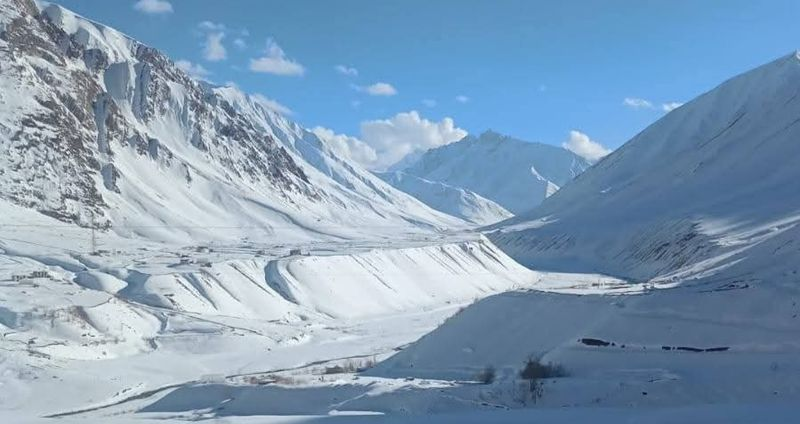
Fourteen villages in the Pin valley of Lahaul & Spiti have decided to boycott the Panchayati Raj elections scheduled for end-May, because the district authorities have failed to build a 64 km-long road that connects Attargu Mud in Pin to Bhaba Nagar in Kinnaur district for several years.
Fed up with the delay, the numberdars of the 14 villages held a meeting under the leadership of the Kothi Numberdar, SP Bodh, a few days ago, to pass this resolution.
“We have decided to deny entry to political parties to even campaign in the area. We have been seeking a road for so many years. We have been patient, but nobody listened to us. We believe that such strong measures are necessary to draw attention to our plight and compel authorities to act,” Bodh told The Tribune.
Kunzang Gatuk, another resident, asserted that the road was not merely a development project but a lifeline for local residents who continue to face severe hardships due to the lack of connectivity.
“We have submitted a memorandum to the state government through Additional Deputy Commissioner Kaza for urgent consideration,” Gatuk told this reporter, adding, “A collective decision had been made after consulting villagers across their respective panchayat areas to boycott the upcoming Panchayat Raj elections if no immediate action was taken with regard to the construction of the road.
“The people have warned that the protest could extend to future Assembly and Lok Sabha elections if the government continued to ignore our demands,” he remarked.
Besides SP Bodh and Kunzang Gatuk, Numberdars Sonam Paldan, Chhewang Gatuk and Lobzang Dorje have also urged the administration to treat the matter with urgency and initiate immediate steps toward the construction of the proposed road.
According to official sources in the Public Works Department, forest clearance is awaited for the construction of this road project, which is why it is delayed. A detailed project report of Rs 99 crore has already been prepared for the purpose.
Lahaul and Spiti MLA Anuradha Rana told The Tribune that the road project was hanging fire for the last 25 years. She said that she had raised this issue twice in the Vidhan Sabha, and Chief Minister Sukhvinder Singh Sukhu had assured her that he would provide the budget for the construction work.
“A part of this project falls under Kinnaur district, where forest clearance is awaited. The state government is trying to get forest clearance but hasn’t succeeded yet,” she said.
Rana said the project was strategically important and plans were afoot to transfer the project to Border Roads Organisation. “The completion of this project will reduce over 100 km distance between Pin valley and Shimla. It will definitely improve transportation service to the region, which will give impetus to the tourism industry here,” the MLA said.
Shikha Simtia, Additional Deputy Commissioner, Kaza, confirmed that she had received a memorandum from the area residents regarding their demand. “I am scheduled to meet these people on April 30 to find a solution to their problem. Every possible effort will be made to persuade them to ensure their participation in the PRI elections,” she told The Tribune.
Salaries & allowances : The status of the armed forces has been kept vague and undefined. PTI
ACCORDING to media reports, the Ministry of Defence (MoD) filed an affidavit in the Supreme Court recently. Citing the findings of a “high-level committee” constituted to review the demands for salary upgradation of armed forces personnel, the MoD informed the court that “…the complexities in implementation, possible legal complications and significantly large financial implications do not favour the grant of NFU (non-functional financial upgradation) to armed forces personnel.”
Given that one of the signatories to the affidavit is a serving Major General, the unstated acquiescence of the military must be assumed, and no dissent should emerge from our disciplined armed forces. However, NFU has played a major role in distorting the relativity between the civilian Services and the armed forces, and has become an irritant in civil-military relations. There is good reason, therefore, for retired Army officers to seek redressal from courts.
The professional hierarchy that drives the government’s administrative machinery — all recruited via the Union Public Service Commission — is three-tiered. The first among equals are the three All-India Services which serve at the Centre as well as in states: the Indian Administrative Service (IAS), the Indian Police Service (IPS) and the Indian Forest Service (IFoS). At the next rung are the Central Group ‘A’ Services, that include the Foreign, Revenue, Audit, Postal and other Services. The third tier is occupied by the technical/specialised services, providing expertise in medicine, engineering, science, etc.
Most of these Services have distinct cadre rules and are formally classified as Organised Group ‘A’ Services (OGAS). This categorisation assumes significance since it has come to form the basis of decisions taken by the 10-yearly Central Pay Commissions (CPC) in deciding salaries and allowances of Central government employees. Since the status of the armed forces has been (deliberately?) kept vague and undefined, successive CPCs, maintaining that they do not fall into any “recognised category”, have employed whimsical logic to depress the emoluments and, consequently, the status of the military relative to the Civil Services.
At the heart of the NFU contention lies the “remunerative edge” granted to the IAS and the Indian Foreign Service (IFS) by the 4th CPC (1986), which manifests as additional increments across three senior grades. Other Central Services agitated against this “edge”, terming it discriminatory, and argued that this preferential treatment was iniquitous since all candidates were recruited through a common UPSC examination and contrary to the principle of “equal pay for equal work.”
Consequently, NFU was introduced in 2006 by the 6th CPC in order to address the disparity between the IAS and other Central Group ‘A’ Services. Whenever an IAS officer (the benchmark) is empanelled for a particular grade at the Centre, all officers of the OGAS would automatically be granted the same pay scale after a delay of two years, regardless of whether a vacancy existed for their actual promotion. Initially, the government granted NFU only to the OGAS. However, following representations, it was extended to the IPS and IFoS in 2010. The Central Armed Police Forces (CAPFs) then approached the courts (2012-19), and after a protracted legal battle, the apex court held that the CAPFs met all criteria for “Organised Group ‘A’ Services” and directed the government to grant them NFU retrospectively from 2006.
The armed forces, even though aggrieved by all these decisions, had no avenue for seeking redressal till the convening of the 7th CPC in 2014 offered them a rare opportunity. In the Joint Services Memorandum (JSM) presented before the CPC, they stated that by extending NFU to the OGAS, but denying it to the military, the 6th CPC (2006) had created a severely anomalous situation.
Commenting on the JSM, a member of the CPC stated that he “…agrees with the view that exclusion of Defence Forces from NFU has been unfair. The gap between career progression in the Defence Forces in comparison with 49 Organised Group ‘A’ Services and IPS/IFoS, which was already large, has been stretched beyond reasonable limits… there is no basis for denying them NFU simply on the ground that they are not classified as an Organised Group ‘A’ Service…This has undermined the status and morale of the Defence Forces, and has been a matter of concern for them for the past decade.”
The JSM had further pointed out that such changes, by downgrading them relative to the IAS, IPS and the CAPFs, had undermined the status of military commanders. Moreover, civilian personnel of organisations such as the Border Roads, Military Engineering Services and Naval Armament Services — created to support the armed forces — having overtaken their military superiors in terms of pay grades, were now demanding an altered relationship.
Then, as now, the MoD seems to have acted as a “spoiler” and its negative intervention served to torpedo the JSM. Against this backdrop, a striking aspect of the 7th CPC report is the discussion (and dissonance) that emerges between the Chairman and two members of the commission, Vivek Rae (an IAS officer), and the economist Dr Rathin Roy, regarding NFU.
In the Chairman’s considered opinion, “…since NFU has been in existence for the last ten years and is being availed by all the Organised Group ‘A’ Services, it should be allowed to continue. The same will be available not only to all organised Central Group ‘A’ Services but also members of CAPFs, ICG (Indian Coast Guard) and Defence Forces.” The two members of the commission have, however, recorded their dissent with this opinion.
Elaborating on the case for withdrawal of NFU from Organised Group ‘A’ Services, Rae said, “In the view of the undersigned, it was a mistake to grant NFU to 49 Organised Group ‘A’ Services, IPS and IFoS till HAG (Higher Administrative Grade) level on untenable grounds of parity with IAS. Exclusion of Defence Forces and CAPFs only aggravated the mistake.” Dr Roy, strongly supporting the case for withdrawal of NFU, said: “I join the dissent of my colleague Mr Vivek Rae and recommend that NFU at the Group `A’ level be completely done away with.”
Officers filing writs in settled matters to pay costs from own pocket, warns HC
In March 2023, the Chandigarh Bench of the Armed Forces Tribunal had granted pensionary benefits to several soldiers on the basis of similar cases decided earlier, which was later challenged by the Centre
Observing that the Central Government is filing writ petitions against orders passed in favour of defence personnel by the Armed Forces Tribunal (AFT), even in cases where the law has been settled, the Punjab and Haryana High Court has warned that officers responsible for filing such appeals would be liable to pay costs from their own pockets.
“Though we wanted the present petition to be dismissed with costs to be paid by the concerned officer who decided to file the said writ petition, we refrain from doing so on the repeated requests of the learned counsel for the petitioner. In case the same trend continues in future, costs will also be imposed in such cases,” the Bench of Justice Harsimran Singh Sethi and Justice Deepak Manchanda said in its order dated April 22.
“It may be noticed that the petitioner, Union of India, has started filing writ petitions on a question of law which has already attained finality and the relief has already been granted to similarly situated employees, which is not appreciated,” the Bench ruled.
The said action is also contrary to the Litigation Policy as well as the settled principle of law that once a question of law has been settled, it should be made applicable to all similarly situated employees, the Bench pointed out.
“However, the petitioner has continued filing writ petitions on such settled principles. Hence, the present petition, filed after a period of three years from the order dated 21.03.2023 passed by the Tribunal, not only raises an already settled issue but also reflects that the concerned soldier has not been granted the benefit despite having the order in his favour for the last three years,” the Bench said.
In March 2023, the Chandigarh Bench of the Armed Forces Tribunal had granted pensionary benefits to several soldiers on the basis of similar cases decided earlier, which was later challenged by the Centre.
The government counsel contended before the High Court that while passing orders in 2023, the AFT had missed the instructions issued by the government in 1987, according to which 10 months’ service in a particular rank prior to retirement was mandatory for fixing pension in that rank, whereas the respondent’s service was six months.
The Bench observed that the same issue had come up before the Principal Bench of the AFT and in 2017 it was held that the benefit of pension is to be granted keeping in view the last wages drawn in the same rank by the concerned officers or soldiers before retirement.
The judgment has already been implemented by the Union of India.
“Once a similar benefit has already been extended to other officers/soldiers, the challenge to the grant of such benefit by the Union of India after a period of three years is liable to be rejected, and the same is accordingly rejected,” the Bench ruled.
IAF dismisses Corporal for gay relation with Australian, AFT grants partial relief over ‘peculiar’ facts
A Corporal with the Indian Air Force (IAF) was dismissed from service for allegedly being in a gay relationship with an Australian citizen and visiting foreign countries with him without permission, but the Armed Forces Tribunal (AFT) has converted the punishment of dismissal into simple discharge so as to enable post-retirement resettlement.
He will, however, not be entitled to any post-retiral or monetary benefits.
The airman, who had joined service in 2014, had sought premature discharge in 2024 on account of family urgencies and personal issues, which he stated to be his involvement in homosexual activities outside the Air Force in his private affairs. He claimed that his choosing of the sexual partner with whom he is involved in a relationship is within the permissible social norms and applicable laws.
After the application of discharge was reviewed, his request for rejected and a court of inquiry was ordered to investigate his activities, which was completed in December 2025. Subsequently a show-cause notice was issued to him and on the basis of his reply, administrative orders for his dismissal were issued in January 2026.
The airman submitted before the AFT that he does not want to challenge the dismissal order, but the court may be kind enough to convert the dismissal into a discharge so that the stigma attached to the dismissal may not come in the way of seeking future vocation. He also declared that he did not reveals any information that could have compromised national security.
The Air Force argued that the applicant had breached military discipline while working in the Indian Air Force as he did not seek permission on certain occasions when he visited foreign countries with his partner and gave incorrect addresses while on leave, and therefore action was taken against him. Besides several trips within India, he and his partner had visited Thailand for three weeks in March 2023 and Sri Lanka for two weeks in October 2023.
The Tribunal’s Bench of Justice Rajendra Menon and Administrative Member Rasika Chaube observed in their order of April 27 that the airman had already disclosed facts about his relationship in his application for discharge. From the material on record, there seemed to be nothing involving national security concern and at best the applicant is said to have visited Thailand and Sri Lanka on two occasions to be with his partner without following the due procedure laid down for the same, the Bench said.
Stating that in normal circumstances, dismissal from service would have been upheld by this Tribunal if the individual had challenged the action of dismissal, the Bench held that the respondents may be right in contending that when a member of the disciplined force breaches the rules, he has to be dismissed but there can be exceptions.
“As an exception to normal rule and in the peculiar facts and circumstances of the case, we deem it appropriate to direct conversion of the administrative dismissal of the applicant into a case of discharge,” the Bench said.
“However, on such discharge the applicant shall not be entitled to any monetary benefit, pension, no post-retiral benefit, even the status of an ex-service men shall not be available to the applicant,” the Bench ruled.
Stating that his cannot be treated as a precedent in all cases, the Bench said that in view of the peculiar facts and circumstances, this case would be deemed to be that of a simple discharge only for the purpose of it not being a stigma or impediment in seeking any further employment elsewhere.
NFU DENIED: GOVT SAYS SOLDIERS ARE TOO COSTLY, ADS ARE NOT
Grant of NFU: The Govt betrays the Armed Forces along with its own General. In the Additional Affidavit filed this morning at 10:21 AM, the Govt of India has denied Non-Functional Upgradation (NFU) to the Armed Forces. The reason given: “significantly large Financial Implications.” Soldiers Are Expensive, Selfies Are Cheap: ₹6,000 crore/year on govt advertisements is “Jan Sampark”. ₹8,000 crore/year on freebies before every election is “Garib Kalyan”. But NFU for fauj is “significantly large Financial Implication”. A Colonel at 26 years service draws less than a Joint Secretary at 16 years. You gave NFU to every babu in 2008. You say it’s too costly for the man who guards Siachen at -40°C. Shame has no pension, but you gave it to bureaucracy. The Mischief of Dates and Benches: The Affidavit is dated 20 January 2026 but filed today , three months later at 10:21 AM. Why? Because Hon’ble Justice JK Maheshwari retires end June 2026. Because elections must not be “adversely affected.” You time your betrayal better than you time your bullets. You play Bench-shopping with the Supreme Court and hide behind “financial implications” when it comes to men who never hid behind anything when bullets flew. This is not affidavit. This is Aphsaar-shahi vs. Afsar — and you chose the chair over the uniform. First Disability Pension Tax, Now NFU. Betrayal in Installments: First you withdrew IT exemption on disability pension. A man loses his leg in Uri, you tax his pension. Now you deny NFU saying “fauj mehngi padti hai”. Fauj sasti tab thi jab Kargil hua tha? When did the nation become too poor for its soldiers, but rich enough for central vista, statues, and 5-trillion-dollar ads? NFU Is Not Charity. It Is Parity. IAS, IPS, IFS get NFU if empanelled but not promoted due to lack of vacancy. They retire as Addl. Secretary without ever holding the post with pay, perks, pension. Army officer fights 30 years, commands troops, faces court martial for one mistake , retires as Colonel because boards are “restricted”. No NFU. No parity. No shame. You say “command is different”. Yes. Command means responsibility for 1000 lives. Babu’s file doesn’t bleed. If file-pushers get NFU for stagnation, why not the man stagnating in Dras? Significantly large Financial Implication” is a lie. Real figure for NFU to Armed Forces: ~₹1,800 crore/year. Your advertisement budget: ₹6,200 crore/year. You chose PR over Paltan. Sad day for the Armed Forces? Sad day for the Republic. Because a nation that finds soldiers costly will soon find surrender cheap. The FIGHT will continue in Court, in Public, in Conscience. We may lose benches. We will not lose honour…
THE FIRST UNRESTRICTED WAR: RED IS THE WINNER(Maj Gen Harvijay Singh, SM)
Before taking the Netanyahu’s bait, America failed to analyse that Venezuela was a backyard limited objective, while Iran a regional system – an unlimited objective. The Concept of Limited vs Unlimited Objectives • Keep the objective modest and the means overwhelming. That is the mathematics of victory and not the burden of a political stalemate. • Success demands a pause. Reorganise first, do not rush to the next objective – victory may just convert into vulnerability. • Do not seek grand victories, choose limited objectives and reject those which cannot be realistically achieved.
• Bottom Line: Only limited objectives are achievable; the rest are illusions. Soldiers chase objectives – politicians pursue optics. The most typical illustration of expanding objectives is the mistake which MacArthur made in the Korean War. MacArthur initially fought a limited defensive war to repel North Korea’s invasion. After the Inchon landing succeeded, he shifted toward a maximalist objective: the total unification of Korea and the destruction of the North Korean regime. A shift from “repel aggression” to “unify Korea” to “defeat China” – from limited to unlimited. Afghanistan: a shift from “destroy al-Qaeda and deny safe havens” to “remove Taliban” to “build a democratic state, reform society, create a national army, reshape governance” – a mouthful limited to unlimited. Understanding the Key Domains of Modern Conflict (extracted from the book ‘UNRESTRICTED WARFARE’ in syllabus for DSSC Exam 2026) • Modern conflicts are no longer confined to traditional domains. War can be waged through any means: f inancial, cyber, media, legal, diplomatic, economic, psychological; blurring the line between war and peace, battlefield and non-battlefield, soldier and civilian – in the very first superior technology aerial attack against Iran, around 170 primary school girls were killed.
• All these domains are visible in the West Asia War. o Financial Warfare – Currency attacks, sanctions, market disruption, blockade of sea routes. o Lawfare – Using courts, treaties (NPT), and regulations to constrain or delegitimize an adversary. o Media Warfare – Narrative control, disinformation, perception shaping. o Cyber Warfare – Attacks on networks, grids, data, and communications. o Economic Warfare – Trade pressure, supply‑chain disruption, resource denial. o Psychological Warfare – Fear, confusion, morale erosion. The Future of Conflicts seen Through the Lens of Unrestricted Warfare • Future conflicts will be multidomain, continuous, and systemic – fought across every layer of national power. • AI, quantum computing, biotechnology, and global networks will open – new fronts, new vulnerabilities. • States will compete through economic coercion, information dominance, and technological control. • The battlefield will be everywhere: in markets, minds, and machines – all contested at once. • Victory will hinge on adaptability, creativity, and the seamless integration of every domain. Lessons to be Learnt: Iran, an asymmetric opponent demonstrated the capacity to absorb sustained pressure from a militarily superior adversary for 40 days and continue striking back. The lessons are structural, rooted in resilience, redundancy, and national preparedness.
• Cyber resilience and redundancy: Uninterrupted operation of Iran’s missile and drone control networks demonstrate the strength of a resilient digital infrastructure. Redundancies keep systems alive. • Diversified supply chains: Iran’s ability to function despite sanctions and wartime disruptions highlights the value of multi-source procurement, protected weapons manufacturing, underground stockpiling, and terrain-exploited parallel logistics channels. Nations that rely on single supply lines receive a rude shock when they face calamities, blockades, or war – even one broken artery collapses the entire system. • Stronger financial regulation: Despite years of sanctions, Iran maintained alternate trade and f inancial channels, and even during the conflict imposed a ‘toll’ on ships transiting the Strait of Hormuz. The broader lesson is clear: financial resilience is national-security resilience.
• Counter‑narratives: Iran’s ability to maintain internal cohesion under extensive bombardment and sustain effective leadership despite the loss of multiple commanders reflects a high degree of organisational resilience. Its tight control of social media and rapid counter-narratives further reinforced internal stability. Iran’s internal cohesion under stress highlighted the power of shared national identity – something that many modern democracies find difficult to maintain.
• Whole‑ of ‑ nation security planning: Iran’s response involved multiple layers: Military, Paramilitary, Civil defence, Energy sector, Diplomatic, Information networks. Modern conflict is multi-domain; resilience requires every sector to be mobilized. Strength is not about matching firepower. It is about standing together as one nation.
State Stalwarts
DEFENCE MINISTER
Minister Rajnath Singh
ALL HUMANS ARE ONE CREATED BY GOD
HINDUS,MUSLIMS,SIKHS.ISAI SAB HAI BHAI BHAI
CHIEF PATRON ALL INDIA SANJHA MORCHA
LT GEN JASBIR SINGH DHALIWAL, DOGRA
SENIOR PATRON ALL INDIA SANJHA MORCHA
MAJOR GEN HARVIJAY SINGH, SENA MEDAL ,corps of signals
.
.
PATRON ALL INDIA SANJHA MORCHA
MAJ GEN RAMINDER GURAYA ,MADRAS REGIMENT
sanjhamorcha303@gmail.com
PRESIDENT SOUTH ALL INDIA SANJHA MORCHA
COL SS RAJAN BOMBAY SAPPERS,
PRESIDENT UTTARAKHAND ALL INDIA SANJHA MORCHA
COL B M THAPA ,BENGAL SAPPERSS
PRESIDENT HARAYANA STATE CUM COORDINATOR ESM
BRIG DALJIT THUKRAL ,BENGAL SAPPERS
PRESIDENT TRICITY
COL B S BRAR (BHUPI BRAR)
PRESIDENT CHANDIGARH ZONE
COL SHANJIT SINGH BHULLAR
.
.
PRESIDENT PANCHKULA ZONE AND ZIRAKPUR
COL SWARAN SINGH
INDIAN DEFENCE FORCES
DEFENCE FORCES INTEGRATED LOGO
INDIAN AIR FORCE
Air Officer C-in-C WESTERN AIR COMMAND
AIR MSHL S PRABHAKARAN AVSM VM
AOC-IN-C, EASTERN AIR COMMAND
Air Marshal Inderpal Singh Walia
AOC-in-C SOUTH WESTERN AIR COMMAND
Air Marshal Vikram Singh
AOC-IN-C, SOUTHERN AIR COMMAND
Air Marshal J.Chalapati
AOC-IN-C TRAINING COMMAND
AIR MARSHAL SK GHOTIA VSM
AOC-IN-C MAINTENANCE COMMAND
Air Marshal Jagdish Chandra
Flag Officer Commanding in Chief, Western Naval Command
ice Admiral R Hari Kumar, PVSM, AVSM, VSM
Flag Officer Commanding in Chief, Eastern Naval Command
Vice Admiral Sanjay Bhalla, AVSM, NM
Flag Officer Commanding in Chief, Southern Naval Command