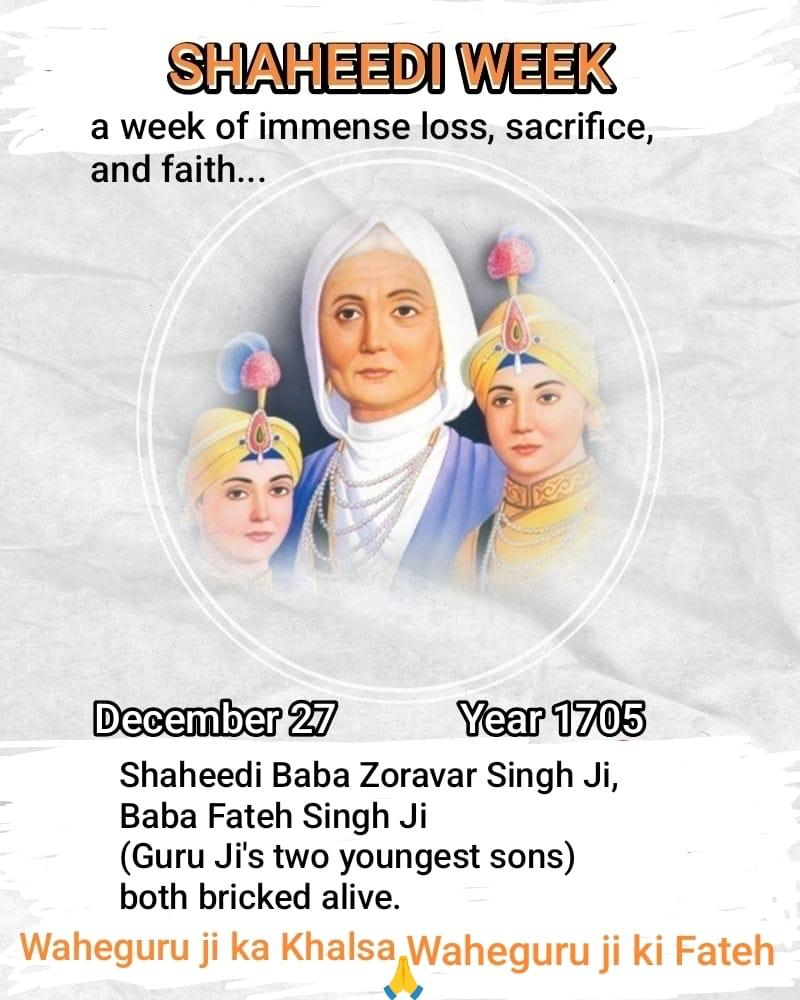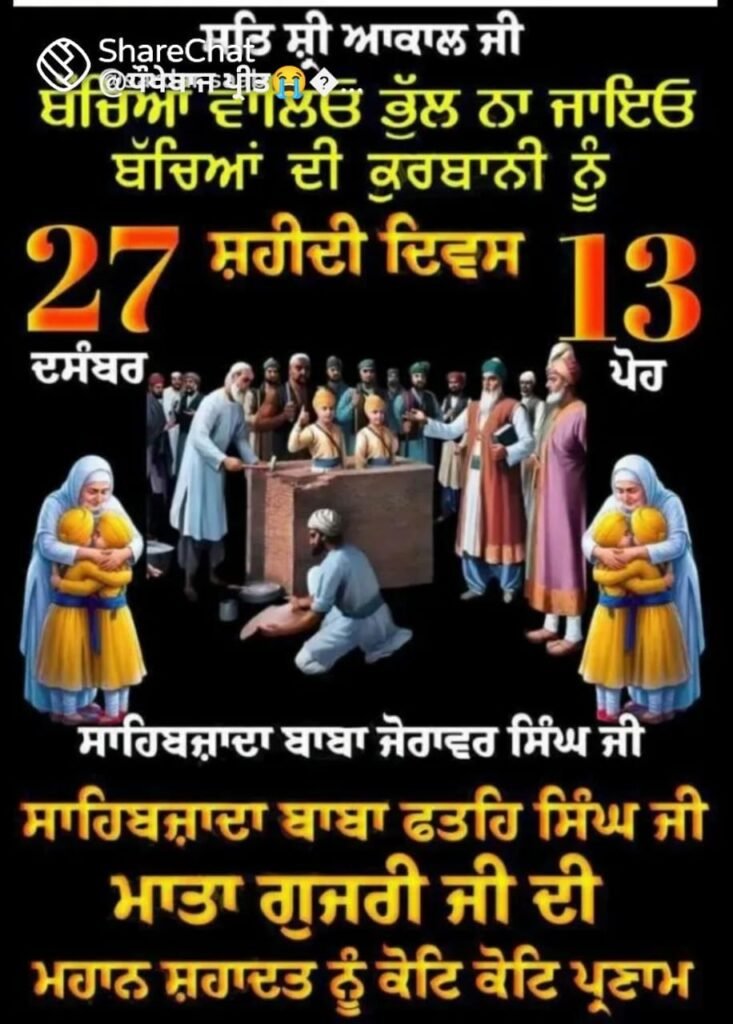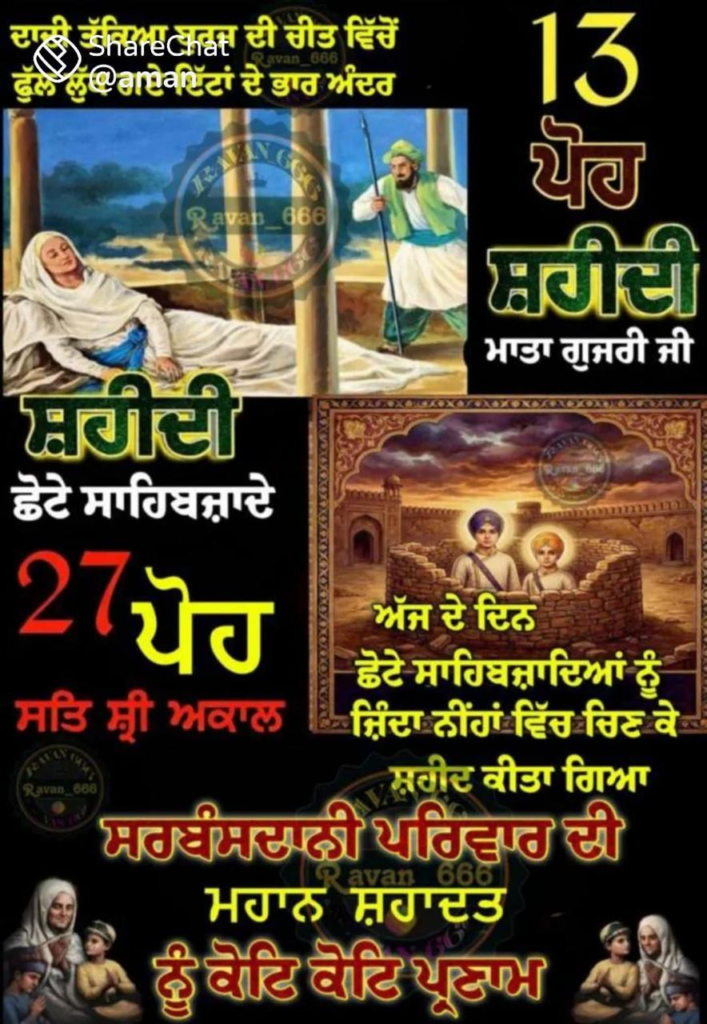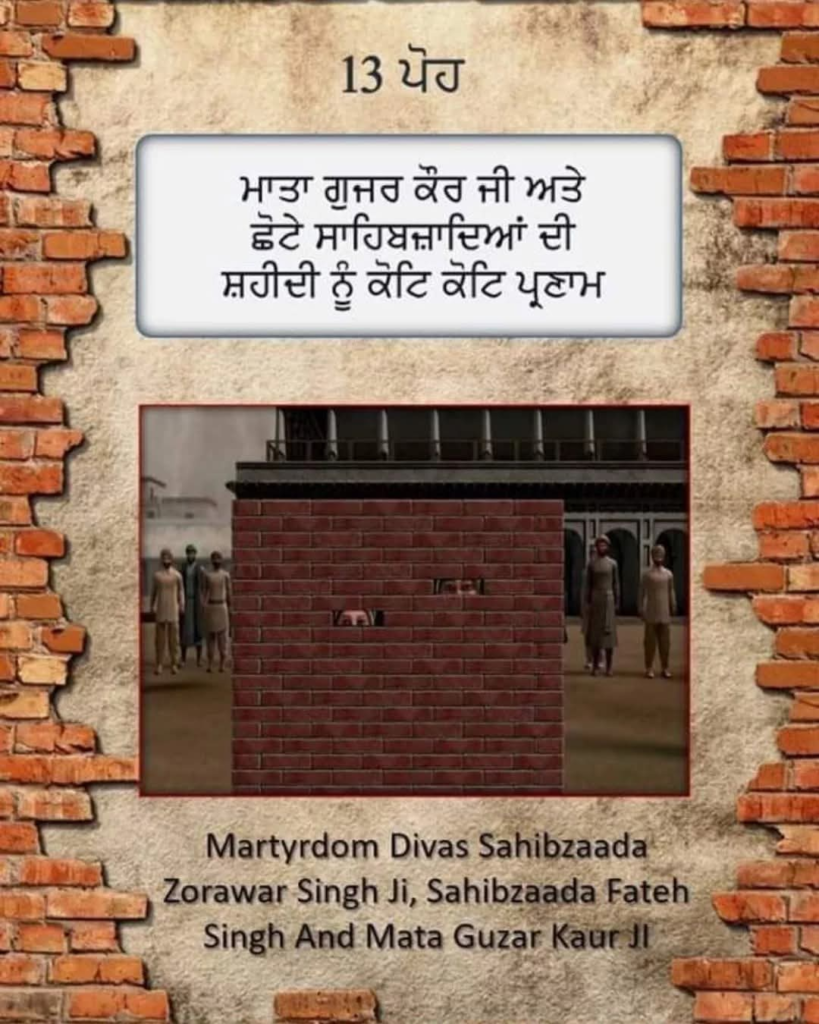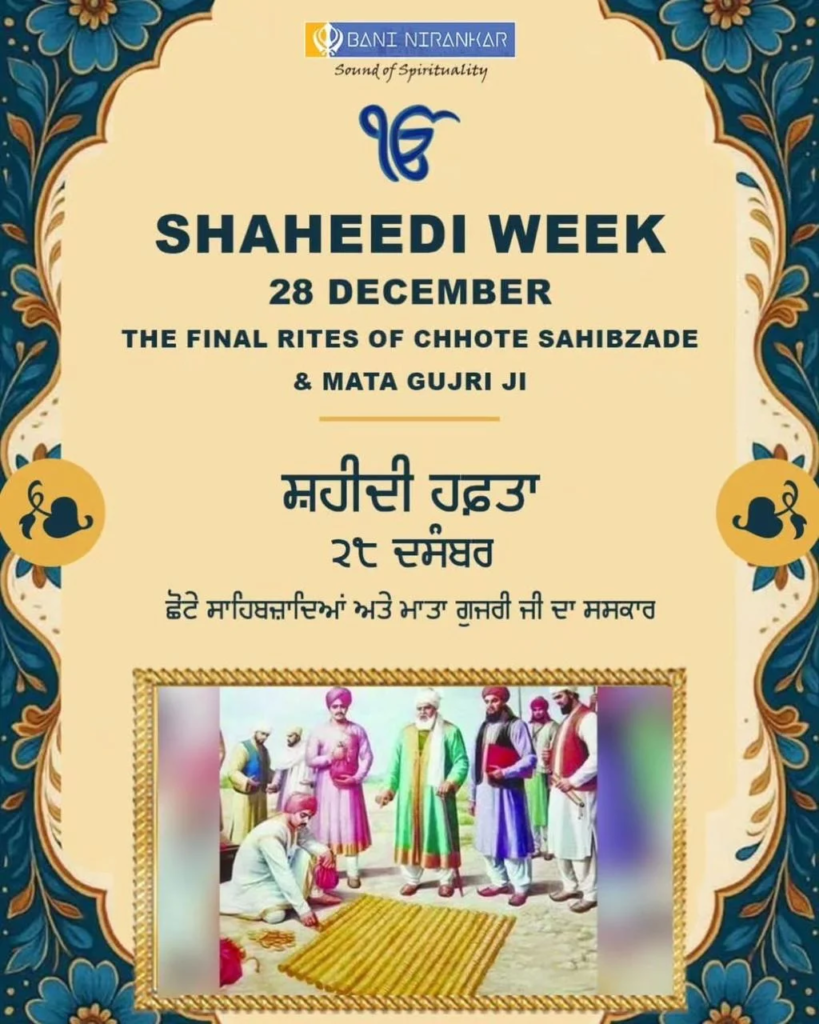
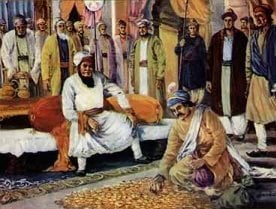
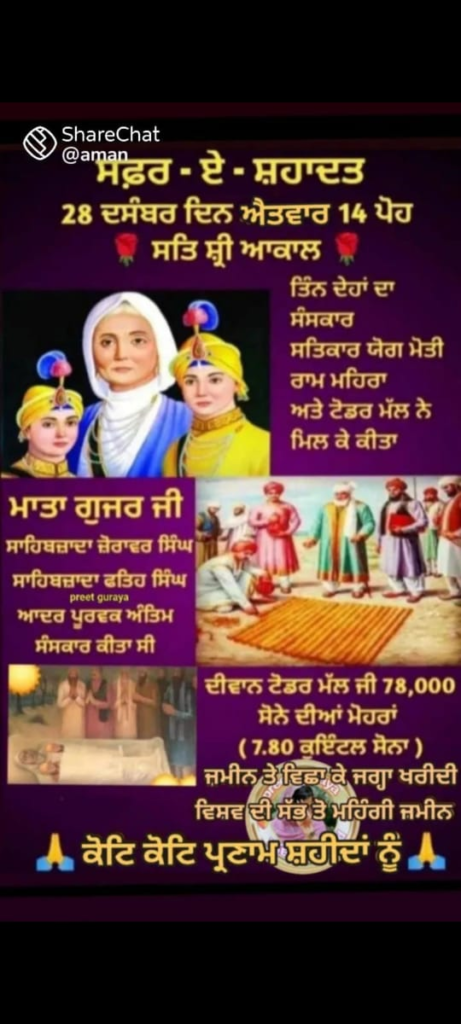
Diwan Todar Mall was a wealthy Sehjdhari Sikh merchant of Sirhind, who on the 13 December 1705 performed the cremation of the three martyred bodies of the two younger sons of Guru Gobind Singh Ji, Zorawar Singh aged about 9, Fateh Singh aged about 6 and their grandmother, Mata Gujari.
n Sikh history, he is remembered for buying a small piece of land at a very huge price, reputed to be the world’s costliest land ever bought, for the cremation of the dead bodies of Mata Gujri, the mother and Sahibzada Zorawar Singh and Baba Fateh Singh, the two younger sons of 10th Sikh Guru, Guru Gobind Singh in 1704 A.D, by paying an exorbitant price to the Wazir Khan ‘Governor Of Sirhind’. He had to cover the whole piece of land with gold coins (ashrafis) in a vertical position, as he was asked to vertically place gold coins on the land and only that much land was given to him which he could cover with gold coins. He later also made arrangements for their cremation.[4] But, according to Harjinder Singh Dilgeer, the bodies of all the three were cremated by the descendants of Todar Mall Shahjahani because the latter had already died in 1665–66.[5]
Todar Mal, however had to bear the brunt of Wazir Khan’s wrath, and he and his family had to abandon the haveli soon after, and themselves faded into oblivion, with dilapidated building being their only reminder. In the coming years, the haveli fell into rapid disrepair, and collapsed at many place. Though it survived ransacking of Sirhind by Banda Bahadur and during the reign of The Sikh Confederacy, the haveli was left untouched out of respect for Diwan Todar Mal.[6][7]
Today, Gurdwara Jyoti Sarup stands where these three martyrs were cremated and the road connecting the two Gurdwaras is known as Dewan Todar Mal Marg. Even today Diwan Todar Mal is deeply respected by the Sikhs and a Diwan Todar Mal Memorial Hall, congregation hall has been constructed at historic Gurudwara Fatehgarh Sahib by SGPC.[8][9]
This incident occurred after the Sahibzade had been executed by the Mughal authorities on the 12 December 1705 for not renouncing their faith and the death from shock of their grandmother at the news of the sudden and despicable execution of the innocent youngsters. This wealthy merchant had to cover the required ground for cremation with gold coins to get the release of the three bodies.
Diwan Todar Mal Gate in Sirhind
The compassionate Sikh trader of Sirhind, according to tradition, performed the last rites for the two younger sons of Guru Gobind Singh Ji martyred on the orders of Wazir Khan, faujdar of Sirhind, and of Mata Gujari, the Guru’s mother. It is said that landowners around the Sirhind Fort would not permit him to hold the cremation in their fields, until one Chaudhari Atta agreed to sell him a plot.
The administrator’s stipulation was that the buyer (Todar Mall) will take only as much of the space as he could cover with gold mohars (gold coins), that he would lay out for the purchase. The diwan produced the coins and bought the piece of land he needed for the cremation. It is estimated (see below) that at least 7,800 gold coins were required to buy the required land.
History tells us the Seth ji raised the required number of coins and that he cremated the three bodies and putting the ashes in an urn which he buried in the land he had bought. The site is now marked by Gurdwara Jyoti Saroop at Fatehgarh Sahib, near Sirhind.
Modern historians have tried to identify Seth Todar Mall as a son or later descendant of Raja Todar Mall, of Sirhind, who won renown as an administrator under the Mughal emperors, Shah Jahan and Aurangzeb, and who, according to Shah Nawaz Khan, Ma’asir ulUmara, lived up to 1076 AH/AD 1666. To perpetuate the memory of the noble-minded Seth, a road in Sirhind town and a hall in Gurdwara Fatehgarh Sahib have now been named after him.
The Haveli Todar Mal also known as Jahaz Haveli is situated on the eastern side of Sirhind-Ropar Railway Line just 1 kilometre away from Fatehgarh Sahib. These are the remains of the Haveli of Devan Todar Mal, and a fine building it must have been in its hay day. Todar Mal was a true Sikh of Guru Gobind Singh Ji. In the dark days when Guru Sahib made his way through the jungles of Machhiwara, and his younger sons were put on trial by Zikharia Khan many Sikhs betrayed the Guru.
As the tenth Guru made his way from Machhiwara through to Talwandi Sabo many so called devotees asked Guru to leave their premises as they were in fear that if the authorities were to hear of it then they would be persecuted. But not Todar Mal, he did not shirk his responsibilities, he put the Guru’s needs before everything.
With Mata Gujri and the younger sons of the Guru – Baba Zorawar Singh and Baba Fateh Singh – shaheed (martyred) at the tender ages of 9 and 6 the despicable Mughal authorities refused their funeral rites on government land, it was decreed that there funeral rites could only be performed on land bought from Chaudhari Atta. Not only this, but the land could only be bought by laying gold coins (ashrifs) on the required area, possibly vertically.
Todar Mal did not shun his responsibility and laid down the required coins and made arrangements for the cremations.
Let us look at this in a little detail, say that a gold coin has a diameter of around 3cm and would take up an area of (3 x 3 ) 9cm squared. The land required for the martyred children would be approximately 2.0m by 2.0m a total area of 40,000 cm squared if laid next to each other. Add to this the area required for Mata Ji (2.0m by 1.5m) if the coins were laid horizontally then to cover this area would require around 7800 gold coins. Now, if the coins had to be stacked vertically then possibly 10 coins would be needed to cover the 9cm squared area, so vertically 7800 x 10 coins would be required, or 78,000. That is an awful lot of gold coins today, one can only imagine how much they were worth three hundred years ago. It is safe to say it was probably his life’s savings. Maybe he had to beg and borrow to raise the total amount, who knows, but the fact remains this was truly a noble deed. Todar Mal forsake everything for his love of Guru Gobind Singh Ji, which is the reason why Sikhs hold Dewan Todar Mal in such high esteem.
A splended Gurdwara, Gurdwara Jyoti Saroop, now stands at the place where these three martyrs were cremated. This Gurdwara is at a distance of about a mile to the east of the main Gurdwara at Fatehgarh Sahib and the road connecting the two Gurdwaras is known as Diwan Todar Mal Marg and a commemorative gate called the Diwan Todar Mal commemorative gate has also been built on this connecting road. A spacious congregation hall has been constructed by the sikhs at Fatehgarh Sahib to commemorate his noble service which is a symbol of the great respect the sikhs have for the Dewan.
Since all historic sites have now been destroyed and covered by such beautiful slabs of marble it is hard to envisage the type of Havali that Guru Gobind Singh Ji and his 40 Sikhs took over at Chamkaur Sahib. By looking at the above images of Devan Todar Mals’ haveli one can get an idea of the types of structure they were. This sweeps away the notion that a haveli was some sort of ramshackle building or wooden stables, rather they were solid buildings which could be defended against a potential siege situation, which is exactly what happened at Chamkaur Sahib. It is now easier to see how Guru Ji and 40 Singhs held out in such a building while around them the enemy hordes laid siege.
Haveli of Todar Mal, 1 km. away from Gurdwara Fatehgarh Sahib
The forgotten Diwan of Sirhind by Surinder Bhardwaj The Tribune India, Fatehgarh Sahib, January 1, 2004
Diwan Todar Mal Jain of Sirhind, a local businessman, was an ardent follower of the Sikh Gurus. His richness could be gauged from his lavish haveli “Jahaz Mahal”. Constructed just outside the Mughal Governor Nawab Wazir Khan’s palace, Diwan Todar Mal’s haveli boasts of a grand reception area to receive and entertain guests and a well laid-out ground complete with a pool and fountains.
Little did he know that fate would bring him to a point where he would have to choose between his faith and fortune. And he sacrificed fortune at the alter of faith. At the end of 1704 A.D. the young Sahibzadas of Guru Gobind Singh Ji,Baba Zorawar Singh and Baba Fateh Singh, were captured and bricked alive by Nawab Wazir Khan of Sirhind. When nobody had the courage to cremate the Sahibzadas, Diwan Todar Mal risked his life and took possession of the bodies.
Todar Mal covers the ground with gold coins to get release of the bodies of the Sahibzade and Mata Gujari
Immediately a royal order was issued, stating that the last rites could not be preformed on Mughal land. The Diwan had to buy land for cremating the Sahibzadas. He ensured that the last rites of the two were performed with full respect. But for this he had lose the peace and prosperity for his own family. Bankrupt and a victim of Nawab Wazir Khan’s wrath the family fled their beautiful home and eventually faded into oblivion.
The only palpable testimony to their existence is the haveli, which stands forlorn. Diwan Todar Mal gained immortality with this act and became a legend. The haveli has withstood the ransacking and destruction of Sirhind by Banda Singh Bahadur. The Sikh Confederacy left the haveli untouched out of great respect for Diwan Todar Mal. Unfortunately, the respect did not endure down the ages and unscrupulous people occupied its gardens and started taking away wood and bricks, causing the fall of certain portions. Nature too left its mark on the beautiful haveli in the absence of any caretaker. Successive governments too could not find time, effort or money to spare on the historical building.
Now Punjab Virasat Charitable Trust under Mr S.K. Ahluwalia, Deputy Commissioner, has formed a charitable association to acquire and restore the haveli to its former glory and to acquaint the people about the sacrifice and selflessness behind it.
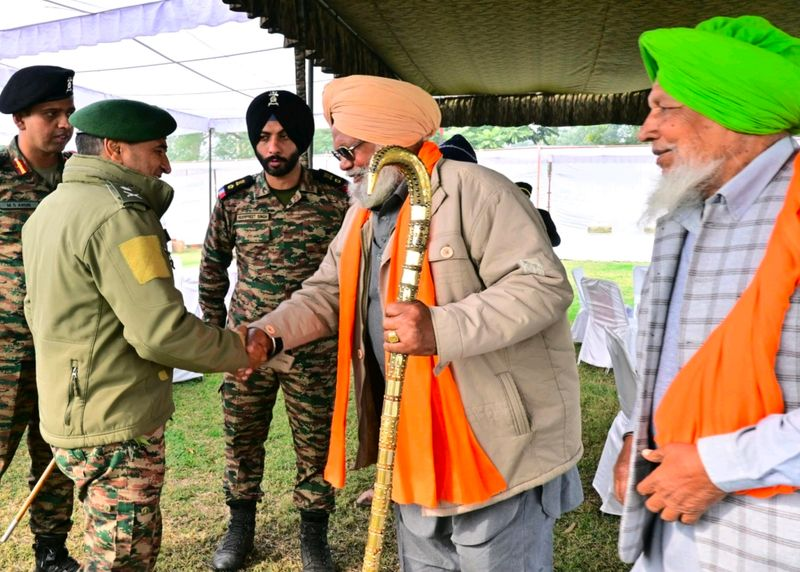
To ensure better facilities for defence veterans and their families, a Raksha Pension Samadhan Aayojan (RPSA) was conducted at Nabha. The outreach programme was organised by the Airawat Division with the primary objective of addressing and resolving pension-related grievances of defence pensioners, including veterans of the Indian Army and their eligible family pensioners.
It witnessed enthusiastic participation from a large number of ex-servicemen, widows and dependents from Nabha and surrounding areas. One of the defining features of the programme was the presence of representatives from all key agencies involved in defence pension administration, to ensure on the spot resolution of anomalies and effective guidance on complex pension matters.
These included officials from the Principal Controller of Defence Accounts (Pensions), representatives of Pension Disbursing Banks, Record Offices of the Army and representatives of Veterans Welfare Sewa Kendra.
Majority of pension cases were resolved immediately and balance pending issues were intimated with clear timelines and follow-up mechanisms.
Special emphasis was laid on addressing the concerns of Veer Naris and widows.
An interactive session was held, allowing veterans to share their experiences and provide feedback on pension-related processes.
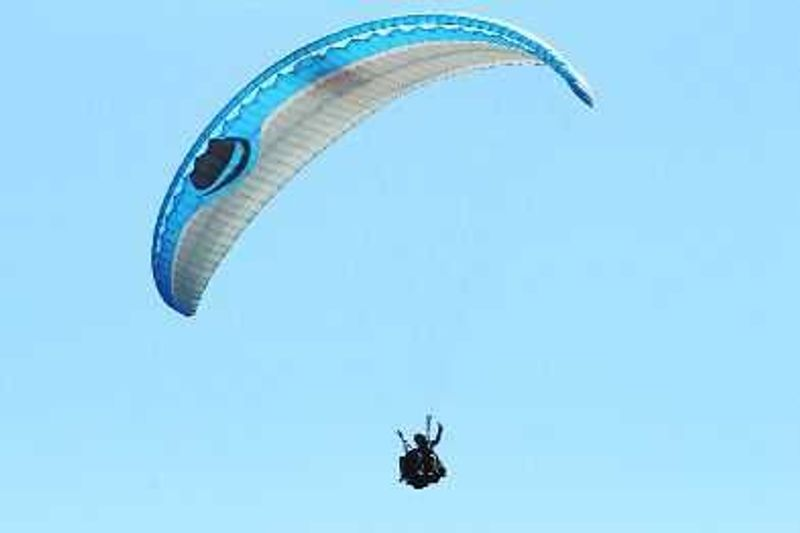
A paragliding accident at the world-famous Bir Billing paragliding site in Kangra district on Friday claimed the life of a pilot after his paraglider reportedly malfunctioned shortly after take-off, raising serious concerns over safety standards and emergency response arrangements at the popular adventure tourism destination.
According to Anurag Sharma, president of the Bir Billing Paragliding Association, the pilot took off from the Billing take-off point with a tourist seated in tandem when the glider suddenly developed a technical fault mid-air. This caused the paraglider to lose balance and crash near the road below the take-off site, leaving the pilot critically injured. The tourist accompanying him also sustained injuries though his condition is stated to be stable.
The deceased pilot has been identified as Mohan Singh, a resident of Barot in Mandi district, who was considered an experienced flyer and had been associated with paragliding operations in the region for several years.
Local residents, fellow pilots and rescue workers rushed to the spot and immediately shifted both the injured pilot and the tourist to the Civil Hospital at Baijnath. Due to the critical nature of Mohan Singh’s injuries, doctors referred him to Dr Rajendra Prasad Government Medical College, Tanda, for advanced treatment. However, the ambulance carrying him was caught in a traffic jam in Baijnath, delaying the transfer by nearly an hour. Mohan Singh succumbed to his injuries on the way to the hospital. The traffic congestion following the accident led to disruption on the Baijnath–Palampur road for about an hour.
Confirming the incident, Sub-Divisional Magistrate (SDM) Baijnath Sankalp Gautam said the administration had received information about the accident soon after take-off and that the tourist flying with the pilot was out of danger. “The matter is being looked into and all necessary procedures are being followed,” he said.

After Russia unleashed a fresh wave of strikes on Kyiv and nearby regions, Ukrainian President Volodymyr Zelensky has called Russian leader Vladimir Putin a “man of war”.
Speaking in Halifax, Nova Scotia, alongside Canadian Prime Minister Mark Carney, Zelensky linked the prolonged assault to Russia’s intentions, a day before his meeting with US President Donald Trump in Florida.
“We want peace,” Zelensky said. “And he’s a man of war.”
Zelensky made a stop in Canada as he prepared for talks with Trump on Sunday in Florida, where he is expected to present a 20-point peace plan aimed at ending the nearly four-year-long conflict. Trump has earlier stated that any peace proposal would require his “approval”.
During his stopover, Zelensky held discussions with Canadian Prime Minister Mark Carney, as well as leaders from NATO and the European Union.
He urged strong positions on both the battlefield and the diplomatic front to stop Putin from manipulating and evading a real and just end to the war.
Following the meetings, Zelensky wrote in a post on X, “Strong positions are needed both at the front and in diplomacy to prevent Putin from manipulating and evading a real and just end to the war. The world has sufficient strength to guarantee security and peace.”
The remarks came hours after Russia launched one of its largest aerial assaults on Ukraine’s capital, Kyiv, and surrounding regions, killing at least two people and injuring four others.
Zelensky alleged that Russia fired more than 500 drones and over 40 missiles during the attack.
According to CNN, the assault lasted more than 10 hours, disrupting daily life in Kyiv and causing widespread power outages that lasted for several hours
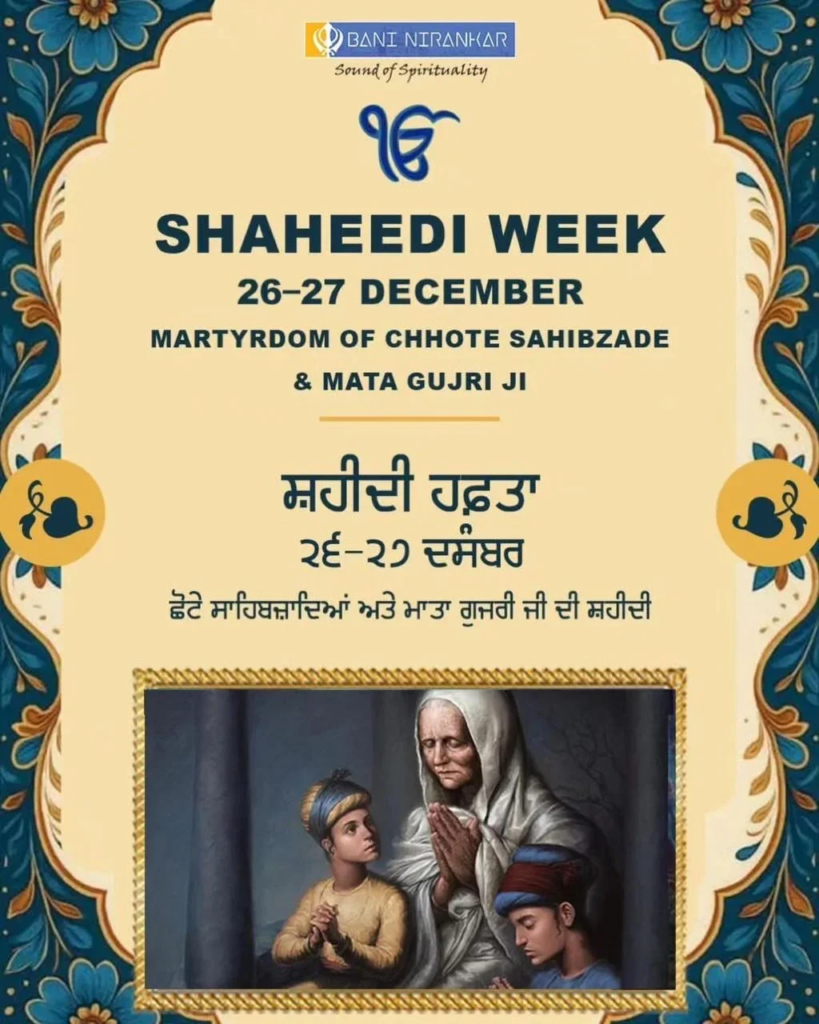
27 Dec -13 Poh Samvat Vikram 1761.
Shaheedi Divas Chote Sahibzade
Finally, young Sahibzadas were brought for bricking alive in a wall. The brave sons raised Jaikaras and fearlessly faced the ordeal.
As the wall reached head height, Sahibzadas fell unconscious.
The wall on completion fell, Sahibzadas were still alive. Wazir Khan ordered that their throats be slit with knife by the process of Zibah.
It’s mentioned that Baba Zorawar Singh passed away instantly, however mortal remains of Baba Fateh Singh took some time to go still. Thus the young children stood by their faith till their end.
Mata Gujri ji also passed away in Thanda Burj the same day.
Thus a saga of unparalleled bravery and sacrifice came to an end. The mortal remains were disposed off in near by Jungle which had carnivorous wild animals.💐
48 Hours after the sacrifice, Diwan Todar Mal, a Shardalu of Guru ji arranged cremation after buying land from the Subedar, at an exorbitant price by paying vertically standing Gold Ashrafis over the piece of land.
Presently Fatehgarh Sahib Gurudwara stands at the bricking site and Gurudwara Joyti Swarup stands at the Cremation site.
Guru ji from Machiwara went Westwards towards Kot Kapura and then Muktsar.
Imperial Forces still chasing.
After the rear guard Battle of Muktsar by 40 Muktas, Imperial Forces retreated and Guru ji went Southwards to Talwandi Sabo near Bathinda. It is one of the Five Takhts of Sikh Panth. Also known as Guru Ki Kashi.
5 years down the line in 1710 AD, Baba Banda Singh Bahadur after collecting motley peasant Army, defeated and killed Wazir khan at Battle of Chappar Chiri near Mohali. Two days later he ransacked Sirhind, and killed Diwan Sucha Nand. The Khalsa flag was hoisted and the place was named Fatehgarh Sahib.
A 328 feet high Fateh Burj now stands at the site of the Battle near Mohali.
🌹🌸🙏🌸🌹⚔️(Concluded)