A rocket fired from Yemen hit an area of Tel Aviv overnight, leaving 16 people injured by shattered glass, the Israeli military said on Saturday, days after Israeli airstrikes hit Houthi rebels who have been launching missiles in solidarity with Palestinians in Gaza.
Another 14 people had minor injuries as they rushed to shelters when air raid sirens sounded before dawn, the military said.
The Houthis in a statement on Telegram said they had aimed a hypersonic ballistic missile at a military target that they did not identify. Israel’s military said it was investigating.
“A flash of light, a blow and we fell to the ground. Big mess, broken glasses all over the place,” said Bar Katz, a resident of a damaged building.
The Houthis’ media office later reported airstrikes on Yemen’s Houthi-held capital, Sanaa. US forces conducted airstrikes against a missile-storage facility and a command facility operated by the Houthis, the US Central Command said in a statement on X.
The attack on Tel Aviv came after Israeli airstrikes on Sanaa and the port city of Hodeida killed at least nine people on Thursday. The strikes came hours after a missile from Yemen hit a school building in central Israel. The Houthis also claimed a drone strike targeting an unspecified military target in central Israel that day.
Israel’s military says the Iran-backed Houthis have launched more than 200 missiles and drones during the 14-month Israel-Hamas war in Gaza. The Houthis have also attacked shipping in the Red Sea and Gulf of Aden and say they will not stop until there is a ceasefire in Gaza.
The Israeli strikes on Thursday caused “considerable damage” to the Houthi-controlled Red Sea ports, UN spokesman Stephane Dujarric said. The Hodeida port has been key for food shipments into Yemen in its decade-long civil war.
Israeli strikes in Gaza kill a dozen children
Mourners in Gaza held funerals for 19 Palestinians — 12 of them children — killed in Israeli strikes on Friday and overnight.
One strike hit a residential building in the built-up Nuseirat refugee camp in central Gaza, killing at least seven, including five children and one woman, and injuring 16 others, health officials said.
In Gaza City, a strike on a house killed 12, including seven children and two women, according to Al-Ahli Hospital where the bodies were taken. One man cradled a tiny shroud-wrapped body as mourners gathered.
Later on Saturday, al-Awda Hospital said an airstrike hit a house in Nuseirat and killed four people including two children, with 14 other people wounded. Israel’s military said it was checking the report.
Navy, Air Force cleared to fly Ospreys after inspecting gears
The military is resuming flights of its tiltrotor V-22 Ospreys after ordering inspections of a gearbox to see which might be at risk of metal failure. (Mass Communication Specialist 3rd Class Amber Smalley/U.S. Navy)
The Navy and Air Force are now cleared to resume flying their grounded V-22 Ospreys after conducting inspections on a crucial gearboxinthe tiltrotor aircraft, and some are already back in the air.
Naval Air Systems Command, or NAVAIR, issued a bulletin to the fleet Friday morning ordering crews to verify how many hours each aircraft’s proprotor gearbox had flown.
If an Osprey’s gearbox meets or exceeds a particular number of flight hours — NAVAIR would not say how many due to operational security concerns — it can resume flying under limitations issued in March.
But if the gearbox is found to have fewer flight hours, it will have to fly under a new and stricter set of limitations, Air Force Special Operations Command Spokeswoman Lt. Col. Becky Heyse told Defense News. Heyse said the groundings were not absolute, and some Ospreys kept flying to conduct necessary operations.
The fatal crash of an Air Force CV-22 near Japan in November 2023 was caused by a cracked gear, which had impurities called inclusions that weakened the metal.Similar metal weaknesses may have also caused the near crash near Cannon Air Force Base last month.
Osprey manufacturer Bell is working with the V-22 Joint Program Office to upgrade some of the aircraft’s gears to make those weakening impurities less common.
But that will take some time to roll out, Heyse said, and the military had to find a way to get its Ospreys back in the air in the meantime.
“It’s really important we don’t keep these aircraft grounded,” Heyse said. “This allows us to fly and keep pilot proficiency while a longer-term fix is put in place.”
Studies of the Osprey have shown that when those impurities cause gear cracks, Heyse said, it typically happens in their early life. Once they have flown a certain number of hours and are “broken in,” she said, they are less likely to crack and the military is more confident in them. That is why the Ospreys under the flight hour threshold must adhere to the more conservative restrictions, she said.
The stricter guidelines for those Ospreys will stay in place until their gearboxes are upgraded, or they exceed the flight hour threshold, NAVAIR said.
Air Force Special Operations Command had already been inspecting some aircraft before today and verifying how many flight hours their gearboxes had, according to Heyse. Those Ospreys are already flying, she said.
The inspection process for each aircraft doesn’t take long, she said.
The military declined to say how many Ospreys are affected by these changes, and what their additional flight restrictions are, for security reasons.
The Marine Corps has by far the most Ospreys in its fleet, at about 350. The Air Force has about 52 Ospreys, and the Navy has roughly 30.Stephen Losey is the air warfare reporter for Defense News. He previously covered leadership and personnel issues at Air Force Times, and the Pentagon, special operations and air warfare at Military.com. He has traveled to the Middle East to cover U.S. Air Force operations.
BATTLE OF CHAMKAUR SAHIB : HISTORY AND SIGNIFICANCE
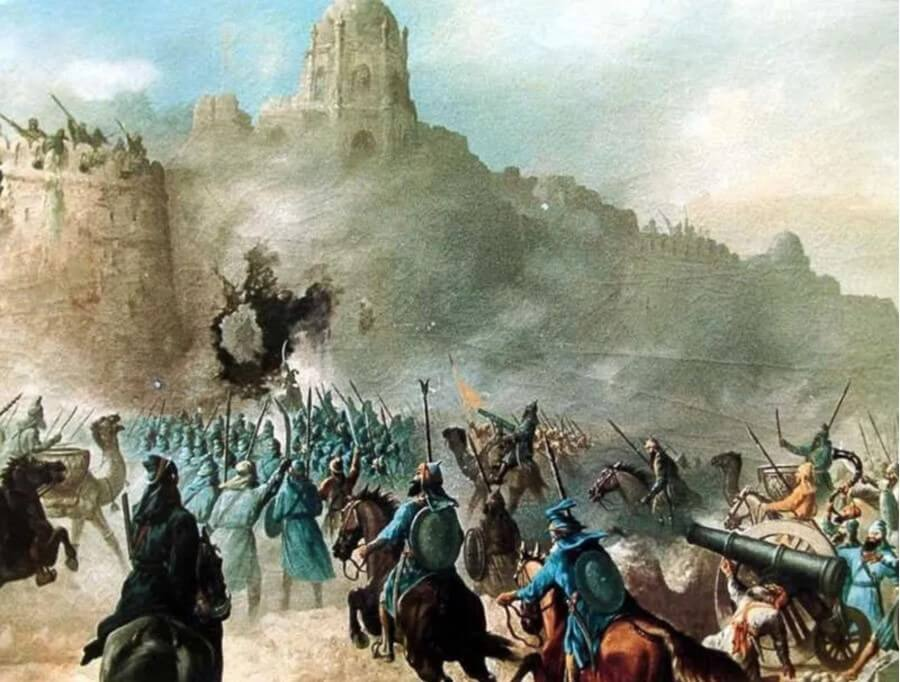
The Battle of Chamkaur, also known as Battle of Chamkaur Sahib or the Second battle of Chamkaur, was fought between the Khalsa, led by Guru Gobind Singh, and the coalition forces of the Mughals led by Wazir Khan and Hindu hill chiefs. Guru Gobind Singh makes a reference to this battle in his letter Zafarnama.
he Battles of Chamkaur, fought in 1704, were crucial events in Sikh history. Led by Guru Gobind Singh Ji, the tenth Sikh Guru, these battles against the Mughal Empire involved fierce fighting and notable sacrifices. The two engagements, known as the Battle of Chamkaur Sahib, highlighted the strength and bravery of the Sikh community.
Historical Context
In the early 18th century, the Mughal Empire was at its height, having expanded its control extensively over the Indian subcontinent. The period was notable for the Empire’s broad territorial reach, complex administration, and cultural achievements. Despite its dominance, the Mughal rulers faced growing dissatisfaction among different communities and increasing resistance from regional powers.
Guru Gobind Singh Ji, the tenth Sikh Guru and a key figure in Sikh history, found himself at the forefront of a growing conflict between the Sikh community and the Mughal authorities. As the leader of the Sikhs, Guru Gobind Singh Ji had established a strong and resilient community committed to spiritual and temporal freedom. His leadership and the growing power of the Sikh community directly challenged the authority and control of the Mughal Empire
Under Emperor Aurangzeb, the Mughal rulers were determined to crush any resistance that threatened their control. The Sikh community’s defiance was seen as a major threat, leading to increasingly severe measures by the Mughal authorities. This era was characterized by rising tensions and conflicts as the Mughals attempted to suppress the growing influence of the Sikhs and reaffirm their dominance.
The conflict reached a crucial moment during the confrontations at Chamkaur. In December 1704, the Battle of Chamkaur was a defining episode in this struggle. Guru Gobind Singh Ji, along with a small group of followers, confronted the large forces of the Mughal Empire. This battle, along with others from that period, highlighted the intense and often harsh nature of the conflict between the Sikhs and the Mughal rulers. It symbolized the Sikh community’s fierce resistance against Mughal oppression and their ongoing fight for justice and freedom.
The First Battle of Chamkaur
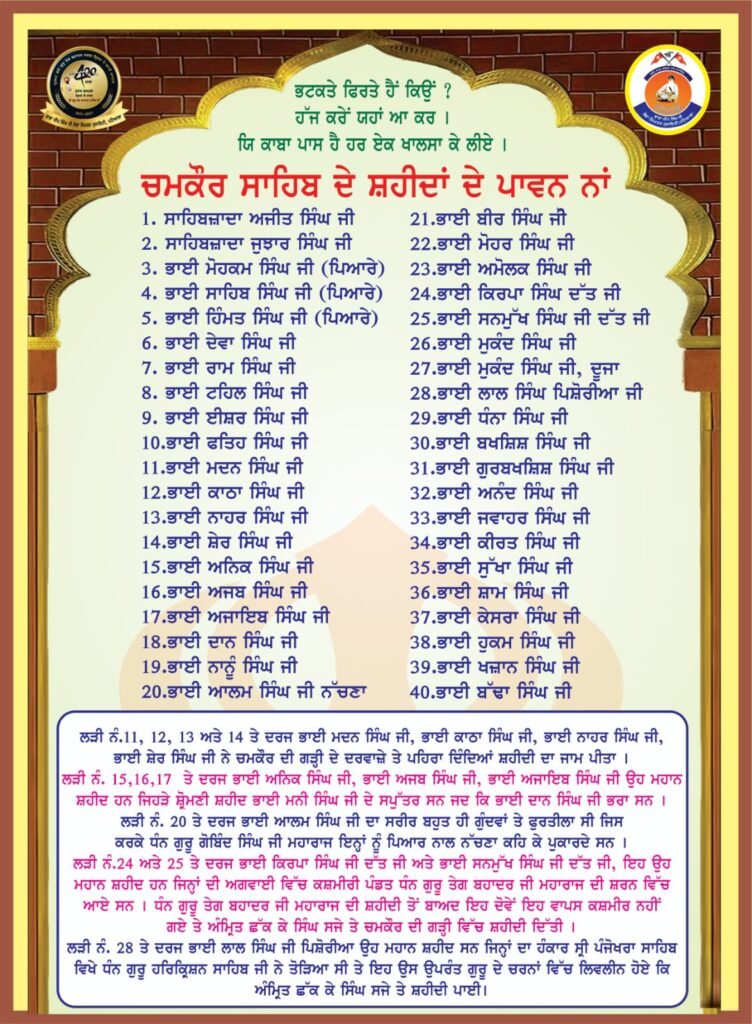
The First Battle of Chamkaur, fought on December 22-23, 1704, is a significant event in Sikh history, showcasing the bravery and resilience of Guru Gobind Singh Ji and his followers. During this crucial battle, Guru Gobind Singh Ji, with only 40 dedicated Sikh warriors, was surrounded by a much larger Mughal force in the town of Chamkaur Sahib.
The Mughal army, which was significantly larger and better equipped, sought to crush the Sikh resistance once and for all. Despite the overwhelming odds, the Sikh warriors displayed extraordinary bravery and tactical prowess. The battle was not just a clash of armies but a testament to the indomitable spirit and unyielding resolve of the Sikh fighters.
Guru Gobind Singh Ji and his small band of Sikhs managed to put up a fierce and resolute defense. They engaged the Mughal forces in a series of skirmishes that showcased their tactical acumen and strategic brilliance. The Sikhs fought with unmatched valor, employing guerrilla tactics and using the terrain to their advantage to inflict significant damage on the Mughal troops.
The battle was marked by intense combat, with both sides suffering heavy casualties. Despite their tenacity, the Sikhs were eventually forced to retreat due to the sheer size of the enemy forces and the exhaustion from continuous fighting. Nevertheless, their performance during the battle was a powerful statement of their resolve and dedication to their cause.
The First Battle of Chamkaur became a symbol of the Sikh community’s resolve to resist oppression and uphold their values. It showcased the strategic prowess and courage of Guru Gobind Singh Ji and his followers, who stood firm despite overwhelming odds. This battle is remembered in Sikh history for its display of bravery and self-sacrifice.
The Second Battle of Chamkaur
The Second Battle of Chamkaur, which unfolded on December 23-24, 1704, was a dramatic continuation of the fierce confrontation that had begun the previous day. Following the initial clash, the Mughal forces, recognizing the relentless resolve of Guru Gobind Singh Ji and his small band of followers, escalated their assault with renewed vigor and determination.
After the first battle, Guru Gobind Singh Ji shifted his focus to a crucial goal: slowing down the advancing Mughal troops to allow his remaining followers to escape safely. Recognizing the need for a strategic retreat and regrouping, Guru Gobind Singh Ji used careful tactics and defensive actions to buy time for his warriors to break free from the encirclement.
The second engagement was marked by intense and grueling combat, with both sides suffering significant losses. The Sikhs, though significantly outnumbered, continued to fight with remarkable bravery and determination. They engaged the Mughal forces in close areas and used the challenging land features to their advantage, demonstrating their tactical ingenuity and unwavering commitment to their cause.
During this battle, the Sikhs made brave stands at various points, pushing back the Mughal advances and causing significant losses. Despite their courageous efforts, the relentless pressure from the Mughal forces and the harsh conditions affected the Sikh defenders. The battle saw heavy losses on both sides, highlighting the high risks and the intense nature of the conflict.
The Second Battle of Chamkaur, while ultimately resulting in a strategic retreat for the Sikhs, is remembered as a testament to their courage, discipline, and self-sacrifice. It highlighted Guru Gobind Singh Ji’s leadership and strategic acumen, and the extraordinary valor of his followers. This battle, like its predecessor, became a symbol of the Sikh community’s enduring spirit and their unwavering stand against oppression.
Martyrdom of Sahibzada Ajit Singh and Sahibzada Jujhar Singh
The martyrdom of Sahibzada Ajit Singh and Sahibzada Jujhar Singh during the battles of Chamkaur stands as one of the most poignant and revered episodes in Sikh history. As the sons of Guru Gobind Singh Ji, both Sahibzada Ajit Singh and Sahibzada Jujhar Singh were not only embodiments of valor and dedication but also crucial figures in the resistance against the Mughal Empire.
Sahibzada Ajit Singh, the elder son, was known for his exceptional courage and leadership. During the intense combat at Chamkaur, he demonstrated extraordinary bravery, engaging the enemy with fierce determination. Despite his youth, Sahibzada Ajit Singh’s combat skills and strategic insight were evident. His sacrifice came as he fought valiantly alongside his father and other Sikh warriors, embodying the Sikh ideals of courage and selfless service.
Sahibzada Jujhar Singh, the younger son, was equally remarkable in his heroism. His commitment to the Sikh cause was unwavering, and he participated actively in the battles, displaying remarkable bravery and steadfastness. His martyrdom was a profound testament to his dedication and the values imparted by his father. Sahibzada Jujhar Singh’s courage in the face of overwhelming odds was emblematic of the Sikh spirit and their resilience.
The martyrdom of these two young warriors is honored with great respect and pride within the Sikh community. Their sacrifices are remembered not just as individual acts of bravery but as powerful symbols of the broader Sikh values of selflessness, courage, and steadfast commitment to justice. Their legacy remains an inspiration for future generations, reflecting the deep impact of their sacrifice on Sikh identity and the fight for religious and moral integrity.
The story of Sahibzada Ajit Singh and Sahibzada Jujhar Singh continues to evoke strong emotions for Sikhs, reflecting the deep values of courage and sacrifice central to Sikhism. Their martyrdom serves as a powerful reminder of the high cost of staying true to one’s beliefs and the lasting spirit of the Sikh community.
The Strategic and Tactical Aspects
Battlefield Tactics
The Battles of Chamkaur demonstrated remarkable tactical ingenuity by Guru Gobind Singh Ji and his Sikh followers. Faced with overwhelming odds, the Sikhs employed several innovative tactics that showcased their strategic acumen and adaptability.
1. Guerilla Warfare: The Sikhs utilized guerrilla warfare tactics, leveraging their knowledge of the terrain to engage in hit-and-run attacks. This approach allowed them to strike at the Mughal forces unexpectedly, disrupt their formations, and then quickly retreat to safer positions. This style of warfare was highly effective against the larger and more cumbersome Mughal army.
2. Use of Terrain: The Sikhs adeptly used the natural landscape to their advantage. By positioning themselves in strategically advantageous locations, such as elevated areas and narrow passes, they were able to maximize the effectiveness of their defensive efforts. The difficult terrain around Chamkaur forced the Mughal forces into a confined space, limiting their ability to maneuver and exploit their numerical superiority.
3. Defensive Strategies: During the battles, Guru Gobind Singh Ji and his followers displayed exceptional defensive strategies. They formed a defensive perimeter that allowed them to hold their ground despite the Mughal forces’ attempts to break through. The Sikhs’ disciplined formation and resilient defense were critical in withstanding the Mughal onslaught and ensuring the safety of their core group.
4. Psychological Warfare: The Sikhs employed psychological tactics to boost their morale and demoralize the enemy. By demonstrating unwavering courage and resilience, they sent a strong message to the Mughal forces about their determination to resist. This psychological edge played a significant role in the battles’ dynamics, impacting the confidence and morale of both sides.
Geographical Significance
The strategic location of Chamkaur played a crucial role in the dynamics of the battles and the overall military strategies employed by both the Sikhs and the Mughal forces.
1. Terrain and Layout: Chamkaur is situated in a region characterized by rugged terrain and dense forests. This geographical feature was significant in shaping the battle strategies of both sides. The uneven terrain provided natural cover for the Sikh forces and hindered the Mughal army’s ability to deploy their full strength effectively.
2. Encirclement Challenges: The geography of Chamkaur posed challenges for the Mughal forces, particularly in their attempt to encircle and trap Guru Gobind Singh Ji and his followers. The natural barriers and limited maneuvering space restricted the Mughal army’s ability to execute complex encirclement tactics and maintain tight control over the battlefield.
3. Strategic Positioning: The location of Chamkaur was strategically important as it lay on a key route that connected different regions. Control over this area would have provided the Mughal forces with significant strategic advantages, including easier access to supply lines and reinforcement routes. Conversely, the Sikhs’ ability to hold their ground at Chamkaur was a testament to their strategic foresight and resilience.
4. Impact on Movement: The challenging terrain influenced the movement of forces and the deployment of troops. The narrow passes and rugged paths limited the speed and effectiveness of large-scale maneuvers, forcing both the Sikhs and the Mughals to adapt their strategies to the geographical constraints. The Sikhs’ adept use of the terrain played a crucial role in their ability to resist and delay the Mughal advance.
The strategic and tactical aspects of the Battles of Chamkaur underscore the importance of battlefield innovation and geographical awareness in determining the outcome of conflicts. Guru Gobind Singh Ji’s tactical brilliance and the challenging terrain of Chamkaur were instrumental in shaping the course of these historic battles.
Post-Battle Impact and Legacy
Sikh Community’s Response
The battles at Chamkaur were turning points for the Sikh community, deeply affecting their identity and spirit. The extraordinary bravery and self-sacrifice shown by Guru Gobind Singh Ji and his followers during these intense battles became a strong rallying point for Sikhs across the region. The fierce confrontations and the courage of the Sikh warriors inspired the community, strengthening their resolve to uphold their faith and resist oppression.
After these battles, the Sikh community grew more united and determined. The sacrifices of their leaders and martyrs inspired a renewed commitment to their ideals. This period marked a crucial strengthening of Sikh identity, as the community drew strength from the courage of their martyrs and the steadfast leadership of Guru Gobind Singh Ji. The battles became symbols of resilience, fostering deeper communal bonds and a spirit of collective determination and solidarity.
Changes in Strategy and Leadership
The aftermath of the battles at Chamkaur led to important changes in Sikh military strategy and leadership. The intense confrontations taught valuable lessons that influenced future Sikh tactics and planning. Recognizing the need to adapt to powerful enemies, Sikh leaders used these lessons to improve their approach to warfare and resistance.
Guru Gobind Singh Ji’s experiences during the battles helped him refine guerrilla tactics and the need for strategic retreats. The focus shifted to more flexible and adaptive strategies, using the strengths of the Sikh forces while addressing their weaknesses. This shift in strategy was crucial for guiding Sikh resistance and enabling the community to effectively challenge the Mughal Empire.
Leadership within the Sikh community also saw a transformation, with a greater emphasis on strategic foresight and tactical acumen. The experiences of Chamkaur underscored the importance of resilient leadership and the need for dynamic approaches to both combat and community organization. The legacy of Guru Gobind Singh Ji’s leadership continued to inspire subsequent generations of Sikh leaders, reinforcing the values of courage, innovation, and perseverance.
Commemoration and Memorials
The legacy of the Battles of Chamkaur is honored through various commemorations and memorials, reflecting their deep significance in Sikh history. Gurdwara Chamkaur Sahib, located near the battlefields, is a central tribute to the sacrifices made during these battles. This sacred site serves as a key place for remembering and honoring the Sikh martyrs and warriors.
Annual events and ceremonies at Gurdwara Chamkaur Sahib and other related sites are essential for preserving the memory of those who fought and fell in these important conflicts. These commemorations not only recognize the historical importance of the battles but also reinforce the values of bravery, sacrifice, and faith exemplified by the Sikh heroes. The rituals and gatherings connected to these memorials help maintain a sense of historical continuity and cultural pride within the Sikh community.
In addition to Gurdwara Chamkaur Sahib, numerous other memorials and educational initiatives continue to honor the legacy of the battles. These include exhibitions, historical documentation, and public lectures that help to educate and inspire future generations about the profound impact of the battles and the enduring spirit of the Sikh resistance.
Comparative Analysis with Other Sikh Battles
Similar Conflicts
The Battles of Chamkaur (1704) stand as a pivotal chapter in Sikh military history, reflecting the broader context of Sikh resistance against Mughal oppression. Comparing these battles with other significant Sikh conflicts provides a deeper understanding of the evolution of Sikh military strategies and their enduring resilience.
1. Battle of Anandpur Sahib (1704): The Battle of Anandpur Sahib, which took place just before the Battles of Chamkaur, serves as a crucial precursor. In this battle, Guru Gobind Singh Ji defended his fort against a formidable Mughal siege. Like Chamkaur, the Battle of Anandpur Sahib showcased the Sikhs’ strategic use of defensive fortifications and their determination to resist overwhelming odds. Both battles highlighted the Sikhs’ ability to adapt their tactics to their environment and the challenges they faced.
2. Battle of Muktsar (1705): Following the Battles of Chamkaur, the Battle of Muktsar is another significant Sikh conflict worth comparing. In Muktsar, the Sikhs, led by Banda Singh Bahadur, faced the Mughal forces in a decisive battle. Similar to Chamkaur, the Sikhs demonstrated remarkable resilience and tactical adaptability. The battle marked a shift in Sikh strategy, emphasizing offensive tactics and guerrilla warfare, which were influenced by the experiences and lessons from Chamkaur.
3. Battle of Saragarhi (1897): While not directly related to the Mughal-Sikh conflicts of the 18th century, the Battle of Saragarhi is another notable Sikh battle that reflects the enduring spirit of Sikh valor. In Saragarhi, 21 Sikh soldiers defended a remote outpost against thousands of Afghan tribesmen. This battle, like Chamkaur, exemplified the Sikh commitment to self-sacrifice and resistance against overwhelming odds, demonstrating the continuity of Sikh military values and tactics across centuries.
Cultural and Historical Significance
The Battles of Chamkaur hold profound influence on Sikh philosophy, reflecting the core values and principles that define Sikhism. These conflicts, marked by extraordinary courage and resilience, are deeply woven into the fabric of Sikh teachings and identity.
Influence on Sikh Philosophy
Courage and Resilience: The unwavering bravery of Guru Gobind Singh Ji and his followers during the Battles of Chamkaur epitomizes the Sikh values of courage and resilience. The Sikh philosophy emphasizes standing firm in the face of adversity and upholding justice even when confronted with overwhelming odds. The sacrifices made during these battles reinforce the Sikh belief in fighting for righteousness and the protection of faith and freedom.
Selflessness and Sacrifice: The martyrdom of Sahibzada Ajit Singh, Sahibzada Jujhar Singh, and other Sikh warriors exemplifies the ideals of selflessness and sacrifice that are central to Sikh teachings. The concept of sacrificing one’s life for a higher cause or for the welfare of others is celebrated in Sikhism, highlighting the importance of putting the collective good above personal interests.
Upholding Justice: The resistance against the Mughal forces during the Battles of Chamkaur underscores the Sikh commitment to justice and resistance against oppression. Sikh philosophy advocates for standing up against tyranny and injustice, reflecting the spirit of the battles and the determination of the Sikhs to protect their religious and cultural freedoms.
Art and Literature
The Battles of Chamkaur have left a lasting imprint on Sikh art, literature, and music, enriching the cultural heritage of the Sikh community. These artistic expressions celebrate the heroism and sacrifices of the participants, preserving the legacy of the battles for future generations.
Poetry and Songs: Sikh poets and musicians have immortalized the Battles of Chamkaur through poignant poems and devotional songs. These literary and musical works capture the valor of Guru Gobind Singh Ji and his followers, celebrating their heroism and the moral lessons derived from the conflicts. The verses often reflect on themes of bravery, sacrifice, and unwavering faith, resonating with the Sikh community’s values.
Paintings and Murals: Visual depictions of the Battles of Chamkaur can be found in Sikh art, including paintings and murals. These artworks illustrate key moments from the battles, such as the valiant stand of the Sikhs and the martyrdom of Sahibzada Ajit Singh and Sahibzada Jujhar Singh. The artistic representations serve as visual narrations of the events, preserving the historical and cultural significance of the battles.
Historical Accounts: Sikh historians and chroniclers have documented the Battles of Chamkaur in various historical accounts and manuscripts. These writings provide detailed descriptions of the events, the strategies employed, and the outcomes of the conflicts. The historical accounts contribute to a deeper understanding of the battles and their impact on Sikh history.
Cultural Celebrations: Annual commemorations and events related to the Battles of Chamkaur often include cultural performances, recitations, and reenactments. These celebrations honor the memory of the martyrs and provide an opportunity for the Sikh community to reflect on the values and lessons derived from the battles.
Educational Resources: The legacy of the Battles of Chamkaur is also preserved through educational resources, including books, documentaries, and lectures. These resources aim to educate new generations about the significance of the battles and the enduring impact of the sacrifices made by Guru Gobind Singh Ji and his followers.
The cultural and historical significance of the Battles of Chamkaur extends beyond their military aspects, shaping Sikh philosophy and enriching the community’s artistic and literary heritage. The bravery, sacrifice, and values exemplified during these battles continue to inspire and resonate with Sikhs around the world.
Inspiration for Future Generations
The legacy of the Battles of Chamkaur continues to inspire Sikh youth, serving as a source of motivation and pride. The stories of the martyrs and the sacrifices made during these conflicts are powerful examples of commitment and valor.
The tales of bravery and sacrifice are used to motivate Sikh youth, encouraging them to embody the same values in their own lives. The resilience shown by Guru Gobind Singh Ji and his followers is highlighted as an example of perseverance in the face of adversity. This motivational aspect helps young Sikhs to face challenges with courage and determination.The battles are celebrated as a symbol of Sikh pride and identity. Learning about the heroic deeds of the martyrs fosters a sense of pride in Sikh heritage and history. This connection to their ancestors’ struggles and triumphs strengthens the sense of belonging and cultural identity among Sikh youth.
The martyrs of the Battles of Chamkaur are revered as role models for Sikh youth. Their stories are shared through various mediums, including books, documentaries, and cultural performances, to illustrate the values of selflessness and bravery. These role models serve as examples of how to live a life of purpose and commitment.
Events and commemorations related to the Battles of Chamkaur often include educational activities for youth. These may include reenactments, storytelling sessions, and discussions about the battles’ significance. Such activities help young Sikhs connect with their history in a meaningful and engaging way.
The battles also serve as a backdrop for discussions about civic responsibility and social justice. The legacy of standing up against oppression and injustice is used to inspire Sikh youth to contribute positively to society and advocate for fairness and equality.
The educational impact of the Battles of Chamkaur extends beyond the classroom, influencing Sikh youth through various channels of learning and community engagement. The legacy of these battles continues to shape Sikh identity and values, inspiring future generations to uphold the principles of courage, resilience, and commitment to faith.
Conclusion
The Battles of Chamkaur highlight the incredible courage and strong commitment of Guru Gobind Singh Ji and his followers. Their bravery and sacrifices marked a crucial time in Sikh history and continue to inspire the Sikh community today.
The lasting impact of these battles is a powerful reminder of the strength found in unity and faith, serving as an example of courage and determination for future generations.
SAHADAT (MARTYRDOM) OF VADDEVSAHIBZAADE BABA AJIT SINGH JI & BABA JUJAR SINGH JI
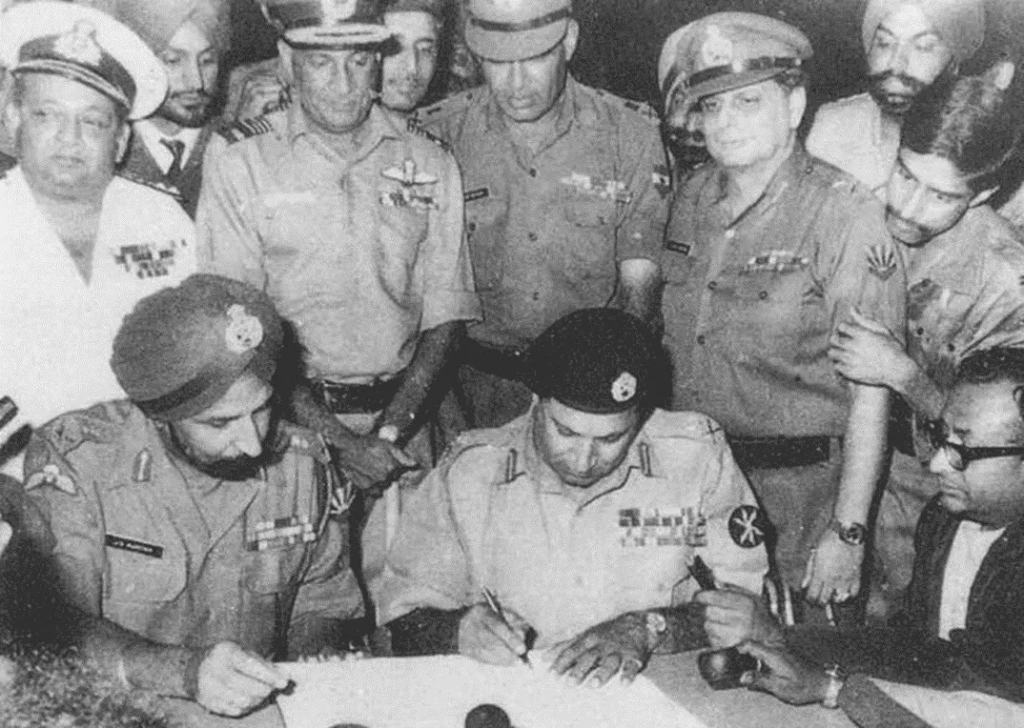
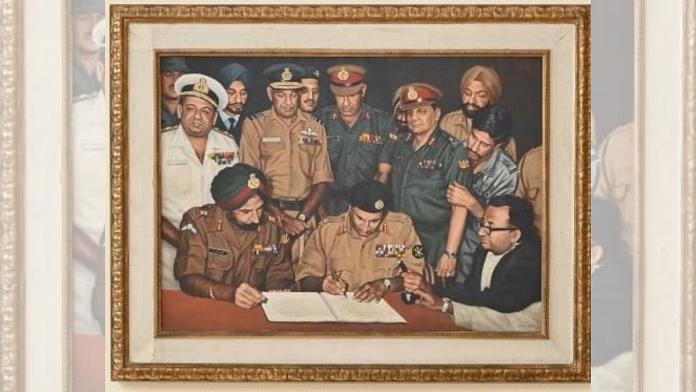
the surrender ceremony at Dacca – 16 December 1971 (in black and white)
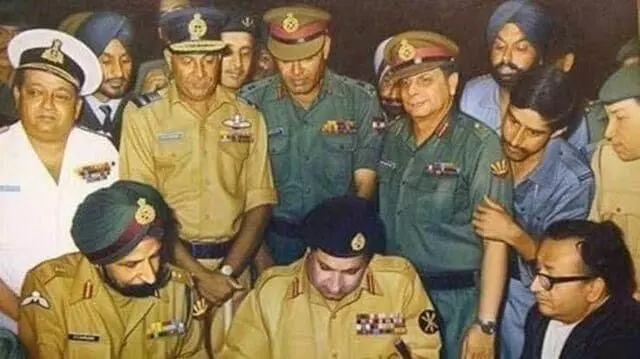
The original photograph in colour
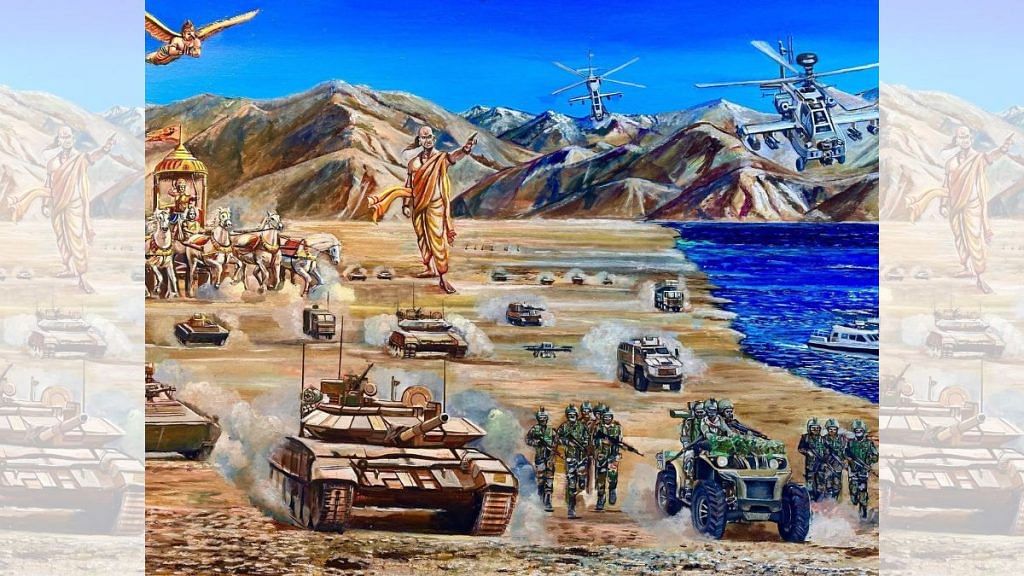
The India-Pakistan War 1971 was rapidly moving to its culminating phase by the middle of December 1971. The wires were buzzing incessantly between South Block in New Delhi, Fort William in Calcutta and the Pakistani Command Centre at Dacca in East Pakistan. I was a witness to these historic events, as a young Major covering the War from the Military Operations Directorate and manning the East Pakistan desk, although the major policy issues were being debated by the Generals – by the COAS and DGMO in New Delhi; by the Eastern Army Commander and his Chief of Staff at Calcutta and similar Pakistani Commanders at Dacca. Besides being on the periphery of these momentous events, my battalion (1 MARATHA LI), operating rapidly on the Northern Axis of Tura-Jamalpur- Tangail-Mirpur Bridge was winning laurels while knocking on the gates of Dacca, while other columns were doing so on their respective Axes. The mood was euphoric but tense. India’s Armed Forces were about to create a much-awaited massive victory. As 16 Dec 1971 dawned, the Indian Armed Forces were ready to accept the surrender of the Pakistani forces. Also Read – The Significance Of The Instrument Of Surrender At around 4:30 PM, General Jagjit Singh Aurora, GOC-in-C Eastern Command, arrived at the Dhaka airport. Gens Jacob and Niazi went there to receive him. They drove to the venue of the Surrender Ceremony at the Dacca Race Course. Once the signing was over, the two commanders rose from their chairs. Then, according to the tradition of surrender, General Niazi with a trembling hand and a melancholic face handed over his revolver to General Aurora. Also Read – 2024 Toxicity Casts Shadows Over The New Year The historic event was recorded for posterity and that photograph became the symbol of this grand and historic event. Since then, this photograph has been displayed at every conceivable place and copies have been published in thousands of documents, including books about the wars and campaigns. However, its most important place has been the Army Chiefs office complex, where our successive Chiefs have used it as a background for meeting foreign and local guests. The surrender ceremony at Dacca – 16 December 1971 (in black and white) The original photograph in colour In the annals of India’s long history of thousands of years, certain wars and battles stand out and are embedded in the psyche of most Indians. Some of them have at various times created controversies, big and small, as some person or a group of persons have not given great thought to what was being contemplated or thought it a trivial matter, not worth wasting time on it. Reasons could be many, from not seeing beyond their noses; deeply immersed in their own self-created aura of personal aggrandizement; or having no sense of history! The discerning persons of today, especially those who have worn or are currently wearing the uniform of soldiers, sailors and airmen, are involved in a raging controversy about an act of omission or commission that has occurred in the hallowed office complex of the Chief of Army Staff (COAS), which despite being in a high security zone, is always under the scrutiny of the media and the common man. For the last few days, it has been catapulted in the public gaze over the removal or shifting or replacement of the iconic photograph/painting of just over half a century back, as displayed above, because of the very nature of the painting, as it reflects the bravery, valor, patriotic fervor and emotional attachment of a huge variety of the Indian polity, especially the veterans, serving soldiers, sailors and airmen, and their families. The removal of the iconic photograph taken at the Race Course Dacca on 16 Dec 1971, as the culmination of the 1971 India-Pakistan War, which our country’s armed forces fought in a lightning campaign, at a loss of 3843 lives of servicemen killed and 9851 wounded, has been till today the greatest feat of Arms of India’s military. It needs to be highlighted that this was the first war on widely dispersed fronts, which India had fought and prevailed on the battlefield, creating a new country- Bangladesh, in the process. In many ways, this date of 16 Dec 1971 had propelled the Indian Armed Forces to the ranks of global few militaries, who noted that the Indian Military had arrived! Thus was Vijay Diwas born and celebrated, despite many bureaucratic and political hurdles, which these two entities have always created. In the early days, the much liked and respected Sam Manekshaw, who had steered not only his beloved Indian Army but also the other services too, was denigrated on specious grounds and even denied a Field Marshal’s pension. In later years, when the parties in power changed, the highly apolitical armed forces were sought to be embroiled in “Congress versus BJP Wars”, although denied by both!! In what may be better called a blunder, the painting that was lovingly placed at the den of the seniormost Tiger of the Indian Army was removed and replaced, without any fanfare or notice. The removal was an act of misguided (stated in lieu of a harsher expletive) judgement, as it was no ordinary painting/photograph, but the recording of the extraordinary event in the annals of the glorious history of the armed forces of not just the modern forces of India, but one that was ranked amongst the very few that qualified to be in the vanguard of wars and battles fought by India in its various ‘avatars’ down the ages, irrespective of which Kingdom or which Ruler had taken on its enemy of his/her time. The rarity of this painting/photograph was that it had catapulted the Indian Armed Forces to the high table at the global level. Now, I understand another painting, but without any soul has replaced the ‘Surrender at Dacca’ and the politico-bureaucratic hoopla seeks to infuse emotions in its soulless façade. It has neither awe nor inspiration, but a hotchpotch of uncoordinated images and scenery, like in a film poster without any actors! Replaced Painting – A mix of politics, religion and military platforms Some aspects of justifying the removal and replacement are even hilarious as a few have argued that offices of Generals should remain exclusive to how they want it and not guided or commented upon by the hoi p’loy like me and others! Perhaps, but when one occupies the highest office of Indian Army, some norms do have to be adhered too, especially if they add to the high morale of the army and motivates them. It is of course too much to expect our politico-bureaucratic combine to understand these nuances! Let me end this missive by quoting an instance that is bound to delight and appeal to the uniformed community (both veterans and those currently in service). For those who may not be aware, all batches who pass out from the Indian Military Academy, Dehradun return to the Academy to celebrate the Golden Jubilee of their commissioning. It is also customary for the courses to present a memento to the Academy on this occasion. In 2021, it was the turn of the 48 Regular and 32 Technical Courses, which had been commissioned on 14 Nov 1971 (less than one month before the commencement of the war). This course had presented a brass life-size trophy of the very iconic Surrender photograph we have been discussing above. Being life-size, every visitor to the Academy would be able to see it and exult over this famous victory. Brass Replica of the Dacca Surrender Ceremony at the IMA Incidentally, two stalwarts of this Course 2/Lts MPS Chaudhary (10 BIHAR) and RM Naresh (9 JAT), displaying exceptional valour, had made the supreme sacrifice on the battlefield.
Lt General Vijay Oberoi is a former Vice Chief of Army Staff and the Former Founder Director of the Centre for Land Warfare Studies (CLAWS), and now its Director General Emeritus. Views expressed are the writer’s own.
Army has projected requirement for 70 such systems, according to a Request for Information issued by Defence Ministry on December 20
The Indian Army has sought an automated vehicle-based system that would enable its combat engineers to rapidly lay minefields during operations to delay or check enemy advances.
Referred to as the Vehicle Based Mine Scattering System (VBMSS), it will be used to deploy both anti-tank and anti-personnel mines. The Army has projected a requirement for 70 such systems, according to a Request for Information (RFI) issued by the Ministry of Defence on December 20.
“During operations, minimum mines are envisaged to be laid ab initio and majority of the mines will be laid as responsive/reactive minefields once enemy build up/thrust line is discerned,” the RFI states.
“Hence there is a need to induct VBMSS in the Indian Army which should give the capability of dispensing mines in the shortest possible time so that it is not only economical in resources but also upsets the enemy’s time schedule and forces him to redeploy,” the RFI adds.
Its timely use can surprise the enemy, unhinge him and be an effective force multiplier by dispensing mines at a faster rate with reasonable accuracy. The system will be employed by engineer units for rapidly laying minefields in a constrained time frame to cater for enemy build-up and disrupt enemy thrust lines.
Minefields are also laid as a defensive measure along vulnerable border stretches during peacetime or before the commencement of actual hostilities in anticipation of possible enemy movements. During Operation Parakram in 2001, the Army had laid thousands of mines along the India-Pakistan border.
The VBMSS will comprise of an independently powered mine dispensing sub-system mounted on a high mobility vehicle that would give it cross country capability in plains, desert and semi-desert terrain, with the ability to carry out operations in temperatures ranging from minus 20 degree Celsius to 45 degree Celsius.
The Army requires the system to capable of dispensing 600 or more anti-tank and anti-personnel mines without replenishment while moving at a speed of 10 kmph. It should be able to lay mines on each side of the vehicle at a distance of 20m to 150m and also have the provision to be rapidly reloaded.
The Defence Research and Development Organisation has also developed an indigenous mine laying system called the Self Propelled Mine Burier, which can carry around 480 mines and can bury 240 mines in an hour using a mechanism installed at the stern of the vehicle.
SEPRATION OF GURUs family at bank of River Sirsa #parivarvichora #shahidihafta
Aurungzeb and 10 hill kings did not keep their promise after even taking oath on Quran and Cows for safe exist of guru an his family from Anandpur sahib, fully knowing that guru’s Sikhs do not have enough ration after 8 months seize of Anandpur sahib fort ,, followed him to attack . By the time Guru had reached Sirsa river Bank which had high Tide and current. Guru Gobind Singh Made his forces to sit down and stated recited Asha De War Kirtan , Thereafter they proceeded and decided to cross Sirsa River in heavy rain. While crossing he got separated from his mother Mata Gujri and two younger Sahibzada’s . Today There is Gurdwara at the Bank of river named :PARIVAAR VICHORA ” the point where the family got separated and known as Parivar Vichora .
The Gurdwara is on a hill top, and commands a panoramic view of the surrounding valley. It is situated near the bank of river Sirsa in the village Majri, Rupnagar, Punjab 140114.[1] At this holy spot Gurudwara Parivar Vichhora, was built by grateful devotees of the great Guru. It marks the place where the Guru’s family was separated from the main body of the Sikhs.
1971 surrender painting celebrated a real victory. New COAS lounge art offers mythology
The surrender painting was tangible and factual — a depiction of the armed forces’ finest hour. The replacement painting is steeped in religiosity, mythology, and a feudal past.
n 16 December, the nation celebrated Vijay Diwas, or Victory Day, to commemorate India’s first comprehensive military victory in a millennium. On this day, 53 years ago, Lt Gen AAK Niazi, commander of the armed forces in erstwhile East Pakistan, signed the instrument of surrender in a public ceremony at Dacca’s Race Course Maidan. A new nation — Bangladesh — was created and 93,000 Pakistani soldiers, paramilitary and police personnel, and government officials became prisoners of war.
This glorious occasion was captured in an iconic photograph of Lt Gen JS Arora, then General Officer Commanding-in-Chief (GOC-in-C) of Eastern Command, making Lt Gen Niazi sign the instrument of surrender, with senior tri-services commanders standing in the background. Copies of this photograph, or paintings based on it, symbolise our armed forces’ greatest feat of arms, recognised the world over as a classic strategic victory. And they find pride of place in all military institutions, museums, and messes. The Bangladesh military too displays this iconic photograph. A statue based on it at the 1971 Shaheed Memorial Complex, Mujibnagar, was sadly vandalised in August post the exit of Sheikh Hasina.
And now, a painting based on the surrender photograph has suffered an unfortunate fate in India too.
This painting was showcased in the lounge of the Chief of Army Staff (COAS), opposite his office, and was traditionally used as a backdrop for photographs of ceremonial meetings with visiting dignitaries and other formal events. A copy of the original photograph was also displayed in the COAS’s office, behind his desk.
On 11 December, social media was agog with the news that the iconic painting had been replaced with a new one titled Karm Kshetra (Field of Deeds), depicting what appears to be Arjuna with Lord Krishna as his sarthi on a chariot, Chanakya, Garuda, and a host of real and imagined military equipment on the western bank of Pangong Lake.
The painting titled Karm Kshetra (Field of Deeds) now hanging in the Army Chief’s office | X/@bsdhanoa
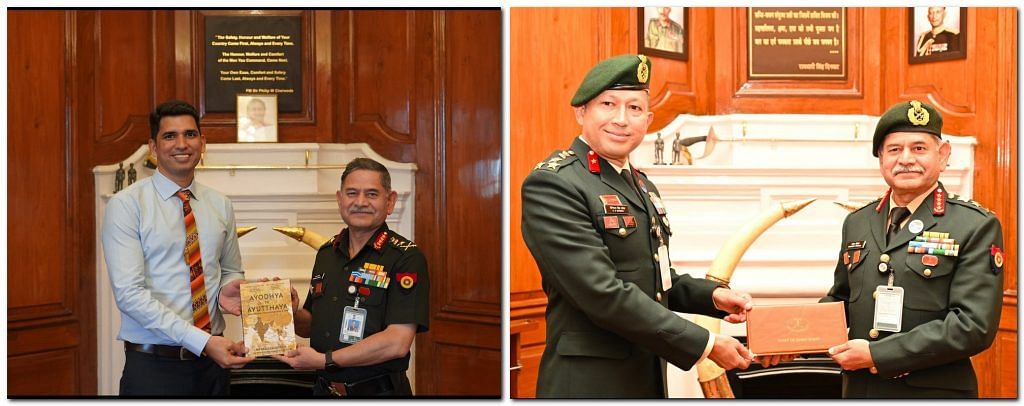
It wasn’t just this. It also emerged that the Chetwode Credo—representative of the ethos of leadership in the Army since 1932— had been removed. The credo, written on a wooden plaque on the wall opposite the 1971 surrender painting in the lounge, was also used as a backdrop for ceremonial photographs. It has now been replaced with a quote from the famous poet Ramdhari Singh Dinkar’s poem, Shakti aur Kshama.
There was scathing criticism of the replacement of the iconic painting and the leadership credo on social media by the public and veterans, as well as articles in the media. The Army has not given any statement or explanation for the change. While “official sources”, off record, have given reasons for the replacement of the painting—such as arguing that the replacement better represents the Army as a “guardian of Dharma”— they have remained silent on the credo.
Possibly as a fallout of the outrage, on 16 December, the iconic painting was relocated “to its most befitting place””—the Manekshaw Centre. As if a new painting could not have been commissioned.
Until the British created a united India, the subcontinent was a feudal society locked in constant conflict. The root cause of both Islamic rule and subsequent British colonisation was this feudalistic culture. While the principal feudal power battled the invader, many of its smaller rivals allied with the enemy. Thus, the military history of a united, independent India — though truncated by Partition — began on 15 August 1947.
Be that as it may, despite all odds, the armed forces performed creditably in the 1947-48 Jammu and Kashmir War and saved the most developed part of the state. However, due to a weak economy and lack of political will, the armed forces did not keep pace with the times in terms of modernisation, and neither was the northern border infrastructure developed to secure territorial integrity against the emerging Chinese threat. This led to the absolute defeat and humiliation in the 1962 India-China war. Odds notwithstanding, the defeat was primarily due to the psychological collapse of the military leadership, which had a cascading effect on the rank and file and, ultimately, the will to fight. It is in the light of this backdrop that we must see the victory in the 1971 war.
The defeated and demoralised Army reformed with manic zeal in thought, leadership, training, and equipment. This still-reforming military machine was tested in the 1965 war with partial success and lessons imbibed. In 1971, the political aim was clearly spelled out—liberate East Pakistan to create Bangladesh. This time, there was excellent politico-military dialogue, and military advice was paid heed to.
The significance of the iconic photograph of the surrender lies in this transformation — from abject defeat to resounding victory. Indian Armed Forces conducted one of the most brilliant and spectacular military campaigns in history to achieve the political aim. The psychological collapse of the Pakistan Army was so complete that, at the time of surrender, it had 30,000 troops defending Dacca (now Dhaka), while only 3,000 Indian troops were on the outskirts, and a handful were inside, including the top brass, flown in by air. Not to forget, the 7th US Naval Fleet was threateningly hovering in the Bay of Bengal.
It is probably the only surrender ceremony in modern history held in full public view— in the full glare of the international media—as opposed to the traditional military-to-military format.
No exaggeration, no fictionalised account, no myths — this photograph says it all through tangible facts. Have our armed forces achieved anything even remotely near this scale to merit its removal ordisplacement from its pride of place? The answer is a flat no.
Now, the Chetwode Credo.
The Chetwode Credo is seen in the photo on the left, while the quote from Ramdhari Singh Dinkar’s poem Shakti aur Kshama appears in the picture on the right | photos: X
“The safety, honour and welfare of your country come first, always and every time. The honour, welfare and comfort of the men you command come next. Your own ease, comfort and safety come last, always and every time,” says the credo, taken from a speech by Field Marshal Philip Chetwode, Commander-in-Chief of the Indian Army, to the first batch of cadets at the Indian Military Academy (IMA) during its inauguration on 10 December 1932.
It is the most complete and all-encompassing credo for the guidance of military leaders and, in particular, the officer corps, placing duty to the nation and the troops under command above all else. Most other armies have a simple ‘to-do’ list. Far from being a colonial relic, the Field Marshal foresaw India’s independence and emphasised that these three principles were for the future officers of a “National Army,” one that must remain apolitical.
Why displays in COAS lounge matter
What the Chief of Army Staff displays in his office or lounge reflects the prowess and ethos of the Army, as well as his own personality, to the visitors — foreign and Indian — he formally meets. The video and photo shoots used for publicity convey the same image to the public. In all armies, the office of the Chief, literally and metaphorically, is an institution. What is displayed within it is his personal decision. According to the grapevine, his reason for displacing the iconic painting was “to show the transition and heritage of the Indian Army beyond just 1971.”
Unofficially, much more has been conveyed. The new Karm Kshetra painting has been said to represent the Indian Army’s timeless commitment to righteousness, as drawn from the teachings of the Mahabharata. It portrays the Army as the guardian of Dharma — fighting not merely as the defender of the nation but as a force upholding justice and protecting the nation’s values.
It is pertinent to mention that this was precisely what the Bangladesh war was about — defeating a genocidal military regime and protecting both the majority and minority populations.
This inspiration, official sources have said, is complemented by the strategic and philosophical wisdom of Chanakya, whose principles guide the Army’s approach to leadership, diplomacy, and warfare. The painting is also intended to capture the Army’s evolution into a technologically advanced, modern, integrated force.
Nothing has been said about the replacement of the Chetwode Credo. However, the quote from Dinkar’s poem Shakti aur Kshama that now occupies its place implies that qualities like tolerance, forgiveness, and compassion are admired only when backed by power and capability. By analogy, it implies that the Indian Army has to be capable if India is to compete and negotiate with adversaries from a position of strength. This is nothing but stating the obvious.
Ladakhi shepherd who alerted Army about Pakistani intrusion into Kargil passes away
Tashi Namgyal, the Ladakhi shepherd who first warned the Indian Army about an intrusion by the Pakistan Army into Kargil in 1999, has passed away.
The Leh-headquartered 14 Corps of the Indian Army on Friday posted on ‘X’ about the sudden demise of Namgyal and added that “his invaluable contribution to the nation during Op Vijay 1999 shall remain etched in golden letters. We offer deep condolences to the bereaved family in this hour of grief”.
‘Operation Vijay’ is the military name for the conflict with Pakistan in May-July 1999.
Local shepherd Namygal was looking for his missing yak when he saw Pakistan Army regulars in Pathan outfits, digging bunkers atop the Batalik mountain range. He informed the Indian Army about the Pakistani infiltration in the Kargil sector that led to the response from India.
Naval craft driver lost control during engine trials causing collision with ferry: Police
The police, probing the accident, recorded the statement of the injured navy staffer, who was on the speeding craft, which collided with the ferry ‘Neel Kamal’ on way to the Elephanta Island
The driver of the naval craft, which rammed into a ferry off the Mumbai coast, lost control over the vessel during its engine trials, leading to the fatal crash mid-sea, an injured Navy staffer has told the police, an official said on Friday.
The police, probing the accident, recorded the statement of the injured navy staffer, who was on the speeding craft, which collided with the ferry ‘Neel Kamal’ on way to the Elephanta Island, a popular tourist destination, from the Gateway of India on late Wednesday afternoon.
Fourteen people, including four on the naval speedboat, were killed in the collision which caused the ferry carrying more than 100 passengers to sink in the Arabian Sea.
A team from the Colaba police station, which is investigating the case, recorded the statement of the injured navy staffer, Karmaveer Yadav, who is undergoing treatment at a hospital, said the official.
According to Yadav, the naval craft was undergoing engine trials in the sea when the driver lost control, leading the vessel to collide with the ferry packed with passengers, he said.
The police team also inspected the craft, said the official.
The navy has instituted a separate ‘Board of Inquiry’ to probe the collision.
State Stalwarts
DEFENCES FORCES RANKS
ARMY, NAVY, AIRFORCE RANKS
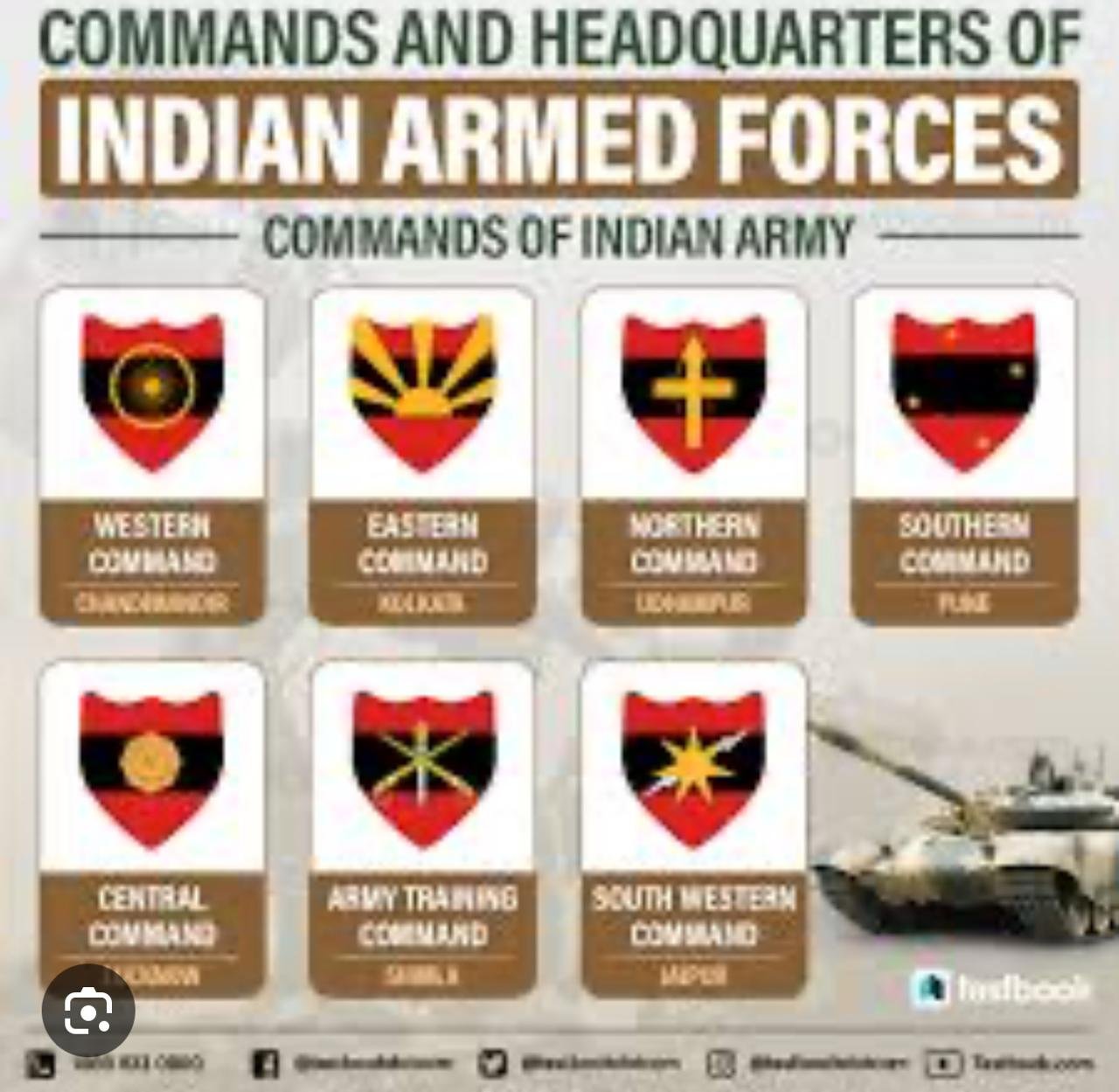
FORMATION SIGNS
FORMATION SIGNS
ALL HUMANS ARE ONE CREATED BY GOD
HINDUS,MUSLIMS,SIKHS.ISAI SAB HAI BHAI BHAI
CHIEF PATRON ALL INDIA SANJHA MORCHA
LT GEN JASBIR SINGH DHALIWAL, DOGRA
SENIOR PATRON ALL INDIA SANJHA MORCHA
MAJOR GEN HARVIJAY SINGH, SENA MEDAL ,corps of signals
.
.
PATRON ALL INDIA SANJHA MORCHA
MAJ GEN RAMINDER GORAYA , CORPS OF
sanjhamorcha303@gmail.com
PRESIDENT HARAYANA STATE CUM COORDINATOR ESM
BRIG DALJIT THUKRAL ,BENGAL SAPPERS
PRESIDENT TRICITY
COL B S BRAR (BHUPI BRAR)
PRESIDENT CHANDIGARH ZONE
COL SHANJIT SINGH BHULLAR
.
.
PRESIDENT PANCHKULA ZONE AND ZIRAKPUR
COL SWARAN SINGH
PRESIDENT SAS NAGAR (MOHALI)
COL BALBIR SINGH , ARTY
INDIAN DEFENCE FORCES
DEFENCE FORCES INTEGRATED LOGO
FORCES FLAGS
15 Th PRESIDENT OF INDIA SUPREME COMMANDER ARMED FORCES
Droupadi Murmu
DEFENCE MINISTER
Minister Rajnath Singh
CHIEF OF DEFENCE STAFF (2nd)
General Anil Chauhan PVSM UYSM AVSM SM VSM
INDIAN FORCES CHIEFS
CHIEF OF ARMY STAFF(29th)
General Upendra Dwivedi, PVSM, AVSM (30 Jun 2024 to Till Date)