THE reimposition of the Armed Forces (Special Powers) Act (AFSPA) in Manipur marks a sombre turn in the state’s struggle for stability and peace. After years of gradual reduction in AFSPA-designated areas, recent escalations have led the Ministry of Home Affairs (MHA) to reinstate the Disturbed Areas status in the jurisdiction of six police stations across the state. This decision reflects the grim reality that, despite past gains, Manipur’s path to peace remains perilously uncertain. AFSPA is controversial due to its broad powers, which allow the armed forces to act with significant immunity. This, in turn, has created an environment of mistrust between civilians and the military. In Manipur, its presence has often been linked with allegations of human rights violations, further complicating the peace process in a region where historical grievances already run deep.
While the MHA has cited ‘volatile’ conditions and “active participation of insurgent groups in heinous acts of violence”, the decision to reintroduce AFSPA as the most effective approach to quell these issues is questionable. The state’s challenges extend beyond insurgency and violence. Ethnic divides, regional grievances and economic stagnation have contributed to the unrest.
Manipur’s people, including the Kukis and Meiteis who are mainly embroiled in the conflict, deserve a future free from violence and repression. To achieve this, the Central government must prioritise non-military solutions, promoting dialogue, economic investment and social programmes that address the underlying issues fuelling the unrest. Enduring peace in Manipur will not come from the barrel of a gun but from comprehensive efforts to bridge divides and build trust. Reimposing AFSPA may restore order, but it is a step backward in the quest for sustainable peace.
India To Refit Maldivian Coast Guard Ship In Strategic Partnership Move
Maldives’ CGS Huravee, gifted by India, goes to Mumbai for refit: The CGS Huravee, an offshore patrol vessel recently commissioned by the Maldives National Defence Force (MNDF), is set to undergo a significant refit in Mumbai. This refurbishment will cost approximately $4 million, which will be funded by the Indian government.
The vessel was officially commissioned on November 12, 2024, during a ceremony attended by high-ranking officials, including the Indian Defence Minister Rajnath Singh and Maldivian Defence Minister Mariya Ahmed Didi. This ship replaces an older vessel of the same name and is part of India’s ongoing support to enhance the maritime capabilities of the Maldives.
The refit is seen as a move to strengthen the strategic partnership between India and the Maldives, which has been growing in recent years through various defense cooperation initiatives. This includes previous gifts of naval vessels and plans for joint training and operational support.
Following its commissioning, the vessel’s crew will consist entirely of Maldivian personnel, with Indian trainers having previously provided necessary operational training. The refit in Mumbai is expected to further enhance its capabilities for maritime security operations in the region.
Two Security Personnel Killed In Recent Terror Attacks In Balochistan
Two security personnel, including an officer, were killed in a recent terror attack in Balochistan, Pakistan publication the Dawn reported on Friday, citing officials.
Quetta Railway Station Bombing: On November 9, a suicide bombing at a railway station in Quetta killed at least 27 people, including security personnel. The Baloch Liberation Army (BLA), a group fighting for freedom from Pakistan occupation, claimed responsibility for the attack, which targeted military personnel present at the station. This incident is part of a worrying trend, as violence in Balochistan has escalated sharply since early 2024, with numerous assaults on security forces reported.
In addition to the Quetta bombing, Balochistan has seen multiple attacks targeting security forces and civilians. For instance, earlier this year, a series of coordinated assaults led to the deaths of 14 security personnel among 73 total fatalities in August. The BLA has been particularly active, claiming responsibility for various attacks aimed at both military and civilian targets throughout the province.
The ISPR statement stated that the Pakistani security forces, alongside the nation, remain committed to preventing attempts to destabilise Balochistan and that the deaths of those soldiers only reinforce their determination in their attempt, the Dawn reported.
In response to these threats, Pakistani security forces have intensified operations against militant groups. On November 12-13, operations in Balochistan resulted in the deaths of four terrorists, including a high-ranking commander associated with the BLA. These operations are part of ongoing efforts to combat the rising tide of terrorism in the region.
The situation remains volatile as Balochistan continues to be a focal point for separatist violence and military responses.
India’s Highest Airfield at Mudh-Nyoma Nears Completion Under Indian Army’s Project Himank
India’s highest airfield, the Mudh-Nyoma airfield, is nearing completion as part of Project Himank, a significant initiative aimed at enhancing military infrastructure in the region. Located at an altitude of 13,700 feet in eastern Ladakh, this airfield is strategically positioned just 35 kilometers from the Line of Actual Control (LAC) with China. It is designed to support a variety of military aircraft, including fighter jets and transport planes, thus bolstering India’s defence capabilities in a region marked by historical tensions and challenging terrain.
At an altitude of 13,700 feet, the Mudh-Nyoma airfield has been developed to handle heavy military aircraft, including fighter jets, transport planes, and rotary-wing helicopters, making it one of the most formidable aviation hubs in high-altitude warfare. The runway length is approximately 3 kilometers long. The completion status is 95% completed; expected to be operational by the end of 2024.
The airfield’s construction has faced unique challenges due to extreme weather conditions, with winter temperatures dropping as low as -35 degrees Celsius. This has limited the working season primarily to the months between May and November. Despite these difficulties, the project has progressed rapidly, utilizing advanced construction techniques and materials suited for high-altitude environments.
The Mudh-Nyoma airfield is not only vital for enhancing military readiness but also has significant socio-economic implications for nearby communities such as Hanley, Loma, and Nyoma. The establishment of this airfield will improve logistical capabilities and enable quicker response times along the LAC, thereby strengthening national security. Brigadier Vishal Srivastava emphasized that the airfield will facilitate rapid troop movements and enhance reconnaissance operations in this strategically sensitive area.
The project was initiated in 2021, with an estimated budget of around Rs 218 crores. The construction is overseen by KCC Build Con Pvt Limited and involves around 450 laborers during peak seasons. The airfield will serve as a critical asset for both military operations and civilian connectivity, potentially supporting local flights that can enhance access to essential services for remote communities.
The completion of the Mudh-Nyoma airfield aligns with recent military disengagement agreements between India and China in areas such as Demchok and Depsang Plains. These developments underscore India’s commitment to strengthening its border infrastructure amid ongoing strategic challenges. Once operational, the airfield will integrate into a network of strategically placed facilities that enhance India’s defence posture along its northern borders.
The Mudh-Nyoma airfield represents a significant advancement in India’s military capabilities and infrastructure development in Ladakh, reinforcing its strategic presence near the LAC while also benefiting local communities economically.
Amid a thick layer of fog covering border areas in Jammu and Kashmir’s Kathua district, security forces on Thursday launched a search operation along the border with Pakistan as a preventive measure, officials said. The operation came in the wake…
Amid a thick layer of fog covering border areas in Jammu and Kashmir’s Kathua district, security forces on Thursday launched a search operation along the border with Pakistan as a preventive measure, officials said.
The operation came in the wake of threat perceptions related to possible infiltration or weapon drops via drones in the district’s border belt. The Special Operation Group of the J&K Police conducted searches in various areas along the district’s International Border (IB), officials said, emphasising that the risk of infiltration increases under the cover of dense fog.
The Border Security Force (BSF) has already put in place a multi-tier security set up along the IB as a precautionary measure to foil infiltration bids, the officials added.
In addition to the BSF’s security grid along the IB, a second tier is in place consisting of the border police, while a third tier is made up of Village Defence Groups as part of the comprehensive anti-infiltration set up, officials said.
Guru Nanak’s Parkash Purb celebrated at Dhaka gurdwara
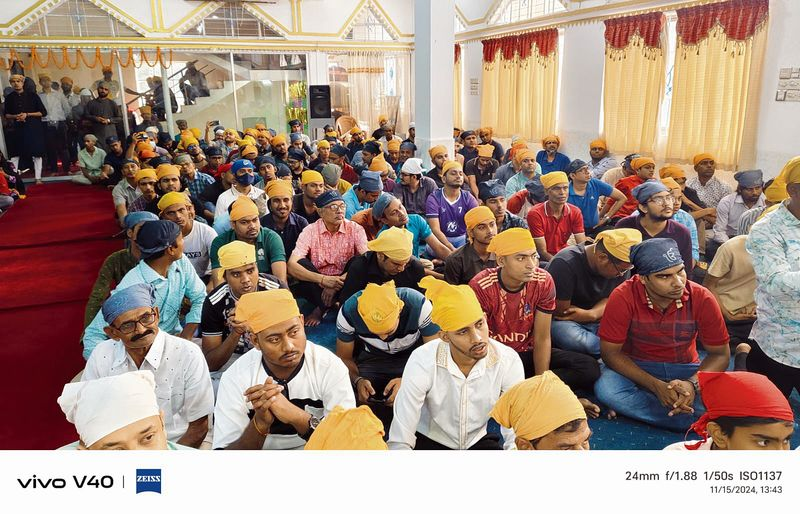
A Gurmat Samagam was held at Gurdwara Nanakshahi in Dhaka (Bangladesh) on Friday by Kar Sewa sect, Sarhali, on the 555th birth anniversary (Parkash Purb) of Guru Nanak Dev. Baba Sukha Singh, head of the sect and Baba Hakam Singh…
A Gurmat Samagam was held at Gurdwara Nanakshahi in Dhaka (Bangladesh) on Friday by Kar Sewa sect, Sarhali, on the 555th birth anniversary (Parkash Purb) of Guru Nanak Dev. Baba Sukha Singh, head of the sect and Baba Hakam Singh have been conducting the Kar Sewa of gurdwaras in Bangladesh since 2004.
Harbhajan Singh, secretary of the sect, informed in a press statement that with the support of devotees in the country and abroad, kirtan was performed by the jathas of Shibu Das, Jitu Das, Opu Das, Dr MK Roy, and Subhasis Das. Head Granthi Bhai Sukhdev Singh prayed and Bhai Kanwaljit Singh recited the Hukamnama to the congregation. Bangladesh Gurdwara Management Committee president Amar Chand thanked the participants and Kar Sewa sect, Sarhali.
The Indian Army is conducting a high-intensity tri-services military exercise, ‘Poorvi Prahar’, from November 10 to 18 in Arunachal Pradesh. This exercise aims to hone the combat effectiveness of the Army, Navy and Air Force in executing integrated joint…
Khan, who went undercover in Paris during the Second World War with Britain’s Special Operations Executive (SOE) and ultimately gave her life for the Allied Forces’ cause, was awarded the UK’s highest civilian honour posthumously for her bravery while operating undercover in German-occupied France
The George Cross medal awarded to British Indian spy and descendant of Tipu Sultan, Noor Inayat Khan, for her “most conspicuous courage” will go on display at Royal Air Force (RAF) Museum at Colindale in northwest London from next month.
Khan, who went undercover in Paris during the Second World War with Britain’s Special Operations Executive (SOE) and ultimately gave her life for the Allied Forces’ cause, was awarded the UK’s highest civilian honour posthumously for her bravery while operating undercover in German-occupied France. She endured intense interrogation before being executed by the Nazis at Dachau Concentration Camp in September 1944.
“I am delighted that Noor’s George Cross has found a home at RAF Museum, where it will be viewed by hundreds of thousands of visitors every year,” said Shrabani Basu, the London-based author of the biography ‘Spy Princess: The Life of Noor Inayat Khan’.
“Noor loved her Women’s Auxiliary Air Force (WAAF) uniform and was always proud to wear it. She was the first woman radio operator to be flown into occupied France and did one of the most dangerous jobs in the field. The George Cross recognised Noor’s bravery in her fight against the Nazis and is the highest civilian honour awarded by Britain. This is the perfect way to remember her legacy and inspire the next generation,” she said.
The medal has been loaned to RAF Museum by Noor Inayat Khan’s family and will be displayed along with the logbook of the pilot who flew the undercover wireless operator to France on her mission. As ambassador for RAF Museum, Basu will be in conversation with Noor’s cousin Shaikh Mahmood at the launch of the display on December 2.
“We are privileged and humbled to share Noor’s George Cross with our visitors. Her story of bravery and determination sings to us across the decades, and we know will inspire people of all ages and from all backgrounds,” said Maggie Appleton, CEO of RAF Museum.
“The generous loan of the medal by her family, alongside the logbook that records her flight into occupied France and our Special Duties Lysander are a powerful representation of her service and sacrifice,” she said.
Born to an Indian Sufi father and an American mother, Noor was living in Paris when Germany invaded France in 1940. She escaped to Britain where she joined the WAAF and trained as a wireless operator. Despite being a Sufi and therefore a pacifist, Noor believed that it was her duty to support the fight against Nazism.
Noor’s technical skills and fluency in French led to her recruitment by SOE and her deployment to Paris as a special agent in 1943. As per her biography, after Noor’s SOE colleagues were identified and arrested, she was given the option to return from enemy territory, but she chose to remain at her post until she was betrayed and arrested. Her dying words in the face of Nazi torture were “liberte”.
Noor Inayat Khan went on to become one of only three women to be awarded the George Cross, Britain’s highest honour bestowed on civilian or military personnel who have carried out an act of bravery while not under enemy fire.
The citation for Noor’s George Cross reads: “Assistant Section Officer Inayat Khan displayed the most conspicuous courage, both moral and physical over a period of more than 12 months.”
The new display at RAF Museum, which opens in early December, is integrated within the museum’s exhibition entitled ‘Strike Hard, Strike Sure: Bomber Command, 1939-1945’. The exhibition explores the story of the incredible bravery of those in Bomber Command during the Second World War, sharing the stories of the people, aircraft and technology that enabled Allied victory.
The new museum display follows a portrait of Noor Inayat Khan leaving on her mission to France being unveiled by Queen Camilla in August last year, which now hangs at RAF Club in London.