Sanjha Morcha

LINK AADHAAR NUMBER WITH PAN

Dear `veterns,

  1. Most of us are income tax payers. The Income Tax department has issued a public notice in major news dailies today 06 Mar 2023 stating that every income tax payer has to link his Aadhaar number with his PAN (Permanent Account Number) card. If they have not done it yet, they are required to pay late fee of ₹ 1,000 and then get these two documents linked. For this last date is 31 Mar 2023.
  2. If linking is not done, IT dept has warned that defaulters will not be able to (a) Use PAN card as it has been made ineffective (b) file income tax return (c) will not get any IT refund for excess recovery by banks or your employer (d) may have to pay higher rate of income tax.
  3. number of complaints from officers that on migration to SPARSH, their TDS deducted by SPARSH is more than what their banks used to deduct as monthly TDS.
  4. In view of the above every income tax payer has to first to check whether his Aadhaar has been linked to PAN. Please follow the the steps given below to know whether your Aadhaar is linked to your PAN.
  5. First Step. In the browser (Google Chrome) enter in the search box https://www.incometax.gov.in/iec/foportal.
  6. Second Step. The home page opens. On the left hand side you see Quick Links. Second one is Link Aadhaar Status. Click on it.
  7. Third Step. Enter your PAN no (AB xxxxK) and also your Aadhaar No in the boxes provided. Click on View Link Aadhaar Status.
  8. Fourth Step. When I clicked it, I got the message Your PAN AB xxxK * is liked to given Aadhaar No 58 xxxx. I do not have to do anything.
  9. In case you have failed to do so. Last date with late fee of ₹ 1,000 is 31 Mar 2023. Ensure you do step 1 to 4 mentioned above and satisfy that your Aadhaar no is linked or NOT. If not linked, then undertake the following steps to pay late fees of Rs 1,000 and get your Aadhaar No linked to your PAN.
  10. Fifth Step. In the Quick Links, click on Link Aadhaar.
  11. Sixth Step. Enter your Aadhaar No and PAN. Then pay late fees of Rs 1,000 is done through E Tax Functionality after following on screen instructions.
  12. Seventh Step. Once payment is complete, visit *Link Aadhaar section again and enter your name, mobile no, Aadhaar number and PAN.
  13. Eighth Step. Verify the information by selecting I agree to validate my Aadhaar Details Option and click on Link Aadhar option.
  14. Ninth Step. Enter the OTP received on your mobile number and click on Validate to complete the linking process.

INCOME TAX-OLD/NEW REGIME WITH ARREARS 1ST/FULL PAYMENT

Dear Veterans

  1. Yesterday, 06 Mar 2023, I worked out my income tax assuming I will not get arrears by 31 Mar 2023 due to Min of Def (ESW) approaching Hon’ble Supreme Court and possibly requesting disbursement of arrears by another three months as Govt of India does not have funds at the end of financial year 2023 – 24. In that case, on 13 Mar 2023, when the case is to be heard and the Hon’ble Supreme Court accedes to request of Govt of India we can forget about receipt of arrears in one instalment or in one go till next extension of time for disbursement is over.
  2. In case the Hon’ble Supreme Court does not accept the plea of Min of Def and gives a judgment which could be (a) all arrears to be paid in one go by 31 Mar 2023 or (b) to pay first instalment by 15 Mar 2023 and balance to be paid in full with 8% interest. We really do not know how the judgment is going to be. We have to wait and watch for the judgment on 13 Mar 2023.
  3. Suppose Hon’ble Supreme Court accedes to the request of Govt of India to pay in four instalments due to financial constraints, then I re-worked out my own Income Tax in the financial year 2023 – 24 when I will get first instalment in Mar 2023 which is accounted for my income in Fin yr 2022-23, second half year instalment in Sep 2023 and third instalment in Mar 2024. Fourth instalment paid in Sep 2024 is accounted for in Fin Yr 2024-25.
  4. I find New Tax Regime is more beneficial for most of us both in Fin Yr 2022-23 and 2023-24. I find we have to pay almost 30% of our arrears if we get it in one by 31 Mar 2023 as our income will go very high in fin yr 2022-23.
  5. If you find any mistakes in my calculations do kindly point them out so that I can make immediate correction. I will work out for all officers from Lt to Lt Gen the way I worked out my rank of Brigadier and my QS of 32 years. But it will take more time as I am not a software engineer and do not have any such software with me.
  6. My worksheet made in MS Excel is attached.

warm regards,
Brig CS Vidyasagar (Retd)


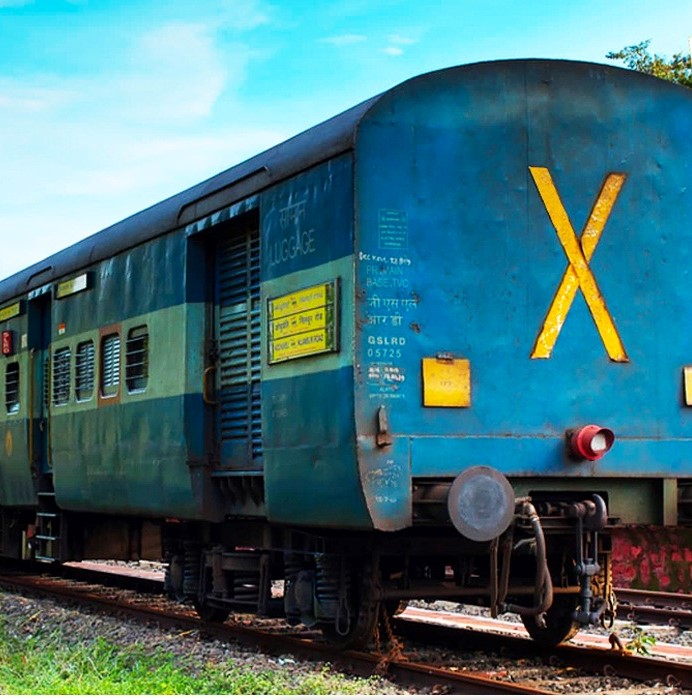
Do you know why there is a X symbol behind the last coach of a train; Find out the answer

Do you know why there is a X symbol behind the last coach of a train; Find out the answer

Tribune Web Desk

Chandigarh, March 6

We all have fond memories related to train journeys. While waiting for the train at the railway station, we observe a lot of things which remain stuck in our minds. One such memory, which often left us scratching our heads, was the X symbol behind the last coach of the train.  

We would often wonder as to what it signified, with no clear answers to our query.

Well, the Railways Ministry has finally resolved our problem and explained in a Twitter post the meaning of the same and many users were relieved to finally find an answer.

The post was shared by the Railways Ministry recently. According to it, the X symbol behind the last coach of a train signifies that the train has passed without leaving any coaches behind. The sign also acts as a confirmation for railway officials that the train has passed entirely.


Tug of war in Pak

Hardening of positions ahead of elections

Tug of war in Pak

THE escalation of the political tug of war in Pakistan while the country experiences perhaps its worst-ever economic crisis indicates a hardening of positions ahead of provincial and general elections. Inflation is at a 58-year high as the country, on the brink of bankruptcy, struggles for an International Monetary Fund bailout. Imran Khan is being accused by the Shehbaz Sharif regime of dodging arrest following issuance of a non-bailable warrant for buying at a discount the gifts given when he was the Prime Minister. The 70-year-old has termed it a sham, on the lines of the cases of sedition, corruption and terrorism slapped on him following his ouster in April last year. Since then, his party, the Pakistan Tehreek-e-Insaf, has been holding protests to push for early polls, due no later than in October. He has pulled out of parliament and dissolved the two assemblies his party controls. Fresh elections are due in Punjab and Khyber-Pakhtunkhwa.

Imran attributed his removal to a US-led conspiracy that involved the powerful military establishment and political rivals. The economic meltdown was termed the work of a cabal of crooks in power. The attempts to make him ineligible to contest have been labelled as a sign of desperation in view of his popularity. Support for the former cricket legend has grown since an attempt on his life was made in November. He’s raised the pitch since. TV channels have been banned from broadcasting his speeches. What the Generals in Rawalpindi make of the possibility of Imran returning to power is the crucial question.

The unfolding political drama has shades of a personal nature too. After evading arrest, Imran said he faced a threat to his life and stated that what was said about former PM Nawaz Sharif applied to him as well. As the premier, Imran was told that he would be held responsible if anything happened to Sharif, who was arrested on corruption charges. Both Sharif and his daughter were quick to mock Imran, saying while genuine leaders bravely faced arrest even in fake cases, cowards ran away. Pakistan’s experiments with democracy never fail to surprise.


MoD pact with HAL, L&T for trainer jets, ships

MoD pact with HAL, L&T for trainer jets, ships

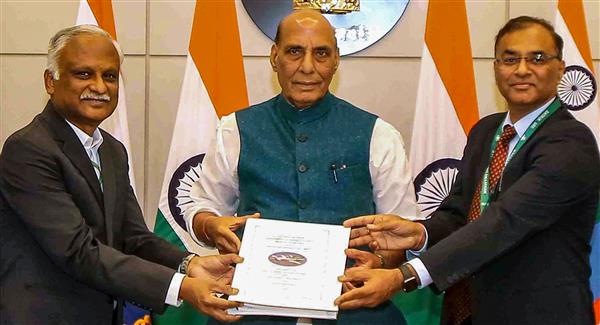
Defence Minister Rajnath Singh during the signing of a contract between the Ministry of Defence and HAL in Delhi on Tuesday. PTI
Tribune News Service

New Delhi, March 7

The Ministry of Defence (MoD) today signed contracts with Hindustan Aeronautics Ltd (HAL) and Larsen & Toubro Ltd (L&T) for the procurement of 70 HTT-40 basic trainer aircraft and three cadet training ships, respectively.

The contracts were signed in the presence of Defence Minister Rajnath Singh and Defence Secretary Giridhar Aramane along with other senior civil and military officials of the MoD and representatives of HAL and L&T.

The Cabinet had, on March 1, approved the procurement of 70 HTT-40 trainer aircraft from HAL at a cost of over Rs 6,800 crore. The Cabinet had also cleared the signing of a contract with L&T for the acquisition of three cadet training ships worth more than Rs 3,100 crore.

The HTT-40 is a turbo prop aircraft possessing good low speed handling qualities and provides better training effectiveness. This fully aerobatic tandem seat turbo trainer has an air-conditioned cockpit, modern avionics, hot refuelling, running change over and zero-zero ejection seats.


The aircraft will meet the shortage of basic trainer aircraft of the IAF for training of newly inducted pilots. The HTT-40 contains 56 per cent indigenous components which will increase to over 60 per cent through indigenisation of major components and subsystems.


ISRO successfully carries out controlled re-entry experiment of aged satellite

ISRO successfully carries out controlled re-entry experiment of aged satellite

PTI

Bengaluru, March 7

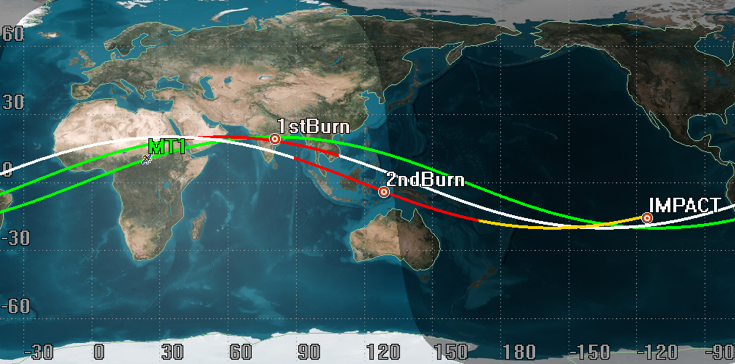
The Indian Space Research Organisation said it successfully carried out an “extremely challenging” controlled re-entry experiment of the decommissioned orbiting Megha-Tropiques-1 (MT-1) satellite on Tuesday.

“The satellite re-entered the Earth’s atmosphere and would have disintegrated over the Pacific Ocean,” the Bengaluru-headquartered national space agency said on Twitter.

The low Earth satellite was launched on October 12, 2011, as a joint satellite venture of ISRO and the French space agency, CNES for tropical weather and climate studies.

An uninhabited area in the Pacific Ocean between 5°S to 14°S latitude and 119°W to 100°W longitude was identified as the targeted re-entry zone for MT1, weighing about 1000 kg, ISRO said earlier this week.

About 125 kg on-board fuel remained unutilised at its end-of-mission that could pose risks for accidental break-up, an ISRO statement had noted.

This left-over fuel was estimated to be sufficient to achieve a fully controlled atmospheric re-entry to impact the uninhabited location in the Pacific Ocean, ISRO had said.

Controlled re-entries involve deorbiting to very low altitudes to ensure impact occurs within a targeted safe zone.

Usually, large satellites/rocket bodies, which are likely to survive aero-thermal fragmentation upon re-entry, are made to undergo controlled re-entry to limit ground casualty risk.

However, all such satellites are specifically designed to undergo controlled re-entry at end-of-life (EOL).

“MT1 was not designed for EOL operations through controlled re-entry which made the entire exercise extremely challenging”, ISRO said.

Furthermore, the on-board constraints of the aged satellite, where several systems had lost redundancy and showed degraded performance, and maintaining subsystems under harsher environmental conditions at much lower than originally designed orbital altitude added to the operational complexities.

Innovative workarounds were implemented by the operations team based on the study, deliberations, and exchanges among the mission, operations, flight dynamics, aerodynamics, propulsion, controls, navigation, thermal, and other sub-system design teams across the ISRO centres, who worked in synergy to surmount these challenges.

Since August 2022, 18 orbit manoeuvres have been performed to progressively lower the orbit. In between the de-orbiting, aero-braking studies at different solar panel orientations were also carried out to gain better insights into the physical process of atmospheric drag affecting the orbital decay of the satellite.

The final de-boost strategy had been designed after taking into consideration several constraints, including visibility of the re-entry trace over ground stations, ground impact within the targeted zone, and allowable operating conditions of subsystems, especially the maximum deliverable thrust and the maximum firing duration of the thrusters.

The final two de-boost burns followed by the ground impact are expected to take place between 16:30 IST to 19:30 IST on March seven, ISRO had said.

Aero-thermal simulations show that no large fragments of the satellites are likely to survive the aerothermal heating during the re-entry, it had said.

Although the mission life of the satellite originally was three years, it continued to provide valuable data services for more than a decade supporting regional and global climate models till 2021, ISRO said.

UN/IADC (Inter-Agency Space Debris Coordination Committee) space debris mitigation guidelines recommend deorbiting a LEO (Low Earth Orbit) object at its EOL, preferably through controlled re-entry to a safe impact zone, or by bringing it to an orbit where the orbital lifetime is less than 25 years, according to ISRO.

It is also recommended to carry out “passivation” of on-board energy sources to minimise the risk of any post-mission accidental break-up.

The orbital lifetime of MT1 would have been more than 100 years in its 20 deg inclined operational orbit of 867 km altitude, according to ISRO.

“As a responsible space agency committed to safe and sustainable operations in outer space, ISRO proactively takes efforts for better compliance with the UN/ IADC space debris mitigation guidelines on post-mission disposal of LEO objects,” an ISRO statement said.

The re-entry experiment of MT1 has been undertaken as a part of the ongoing efforts as this satellite with sufficient left-over fuel presented a unique opportunity to test the relevant methodologies and understand the associated operational nuances of post mission disposal by direct re-entry into the Earth’s atmosphere, it was stated.


Sikh teen in UK was stabbed 15 times in case of mistaken identity, 2 convicted

Sikh teen in UK was stabbed 15 times in case of mistaken identity, 2 convicted

London, March 7

Two teenagers have been found guilty of murdering a 16-year-old Sikh boy who they mistakenly thought belonged to a rival gang in West London.

Vanushan Balakrishnan and Ilyas Suleiman, both 18 year-olds from Hillingdon, were found guilty of murdering Rishmeet Singh, following a trial at the Old Bailey on Monday.

Rishmeet, who came to the UK in October 2019 with his mother and grandmother to seek asylum from Afghanistan, was mistakenly targeted and murdered after being stabbed 15 times while lying defenseless on the ground.

“I have lost my husband and now I have lost my only child, my son. Justice is finally served for Rishmeet but their sentence will never be enough for me. They have taken my whole life away from me and Rishmeet will never come home again,” the victim’s mother Gulinder said in a statement.

The court heard that on the night of November 24, 2021, Rishmeet was walking home when he saw two unknown males running towards him.

He ran down Raleigh Road, in Southall, where he tripped and fell, according to a Metropolitan Police release.

One of his pursuers then stabbed him at least five times in the back, and the second one stabbed him at least 10 times.

His attackers then fled, leaving his bloodied and injured body on the ground, the Met Police said, adding that the whole attack lasted 27 seconds.

Officers and the London Ambulance Service scrambled to the scene after receiving a 999 call from a member of the public, but despite their best efforts Rishmeet died at the scene.

Enquiries revealed that Balakrishnan and Suleiman dumped their bikes near the bridge and chased after Rishmeet on foot, with Balakrishnan attacking him first followed by Suleiman.

They are captured on CCTV fleeing the scene, and are clearly identifiable from the distinctive clothing and Covid masks they were wearing – including Balakrishnan’s dark trousers with a white stripe behind the knee.

While Balakrishnan was arrested on suspicion of murder at his home address on December 2, 2021, Suleiman was held from an address in Edgware on December 9.

The pair will be sentenced at the Old Bailey on April 28, 2023.


OROP PENSION FIXATION

Dear Col Khera Sir,
Very interesting case came to my notice. The OROP pension fixation is simply the Average pension of your counterpart retiring in calendar year 2018. The average pension is (maximum pension + minimum pension)/2. But at times this average pension could be lower than what is given in the pension tables. A bit of analysis gives a clue as to why one gets pension higher than Average pension. The same is sent herewith.
The title of this short article is How some get higher pension in OROP – II than Average pension of their counter parts with same rank and same length of service or same Gp X or Y for JCOs/OR.
If you consider it is worth while in putting up in Sanja Morcha, kindly do so and send the extract at your convenience.
Dear Sir,
Lt Col RK Bhardwaj (Retd) got a reply to his query under RTI Act 2005 from PCDA (Pensions) Prayagraj vide their letter dated 14 Feb 2023 on the number of Lt Cols retired in calendar year and specifically how many retired with qualifying service (QS) of 29.50 years. The reply from PCDA (Pensions) Prayagraj is attached.
Though the average pension of three Lt Cols with QS of 29.50 comes to ₹ 83,425 (=(96700+70150)/2), yet their pension is fixed at ₹ 95,400. The moot question can one get higher pension than Average pension of your counterparts retired in calendar year 2018?
You can draw the following conclusions as some of us are not very clear as to how pension in OROP is worked out.

  1. The pension of pre – Jul 2019 pensioners is dependent upon the average pension of those retired in calendar year 2018 of same rank and length of service. Here you see though the Maximum pension is Rs 96,700, the average pension has been pulled down by minimum pension of another Lt Col with 29.50 years of QS of ₹ 70.150. Thus the Average pension of Lt Cols with 29.50 years of service comes down to ₹ 83,425.
  2. Why did Lt Cols in 2018 with QS of 26 years or more not got promoted to Col (TS)?. The answer is they might not have been fulfilled certain conditions for grant of Col (TS) such as medical Category or disciplinary cases or not having commissioned service etc. But I am not aware of the conditions to get rank of Col (TS). I can only say that Lt Cols with 26 years of commissioned service are not automatically promoted to the rank of Col (TS). Moreover there are SL officers or SCOs or others with Pre commission service which is counted towards pensionable service but their commissioned service may not be 26 years. (Some with pre commission service as JCOs / OR or in Central Govt or State Govt service is also counted for pensionable service). So you might find all these Lt Cols with QS of 29.50 service could be Officers with Pre commission service like SL Officers or SCOs etc or those who had Central or State Govt service before joining Armed Forces.
  3. Third question is how is that the average pension of Lt Cols with 29.50 years’ QS are getting ₹ 95,400 when the average pension is only ₹ 83,425. The answer is if you see the OROP – II tables luckily there was a Lt Col with QS of 26 years whose pension is ₹ 95,400 pm. If there is only one Lt Col of 26 years’ QS then his own pension is considered as Average pension. That is why all Lt Cols with QS of 26 to 33 yrs get pension of ₹ 95,400 thanks to that Lt Col with 26 yrs QS.
    Summary
    Your pension in OROP – III from Jul 2024 is dependent upon the pension of your counterpart with the same rank and same QS retiring in calendar year 2023. If there is only one retires with pension higher than your current pension of OROP – II, then only you get higher pension in OROP – III. In case your current pension is higher than your counterpart retires in 2023 then sorry, your pension in OROP – III will not get enhanced. So pray for someone who is your counterpart retires in 2023 with pension higher than yours in OROP – II.
    warm regards,
    Brig CS Vidyasagar (Retd)

ONE YEAR OF UKRAINE WAR

Entering uncharted waters

Entering uncharted waters

MK Bhadrakumar

Former Ambassador

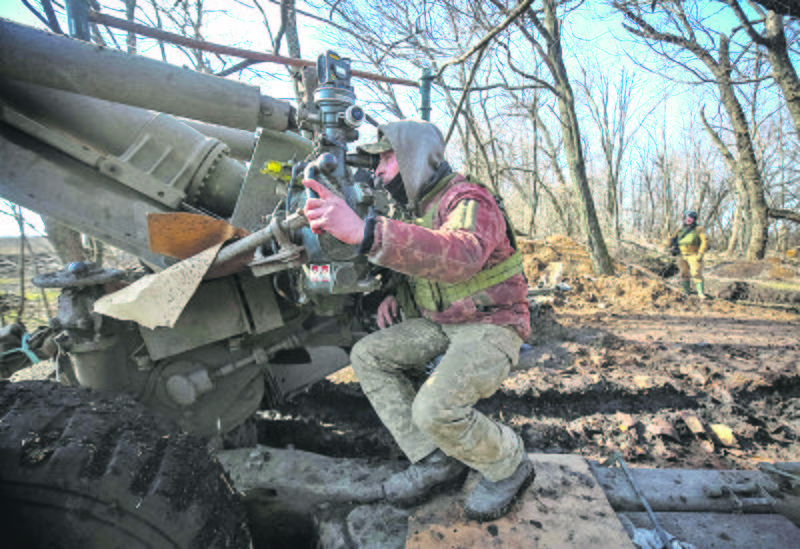
MILITARY minds expected a massive Russian offensive in Ukraine after the mobilisation, sometime between January and February when in the freezing, windswept steppes of the Donbass, temperatures dropped to minus 30°C, the ground hardened, and it was possible to move heavy artillery. However, that didn’t materialise.

NATO is close to crossing a Russian ‘red line’, pushing the war towards a confrontation with incalculable risks.

Instead, a great deal of intense combat did occur in the Donbass front and the Russian forces scored a string of successes in what appeared to be positional battles, but which helped seize the military initiative right across the front, forcing Ukraine’s reservists into a perilous state now.

The Russian tactic has been to keep the burn rate on the front high and degrade Ukraine’s ability to form reserves, while well-fortified defence lines stretching over 800 km denied Kyiv any chance at regaining operational initiative. Unsurprisingly, Russians are in no mood to rush into ambitious operations. Besides, they are also in the long game sorting out organisational issues. A restructuring in the Russian armed forces is underway, which involves transitioning from the so-called Battalion Tactical Group formations of an expeditionary army that is heavy on firepower but exceptionally light on infantry to reverting to the Soviet army’s division structure, which, along with a massive expansion in armaments production and retooling of the military-industrial complex, would meet the requirements of a continental war, should the need arise.

Meanwhile, the operations in Donbass have reached a tipping point. With the impending fall of Bakhmut, the linchpin of the Ukrainian defence line in Donbass, the path for the Russian assault on Slavyansk and Kramatorsk, the last two cities under Kyiv’s control, is opening. Some intense fighting can also be expected in the coming weeks in the Ugledar sector in south-western Donbass, which overlooks the trunk rail line connecting Donetsk with Mariupol port on Azov Sea and the land bridge to Crimea and potentially threatens the entire Russian logistics in the south.

Therefore, control of the Ugledar ‘bulge’ is a priority for both Ukraine and Russia. Again, Kremlin spokesman Dmitry Peskov recently flagged that it is a constitutional obligation to fully liberate Zaporizhzhia oblast (two-thirds of which are under Russian control) and Kherson (which changed hands in the Ukrainian counteroffensive in November.)

Of course, if the US dramatically escalates the scope of the proxy war by supplying Ukraine with long-range weapons, the Russian operations will also, inevitably, escalate to the entire region east of Dnieper River and create a buffer zone for the security of the Russian territories. Basically, Russia keeps the escalation dominance.

To be sure, the trajectory of the Russian operations in the period ahead will also depend on emergent political factors. The spring offensive is unlikely to begin before the visit of Chinese President Xi Jinping to Moscow this month. Closer cooperation and coordination between China and Russia in these times of war under conditions of western sanctions is gradually emerging as in their common strategic interests.

Much will depend on some kind of new equilibrium emerging in the conflict by this summer — and is recognised by all parties. At present, though, a peaceful and consensual security order in Europe looks very far away. While Russia has already absorbed western sanctions and demonstrated its determination to see things through to the end, the US and its European allies are unable to influence the course of the conflict. What we are witnessing — Challenger tanks from the British, negotiations to send Patriot batteries, M1 Abrams tanks, F16s from the US, etc. — is faux escalation, as these weapon systems are unlikely to ever arrive.

Without doubt, the strategic, industrial, economic, political, and military situation in Europe is deteriorating significantly due to the blowback from sanctions against Russia. High cost of production has forced the closure of European industries resulting in layoffs. The German public opinion is increasingly sceptical about the West’s approach to the war. The recent finding that the Biden administration was responsible for the Nord Stream sabotage exacerbates these sentiments. How all this pans out through the difficult months ahead remains to be seen, as a deep recession takes hold and America’s diplomatic hubris is in focus.

Russia will not listen anymore to dubious western offers to negotiate that ignore the issues that caused the war in the first place. The Russian leadership has concluded that no western government can be trusted, and that the West as a whole is implacably hostile to Russia.

While both Russia and the West face an existential crisis, there is also a crucial difference insofar as for Russia, this is about the threat to historical statehood, but for the West, it is about preservation of its global dominance and the unwillingness to adapt to a qualitatively changed global environment that has suddenly become highly competitive.

Thus, a defeat in the proxy war will not only dent the credibility of the US globally — coming after the debacle in Afghanistan — but also damage its transatlantic leadership. There could also be deleterious consequences for NATO. That is why NATO is dangerously close to crossing a Russian “red line”, pushing the proxy war towards a direct confrontation with incalculable risks.

If that happens, Russia may be compelled to respond with an internal and qualitative escalation. What if Russia declares a state of de facto war with NATO? What if Russia transfers the conflict to NATO space? Hungarian Prime Minister Viktor Orban told Swiss weekly Die Weltwoche last week that his priority in the period ahead is “to keep the war away from our country.” Here is an ominous warning that the Ukraine conflict is entering uncharted waters.


Imran Khan dodges arrest after Islamabad Police show up at his residence; addresses party workers

Imran Khan dodges arrest after Islamabad Police show up at his residence; addresses party workers

PTI

Lahore, March 5

A team of Islamabad police on Sunday reached Lahore residence of ousted prime minister Imran Khan to arrest him in the Toshakhana case, but returned after assurance from his legal team that he will appear before the court on March 7.

Pakistan Tehreek-e-Insaf (PTI) vice chairman and former foreign minister Shah Mahmood Qureshi said there is no mention of “arrest” in the warrants as an Islamabad sessions court has asked him to appear before it on March 7 in the Toshakhana case.

The 70-year-old cricketer-turned politician, who has been recovering from a gunshot injury from an assassination attempt in Wazirabad last year, has thrice skipped indictment hearings in the case.

The Pakistan Tehreek-e-Insaf (PTI) chief has been in the crosshairs for buying gifts, including an expensive Graff wristwatch he had received as the premier at a discounted price from the state depository called Toshakhana and selling them for profit.

The court issued a non-bailable arrest warrant against Khan last week and adjourned the hearing till March 7 for his repeated failure to appear before the court.

Meanwhile, Lahore police have closed the main road leading to the Zaman Park residence of Khan by placing containers. Riot police and water cannons are currently present near Khan’s residence. His party fears that police may raid Khan’s house anytime. However, it said the party workers will foil any such attempt.

Punjab Inspector General of Police Dr Usman Anwar said in a statement that Punjab police would cooperate with Islamabad police to implement the court’s order regarding Khan’s case. He, however, did not say that police are going to arrest Khan.

“Punjab police will help Islamabad police in implementing the court’s order,” he said.

The Prime Minister’s special assistant on interior Attaullah Tarar told reporters that the Islamabad police went to Khan’s residence to deliver a notice to him to appear before a court in the Toshakhana case on March 7 when he will be indicted in the case.

“Today Imran Khan locked himself in a room in Zaman Park. Khan’s chief of staff Shibli Faraz said he wasn’t at home when the Islamabad police came to deliver a court’s notice. But Khan later appeared from his house addressing the party workers,” Tarar said.

A large number of PTI workers reached the Zaman Park following the news of his possible arrest. “Arrest of Imran Khan is our red line and we will not allow this,” PTI senior leader Shafqat Mahmood said.

As the Islamabad police were present outside his residence to deliver the court’s order, Khan was speaking at the gathering of those workers arrested in ‘Jail Bharo Tehreek’ (court arrest movement) at his residence.

Khan claimed “they” wanted to kill him while on the way to his court appearance. “They have made yet another plan to kill me during a court appearance,” he alleged.

“I will write to the chief justice of Pakistan telling him that 74 false cases have been registered against me. I have a threat to my life from those who are supposed to protect me,” he said, in an indirect reference to the establishment.

“Take an example of criminals like (Prime Minister) Shehbaz Sharif and (Interior Minister) Rana Sanaullah who were involved in killing people and an attempt on his life (in Wazirabad in November last year) “ he said.

Khan also named “Dirty Harry’, a reference to a top ISI officer, for brutal torture of his party leaders and social media activists. “Dirty Harry is a psychopath. He is a sick man. There is a threat to my life from such people,” he said.

In a series of tweets, the Islamabad Police earlier said an operation to arrest Khan was being conducted with the cooperation of the Lahore police.

“Imran Khan is avoiding the arrest. The superintendent of police had gone into Imran’s room but he was not present there. Islamabad Police will transfer Imran Khan to Islamabad under their protection. Law is equal for all. Legal action will be taken against those obstructing the execution of court orders,” the Islamabad police said.

The Islamabad police said its team is still present in Lahore.

IG Islamabad Akbar Nasir said that the court has ordered police to present Khan before it by March 7 after arresting him.

“The Islamabad police team will remain in Lahore till further orders,” he said.

Meanwhile, senior PTI leader Fawad Chaudhry told reporters that Khan is filing a protective bail petition in the Lahore High Court in the attack on Islamabad judicial complex.

Khan was ousted from power in April after losing a no-confidence vote, which he alleged was part of a US-led conspiracy targeting him because of his independent foreign policy decisions on Russia, China, and Afghanistan.

Since his ouster, Khan has been clamouring for immediate elections to oust what he termed was an “imported government” led by prime minister Shehbaz Sharif.

Sharif has maintained that elections will be held later this year once the parliament completes its five-year tenure.