Sanjha Morcha

Reduction of Army troops from J&K not likely anytime soon

Govt mulls handing over anti-terror operations to CRPF, police

Reduction of Army troops from J&K not likely anytime soon

Samaan Lateef

Srinagar, March 10

The de-induction of the Army from J&K has been put on hold for the time being as the move has faced opposition from some security agencies. A top officer in the Unified Command said the reduction of troops would happen but not at least until next year.

“It has been made clear that there won’t be any talk on the withdrawal as of now,” he said while referring to a security review meeting held by Home Minister Amit Shah in the first week of December.

“We want it (withdrawal of troops) to happen but we have told the government that let’s not do it in a hurry. There is a growing militancy threat in Srinagar,” he said.

Srinagar has become a hub of militancy and around 10 foreign militants are active in the city, he said. “They are lying low on the directions of their handlers across the border but they certainly are a big threat,” he said.

He rejected the notion that the troops would be removed from J&K and shifted to the Line of Actual Control (LAC) to reinforce the Indian position against China.

“We have sufficient forces along the LAC. We are improving the capabilities now,” he said.

A senior defence officer said, “There is certainly a pressure on the LAC due to the Chinese aggression. The security situation in Kashmir is under control. Infiltration from Pakistan has also gone down. If the counter-insurgency is handled by the CRPF and the police in Kashmir, I don’t think there is any harm in withdrawing the Army.”

He also said that the Army had been engaged in counter-insurgency operations in J&K for over three decades, having no experience of war.

However, the Unified Command officer said soldiers were involved in live situational training in J&K.

The Central Government has been discussing the proposal to withdraw the Army from hinterland in J&K and hand over the counter-insurgency and counter-terrorism operations to the the CRPF and the police.https://727058fc7ccc3308e7ca7804bb3b18a1.safeframe.googlesyndication.com/safeframe/1-0-40/html/container.html

The government has not provided figures that indicate a draw-down but there is the possibility of removing the Army’s nearly 60,000 Rashtriya Rifles soldiers, who are mainly engaged in counter-insurgency operations since mid 1990s, from J&K.

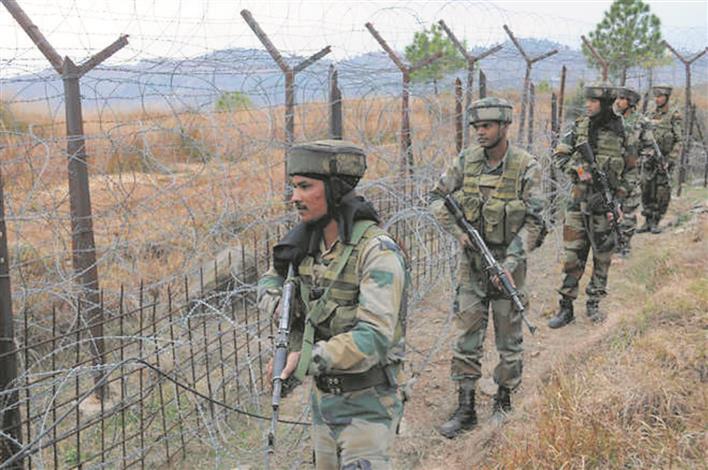
Nearly 1.3 lakh soldiers are deployed in J&K of which around 80,000 are deployed on the Line of Control (LoC).

As per the proposal, the Army would continue to dominate the LoC with Pakistan but would be withdrawn in a phased manner, starting from the relatively peaceful districts.


India, Australia to boost defence ties

Ink pacts on sports, innovation, audio-visual production, solar power

India, Australia to boost defence ties

Tribune News Service

New Delhi, March 10

Australia and India on Friday decided to strengthen their defence and security partnership to address the shared challenges and work towards an open, stable and prosperous Indo-Pacific.

The two sides signed four pacts, including an audiovisual co-production agreement, MoU on cooperation in sports, solar taskforce deal and a letter of intent between Atal Innovation Mission (AIM) and the Commonwealth Scientific and Industrial Research Organisation.

In a joint statement, Prime Ministers Narendra Modi and Anthony Albanese welcomed sustained progress under the defence and security pillar and discussed ways to enhance it. In this respect, they noted the forthcoming 2+2 defence and foreign ministerial dialogue and the meeting of the Defence Ministers which would enhance mutual understanding and coordination of engagements between the two countries.

They acknowledged the increasing interoperability between the respective forces through implementation of the India-Australia Mutual Logistics Support Arrangement and welcomed the arrangements for enhancing maritime domain awareness in the Indian Ocean region, increased defence information sharing and consolidation of mutual access that continue to deepen operational defence cooperation.

The Prime Ministers agreed that, as a practical step, India and Australia might continue to explore aircraft deployments from each other’s territories to build operational familiarity and enhance maritime domain awareness.

“Prime Minister Modi and I discussed the increasingly uncertain global security environment and committed to strengthening the Australia-India defence and security partnership to address shared challenges and work towards an open, stable and prosperous Indo-Pacific,” said Albanese in this respect.

In his media statement, PM Modi said, “We had a detailed discussion on maritime security in the Indo-Pacific region, and on increasing the mutual defence and security cooperation. In the field of defence, we have made remarkable agreements in the last few years, including logistics support for each other’s armed forces.

They expressed satisfaction at the progress under the MoU between India’s Khanij Bidesh (KABIL) and Australia’s Critical Minerals Office and looked forward to the continued development of critical minerals supply chains.


Pakistan CJ skips SCO meet hosted by India

Pakistan CJ skips SCO meet hosted by India

Chief Justice of India DY Chandrachud speaks during a meeting of CJs of Supreme Courts of SCO member states in New Delhi. PTI
Tribune News Service

New Delhi, March 10

Pakistan on Friday reversed its decision not to participate in the meeting of Chief Justices of SCO member countries being held here. However, Pakistan downgraded its participation by a notch. Instead of Chief Justice of Pakistan Umar Ata Bandial, who had “scheduling issues”, his brother judge Muneeb Akhtar participated in the conference via a video link.

Earlier in the day, Pakistan Foreign Office spokesperson Mumtaz Zahra Baloch had announced that Justice Bandial would not participate in the meeting being held from March 10 to 12 in India.

The SCO has so far not let bilateral disputes disrupt its meetings but this resolve will be tested when it will hold the meeting of Foreign Ministers in Goa on May 4 and 5. India had in January invited Pakistan Foreign Minister Bilawal Bhutto Zardari for this meeting. Sources said so far there was no confirmation from Islamabad about Bilawal’s acceptance of the invite.

On the question of Bilawal attending the SCO conference, the Pakistan Foreign Office spokesperson said: “The matter is under consideration and as and when this decision is taken, we will share it with everyone.”

India took over the chairmanship of the nine-member SCO for a year in September last year and will hold several ministerial meetings, including that of Defence Ministers.

Meanwhile, the US has said it backed a constructive dialogue and meaningful conversation between India and Pakistan. The US is ready to play its role if they agree, US State Department spokesperson Ned Price told reporters in Washington on Thursday.


Chandigarh SSP’s powers curtailed

Can’t appoint, transfer cops up to inspector’s rank now

Chandigarh SSP’s powers curtailed

Tribune News Service

Chandigarh, March 9

In a move apparently aimed at curtailing the powers of the UT SSP, the authority to appoint/transfer an inspector has been delegated to the DIG (incharge of headquarters). The powers to transfer sub-inspector, assistant sub-inspector, head constable and constables have also been delegated to SP/SSP (Headquarters).

The orders were issued by UT DGP Praveer Ranjan on March 3.

The orders mentioned that there was a need to lay down various aspects of establishment matters in the Chandigarh Police holistically and systematically.

Currently, no comprehensive standing orders exist on establishment matters and the provisions are either not objectively defined or are spread over various ad hoc orders.

The fresh order mentioned that this standing order superseded the orders of May 2013 and April 2014 and all amendments made thereto.

An SP/SSP (Headquarters) is always an officer of the AGUMT (Arunachal Pradesh, Goa, Mizoram and Union Territory) cadre.

The orders have led to murmurs among cops who claim it to be a surprising move.

A police official said earlier, the UT SSP could issue the transfer orders. However, the powers have been delegated to other officers now.

“All police stations are under the UT SSP. However, the SSP won’t have the powers to transfer the SHO of a police station or the incharge of a police post,” said an official on anonymity.

Earlier, when Kuldeep Singh Chahal, a 2009-batch IPS officer of the Punjab cadre, was the UT SSP, differences had reportedly cropped up between him and senior officials over transfer of SHOs.

Chahal was repatriated in December last year, around 10 months before his deputation was to end.

Last year, the UT Administration had decided to take way the charge of SSP (Security) from Manisha Chaudhary, the city’s first woman SSP (Traffic), following which the Haryana Home Secretary shot off a letter to the Chandigarh counterpart, seeking reversal of the order. Later, the UT had given the charge back to Chaudhary.

“There seems to be a cadre war going on in the police department,” added a cop.

Kanwardeep Kaur assumes charge

Chandigarh: New UT SSP Kanwardeep Kaur, a 2013-batch Punjab-cadre IPS officer, joined the Chandigarh Police on Thursday, on a three-year deputation period. Kaur was given guard of honour at the Police Headquarters in Sector 9 here. Kaur took charge from officiating SSP (UT) Manisha Chaudhary, a 2011-batch Haryana-cadre officer. TNS


IAF airlifts 438 stranded passengers

IAF airlifts 438 stranded passengers

PTI

Jammu, March 9

A total of 438 stranded passengers were airlifted by the Indian Air Force (IAF) between J&K and Ladakh on Thursday, an official said. The stranded passengers were mostly airlifted from Jammu to Kargil and Srinagar to Leh due to the closure of the 434-km Srinagar-Leh highway, he said.

The official said 260 passengers were airlifted from Srinagar to Leh in IL-76 Aircraft of the IAF. Similarly, 165 passengers were airlifted from Jammu to Kargil in four sorties of AN-32, while 13 passengers were flown from Kargil to Jammu.


SGPC seeks President’s help on release of ‘Bandi Singhs’

SGPC seeks President's  help on release of 'Bandi Singhs'

Tribune News Service

GS Paul

Amritsar, March 9

The SGPC has raised the issues of “Bandi Singhs” and the “illegal occupation” of Haryana Sikh shrines and institutions by the ad hoc Haryana Sikh Gurdwara Management Committee (HSGMC) with the President of India, Droupadi Murmu, during her visit to Amritsar.

The SGPC has been demanding the release of the Sikh prisoners through democratic means for a long time, Harjinder Singh Dhami said in the memorandum.

The SGPC has shortlisted a total of 21 Bandi Singhs, but it submitted to the President the names of nine convicts who had been behind the bars from 17 to 32 years.

“We demand from you to take cognisance of this important issue of release of Sikh prisoners and give necessary directions to the Government of India and the state governments concerned for their release….. We feel that by not releasing them, they are being discriminated against and their human rights are being violated grossly in the world’s largest democracy,” Dhami wrote to the President.

Another memorandum pertained to the setting up of a separate HSGMC for management of affairs of gurdwaras in Haryana.

The SGPC said that in February 2022, using police force, the Haryana government-nominated ad hoc HSGMC took possession of eight historic gurdwaras in the state, which are still notified under the management of SGPC under Section 85 of the Sikh Gurdwaras Act, 1925.

“Nowhere, in its order, the Supreme Court gave liberty to the Haryana Government to forcibly take over the management of the gurdwaras of the state under SGPC management…. we request you to intervene in this matter and instruct the Centre to ensure that the managements of the gurdwaras of the state, which are still notified under the Sikh Gurdwaras Act are returned to the SGPC besides repealing the HSGMC Act,” read the memorandum.

In the visitors’ book at the Golden Temple, the President wrote, “I am happy to visit and pay obeisance at the holy temple. This holy place with its beautiful architecture and the divine serenity around it evokes feelings of calmness and harmony. I prayed for peace, progress and prosperity of the country. It was great to see the volunteers working tirelessly in the spirit of service and devotion. May the teachings of Sikh Gurus continue to inspire us to practice brotherhood and unity.

Later, she visited the Jallianwala Bagh and paid homage to the victims of the 1919 massacre. She penned down her experience in the visitors’ book in Hindi. She also paid obeisance at the Durgiana Mandir where she was received by Durgiana Committee members, led by Luxmi Kanta Chawla. This was followed by her visit to the Bhagwan Valmiki Ram Tirath Sthal before she returned in the evening.


President Murmu pays obeisance at Golden Temple in Amritsar, SGPC submits memo on ‘Bandi Singhs’, HSGPC

President Murmu pays obeisance at Golden Temple in Amritsar, SGPC submits memo on 'Bandi Singhs', HSGPC

Tribune News Service

Amritsar, March 9

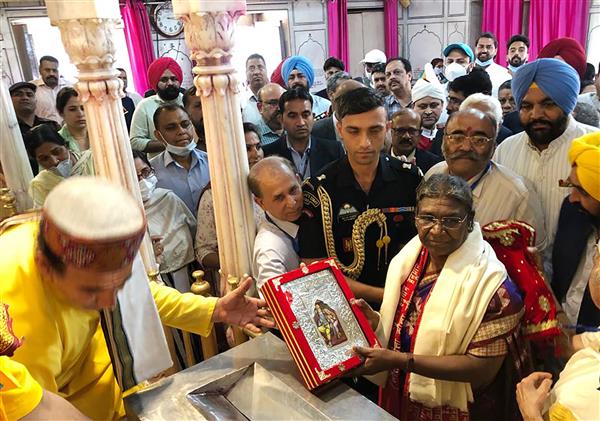
President Droupadi Murmu paid obeisance at the Golden Temple here on Thursday.

Tight security arrangements were made in the city for the president’s day-long visit.

Accompanied by Punjab Chief Minister Bhagwant Mann and Shiromani Gurdwara Parbandhak Committee (SGPC) chief Harjinder Singh Dhami, the president paid obeisance at sanctum sanctorum of the Golden Temple and listened to “kirtan”. She also took “karah prasad”.

This was her first visit to the city after becoming the president.

After paying obeisance, she went to the “langar hall” (community kitchen) and visited the area where utensils are washed.

Afterwards, she went to the Information Centre of the Golden Temple where she was presented a robe of honour, a set of Sikh religious books, a replica of the Golden Temple, and a set of woolen shawls.

In the visitors book at the Golden Temple, the President wrote “I am happy to visit Sri Harmandar Sahib and pay obeisance at the holy temple. This holy place with beautiful architecture and divine serenity around it evokes feelings of calmness and harmony. I prayed for peace, progress and prosperity of the country. It was great to see the volunteers working tirelessly in the spirit of service and devotion specially during Langar. May the teachings of Sikh Gurus continue to inspire us to practice brotherhood and unity”

The president is also scheduled to visit Jallianwala Bagh, Durgiana Temple and Bhagwan Valmiki Ram Tirath Sthal.

During her visit to the Golden Temple, the president was given two memorandums by the SGPC, the apex religious body of the Sikhs, including one pertaining to the release of Sikh political prisoners, its general secretary Gurcharan Singh Grewal said.

The SGPC has been seeking the release of Sikh prisoners who, it claims, continue to be in jails despite completion of their sentences.

On the “Bandi Singhs”, the SGPC has been demanding the release of Sikh prisoners through democratic means for a long time, Harjinder Singh Dhami said in the memorandum.

“…we feel that by not releasing the Sikh prisoners, they are being discriminated against and their human rights are being violated grossly in the world’s largest democracy,” he said.

“We demand from you to take cognizance of this important issue of release of Sikh prisoners and give necessary directions to the Government of India and concerned State Governments for their release,” Dhami wrote to the president.

Another memorandum pertained to the setting up of a separate Haryana Sikh Gurdwara Parbandhak Committee for management of affairs of gurdwaras in Haryana.

Notably, the Supreme Court last year had upheld the constitutional validity of the Haryana Sikh Gurdwara (Management) Act, 2014, under which a separate committee was formed to manage the affairs of gurdwaras in Haryana.

Afterwards, the Haryana government nominated an ad-hoc gurdwara panel in December last year.

“In February 2022, using the police force and administration, the Haryana government’s nominated gurdwara panel took illegal possession of the historical Gurdwara Sahibs in the state, which are still notified under the management of SGPC under Section 85 of the Sikh Gurdwaras Act, 1925.

“Nowhere, in its order, the Supreme Court gave liberty to the Haryana government to forcibly take over the management of gurdwaras of the state under SGPC management,” read the memorandum.

“…we request you to intervene in this matter and instruct the Government of India to ensure that the managements of Gurdwara Sahibs of Haryana state which are still notified under the Sikh Gurdwaras Act, 1925, are returned to the SGPC besides repealing the HSGMC Act, 2014,” read the memorandum.

Earlier, upon her arrival at the airport here in the afternoon, the president was received by Punjab Governor Banwarilal Purohit, Chief Minister Mann, Union Minister Som Prakash, and Congress MP from Amritsar Gurjeet Singh Aujla. PTI


India our top-tier security partner: Australian PM

India our top-tier security partner: Australian PM

Tribune News Service

New Delhi, March 9

Australian Prime Minister Anthony Albanese on Thursday visited the Indian Navy’s indigenous aircraft carrier INS Vikrant at Mumbai and termed relations between the two countries as “a partnership that is of increasing strategic importance as we navigate the challenges of our region together”.

Oz to host Malabar exercise

The Australian PM formally announced that Australia would host Exercise Malabar for the first time this year. India, Australia, Japan, United States are partners in the Malabar series of exercises.

“There has never been a point in both of our country’s histories where we’ve had such a strong strategic alignment,” the Australian PM’s statement said. Albanese said he could predict that 2023 would be busier than ever for the bilateral defence cooperation. “There has never been a busier or more productive time in our defence and security partnership.”

The Australian PM termed the aircraft carrier as a “landmark capability” while adding that “for Australia, India is a top-tier security partner. The Indian Ocean is central to both countries’ security and prosperity”. Australia and India both depend on free and open access to sea lanes in the Indo-Pacific for trade and economic well-being.

Last year, he said, India and Australia conducted more exercises, operations and dialogues than ever before. The operations included maritime patrol aircraft deployments in each other’s territories for the first time. In November, Indo-Pacific Endeavour and exercise ‘Austra-Hind’ were conducted.

Meanwhile, separately, the inaugural Australia-India General Bipin Rawat Defence Officer Exchange Programme is taking place in India.


India, US to ink agreement on chips today

India, US to ink agreement on chips today

Tribune News Service

New Delhi, March 9

India and the US will sign a pact on semiconductors on Friday after launching a track on smoothening strategic trade that is hampered due to several global and national rules and processes.

US Commerce Secretary Gina Raimondo said an MoU would be the first step in this direction. Most global majors want to refocus the hi-tech semiconductor foundry and packaging processes away from over-dependence on a handful of countries, especially China and also Taiwan, in case of a conflict.

Raimondo will participate in the India-US Commercial Dialogue and the CEO Forum on Friday to discuss cooperation in sectors that could unlock new trade and investment opportunities between the two nations, said the Commerce Ministry. The India-US Commercial Dialogue, which she and Commerce Minister Piyush Goyal will host, is being held after a pandemic-induced gap of four years. Raimondo is accompanied by US CEOs but said they had no specific investment commitments.

Raimondo said at the virtual press conference that she had “excellent and productive discussions” with Indian ministers including S Jaishankar, Nirmala Sitharaman and Dharmendra Pradhan here on Thursday.

The MEA said talks between Jaishankar and Raimondo covered “ongoing efforts to deepen the economic and commercial engagement” including through the initiative on Critical and Emerging Technology (iCET) and the Indo-Pacific Economic Framework (IPEF). “They also concurred on the need for increased bilateral strategic and high technology trade given the shared priorities of both countries in building resilient and trusted global supply chains,” said the MEA.

In this context, EAM and Secretary Raimondo agreed to launch an India-US Strategic Trade Dialogue, led by Foreign Secretary from Ministry of External Affairs of India and Under Secretary, Bureau of Industry and Security in US Department of Commerce. The Strategic Trade Dialogue will address export controls, explore ways of enhancing high technology commerce and facilitate technology transfer between the two countries.


India’s strained ties with China, Pak raise risk of armed confrontation, says US intel

India's strained ties with China, Pak raise risk of armed confrontation, says US intel

Tribune News Service

New Delhi, March 9

A US intelligence report has said there’s a possibility that India’s increased tensions with China and Pakistan could spill over, and there could be repercussions that may require immediate US attention.

On India-China conflict

  • India and China have engaged in border talks, but ties will remain strained in the wake of lethal clash in 2020
  • Expanded military postures along border elevate risk of armed confrontation between two nuke powers
  • This might involve direct threats to US interests, and calls for US intervention

On India-Pak crisis

  • Pak has a history of supporting anti-India militant groups
  • Unrest in Kashmir/militant attack potential flashpoints

There is the high risk of an escalatory cycle if India responded with military force to perceived or real Pakistani provocations, says the annual threat assessment of the American intelligence community.

The India-Pakistan crisis is of “particular concern” because of the risk of an escalatory cycle though New Delhi and Islamabad probably are inclined to reinforce the current calm in their relationship following both sides’ renewal of a ceasefire along the LoC in early 2021.

“However, Pakistan has a long history of supporting anti-India militant groups, and under the leadership of PM Narendra Modi, India is more likely than in the past to respond with military force to perceived or real Pakistani provocations. Each side’s perception of heightened tensions raises the risk of conflict, with violent unrest in Kashmir or a militant attack in India being potential flashpoints,” said the section on “Conflicts and Fragility”.

Previous standoffs between India and China have demonstrated that persistent low-level friction on the LAC can escalate swiftly.

It noted that India and China have engaged in bilateral border talks and resolved border points. But relations will remain strained in the wake of the countries’ lethal clash in 2020, the most serious in decades. The expanded military postures by both India and China along the border elevate the risk of armed confrontation between two nuclear powers that might involve direct threats to US interests, and calls for “US intervention”, said the report.