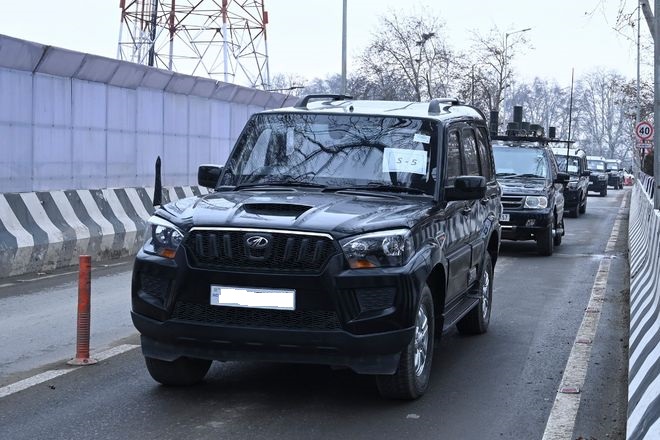
The Army is procuring 1,470 units ofScorpio, a popular SUV from Mahindra and Mahindra, which will be inducted in12 units. The SUV is already in use with the Air Force as well as the Central Armed Police Forces (CAFPs) and state police forces.
The Scorpio is expected to perform utility and staff transport duties that are presently being fulfilled by the Maruti Gypsy and Tata Safari light vehicles. Scorpios could also be modified and retrofitted to meet the Army’s specific operational requirements. According to some reports, Scorpio variants for the Army were spotted undergoing road tests in 2021, which had bullet proof windows and firing ports for small arms. Mahindra had also pitched an Army specific variant of the Scorpio a few years ago, which was presented at Defence Expositions.
As far as light vehicles go, the Army also uses the Tata Xenon and Sumo, Mahindra 550 jeep, Force Gurkha, Maruti Ciaz and Swift Dezire. In addition, it also has some specialist light armoured vehicles for use in counter insurgency areas.
CLICK BELOW TO OPEN THE GUTS AND GLORY ON FOREIGN SOILS – VIII
LEST WE FORGET: GUTS AND GLORY ON FOREIGN SOILS – VIII
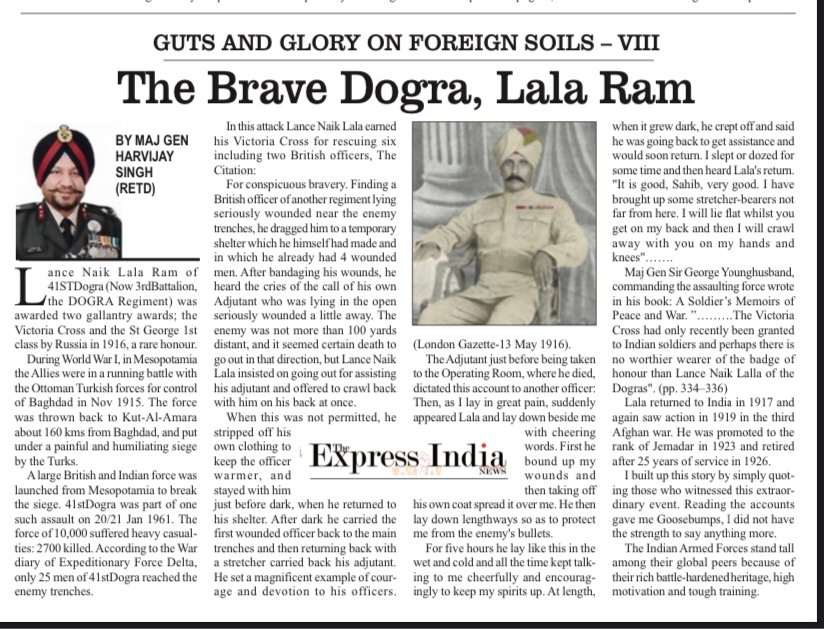
The Brave Dogra: Lala Ram
(Maj Gen Harvijay Singh, SM)
Lance Naik Lala Ram of 41ST Dogra (Now 3rd Battalion, the DOGRA Regiment) was awarded two gallantry awards; the Victoria Cross and the St George 1st class by Russia in 1916, a rare honour.
During World War I, in Mesopotamia the Allies were in running battle with the Ottoman Turkish forces for control of Baghdad in Nov 1915. The force was thrown back to Kut-Al-Amara about 160 kms from Bagdad, and put under a painful and humiliating siege by the Turks.
A large British and Indian force was launched from Mesopotamia to break the siege. 41st Dogra was part of one such assault on 20/21 Jan 1961. The force of 10,000 suffered heavy casualties: 2700 killed. According to the War diary of Expeditionary Force Delta, only 25 men of 41st Dogra reached the enemy trenches.
In this attack Lance Naik Lala earned his Victoria Cross for rescuing six including two British officers, The Citation:
For conspicuous bravery. Finding a British officer of another regiment lying seriously wounded near the enemy trenches, he dragged him to temporary shelter which he himself had made and in which he already had 4 wounded men. After bandaging his wounds, he heard the cries of call of his own Adjutant who was lying in the open seriously wounded a little away. The enemy was not more than 100 yards distant, and it seemed certain death to go out in that direction, but Lance Naik Lala insisted on going out for assisting his adjutant and offered to crawl back with him on his back at once. When this was not permitted, he stripped of his own clothing to keep the officer warmer, and stayed with him just before dark, when he returned to his shelter. After dark he carried the first wounded officer back to the main trenches and then returning back with stretcher carried back his adjutant. He set a magnificent example of courage and devotion to his officers. (London Gazette-13 May 1916).
The Adjutant just before being taken to the Operating Room, where he died, dictated this account to another officer: Then, as I lay in great pain, suddenly appeared Lala and lay down beside me with cheering words. First he bound up my wounds and then taking off his own coat spread it over me. He then lay down lengthways so as to protect me from the enemy’s bullets. For five hours he lay like this in the wet and cold and all the time kept talking to me cheerfully and encouragingly to keep my spirits up. At length, when it grew dark, he crept off and said he was going back to get assistance and would soon return. I slept or dozed for some time and then heard Lala’s return. “It is good, Sahib, very good. I have brought up some stretcher-bearers not far from here. I will lie flat whilst you get on my back and then I will crawl away with you on my hands and knees”…….
Maj Gen Sir George Younghusband, commanding the assaulting force wrote in his book: A Soldier’s Memoirs of Peace and War. ”………The Victoria Cross had only recently been granted to Indian soldiers and perhaps there is no worthier wearer of the badge of honour than Lance Naik Lalla of the Dogras”. (pp. 334–336)
Lala returned to India in 1917 and again saw action in 1919 in the third Afghan war. He was promoted to the rank of Jemadar in 1923 and retired after 25 years of service in 1926.
I built up this story by simply quoting those who witnessed this extraordinary event. Reading the accounts gave me Goosebumps, I did not have the strength to say anything more.
The Indian Armed Forces stand tall among their global peers because of their rich battle-hardened heritage, high motivation and tough training.
This mega national event being held for the first time outside Delhi
Bengaluru, January 10
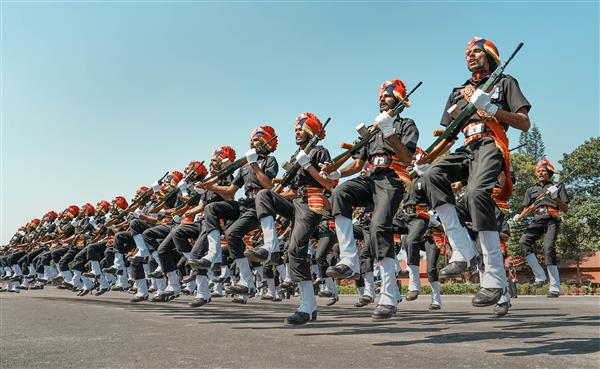
The stage is set for the 75th Army Day Parade here on January 15. This is the first such event taking place outside the national capital.
Chief of the Army Staff General Manoj Pande will attend the event
“Karnataka became the first State to host this mega national event for the first time outside Delhi because the first Army Chief Field Marshal KM Cariappa took command of the Indian Army from General Sir Francis Roy Bucher, the last British Commander-in-Chief in 1949, thus becoming the first Indian Commander-in-Chief post-independence,” Parade Commander Major General Ravi Murugan told reporters here.
According to him, the programme will start with laying a wreath by Major General Pande at the Madras Engineering War Memorial as tribute to those who made sacrifices for the nation.
The parade will witness 8 contingents including a mounted contingent from the Army Service Corps and a military band comprising 5 regimental bands, the Army officer said.
Major General Murugan added that the parade will be supported by a fly-past of Army aviation Dhruv and Rudra helicopters.
In addition, various weapon systems held in the Army’s inventory will be on display. They include K9 Vajra self-propelled guns, Pinaka rockets, T-90 tanks, BMP-2 Infantry Fighting Vehicle, Tunguska Air Defence System, 155mm Bofors guns, light strike vehicles, Swathi Radar and different assault bridges,” the Parade Commander said.
“We have invited people from all walks of life, even students from schools, colleges, NCC cadets, children from orphanages. Over 8,000 civilians have witnessed the parade during the pre-event displays thus far,” Major General Murugan said.
A high tea on January 14 has been planned in which Karnataka Governor Thaawarchand Gehlot will be the chief guest, the Army officer said adding, a military tattoo programme has also been organised on January 15 which Defence Minister Rajnath Singh will attend.
First batch of 217 ‘Agniveers’ start training in Punjab Regimental Centre in Jharkhand
Military training of the first batch of ‘Agniveers’ has started in Punjab Regimental Centre (PRC) in Jharkhand’s Ramgarh district, a senior officer of the regiment said on Tuesday.
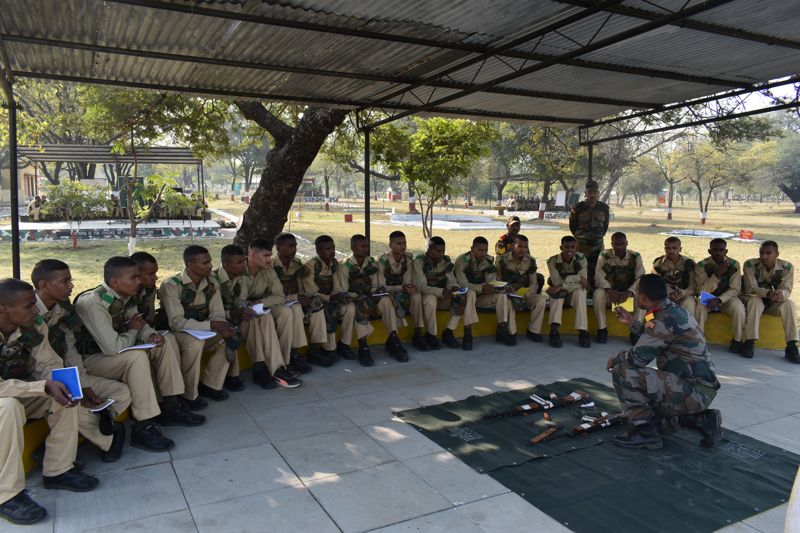
Terming it a new chapter in the history of the Indian Army as well as the centre, the Commandant of PRC Brigadier Sanjay Kendpal while talking to mediapersons here, said the PRC was fully prepared for providing military training to the first batch of 217 ‘Agniveers’ with upgraded infrastructure, incorporating state of the art technology simulators, infrastructure faculty development programme.
The PRC, one of the oldest regiments of Indian Army, prepared a scientifically driven approach to inculcate gradual yet rigorous military training to young ‘Agniveers’.
The training programme at PRC which began on January 2, has been enmeshed with activities to improve the physical and mental endurance of the trainees, the PRC said in a statement.1
The statement said PRC is fully geared up and aware of the onerous responsibility bestowed on it to organise and amalgamate the young ‘Agniveers’ into a well trained, motivated and disciplined lot of ‘Soldiers citizen’, who will also form an important ingredient of “Nation Building Process”.
The regimental and the Indian Army ethos and traditions imbibed by a soldier are the driving force behind selfless service to the nation. Keeping this in mind, the training curriculum aims to infuse ‘Agniveers’ with these values during their journey as they mature into young soldiers, the PRC statement added.
The Ministry of Defence had, in June 2022, unveiled the ‘Agnipath’ scheme, which is a pan-India merit-based recruitment programme for enrolling soldiers, airmen and sailors.
Under the scheme, ‘Agniveers’ will be recruited between the ages of 17.5 and 21 years.
They will be provided with an opportunity to serve in the armed forces as ‘Agniveer’ for a period of four years, including a training period.
As Agnipath recruitment and soldiering policy of armed forces becomes operational, a look at challenges that lie ahead
Ajay Banerjee
SIX months after the Ministry of Defence (MoD) announced a new policy — Agnipath — on recruiting troops for the armed forces, the first batch of recruits commenced training last week at multiple establishments across the country.
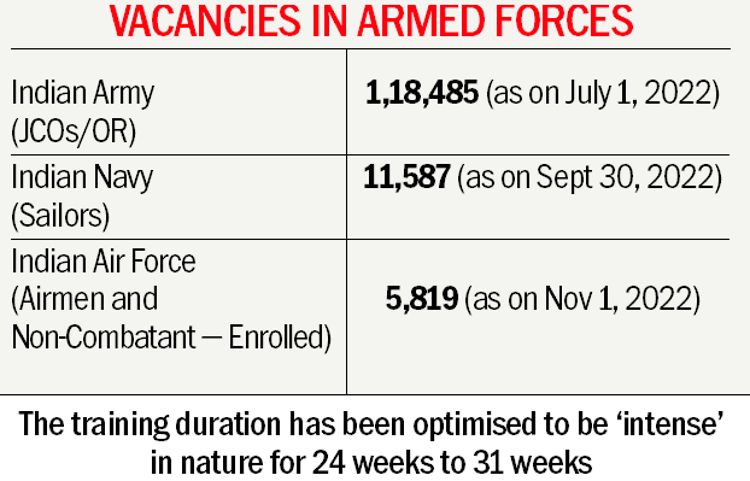
These young men — about 26,000 in number — are in the age group of 17 to 23 and have been picked up after a rigorous selection process from among 60 lakh applicants. They will serve the armed forces for a period of four years. About 25 per cent of these recruits will be offered positions as full-time soldiers for a longer service of 15 to 17 years.
The Agnipath scheme, considered the single biggest military reform since Independence, was announced by Defence Minister Rajnath Singh on June 14 last year. The announcement was met by violent protests by the youth across several states. From veterans to parliamentarians, many ‘warned’ the government against going ahead with the scheme. Following the uproar, a few tweaks, such as increasing the age limit, were made in the scheme. Lakhs of young men and women turned up at the recruitment rallies.
The Army received 37 lakh applications while there were 7.7 lakh and 15 lakh applications for the Indian Air Force and the Navy, respectively. Of these, 20,000 were selected in the Army and about 3,000 each recruited into the Navy and the IAF.
The Army, which has had no recruitment since 2020 and has an existing shortfall of troops, will add 20,000 more by March and will also start taking women at the same time. Meanwhile, the Navy has already started the recruitment of women.
Intense training schedule
Training methodology and infrastructure have been adapted to meet the needs for ‘future-ready’ soldiers and cater to the short duration of engagement of Agniveers in the forces. The training duration has been optimised to be ‘intense’ in nature for 24 weeks to 31 weeks. Earlier, training schedules in the Army varied from six months to two years, depending on the stream the jawan was selected into.
The big change is having some 500 simulators for training on various weapons and creation of infrastructure. All training centres have sports injury specialists as a pre-emptive measure for preventing stress injuries.https://aa5c801b82a0dc636c829de97fad4552.safeframe.googlesyndication.com/safeframe/1-0-40/html/container.html
The IAF and the Navy are more technology-intensive compared to the Army, and, hence, recruit youths with a science background after a written examination.
After a compressed training programme of six months, the second round of training will be held at Army regiments, IAF squadrons or Naval establishments. According to Maj Gen Ashok Kumar (retd), who has been an instructor at the Army Air Defence College and Indian Military Academy, “On-the-job training (the second round of training) has been an essential component even in pre-Agnipath times.”
Is six-month training enough?
When the MoD announced that the basic training period for Agniveers would be of six months, many questions were raised. According to a serving officer, “Training schedule with breaks has been a pre-Independence practice.
Col DPK Pillay (retd), Research Fellow at the Institute of Defence Studies and Analyses (IDSA), says, “Every system needs a periodic overhaul. In the 1950s, ’60s or ’70s, literacy levels were low and recruits needed to be brought at a par. Today, literacy levels have gone up and the level of technological awareness is high. So, a truncated, scientifically-designed training tenure is sufficient.”
Maj Gen Kumar adds, “Modern training techniques allow reduced durations. Entry-level standards, through physical tests and written tests, improve the quality of intake.”
The government argument
The Agnipath scheme has been designed to enable a youthful profile to the armed forces and take in the youth in tune with the contemporary technological trends. The forces are looking at a transformational shift towards a more tech-oriented role. The scheme will lower the age profile of Indian armed forces by four to five years. Col Pillay explains, “We need soldiers who are willing to learn new technology and adapt themselves to military situations.
What after four years?
With just 25 per cent of Agniveers getting selected for full-time soldiering, questions are being raised on the future of youth who are released from service and how military-trained youth will be absorbed in jobs after four years.
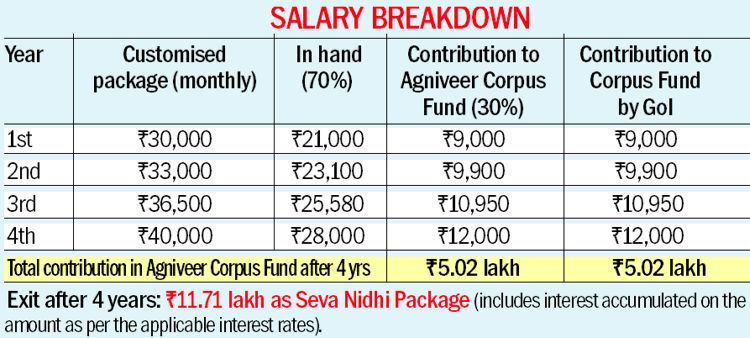
The Agnipath scheme does not offer pension but has a payout in case of injuries. Till the early 1980s, troops served for seven years and only a small percentage earned pension after putting in 15 years of service.
In a multi-pronged approach, the MoD has roped in the Society of Indian Defence Manufacturers (SIDM) and taken ‘suggestions’ on industry-specific skills needed by Agniveers. The private sector is making aerostructures, guns, tanks, and even ships. The public sector has been making planes, helicopters, ships, guns and missiles. Public sector and private banks have signed up to provide soft loans to Agniveers after they exit from the services for starting their own enterprises.
The MoD has reserved 10 per cent of job vacancies. The Union Home Ministry has reserved 10 per cent vacancies for recruitment in the Central Armed Police Forces (CAPFs) and Assam Rifles for ‘Agniveers’. Several state governments have announced supportive measures.
Last week, separate MoUs were signed by the MoD with the Ministry of Education (MoE) and the Ministry of Skill Development and Entrepreneurship (MoSDE) to facilitate continued education of Agniveers while serving in the armed forces and for the award of appropriate skill certificates.
Need to balance the gaps
A stark gap exists in case of an Agniveer and a regular soldier getting killed in action. The family of a serving Agniveer would get Rs 1.04 crore as compensation, besides full pay for the unserved period up to four years (effective from the date of death), along with the Seva Nidhi fund.
However, in case a regular soldier is killed in action, besides the one-time compensation, there is a fund of insurance, and the widow or parents are entitled to family pension till they are alive. The children get fully-funded free education till graduation in an institute of choice. Thus, if the child of a soldier, who has sacrificed his life, clears a medical or engineering entrance examination, the fee is paid by the MoD.
No change in regimental system
The Agnipath scheme is not expected to make a major change in the ‘class-specific’ regiments, which have, for more than 150 years, recruited boys from the same gene pool and defined geographical locations.
Those recruited from the same gene pool would be inducted into existing ‘class-specific’ regiments. For example, a Sikh recruited as an Agniveer would be allocated to one of the battalions of the Sikh Regiment. It would be similar for a Jat Agniveer, and so on.
Class-specific regiments, among others, include the Sikh, the Sikh Light Infantry, the Gorkhas, the Dogra, the Jat, J&K Light Infantry and Rajputana Rifles and some of these have existed since the times of the British.
Maj Gen Kumar explains, “The ethos of a regiment is related to the value system being followed in a particular regiment.” Since 25 per cent are being retained on a permanent basis, there will not be too much of stress on the fabric of regiments and this is not likely to create any major disruptions, the General adds.
The Agnipath scheme mandates an all-India merit-based selection termed ‘All India All Class’. In the long run, some 10 years down the line, the number of troops from ‘All India All Class’ origin would not form more than 10 per cent of the strength in a ‘class-specific’ battalion. The strength of a battalion is about 850-900 men and there are multiple battalions in a regiment.
Almost 75 per cent of the Army is ‘All India All Class’, only a limited have ‘class-specific’formations. No compromise is expected on the ethos of ‘Naam Namak Nishaan’. Each regiment has a specific war cry (Naam), a flag (Nishan) and a specific diet (Namak)
Defence ministry approves capital procurement proposals worth Rs 4,276 cr
The Defence Acquisition Council (DAC), at its meeting on Tuesday, okayed the ‘need to procure’ procure 500 HELINA missiles for an anti-tank role and very short range air defence VSHORAD missile for the northern borders with China.
The ‘need to procure’ is termed as Acceptance of Necessity (AoN) of the said equipment. The AoN is the first step in the acquisition process of the MoD and is like a green light to the forces to frame the tenders for procurement. The DAC chaired by Defence Minister Rajnath Singh.
Three acquisition proposals, amounting to Rs 4,276 crore, have been accorded an AoN, the Ministry of Defence said.
The DAC accorded AoN for procurement of HELINA anti-tank guided missiles, launchers and associated support equipment which will be integrated to the Advanced Light Helicopter (ALH). This missile is an essential part of weaponisation of ALH for countering enemy threat. Its induction will strengthen the offensive capability of Indian Army, The LCH has been inducted in the Indian Air Force and Army.
DAC also accorded AoN for procurement of VSHORAD (IR Homing) missile system under design and development by DRDO. In view of the recent developments along the Northern borders there is a need to focus on effective Air Defence (AD) weapon systems which are man portable and can be deployed quickly in rugged terrain and maritime domain.
“Procurement of VSHORAD, as a robust and quickly deployable system, will strengthen the Air Defence capabilities,” the MoD said.
The DAC granted approval for procurement of Brahmos Missile launcher and fire control system (FCS) for the Shivalik class of ships and Next Generation Missile Vessels (NGMVs) for Indian Navy. With their induction, these ships would have enhanced capability of carrying out maritime strike operations, interdicting and destroying enemy’s warships and merchant vessels.
The Defence Acquisition Council (DAC), at its meeting on Tuesday, okayed the ‘need to procure’ procure 500 HELINA missiles for an anti-tank role and very short range air defence VSHORAD missile for the northern borders with China.
The ‘need to procure’ is termed as Acceptance of Necessity (AoN) of the said equipment. The AoN is the first step in the acquisition process of the MoD and is like a green light to the forces to frame the tenders for procurement. The DAC chaired by Defence Minister Rajnath Singh.
Three acquisition proposals, amounting to Rs 4,276 crore, have been accorded an AoN, the Ministry of Defence said.
The DAC accorded AoN for procurement of HELINA anti-tank guided missiles, launchers and associated support equipment which will be integrated to the Advanced Light Helicopter (ALH). This missile is an essential part of weaponisation of ALH for countering enemy threat. Its induction will strengthen the offensive capability of Indian Army, The LCH has been inducted in the Indian Air Force and Army.
DAC also accorded AoN for procurement of VSHORAD (IR Homing) missile system under design and development by DRDO. In view of the recent developments along the Northern borders there is a need to focus on effective Air Defence (AD) weapon systems which are man portable and can be deployed quickly in rugged terrain and maritime domain.
“Procurement of VSHORAD, as a robust and quickly deployable system, will strengthen the Air Defence capabilities,” the MoD said.
The DAC granted approval for procurement of Brahmos Missile launcher and fire control system (FCS) for the Shivalik class of ships and Next Generation Missile Vessels (NGMVs) for Indian Navy. With their induction, these ships would have enhanced capability of carrying out maritime strike operations, interdicting and destroying enemy’s warships and merchant vessels.
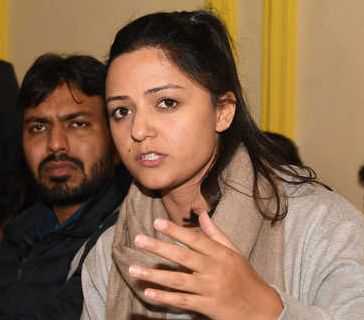
Delhi L-G grants sanction to prosecute Shehla Rashid for tweets about Army
Delhi Lieutenant Governor VK Saxena has granted sanction to prosecute former Jawaharlal Nehru University Students’ Union vice president Shehla Rashid Shora for her tweets on the Indian Army, officials said on Tuesday.
According to officials at the L-G office, the sanction is related to a 2019 FIR against her, under Section 153-A of the IPC, registered at Special Cell police station in New Delhi, on the basis of a complaint by one Alakh Alok Srivastava.
The former JNUSU leader is accused of promoting enmity between different groups and indulging in acts prejudicial to maintenance of harmony through her tweets, they said.
The proposal for the prosecution sanction was moved by Delhi Police and supported by the Home Department of the Delhi government, the L-G office said.
The tweets by Shora, dated August 18, 2019, had accused the Army of entering houses and “torturing” locals in Kashmir.
The allegations were rejected by the Army as baseless.
DRDO developing intelligent aircraft-mounted system for long-range surveillance and reconnaissance
The Defence Research and Development Organisation (DRDO) is developing an intelligent electro-optical imaging system that can be mounted on aerial platforms for long range surveillance and reconnaissance.
The system will be retrofitted on aircraft, helicopters and unmanned aerial vehicles to facilitate auto-acquisition and auto-tracking of multiple targets by day and night in varied climatic and environmental conditions, DRDO sources said.
It will include several payloads and sensors such as a thermal imager, high-definition TV camera, infra-red cameras, laser range finder and laser target designator along with video target tracking, geo-positioning and geo-navigation capabilities.
According to DRDO officials, the ruggedised, gimbal-shaped system is expected to weigh approximately 50kg along with its payloads and measure around 16 inches in diameter and 20 inches in height.
It can be mounted on the nose or underbelly, depending upon the type of platform being a helicopter or fixed-wing aircraft. Inputs from the sensor will be integrated into the IAF’s surveillance and communication networks and relayed to command centres in real-time for decision-making.
DRDO’s Instruments Research and Development Establishment (IRDE) at Dehradun is the nodal agency for the project, which will be undertaken in collaboration with the private industry as a fillip to self-reliance. The work is expected to commence this year.
Mandated with research in advanced electro-optics, lasers systems, photonics, imagers and gun-sights, IRDE has also recently taken up projects to develop different electro-optical systems for detecting drones and for coastal and harbour surveillance.
Electro-optical imaging sensors are employed on land-based, air-based and sea-based platforms to detect, identify and track human and machine movements and designate potential targets.
With the advent of newer technologies and growing use of artificial intelligence, the capability of such sensors is increasing exponentially and their operations are becoming increasingly automated, requiring lesser human interface.
Home Ministry declares PAFF, TRF as terrorist organisations as militancy spikes in Jammu province
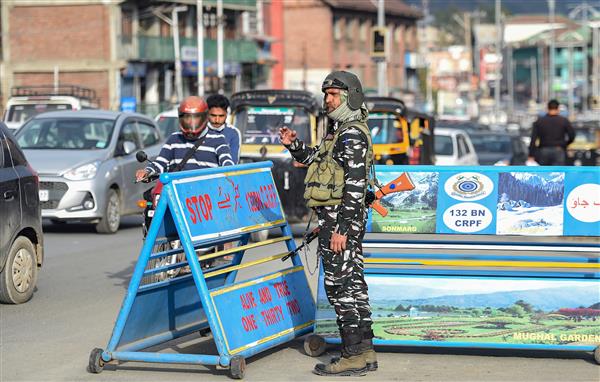
As militancy is spreading to relatively peaceful areas of Jammu province, the Ministry of Home Affairs banned the People’s Anti-Fascist Front (PAFF) and The Resistance Front (TRF), which have been involved in major terror activities after the abrogation of Article 370 in 2019.
Home Ministry said that PAFF is a proxy outfit of Maulana Masood Azhar-led Jaish-e-Mohammed (JeM) while the TRF is the proxy outfit of the Lashkar-e-Toiba (LeT), which emerged in 2019 and targeted civilians.
“PAFF was involved in terror acts and is regularly issuing threats to Indian security forces, political leaders, civilians working in Jammu-Kashmir from other states and is involved, along with other organisations, in conspiring pro-actively physically and in social media to undertake violent terrorist acts and Jammu-Kashmir and other major cities in India,” the MHA notification said.
The TRF on Saturday warned of terror attacks on people whose names it has released on the “hit list” two days after it was declared as a banned organization by the Home Ministry.
The MHA said that TRF is recruiting youth through the online medium for the furtherance of terrorist activities, recruitment of terrorists, infiltration of terrorists and smuggling of weapons and narcotics from Pakistan into Jammu and Kashmir.
The MHA also designated Pakistan-based TRF commander Sheikh Sajjad Gul as a terrorist under the Unlawful Activities Prevention Act 1967.
The government also designated Mohammed Amin alias Abu Khubaib, who belongs to Jammu and Kashmir but currently lives in Pakistan, as an individual terrorist.
Khubaib is acting as the launching commander of Lashkar-e-Taiba and is playing a vital role to revive and accelerate terrorist activities of LeT in the Jammu region, the MHA said.
He has been involved in coordinating terrorist attacks, supply of arms or weapons and explosives, and terror financing in Jammu and Kashmir from across the border.
Also, Arbaz Ahmad Mir, a Lashkar-e-Tobia operative who is currently based in Pakistan, has been designated as an “individual terrorist”. The MHA said Mir was the main accused in the targeted killing of Rajni Bala, a school teacher in Kulgam in May last year.
Both TRF and PAFF have been involved in multiple attacks including the killing of Kashmiri Pandits and migrant labourers while threatening journalists after the abrogation of Articles 370 and 35-A on August 5, 2019.
After the abrogation of Article 370, militant activities and smuggling of weapons through drones have increased in Jammu province.
Six civilians including two children were killed by the militants earlier this week in a targeted attack in the Rajouri district.
State Stalwarts
DEFENCES FORCES RANKS
ARMY, NAVY, AIRFORCE RANKS
FORMATION SIGNS
FORMATION SIGNS
ALL HUMANS ARE ONE CREATED BY GOD
HINDUS,MUSLIMS,SIKHS.ISAI SAB HAI BHAI BHAI
CHIEF PATRON ALL INDIA SANJHA MORCHA
LT GEN JASBIR SINGH DHALIWAL, DOGRA
SENIOR PATRON ALL INDIA SANJHA MORCHA
MAJOR GEN HARVIJAY SINGH, SENA MEDAL ,corps of signals
.
.
PATRON ALL INDIA SANJHA MORCHA
MAJ GEN RAMINDER GORAYA , CORPS OF
sanjhamorcha303@gmail.com
PRESIDENT HARAYANA STATE CUM COORDINATOR ESM
BRIG DALJIT THUKRAL ,BENGAL SAPPERS
PRESIDENT TRICITY
COL B S BRAR (BHUPI BRAR)
PRESIDENT CHANDIGARH ZONE
COL SHANJIT SINGH BHULLAR
.
.
PRESIDENT PANCHKULA ZONE AND ZIRAKPUR
COL SWARAN SINGH
PRESIDENT SAS NAGAR (MOHALI)
COL BALBIR SINGH , ARTY
INDIAN DEFENCE FORCES
DEFENCE FORCES INTEGRATED LOGO
FORCES FLAGS
15 Th PRESIDENT OF INDIA SUPREME COMMANDER ARMED FORCES
Droupadi Murmu
DEFENCE MINISTER
Minister Rajnath Singh
CHIEF OF DEFENCE STAFF (2nd)
General Anil Chauhan PVSM UYSM AVSM SM VSM
INDIAN FORCES CHIEFS
CHIEF OF ARMY STAFF(29th)
General Upendra Dwivedi, PVSM, AVSM (30 Jun 2024 to Till Date)