JOSHIMATH, a small town atop the mountains, was my home in 1977 while serving with an Army organisation, ‘Sentinels of the Snow’. Situated on the threshold of Badrinath and Hemkund Sahib, Joshimath has an evolved cosmopolitan culture as it beckons pilgrims of different religions and creeds. The town remains appropriate for night halts and as a rallying point for the pilgrim’s progress.
The meagre resources of this town notwithstanding, its brave residents are as large-hearted as the gigantic mountains they live in. However, now a palpable feeling of loss envelops this Garhwali town as it faces the agony of its sinking landmass.
My posting at Joshimath had been fraught with multiple challenges. One of these concerned the Ocean to Sky Expedition led by Sir Edmund Hillary, the conqueror of the Everest. This expedition, that also included Hillary’s son Peter, was planned from Ganga Sagar, where the Ganga meets the sea, to any destination that they could traverse upstream against the current in their three powerful jet boats, and then, they were to climb the Akash Parbat near the Badrinath shrine.
While negotiating the mountainous terrain, their boats could eventually go no further. Rocky edges protruding from the riverbed amid the gushing waters and a waterfall became impediments. They resorted to walking, believing that they could acclimatise themselves as they walked up in the mountains. On ascending 18,000 ft, Hillary, then in his late 50s — no longer the young man he was when he climbed the Everest — fell ill, struck with high-altitude pulmonary oedema. His team suddenly found him turning blue, decaying and dying. With Hillary on his air-mattress, his comrades collapsed his tent. Wrapping him in it, they dragged him down to a lower altitude.
One of his aides raced down and contacted our post. We despatched our patrol to assist. Overcoming communication hiccups, our signallers latched onto the radio-set frequency of the expedition and elicited a response that Hillary was being brought down.
A medical officer rushed with me to the makeshift helipad, where we met the team. Being carried on a stretcher, Hillary had lamented: ‘Starting my career with a roar, I end it with a whimper.’ He touched me with his gloved hand when I responded, ‘Sir, you have many more mountains to conquer.’ Peter murmured that his father’s faith brought him alive from the valley of gods. We prayed for him as the Air Force helicopter evacuated him. A few years later, Sir Hillary was appointed New Zealand’s High Commissioner to India.
Drass in Ladakh freezes at minus 29 as cold wave continues in Kashmir Valley
Drass town in Ladakh region froze at minus 29 degrees Celsius on Tuesday even as severe cold wave continued in the Valley, as per the MeT office.
Water taps were frozen in Srinagar city in the morning as the MeT office forecast generally clear sky in Jammu and partly cloudy in the Valley is expected during the next 24 hours.
Meanwhile, Srinagar registered minus 2.7 degree Celsius, Pahalgam minus 11.8 and Gulmarg minus 11.5 degrees as the minimum temperature.
Drass town in Ladakh region had minus 29 degrees, Kargil minus 20.9 and Leh minus 15.6.https://ad5349394df7bcb406631e38cc899110.safeframe.googlesyndication.com/safeframe/1-0-40/html/container.html
Jammu recorded 3.1 degrees, Katra 3.6, Batote minus 2, Banihal minus 1.5 and Bhaderwah minus 2.6 degrees as the minimum temperature. IANS
Soldiers cremated with Army honours in Una, Hamirpur districts
Havildar Amrik Singh and soldier Amit Sharma were cremated with military and state honours at their native villages in Una and Hamirpur districts today.
Gagret SDM Somil Gautam lays a wreath on the body of Havildar Amrik Singh at Ganu Mandhwara village in Una district. Tribune photo
The mortal remains of Havildar Amrik Singh, who, along with two other soldiers, died last week while on patrol duty in the Machil Sector of Kupwara district in Jammu and Kashmir along the LoC, were consigned to flames at his native Ganu Mandhwara village of Gagret sub division with full military honors today.
A three-member patrol party led by JCO Parshottam Kumar (43), Hav Amrik Singh (31) and Sepoy Amit Sharma (23) was moving towards a forward post at about 5.30 pm on January 10 when snow along the narrow track gave way and the three soldiers slipped into a deep gorge. A search and rescue operation was launched and all three bodies were recovered by early morning.
Amrik Singh had joined the Army’s Dogra regiment about 17 years ago. He is survived by his parents, wife and a two-year-old son, who lit the pyre amid slogans of ‘Amrik Singh amar rahe’ and ‘Bharat Mata ki Jai’ by the locals.
Earlier, the soldier’s body was brought to his ancestral village from Chandigarh in the morning. A contingent led by Capt Rahul Mehta of the 14 Dogra Regiment accompanied the casket draped in the Indian Tricolour. Amrik Singh’s wife Ruchi, mother Usha Devi and father Dharam Pal were inconsolable when the body reached their house.
Subedar Arun Kumar, who was part of the Army contingent which accompanied the body, said Amrik was an outstanding soldier and a sportsman.
Una SP Arijit Sen, SDM Somil Gautam and DSP Vasudha Sood laid wreaths on behalf of the state government and the district administration. A posse of Army men gave a gun salute to the late comrade.
Hamirpur: Army soldier Amit Sharma from the district was cremated with military and state honours at his native Talasi Khurd village, near here, today. Sharma was one of the three soldiers who were killed near the LoC when their vehicle fell into a deep gorge in Machil sector of Kupwara on January 10 night. A pal of gloom descended on the village as Sharma’s mortal remains reached the village this morning. Hundreds of local people thronged his village to pay tributes to him.
A contingent led by a Captain-rank officer placed a floral wreath near the body on behalf of the Army Chief and other ranks while Jitender Sanjta, Additional District Magistrate, paid tributes to Sharma on behalf of the state government.
Local MLA Ashish Sharma and SDM Manish Soni also paid tributes.
Earlier, the Captain of Dogra Regiment handed over Amit Sharma’s uniform and the national flag to his father Vijay Sharma.
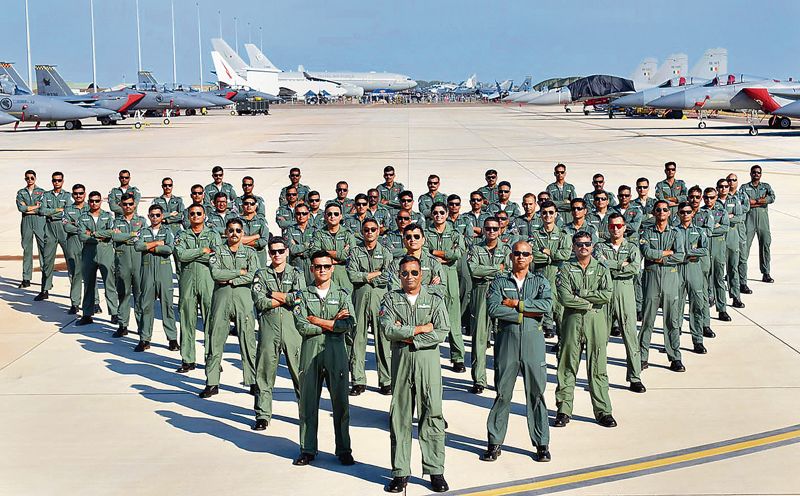
ndia must modernise its fighter fleet, for which it needs to curb mounting import expenditure and cultivate doubling up her indigenous combat craft enterprise. Like what China achieved after Mao’s death in October 1976. Today, the Beijing air force inventory contains 2,500 combat-capable aircraft because China went all out with indigenisation and went slow on imported craft.
Abhijit Bhattacharyya
Author and Columnist
THE Military Balance 2001-02, published by the International Institute for Strategic Studies, London, reported that when the Indian Air Force (IAF) operated 40 fighter squadrons in 2001, Pakistan had 19 squadrons. At that time, the Chinese air force’s numbers were three times that of India and Pakistan taken together. Hence, whatever the quality of the two South Asian countries’ fighter aircraft, the sheer squadron volume of the China-Pakistan duo make it a daunting task for the IAF to deal with in a multi-front conflict.
The glib talk about confronting two hostile neighbours makes little sense because of the rapidly dwindling squadrons of IAF fighters. Successive Indian Air Force chiefs have wailed, failed and faded away, yet the establishment has remained unmoved.
Does anyone remember the then IAF Chief, NAK Browne’s words of October 2013? “Of 42 squadrons it should have, IAF now has 34.” And now, incumbent IAF Chief Air Chief Marshal VR Chaudhari stated on December 22, 2022, that the “squadron strength is down to 31” and that “fighter shortage is now critical.”
Isn’t India proving herself to be an amazing compound of contradictions, chaos and confusion? Do time and tide wait for anyone in the combat zone or, for that matter, on the nation’s enemy lines?
While the IAF plays the tragic tune of the depleted and fast-depleting strength of its fighter squadrons, a small bunch of self-serving optimists, including some NRIs, is misleadingly telling the world as to how great the economy of India will become if the rupee depreciates vis-a-vis the dollar every hour, foreign exchange reserves deplete every week, and the current account deficit mounts every month to an astronomical figure, and that what a boon it would be for Delhi if it allows Beijing to spread its wings in industry, investment, commerce, trade, banking etc.
No country of India’s shape, size and demography can ever prosper with a mounting debt, an unbridgeable deficit trade, skyrocketing negative current account, depreciating currency and unbridled entry of an enemy nation just for a few investment projects covered with a systemically entrenched espionage in the Indian hinterland.
The harsh reality is that India’s imports are several times higher than her exports, thereby making the imported foreign-made goods much more expensive, which inflicts a mounting deficit on India’s economy. Thus, whereas importing a fighter aircraft in 2001 would have been an outflow of Rs 45 a dollar, the same import will now be Rs 83 a dollar. Hence, even assuming that the unit production and sale price of the imported machine is constant at $40 million, one can very well calculate the price difference (owing to the mounting rupee-dollar exchange rate differential) between 2001 and 2023.
The reference to the fluctuating rupee-dollar exchange rate was made to make a point to modernise the fighter fleet, for which India needs to curb mounting import expenditure and cultivate doubling up her indigenous combat craft enterprise. Like what China achieved after Mao’s death in October 1976. Today, the Beijing air force inventory contains 2,500 combat-capable aircraft because China went all out with indigenisation and went slow on imported craft. Thus, it’s now an open secret that it will take several years for the IAF to operate to its sanctioned 42 squadron-fleet level.
So, how did China lure the West and endure her worst to develop indigenous fighters to stump all? Chinese indigenisation began in the early 1980s with lightning speed copying of Soviet fighters and inviting UK’s Rolls Royce and Canadian Pratt and Whitney engines, followed by American Bell and French Dauphin helicopter. The Chinese strategy was clear. Cultivate the West through the charm offensive. Follow Deng Xiaoping’s dictum: “Hide and bide” (hide intent and bide time) — show the smiling teeth and bite when you get the time.
Thus, when the Soviets were neck-deep in the Afghanistan quagmire, the Chinese silently cut a deal with US aviation giant McDonnell Douglas to co-produce MD-82 twin engine passenger jet in January 1984. During the course of the next three decades, Communist China-backed companies lured gullible western corporations to strike deal after deal to shift their production line and latest technology to Beijing’s special industrial zones. So much so that the West is now bogged down in the yellow terrain just as the way Hitler’s tanks got stuck in the slushy soil of Russia during the harsh winter of the early 1940s.
By the late 1980s, it was western aviation on eastern soil. From capitalist America’s Grumman Corporation, McDonnell Douglas to British Aerospace to French Aerospatiale, all are collaborating with the communist China in building air power. And today, the situation has reached a point of no return for the West. The West groans in agony in vain because engine makers of all variety and shade have entered China: the likes of Pratt and Whitney, General Electric, Honeywell, French Snecma, and even Germany’s MTU, thereby making the Chinese air force ‘atmanirbhar’.
The desperate callout of successive IAF chiefs needs be understood and acted upon in this grim perspective. India must accelerate indigenisation through any means; fair or foul. Morality and ethics have no place when it comes to national self-interest, especially if there is an existential threat to national security in the form of the perennially active, two-front, unholy Sino-Pak alliance.
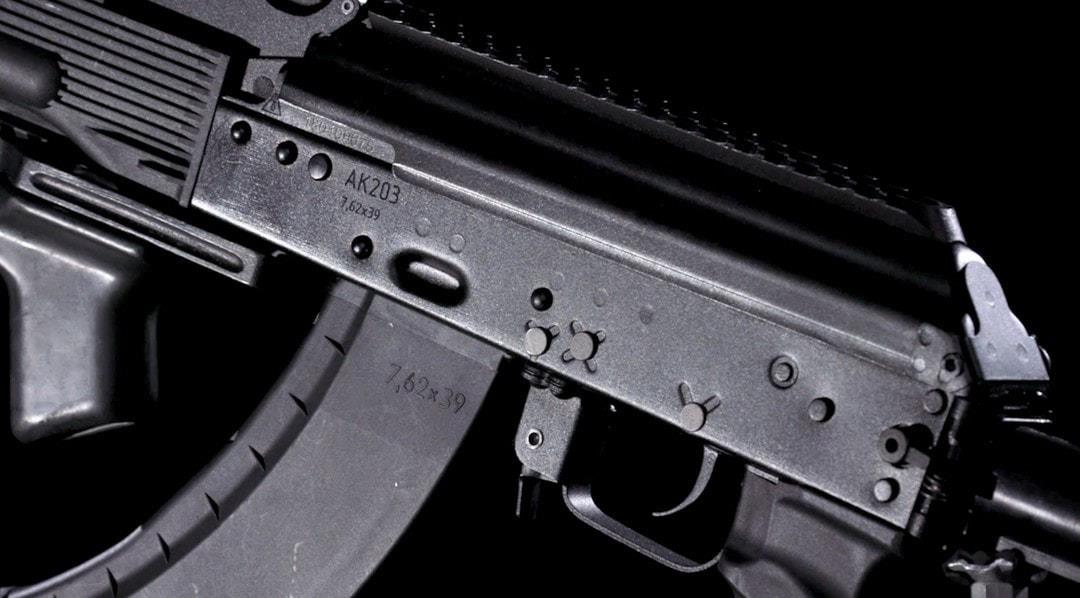
Indo-Russian joint venture produces first batch of Kalashnikov AK-203 rifles; deliveries to Indian Army expected soon
An Indo-Russian joint venture has started manufacturing Kalashnikov AK-203 assault rifles in Uttar Pradesh’s Amethi, a move that will lend greater firepower to the Indian armed forces.
Indo-Russian Rifles Private Limited plans to ensure 100 per cent localisation of the production of AK-203 rifles in India.
In future, the company may also increase output and upgrade its production facilities to produce advanced rifles based on the Kalashnikov assault rifle platform, Rostec State Corporation said in a statement.
The joint venture, registered and located in India, whose founders on the Russian side are Rosoboronexport and Kalashnikov Concern (both subsidiaries of the Rostec State Corporation), has started producing Kalashnikov assault rifles, it said.
“Russia and India are linked by strong partnership relations. Military-technical cooperation between the two countries has resulted in the construction of the joint venture Indo-Russian Rifles Private Limited,” the statement said.
“With the launch of series production of Kalashnikov AK-203 assault rifles, high-quality, convenient and modern small arms will begin to enter service with India’s defence and law enforcement agencies,” it said.
The model combines “excellent ergonomics, adaptability to different shooters and high performance characteristics, it is one of the best assault rifles in the world,” Sergey Chemezov, General Director of Rostec, was quoted as saying in the statement.
“Korwa Ordnance Factory in Amethi, Uttar Pradesh, has produced the first batch of 7.62 mm Kalashnikov AK-203 assault rifles. The beginning of deliveries to the Indian Army is expected soon,” said Alexander Mikheev, Director General of Rosoboronexport.
“At the same time, the factory’s capacity makes it possible to fully equip the personnel of other law enforcement agencies in India with AK-203 assault rifles, which, due to their high adaptability, are suitable for various operators. In addition, the joint venture will be able to export its products to third countries,” Mikheev said.
Indo-Russian Rifles Private Limited fully complies with the government of India’s Made in India initiative and DAP (Defence Acquisition Procedure) 2020. Today, India is the first country to start producing the AK-200-series assault rifles of the world-famous brand, the statement by Rostec said.
“The AK-200-series assault rifles have retained all the advantages of the traditional AK scheme—reliability, durability and ease of maintenance. At the same time, they fully meet the latest requirements for firearms in the world in terms of ergonomics and the ability to mount high-tech additional equipment,” it added.
Russia and India continue to implement military-technical cooperation projects. Their current and future programmes are “maximally focused” on technological cooperation, including on the basis of joint ventures, in the format of licensed production and joint research and development projects, the statement said.
Rosoboronexport aims to cooperate on terms of transfer of technology put forward by the Indian side and in accordance with the Make in India initiative, it said.
They could also be considered for future promotions also to higher ranks in the force
ANI
New Delhi, January 16
Further empowering female officers, the Army has cleared more than 30 women officers for command roles. The Army is holding promotion boards for 108 vacancies of select Colonel rank for women officers including batches from 1992 to 2005.
The initial list of over 30 women officers has been cleared from different arms and services including Corps of Engineers, Signals, Ordnance and Electrical and Mechanical Engineers, Army officials told ANI.
More lists would be coming out soon as the boards would be compiled and results would be announced, they said.
The women officers clearing the boards would be given command roles and they could also be considered for future promotions also to higher ranks in the force.
Army headquarters officials said women are serving proudly and confidently in various operational theatres of the Indian Army.
“Women officers are being given opportunities at par with their male counterparts. The process for selection of women officers to tenant command assignments in Colonel rank is in progress,” they said.
Recently, a woman officer from the 57 Engineers regiment was deployed in the Siachen Glacier and has been tasked in operations there.
Women soldiers are also being inducted through the Agnipath entry scheme. The first batch of over 100 women Agniveers will join their training centre in Bengaluru in March 2023.
Army has also started deployment of women soldiers in joint exercises with friendly foreign countries and in peacekeeping missions.
“We have considerably stepped up the role of our women soldiers in various UN Peacekeeping missions. In consonance with the United Nations’ Gender Parity drive, we recently deployed an Enhanced Female Engagement Team comprising of two officers and 25 women soldiers to the strive torn Abeyi region of Africa to provide relief and assistance to women and children in one of the most challenging operational and terrain conditions under the UN flag,” an official said.
Army Chief Gen Manoj Pande is in favour of giving all possible opportunities to the women officers and soldiers and their entry into the artillery regiments is expected to be cleared soon. The Army has sent a proposal to the government in this regard and is also looking to open more avenues for them in line with the central government’s policy in this regard.
State Stalwarts
DEFENCES FORCES RANKS
ARMY, NAVY, AIRFORCE RANKS
FORMATION SIGNS
FORMATION SIGNS
ALL HUMANS ARE ONE CREATED BY GOD
HINDUS,MUSLIMS,SIKHS.ISAI SAB HAI BHAI BHAI
CHIEF PATRON ALL INDIA SANJHA MORCHA
LT GEN JASBIR SINGH DHALIWAL, DOGRA
SENIOR PATRON ALL INDIA SANJHA MORCHA
MAJOR GEN HARVIJAY SINGH, SENA MEDAL ,corps of signals
.
.
PATRON ALL INDIA SANJHA MORCHA
MAJ GEN RAMINDER GORAYA , CORPS OF
sanjhamorcha303@gmail.com
PRESIDENT HARAYANA STATE CUM COORDINATOR ESM
BRIG DALJIT THUKRAL ,BENGAL SAPPERS
PRESIDENT TRICITY
COL B S BRAR (BHUPI BRAR)
PRESIDENT CHANDIGARH ZONE
COL SHANJIT SINGH BHULLAR
.
.
PRESIDENT PANCHKULA ZONE AND ZIRAKPUR
COL SWARAN SINGH
PRESIDENT SAS NAGAR (MOHALI)
COL BALBIR SINGH , ARTY
INDIAN DEFENCE FORCES
DEFENCE FORCES INTEGRATED LOGO
FORCES FLAGS
15 Th PRESIDENT OF INDIA SUPREME COMMANDER ARMED FORCES
Droupadi Murmu
DEFENCE MINISTER
Minister Rajnath Singh
CHIEF OF DEFENCE STAFF (2nd)
General Anil Chauhan PVSM UYSM AVSM SM VSM
INDIAN FORCES CHIEFS
CHIEF OF ARMY STAFF(29th)
General Upendra Dwivedi, PVSM, AVSM (30 Jun 2024 to Till Date)