The Mughal Road, an alternate link connecting Kashmir with rest of the country, was closed for vehicular traffic on Sunday as most of the high-altitude area experienced light to moderate snowf overnight, officials said.
However, the traffic on the strategic Srinagar-Jammu National Highway is moving normally despite rain which lashed wide parts of Jammu and Kashmir, they said.
More than five inches of snow accumulated on the ground between Poshana and Peer Ki Gali rendering the Mughal Road, connecting the twin districts of Poonch and Rajouri in Jammu province with south Kashmir’s Shopian district, unsafe, officials said.
The weatherman has predicted inclement weather in Jammu and Kashmir with intermittent rain and snowfall till November 10 under the influence of western disturbance.
The Mughal Road usually remains closed for winter months owing to heavy snowfall in 11,433-foot high Peer Ki Gali.
A traffic department official said the 270-km Jammu-Srinagar National Highway is open with no report of any disruption in the movement of vehicles which are plying from both sides.
The Jammu city also witnessed high-speed winds overnight along with a spell of heavy rains during the intervening night of Saturday and Sunday but there was no report of any damage, they said.
CATC-91 training starts at SBS State University Ferozepur
The Combined Annual Training Camp (CATC)- 91 was started by 13 Punjab NCC Battalion, Ferozepur Cantt. A weeklong camp will conclude on November 9. Camp Commander Col ML Sharma said that around 500 candidates from different schools and colleges are participating in it. Col Sharma in his address to the NCC cadets highlighted the importance of such camps and how these help in the all-round development of the cadets. He said, during this camp, the cadets will be given various types of training such as drill, shooting map reading, PT apart from NCC syllabus classes. He said that this camp will continue till November 09 and in the next few days the cadets will also be given training to deal with various social problems. Col Sharma also specially thanked the Vice Chancellor of Shaheed Bhagat Singh State University, Dr Buta Singh, for extending full support in making this CATC-91 a successful event by providing the campus and required infrastructure. On this occasion, the Deputy Camp Commandant Col Piyush Berry also gave information about the training to be given to the cadets. Captain Kulbushan Agnihotri, Captain Inderpal Singh, Lieutenant Dr. Azadwinder Singh Singh, Second Officer Vinay Vohra Subedar Major Angrej Singh, Training Office staff were also present.
Chint Singh: The Man Who Should Have Died’ brings us the story of WW-II veteran who was lone survivor among 2,400 Indian prisoners-of-war
Belonging to the 12th Frontier Force Regiment, Chint Singh, a native of Himachal Pradesh, was taken POW after the fall of Singapore and shipped to New Guinea in April 1943
Vijay Mohan
Tribune News Service
Chandigarh, November 6
The son of an Indian veteran of World War-II who was held as a prisoner-of-war (POW) in New Guinea by the Japanese has documented his ordeal and how he became the sole survivor among 2,400 other captives.
Belonging to the 12th Frontier Force Regiment, Chint Singh, a native of Himachal Pradesh, was taken POW after the fall of Singapore and shipped to New Guinea in April 1943.
In a book, ‘Chint Singh: The Man Who Should Have Died’, his son, Narinder Singh Parmar, a former lecturer at the DAV College, Chandigarh and now an educator based in Australia, has pieced together the story of resilience and survival in unimaginable conditions. The book details the experiences in remote POW camps and the daily grim fight for existence.
Over two years, many of the POWs had died in the thick jungles and swamps due to disease, malnutrition, torture by the Japanese or bombing by Allied forces. Only Chint Singh and 10 others were rescued by Australian forces in September 1945.
Tragically, the other ten died in a plane crash while heading home in November 1945. Chint Singh, should have been on board, but he was needed for testimony in the trials of Japanese soldiers charged with war crimes, making him the sole survivor among the 2,400 Indian POWs.
After returning to India, Chint Singh shifted to the Dogra Regiment and retired in 1974 after commanding an NCC girls’ battalion and then serving as Commandant of a Central Industrial Security Force battalion.
“I have taken up a case with the Australian authorities for a memorial dedicated to the Indian POWs of New Guinea to be established in Australia so as to spread awareness about the role of Indian soldiers and the unimaginable ordeal they underwent. I have been asked to submit a written proposal in this regard,” Parmar told The Tribune during a recent visit to Chandigarh.
Kashmir village along Line of Control hopes divided bridge will bridge the divide
A neat white line drawn in the middle of a suspension bridge that sits right on the Line of Control separates the border village of India’s Tithwal and Pakistan-occupied Kashmir (PoK). The bridge has seen wars and tumultuous phases of history in the heavily militarised region.
With a ceasefire understanding reached between India and Pakistan since February last year, resulting in peace and tranquillity here, many residents of this Jammu and Kashmir village are now appealing that the crossing point over the Kishanganga river be again reopened to allow passage and “connect hearts” of people on both sides.
The bridge, constructed in 1931 by the then princely state of Jammu and Kashmir, has seen the bloody Partition in 1947 and the tragic human migrations that accompanied it, witnessed wars between India and Pakistan and see-sawing relationship between the two countries over the last 75 years.
The 160-ft-long wooden suspension bridge on Kishanganga—called Neelum in Pakistan—is one of the four crossing points on the LoC.
Some of the locals also recalled the poignant fictional story ‘Titwal ka Kutta’ by noted author Saadat Hasan Manto describing the “pains of Partition”.
The bridge, officially called the Chilehana Tithwal Crossing Point (CTCP), is heavily guarded on both sides.
Since the ceasefire understanding last year, “curiosity of people has grown” from both sides to know about each other, Indian Army officials said.
Zameer Ahmad, 55, the Numberdar of Tithwal village, located 175 km from Srinagar, told PTI that “the village on the PoK side across the river has become a tourist point and people come there from Muzaffarabad, Lahore and Rawalpindi to see the LoC and life in India”.
He pointed to a restaurant perched on the edge of a hill with a Pakistani flag on it and a group of people curiously looking towards Tithwal from a street built on a higher elevation in the hills which face the Indian village.
India and Pakistan are “brothers, separated at birth”. Now, the two sides should try to achieve lasting peace “through talks and without any fight”, Ahmad said.
“After the Partition, the land got divided overnight but families were living on both sides of Kishanganga. Many children got separated from their parents, others lost their relatives in wars between the two sides. But they yearn to go back to their ancestral place to at least see it or reunite with separated family members,” he said.
“Now, with the ceasefire since early last year, resulting in peace in the area, the crossing point at Tithwal should be reopened for people on both sides with proper permit,” Ahmad said.
Army sources said that ceasefire violations had impacted regular life in Tithwal “enormously”. The locals couldn’t move freely during any time of the day and schools weren’t regular, they said.
Since the ceasefire understanding, there has been a “marked improvement in the routine activities”, a source said.
The old bridge was destroyed by Kabaili raiders from the Pakistan side in 1948. It was rebuilt jointly by India and Pakistan in 1988, official sources said.
“Citizens from both sides were allowed to move across the bridge on every second and fourth Thursdays on a special permit. This move has been stopped post August 5, 2019. The special permit was valid for a fortnight,” an Army source told PTI.
Civilians who have since then inadvertently wandered on to the other side have been repatriated as humanitarian gestures.
A young boy from the other side had been repatriated on September 25, the last such repatriation from the Indian side, the source said.
Tithwal village with a population is 1,270 is the second last village along the LoC, Simari being the last, and is located between the LoC and the AIOS (anti-inflitration obstacle system), a fencing layer of concertina wires.
The village is located 82 km from Kupwara town. Tourists require permission from the civil administration to visit the village.
Ajaz Ahmad, member of a committee that is working to rebuild an old temple dedicated to goddess Sharada in Tithwal village, appealed to both the Indian and Pakistani governments to allow opening of the Tithwal crossing point so that pilgrims can easily go to the ancient Sharada Peeth located in PoK after reaching the Tithwal temple.
Signs of patriotism are obvious around the bridge with a huge tricolour hoisted on a towering flagpole and a small wooden gate near the river, which leads to the bridge, painted in a tricolour theme with ‘Mera Desh Mahan’ inscribed on both sides of it, but signs of hope for achieving lasting peace are also there.
Near the bridge there is also a ‘Sarva Dharm Sthal’ and an open gate—barely a few metres from the iron gate that leads to the Tithwal bridge—carries an inscription on top that reads “Bridging the Divide for Peace and Prosperity Tithwal”.
Also, sweets are exchanged between the two sides on Independence Day, Republic Day and New Year’s Day, as also on Eid and Diwali festivals.
Ahmad calls the Tithwal crossing point a “bridge of hope (‘aman ki umeed’)” and, said though the bridge itself is divided, it may help bridge the divide between the two neighbours.
INDIAN NAVY TRACKING CHINESE RESEARCH VESSEL WHICH ENTERED INDIAN OCEAN REGION AHEAD OF MISSILE TESTS
The Indian Navy on Friday said that it is closely monitoring the movement of a Chinese research vessel which has entered the Indian Ocean Region (IOR), news agency ANI reported citing people familiar with the developments. The people mentioned above told ANI that the Indian Navy is keeping its eye on the vessel. They said the Indian Navy’s assets and its aerial surveillance capabilities ensure that the Navy ‘maintains a comprehensive maritime domain awareness in the region’. They said that the Indian Navy keeps an eye on any such activity in its area of responsibility through both aerial and maritime assets. The Chinese research vessel entered the IOR through the Sunda straits and remains at a significant distance from Indian waters. Several high altitude long-range unmanned aerial vehicles will keep a close watch and the vessel’s movements are being monitored closely. If the vessel comes closer to Indian waters, the possibility of a rendezvous with an Indian surface warship increases. There is a strong possibility that the so-called Chinese vessel may track upcoming Indian missile launches planned by the Defence Research and Development Organisation (DRDO). This is not the first time China has sent its so-called ‘research vessels’ in the Indian Ocean region. Though Beijing claims these are research vessels, it uses such vessels to spy on its neighbours. Earlier in August, China forced its neighbour Sri Lanka to allow the spy ship Yuan Wang 5 to dock in the Hambantota Port. Though Sri Lanka has lost full administrative rights to the port as it was developed with Chinese money and the bankrupt nation also handed the port on a 99-year lease as part of a debt swap. The Indian Ocean Region (IOR) is an area that India considers as an area of traditional influence and the presence of Chinese spy ships pose threat to safety and security of the Kudankulam and Kalpakkam nuclear reactors, as well as to the Chennai and Thoothukudi ports. China calls these ships ‘research vessels’ but the US Pentagon deems these ships as spy vessels and says these ships have the potential to track missiles and rockets launched and also help in launching them as they are equipped with top-of-the-line antennas and electronic equipment.
Upholding life sentence in fratricide incident, AFT stresses on strict handling of such cases to maintain discipline
Upholding the sentence of life imprisonment and dismissal from service awarded by a court martial to an army jawan for shooting dead his guard commander and attempting suicide, the Armed Forces Tribunal has ruled that such cases should be dealt with strictly in order to maintain discipline.
Upholding the charges against the jawan to be legally and factually sustainable, the Tribunal held that the general court martial (GCM) had considered all the aspects in proper perspective and there was no infirmity in the order passed by the GCM.
“We are further of the view that Army personnel who are involved in such activities should not be dealt leniently. Nobody should escape from the clutches of law in order to set an example to others with a view to maintain Army discipline,” the Tribunal’s bench comprising Justice Umesh Chandra Srivastava and Vice Admiral Abhay Raghunath Karve remarked in its recent order.
The GCM had tried the jawan, belonging to the Gharwal rifles, on two charges. The first charge under Section 69 of the Army Act, contrary to Section 302 of the Indian Penal Code, was for committing murder by shooting a colleague, while the second charge under Section 64(c) of the Army Act was for attempting to commit suicide by shooting himself on his chest and thigh.
The jawan, along with a Naik, who was the guard commander, and another jawan were detailed for sentry duty at night at the main gate of their unit’s complex. He had fired at the guard commander and later shot at himself. The unit’s medical officer had pronounced the Naik dead at the site of the incident while the injured jawan was moved to hospital.
The GCM had examined 19 prosecution witnesses, including the other jawan on guard duty who was an eyewitness to the incident. The defence had contended that there was no motive for the jawan to kill his commander, the prosecution could not prove its case beyond reasonable doubt, there were disparities in statements of witnesses and many issues left untouched or unanswered.
The Bench held that based on statements by the eyewitness and the facts on record, the prosecution has been able to prove that the jawan had killed the guard commander and later he tried to commit suicide by firing two cartridges by the same rifle, as proved by forensic reports.
The Bench also made an important observation that some of the material placed on record clearly established that all the persons were drunk, but it could not be proved in the court of inquiry. Also it could not be established that the jawan fired upon the commander under the influence of alcohol.
AHEAD OF EXERCISE MALABAR 2022, NAVY CHIEF HARI KUMAR MEETS COUNTERPARTS FROM AUSTRALIA, JAPAN AND US
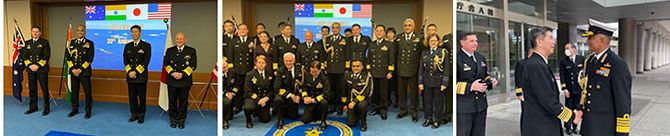
Tokyo: Ahead of the commencement of the 2022 edition of Exercise MALABAR, marking the 30th anniversary of the engagement, Indian Navy chief Admiral R Hari Kumar met Navy Chiefs of the Royal Australian Navy, Japan Maritime Self-Defence Force and US Navy where the leaders exchanged views on further enhancing inter-operability in future editions of MALABAR. Indian Navy chief Admiral R Hari Kumar is visiting Japan from November 5-9 where he will witness the Japanese international fleet review and also attend the inauguration of multilateral naval drills Malabar being held there in its 30th year. During the visit, as one of the Observer Navies in the Western Pacific Naval Symposium (WPNS), the CNS will attend the 18th WPNS on November 7-8 at Yokohama, being hosted by Japan, as the current Chair of WPNS. In addition to representing India and the Indian Navy during the International Fleet Review (IFR) and Western Pacific Naval Symposium (WPNS), he will also be in attendance for the inauguration of the 2022 edition of Exercise MALABAR, being held at Yokosuka with the participation of Australia, Japan and the USA. Initiated in 1992, this year marks the 30th anniversary year of Exercise MALABAR. Admiral R Hari Kumar would also be interacting with his counterparts and other Heads of Delegations from close to 30 countries participating in the IFR, WPNS, and MALABAR. Indian Naval Ships Shivalik and Kamorta also arrived at Yokosuka, Japan on November 2 to participate in the IFR and Exercise MALABAR-2022. The presence of these indigenously built ships of the Indian Navy at these multi-national events will be an opportunity to showcase the ship-building capabilities of Indian Shipyards during a large international gathering. The visit of the CNS to Japan signifies a high level of bilateral defence engagements with Japan, as well as India’s active support and participation in multilateral engagements.
IAF veteran from Chandigarh pens book on 1971 war, Kargil conflict
A book on war stories emanating from the 1971 Indo-Pak war and the 1999 Kargil conflict has been published by a retired Air Force officer based in the city.
Titled “1971.1999.War Stories”, it was released at a seminar on military history and strategy held in association with the United Services Institution in New Delhi today.
Authored by Air Cmde Nitin Sathe, a helicopter pilot now posted with Maharaja Ranjit Singh Armed Forces Preparatory Institute, Mohali, the book’s foreword has been written by Chief of the Air Staff Air Chief Marshal VR Chaudhary.
The first part of the book is devoted to the 1971 war and contains stories told by those who fought the war on ground or from the cockpit during interviews conducted by the author over the years. The other portion is devoted to the Kargil conflict, which covers a large area both geographically as well as emotionally, highlighting the human and humane aspects of the war besides other operations.
The author, who retired this year after 35 years of service, has undertaken an array of operational and humanitarian missions involving over 5,500 hours of incident-free flying. This is his fourth book on defence-related topics.
PRIVATE PLAYERS COMING TO INDIA NOT THREAT, BUT OPPORTUNITY: HAL CHIEF
HAL CMD CB Ananthakrishnan shared that HAL has initiated some major projects, like the Medium-Role Helicopter and AMCA Bangalore: With rising concerns around national security, especially cross-border threats, along with the country’s bid to achieve indigenisation in manufacturing, India is bullish about developing its homegrown defence potential. According to the Indian Brand Equity Foundation, India is one of the world’s biggest defence spenders with a total outlay of Rs 5.25 lakh crore, accounting for 13.31 per cent of the total budget and indicating an increase by Rs 46,970 crore over the budget estimates of 2021-22. These numbers throw open a massive opportunity for several players, including private, and global ones, to participate in building the country’s strategic capabilities. HAL CMD CB Ananthakrishnan said, “Private players coming to India is not a challenge, but an opportunity for us. We see the private sector as a collaborator. Today, some buzzwords in our industry are self-reliance (Atmanirbhar Bharat), and Make for India and Make for the World. We are confident that there is enough space for other players as well. The common objective should be to catapult India as a global defence manufacturing hub.” “We are keen to complete the transfer, through tender, rather than getting projects on a nomination basis. We are quite comfortable participating in a tender if it is fruitful… Today, the processes are transparent, and interests of private defence companies and the industry will not affect government policy,” he told TNIE on the sidelines of a conclave, ‘Roadmap for India to become self-reliant in defence and aerospace manufacturing’, at GIM 2022. He shared that HAL has initiated some major projects, like the Medium-Role Helicopter and AMCA. “We wanted to work with the private industry right from the design stage so that the IPR can be developed within the country. If we synergise our efficiencies, along with entrepreneurial efficiencies of the private sector, to be more agile and aggressive, I expect exciting days ahead,” he added. Sharing his experience in India, Vincent Panzera, vice-president, International Supply Chain & Industrial Development at US-based Lockheed Martin, said “There’s a rich history between my corporation and Indian industry. In India, there’s unparalleled dedication to managing costs, improving quality and upping the technical competence of this industry, by companies and the government. We are very proud of our partnerships with India.”
The Ministry of Defence (MoD) has extended the provision of pro-rata pension for those Junior Commissioned Officers (JCO) and jawans who join central public sector undertakings after serving 10 years in the armed forces.
Defence Minister Rajnath Singh approved a proposal of the Department of Ex-servicemen Welfare in this regard after which the ministry issued the order today.
Now, those who leave the armed forces after 10 years of service and enrol in central organisations will get their full eligible pension from armed forces, besides salary from the present employer. Till now, the pension from armed forces is subsumed under the present salary at PSUs. It means equal salary for ex-servicemen and other employees holding the same position.
The benefit of separate pension and salary was earlier given to only to commissioned officers.
The order shall cover those who join central public enterprises, central autonomous bodies, central public sector undertakings on permanent absorption.
The orders shall apply to those who were appointed in central public sector enterprises on or after June 3, 1985, or those who joined central autonomous bodies on or after March 31, 1987. However, the financial benefit in past cases will be allowed prospectively from the date of the order.
State Stalwarts
DEFENCES FORCES RANKS
ARMY, NAVY, AIRFORCE RANKS
FORMATION SIGNS
FORMATION SIGNS
ALL HUMANS ARE ONE CREATED BY GOD
HINDUS,MUSLIMS,SIKHS.ISAI SAB HAI BHAI BHAI
CHIEF PATRON ALL INDIA SANJHA MORCHA
LT GEN JASBIR SINGH DHALIWAL, DOGRA
SENIOR PATRON ALL INDIA SANJHA MORCHA
MAJOR GEN HARVIJAY SINGH, SENA MEDAL ,corps of signals
.
.
PATRON ALL INDIA SANJHA MORCHA
MAJ GEN RAMINDER GORAYA , CORPS OF
sanjhamorcha303@gmail.com
PRESIDENT HARAYANA STATE CUM COORDINATOR ESM
BRIG DALJIT THUKRAL ,BENGAL SAPPERS
PRESIDENT TRICITY
COL B S BRAR (BHUPI BRAR)
PRESIDENT CHANDIGARH ZONE
COL SHANJIT SINGH BHULLAR
.
.
PRESIDENT PANCHKULA ZONE AND ZIRAKPUR
COL SWARAN SINGH
PRESIDENT SAS NAGAR (MOHALI)
COL BALBIR SINGH , ARTY
INDIAN DEFENCE FORCES
DEFENCE FORCES INTEGRATED LOGO
FORCES FLAGS
15 Th PRESIDENT OF INDIA SUPREME COMMANDER ARMED FORCES
Droupadi Murmu
DEFENCE MINISTER
Minister Rajnath Singh
CHIEF OF DEFENCE STAFF (2nd)
General Anil Chauhan PVSM UYSM AVSM SM VSM
INDIAN FORCES CHIEFS
CHIEF OF ARMY STAFF(29th)
General Upendra Dwivedi, PVSM, AVSM (30 Jun 2024 to Till Date)