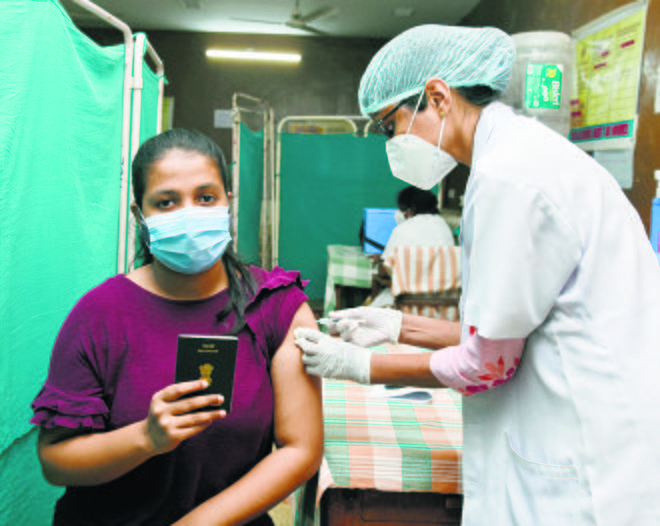
The district administration in collaboration with the Army (Western Command) and Avtar Education Trust organised a vaccination camp under Mission Fateh 2.0 at Heritage Public School, Jagatpura, here.
Appreciating the initiative, Deputy Commissioner Girish Dyalan said 100 doses each were procured and provided by the family of martyr Col Sanjay Rana and Avtar Education Trust.
Dayalan said a large number of ex-servicemen were supporting the campaign and the Army provided doctors, paramedics, support staff, ambulances and other necessary equipment for the camp on Thursday.
He said Jagatpura village was densely populated and efforts were being made for maximum vaccination on priority basis.
“This will not only help in curbing the current wave of Covid but also help in achieving the target of 100 per cent vaccination in the district,” he said.
Col Jasdeep Singh Sandhu, Director, Civil Military Affairs and Joint Operations, Western Command, said the Commander Lt General RP Singh had decided to extend all possible cooperation to the district administrations for expanding vaccination campaign.
He said the vaccination camp emerged as a model in which the Army provided doctors, paramedics, ambulances, etc.
“Such efforts by the Army will continue in future as well,” said Colonel Sandhu.
Kinshuka Sethi, director, The Heritage Public School and Nodal Institute of Security Guards, said the school teachers went door to door to sensitise people on vaccination.
Army pays floral tributes to soldier who slipped to death in Jammu and Kashmir
The Army on Saturday paid floral tributes to Sepoy Arun Singh who had slipped to death while on an area domination patrol in Shopian district of Jammu and Kashmir.
In a solemn ceremony at Badamibagh Cantonment, officiating Corps Commander, Chinar Corps, Major General Anupam Bhagi and all ranks paid homage to the gallant soldier on behalf of the proud nation, a defence spokesman said here.
He said Singh was on Area Domination Patrol from Sedhau to Tangimarg when he slipped and fell into the Vishwa River while crossing a wooden bridge at Ada on Friday.
The soldier was swept downstream due to the fast current of the river before he was finally pulled out by other soldiers and civilians, the spokesman said.
Singh was immediately evacuated to a hospital where he was declared dead.
Singh (26) had joined the Army in 2016 and belonged to Gho Mangni village of Pathankot Tehsil, Pathankot district in Punjab. He is survived by his parents, the spokesman said.
“The mortal remains of Arun Singh were taken to his native place where he would be laid to rest with full military honours. In this hour of grief, the Army stands in solidarity with the bereaved family and remains committed to their dignity and wellbeing,” he said. — PTI
Observe anniversary of ordinance promulgation by Centre as ‘Sampoorna Kranti Diwas’
BKU (Ekta Ugrahan) members protest in Bathinda.
Tribune News Service
Patiala/Muktsar, June 5
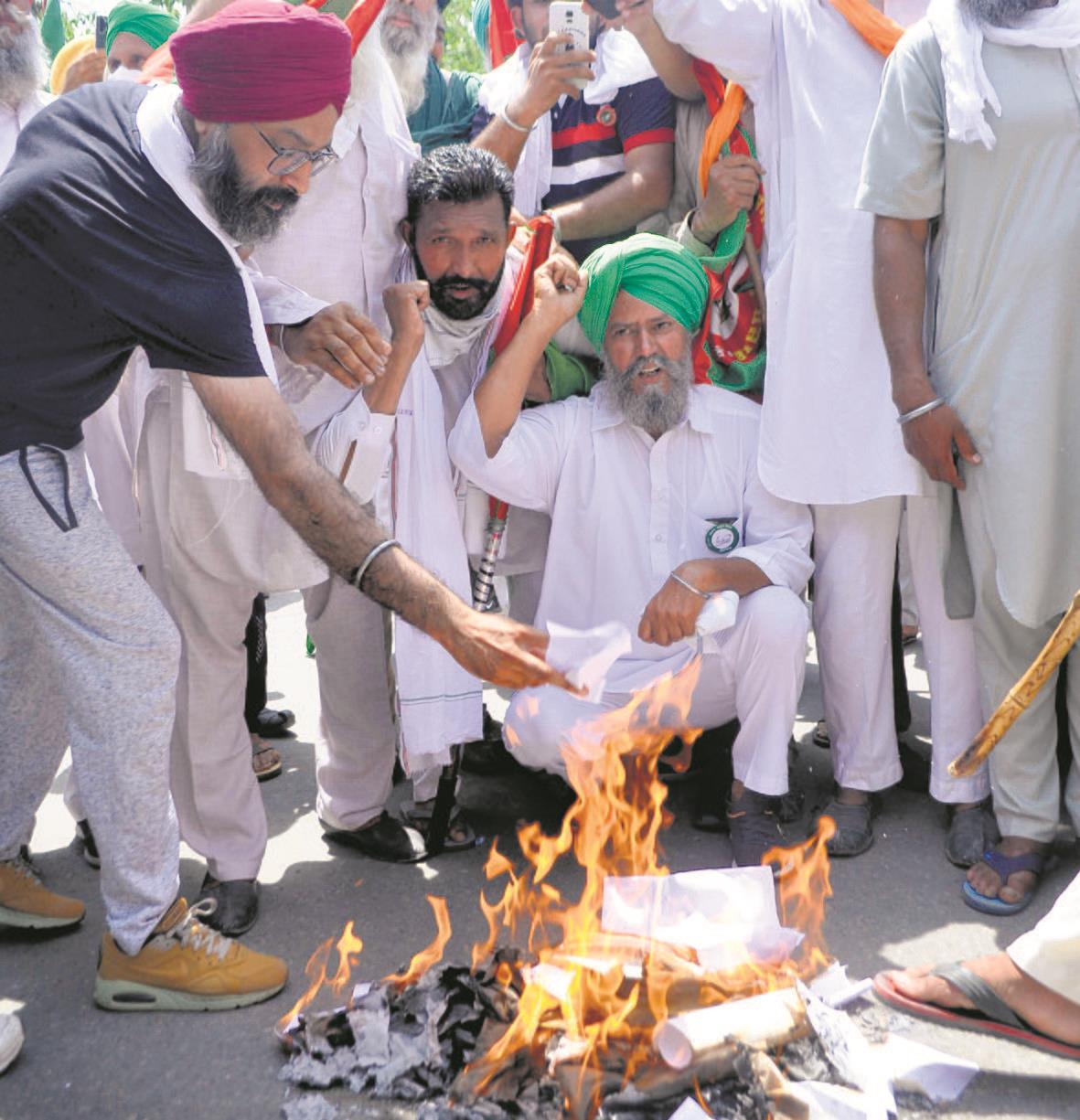
Farmers burnt the copies of the Centre’s three farm laws near residences of BJP leaders and at other places in Patiala and Rajpura on Saturday, observing the day of the promulgation of the farm ordinances last year as ‘Sampoorna Kranti Diwas’.
Farmers carrying black flags raised slogans against the BJP-led central government for not scrapping the legislation which, they said, would destroy the farming community.
Farmers burn copies of the laws in Patiala on Saturday. Pawan Sharma & Rajesh Sachar
Farmers gathered in Rajpura and burnt the hoardings of BJP leaders, including Harjeet Grewal, while in Patiala they protested against BJP leader Bhupesh Aggarwal. Heavy police was deployed and barricades put up near the protest sites to maintain law and order, even as farmers managed to reach the protest sites.https://f55994d636d761f1a2a3ee6aa68d85f6.safeframe.googlesyndication.com/safeframe/1-0-38/html/container.html
In Muktsar, the district police had made strict security arrangements near the residence of BJP’s Muktsar district president Rajesh Pathela. The farmers could not reach there and burnt the copies of the three farm Bills on Tibbi Sahib Road at some distance. In Bathinda, the BKU (Ekta Ugrahan) staged a protest outside the houses of BJP leaders Dyal Dass Sodhi at Tungwali and Vinod Kumar Binta at Bhucho Mandi. The farmers also burnt the copies of the laws outside the office of the SDM, Talwandi Sabo, and staged a protest at Fire Brigade Chowk here.
Senior leaders Mothu Singh Kotra and Harjinder Singh Baggi said the new laws were being rolled out in the name of economic reforms by the BJP government. They said attempts were being made to tarnish the image of Punjab by fanning the flames of religious issues.
In Jalandhar, farmers burnt copies of the three farm ordinances and marched to the residence of BJP leader Manoranjan Kalia to mark a year of the passing of the farm laws and the anniversary of the protests at the Delhi borders. Members of the BKU (Rajewal) held protests at the DC office, Nakodar, while those of the Kirti Kisan Union and Dehati Mazdoor Sabha raised slogans and burnt the copies of the laws outside BJP leaders’ residences.
‘Corporates making products costlier’
Farm leaders Mothu Singh Kotra and Harjinder Singh Baggi said by handing over public institutions to corporate houses, household products and facilities were becoming inaccessible to the people of the country due to their high cost. They said attempts were being made to tarnish the image of Punjab by fanning the flames of religious issues.
Mob storms Assam Rifles camp after Manipur man killed in firing
One person was shot dead allegedly by a staff of the Assam Rifles in a village in Manipur’s Kangpokpi district, triggering a mob to storm a camp of the para-military force in the area, police said on Saturday.
Posts on torching of an Assam Rifles vehicle are being circulated on social media but it could not be confirmed by the authorities.
The victim was fired upon in Chalwa village on Friday night and he succumbed to his injuries on way to a hospital in state capital Imphal early Saturday, Superintendent of Police P Goulungmuon Singsit said.
It is still not clear what led to the incident in the village.
The SP told PTI that following the shooting incident, a group of villagers reached the local Assam Rifles camp and demanded that the force hand over the accused to them.
The situation was tense in the area till Saturday morning but the police brought the situation under control, Singsit said.
A case was registered in this regard at Kangpokpi police station.
The Assam Rifles spokesperson could not be reached for comment.
The para-military force personnel have been deployed in Manipur to help the state administration in counter-insurgency operation. PTI
Produces higher level of antibodies, shows study on health staff
A health worker administers a vaccine dose to a student in Hyderabad. PTI
Aditi Tandon
Tribune News Service
New Delhi, June 5
Indian healthcare workers have shown high immune response to Covid after receiving the two mandated doses of both domestically manufactured vaccines —Covishield and Covaxin.
A preprint of the first Indian study among doctors and nurses who received both shots shows that a higher proportion of those inoculated with Covishield produced antibodies compared to those who received Covaxin, even though both shots elicited a good immune response.
“Among 515 healthcare workers (305 male, 210 female), 95 per cent showed seropositivity (higher antibodies) after two doses of both vaccines. Of the 425 Covishield and 90 Covaxin recipients, 98.1 per cent and 80 per cent, respectively, showed seropositivity. However, both seropositivity rate and average rise in anti-spike antibody was significantly higher in Covishield versus Covaxin recipients,” the study authors show.
The study highlights the significance of speedy vaccination to avert a potential third wave of the pandemic, signalling the urgency of expanding the coverage, which is running low due to stock shortages of Covaxin and Covishield.
While no difference was observed in relation to gender, body mass index, blood group and any comorbidities, people aged 60 years and above or those with type 2 diabetes had a significantly lower seropositivity rate, indicating a comparatively lower antibody response. The study also shows a good safety profile for both vaccines.
“Both the vaccine recipients had similar solicited mild to moderate adverse events and none had severe or unsolicited side-effects. In conclusion, both vaccines elicited good immune response after two doses, although seropositivity rates and median anti-spike antibody titre was significantly higher in Covishield compared to Covaxin arm,” researcher AK Singh says.
India has so far inoculated 43 per cent of its 60-plus people with one dose (the rates being as low as 35 per cent in Punjab, 39 in Telangana, and as high as 78 in Himachal Pradesh and 80 in Tripura). In the 45-plus group, 37 per cent people have received at least one dose.
The government is hoping to reach all 95 crore adults by December this year, with vaccine stocks expected to improve from June.
Delhi to ease curbs further from June 7
Govt, private offices to reopen with 50% attendance
Kolkata: BKU leader Rakesh Tikait, accompanied by three other farmer leaders, will meet West Bengal CM Mamata Banerjee in Kolkata on June 9. Sources said they would formally invite Mamata Banerjee to the farmers’ protest site on the outskirts of Delhi to address the agitators there. tns
Govt: Appoint officers to help kin of deceased
New Delhi: The Department of Personnel & Training (DoPT) has asked all Central ministries and departments to appoint nodal officers to help deceased employees’ kin get their monetary and other entitlements as quickly as possible. Details of the nodal officer may be displayed on the official websites of offices at different levels. TNS
Delhi’s doorstep ration delivery plan ‘blocked’
New Delhi: The Centre has stopped Delhi Government’s doorstep delivery of ration scheme, scheduled for rollout next week, for not seeking prior approval, said sources. — PTI
A months-long clash between India and China on their Himalaya border has dramatically increased tensions. But the growing rivalry between the two Asian powers is also likely to play out in the Indian Ocean. China’s navy is capable and only getting bigger, and India is trying to catch up Last year, an all-out brawl between Chinese and Indian troops along the disputed Sino-Indian border killed 20 Indian and at least four Chinese soldiers. The medieval-style battle in the Himalayas showed that the countries’ rivalry is entering a new phase of intensity. “China is definitely factoring larger and larger in India’s defence strategy today,” Timothy Heath, a senior international and defence researcher at the Rand Corporation think tank, told Insider. The military focus of that rivalry has primarily been on the ground, as reflected by the build-up in the Himalayas, but another area is growing in importance: the Indian Ocean. With some of the world’s most important trade routes running through it, the Indian Ocean’s value is hard to understate, which China has already recognized. “Given its importance for China, it’s pretty obvious the Chinese are elevating in priority the security needs for the maritime silk road,” Heath said. “That means India has to be ready for possible situations involving China.” But Indian dominance in its home waters is far from assured. While India’s navy has some advanced capabilities, China’s People’s Liberation Army Navy, or PLAN, is substantially larger and more sophisticated. With the rivalry entering a new phase, India is trying to catch up. Outnumbered At Sea The Indian navy isn’t small or weak. Its primary combatants include 10 destroyers, 13 frigates, 17 submarines, and one aircraft carrier. A number of India’s warships, like its Kolkata-class destroyers and Shivalik-class frigates, were commissioned within the last decade and have stealth capabilities. Some Indian ships have modern vertical launching systems and are armed with Russian and Israeli anti-ship and anti-aircraft missiles. India’s navy also has the BrahMos supersonic missile, a joint Indian-Russian design that is one of the fastest missiles in the world. Two of India’s submarines are nuclear-powered: one attack submarine (SSN) on loan from Russia and one Arihant-class domestically designed and built ballistic-missile submarine (SSBN) – the first SSBN for a non-permanent member of the UN Security Council. India expects to commission a second Arihant SSBN and a second aircraft carrier (also domestically designed and built) within the year. But the Indian navy is outnumbered and outclassed by the PLAN. Chinese ships are “largely composed of modern multi-role platforms featuring advanced anti-ship, anti-air, and anti-submarine weapons and sensors,” according to a 2020 Pentagon report. By comparison, India is “still quite a way behind the Chinese in their warship development,” Heath said. “The Chinese have certainly developed some very impressive platforms, and the Indians are really trying to catch up.” The Indian navy’s primary fighting vessels are outnumbered by the PLAN’s South Sea Fleet alone, which has some 11 destroyers, 19 frigates, 22 submarines (including two SSNs and four SSBNs), and one aircraft carrier. The PLAN, now the largest navy in the world, can draw on even more vessels from its two other fleets. To address the imbalance, the Indian navy plans on acquiring a number of new and advanced vessels, especially nuclear-powered and diesel-electric submarines. Two more Arihant-class SSBNs are in production and are expected to join the fleet by 2025. Three more larger SSBNs from the new S5-class are also being planned. The Indian navy also hopes to build six Project-75 Alpha-class SSNs and to replace its leased Russian SSN INS Chakra (which will be returned soon) with another leased Akula-class SSN by 2025. Six new Project 75I-class diesel-electric attack submarines have been delayed but could start entering Indian service by 2030. A third aircraft carrier, INS Vishal, is planned to replace the aging INS Vikramaditya. The new carrier, not expected to be completed before 2030, may be based on the UK’s Queen Elizabeth-class supercarrier. Seven brand-new Nilgiri-Class stealth frigates are also under construction, and four Admiral Grigorovich-class frigates, two built by Russia and two by India, are also expected to join India’s navy before the end of the decade. China’s ‘String of Pearls’ There is little doubt in India that the new vessels are needed. Although China is relatively far from the Indian Ocean, it has ramped up its activity there. Over the last few years, China has taken control of ports across the Indian Ocean that have the potential to support the PLAN – a network that has been called China’s “String of Pearls.” “People have been theorizing about the so-called String of Pearls for years,” Heath said. “We are actually starting to see some evidence of the Chinese implementing something along these lines.” China has taken control of a port in Sri Lanka, is building naval facilities in Pakistan, and is pursuing port projects in Myanmar, Bangladesh, and Tanzania. China already has a military base in Djibouti, but other “pearls” appear to be primarily for civilian use. That doesn’t mean those facilities couldn’t be used to support PLAN vessels. A number of Chinese ships and submarines have already docked at Sri Lanka to refuel and resupply. Sri Lanka has since denied Chinese requests for other warship port visits due to Indian concerns. “The Chinese are not interested in building full-fledged bases in the US model,” Heath said. “These are facilities that primarily offer refuelling, repair, and replenishment to passing warships.” India does have a few advantages over China. As the region is its backyard, it will always be able to bring more to bear against threatening Chinese vessels, such as land-based aircraft and anti-ship missiles. India also has its own overseas outposts. It has set up radar stations for maritime surveillance in Sri Lanka, Seychelles, and Mauritius; it’s constructing facilities on the Mauritian island of North Agalega, and it’s pursuing military facilities elsewhere in the region. India also controls the Andaman and Nicobar Islands, strategically important islands on the Indian Ocean side of the Malacca Strait. India has beefed up its military presence there, and some advocate allowing partner countries to have a presence there as well. (A US Navy patrol plane has already refuelled there.) Despite the government’s renewed attention, India’s navy still has a ways to go. Most of its new ships and submarines will not be fully operational until the end of the decade at the earliest, and its budget is still smaller than that of India’s army or air force. India’s navy will also have to compete with the considerable attention that remains focused on India’s land borders, where New Delhi also has to worry about Pakistan, the rival it has focused on almost exclusively since independence. But the rivalry with Pakistan also has a naval element. The Pakistani terrorists who carried out the deadly 2008 attack in Mumbai arrived by sea, and Islamabad, which is a Chinese military partner, is modernizing its own navy, including with Chinese submarines and drones.
KASHMIR FACES DEEP THREAT AS PAKISTAN OFFERS TACIT SUPPORT TO HOUSTON NETWORK TO SPREAD ISLAMIC FANATICISM, SEPARATISM IN VALLEY
All across the United States, the Pakistani regime and its cheerleaders exploit the question of Kashmir to advance Islamist interests and attack India, in state and federal legislatures, newsrooms and town halls The Pakistani regime, making use of lobbyists, Congressmen, terror supporters, and well-organised grassroots networks of American Pakistani Muslims, is working hard to advance a radical, Islamist-inspired agenda at the highest levels in the United States, using Kashmir as its cause. One Texas-based group, Friends of Kashmir, stands at the forefront of one of these efforts. On 5 August, 2020, Friends of Kashmir and its head a prominent pro-Pakistani activist, writer and self-described poet named Ghazala Habib organised an online event, in collaboration with the Pakistani embassy and its consulate in Houston, to discuss the “Crisis in Kashmir.” In a sign of the Pakistani regime’s growing influence, speakers included the two co-chairs of the United States Congress’s Pakistan Caucus, the president of Pakistan-administered Kashmir, and the Pakistani ambassador to the United States and the Houston consul-general. Other advertised speakers included Congresswoman Eddie Bernice Johnson, along with Texas state legislators Ron Reynolds and Terry Meza. Sharing a screen with such illustrious figures, however, were open supporters of terror. Extremists And Congressmen The webinar was held to mark Youm-e-Istehsal, or ‘Day of Exploitation,’ an annual event recently established by Imran Khan’s government to bemoan India’s “seizure” of Kashmir in 2019.
During the webinar, broadcast on social media and American Pakistani television channel TVOne USA, Congressional Caucus co-chairs Representatives Jim Banks and Sheila Jackson Lee offered the dignified remarks expected of seasoned statesmen. Banks, who has otherwise been an outspoken critic of South Asian Islamist movements, explained his intention to “draw attention to what’s going on in Kashmir” and “provide American leadership.” Jackson Lee expressed broad support for “security” and “human rights.” She fleetingly praised Imran Khan’s leadership but quickly switched to topics such as COVID and unrelated events in Lebanon.
State Stalwarts
DEFENCES FORCES RANKS
ARMY, NAVY, AIRFORCE RANKS
FORMATION SIGNS
FORMATION SIGNS
ALL HUMANS ARE ONE CREATED BY GOD
HINDUS,MUSLIMS,SIKHS.ISAI SAB HAI BHAI BHAI
CHIEF PATRON ALL INDIA SANJHA MORCHA
LT GEN JASBIR SINGH DHALIWAL, DOGRA
SENIOR PATRON ALL INDIA SANJHA MORCHA
MAJOR GEN HARVIJAY SINGH, SENA MEDAL ,corps of signals
.
.
PATRON ALL INDIA SANJHA MORCHA
MAJ GEN RAMINDER GORAYA , CORPS OF
sanjhamorcha303@gmail.com
PRESIDENT HARAYANA STATE CUM COORDINATOR ESM
BRIG DALJIT THUKRAL ,BENGAL SAPPERS
PRESIDENT TRICITY
COL B S BRAR (BHUPI BRAR)
PRESIDENT CHANDIGARH ZONE
COL SHANJIT SINGH BHULLAR
.
.
PRESIDENT PANCHKULA ZONE AND ZIRAKPUR
COL SWARAN SINGH
PRESIDENT SAS NAGAR (MOHALI)
COL BALBIR SINGH , ARTY
INDIAN DEFENCE FORCES
DEFENCE FORCES INTEGRATED LOGO
FORCES FLAGS
15 Th PRESIDENT OF INDIA SUPREME COMMANDER ARMED FORCES
Droupadi Murmu
DEFENCE MINISTER
Minister Rajnath Singh
CHIEF OF DEFENCE STAFF (2nd)
General Anil Chauhan PVSM UYSM AVSM SM VSM
INDIAN FORCES CHIEFS
CHIEF OF ARMY STAFF(29th)
General Upendra Dwivedi, PVSM, AVSM (30 Jun 2024 to Till Date)