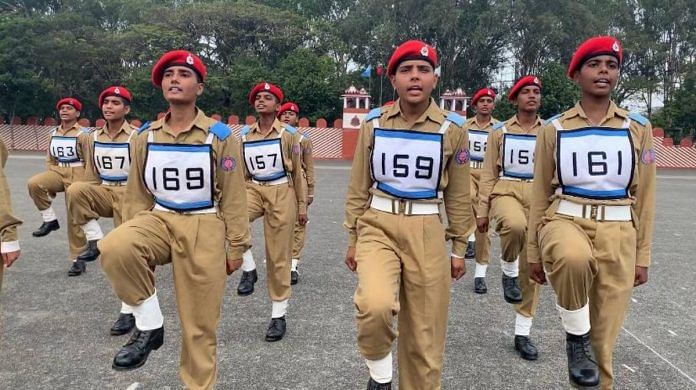
File photo of women recruits at the Corps of Military Police Centre and School in Bengaluru | Rohini Swamy | ThePrint
Text Size: A- A+
New Delhi: The Army has received such an overwhelming response to its initiative of recruiting women in the Military Police Corps — started two years back — that the shortlisting of candidates had to be based on a steep cut-off of over 80 per cent score in the Class 10 examinations, top Army officers told ThePrint.
In 2019, when the Army first invited applications from women for 100 posts in the Military Police Corps, the eligibility criteria for applicants had been an aggregate score of at least 45 per cent in the secondary examinations and an individual score of at least 33 per cent in all subjects. However, because of the 1.5 lakh applications received for vacancies numbering only a hundred, the cut-off for shortlisting candidates in 2019 became a much higher 86 per cent.https://38aeca62040cc687999359204f092b29.safeframe.googlesyndication.com/safeframe/1-0-38/html/container.html
The following year, in 2020, the cut-off for shortlisting candidates was 84 per cent, though the eligibility criteria had still been 45 per cent.
In both years, the notice inviting applications had mentioned that a cut-off list would be generated after the registration of the candidates was completed and only a limited number of candidates, proportionate to the vacancies, would be issued admit cards for the written exams for the candidates. This is followed by a medical examination.
Confirming this, a senior Army officer told ThePrint: “The demand was high. Thus, to shortlist candidates, the cut-off percentage had to be fixed at 86 and 84 percentage in the past two years.”
In both 2019 and 2020, the response to the recruitment notice was overwhelming. According to sources in the Army, up to 1.6 lakh women registered in 2019 and 2020, for the 100 positions advertised in both years.
Explaining the huge demand for the job, a senior government official said it could be because of the general attraction that many people have for military jobs — not only because of the thrill and adventure associated with such jobs, but also because of the security and other benefits usually associated with a government job.
“This assumes more significance in the current situation when the private job market is not at its best and unemployment remains high,” said the official.
When recruitment was opened for women in 2019, the idea was to recruit 100 women for the unit every year, so that the Military Police Corps would have a total strength of 1,700 women at the end of 17 years. This would be 20 per cent of the total strength of the Corps. A mid-term review is scheduled to be carried out after nine years.
The aim of this initiative was to give women more active military duties.
Dr (Major General) Rashmi Datta (Retd) told ThePrint the sheer number of women keen on joining the Army’s military police every year shows an attempt on their part to break the proverbial glass ceiling in the armed forces.https://38aeca62040cc687999359204f092b29.safeframe.googlesyndication.com/safeframe/1-0-38/html/container.html
The Army last month invited online applications for the third batch of women recruits. As in the past two instances, the criteria listed for applicants is an age limit of between 17-and-a-half years and 21 years, and a higher secondary aggregate score of 45 per cent, with an individual subject score of 33 per cent.
The last date for sending in the applications is 20 July.
For male soldiers, the basic eligibility for applications is a 45 per cent aggregate score in secondary examinations. Following this, the first round of shortlisting is based on a test of physical efficiency, which is followed by a medical examination and written tests.
The number of vacancies for male soldiers is also considerably higher, since they are recruited in not just the Police Corps, but many other arms. Region-wise recruitment is done, as against for women being recruited in military police, where vacancies are limited and recruitment is done on a pan-India basis.
The first batch of 100 women recruits had successfully completed their 62 weeks of basic and advanced provost training that started in January 2020 at the Corps of Military Police Centre and School in Bengaluru. About 40 per cent of them have now been deployed in different units in Jammu and Kashmir and the Northeast in the rank of lance naiks.
Along with their basic military training, all the women have also been taught to drive.
The shortlisting for the second batch of women military police personnel has also been completed, but owing to the existing Covid-19 restrictions, their recruitment process is yet to be completed.
Army sources said their training could commence towards the last quarter of this year.
Women military police personnel in the future will have a role in combatting counter-insurgency, as well as in ceremonial roles and police duties such as crowd control and investigation of offences involving women and children.
Dr (Maj. Gen.) Rashmi Datta (Retd) told ThePrint that while the glass ceiling still exists for women in the defence forces, the volume of applications received for the positions in the Military Police Corps, shows women are keen to smash it.
“With women getting the required military training, I hope it turns out to be an eye opener for the other arms too and it prompts them to take in women recruits,” she said.
She said more women recruits joining here will also show the men what their daughters back home are capable of, and added that it would give a fillip to women empowerment in the country.
“But, a lot of responsibilities also lie with these women, in conducting themselves as professional soldiers, to ensure more and more women are encouraged to join the forces,” she said.
Last year, ThePrint had been the first to report that the Army had commissioned a study to assess the feasibility of inducting women in ranks other than officers, and the possible branches these recruits can be inducted into.
In weeks before Galwan Valley clash, IAF had helped deploy Army personnel and equipment to Ladakh, besides bringing in winter stocks for the additional soldiers posted there.
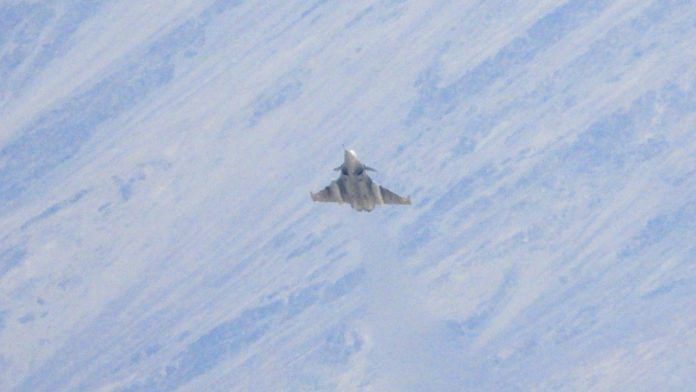
A Rafale fighter jet of the IAF seen flying in Leh last month | ANI
New Delhi: Weeks after the India-China stand-off began in Ladakh last year, soldiers on the two sides faced off in the Galwan Valley as a disengagement attempt was derailed by the refusal of the Chinese to keep up their end of the deal. Twenty Indian soldiers, including Commanding Officer Col. B. Santosh Babu, were killed in action.
This was the first time since 1975 that Indian soldiers had died in a clash on the India-China border, and the episode marked a shift in the nature of the stand-off. That is when the Indian Air Force (IAF), which has a considerable advantage along the Line of Actual Control (LAC), was brought in for active combat deployment in the area.
In the weeks before, the IAF had been helping deploy Army personnel and equipment, including tanks and armoured personnel carriers, besides bringing in winter stocks for the additional soldiers posted in Ladakh.
A year on, the IAF remains operationally deployed against China, with fighter aircraft continuing with forward deployment along with new radars and surface-to-air missile sites close to the LAC.
“The IAF, which was deployed fully after the Galwan clash, continues to remain operationally deployed,” a senior government source told ThePrint.
As its role in Ladakh underwent a shift last year, the IAF put in place a full offensive and defensive deployment to counter China’s strategy of “Anti Access Area Denial (A2AD)”, sources in the defence establishment said.
This strategy involves restricting the enemy’s freedom of movement in the battlefield, and saw China deploy a wide range of surface-to-air missile (SAM) sites and long-range radars, apart from a large number of soldiers, artillery, rocket forces and armoured elements, the sources said.
The IAF, in turn, deployed assets of multiple commands against China. Unlike the Army and the Navy, the deployment of assets in the IAF is centrally controlled. In times of need, the IAF headquarters decides where the assets are to be deployed.
The assets deployed ranged from transport aircraft like AN32, C-130J and C-17, to helicopters, including Apaches and Chinooks, besides fighters, including Rafale. The deployment also included surface-to-air missiles, radars and increased surveillance duty, the sources said.
For ground staff and specialists in the IAF, this marked the first time they were deployed in extreme high-altitude areas along the LAC, close to the site of friction, the sources said.
“The 15 June Galwan clash changed everything. The casualties meant that there was every possibility of things going in a very different direction than what was anticipated initially,” said a source in the defence establishment.
“The IAF has considerable advantage along the LAC and a decision was taken to induct the force into active combat deployment.”
While China has an edge over India in its air defence systems, the Indians have an advantage over the former in the high-altitude Ladakh sector from a pure air-to-air combat perspective.
One of the biggest disadvantages for China’s People’s Liberation Army Air Force (PLAAF) is that all their bases in the Tibet region are far away from the LAC and are at high altitudes, unlike India’s.
And because of high altitudes, the fighters cannot take off with full fuel or weapons packages. This means that the high altitude effectively saps the energy of the fighters.
China brought five of its ‘fifth-generation’ Chengdu J-20, also called the Mighty Dragon, in July, days before India got its first set of Rafale fighters earlier that month.
These fighters remained deployed till March this year. Sources said it was flexing of muscles by China ahead of the induction of the Rafale aircraft.
“Chinese had set up new SAM sites, which basically included HQ 9, 22 and 16 (types of SAM). The Chinese had also deployed Russian systems,” a source said.
“The Chinese broader thought process for defence is A2AD, which stands for Anti Access Area Denial. They do the same in the South China Sea also. They first deny access and then deny the area,” the source added.
Anti-access is limiting enemy military movement into an area of operations and involves the use of fighters, warships, and specialised ballistic and cruise missiles designed to strike key targets. Area denial is denying enemy freedom of action in areas under friendly control and employs more defensive means such as air and sea defence systems.
“Their entire deployment is based on this concept and they sought to do the same in Ladakh. Hence, there was a need for a combined response to Chinese aggression and that is exactly what was done,” the source said.
IAF deployment took place in hours
It is believed that the IAF had fine-tuned a fresh plan in mid-2019 on what all needs to be done in case tensions break out along the LAC.
After Galwan, within hours of the decision by the government, fighters from multiple locations flew off to ramp up presence in the airfields nearer to Ladakh. This included bases in Haryana, Punjab, and Jammu and Kashmir.
For example, the Mirage 2000s, which operate from Gwalior, moved to bases near Ladakh. While the IAF has capabilities of mid-air refuelling, the movement closer to Ladakh was to ensure that the fighters can reach the location in minutes if needed.
The IAF started off with aggressive combat air patrols (CAPs) near the LAC as ground support staff and equipment were deployed.
The IAF also extensively deployed its unmanned aerial vehicles to keep track of Chinese movement and deployment besides depending on satellite imagery.
When the tensions broke out, sources said, it was realised that there were certain gaps, specifically with ground air defence assets. To counter this, India started deploying its SAM assets in the region.
“We did not have too many radars along the LAC. The Chinese have a flatter terrain on their side of the LAC and hence it was easy for them to move in and set up radars and SAMs. In total, about 8-10 new SAM sites were established by the Chinese. We built up too,” another source said, refusing to get into the numbers.
Sources said IAF ground staff co-located themselves with both the Army and the ITBP, depending on who held what areas.
The deployment of equipment also meant that IAF specialists had to be deployed in the area. Many locations were very close to the scene of friction and this meant that IAF ground staff and specialists were deployed in certain forward locations for the first time, and, that too, right through the winter.
The IAF also went in for faster operationalising of the Rafale fighter jets soon after they came in July. It went in for the emergency procurement of the French HAMMER air-to-ground precision-guided weapon system as well to deploy the Rafale faster.
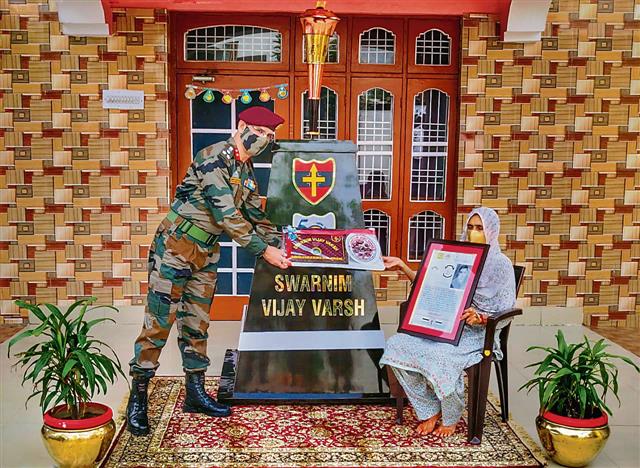
Veer Nari Pushpa Devi, wife of the late Lance Naik Gullu Ram of 8 Grenadiers, being felicitated in Akhnoor, J&K.
Major Ishleen Kaur
The history of any army is replete with immortalised tales of selflessness, camaraderie and the ultimate sacrifice. While soldiers who have brought victory have been inscribed in the memories of the country as ‘Forever Young’, there are women who have faced the brunt of these wars not by facing the nameless bullet, but by bravely living the turbulent life that comes after a war. On the 50th anniversary of the 1971 Indo-Pak war, and to commemorate the victory, homage is being paid along the length and breadth of the country to the fallen, and respect to the veterans and Veer Naris.
As the Akhnoor-based Crossed Swords Division commenced on a humble odyssey to pay respect to veterans and felicitate Veer Naris, what emerged were stories of courage, valour, hardships and sacrifices. The Division set out to recognise and felicitate the wives, mothers and daughters of the men who returned home wrapped in the Tricolour without a chance to say their words of farewell.
“I do not want to be called a victim of war. I was strong enough to survive on my own,” a Veer Nari famously said, echoing the sentiments of many like her. To understand the story of a soldier, one must fathom the depth of their moist eyes. The war left us with many such stories, but those of Git Kaur, Kanta Devi, Karnataro Devi, Simro Devi and Pushpa Devi can melt any heart. These women were at the epitome of marital bliss, proud to be married to men who donned the olive green in a society that has a rich martial tradition. Belonging to Jammu and its nearby areas, these Veer Naris have struggled to live their lives without their husbands for the past 50 years, but have emerged as stellar examples of what true grit, determination and courage mean.
Git Kaur, wife of the late Sepoy Balwant Singh of the 5th Battalion, Sikh Regiment, lives a mere 30 km from Chhamb-Jaurian, the place where her husband made the supreme sacrifice. A mother of two, the latter of who never saw her father, she recounts how the indomitable spirit she imbibed from her husband pushed her on when times seemed bleak, with the relentless support of the Army.
Kanta Devi, wife of the late Havildar Amarnath, Sena Medal, of the 8th Battalion of JAK Light Infantry, still vividly remembers the playful jokes of her husband, who used to say that the Army would be with her long after he’d gone. He lost his life defending his homeland just 15 km from his home in Sunderbani. Times were tough thereafter; goons and thugs assuming her to be a soft target tried to extort money, but were warded off with the assistance of the Army. Her two sons and a daughter, one of whom serves in the CRPF, are now well settled and happily married.
Turned into a refugee in her own country during the 1971 war, Karnataro Devi, wife of the late Sepoy Sundurilal of the 5th Battalion of the Dogra Regiment, came to know about her husband’s martyrdom three months after the war, when his mortal remains arrived, as the roads from Kargil were blocked due to the hazardous weather. But fate had yet more tests for her; she lost her young son to an ailment soon after. However, with a will to fight on, she rallied her courage and worked even harder to provide the best for her daughter, the last living symbol of her eternal bond with a soldier.
The story of Simro Devi, wife of the late Sepoy Sahib Singh of the 9th Battalion of JAK Light Infantry, is yet another tale to draw inspiration from. Only a mirage remained of the dreams the couple had woven together of having a daughter and bringing her up with love and care, but after the demise of her husband, life was altered and gloom lay heavy upon the young woman. Nevertheless, she found her inner strength and took up tailoring to lead a life of respect and dignity. She adopted a girl and raised her the way they had dreamt of, to honour the wishes of her late husband.
The moist eyes of Pushpa Devi, wife of the late Lance Naik Gullu Ram of 8 Grenadiers, tell a story of perseverance without a single word being uttered. Sorrow and grief may have wrinkled her features, but not her spirit. Gullu Ram made the supreme sacrifice while fighting the enemy in the battle of Chakra in the Shakargarh bulge.
These stories form a part of the tapestry that is the Indian Army and the countless sacrifices made for the country. These also serve as an inspiration in these trying times of the pandemic, when uncertainty looms large. It sends out a message that even after such an ordeal if a person can survive and thrive in this world, there is no obstacle that the human endeavour cannot surmount.
Army releases video in tribute to ‘heroes of Galwan’
Nearly five-minute video captures glimpses of the lives of soldiers deployed along the ice-capped mountains
Maj Gen Akash Kaushik, Officiating GOC Fire and Fury Corps laid a wreath at Leh War Memorial and paid homage to martyrs who laid down their lives at Galwan on 15 Jun 2020 while fighting for the Nation. PTI
New Delhi, June 15
On the first anniversary of the Galwan valley clashes, the Indian Army on Tuesday released a video song in a tribute to the Indian soldiers who fought valiantly in a fierce hand-to-hand combat with Chinese troops in the treacherous region of eastern Ladakh to defend India’s territorial integrity.
Sung by popular singer Hariharan, the song titled ‘Galwan ke Veer’ highlights the valour of the Indian troops guarding the Galwan and some other inhospitable regions along the country’s northern frontier and says the “heroes” had risen to the occasion when challenged on the mountains.
The nearly five-minute video captured glimpses of the lives of soldiers deployed along the ice-capped mountains of the high-altitude region including their round-the-clock vigil, training and combat readiness to deal with any threat.
On the first anniversary of the deadly clashes, the Army said the supreme sacrifice of the soldiers will be “eternally etched” in the memory of the nation.
Twenty Indian Army personnel laid down their lives in the clashes on June 15 last year in Galwan Valley, an incident that marked the most serious military conflicts between the two sides in decades.
In February, China officially acknowledged that five Chinese military officers and soldiers were killed in the clashes with the Indian Army though it is widely believed that the death toll was higher.
Both sides rushed in a large number of battle tanks, armoured vehicles and heavy equipment in the high-altitude areas of the region after tension escalated following the deadly clashes.
Colonel Bikumalla Santosh Babu, the commanding officer of the 16 Bihar regiment, had led from the front against the Chinese aggression near Patrolling Point 14 in Galwan Valley.
In January, he was posthumously awarded Mahavir Chakra, the second-highest military award for acts of gallantry in the presence of the enemy.
The Army last year built a memorial for the ‘Gallants of Galwan’ at Post 120 in eastern Ladakh.
The memorial mentioned their heroics under operation ‘Snow Leopard’ and the way they evicted the PLA troops from the area while inflicting “heavy casualties” on them.
The names of the 20 Army personnel were also inscribed on the National War Memorial in Delhi in January last.
The two sides completed the withdrawal of troops and weapons from the North and South banks of Pangong lake in February following a series of military and diplomatic talks.
They are now engaged in talks to extend the disengagement process to the remaining friction points. PTI
Former Western Army Commander Lt Gen SS Mehta (Retd), who commanded a tank squadron that rolled into Dhaka as a greenhorn, remembers the epic battles beyond the brief
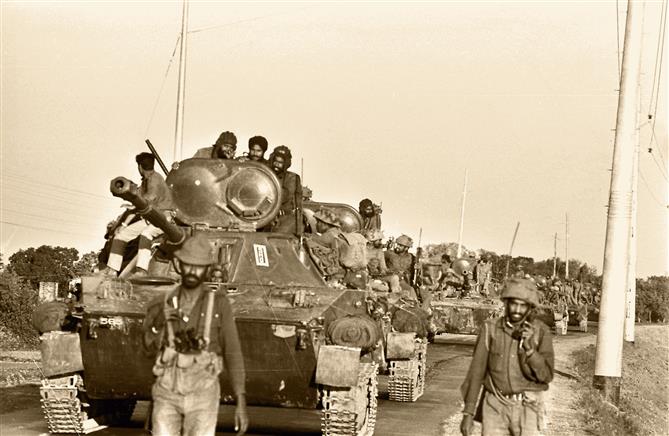
The 5 Independent Armoured Squadron (63 Cavalry) making a victorious entry into Dhaka. Troops of assorted units and some correspondents can be seen atop tanks.
Lt Gen SS Mehta (Retd)
It is now only a four-hour journey by road but 50 years ago, the Akhaura to Dhaka march that redrew the map of South Asia and rewrote its military history took us 13 tumultuous days. After a brilliant 72-hour operation at Akhaura, the enemy’s formidable stronghold — defended by a battalion of their elite 12 Frontier Force and elements of 12 Azad Kashmir, supported by tanks, artillery and air service — wilted, and whatever was left of them were in retreat.
The credit for this remarkable victory goes to 311 Mountain Brigade Group, commanded by Brig RN Mishra. The operation was a brilliant success, with 4 Guards, commanded by the dashing and inspirational Lt Col Himmeth Singh, infiltrating the enemy lines, and the lead company, commanded by Maj Chandrakant Singh, repulsing a counter-attack of infantry and tanks. Maj Chandrakant earned an instant Vir Chakra for his brave leadership.
As a young Major, I was in command of 5 Independent Armoured Squadron (63 Cavalry), equipped with PT-76 tanks. In early November, the squadron had been ordered to assist the 61 Mountain Brigade in infiltrating behind Lalmai Hills in Comilla, 63 km west of Agartala. We had done all the reconnaissance and coordination to execute the operation but, after a change in plans on November 28, the squadron was tasked to move with the infiltrating column with 4 Guards on the night of December 1. We had no time to reconnoitre and gather terrain and enemy obstacle layout along our route. It was therefore no surprise that on the night of our infiltration, we were caught in a cleverly laid anti-tank ditch on the fringes of Akhaura. 4 Guards, ahead of us, was wading through deep slush. A ditch is no obstacle for the infantry but for the tanks, it is designed to separate the infantry from the tanks.
The writer, Lt Gen SS Mehta, then a Major (right), with Lt Col Himmeth Singh, CO of 4 Guards, in the eastern sector during the 1971 war. photos: Bayerische Staatsbibliothek München/STERN-Fotoarchiv/Jay Ullal
After a night spent in recovery under intense enemy artillery fire, and faced with a relentless assault from the sky by the enemy Sabre jets next morning, we recovered in time to assist 18 Rajput, commanded by the gallant Lt Col Ashok Verma, in a successful day attack on the enemy defences guarding the Akhaura railway station. Earlier, a masterful frontal closing-in operation by 10 Bihar, commanded by the ever-cheerful Lt Col PC Sawhney — with lethal fire support provided by 65 Mountain Regiment, ably led by Col DS Bahl, and with the 57 Mountain Artillery Brigade fire support under Brig Jangi Bawa — the enemy was pulverised. Attack by infiltration was an unorthodox plan. It worked. For us, the start could not have been more propitious.
The masterstroke of crossing the Meghna river bypassing ground opposition is a classic example of an operational manoeuvre exercised targeting the enemy mind. It created shock and awe, a term now fashionable in Western capitals. The prospect of a captured Dhaka galvanised everyone up and down the security establishment. It saw Team India at its historic best. Indira Gandhi’s statement — ‘Dhaka is the free capital of a free country’ — exemplifies 20th century’s most successful humanitarian intervention against genocide surmounting all odds
Routed Pak brigade on the run
The momentous fall of Akhaura triggered a hasty retreat by Pakistan’s 27 Infantry Brigade towards Meghna river. The tank squadron and 4 Guards were in hot pursuit. Having captured the enemy advance defences at Talashahar, 4 Guards were ordered to break contact with the enemy and assemble at Brahmanbaria in anticipation of a new task, as yet under active consideration. Breaking contact with a withdrawing enemy in battle amounts to having the enemy on the ropes, yet not delivering the knockout punch. However, this is where experience and military judgement take over. At the tactical level, such a direction seemed strange; however, at the operational level, as it later turned out, the stage was being set for a bigger blow — Dhaka.
Photo by the then ADC to Lt Gen Sagat Singh, (later Maj Gen) Randhir Singh
18 Rajput and 10 Bihar continued their relentless drive towards the bridge. This reinforced the enemy perception that our objective was to capture the bridge intact. Both battalions reached within 300 yards of the bridge on the Meghna. Such speed, always necessary when in contact with the enemy, is an adrenalin booster. So it was. However, the demolished bridges and culverts delayed their redeployment. Our troops were soon beyond artillery range; besides, our Forward Air Controller, Flying Officer Shahid, had been injured and his communication equipment destroyed. With an SOS from 18 Rajput, my squadron detached from 4 Guards and joined the firefight. When we arrived, the battle was raging. The enemy brigade commander had launched a spoiling attack with infantry and tanks, supported by anti-tank guns. A melee ensued. My squadron lost three tanks in the firefight. One of them was led by my brave troop leader Lt Rajindar Mohan, who was hit by an anti-tank gun after he had silenced two of the enemy’s. He escaped with severe burn injuries. The enemy was neutralised by our joint action and their counter-attack fizzled out. Some Pakistani soldiers were killed, others escaped over the bridge, while a few got across on country boats. However, due to the ferocity of our pursuit and to prevent the capture of the Meghna bridge, the Pakistani general in command of 14 Division, Maj Gen Majid, ordered its demolition. Commanders, who leave their troops stranded across an obstacle and order its demolition, tell the story of panic in the enemy garrison.
The masterstroke
With the bridge blown, our Corps Commander, Lt Gen Sagat Singh, was at the proverbial dead end. History is replete with instances when in a battle situation there is an unanticipated pause — because of one’s own actions, or that of the enemy’s. The former gives you food for thought; the latter invariably provides you a fleeting opportunity. Our GOC could have chosen to defer the advance and draw comfort from having completed his assigned task. However, Sagat’s lifetime experience of combat told him otherwise. It served only to stoke the flame within him. For him, an opportunity beckoned. He had Dhaka in sight. He knew it was the strategic centre of gravity, the focal point — although it was beyond his brief. His experiences of the past intuitively brought a glint in his eye. He later described that day as the most exciting of his life. He could not let a brilliant opportunity go unaddressed. He knew what Dhaka meant in the larger scheme. He wagered on his intuition.
Sagat conferred with his Air Force commander, Group Captain Chandan Singh, and ordered a battalion to be flown in helicopters across the Meghna for the march to Dhaka — this later came to be known as the ‘Helibridge over the Meghna’. The battalion was 4 Guards. There was some murmur about ground fire, to which Chandan retorted: “I will be in the leading chopper.” That provided closure to the debate. The heli-lift of 4 Guards was Air Force’s golden moment. 110 Helicopter Unit under Squadron Leader CS Sandhu’s leadership, supported by a band of brave young pilots, worked with precision and a tireless turnaround schedule. They positioned the battalion across the Meghna: a feat nonpareil.
Next, I was ordered to take my tanks across the Meghna. The Soviet-made PT-76 tank was designed to cross European rivers, which are generally 200-300 metres wide. In comparison, the Meghna was almost like a sea and in the midst of the battle and when ordered to cross it, to me, it seemed like an ocean! I could not see the other bank. However, my GOC’s intent was set in stone and when he asked me whether we could cross the river, my reply was in the affirmative.
Having said that, I was not sure of the ‘how’ part of the operation. I was a greenhorn and thank God for it! Greenhorns get smitten by commanders whose reputation and charisma settle for nothing less than the best. My answer had to be a ‘Yes sir’; and so it was. The speed of the water current in the Meghna was in double digits in knots. I don’t know exactly what it was, but I could see the flow was very swift. As the rivers get closer to the Bay of Bengal, they pick speed and the current is much stronger than what the PT-76 tanks could negotiate in a near perpendicular crossing across two banks, which is often the battle requirement when the opposite bank is held. Fortunately, in our case, the far bank was not held by the enemy. Anticipating that I would have to exit downstream of my entry due to the speed of the water current, I requested for a helicopter to do a reconnaissance of the river. It was granted. Not satisfied with the first sortie, I asked for a second sortie and that too was approved. In the meantime, my troop leader, Lt Raj Khindri, assisted by the locals, had reconnoitered the home bank and found a marsh-free entry route into the river. My aerial sorties helped me to mark out small islands in the river which would allow me to make short hops. The entry and exit points to the islands were laterally separated by miles. My idea was to move from island to island — island hopping, as it were. We hopped countless times and crossed.
Team India
The masterstroke of crossing the Meghna bypassing ground opposition is a classic example of an operational manoeuvre exercised by a military commander targeting the enemy mind. It created shock and awe, a term that has now become fashionable in the Western capitals. The prospect of a captured Dhaka galvanised everyone up and down the security establishment. It saw Team India at its historic best. It led to the march of a column, infantry, tanks and guns straight into the heart of the centre of gravity. Further, as part of the teamwork at Delhi and Kolkata, 2 Para, commanded by the daredevil Lt Col KS Pannu, was on standby to paradrop at Tangail with a column of 1 Maratha under Lt Col KS ‘Bulbul’ Brar gliding down from Tura in Meghalaya for a link-up. The Navy was punishing Karachi with missiles from ships, accompanied with Petya Class frigates. The Air Force, master of the skies in the East, having successfully flown an infantry battalion across the Meghna, was targeting the Government House at Dhaka where Pakistani options to surrender or fight till the last were perhaps under discussion. At that stage, we did not know which of the two options was finding favour. Leaflets were dropped over enemy emplacements, in which Pakistani soldiers were exhorted to surrender lest they should fall into the hands of those they had tormented — the unfortunate Bengalis of East Pakistan.
Behind the scenes, the staff were busy — Maj Gen Jacob in Kolkata was deliberating the Terms of Surrender. Lt Gen Jagjit Aurora at his HQ in Kolkata, Lt Gen Inder Gill, the DGMO, and COAS Gen Sam Manekshaw were monitoring the battlefield and the developing global reactions. They were conscious that time was at a premium.
The intelligence agencies and the diplomats were tracking the Nixon-Kissinger threat of deploying the US 7th fleet into the Bay of Bengal. The trump card of the Indo-Soviet treaty, signed in August 1971, came into play and India was supported with repeated vetoes by the USSR at the United Nations Security Council. Our diplomats were also fighting Bhutto’s canards at the UN. The administrators were gearing up for a temporary governance structure in the captured territory of East Pakistan, till Bangladeshis themselves took over. Prime Minister Indira Gandhi and her colleagues held their nerve amidst intense rumours of intervention by the powers beyond.
This sort of seamless synergy is an assured recipe for success. There were tasks cut out and delivered on all fronts — military, diplomatic, political, strategic, operational and tactical. It is this synergy that enabled the capture of Dhaka after Sagat’s breathtaking Meghna river-crossing manoeuvre. I learnt early in my service that initiative is not only a trait, it is a duty.
Mukti Bahini
In 13 days, 75 million were rescued from possible genocide; it emphasised the totality of victory; shock and awe with little or no collateral damage; a historical moment to be recorded in the archives of military history in India, and across the world. It was a lesson in the inextricable linkages between grand strategy and conflict-termination objectives. Unless the two are co-terminus, victory remains but a mirage.
In 50 years since, we have witnessed numerous military interventions where the absence of appropriate, thought-out conflict-termination objectives has resulted in face-saving withdrawals. If Dhaka had not been addressed, and its surrender not achieved, one more mirage would have been added to this ever growing list.
The Mukti Bahini kept the wheel turning, keeping the momentum in our favour. In today’s age we talk about battlefield transparency rendered possible by sensors, radars, artificial intelligence and satellites. In 1971, battlefield transparency was, whenever possible, provided by the Mukti Bahini. Their presence and their will to fight for a just cause made an outstanding contribution towards the capitulation of the enemy before the Joint Command.
Indira Gandhi’s statement in Parliament — “Dhaka is the free capital of a free country” —- exemplifies 20th century’s most successful humanitarian intervention against genocide surmounting all odds
WAR DESPATCHES
Sidney Schanberg, the Pulitzer Prize-winning correspondent of New York Times who rode into Dhaka with us, had this to say: “I don’t like sitting around praising armies. I don’t like armies because armies mean wars. But this (Indian) army was something. They were great all the way. There never was a black mark… I lived with the officers and I walked, rode with the jawans — and they were all great. Sure some of them were scared at first — they wouldn’t be human if they weren’t. But I never saw a man flinch because he was scared. There was a tremendous spirit in the Indian Army and it did one good to experience it.”
INDIAN ARMY, AIR FORCE EMERGE STRONGER AFTER ONE YEAR OF GALWAN CLASH
An IAF Apache attack gunship flies over Ladakh region amid border tension with China Post the deadly Galwan clash between the Indian and the Chinese forces along the Line of Actual Control (LAC) in Ladakh, the Indian Army and the Air Force (IAF) have emerged stronger and have enhanced their capabilities manifold in all fields to evolve strongly Having fought bravely during the Galwan valley clash last year on June 15, the Indian Army and the Air Force (IAF) have emerged stronger and have enhanced their capabilities manifold in all fields to evolve strongly. While the Indian Army has strengthened its presence in the Ladakh sector, the Indian Air Force (IAF) has been boosted strongly by the inclusion of the Rafale fighter jets in its fleet. India Today TV takes a look at the major developments undertaken by the armed forces in the one year after the Galwan clash in which 20 soldiers were killed. Infrastructure From the infrastructure point of view, the biggest achievements have been clinched by the day and night work of the Border Roads Organisation (BRO). The road connectivity to all the forward locations has been improved in all areas including the Zojila pass, world’s highest motorable road Umling La, Marsmik La or Khardung La. They have been kept open for troop movement throughout the year, courtesy the BRO, officials said. The connectivity has also helped us to keep all our forward locations supplied throughout the year and given us the capability to deploy troops in no time there, they said. Additional Strike Corps Addition The Indian Army has also strengthened its deployments in Ladakh as well as along the entire Line of Actual Control (LAC) with Additional Strike Corps now being deployed to tackle the China border. “The Mathura-based One Strike Corps has been reoriented towards the northern borders in Ladakh and the 17 Mountain Strike Corps has been given the charge of the entire north-eastern states along with providing it an additional Division comprising over 10,000 troops,” officials said. Rafale Boost The Indian Air Force on its part is also strengthening itself with the arrival of its Rafale fighter jets every couple of months, the officials said. Along with the Rafales, the MiG-29s and the Su-30 fleets have been dominating the skies all along the northern borders and the second squadron or the planes would be ready for operations by the end of this month, the officials said. Troop Accommodation The biggest achievement of the defence forces has been in creating accommodation for the troops as the Military Engineers have created facilities planned to have been built in the next five years within the last 11 months. Officials said the preparedness of the armed forces is now at a level where the Chinese or any other adversary cannot surprise us in any way.
RETIRED CHINESE MILITARY OFFICIAL MOOTS ‘BUFFER ZONES’ TO PREVENT INDO-CHINA BORDER CONFLICT
Says, previously agreed CBMs should be revisited and the less-contentious ones enforced A retired senior Chinese military official has proposed that China and India should implement the existing confidence building measures (CBMs) and follow up by taking the “boldest step” of establishing “buffer zones” in the “most dangerous areas” along the Line of Actual Control (LAC) to prevent any border dispute from spilling over into a conflict. In an article titled “China and India should look back to move forward on border impasse” in the Hong Kong-based South China Morning Post newspaper on Tuesday to mark the first anniversary of the Galwan Valley border clash between Indian and Chinese troops, Senior Colonel (Retd) Zhou Bo of the People’s Liberation Army said, “The deadly incident was dreadful in that it came closest to breaking a decades-old tacit agreement between the two countries not to use force.” In the first deadly clash in the border area in nearly five decades, 20 Indian soldiers were killed on June 15 last year in the Galwan Valley in fierce hand-to-hand combat with Chinese troops, triggering a large deployment of troops and heavy weaponry by both armies at the friction points in eastern Ladakh. In February, China officially acknowledged that only five Chinese military officers and soldiers were killed in the clashes with the Indian Army though it is widely believed that the death toll was higher. Significantly Bo, who is a senior fellow at the Centre for International Security and Strategy at Tsinghua University here, chose to publish the article containing his proposals to defuse the tensions in the Hong Kong media instead of China’s official media. “A year after the shock of a fatal border clash, tensions remain high with no consensus on how to resolve the issues over an unverified LAC,” he noted. The aftermath is still being felt today. Beijing was given the cold shoulder when it offered to help pandemic-devastated India. Such resentment speaks volumes of the frosty relationship, he pointed out. “To prevent conflict, both sides should dust off previously agreed confidence-building measures and enforce the less-contentious ones,” he suggested. It has been more than a year since the military stand-off between China and India erupted in eastern Ladakh on May 5, 2020 during which there were fatalities on both sides. The two sides have made limited progress in achieving disengagement at the Pangong Lake area while negotiations for similar steps at other friction points remained deadlocked. In his lengthy article, Bo, while addressing the question on “how to prevent the dispute from spilling over into a conflict”, did touch upon India’s demand for withdrawal from the remaining areas of eastern Ladakh. “The way forward is to look back. Between 1993 and 2013, China and India reached four agreements on confidence-building measures at governmental and military levels. This is more than any bilateral agreements China has signed with other countries. And they are substantive, too, which is impressive,” Bo noted. The four agreements India and China signed in that period included the 1993 Agreement on the Maintenance of Peace and Tranquillity along the LAC and the 1996 Agreement on Confidence-Building Measures in the Military Field along the LAC. In the agreements, both the countries “reaffirm that they shall reduce or limit their respective military forces along the LAC to minimum levels”, Bo points out. “If only these measures were being implemented. In fact, both sides are strengthening their military presence in the region. This is no surprise in the wake of a crisis. But when the situation cools down, both countries will have to think about how they can best make the border areas peaceful and tranquil,” he noted. “Perhaps the boldest step might be to establish buffer zones in the most dangerous areas along the LAC. Without prejudicing their respective positions on the boundary question, this is the most effective way to disengage and prevent conflict,” he said. “Both sides agree they shall not follow or tail patrols of the other side in areas where there is no common understanding of the LAC. Building buffer zones is a step further. And it is possible, too,” Bo noted. “From the mountains around Pangong Lake, a de facto buffer zone has already been established after the mutual withdrawal of troops,” he pointed out. Another way is to resume the joint working group and ask the diplomatic and military experts working under it to find the “low-hanging fruits” in the confidence-building agreements, he said. New confidence-building measures could also be ushered in, he said. While the 11 rounds of Corps Commander-level talks helped to de-escalate the situation, “such regular meetings of front-line senior military officers should be maintained”, he suggested. Both sides should also consider establishing hotlines for real-time communication, he said, pointing out that China has military hotlines with Russia, the United States, South Korea and Vietnam. “India often uses its hotline with Pakistan. There is no reason the two immediate neighbours with territorial disputes should not have similar instruments,” he said. “Since the Line of Actual Control in the border areas is not demarcated, it is not rare for face-offs between Chinese and Indian troops,” he said. “The complexity of the China-India border dispute is daunting. Even the length of the border is not necessarily agreed on. China believes it is 2,000-km-long, while India believes it is 3,488 km,” he pointed out. “It is ridiculous if, in the 21st century, Beijing and New Delhi are still hijacked by a dispute that is a colonial remnant, not least because apart from this dispute, they have no outstanding problems with each other,” Bo said. “Gone are the days when India said “Hindi Chini bhai bhai,” Bo noted. “But China and India have every reason not to become foes. The border issue should not be a perennial curse. The two nuclear neighbours can ill-afford even a conventional war,” Bo added.
India, Pakistan, China appear to be expanding nuclear arsenals: Swedish think tank
New Delhi: China, Pakistan and India have 350, 165 and 156 nuclear warheads respectively as of January this year and the three countries appear to be expanding their nuclear arsenals, a study by Stockholm International Peace Research Institute (SIPRI) has said.
It also said as per its assessment, Russia and the US together possess over 90 percent of the estimated 13,080 global nuclear weapons.
China, Pakistan and India had 320, 160 and 150 nuclear warheads respectively as of January last year, the SIPRI’s study said on Monday.
There are nine countries in the world that have nuclear weapons: the US, Russia, the UK, France, China, India, Pakistan, Israel and North Korea.
“China is in the middle of a significant modernisation and expansion of its nuclear weapon inventory, and India and Pakistan also appear to be expanding their nuclear arsenals,” the study said.
It has been more than a year since the military standoff between the armies of India and China erupted in eastern Ladakh on May 5, 2020, during which there were fatalities on both sides for the first time in 45 years.
India and China have made limited progress in achieving disengagement at the Pangong lake area while negotiations for similar steps at other friction points remained deadlocked.
India and Pakistan had on February 25 this year released a joint statement announcing a ceasefire along the Line of Control, following talks between their Directors General of Military Operations.
The SIPRI’s study also talked about the fissile raw material stocks that the countries have for their nuclear weapons.
“The raw material for nuclear weapons is fissile material, either highly enriched uranium (HEU) or separated plutonium…India and Israel have produced mainly plutonium, and Pakistan has produced mainly HEU but is increasing its ability to produce plutonium,” it said.
China, France, Russia, the UK and the US have produced both HEU and plutonium for use in their nuclear weapons, the study mentioned.
“The governments of India and Pakistan make statements about some of their missile tests but provide no information about the status or size of their (nuclear) arsenals,” it noted.
Approximately 2,000 of the total 13,080 global nuclear warheads in the world are “kept in a state of high operational alert”, said the study mentioned in the SIPRI Yearbook 2021.
It also said Saudi Arabia, India, Egypt, Australia and China were the five largest importers of major arms in the world between 2016 and 2020.
Saudi Arabia had 11 percent share and India 9.5 percent in the global imports of the major arms in this time period, it added.
For years, India said border row was one of many issues in relationship with China. Sometimes, there needs to be a catalyst For India, Galwan was the catalyst that helped bring out many foreign policy ‘indecisions’ for review, and shaped India’s new approach. It also completely changed the template of engagement with China. For years, India had maintained that the border issue with China was one of the many issues of the bilateral relationship and had continued to engage with the neighbour in other arenas. Post Galwan, the writing is clear, and underscored, that the border issue is central to ties. Harsh Pant of the Observer Research Foundation notes that External Affairs Minister S. Jaishankar has made this aspect of India’s foreign policy very clear over the last few months. India, for a long time, had been hesitant about making certain choices, which, in a changing world order, were becoming abundantly clear that it should. Teaming up with the western world was one of these. India tried balancing its options, and both China and India thought that giving the chance for a personal rapport to develop between their leaders might help. Thus there was the Wuhan Spirit and Chennai Connect post Doklam. This time, though, there is no such soft diplomacy effort in the offing. Of course, India continues to engage with China and the endless meetings at the military and diplomatic levels, including those between senior ministers, continue. But India is now clear that unless the border issue is resolved, the bilateral cannot proceed. The most obvious outcome has been India’s willingness to have the Quad meeting at the level of heads of governments, although it was an online one. Upgrading Quad meetings to the highest level was only a matter of time, given that after years of meeting at bureaucratic levels, the Quad finally met at foreign ministers’ level in New York in September 2019. Galwan made the decision clear for India on the Quad, even though India has been careful in insisting that this is not a military grouping, and has stressed on post-pandemic rebuilding as one of the major thrust areas of the Quad. The Quad development certainly has China worried, notes Pant. “Their bullying of Bangladesh to keep away from the Quad shows their worry,” he emphasised. The timing of the Galwan clash was certainly not in China’s favour, happening right at a time when the world was grappling with the pandemic and blaming its origin and poor handling on China. Global sympathies, thus, were staunchly with India, even if the support was rhetorical. Given the vast differential in the economic relationship between the two countries, it hasn’t been easy for India to punch above its weight. But the clash clearly pointed out that even for the minimal impact on China that cutting our trade links can manage, India has to either be self-reliant or look at other supply chains. For it came as a shock to the country to realise that its drug diplomacy hinged on procurement of active pharmaceutical ingredients from China! Of course, India hasn’t been able to wean itself off China, and might not do so in the foreseeable future, but the very fact that it is looking at alternative supply routes with Japan and Australia means that India is now an active part of the efforts to stem Chinese monopoly. The G7’s initiative of the ‘Build Back Better World Partnership’ minces no words in stating it is to provide strategic competition to China and help build infrastructure in low- and middle-income countries. For a long while, India has been careful to avoid annoying China on its Belt and Road Initiative (BRI) and presented the China Pakistan Economic Corridor (CPEC), which passes through Pakistan-occupied Kashmir and therefore impinges on India’s sovereignty, as the reason for being against the BRI. Now, there are alternatives being discussed, and the west is keen to have India aligned with these partnerships. India will not have to worry about balancing with China when it decides to join such initiatives now.
Maj Gen Akash Kaushik, Chief of Staff at 14 Corps, pays tribute to Galwan martyrs in Leh.
Tribune News Service
New Delhi, June 15
The Army on Tuesday remembered the bravehearts of the Galwan clash with China on June 15 last year, saying their sacrifice and valour would remain etched in memory of the nation.
Twenty Indian soldiers had died in a bloody clash in eastern Ladakh. In February, China officially acknowledged that its five military officers and soldiers were killed in the clash with the Indian Army though it is widely believed that the death toll was much higher.
The Indian Army tweeted: “General MM Naravane and all ranks of Indian Army pay homage to the bravehearts who made supreme sacrifice in Galwan Valley, Ladakh, while defending the territorial integrity and sovereignty of the country. Their valour will be eternally etched in memory of the nation.”
Today is the first anniversary of the deadly clash. The Army said it was in the face of unprecedented Chinese aggression that 20 Indian soldiers laid down their lives defending our land and inflicted heavy casualties on the PLA. The gallant soldiers fought in the most difficult high-altitude terrain, said the Army. The clash occurred at an altitude of 15,000 feet.
At Leh, the headquarters of the 14 Corps, a solemn ceremony was organised where Major General Akash Kaushik, Chief of Staff of the Corps, laid a wreath at the war memorial. Military posturing by India and China continues on either side of the Line of Actual Control (LAC).
State Stalwarts
DEFENCES FORCES RANKS
ARMY, NAVY, AIRFORCE RANKS
FORMATION SIGNS
FORMATION SIGNS
ALL HUMANS ARE ONE CREATED BY GOD
HINDUS,MUSLIMS,SIKHS.ISAI SAB HAI BHAI BHAI
CHIEF PATRON ALL INDIA SANJHA MORCHA
LT GEN JASBIR SINGH DHALIWAL, DOGRA
SENIOR PATRON ALL INDIA SANJHA MORCHA
MAJOR GEN HARVIJAY SINGH, SENA MEDAL ,corps of signals
.
.
PATRON ALL INDIA SANJHA MORCHA
MAJ GEN RAMINDER GORAYA , CORPS OF
sanjhamorcha303@gmail.com
PRESIDENT HARAYANA STATE CUM COORDINATOR ESM
BRIG DALJIT THUKRAL ,BENGAL SAPPERS
PRESIDENT TRICITY
COL B S BRAR (BHUPI BRAR)
PRESIDENT CHANDIGARH ZONE
COL SHANJIT SINGH BHULLAR
.
.
PRESIDENT PANCHKULA ZONE AND ZIRAKPUR
COL SWARAN SINGH
PRESIDENT SAS NAGAR (MOHALI)
COL BALBIR SINGH , ARTY
INDIAN DEFENCE FORCES
DEFENCE FORCES INTEGRATED LOGO
FORCES FLAGS
15 Th PRESIDENT OF INDIA SUPREME COMMANDER ARMED FORCES
Droupadi Murmu
DEFENCE MINISTER
Minister Rajnath Singh
CHIEF OF DEFENCE STAFF (2nd)
General Anil Chauhan PVSM UYSM AVSM SM VSM
INDIAN FORCES CHIEFS
CHIEF OF ARMY STAFF(29th)
General Upendra Dwivedi, PVSM, AVSM (30 Jun 2024 to Till Date)