



Sanjha Morcha

INDIA, PAKISTAN NEED TO PRIORITISE NUCLEAR STABILITY

Strategic instability is to be expected, especially when there is a large size differential between two nuclear-armed countries, as is the case between India and Pakistan. Conversely, striving for strategic stability is good for avoiding war. But this has no single end-state and requires careful attention, one new weapon system at a time. Seeking an edge over the opponent is more dangerous when official statements show peace is fragile and rhetoric is high during moments of tension
OPEN government assessments of the state of India-Pakistan deterrence are rare. A recent US intelligence overview considered a ‘general war’ between the two countries ‘unlikely’, although ‘heightened tensions’ remain a ‘concern for the world’, raising the risk of ‘conflict between the two nuclear-armed neighbours’.
While awaiting the first major statement on South Asia by US President Joe Biden’s administration, the words of the previous administration’s Secretary of Defence, spoken last July, are still relevant. I had asked specifically about the nuclear and crisis stability. The six-sentence answer repeated three times that the matter was under close US observation. On short-term prospects for escalation, the statement was categorical: ‘I don’t see any indications right now that’s happening at all’.
Ten months on, there is indeed no imminent crisis. Since February, there are even signs and reports of decreased, rather than increased tensions.
Yet today, a new analysis published by the International Institute for Strategic Studies (IISS) provides comprehensive evidence of the persistence of major unresolved sources of instability at the heart of the India-Pakistan nuclear deterrence relationship, 23 years after they overtly tested nuclear weapons.
There exist grave deficiencies and asymmetries in the nuclear doctrines of India and Pakistan, which are compounded by mutual disbelief, existing and emerging military capabilities, and the prolonged absence of related dialogue mechanisms.
There is no indisputable yardstick to judge a nuclear doctrine. Yet a universal perspective is possible: with nuclear weapons, necessity and proportionality, as cornerstones of the laws of war and civilised conduct outweigh claims of regional or cultural exceptionalism. Moreover, nuclear doctrines, while not immutable, are designed to last. They carry weight and deserve respect.
Strategic instability is to be expected, especially when there is a large size differential between two nuclear-armed countries, as is the case between India and Pakistan. Conversely, striving for strategic stability is good for avoiding war. But this has no single end-state and requires careful attention, one new weapon system at a time. Seeking an edge over the opponent is more dangerous when official statements show peace is fragile and rhetoric is high during moments of tension.
In the specific case of nuclear doctrines of India and Pakistan, textual analysis finds these are not symmetrical. Most worryingly, neither side believes the other side’s core tenets. Doctrines suggest a scenario in which both sides could use nuclear weapons disproportionately. Meanwhile, that India’s no-first-use commitment is a bedrock of its policy is not in doubt.
Capabilities-wise, in conventional weaponry, neither side has a qualitative edge, even if India outdoes Pakistan by every measure of quantity. Based on numbers of nuclear warheads only, the growing arsenal sizes of both are broadly equal as far as can be determined. India and Pakistan claim to already possess sufficient weapons to ensure a robust, largely stable mutual nuclear deterrence. Both have a fledgling capability to mobilise enough nuclear weapons to strike back after being struck. But neither can yet launch a first strike against the other’s military with any assurance of success.
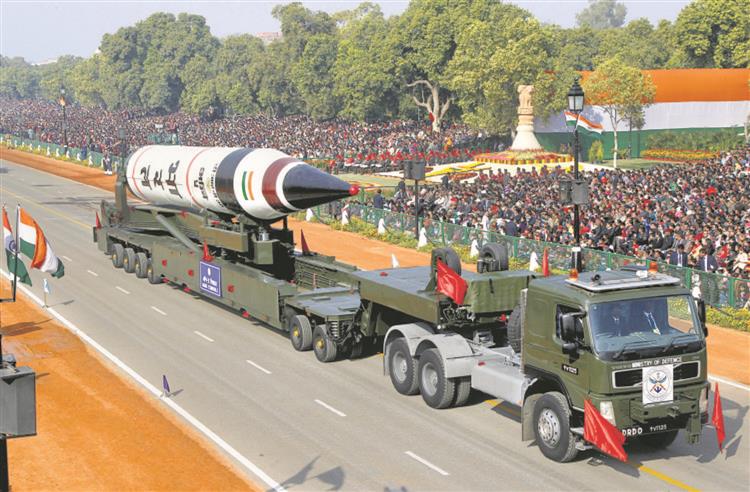
Each is developing new missile types in addition to India’s seven and Pakistan’s nine nuclear-capable missile designations in service. Apart from the high cost of the arms race in the post-pandemic era, nuclear expansion casts doubt on their stated policies of having minimally-sized nuclear arsenals.
Beyond, India and Pakistan seek relevant technologies and capabilities in the naval or space domains. Sober analysis can identify which threshold capabilities may or may not become actual military options. But the strategic whole is arguably greater than the sum of the parts: India and Pakistan may continue to dangerously undermine each other’s defence under the nuclear threshold and this could further affect future crisis stability negatively.
Meanwhile, crisis triggers persist. In February 2019, tensions saw India and Pakistan make unprecedented use of airpower in each other’s territory. The uncomfortable truth is that, based on what is known, chance played an ameliorative role in this episode. Whichever the lessons learnt from past crises, India and Pakistan are in uncharted territory requiring enlightened judgement.
The diagnosis is incomplete without considering the manifest fatigue in both capitals about confidence-building measures (CBMs). Over a dozen past agreements remain in place, an often unsung achievement. But CBMs have in-built limitations and a chequered history in South Asia. Not one has been adopted in the prolonged diplomatic lost decade since the 2008 Mumbai attacks. Yet enabled by top-level political will, CBMs can lay a foundation upon which trust can grow.
Overall, these many challenges to nuclear deterrence stability do not mean that the proverbial next crisis between India and Pakistan, one major terrorist attack away, will necessarily hit the nuclear threshold. But they make it more likely that the situation may come close to it. India and Pakistan could stumble into using their nuclear weapons through miscalculation or misinterpretation.
The stakes keep rising. A nuclear exchange would have catastrophic consequences for the two countries, including appalling ones for human security. Economically, even compared to the cost of the Covid-19 pandemic (both countries’ worst post-independence economic shock), the damage from nuclear use would likely be several times higher.
For onlookers, the use of a nuclear weapon for anything else than the tallest order of national interest — to ensure survival of the state — would be entirely unacceptable because the effects would be multidimensional and uncontainable, well beyond the breach of a norm in place since 1945. Among others, the hit to the global economy would be severe and systemic.
The UK, during the 2001-02 tensions, conservatively estimated at £20 billion the hit to its economy from a nuclear use in South Asia. In today’s currency and context, this figure alone might translate into nearly two- thirds of what that country is spending, supporting individuals and families in the pandemic.
Wider damage, however hard to assess, would be commensurate to India and Pakistan’s joint rising share of global GDP and trade over the last generation. A recent US intelligence report suggests a doubling of India’s share of world GDP by 2040, lifting it to the third position, from sixth today. Since India now discusses technology and supply chain resilience at the Quad high table with the US, Japan and Australia, the future shared costs of a disruption from an imprudent or mistaken use of nuclear weapons in the region could rise even higher.
Growing consensus on seeing Asia through the Indo-Pacific lens is also reshaping the matter. China’s evolving profile as a nuclear-weapons state compounds India’s security challenges. But control over the drivers of the India-Pakistan nuclear deterrence and stability equation remains almost entirely in the hands of leaders in New Delhi and Islamabad. Yet implications for crisis management are unclear.
With such facts and many more, this situation and its policy implications become more widely accessible. For its part, the report concludes neither India nor Pakistan can afford to be complacent. Only they can choose to creatively overcome the challenges to nuclear deterrence stability. To this end, the study proposes 15 measures India and Pakistan’s leaderships can choose from to prioritise nuclear stability, without conceding that each can deter the other; that nuclear weapons are instruments of last resort, and mutual vulnerability can be a factor of stability.
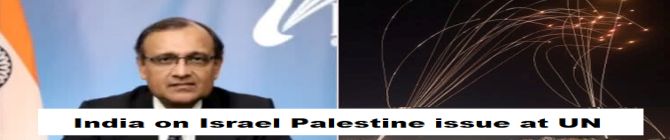

INDIA ON ISRAEL- PALESTINE CONFLICT- ALL ABOUT INDIA’S SUPPORT TO ‘JUST PALESTINIAN CAUSE’ AT THE UN?

India recently attended the United Nations Security Council (UNSC) meet. It’s representative was TS Tirumurti. India supported the Palestinian cause which was not much liked by Israel. Take a look at the reason of India’s support to Palestine below
United Nations Organization is always on heels to fulfil its motive of World peace and security. Recently on issues raised by China, UNSC held an emergency meeting regarding the Israel Palestine conflict. Many countries came in support of Israel and others in support of Palestine.
Israeli PM Netyanyahu tweeted on May 16, 2021 thanking 25 countries for their support against the Hamas attack. India however was not addressed in the statement. The reason could have been the statements made by India in the UNSC.
India’s permanent representative TS Tirumurti asked both Israel and Palestine to resume the dialogue and reduce their tensions. It was also made clear that India supports the two state solution and Israel was just reacting to the attacks by Hamas.
What Was Said By India?
Tirumurti in his statement said, “the events of the last several days have resulted in a sharp deterioration of the security situation. The indiscriminate rocket firings from Gaza targeting the civilian population in Israel, which we condemn, and the retaliatory strikes into Gaza, have caused immense suffering and resulted in deaths, including women and children.
As per India’s stance, both sides were urged to show restraint to the highest level and were asked to begin negotiations.
TS Tirumurti also talked about the city of Jerusalem and its connection with various Indians. He said,” The Old City also houses the Al Zawiyya Al Hindiyya – the Indian Hospice, which is a historic place associated with a great Indian Sufi saint Baba Farid and located inside the Old City. India has restored this Indian Hospice”
He also said in the end which changed the entire dynamics, “in conclusion, I reiterate India’s strong support to the just Palestinian cause and its unwavering commitment to the two-state solution.”
Take a look below:
Who Did India Support At UNSC?
TS Tirumurti’s statement clarified two things.
i) He said that, “violence began in East Jerusalem a week back”. This meant he was talking about the clashes in the Al-Aqsa compound and East Jerusalem areas.
This implies that India doesn’t see Hamas’s rocket firing on May 10, which followed Israeli forces storming Al-Aqsa Mosque, as the reason for the recent conflict.
ii) TS Tirumurti’s statement clarified the reason for the latest conflicts as per India. He said, “our deep concern over the violence in Jerusalem, especially on Haram esh-Sharif/Temple Mount during the holy month of Ramzan and about the possible eviction process in Sheikh Jarrah and Silwan neighbourhood in East Jerusalem,”

Various Arab families of the occupied territory of East Jerusalem face eviction by the Israelis. This was said to be the trigger of Arab protests last week.
This means that without clearly putting out any names, India called for the eviction process to be stopped and status quo ante to be restored at the Al Aqsa compound.
It was until 2017 when India openly supported the Palestinian cause. It called for a negotiated solution that may form a sovereign, independent state of Palestine with its capital as East Jerusalem.
Later in 2017, PM Modi changed the stance and said, ” We hope to see the realization of a sovereign, independent, united and viable Palestine, coexisting peacefully with Israel. I have reaffirmed our position on this to President Abbas during our conversation today.”
Why Did India Not Support Israel Straightaway?
India is a follower of peaceful coexistence. It is also a follower of Non Alignment Movement. So even though India receives and provides support to Israel, it would always be on Palestinian side here as it strongly says the land of the Palestine was occupied forcefully.
Moreover, facing similar problems in its own homeland via Pakistan and China, India would find it difficult to accept forceful occupation of the Jewish territory.
Way Forward:
So India looking forward has tried to sort out the issue by raising the real issue of a two-state solution, coexisting side by side.
Also by referring to Haram e Sharif twice, it was implied that the real issue was not the Palestinian narrative. India addressed it along with Temple Mount which counted Jewish and Islamic religions together as well. India also openly condemned the rockets, but provided no such reference to Israeli reaction.


INDIAN ARMY KEEPING AN EYE ON DRILL BY CHINESE MILITARY NEAR LADAKH REGION: GEN NARAVANE

The Indian Army is keeping a constant eye on activities by the Chinese military including a drill it is conducting in its training areas near Ladakh region and there were no ”violations” by either side since the implementation of the disengagement in Pangong lake areas, Chief of Army Staff Gen M M Naravane said on Wednesday. Gen Naravane also expressed hope that both sides will be able to make forward movement in resolving issues in other areas.
The Chief of the Army Staff said the disengagement has been cordial so far, but added that Indian troops are maintaining an effective vigil to deal with any eventualities along the Line of Actual Control in eastern Ladakh. Asked about a military drill by the Chinese Army in their depth areas, he said Indian troops are keeping a constant eye on it.
”We have seen movements in training areas. It is an annual exercise. They come for training. We also go to training areas. We have been keeping a constant eye on it. We have forces along the LAC and they are adequate to deal with any action or activity,” Gen Naravane told India Today channel. He said there were no ”transgressions and violations” since the disengagement process took place in February and both sides are observing it in letter and spirit.
”What is important is that we are talking. And what is important to know is that between two phases, there are periods where the trust has to be built up. I think the trust has (been) built. Because of that trust, maybe we will be able to make forward movement in other areas where issues are still to be resolved,” he said. The Chief of Army Staff said India will maintain its enhanced presence on the northern front till de-escalation is achieved.
India and China were locked in a military standoff at multiple friction points in eastern Ladakh since early May last year but they have completed the withdrawal of troops and weapons from the North and South banks of Pangong lake in February following a series of military and diplomatic talks. The two sides are now engaged in talks to extend the disengagement process to the remaining friction points.
There was no visible forward movement in disengagement of troops in the remaining friction points as the Chinese side did not show flexibility in their approach on it at the 11th round of military talks with the Indian Army on April 9. About the coronavirus crisis, Gen Naravane said the Army is fully ready to extend all possible assistance in India’s fight against the pandemic ”We are an Army of the people, for the people,” he said. ”There is no difference in mobilising for the pandemic. This is because from time to time we also assist in dealing with other natural calamities. We are quite well geared up. All three branches of armed forces have been working collectively,” he said.
Naravane said 90 percent of the forces’ personnel have been administered the second dose of coronavirus vaccine and soon it will touch 95 percent.


India’s armed forces stave off deadly 2nd Covid wave thanks to vaccines, strict protocols

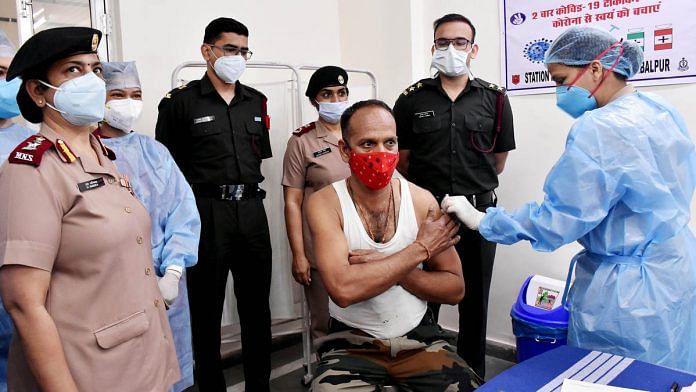
Representational image of an Armyman being vaccinated in Jabalpur | File photo: ANI

Madhya Pradesh, March 03 (ANI): Indian Army personnel get a dose of the COVID-19 vaccine at the Military Hospital in Jabalpur on Wednesday. (ANI Photo)Text Size: A- A+

New Delhi: Since the beginning of the Covid-19 pandemic last year, there have been about 52,000 cases and 140 deaths among the nearly 17 lakh armed forces personnel in India, ThePrint has learnt. And, even as the civilian population has been badly hit by the second wave of coronavirus in the last couple of months, the armed forces have been largely safe — thanks to nearly 90 per cent double vaccination and strict protocols implemented by the Army, Navy and Air Force.

Now, with the possibility of a third wave looming, the Army has increased its medical capacity across the country, while also helping the civilian administration in tackling the coronavirus.

According to figures accessed by ThePrint, the armed forces are currently registering about 200 Covid-19 cases every day, with the Army alone accounting for about 140 of them. But, significantly, most of these cases are mild and haven’t required hospitalisation.

“The vaccine has really helped. There were few cases that needed hospitalisation, but most cases were milder. Nearly 90 per cent of the deaths in the armed forces were of those who had comorbidities like cancer, heart issues or diabetes,” a source in the Army establishment said.

The source said only 0.40 per cent of vaccinated soldiers got Covid, and that only 0.004 per cent — that is, 1 per cent of those who got the disease — had to be hospitalised.

A second Army source said: “In the Army, the average daily case load was over 200 during the peak of the second wave; it has come down to about 140 now.”

The second source said the majority of the cases were from the peace stations (urban areas), and not at the frontlines, where the number cases had dropped drastically compared to last year.

Sources also attributed the fewer cases to the strict protocols put in place by the armed forces.

“When Covid began last year, a series of instructions were issued, which dealt with quarantine and movement. These protocols were not really diluted even when the cases had come down earlier this year. Those at the front had a different set of protocols,” a third source said.

“There were some cases last year because of mobilisation of troops for Ladakh, but stricter norms were followed, which ensured much less cases this time around.”


Also read: What’s DGAFMS, Indian military’s medical wing leading the fight against Covid


Cases among personnel, dependents, veterans

According to official figures presented to Parliament by the government in March this year, 119 armed forces personnel died of Covid-19 while 44,766 contracted the infection across the three services.

The data accessed by ThePrint now showed that as of 19 May, the total number of Covid cases among serving armed forces personnel is 52,000, while 14,000 of their dependents have tested positive too. Among ex-servicemen, the corresponding figures are 9,000 and 6,000.

While the second wave of Covid surged, the number of active cases in the armed forced increased from 1,067 on 18 April to 5,134 on 10 May.

Last month, ThePrint had reported that 99 per cent of the 13 lakh-strong Army had received the first dose of the Covid vaccine, and 82 per cent had received the second dost. Sources said now, about 90 per cent of soldiers have got the second dose too.

Increasing capacity to fight Covid

The Army is using the emergency financial powers extended by Defence Minister Rajnath Singh to purchase key equipment like oxygen concentrators, oxygen generation systems and additional beds.

On 18 April this year, the Army had about 1,800 oxygen supported beds, but the number has now been increased to 5,000. The number of oxygen storage rooms has more than doubled to 50 from 24 in the same period, while 93 oxygen generation plants have been set up.

The number of oxygen concentrators has been increased to 4,700 from 3,300.

(Edited by Shreyas Sharma)


Also read: Armed forces plan to hire 400 retired military doctors to assist in fight against Covid


Israel-Hamas violence fuelled by emotive triggers

Israel will have to introspect. Its hard-line, extreme-right approach is pulling it into a black hole. The prospects of Hamas East and West, Hezbollah to the North and restive Palestinians within the country do not bode well for the long-term security and prosperity of its populace. When asymmetric entities engage in conflict, outcomes are unpredictable. Rocket salvo attacks by Hamas have broken through the Israeli Iron Dome, challenging its invincibility.

Israel-Hamas violence fuelled by emotive triggers

Conflict: This time, in an ominous departure, the Arab population within Israel has raised its hand. Reuters

Lt Gen Sanjiv Langer (retd)

Former Deputy Chief, Defence Staff

Let there be no strife, I pray thee, between me and thee, and between my herdsmen and thy herdsmen; for we be brethren. — Abraham, Old Testament

RAMZAN’S Laylat al Qadr, the Night of Destiny, catapulted Israel and Palestine to a crescendo of violence. With more than 200 killed in Gaza and at least 10 in Israel, the battle has entered its second week. Hamas, having fired about 3,000 rockets in salvos, and relentless Israeli air, land and sea bombardments on hundreds of targets are edging the protagonists towards an expanded conflict.

The combat comes at a time when Israeli Premier Benjamin Netanyahu and Palestinian President Mahmoud Abbas are both in political quicksand. Netanyahu may gain a lifeline as his opponent Yair Lapid is unable to engineer support. President Abbas will, however, sink deeper, ceding vital space to Hamas. Al Fatah and Hamas took birth in the Palestinian Intifada of 1987. While Fatah and Arafat took centre stage in the Palestine Liberation Organisation (PLO), Hamas unrelenting, fundamentally divergent, bided its time. Post elections in 2006, Hamas expelled Fatah from the Gaza Strip, resulting in a fractured Palestinian Authority: Hamas in Gaza and Fatah in Palestine territories, to the East of Israel.

The conflict between Hamas and Israel is endemic, manifesting itself in the wars of 2009 and 2014. The present firestorm was preceded by a slow but definite burn. Stoking the fires of Palestinian resentment have been the US-supported declarations on Jerusalem, the Golan Heights and the ill-conceived Trump ‘Deal of the Century — Peace Plan’.

The night of May 8 was nestled in an unfortunate convergence of emotive triggers: Heavy Israeli hand in crowd management for Ramzan; Israeli celebrations of their 1967 victory and capture of East Jerusalem; and Israeli Court permitting the eviction of four Palestinian families from Sheikh Jarrah (suburb of Jerusalem) for Jewish settlers.

Consequently, this time, in an ominous departure, the Arab population within Israel has raised its hand. This explains the violence in the areas of Bat Yam, Lod, Sheikh Jarrah and the West Bank. While the move for eviction impacts 700 Palestinian families, the court order is seen as a precedent. The incendiary role and active precipitation by Hamas is, however, writ large in the fire. Hamas repeatedly threatened violence, treating Israeli actions in the vicinity of the Al-Aqsa Mosque as a Red Line.

Hamas, equipped by Iran, modelling itself on the Lebanese Hezbollah, seeks supremacy in the Palestinian affairs. Its mass appeal is enhanced by its ability to confront the Israeli forces and take casualties. Civilian deaths are an unfortunate but necessary consequence of ‘The Struggle’. Violence works to its political advantage and diminishes the political signature of Fatah.

Israel faces tough choices. Standoff attacks have a limited deterrence since Hamas cadres welcome death. Hamas has embedded its facilities deep into the civilian habitation. Enormous casualties are on show. The present targeting by Israel of the HQ, leaders and military facilities orchestrates casualties. Israeli polity is in turmoil. Sections of the resident 21 per cent Palestinian population are inflamed. They have challenges on both sides of the border. The Gaza Strip is one of the densest urban entities in the world. Concrete rises and spreads with little gaps. It is a nightmare for the land forces. Past land interventions have caused high casualties and had had no enduring gains.

The Indian response has been nuanced. With a history of support to the Palestinian cause, a multi-dimensional robust, flourishing relationship with Israel since 1992, this is mandated. While Israeli centrality is unambiguous, India is autonomous on the larger issues. This has been echoed in the response of TS Tirumurti, Ambassador of India to the UN: deep concern over all clashes and violence, with specific reference to Hamas rocket attacks and violence on Temple Mount; concern over evictions in Sheikh Jarrah; insistence on maintaining status quo; adherence to UN Security Council Resolution 2334, which stigmatises Israeli settlements, calls them flagrant violations; and commitment to the Two-State Solution.

While India has stayed its hand on Hamas in the UN, the present specific reference to its rocket attacks is also due to the fact that Hamas initiated the violence as an act of war.

Historic Indian commitment to the region also included a large presence in the UN Mission, UNEF I from 1956 to 1967. The mission had illustrious Indian Force Commanders — Generals PS Gyani and Inderjit Rikhye. While the mission was largely deployed in Gaza, Indians were a welcome presence in the region, as they continue to be today, in the UN Mission UNIFIL, Lebanon.

It also bears mention that India’s support to the Palestinians has been unfailing and since 2018, the Indian contribution to them has been quadrupled to $5 million a year. The assistance has been sharpened with project-based interventions. Indian outreach is both in Gaza and the Eastern Palestinian territories.

Hamas military spokesman Abu Ubaida has threatened: “…we have prepared for your kind of deaths that would make you curse yourselves…” Hamas may have chosen the moment well, but the Israelis will not oblige it. Israeli institutions are strong, their crisis response is outstanding and defence and security capabilities have a wide spectrum and bleeding edge.

Hamas, undoubtedly, has an eye on the impending Palestinian elections, which President Abbas has postponed. This conflagration will possibly give electoral margins to Hamas for realising its dream of control over all territories.

Israel will have to introspect. Its hard-line, extreme-right approach is pulling it into a black hole. The prospects of Hamas East and West, Hezbollah to the North and restive Palestinians within the country do not bode well for the long-term security and prosperity of its populace.

When asymmetric entities engage in conflict, outcomes are unpredictable. Rocket salvo attacks by Hamas have broken through the Israeli Iron Dome, challenging its invincibility. There is a blurring of focus for Israel, with the incidence of domestic violence.

Hamas is presently poised for political gains. Israeli military superiority will not transcend to assuage damaged psyche and heal emotional wounds. Hamas is on track, while Israel will have to review its existential challenges. We must pray for the innocent victims. We must also, in time, assist them to pick up the threads of their lives.


India, Pakistan need to prioritise nuclear stability

Strategic instability is to be expected, especially when there is a large size differential between two nuclear-armed countries, as is the case between India and Pakistan. Conversely, striving for strategic stability is good for avoiding war. But this has no single end-state and requires careful attention, one new weapon system at a time. Seeking an edge over the opponent is more dangerous when official statements show peace is fragile and rhetoric is high during moments of tension.

India, Pakistan need to prioritise nuclear stability

At odds: A nuclear exchange would have grave consequences for both nations. Reuters

Antoine Levesques

Research Fellow for South Asia, International Institute for Strategic Studies

OPEN government assessments of the state of India-Pakistan deterrence are rare. A recent US intelligence overview considered a ‘general war’ between the two countries ‘unlikely’, although ‘heightened tensions’ remain a ‘concern for the world’, raising the risk of ‘conflict between the two nuclear-armed neighbours’.

While awaiting the first major statement on South Asia by US President Joe Biden’s administration, the words of the previous administration’s Secretary of Defence, spoken last July, are still relevant. I had asked specifically about the nuclear and crisis stability. The six-sentence answer repeated three times that the matter was under close US observation. On short-term prospects for escalation, the statement was categorical: ‘I don’t see any indications right now that’s happening at all’.

Ten months on, there is indeed no imminent crisis. Since February, there are even signs and reports of decreased, rather than increased tensions.

Yet today, a new analysis published by the International Institute for Strategic Studies (IISS) provides comprehensive evidence of the persistence of major unresolved sources of instability at the heart of the India-Pakistan nuclear deterrence relationship, 23 years after they overtly tested nuclear weapons.

There exist grave deficiencies and asymmetries in the nuclear doctrines of India and Pakistan, which are compounded by mutual disbelief, existing and emerging military capabilities, and the prolonged absence of related dialogue mechanisms.

There is no indisputable yardstick to judge a nuclear doctrine. Yet a universal perspective is possible: with nuclear weapons, necessity and proportionality, as cornerstones of the laws of war and civilised conduct outweigh claims of regional or cultural exceptionalism. Moreover, nuclear doctrines, while not immutable, are designed to last. They carry weight and deserve respect.

Strategic instability is to be expected, especially when there is a large size differential between two nuclear-armed countries, as is the case between India and Pakistan. Conversely, striving for strategic stability is good for avoiding war. But this has no single end-state and requires careful attention, one new weapon system at a time. Seeking an edge over the opponent is more dangerous when official statements show peace is fragile and rhetoric is high during moments of tension.

In the specific case of nuclear doctrines of India and Pakistan, textual analysis finds these are not symmetrical. Most worryingly, neither side believes the other side’s core tenets. Doctrines suggest a scenario in which both sides could use nuclear weapons disproportionately. Meanwhile, that India’s no-first-use commitment is a bedrock of its policy is not in doubt.

Capabilities-wise, in conventional weaponry, neither side has a qualitative edge, even if India outdoes Pakistan by every measure of quantity. Based on numbers of nuclear warheads only, the growing arsenal sizes of both are broadly equal as far as can be determined. India and Pakistan claim to already possess sufficient weapons to ensure a robust, largely stable mutual nuclear deterrence. Both have a fledgling capability to mobilise enough nuclear weapons to strike back after being struck. But neither can yet launch a first strike against the other’s military with any assurance of success.

Each is developing new missile types in addition to India’s seven and Pakistan’s nine nuclear-capable missile designations in service. Apart from the high cost of the arms race in the post-pandemic era, nuclear expansion casts doubt on their stated policies of having minimally-sized nuclear arsenals.

Beyond, India and Pakistan seek relevant technologies and capabilities in the naval or space domains. Sober analysis can identify which threshold capabilities may or may not become actual military options. But the strategic whole is arguably greater than the sum of the parts: India and Pakistan may continue to dangerously undermine each other’s defence under the nuclear threshold and this could further affect future crisis stability negatively.

Meanwhile, crisis triggers persist. In February 2019, tensions saw India and Pakistan make unprecedented use of airpower in each other’s territory. The uncomfortable truth is that, based on what is known, chance played an ameliorative role in this episode. Whichever the lessons learnt from past crises, India and Pakistan are in uncharted territory requiring enlightened judgement.

The diagnosis is incomplete without considering the manifest fatigue in both capitals about confidence-building measures (CBMs). Over a dozen past agreements remain in place, an often unsung achievement. But CBMs have in-built limitations and a chequered history in South Asia. Not one has been adopted in the prolonged diplomatic lost decade since the 2008 Mumbai attacks. Yet enabled by top-level political will, CBMs can lay a foundation upon which trust can grow.

Overall, these many challenges to nuclear deterrence stability do not mean that the proverbial next crisis between India and Pakistan, one major terrorist attack away, will necessarily hit the nuclear threshold. But they make it more likely that the situation may come close to it. India and Pakistan could stumble into using their nuclear weapons through miscalculation or misinterpretation.

The stakes keep rising. A nuclear exchange would have catastrophic consequences for the two countries, including appalling ones for human security. Economically, even compared to the cost of the Covid-19 pandemic (both countries’ worst post-independence economic shock), the damage from nuclear use would likely be several times higher.

For onlookers, the use of a nuclear weapon for anything else than the tallest order of national interest — to ensure survival of the state — would be entirely unacceptable because the effects would be multidimensional and uncontainable, well beyond the breach of a norm in place since 1945. Among others, the hit to the global economy would be severe and systemic.

The UK, during the 2001-02 tensions, conservatively estimated at £20 billion the hit to its economy from a nuclear use in South Asia. In today’s currency and context, this figure alone might translate into nearly two- thirds of what that country is spending, supporting individuals and families in the pandemic.

Wider damage, however hard to assess, would be commensurate to India and Pakistan’s joint rising share of global GDP and trade over the last generation. A recent US intelligence report suggests a doubling of India’s share of world GDP by 2040, lifting it to the third position, from sixth today. Since India now discusses technology and supply chain resilience at the Quad high table with the US, Japan and Australia, the future shared costs of a disruption from an imprudent or mistaken use of nuclear weapons in the region could rise even higher.

Growing consensus on seeing Asia through the Indo-Pacific lens is also reshaping the matter. China’s evolving profile as a nuclear-weapons state compounds India’s security challenges. But control over the drivers of the India-Pakistan nuclear deterrence and stability equation remains almost entirely in the hands of leaders in New Delhi and Islamabad. Yet implications for crisis management are unclear.

With such facts and many more, this situation and its policy implications become more widely accessible. For its part, the report concludes neither India nor Pakistan can afford to be complacent. Only they can choose to creatively overcome the challenges to nuclear deterrence stability. To this end, the study proposes 15 measures India and Pakistan’s leaderships can choose from to prioritise nuclear stability, without conceding that each can deter the other; that nuclear weapons are instruments of last resort, and mutual vulnerability can be a factor of stability.


Army saves 2 persons from drowning in Kashmir

Army saves 2 persons from drowning in Kashmir

Photo tweeted by @ians_india

Jammu, May 20

The Army rescued two people from drowning in the JCB vehicle that had got washed away in Marua River near Nawapachi village in Marwah valley of Kishtwar district of Jammu and Kashmir, army said on Thursday.

Army said two civilians identified as Sajid Ahmad Mir, the driver, and Mushtaq Ahmad got stuck in the JCB when it got submerged while working on the bank and in the fast current. The vehicle had got washed away for around 500 meters.

“On receipt of information from locals, an Army column from Nawapachi post immediately rushed towards the site of the accident. Jumping into the river in the fast flowing water, Indian Army along with Jammu and Kashmir Police and locals successfully took out the civilians from the submerged JCB vehicle with the help of ropes in a 90 minute long difficult rescue mission,” army said.

“Prompt action of troops in the rescue operation saved the lives of two civilians.” IANS


26 dead, 49 missing; operations on

186 rescued from sunken barge

Tribune News Service

New Delhi, May 19

Twenty-six bodies have been found in the Arabian Sea and are of possibly of the persons who were on board the ill-fated barge ‘P305’ that sunk on the night intervening May 17 and May

Two more survivors have been found on Wednesday, taking the number of those rescued from the barge to 186. Still 49 persons are missing at sea and with hopes of finding survivors now would be miracle. 

A DNA match of the dead would reveal their identity. A DNA sample is collected, as part of protocol, of those working on oil rigs and at sea.


Read also: Why barges and ships were out in cyclone, Government orders probe

Rescued workmen from barge recall horror in sea

Cyclone Yaas to hit West Bengal-Odisha coast by May 26, says IMD

Editorial: Ill-prepared for cyclone


The sunken barge was working at the Heera oil rig part of the Bombay High oil rigs, 70 km south-west of Mumbai. It was a part of six separate vessels which had been adrift at sea since Monday following the Cyclone Tauktae. All were connected with oil-drilling work or new projects at the Bombay High. The others are safe.

Also the number of persons on board the ill-fated barge ‘P305’ has been down revised from the 273 announced earlier to 261, the latest number. The Navy had initially said 273 were on board the barge and this was based on the first SOS message. The Oil and Natural Gas Commission clarified that the number on board the barge was 261. The Navy has confirmed the figure and now it has been revised to 261 on board before the accident.

A massive search operation is on for the past 48 hours. The first lot of rescued men arrived at Mumbai on board INS Kochi, the Indian Naval warship and a second lot of survivors would reach Mumbai tonight.

Warships, planes and helicopters continue their search for those missing at sea. INS Teg, INS Betwa, INS Beas are at location. Maritime reconnaissance plane the P8I, fitted with sharp sensors, is scanning the area. Helicopters with sensors are at location. All the copters can land on decks of the available ships at sea.

Meanwhile, the tugs of the Oil and Natural Gas Commission (ONGC) are towing the drill ship Sagar Bhushan and barge ‘Support Station 3’ to harbour. Food and drinking water has been being provided to crew on board these vessels by Indian Navy copters. The both care carrying 297 men on board.

Meanwhile, all the 137 personnel on barge GAL Constructor were rescued on Tuesday by the Navy and Coast Guard.


Army engineers come up with innovative solution for conversion of liquid oxygen to bedside oxygen Covid-19 patients

Army engineers come up with innovative solution for conversion of liquid oxygen to bedside oxygen Covid-19 patients

Tribune photo

Vijay Mohan
Tribune News Service
Chandigarh, May 19

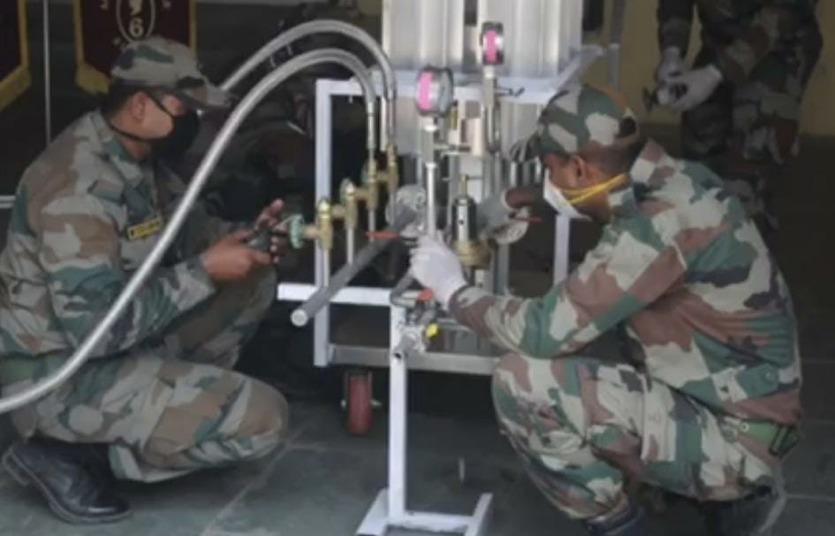
Indian Army engineers have come up with an innovative solution for efficient conversion of liquid oxygen to low pressure oxygen for administering it to Covid-19 patients.

Since oxygen was transported in liquid form in cryogenic tanks, quick conversion of liquid oxygen to oxygen gas and ensuring availability at the patients’ bed was a critical challenge faced by all hospitals managing Covid patients. 

A specialised task force was quickly put together for the early execution of an innovation to ensure that oxygen is made available without the use of gas cylinders, thus obviating the need to refill them frequently.  

Over a period of seven days, a team under Maj Gen Sanjay Rihani, in-direct consultation and material support from Council for Scientific and Industrial Research and the Defence Research and Development Organisation, put together a working solution using vaporisers, PRVs and liquid oxygen cylinders, according to an official statement.

In order to ensure continuous conversion of liquid oxygen into oxygen gas at the requisite pressure and temperature at the Covid bed, the team used a self pressuring liquid oxygen cylinder of small capacity (250 litres) and processed it through a specially designed vaporiser and directly usable outlet pressure (4 Bar) with requisite leak proof pipeline and pressure valves. 

A prototype with two liquid cylinders capable of feeding oxygen gas for 40 beds for a period of two to three days has been made functional at Base Hospital, Delhi Cantonment.