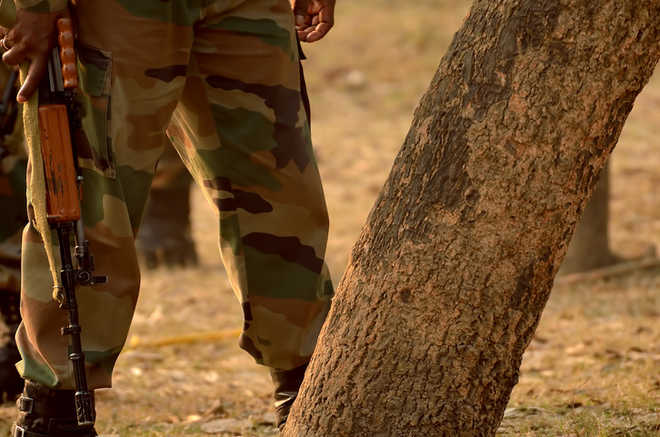
American withdrawal from Afghanistan will bring the Taliban back and this may mark the beginning of a possible “new great game” where there are non-state actors and state actors. American withdrawal has effectively opened up space for states like Pakistan, Turkey, Russia and China. Read the detailed report below.
Shattering yet another glass ceiling in the overwhelmingly male-dominated armed forces, the first-ever batch of 83 women jawans have now been inducted into the Corps of Military Police (CMP) in the 13-lakh strong Army.
Saudi Arabia has emphasised the importance of dialogue between Pakistan and India to resolve their outstanding matters, including the Kashmir issue.
The Defence Ministry said on Sunday it has issued an order to the Armed Forces Medical Services (AFMS) to recruit 400 retired medical officers of the Army Medical Corps (AMC) and the Short Service Commission (SSC) on a contract basis.
Punjab Chief Minister Amarinder Singh on Monday announced an ex-gratia compensation of Rs 50 lakh and a government job to the next of kin of a soldier who laid down his life in the line of duty.
President Vladimir Putin reviewed Russia’s traditional World War Two victory parade on Sunday, a patriotic display of raw military power that this year coincides with soaring tensions with the West.
South Korea’s leader said Monday he’ll use his upcoming summit with President Joe Biden to push to restart diplomacy with North Korea, saying that the US has opted for a diplomatic, phased approach to resolve the North Korean nuclear crisis.
The Taliban on Monday declared a three-day ceasefire for this week’s Eid al-Fitr holiday, following a sharp spike in violence as Washington goes about withdrawing its remaining troops from Afghanistan.
German defence projects with a total value of several billion euros are at risk of being scrapped as the necessary budget has not been secured yet, according to a confidential paper by the defence ministry in Berlin.
A suicide bomber killed six police officers in front of a district police station in the Somali capital Mogadishu late on Sunday, police said, in an attack claimed by the al Shabaab Islamist group.
With formal appointments in, this is how the Department of Military Affairs will function
With uniformed officers being given joint secretary ranks, all files will no longer need to be moved to the Secretary of Dept of Military Affairs for decisions.
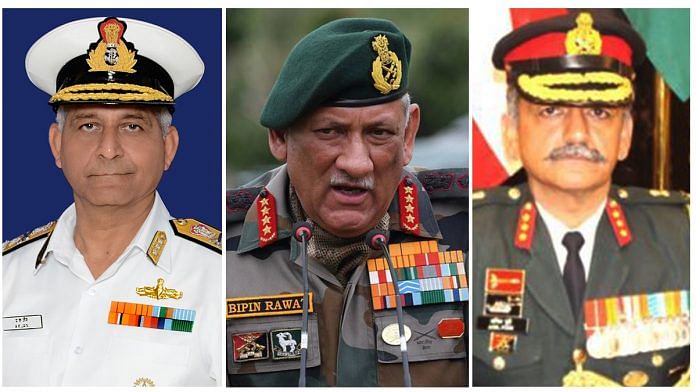
ice Admiral Atul Kumar Jain, Gen Rawat and Lt Gen Anil Puri | ThePrintText Size: A- A+
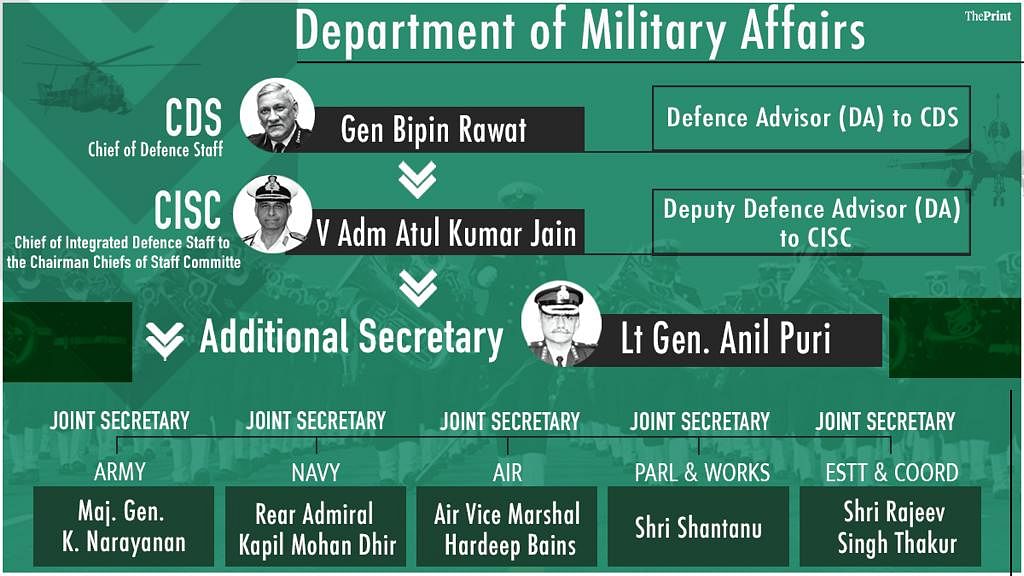
New Delhi: With formal appointment orders coming in last week, the Department of Military Affairs (DMA), under the Defence Ministry, is now staffed with designated senior officers, including uniformed personnel as Additional Secretary and Joint Secretaries.
Gen. Rawat holds the rank of both Secretary, DMA and the Chief of Defence Staff (CDS). The Chief of the Integrated Defence Staff to the Chairman Chiefs of Staff Committee (CISC), Vice Admiral Atul Kumar Jain, will be the Vice CDS, but formal orders for the same are yet to come.https://40d484cdf6811186d367671bccdccd9d.safeframe.googlesyndication.com/safeframe/1-0-38/html/container.html
Lt Gen. Anil Puri has been appointed as the Additional Secretary in the DMA. He is the first uniformed officer to take over this position in a formal capacity, following his appointment by the Appointments Committee of the Cabinet. This position has been traditionally held by IAS officers.
Maj. Gen. K. Narayanan has been appointed as the Joint Secretary (Army) and Rear Admiral Kapil Mohan Dhir as Joint Secretary (Navy). Air Vice Marshal Hardeep Bains has been appointed as Joint Secretary (Air Force).
Graphic: Soham Sen | ThePrint
The government had earlier appointed Shantanu as Joint Secretary (Parliament and Works) and Rajeev Singh Thakur as Joint Secretary (Establishment and Coordination).
Till now, uniformed officers were holding positions only in officiating capacity. This meant that all files had to be moved to Secretary, DMA for decisions.
This is no longer needed because each appointment can now dispose of files according to powers delegated.
As reported by ThePrint in 2019, the DMA will be in charge of the affairs of the Army, the Navy and the Air Force. At the moment, the CDS will have no operational control over individual organisations, which will remain with the respective service chiefs.
The DMA will look after all procurement exclusive to the three services — barring capital acquisitions besides the Territorial Army and various functions relating to the Services. Its mandate includes promoting ‘jointness’ in procurement, training and staffing for the services through joint planning and integration of their requirements.
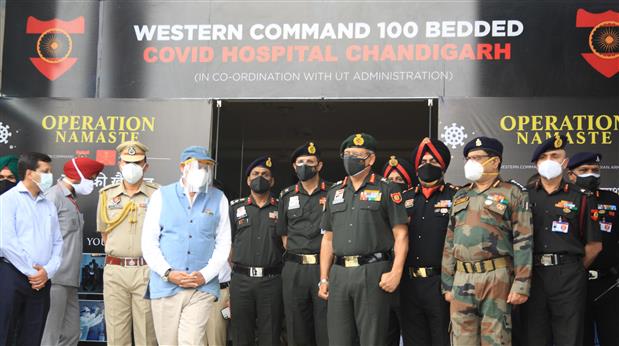
100-bed facility established in Panjab University’s Sector 25 campus under Operation Namaste
Chandigarh, May 10
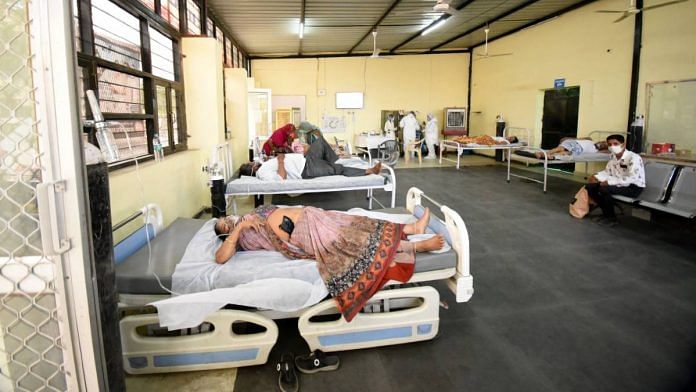
As part of the continued fight against the unprecedented rise in COVID-19 cases, the Western Command on Monday operationalised a dedicated hospital in Chandigarh for catering to civilian patients.
The facility was inaugurated by Governor of Punjab and Administrator of Chandigarh, VP Singh Badnore.
The 100-bed hospital, established in Panjab University’s Sector 25 campus under Operation Namaste, was inaugurated by the Governor of Punjab and Administrator of Chandigarh, VP Singh Badnore, who went around the facilities and discussed its functional modalities with the doctors and staff.
The General Officer Commanding-in-Chief, Western Command, Lt Gen RP Singh, who was also present on the occasion, highlighted the efforts put in by both, the Indian Army as well as the civil administration, in the early operationalisation of these Hospitals. He assured the governments of Punjab, Haryana and Chandigarh of continued support of the Armed Forces in the fight against COVID-19.
In addition to this, similar 100-bed facilities will also be operationalised by the Army under Operation Namaste at the Shri Atal Bihari Vajpayee Medical College in Faridabad and the Rajindra Government Hospital in Patiala on May 11 and May 12, respectively.
The three COVID care facilities, which will treat patients with mild to moderate symptoms, have been set up on a war footing in coordination with the civil administration of respective states and union territory. The Army has temporarily relocated its field hospitals for the purpose.
The Army has deployed its doctors, nursing officers and paramedics for holistic treatment to patients as per ICMR guidelines, provided service ambulances and trained personnel for administration and management of the hospitals.
The civil administration, on the other hand, is facilitating essential amenities, service management, uninterrupted oxygen supply, patient admission and discharge processes and ambulance services at these hospitals.
The hospitals will also cater for basic laboratory, X-ray, pharmacy and catering for patients. The admission to these Hospitals is open for all affected citizens and coordinated by the chief medical officers of the respective districts. On admission, ISO numbers will be issued to patients by the respective hospital management and the discharge will be on recommendation of the Army medical officer treating the patient. Patients requiring higher grade of treatment will be shifted to other hospitals, coordinated by the CMO as per availability of ICU facilities.
Armed forces can turn Delhi’s Covid situation around in 48 hours. Time to call them in
The scourge of the second wave of Covid 19 has brought our ill-prepared nation to its knees. The heart-rending images of the overcrowded hospitals bereft of fundamental necessities, particularly medical oxygen, the hapless citizens begging for care and mass cremations/burials have all exposed our governments and institutions. Yet the State seems to be shy of optimally utilising its instrument of last resort — the armed forces — to make the dysfunctional healthcare system perform more efficiently through better management.
In my view, there are two reasons for this reluctance. First, the government seems apprehensive about its incompetency getting exposed. Second, the military hierarchy has itself failed to advise the government about its capabilities/core competencies, and on how best to utilise the resources of the armed forces. It appears to have mechanically followed the directions it has received from various empowered committees, which ironically have no military representatives.
Experience of the first wave
In the first wave, the armed forces remained on the fringes, merely transporting Indians stranded abroad and constructing/managing the isolation centres for them. The government failed to use the Army to manage its most serious crisis for which the latter was most suited for – migrant labourers exodus. This added to virus spread.
The armed forces’ infamous contribution last year was to organise the spectacle of fly pasts, band displays, sailing ships and showering of petals on 3 May to honour the Covid warriors. Ironically, the timing coincided with the People’s Liberation Army’s preemptive offensive manoeuvres in Eastern Ladakh. Thereafter, national security became the priority. It is worthwhile to recall that we fought the 1947-48 Jammu and Kashmir War while simultaneously handling the Partition refugee crisis.
The armed forces have done exceptionally well to preserve their force through good management. Bulk of the personnel have already been vaccinated.
Armed forces must not be left out of the battle
In fighting the second Covid wave, the armed forces must not be LOB — Left Out of Battle — an archaic military term wherein anticipating heavy casualties, units would leave five per cent of key personnel out of the battle to re-raise the unit. Valuable time has already been lost. The magnitude of the second wave was obvious by 15 April and I would have liked to see the armed forces standing by to swing into action, executing contingency plans to take over as crisis managers in major cities and districts with poor medical cover.
So far, the actions have been knee jerk, without a holistic plan. Indeed the armed forces have earmarked 10-15 per cent of the beds in selected hospitals for civilians. But this has brought it into conflict with its “own” as the hospitals were already choked with soldiers, their dependents and veterans who cannot utilise the civilian hospitals empaneled with Ex-servicemen Contributory Health Scheme due to overcrowding. There are many reports on social media about dependents/veterans facing serious problems in hospital admission. On Tuesday, there were reports that were later denied by the Army, of Base Hospital, Delhi Cantonment facing O2 crisis.
The Indian Air Force (IAF) and the Indian Navy have done well to post-haste transport O2 containers and tankers from abroad and within India. But the organisational skills and transport facilities of the military have not been utilised for the critical last mile distribution.
The DRDO, through out-sourcing, has constructed four Covid hospitals in Ahmedabad, Varanasi, Lucknow and Delhi. Except the one in Delhi, the other three are in the constituencies of the top three politicians of the ruling party. These facilities are being managed by the armed forces and have sucked in disproportionate resources of doctors/ medical support personnel and medical equipment. The armed forces have very limited reserves of personnel left for the crisis which is still unfolding.
In my view, the full potential of the armed forces is not being utilised. The armed forces are not in the decision-making loop and military representatives have not been consulted. This is evident from the absence of their representation in the 11 empowered groups set up last year to coordinate the management and control of the Covid-19 pandemic across India. This is when the armed forces have the capacity to directly influence almost all domains of the empowered groups. The Chief of Defence Staff (CDS) and the Services Chiefs have held much publicised face-to-face meetings with the Prime Minister. One wonders what purpose such meetings would serve in the absence of formal minutes being recorded or directions being given.
How best to utilise the armed forces
The disturbing reports being flashed on TV screens and newspapers everyday showcase the scale of the crisis India faces today. What they also suggest is that no one is in charge to coordinate the fight against Covid. Governments work in watertight compartments and are overtaken by events in a crisis. This is true the world over.
India’s armed forces have 1.5 million trained personnel and, by now, they are Covid vaccinated, spread across the length and breadth of the country. The primary strength of the military is in the field of organisation and crisis management. It has a large workforce and vast resources for transportation. In critical cities/towns/areas, the management of the fight against Covid must be taken over by the military. War rooms must be set up to coordinate the battle.
Procurement/transportation/allocation of O2, other critical medical resources, allocation of hospital beds, transportation of patients and dead can be coordinated and augmented by the armed forces. I see no reason as to why the situation, for example, in Delhi cannot be turned around in 48 hours. However, the government will have to formally authorise the Army and allocate the resources.
The armed forces have approximately 13,000 officers (doctors/specialists/nursing officers) and one lakh medical support staff. Veteran officers and medical personnel can nearly double the existing resources. 130 military hospitals are already committed, taking care of soldiers, dependents and veterans and can do little more than the 10-15 per cent capacity already committed for civilian patients.
However, the armed forces have the capacity to create 100 field hospitals with 100 beds each. With the help of private doctors, medical students and additional medical equipment, many more temporary facilities can be made operational in a short span of time. It is these resources which can be superimposed on the civilian hospitals to take on the overload. War rooms can coordinate the deployment of the field hospitals in critical areas. It is counter-productive to commit military resources to standalone large facilities like the DRDO-constructed hospitals.
Military engineers can convert requisitioned buildings/sheds/factories into hospitals and also construct new ones using prefabricated material. All that the armed forces will require will be funds, ICU equipment, ventilators, medicines and other essential equipment. War rooms can also coordinate and augment the door-to-door vaccination programme.
Our war on Covid is hampered by lack of organisation, coordination and management. The government must press into service its instrument of last resort, which has proven capability for the same. India needs an honest, disciplined and swift response of a scale as large as the crisis. Only one institution’s name comes to the mind — the Indian Armed Forces.
COVID-19: Indian Navy brings large amount of medical supplies from abroad
Three Indian Navy warships are bringing to India on Monday 80 tonnes of liquid oxygen, 20 cryogenic oxygen tanks, 3,150 cylinders and a large amount of other medical supplies from abroad as the country reels under a severe second wave of the coronavirus pandemic.
The medical supplies being brought by the ships included 900 oxygen-filled cylinders and 10,000 rapid antigen COVID-19 test kits, 54 oxygen concentrators, 450 PPE (personal protective equipment) kits, Indian Navy spokesperson Commander Vivek Madhwal said.
Indian Navy ship Airavat is reaching Visakhapatnam from Singapore carrying eight cryogenic oxygen tanks each having a capacity of 20 metric tonnes of oxygen and other supplies.
Another warship, INS Kolkata, is arriving at New Mangalore port carrying 40 metric tonnes of liquid oxygen, 400 Oxygen cylinders and 47 oxygen concentrators from Qatar and Kuwait, Commander Madhwal said.
INS Trikand is reaching Mumbai with 40 tonnes of oxygen from Qatar, he said.
Last week, the Indian Navy deployed nine warships to bring liquid medical oxygen and other supplies from several countries in Persian Gulf and south-east Asia.
The Navy said it has stepped up its efforts as ships from all three naval commands in Mumbai, Visakhapatnam and Kochi were deployed to bring oxygen and other medical equipment under operation ‘Samudra Setu II’.
Last year, Indian Navy had launched Operation Samudra Setu as part of the Vande Bharat evacuation mission under which it brought back to India around 4,000 stranded Indians from Maldives, Sri Lanka and Iran.
As India battles a devastating second wave of coronavirus pandemic, countries around the world have sent medical supplies including oxygen-related equipment to help it tide over the situation.
Most countries used ‘Swiss cheese’ model to reduce Covid. In India, the holes were too big
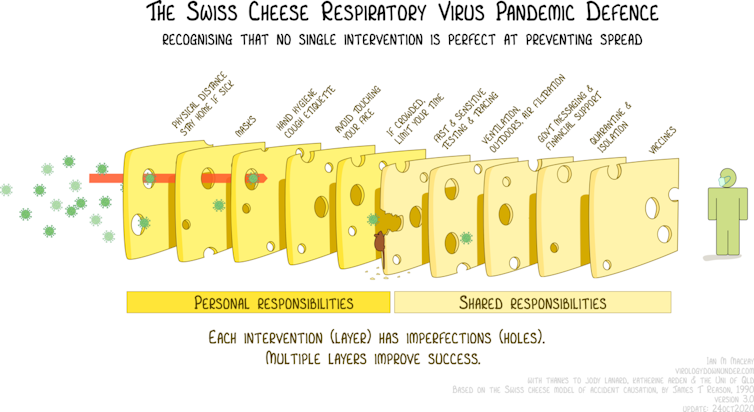
Most countries have used what’s known as the Swiss cheese model in planning their COVID response. In this risk-management model, each preventative measure is represented by a slice of cheese. No slice on its own can stop the virus from spreading because it has holes (flaws). But many slices, stacked one in front of the other, are enough to stop the contagion. In India – to continue the analogy – some of the holes were too big in three of the most important layers.
The first layer (as shown in the diagram below) is physical distancing – a tall order for India. India’s cities are densely populated and made denser by the daily arrival of millions of migrant workers who do most of the menial work.https://7535a4aec6e4ccaae7212b20983765a7.safeframe.googlesyndication.com/safeframe/1-0-38/html/container.html
The second layer is the proper use of masks and enhanced sanitation. This was always expected to be unreliable because of India’s low literacy rates and patchy social compliance. Excruciatingly hot weather in parts of the country, which can get to 48℃-50℃ in peak summer, doesn’t help either.
The final layer is mass vaccination. This measure has been severely dented from the beginning. High rates of vaccine hesitancy and, more recently, vaccine shortage are to blame. India has partially or fully vaccinated just 12% of its population. The challenge of vaccinating the vast majority of people in such a large, populous and demographically complex country was always going to be difficult.
During the first wave, India’s lockdown was one of the strictest in the world. And the stigma of dying from a new unknown disease encouraged people to wear masks. So two of the three primary layers of protection mentioned above, worked well to protect India from widespread infection.
In the second wave, however, the prolonged and harmonious failure of all the three basic layers resulted in a catastrophic blow to India’s already busy infectious disease landscape and strained healthcare system.
A study known as a serosurvey, conducted in February 2021 in New Delhi, showed that over 56% of the population had antibodies to the coronavirus. This number could have only increased in the months that followed. However, it’s not clear if the antibodies are as effective against the new circulating variants.
The limited viral genomic sequencing in India makes it difficult to conclusively blame either of the two most reported circulating variants B117 (first detected in the UK) and B1617 (first detected in India) or any other yet unknown variant.
Too relaxed by far
With other contributors, such as the government’s relaxation of restrictions on holding religious gatherings, election rallies, sporting events (until just before the new surge) and social and festive celebrations, it is not surprising that the COVID response layers were torn apart by this highly opportunistic virus, causing the devastation we are seeing today.
India is now reporting the highest number of cases in the world, with over 1 million recorded every three days. This has put an enormous strain on the mostly privately run diagnostic industry. The diagnoses that used to be made available in less than 24 hours are now taking up to five days in some cases.
This has resulted in several patients dying without even considering a trip to the hospital. And those lucky enough to get to a hospital are fairly sick by that point, making recovery all the harder, or already on the mend and don’t need to be in hospital.
This crisis in India reminds us how an out-of-control public health situation and healthcare infrastructure failure can lead to a much higher mortality rate than would otherwise be the case. It is an important lesson for every country that healthcare systems should be prepared, poised for another potential surge, until we are all safe as one world.
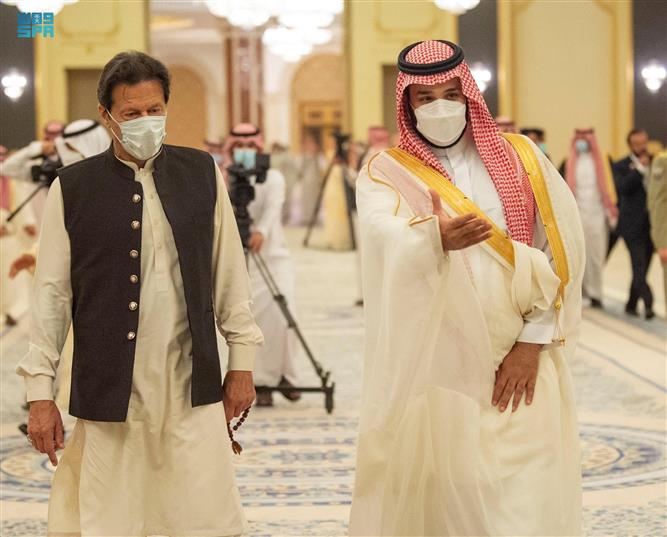
Imran Khan is on an official visit to Saudi Arabia from May 7-May 9
Saudi Crown Prince Mohammed Bin Salman welcomes Pakistani Prime Minister Imran Khan upon his arrival in Jeddah, Saudi Arabia. Reuters
Islamabad, May 9
Saudi Arabia has emphasised the importance of dialogue between Pakistan and India to resolve their outstanding matters, including the Kashmir issue.
Pakistan Foreign Office on Saturday night released a joint statement agreed between Pakistan and Saudi Arabia after Prime Minister Imran Khan held high-level talks with Crown Prince Mohammad bin Salman.
Khan is on an official visit to Saudi Arabia from May 7-May 9.
“The two sides emphasised the importance of dialogue between Pakistan and India to resolve the outstanding issues between the two countries, especially Jammu and Kashmir issue, to ensure peace and stability in the region,” according to the joint statement.
The Crown Prince “welcomed the recent understanding reached between the military authorities of Pakistan and India regarding ceasefire at the Line of Control (LoC), which is based on a 2003 understanding between Pakistan and India”.
The militaries of India and Pakistan, in a surprise announcement on February 25, said that they have agreed to strictly observe all agreements on ceasefire along the Line of Control (LoC) in Jammu and Kashmir and other sectors.
India has told Pakistan that it desires normal neighbourly relations with it in an environment free of terror, hostility and violence.
During Khan’s Saudi visit, the two sides also reviewed all facets of bilateral cooperation and discussed regional and international issues of mutual interest and agreed to further strengthen the relationship in diverse fields.
They signed an agreement on the establishment of the Saudi-Pakistan Supreme Coordination Council (SPSCC). An MoU on combating illicit traffic in narcotics, drugs, psychotropic substances and precursor chemicals was also signed.
They also inked a framework MoU between Saudi Fund for Development and Pakistan for financing projects in energy, hydropower generation, Infrastructure, transport communication and water resource development.
Cooperation agreements in the field of combating crimes and on the transfer of convicted prisoners were also signed.
The two leaders also stressed the need for concerted efforts by the Muslim countries to confront extremism and violence, reject sectarianism, and strive to achieve international peace and security.
They called for joint efforts to combat terrorism in all its forms and manifestations. PTI
here is more brutality to the war in this poorest of the countries in terms of psychological scars of the young and old, and families and communities which were caught between the Taliban, the US-led International Security Assistance Force and the Afghan government. Against this background comes the decision of American President Joe Biden to bring home the remaining 2,500 American soldiers stationed in Afghanistan and make way for the return of the Taliban.
HUGE TOLL: Nearly 2,000 US defence personnel, 70,000 Afghan security men and 47,000 civilians have died in the Afghan war since 2001. Reuters
Parsa Venkateshwar Rao Jr
Senior Journalist
In the aftermath of the September 11, 2001, terror attacks in New York and Washington and the death of around 3,000 office-goers and rescue workers in the twin towers, the then United States President George W Bush rushed the mighty American commando forces, with NATO in tow, into the target-impoverished, Taliban-ruled Afghanistan.
Initially, the Bush Administration asked the Pakistan interlocutors to persuade the Taliban, who had been in power in Afghanistan since 1996, to hand over the prime suspect of the terror attack, Osama bin Laden, the leader of Al Qaida. The Taliban mulishly refused. And the American troops poured in.
There were warnings then that it would not be an easy war for the Americans in Afghanistan. Two other great powers before them — the British in the late 19th century and the Soviet Union in the 1980s — had failed in their attempts to control the country.
It seemed that the Americans had had the last laugh when the Taliban resistance collapsed. A lot many of the Taliban troops were captured along with Al Qaeda men. In violation of international law, these prisoners of war were transferred to Guantanamo Bay and other undisclosed centres of the Central Intelligence Agency (CIA) — the American spy oprganisation — in different parts of Europe and in some other places like Egypt.
American troops scoured the Tora-Bora mountains and caves there in search of Osama bin Laden, but they could find no trace of the man.
It was only a decade later that the American Navy Seals swooped on Osama’s hideout at Abbotabad in Pakistan, where he was found with his young wife and children on
May 2, 2011. Instead of being imprisoned and brought to trial, he was killed without ceremony and his body was thrown into the sea
Perhaps, the Americans feared that he would spill the beans about his American connections in his war against the Soviets in Afghanistan in the 1980s.
It is estimated that in the years between end-2001 and up till now, more than 2,000 US defence personnel, nearly 70,000 Afghan security men and about 47,000 Afghan civilians have died in the war.https://312992a8840c2febd9cc6ec6458b1665.safeframe.googlesyndication.com/safeframe/1-0-38/html/container.html
The economic cost of the war is estimated to range between $800 and over $500 billion.
These are but statistics. There is more brutality to the war in this poorest of the countries in terms of psychological scars of the young and old, and families and communities which were caught between the Taliban, the US-led International Security Assistance Force (ISAF) and the Afghan government.https://312992a8840c2febd9cc6ec6458b1665.safeframe.googlesyndication.com/safeframe/1-0-38/html/container.html
Against this background comes the decision of American President Joe Biden to bring home the remaining 2,500 American soldiers stationed in Afghanistan and make way for the return of the Taliban.
In effect, America has lost the war against the Taliban in the same way that it had lost the war against the Vietcong in Vietnam.
Unsurprisingly, pundits in America and America-friendly pundits in India are literally skirting the issue of the return of the Taliban to the mainstream Afghan politics.
The America-supported democratically elected government of President Ashraf Ghani is tottering in the face of the imminent dominance of the Taliban. Despite the ostensible international conferences in Doha, Moscow and Istanbul among the stakeholders, which include Pakistan, China, Iran, the US, Russia — and not India — the Taliban had been insisting that the American forces must leave Afghanistan before the puritanical Islamist group accepted the terms of peace and participated in the established political system.
There is, however, no explicit guarantee that the Taliban will conform to the norms of the post-2001 democratic Afghanistan.
It became clear after the Taliban regime was dislodged in late 2001 that there could be no political stability in Afghanistan without the participation of the Taliban. The armed Islamist group had sustained a credible insurgency over the past two decades, threatening the national and provincial governments of democratic Afghanistan. It is the sustained insurgency of the Taliban that has forced the Americans to bring them to the negotiating table.
It is indeed a matter of speculation as to the role Pakistan played in nudging and propping up the Taliban. It is a known fact that the Taliban, when they ruled Afghanistan between 1996 and 2001, were amply supported by Pakistan, both diplomatically and materially.
The Americans were very much aware of the Pakistan-Taliban nexus.
There is general hostility towards Pakistan among the people of Afghanistan because they are aware that it is Pakistan that facilitated the Taliban’s repressive regime.
Pakistan, in its desperate search for strategic depth, wants a Pakistan-pliant regime in Kabul.
The reason for India’s opposition to the Taliban is the Islamist group’s Pakistan connection. That is why India’s official stance over the last many years has been that there cannot be a distinction between good Taliban and bad Taliban, and that the Taliban are bad per se because of their ultra-Islamist tenor and their terrorising tactics against their own people.
Pakistan has been trying to convince India through the backchannels that India should not maintain a rigid stance towards the Taliban, and that New Delhi should see the change in the attitude of the Taliban. This was nearly a decade ago.
For two decades now, the Americans have tried to convince the world, including India, about the spectre of Islamic terrorism threatening the global order. It turns out that Islamic terrorism was only a pretext to unleash the American firepower in a post-Cold War world. Now that China has emerged as the new ideological adversary, the Americans are only too eager to turn their back on the spectre of Islamic terrorism because it was just a spectre all along, and it was the proverbial Frankenstein’s creature created to unseat the Ba’ath governments of Saddam Hussein in Iraq and Bashar Assad in Syria.
Saddam Hussein has gone, but Bashar Assad remains. And chaos reigns in the Iraq-Syria region, and the Americans have burnt their fingers with the Islamic State in Iraq and Syria (ISIS).
At least in the case of the Taliban, the Afghan Islamist group has no extra-territorial ambitions like the ISIS.
The Northern Command of the Army on Saturday said it was taking proactive actions to assist the ex-servicemen in the twin Union Territories of Jammu and Kashmir and Ladakh in the wake of the prevailing Covid situation.
Over 34,000 ex-servicemen and their dependents are residing in J-K and Ladakh.
“Efforts are being made to educate them on preventive measures, facilities that have been created, helpline numbers, symptoms, testing facilities, Army hospitals located in their vicinity and facilities existing,” the spokesman said, adding 1,878 ex-servicemen had been given the first dose of vaccine and 137 the second dose so far. — PTI
Punjab announces Rs 50 lakh compensation, job for kin of soldier killed in Arunachal
Amritpaul Singh was on a patrol when he lost his balance and slipped into Siyom river near Manigong village on April 8
Photo for representation. — iStock
Chandigarh, May 10
Punjab Chief Minister Amarinder Singh on Monday announced an ex-gratia compensation of Rs 50 lakh and a government job to the next of kin of a soldier who laid down his life in the line of duty.
Havildar Amritpaul Singh was part of the 31 Field Regiment, was on a patrol when he lost his balance and slipped into Siyom river near Manigong village in Arunachal Pradesh on April 8.
His body was found on May 7, according to a state government statement.
The chief minister extended his sympathies to the bereaved family of the soldier, it said.
Amritpaul Singh, hailed from Kheri village in Sangrur district and is survived by his wife Harmeet Kaur, 11-year-old son Gursewak Singh, father Balveer Singh, mother Bhagwan Kaur and brother Harvinder Singh.
The mortal remains of the soldier were consigned to flames at his native village on Monday. PTI
State Stalwarts
DEFENCE MINISTER
Minister Rajnath Singh
ALL HUMANS ARE ONE CREATED BY GOD
HINDUS,MUSLIMS,SIKHS.ISAI SAB HAI BHAI BHAI
CHIEF PATRON ALL INDIA SANJHA MORCHA
LT GEN JASBIR SINGH DHALIWAL, DOGRA
SENIOR PATRON ALL INDIA SANJHA MORCHA
MAJOR GEN HARVIJAY SINGH, SENA MEDAL ,corps of signals
.
.
PATRON ALL INDIA SANJHA MORCHA
MAJ GEN RAMINDER GURAYA ,MADRAS REGIMENT
sanjhamorcha303@gmail.com
PRESIDENT SOUTH ALL INDIA SANJHA MORCHA
COL SS RAJAN BOMBAY SAPPERS,
PRESIDENT UTTARAKHAND ALL INDIA SANJHA MORCHA
COL B M THAPA ,BENGAL SAPPERSS
PRESIDENT HARAYANA STATE CUM COORDINATOR ESM
BRIG DALJIT THUKRAL ,BENGAL SAPPERS
PRESIDENT TRICITY
COL B S BRAR (BHUPI BRAR)
PRESIDENT CHANDIGARH ZONE
COL SHANJIT SINGH BHULLAR
.
.
PRESIDENT PANCHKULA ZONE AND ZIRAKPUR
COL SWARAN SINGH
INDIAN DEFENCE FORCES
DEFENCE FORCES INTEGRATED LOGO
INDIAN AIR FORCE
Air Officer C-in-C WESTERN AIR COMMAND
AIR MSHL S PRABHAKARAN AVSM VM
AOC-IN-C, EASTERN AIR COMMAND
Air Marshal Inderpal Singh Walia
AOC-in-C SOUTH WESTERN AIR COMMAND
Air Marshal Vikram Singh
AOC-IN-C, SOUTHERN AIR COMMAND
Air Marshal J.Chalapati
AOC-IN-C TRAINING COMMAND
AIR MARSHAL SK GHOTIA VSM
AOC-IN-C MAINTENANCE COMMAND
Air Marshal Jagdish Chandra
Flag Officer Commanding in Chief, Western Naval Command
ice Admiral R Hari Kumar, PVSM, AVSM, VSM
Flag Officer Commanding in Chief, Eastern Naval Command
Vice Admiral Sanjay Bhalla, AVSM, NM
Flag Officer Commanding in Chief, Southern Naval Command