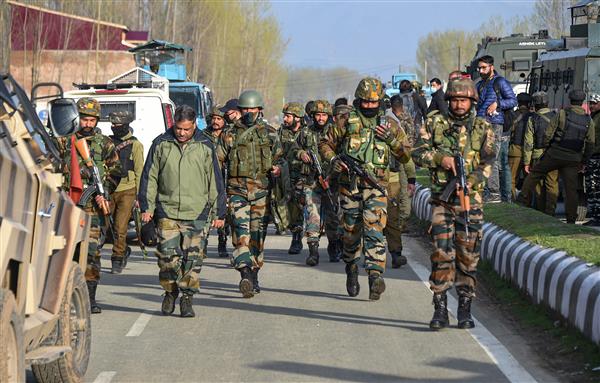
Security personnel during a search operation after a militant attack, at Lawaypora on the outskirts of Srinagar. PTI file
Srinagar, March 29
A CRPF constable who suffered injuries in militant firing died at a hospital here on Monday, taking the death toll in the attack in Lawaypora on the outskirts of Srinagar last week to three, officials said.
Constable Jagannath Ray succumbed to injuries at the SKIMS Hospital in Soura after battling for life for four days, a police official said.
He said Constable Ray was among the four CRPF personnel injured in the militant attack on Thursday.
Two personnel—a sub-inspector and a constable—had died within hours of the attack.
Police have arrested two overground workers involved in providing logistical support to the militants who carried out the attack. PTI
Imran writes to PM Modi; says creation of ‘enabling environment’ imperative for dialogue
Letter comes in reply to Modi’s letter to Imran last week to extend greetings on the occasion of Pakistan Day
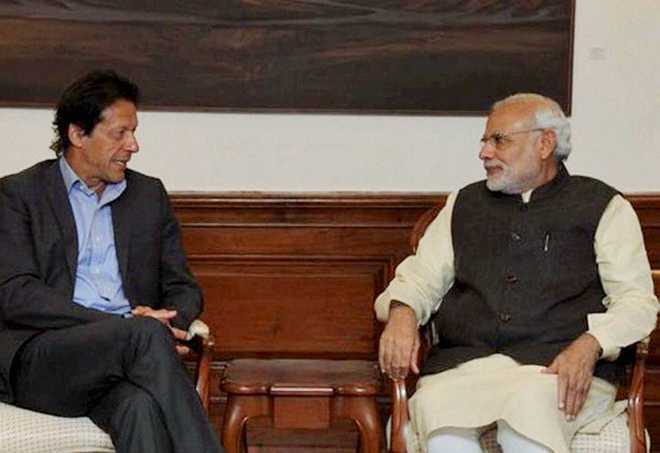
Prime Minister Narendra Modi with his Pak counterpart Imran Khan. PTI file
Islamabad, March 30
Prime Minister Imran Khan has written a letter to his Indian counterpart Narendra Modi, saying creation of an “enabling environment” is imperative for a constructive and result-oriented dialogue to resolve all outstanding issues between Pakistan and India, in particular the Jammu and Kashmir issue.
Khan’s letter was in reply to Prime Minister Modi’s letter to him last week to extend greetings on the occasion of Pakistan Day. In his letter, Modi had said India desires cordial relations with Pakistan but an atmosphere of trust, devoid of terror and hostility, is “imperative” for it.
In his reply to Prime Minister Modi’s letter, Khan thanked him and said the people of Pakistan also desire peaceful cooperative relations with all neighbours, including India.
While Prime Minister Modi talked about a terror-free environment for peace, Khan said that peace was possible only if outstanding issues like Kashmir were resolved.
“We are convinced that durable peace and stability in South Asia is contingent upon resolving all outstanding issues between India and Pakistan in particular the Jammu and Kashmir dispute,” he wrote in the letter dated March 29.
Khan said that creation of an “enabling environment is imperative for a constructive and result-oriented dialogue.”
He also expressed best wishes for the people of India in their struggle against the COVID-19 pandemic.
The militaries of India and Pakistan announced on February 25 that they have agreed to strictly observe all agreements on ceasefire along the Line of Control in Jammu and Kashmir and other sectors.
Weeks later, both Pakistan’s Prime Minister Khan and powerful Army chief Gen Qamar Javed Bajwa made peace overtures towards New Delhi saying it was time for the two neighbours to “bury the past and move forward”.
Ties between India and Pakistan nose-dived after a terror attack on the Pathankot Air Force base in 2016 by terror groups based in Pakistan. Subsequent attacks, including one on an Indian Army camp in Uri, further deteriorated the relationship.
The ties hit rock bottom after India’s war planes pounded a Jaish-e-Mohammed terrorist training camp deep inside Pakistan on February 26, 2019 in response to the Pulwama terror attack in 2019 in which 40 CRPF jawans were killed.
The relations further nosedived after India withdrew special status of Jammu and Kashmir and bifurcated the State into two union territories in 2019. Since then, India and Pakistan are without high commissioners in each other’s capital—New Delhi and Islamabad, respectively.
On March 18, powerful Army chief Bajwa said it was time for India and Pakistan to “bury the past and move forward”. PTI
Special forces of India and US carry out military drill in Himachal Pradesh
It was the 11th edition of the exercise ‘Vajra Prahar’
Photo for representation. — iStock
New Delhi, March 30
Special forces of India and the US carried out a joint military exercise at Bakloh in Himachal Pradesh this month to further enhance interoperability between the two sides, the defence ministry said on Tuesday.
It was the 11th edition of the exercise ‘Vajra Prahar’ which is aimed at sharing best practices and experiences in areas such as joint mission planning and operational tactics.
“The 11th edition of Indo-US joint special forces exercise Vajra Prahar 2021 was conducted at Special Forces training school located at Bakloh, in Himachal Pradesh in March,” the defence ministry said.
It said the exercise was aimed at improving interoperability between the special forces of the two countries.
The ministry, in a statement, said bilateral military exercises and defence exchanges are an important facet of deepening bilateral defence cooperation between friendly countries.
“During such events, the armies of participating nations jointly train, plan and execute a series of operations for neutralisation of threats of varied nature with a common aim of countering threats of international terrorism through mutual training and jointness,” it said.
India and the US carried out a two-day naval exercise in the eastern Indian Ocean Region on March 28 ad 29.
The Indian Navy deployed its warship Shivalik and long-range maritime patrol aircraft P8I in the ‘PASSEX’ exercise while the US Navy was represented by USS Theodore Roosevelt carrier strike group. PTI
*Real experience related to SENIOR CITIZEN SAVING SCHEME (SCSS) DEPOSIT.*
*Banks have been found to looting our hard earned money.*
• *Senior citizens invest in SCSS for better interest rates (always 0.7% higher than PPF) and safety as it is guaranteed by the Goverment of India.*
*However, fraud starts when the deposit holder dies and nominee/legal heir is forced to close the deposit by the law.*
• *Few Banks treat such closure as premature closure of deposits* • *These banks therefore refund the original deposit money after deducting penalty.*
• *This deduction is the fraud* and most accept this deduction as genuine deduction as they lack the knowledge or they don’t have time to follow up with authorities.
• *Income Tax website clearly mentions rules governing SCSS deposit. *Sub Section 5 of Rule 8, clearly states that no penalty deduction shall apply in case the deposit holder dies.The original gazette notification for this SCSS scheme is 490 (E).*
Some one has just *experienced this fraudulent deduction from BANK OF INDIA KANDIVALI (W) station branch, Mumbai*. He fought for about 45 days with the bank with e-mails to higher authorities, personal visits and twitter tagging. *Eventually he received about Rs. 9,500 back from the bank that was deducted as penalty treating the SCSS deposit closure as premature despite the fact that the closure was due to death of the deposit holder.*
Just imagine how many SCSS deposit holders must be dying every year and amount that banks may be deducting as penalty for closure!
*Update your information on such schemes. Be aware.* We request all RETIREES ASSOCIATIONS & FEDERATIONS, & individuals, to take up the matter with finance ministries and IBA & CEO OF all banks to issue, IMMEDIATELY, circular to STOP this unjust & cruel penality to widow of deceased depositor.
A country that lifted 271 million people out of poverty between 2004 and 2014 is today staring at the spectre of a growing income and wealth inequality. (Photo: PTI)
One thing that stood out during the recently concluded budget session of Parliament was how ministers of the Union kept parroting ad nauseam “It is not the business of government to do business”. It left me wondering as to whether they really even understood the full import or implications of their utterances.
I could not help wondering every time the above proposition was articulated that the next inevitable and portentous consequence would be that it no longer would remain the business of government to be in government. By the time the grand garage sale of India’s public assets would be over economic and, by extension, political power would have become so intensely concentrated in the hands of chaebols and oligarchs that they would be the real overlords of India giving even the American gilded age a run for its money.
No government would in future either be able to challenge them meaningfully or deliver public goods and services for the teaming millions who make up the bulk of our populace and require them most.
The Gilded Age, 1870-1899, was a period in American history when a few people through gross chicanery and outright sophistry became vulgarly wealthy in a very short span of time.
The eminence grise of the gilded age were the quick-rich moguls namely John D. Rockefeller, Andrew W. Mellon, Andrew Carnegie, Henry Flagler, Henry H. Rogers, J.P. Morgan, Cornelius Vanderbilt and John Jacob Astor. However, in the popular imagination of American people, they are still the robber barons who had become affluent through illegitimate means.
The later iterations of the gilded age have been periods in the history of nations when public assets created out of public money have been privatised on a mega scale.
The person who really put wheels under this large-scale privatisation of public assets in the penultimate decade of the twentieth century was Prime Minister Margaret Thatcher.
On becoming the Premier in May 1979, she sold off steelmakers, carmakers, aerospace firms, oil and gas giants, airlines and the telecoms’ monopoly in the face of robust protests by well-meaning and sober public intellectuals, and even the directly impacted workers of these former state-owned enterprises. Even public housing was pawned of the tenants who lived in it.
However, in the ultimate analysis, this privatisation turned out to be more of a societal shock, rather than therapy for an ailing economy. It was a violent act of economic engineering enforced by resorting to the coercive powers of the state. Its social implications were colossal. Short-sighted un-egalitarian, and antithetical to the notion of public investment, it did not lay the underpinnings for either sustainable or pervasive prosperity. It was a chimera.
In fact, a 2005 study by economists Blanden, Gregg and Machin found that; “The rapid increase in UK income inequality that began in 1979 is sometimes justified by the argument that society is now more meritocratic so that it is easier for the poor to become richer if they are willing and able to work hard. In fact, our research shows that the opposite has occurred — there has actually been a fall in the degree of social mobility over recent decades.
Children born to poor families are now less likely to break free of their background and fulfill their potential than they were in the past. Thus the only enduring legacy of the Thatcher years was that while the rich became richer the poor became poorer.”
Post the collapse of the Soviet Union in the mid and late 1990s, Russian President Boris Yeltsin launched a ruthless privatisation programme of the Soviet created and commanded economic model incubated public sector. In what became the hugest disposal ever of state-owned property, history enterprises were sold at a rate of over eight hundred per month. By time the process ended 77 per cent of Russia’s large and mid-size organizations and 82 per cent of the small ones were transferred to private owners. These 15,000 privatised assets accounted for two-thirds of industrial output and over 60 per cent of the industrial workforce of Russia, the official successor state of the Soviet Union.
The auctions conducted to privatise these assets were completely rigged. The most lucrative enterprises did not even come up at these public sales. These were either simply farmed out to favoured businesspersons or were disposed of through opaque processes.
Productive establishments and other precious assets were simply pawned off at a fraction of their worth. A tiny clique of oligarchs and carpetbaggers simply took over much of Russia’s economy and became filthy rich. They snapped up valuable state assets at rock bottom prices. More often than not oligarchs just stripped their acquirements of all value simply leaving a shell of a company behind.
They acquired natural resources and then re-sold them at hefty premiums and parked the money abroad. Another favoured modus operandi was the acquisition of majority shareholding invaluable state properties. Having achieved that goal the minority shareholders that more often than not was the Russian State or provincial governments became putty in their hands. The bottom line was not wealth generation but wealth extraction.
As a consequence, billions of dollars of public money found its way into private hands as unearned income. The result was that there was hyperinflation, the bottom dropped out of the Russian currency and ordinary people were forced into the most extreme form of destitution. It was a plight far worse than even the years of Communism.
Similarly in India today there are capitalists who are benefiting from a very similar modus operandi. They are “growing fatter” by the hour cornering public assets at basement prices aided and abetted actively by a collusive state. Airports, airlines, public sector units, power utilities are all being put on the chopping block under a fallacious construct that it is not the business of government to be in business. The consequences of such an ill-conceived strategy in the name of privatisation and disinvestment would haunt India for decades to come.
A country that lifted 271 million people out of poverty between 2004 and 2014 is today staring at the spectre of a growing income and wealth inequality. Even before the pandemic hit India in all its ferocity India’s richest one per cent held more than four-times the wealth held by 953 million people who make up for the bottom 70 per cent of the country’s population.
If there is a time to revisit the fundamental construct it is now. It must be reemphasised with all the force at our command that it is indeed the business of government to be in business or there would be hell to pay in the years ahead.
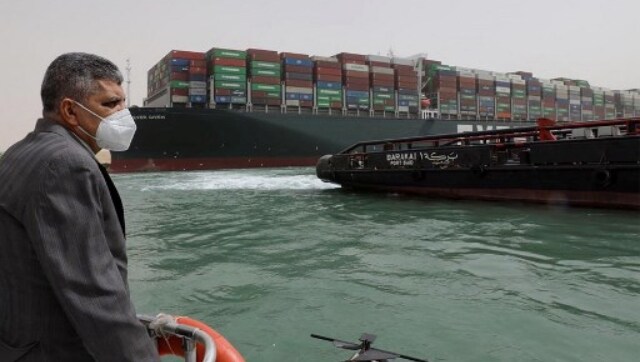
A handout picture released by the Suez Canal Authority on 25 March shows an Egyptian officials checking the operation trying to free Taiwan-owned cargo MV Ever Given (Evergreen). AFP
Regime-insecurity is the principal driver of the asymmetric and indecipherable Chinese government’s behaviour. Since defeating the Kuomintang (KMT) or the Chinese Nationalist Party at the end of the civil war in 1949, the Chinese Communist Party (CCP) has helmed one of the longest-running single-party regimes in modern history. It is arguably the most sophisticated regimes that deploys a complex admixture of repression, censorship, propaganda, technology and nationalism to overcome any threat to its perceived legitimacy.
The widely-believed transformation from one of the world’s poorest countries to among the biggest economies on earth (lifting over half a billion Chinese out of poverty) has denied public space and rationale for any counter-revolution. But externally, where the CCP’s power to control the narrative is beyond its control, it remains skittish, hypersensitive and proactive to take preemptive measures. These carefully-calibrated plans are borne out of deep introspection, scenario imagination and perspective planning.
What plays out thereafter is a slew of relentless investments under the Military-Industrial Complex framework, expansionist tendencies and the sovereign bankrolling — executed cleverly by remaining deliberately vague, practicing realpolitik and often doing so, counter-intuitively. Reading Beijing confounds pundits of diplomacy, as Beijing plans decades ‘ahead of demand’, and that strategic forethought typically challenges the tenure-linked leaderships, in the fast-revolving doors of democracies.
China rarely sleeps, it watches ever global changes very intently.
US Chairman of the Joint Chiefs of Staff, General Mark Milley remarked, “China went to school on us” in an allusion to the Chinese learning lessons from watching the US conduct wars in West Asia. He added, “They watched us very closely in the First Gulf War, the Second Gulf War. They watched our capabilities. And in many ways, they have mimicked those, and they have adopted many of the doctrines and organisations.”
The CCP also monitored the political-societal unrest following the so-called Arab Spring (just as it had conducted a massive study to understand the causes of the Soviet Union collapse) and prematurely snubbed any portent of a potential Jasmine Revolution by getting ahead of events and controlling the narrative. The most significant strategic punt to stay ahead-of-the-curve, is the $1 trillion outflow-led, Belt and Road Initiative (BRI), a hyper-connectivity and ‘cooperation’ gambit that seeks to unleash the Chinese footprint and facilitate covert expansionism, by securing multiple arterial options beyond the existing infrastructural routes and vulnerabilities, for the existing to-and-fro.
One acutely imagined vulnerability for the Chinese was coined as the Malacca Dilemma in 2003, by then-Chinese president Hu Jintao. This ultra-narrow and practically unavoidable marine strait sustains the Chinese juggernaut of the mammoth energy-guzzling Military-Industrial Complexes on the Chinese mainland, and opens perilously close to the southern tip of the Andaman and Nicobar Islands.
This potentially offers a practical ‘choke-point’ to India, to potentially enforce military measures to block these supply lines that are critical to China’s energy and commerce, hence regime-sustenance. Expectedly, China moved quickly and created a viable Strategic Petroleum Reserve (SPR) and started building oil pipelines (eg Kazakhstan-China Pipeline, Eastern Siberian Pacific Ocean Pipeline, Myanmar-Yunnan Pipeline, Gwadar-Xinjiang Pipeline etc) — besides, other BRI imperatives like the China-Pakistan Economic Corridor (CPEC) which physically connects Gwadar port in Balochistan to mainland China, through interlinkages of infrastructural projects.
So far, all alternatives are in various stages of development and the pandemic pressures have ebbed the appetite to invest as aggressively, as originally envisaged. Till then, Malacca Straits is a geopolitical sweet-spot/nightmare of a ‘choke-point’ that till now, was only imagined — but, the ensuing spectre of giant container ship MVEver Given stuck sideways, that ran aground in the narrow Suez Canal that cuts between the African continent and the Sinai Peninsula, is Doomsday 1.0.1 for the Chinese, playing out in chilling reality.
The virtual maritime jam, re-routing of ships and the colossal financial damages caused by this Suez Canal ‘choke’ is a real-time experience, of inevitable helplessness, in such situations. Obviously the context of the choke-point is literally and physically choke-able in the single-lane stretches (for about six kilometres) of the Suez Canal – and the same physical ‘narrowness’ is not applicable in the Malacca Straits (given the narrowest stretch is one-and-a-half kilometres wide), however the same dynamic of the ‘choke’ is potentially enforceable with Indian Navy ships positioned at the mouth of the Malacca Straits. Less than 20,000 ships pass the Suez Canal annually or about 12 percent of world trade, whereas the stakes at the Malacca Straits are substantially higher with at least 1,00,000 ships traversing through the narrow straits.
Wedged diagonally, Ever Given, longer than four football fields has remained unexcavated for nearly a week with the global might of technology, resources and investments to remedy the situation. Interestingly and expectedly, China has enthusiastically joined the global efforts to support the efforts to dislodge the ship — China could well be using this opportunity ‘to go to school’ on managing such choke-points, something that has haunted its imagination and fueled its alternative plans, for long.
While the Chinese account for only 10 percent of the value that passes through the Suez Canal, they also realise that this is a non-hostile and inadvertent ‘choke’ that impacts the entire global supply chain — what could happen in Malacca Straits in an belligerent mode, could be decidedly more complex. Unlike the Suez Canal crisis, where the Chinese benefit from the only international power-projection outpost of Chinese People’s Liberation Army Navy (PLAN) base at Djibouti in the Horn of Africa, further down the Red Sea — the geography surrounding Malacca Straits offers no such base of consequence within SOS reach.
The current outreach of the Chinese navy is effectively limited to the restive South China Seas, as it has yet to acquire Blue-Water-Force capabilities and the recent coalescing of the Sino-wary Quad (US, Japan, India and Australia) do not augur well for Beijing, either. India’s still conceptual/posturing ‘Tri-Service Command’ at the Andaman and Nicobar Islands can be given meaningful bite with additional reinforcements and supplements.
Already the theatre has witnessed many interoperability naval exercises with many ‘friendly’ nations joining hands in a symbolic show of strength and intent. The exact theatre of concern for the Chinese and the invaluable lever of ‘choke’ for the Sino-wary forces, is Malacca Straits. But the Chinese are past masters in learning lessons at others’ expense and in this latest incident playing out in the Suez Canal, the Chinese would be drawing up crucial lessons for what President Xi Jinping calls ‘comprehensive national strength’, which is predicated on China operating on its own terms, without any ‘choke’.
The author is former Lieutenant-Governor of Andaman and Nicobar Islands, and Puducherry
Clean energy, tech in focus as France looks beyond defence to boost business with India
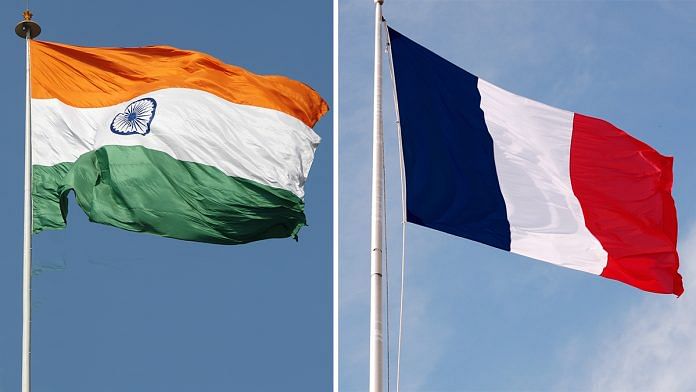
epresentational image of Indian and French flags | Wikimedia CommonsText Size: A- A+
New Delhi: France, which has emerged as one of the closest strategic partners of India in recent years, is looking at bilateral business growth beyond defence by focusing on energy and technology, said an Indo-French trade body.
While defence has been a key element in bilateral trade, according to the Indo-French Chamber of Commerce and Industry (IFCCI), the share of aviation and aeronautics has fallen to 30 per cent in 2020, from 50 per cent in 2019.
However, it is not clear if the dip also includes the defence sector since the chamber does not maintain the numbers in that regard.
“Traditionally, it is true that a big chunk of Indo-French economic ties have been defence and aerospace. Now, we see a number of industries doing so well and coming into limelight, even if we take the last two years,” Payal S. Kanwar, director-general of IFCCI, told ThePrint in an interview.
She said there is an increased focus in the clean energy and digital sectors, and these are the fields where the French can offer more.https://imasdk.googleapis.com/js/core/bridge3.447.1_en.html#goog_1793468704
France is a significant source of FDI in India with more than 1,000 French establishments already present in the country.
According to the official figures, France is the ninth largest foreign investor in India with a cumulative investment of $9.67 billion from April 2000 to September 2020, which represents 1.93 per cent of the total FDI inflows.
The highest FDI equity inflows are in the services sector (19.22 per cent), with cement and gypsum products (10.05 per cent) in the second place, followed by air transport, including air freight, (8.13 per cent), petroleum and natural gas (7.70 per cent) and electrical equipment (5.74 per cent).
Giving details of the new investments, Kanwar said these included Schneider Electric’s $2 billion acquisition of L&T’s electrical business, Total’s announcement of $2.5 billion in Adani Green Energy Limited, and French airport operator Groupe ADP carrying out a 49 per cent buyout of GMR’s airport business.
“Right now, in terms of French investment in India, it is currently about $9 billion, which has actually quadrupled in the last 10 years. France is also the largest European employer in the country with 3.5 lakh jobs with very few expats,” Kanwar said.
She added that what she sees at the chamber level is “expanded footprints within the country”.
“We see new plants, R&D centres coming up. French companies are quite bullish on India,” she said.
According to official figures, in 2020, the India-France bilateral trade stood at 9.04 billion Euros, a drop of 21.99 per cent as compared to the corresponding period of the previous year. This downfall could be due to the Covid.
India’s exports to France in the period were valued at 4.80 billion Euros, down by 22.9 per cent in the corresponding period. Indian imports from France decreased by 20.95 per cent to 4.23 billion Euros.
‘It is not going to be a cakewalk’
Kanwar said while companies do face challenges, the situation has improved under the Narendra Modi government.
“We all know it is not going to be a cakewalk,” she said, adding that GST was an issue for some companies, and customs and import duties for others.
Kanwar said the common issue was with regard to labour and land acquisition laws. However, the French industry welcomes the Modi government’s efforts to streamline these issues, she said.
China on Monday donated 800,000 doses of anti-COVID-19 vaccines to Nepal
hoto for representation.
Kathmandu, March 29
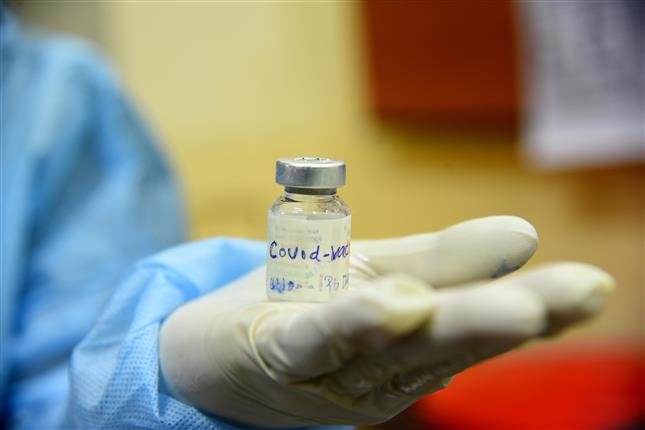
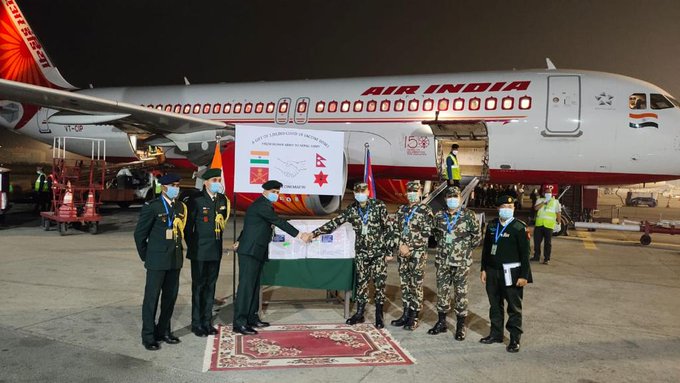
The Indian Army has gifted one lakh doses of India-made anti-COVID-19 vaccines to the Nepal Army as part of the efforts of the militaries of the two neighbours to enhance bilateral cooperation.
The vaccines were handed over by the Indian Army officials to their counterparts from the Nepal Army at the Tribhuvan International Airport on Sunday, the Indian Embassy here tweeted.
“100,000 doses of #MadeInIndia COVID-19 vaccine gifted by Indian Army to the Nepali Army were received at Tribhuvan Airport,” the mission tweeted.
India has previously gifted one million doses of ‘Made in India’ COVID-19 vaccines to Nepal for the immediate requirement of Nepal’s healthcare and front-line workers.https://platform.twitter.com/embed/Tweet.html?dnt=false&embedId=twitter-widget-0&frame=false&hideCard=false&hideThread=false&id=1376187960475848716&lang=en&origin=https%3A%2F%2Fwww.tribuneindia.com%2Fnews%2Fnation%2Findian-army-donates-1-lakh-covid-19-vaccine-doses-to-nepal-army-
Meanwhile, China on Monday donated 800,000 doses of anti-COVID-19 vaccines to Nepal, according to media reports here.
The Vero cell vaccines, which arrived at Kathmandu’s Tribhuvan International Airport (TIA), was handed over by the Chinese ambassador to Nepal Hou Yanqi to the Minister for Health and Population (MoHP) Hridayesh Tripathi during a ceremony organised for the occasion, The Himalayan Times reported.
Even though China had pledged to provide 800,000 doses, initially 500,000 and then later 300,000, to Nepal, the consignment was brought to Kathmandu on Monday by a Nepal Airlines Corporation plane that had flown to Beijing on Sunday.
The vaccine is developed by Sinopharm, an affiliate of state-backed pharmaceutical company Sinopharm.
The Department of Drug Administration (DDA) under Nepal’s Ministry of Health and Population, had approved the Chinese-made ‘Vero Cell’ vaccine for emergency use against COVID-19 in Nepal, on February 17.
Following a delay in procurement of Covishield vaccines by the Serum Institute in India, Nepal had suspended the ongoing COVID-19 vaccination drive, My Republica news portal reported.
Nepal has suspended its vaccination drive after inoculating a little over 1.7 million people in two phases until March 15, The Kathmandu Post reported.
Nepal has reported 276,839 cases of coronavirus and 3,027 deaths related to the disease. PTI
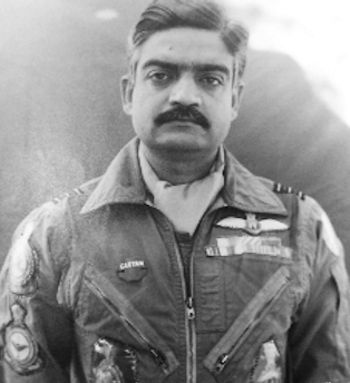
Remembering the CO of 16 Squadron, Wing Commander Padmanabha Gautam, MVC & Bar
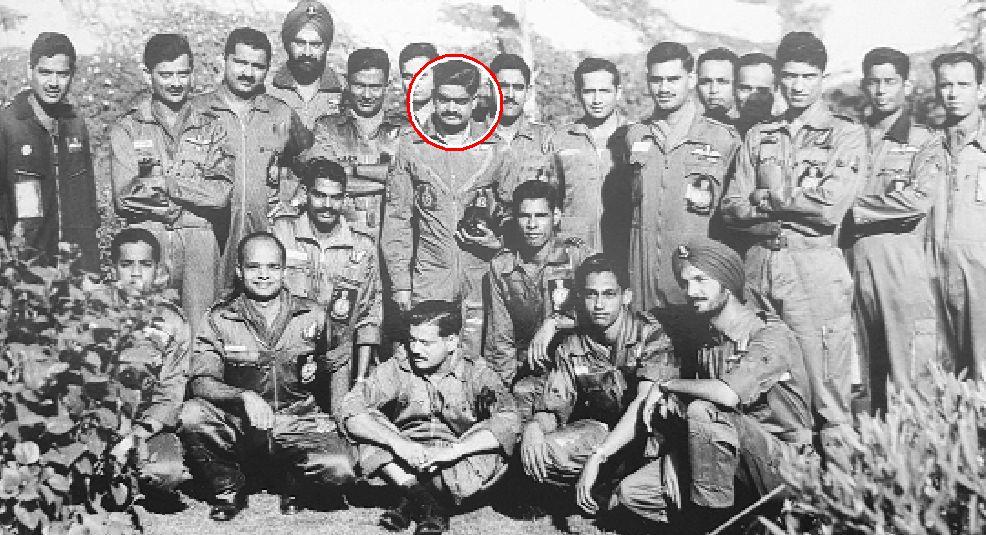
Wing Commander Padmanabha Gautam (encircled), the Commanding Officer of 16 Squadron during the 1971 war, made it a point to engage with all his aircrew on issues such as courage, bravery and fear. Everyone in the Black Cobras knew who would be the one to fly the riskiest missions and that leadership under fire would never be an issue. Photos courtesy: The writer
Air Vice Marshal Arjun Subramaniam (Retd)
The Canberra fleet of the Indian Air Force is a proud one. Its contribution in the bombing role in Congo, the two India-Pakistan wars of 1965 and 1971, and in the recce roles in 1962 and Kargil is outstanding by any yardstick. We celebrate the accomplishments of one of the two IAF Canberra pilots who are recipients of the Maha Vir Chakra twice over, Wing Commander Padmanabha Gautam, the Commanding Officer of 16 Squadron during the 1971 conflict. (Wing Commander JM Nath is the other).
Wing CommanderP Gautam, MVC & Bar
Gautam took over command of 16 Squadron, also known as the Black Cobras, in November 1969. He had just returned from Iraq after a welcome instructional assignment that had followed a hectic six years of flying and achievement. He was also part of the IAF Canberra contingent in Congo in the early 1960s. As the CO of the Joint Bomber Conversion Unit (JBCU), a Canberra squadron in 1965, he was awarded his first Maha Vir Chakra for the several risky missions that he flew as a pathfinder to hit targets at the extremities of the Canberra’s radius of action such as Peshawar. Not satisfied with that, he executed a near dead-stick landing in Iraq on a MiG-17, for which he was commended by both the Iraqi government and the IAF. Air Marshal Vir Narain, one of the pioneer navigators from the Canberra fleet and several years senior to Gautam, remembers him as a confident, cocky and very competent young pilot.
Two navigators from the squadron, Wing Commanders Dutta and Ranganathan, had a ringside view of Gautam’s tenure as Commanding Officer from two different perspectives. While the former, now in his late eighties, was a Squadron Leader and a few years junior to Gautam and was his navigation leader in the squadron, the latter was a Flying Officer with three years of service and still talks about his former CO with awe. Training and bonding for over two years under Gautam made the Black Cobras a formidable unit as war clouds loomed on the horizon in mid-1971. Gautam was an addicted flyer, according to both Dutta and Ranganathan, and wanted to be in a cockpit whenever the opportunity presented itself. Based in Gorakhpur, Dutta recollects that though 16 Squadron was primarily assigned with roles in the eastern theatre of operations, Gautam’s experience in the western sector in 1965 prompted Air HQ to assign the squadron with several missions in the west too.
Reflecting the systematic approach to training and preparing for war that had permeated through several squadrons of the IAF in the build-up to December 1971, Gautam created pilot-navigator teams that commenced training as early as March 1971. Choosing abandoned WW-II airfields in Uttar Pradesh, Bihar and West Bengal as simulated targets, the squadron perfected the art of low-level ingress at night into hostile territory at 500 feet, popping up to 7,000 feet for weapon delivery, which comprised 8X1000 lb bombs, and then diving down to 300-500 feet for the perilous return leg home. Being the senior-most among the commanding officers of the three Canberra squadrons, Gautam was often called to Allahabad, the HQ of Central Air Command, where all mission planning was done.
Remembering his former CO as a fun-loving family man with a great sense of humour and a love for music who wore his accomplishments lightly on his shoulders and drove around in his Mercedes Benz, Ranganathan recollects that from early November 1971 onwards, Gautam made it a point to engage with all his aircrew on issues such as courage, bravery and fear. Everyone in the Black Cobras knew who would be the one to fly the riskiest missions and that leadership under fire would never be an issue.
Dutta recollects that Gautam and he were an inseparable pilot-navigator pair as they initially undertook night bombing missions in the western sector over Mianwali airfield and the Raiwind railway marshalling yard near Lahore. Three-four aircraft would get airborne from Gorakhpur, land at Ambala to refuel and arm before striking targets and returning to Gorakhpur in the wee hours of the morning. All the missions faced a hostile reception over the target area as the sky would be invariably lit up with ack-ack fire, and it was a combination of skill and luck that the squadron suffered no losses in the western sector. Shifting focus to the east once the IAF had achieved air superiority, 16 Squadron commenced its attacks on targets in Chittagong, Khulna and the military cantonment on the outskirts of Dacca. The squadron got hit on the last day of the war when they lost the effervescent Flight Lieutenant Brian Wilson and his navigator Flight Lieutenant Mehta over Dacca in a day raid over Kurmitola.
Gautam and Dutta flew together on six long-distance and long-duration missions as the squadron clocked almost 70 operational missions during the war. Dutta particularly remembers a night mission to Mianwali where they dropped jelly-filled spike bombs that were innovative runway denial weapons. It was later confirmed by one of the Bengali pilots of the PAF based at Mianwali, who escaped to India via Afghanistan, that a PAF F-86 Sabre was destroyed while trying to scramble without realising that there was jelly and spikes on the runway. Dutta was awarded a Vir Chakra for being an ideal foil to Gautam, who himself was awarded a Bar to the Maha Vir Chakra for his inspirational leadership of the squadron and personal exploits of sustained courage and flying skill in war.
Moving to Pune as the Chief Operations Officer (OC Flying in those days) on promotion to Group Captain, Gautam flew both the MiG-21 and the Canberra there. Unfortunately, he perished in a MiG-21 crash on November 25, 1972, after his aircraft flamed out after take-off. A school located close to the Air Force station still commemorates that day with a silent prayer in remembrance of Gautam, as he is believed to have steered the stricken MiG-21 away from the school where it was directly headed for impact. In the process, he lost critical seconds that would have facilitated an ejection. Gautam’s courage and selflessness had followed him from the war zone and he will remain an inspiration for future generations of the IAF.
State Stalwarts
DEFENCES FORCES RANKS
ARMY, NAVY, AIRFORCE RANKS
FORMATION SIGNS
FORMATION SIGNS
ALL HUMANS ARE ONE CREATED BY GOD
HINDUS,MUSLIMS,SIKHS.ISAI SAB HAI BHAI BHAI
CHIEF PATRON ALL INDIA SANJHA MORCHA
LT GEN JASBIR SINGH DHALIWAL, DOGRA
SENIOR PATRON ALL INDIA SANJHA MORCHA
MAJOR GEN HARVIJAY SINGH, SENA MEDAL ,corps of signals
.
.
PRESIDENT SOUTH ALL INDIA SANJHA MORCHA
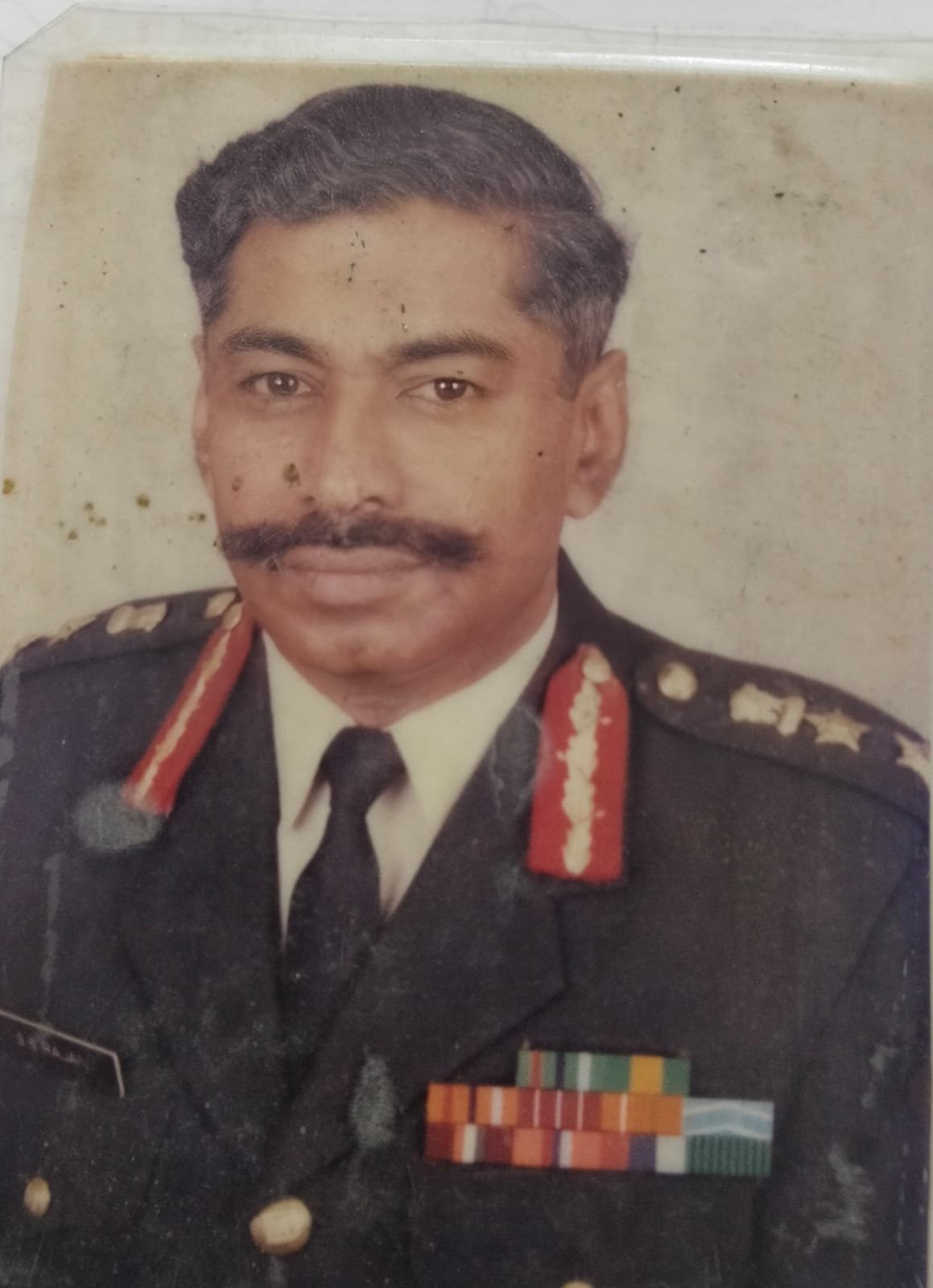
COL SS RAJAN BOMBAY SAPPERS,
PATRON ALL INDIA SANJHA MORCHA
MAJ GEN RAMINDER GORAYA , CORPS OF
sanjhamorcha303@gmail.com
PRESIDENT HARAYANA STATE CUM COORDINATOR ESM
BRIG DALJIT THUKRAL ,BENGAL SAPPERS
PRESIDENT TRICITY
COL B S BRAR (BHUPI BRAR)
PRESIDENT CHANDIGARH ZONE
COL SHANJIT SINGH BHULLAR
.
.
PRESIDENT PANCHKULA ZONE AND ZIRAKPUR
COL SWARAN SINGH
PRESIDENT SAS NAGAR (MOHALI)
COL BALBIR SINGH , ARTY
INDIAN DEFENCE FORCES
DEFENCE FORCES INTEGRATED LOGO
FORCES FLAGS
15 Th PRESIDENT OF INDIA SUPREME COMMANDER ARMED FORCES
Droupadi Murmu
DEFENCE MINISTER
Minister Rajnath Singh
CHIEF OF DEFENCE STAFF (2nd)
General Anil Chauhan PVSM UYSM AVSM SM VSM
INDIAN FORCES CHIEFS
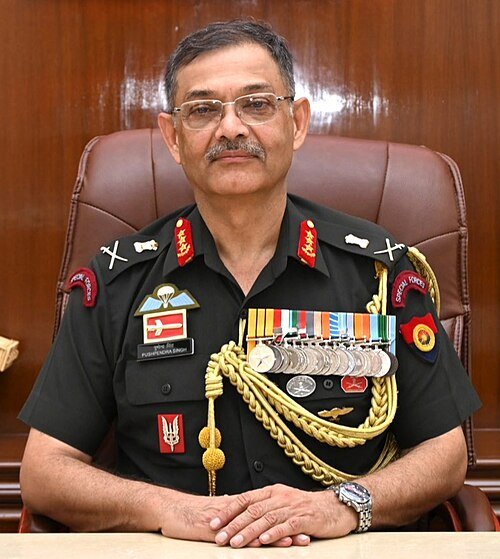
CHIEF OF ARMY STAFF(29th)
General Upendra Dwivedi, PVSM, AVSM (30 Jun 2024 to Till Date)