



Sanjha Morcha

China builds village on ‘Arunachal Pradesh territory’ it occupied in 1959

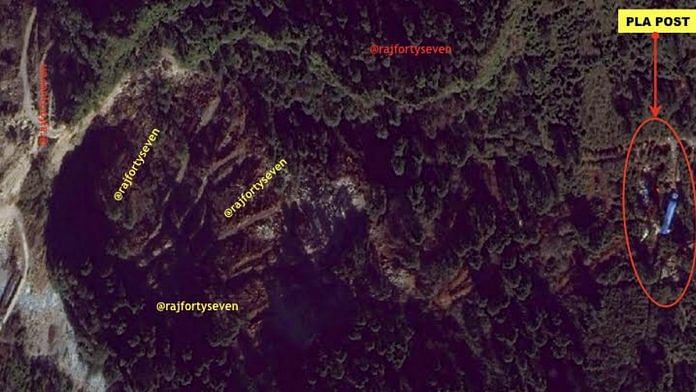
A 2018 satellite image of a road being built in Tsari Chu valley, with previously constructed PLA post marked | Photo: Col. Vinayak Bhat | ThePrint

A 2018 satellite image of a road being built in Tsari Chu valley, with previously constructed PLA post marked | Photo: Col. Vinayak Bhat | ThePrint

New Delhi: China has managed to build a village on land occupied by the People’s Liberation Army (PLA) by overrunning an Assam Rifles post in 1959 on the disputed frontier in Arunachal Pradesh and not on territory controlled by India, sources in the defence and security establishment said.

They said the village on the disputed border in Upper Subansiri district was on territory under Chinese control. Beijing has, for years, maintained an Army post on this territory and the various constructions by the Chinese haven’t happened suddenly, the sources added.

“Even after the 1962 war, they did not withdraw from the area, and it continued to be under Chinese control, just like Aksai Chin, where they have built airfields and other military establishments,” a source said.

ThePrint had, in June 2018, reported on the basis of satellite images that the Chinese PLA had moved at least 5 km inside what was Indian territory, and was setting up base in the strategic Tsari Chu valley, where the village has come up now.

Fresh satellite images of the village, located on the banks of the river Tsari Chu were put out by NDTV Monday. Images from 26 August 2019 don’t show any village, but those from 1 November 2020 do.

Also read: China releases 5 ‘abducted’ Arunachal Pradesh youths to India


Chinese attack in 1959

China’s 1959 operation is known as the Longju incident, and has been chronicled in the book 1962 War – The Unknown Battles: Operations in Subansiri and Siang Frontier Divisions, by retired major generals G.G. Dwivedi and P.J.S. Sandhu.

The book states that the Tibetan rebellion broke out on 10 March 1959, and was brutally suppressed by the PLA. The 14th Dalai Lama escaped and entered Indian territory on 31 March along with some followers, and was subsequently granted political asylum by India.

“This upset the Chinese authorities a great deal, as they felt that the rebellion had been instigated by India, and was aimed at securing ‘independence for Tibet’,” the major generals state.

The book also notes that the Indian post at Longju irked the Chinese, and in a note dated 23 June 1959, they accused Indian troops of intrusion and occupation of Migyitun and some other places in Tibet, and collusion with Tibetan rebels.

“It was at Longju in the Subansiri Frontier Division that the first armed clash took place between the PLA (2nd Company of 1st Regiment of Shannan Military Sub Command) and personnel of 9 Assam Rifles occupying the Indian post at Longju on 25 Aug 1959 which resulted in two Indian casualties,” the book states, adding that the issue was finally resolved through diplomatic channels, and both sides “withdrew from the area” on 29 August 1960.

“However, after this incident, with effect from 27 Aug 1959, the defence of NEFA which till then was the responsibility of Intelligence Bureau (IB) under the Ministry of Home Affairs and Assam Rifles under the Ministry of External Affairs became the responsibility of the Indian Army. Though Assam Rifles was to continue to remain deployed on the border but henceforth, it would be under the operational control of the Army,” it says.

The book adds that after the Longju incident, Assam Rifles did not reoccupy the post, and instead, set up a post at Maja, 10 km to the south, on 29 August 1959.

PLA set up a post in disputed area in late 1990s

According to ThePrint’s 2018 report cited above, in the late 1990s and early 2000, the Chinese PLA had started a campaign to improve its border roads, especially in eastern Tibet, close to the Chumbi Valley, Bhutan and Arunachal Pradesh.

In the same period, in the Tsari Chu area, the PLA had established a company-level post at least 3 km inside Indian territory. At the time, the post was hardly an administrative barracks, with a jeep track serving it.

Located on the eastern side of the river, at a height of 2700 m, the post had three barracks arranged in a C-shape, with a small listening post slightly ahead. With the passage of time and India’s continued indifference, the PLA was encouraged to extend the track further with a bridge and another hut at around 2600m height on the west side of the river, the report added.


Also read: BJP MP flags China ‘encroachment’, says ‘don’t allow next Doklam in Arunachal’


Farmers have constitutional right to take out tractor rally: Unions SC said Delhi Police is first authority to decide the entry of protesting farmers into national capital.

Farmers have constitutional right to take out tractor rally: Unions

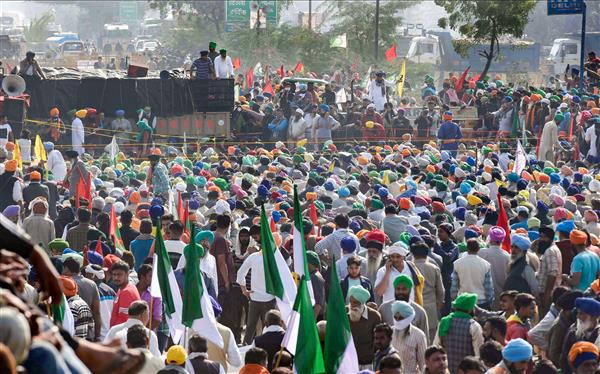
Farmers at the Singhu border. PTI file photo.

New Delhi, January 18

Protesting union leaders on Monday said that farmers have a constitutional right to take out their tractor rally peacefully and asserted that thousands of people will participate in the proposed event on January 26.

The Supreme Court said on Monday that the Delhi Police is the first authority to decide the entry of protesting farmers into the national capital.

Also read: On farmers’ planned tractor rally on Republic Day, SC says entry into Delhi to be decided by police

Bhartiya Kisan Union (Lakhowal) Punjab general secretary Paramjit Singh said that farmers are not going to hold their rally on Rajpath and in other high-security areas, adding that they would only take out it on the Outer Ring Road in Delhi and that there will be no disruption in the official Republic Day parade.

“We are stuck at the Delhi borders. We have not decided to sit at these borders ourselves, we have been stopped from entering Delhi. We will take out the rally peacefully without disrupting any law and order. We will exercise our constitutional right and we will definitely enter Delhi,” Singh told PTI.

Another farmer leader Lakhbir Singh, who is vice president (Punjab) of All India Kisan Sabha, said that farmers will return to protest sites after taking out the tractor rally on the Outer Ring Road on January 26.

“We will not go to any place where there might be a government gathering, and all our tractors will have a national flag and the flags of our farmer unions,” Lakhbir said.

Asked about their stand in case the Delhi Police does not give them permission for the tractor parade, BKU (Ekta Ugrahan) president Joginder Singh Ugrahan said that farmers have constitutional rights to hold the tractor rally peacefully.

“If the Delhi Police has some issues over law and order on Republic Day, they can sit with Sankyukt Kisan Morcha and tell about alternatives routes for the tractor rally. Thereafter, our farmers’ committee will decide the same. But, it is very clear that their tractor rally will be taken out in the national capital on January 26,” Ugrahan told PTI.

Thousands of farmers, mostly from Punjab and Haryana, have been camping at several Delhi borders since November 28, demanding a repeal of farm laws and legal guarantee on minimum support price for their crops.

While hearing a petition, the Supreme Court told the Centre that the proposed tractor rally by farmers on the Republic Day on January 26 is a matter of “law and order” and Delhi Police is the first authority to decide who should be allowed to enter the national capital.

A bench headed by Chief Justice S A Bobde, while hearing the Centre’s application seeking an injunction against the proposed tractor or trolley march or any other kind of protest which seeks to disrupt the gathering and celebrations of the Republic Day, said that police has all the authority to deal with the matter.

The tenth round of talks between the government and the protesting farmer unions is scheduled on January 19. On the same day, the Supreme Court-appointed committee to resolve the impasse will hold its first meeting.

The previous nine rounds of formal talks between the Centre and 41 farmer unions have failed to yield any concrete results to end the long-running protest at Delhi’s borders as the latter have stuck to their main demand of a complete repeal of the three acts.

The Supreme Court had on January 11 stayed the implementation of the three laws till further orders and appointed a four-member panel to resolve the impasse.

Bhartiya Kisan Union president Bhupinder Singh Mann, however, recused himself from the committee last week. —PTI


Had ‘prior info’ on Balakot air strike Leaked messages should invite serious inquiry: Tharoor

Had ‘prior info’ on Balakot air strike

Photo for representational purpose only

New Delhi, January 17

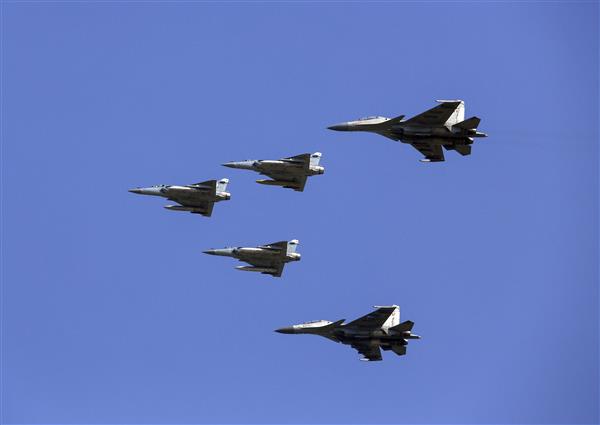
Three days before the Indian Air Force (IAF) jets launched an air strike at Balakot in Pakistan, Arnab had sent a purported WhatsApp message claiming that it would be “bigger than a normal strike”.

“On Pakistan, the government is confident of striking in a way that people will be elated,” he allegedly said in the same message sent to Dasgupta on February 23, 2019. Three days later, IAF jets indeed struck at Balakot. A day later Dasgupta asked Arnab if this was the “big one he was referring to”.

This chat and on many other matters of national security are part of the chargesheet filed by the Mumbai Police in the TRP scam case.

Arnab’s alleged knowledge about the air strike indicates leakage of highly classified information, including military operations. And why did Arnab, who may have gotten a tip-off as a journalist, share this information with Dasgupta over WhatsApp?

Dasgupta was not connected to news operations, but was heading the BARC, which was supposed to check which channel was getting more viewers.

Similarly, just before the abrogation of Article 370 to strip Jammu and Kashmir of its special status, Arnab claimed on August 2, 2019 – again three days prior to the event — “have set platinum standards in breaking and this story is ours”. He was responding to Dasgupta who had sent him a newsflash on (Republic TV), saying: “Government of India to make Jammu separate state, Kashmir and Ladakh as Union Territories.” — TNS


Don’t join WhatsApp if not accepting new policy: HC

Don't join WhatsApp if not accepting new policy: HC

New Delhi, January 18

The Delhi High Court on Monday said accepting the new privacy policy of social messaging app WhatsApp was a “voluntary” thing and one can choose not to use or join that platform if one did not agree with its terms and conditions.

“It is a private app. Don’t join it. It is a voluntary thing, don’t accept it. Use some other app,” Justice Sanjeev Sachdeva said to the petitioner, a lawyer, who has challenged WhatsApp’s new privacy policy which was slated to come into effect in February but has been deferred till May.

The court also said that if the terms and conditions of most mobile apps are read, “you would be surprised as to what all you are consenting to”.

“Even Google maps captures all your data and stores it,” the court said.

The court further said it could not understand what data would be leaked according to the petitioner and since the issue requires consideration, it will be listed on January 25 due to paucity of time on Monday.

The central government also agreed with the court that the issue needs to be analysed.   WhatsApp and Facebook, represented by senior advocates Kapil Sibal and Mukul Rohatgi, told the court that the plea was not maintainable and many of the issues raised in it were without any foundation.

They further told the court that private chat messages between family and friends would remain encrypted and cannot be stored by WhatsApp and this position would not change under the new policy.

The change in policy would only affect the business chats on WhatsApp, they said.

The petition, by a lawyer, has contended that the updated privacy policy violates users right to privacy under the Constitution.

The plea has claimed that the new privacy policy of WhatsApp allows full access into a user’s online activity without there being any supervision by the government.

Under the new policy, users can either accept it or exit the app, but they cannot opt not to share their data with other Facebook-owned or third party apps.

The lawyer appearing for the petitioner claimed that the option not to agree with the new policy was given to users in European nations, but not in India. PTI


NCP demands JPC on purported chats between Goswami, Dasgupta ‘Shocking, disturbing to know how issues related to national security have been used to gain TRPs’

NCP demands JPC on purported chats between Goswami, Dasgupta

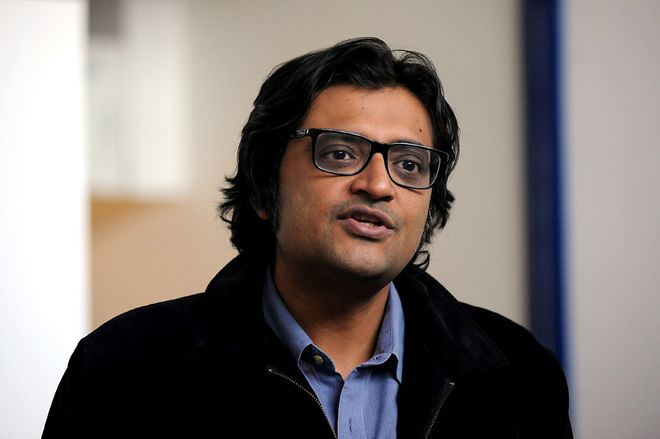
Republic TV editor-in-chief Arnab Goswami

Mumbai, January 18

The Sharad Pawar-led Nationalist Congress Party (NCP) on Monday asked the government to set up a Joint Parliamentary Committee to probe the purported chats between Republic TV editor-in-chief Arnab Goswami and former Broadcast Audience Research Council head Partho Dasgupta.

Referring to the purported chats widely reported in media which mentioned that Goswami was privy to the Balakot airstrikes, NCP chief spokesperson Mahesh Tapase said, “It is extremely shocking and disturbing to know how issues related to national security have been used to gain TRPs.”

Tapase said he will meet Maharashtra Home Minister Anil Deshmukh on Tuesday on the issue and seek clarification from Union Home Minister Amit Shah on the ‘chatgate’.

“The question also arises how Arnab was privy to such sensitive information. The Ministry of Home Affairs has to identify the source and immediately take action,” he said.

Goswami has been at the forefront in maligning the image of the Mumbai police and also the Maha Vikas Aghadi government in the state, Tapase claimed.

“In his TV debates, he tried to give a communal angle to the Palghar incident. The Sushant Singh Rajput death case was blown out of proportion and a false narrative was set. All this was done with the sole intention to destabilise the MVA government,” Tapase said.

The BJP should clarify its position on Arnab Goswami, he said.

Dasgupta, who was arrested in the fake Television Rating Point (TRP) case, is now in the ICU of state-run JJ hospital in central Mumbai.

A diabetic, he was rushed to the hospital from the Taloja Central Prison in Navi Mumbai on Saturday after his blood sugar levels went up on Friday midnight.

The Mumbai police had earlier told the court that Goswami had allegedly bribed Dasgupta with lakhs of rupees to ramp up Republic TV’s viewership. PTI


CRPF gets 21 DRDO-developed bike ambulances for remote area operations

CRPF gets 21 DRDO-developed bike ambulances for remote area operations]

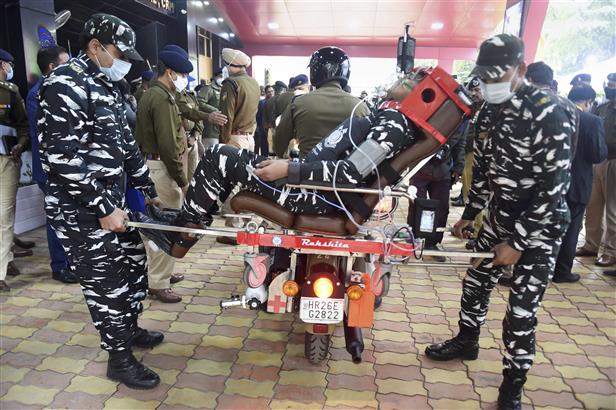
ecurity personnel carry out demonstration after CRPF and DRDO launched specially developed bike-ambulance called Rakshita to attend to urgent evacuation needs of security personnel in an event of injury in naxal affected areas, in New Delhi on Monday. PTI photo

 New Delhi, January 18

Twenty-one ‘bike ambulances’ developed by the DRDO were on Monday inducted into the Central Reserve Police Force (CRPF) for casualty evacuation tasks in remote Naxal violence and insurgency-affected areas.

The customised ‘Rakshita’ ambulances have been created on 350cc Royal Enfield Classic bikes by the Institute of Nuclear Medicine and Allied Sciences (INMAS), a scientific research body under the Defence Research and Development Organisation (DRDO).

CRPF chief A P Maheshwari said the bikes will be used in operational areas like the Left Wing Extremism-affected states and insurgency-hit areas for evacuating sick or injured troops of the paramilitary force.

He added that these ambulances will be “gainfully utilised” to also help the locals of the area where the force is deployed.

The bike’s pillion has been customised as a casualty evacuation seat with recline and has a hand immobiliser and harness jacket, a CRPF spokesperson said.

He added that a physiological parameter measuring equipment with monitoring capability and auto-warning system has been provided to the driver along with a dashboard-mounted LCD for measuring vital parameters of the casualty.

The ambulance also has an air splint medical and oxygen kit, can provide saline and oxygen on the move, adjustable footrest, and hand and foot strap for safety among others, the spokesperson said.

The force has sanctioned an initial fund of more than Rs 35.49 lakh for this project, he said.

The CRPF, the lead force for anti-Naxal operations and internal security in the country, first toyed with the bike ambulance idea in February 2018 when the troops of its 85th battalion deployed in Chhattisgarh’s Bijapur district used their patrolling bikes to evacuate casualties from remote areas under its jurisdiction.

Following this, the force approached the INMAS to develop a fully capable and equipment-supported bike ambulance.

“The INMAS promptly put up a team of scientists and experts to make the idea a reality. The team developed a prototype and improved it with the feedback from CRPF personnel deployed in disturbed areas,” the spokesperson said.

Distinguished scientist and director general (life sciences) at the DRDO A K Singh was also present during the handing over of the bike ambulances event held at the CRPF headquarters on Lodhi Road here. — PT


Farmers’ stir: Joint forum distances itself from its leader Chaduni’s meeting with Oppn parties

Farmers’ stir: Joint forum distances itself from its leader Chaduni’s meeting with Oppn parties

Gurnam Singh Chaduni. File photo

Chandigarh, January 18

The Samyukt Kisan Morcha, a joint forum of farmer organisations spearheading the ongoing protest against farm laws, on Monday disassociated itself from a meeting its constituent Gurnam Singh Chaduni had attended with some opposition leaders, and reiterated that the movement “will not have any direct engagement with any political party”.

A controversy erupted after Bhartiya Kisan Union-Haryana president Chaduni attended the meeting along with the opposition leaders in Delhi on Sunday and supported a call for convening a ‘Jan Sansad’ (People’s Parliament) on the farmers’ issue on January 22-23.

In a statement, the Samyukt Kisan Morcha (SKM) said its coordination committee “inquired into the controversial matter of Chaduni’s meeting with several political parties”.

“Chaduni, clarifying his stand to the committee, stated in writing that yesterday’s meeting was organised by him in his personal capacity. SKM is not associated with this activity in any way. Realising this, he assured the committee that in future, while the ongoing farmers’ agitation is underway, he will not attend any political party meeting,” it said, adding that the committee “welcomed his statement and decided to end the controversy here”.

However, the SKM had said earlier in the day that it “has formed a committee that will inquire into the matter and give its report in three days’ time. SKM will take further steps thereafter”.

In the late-evening statement, the morcha said, “The juncture at which this current unprecedented farmers’ movement is, unity and discipline are of highest priority…. Any organisation and party is free to extend its support; however, the Samyukt Kisan Morcha and the movement will not have any direct engagement with any political party.”

On his meeting with opposition leaders, Chaduni told reporters near Delhi’s Singhu border on Monday that he wanted to let the country know where all these parties “stand on farm laws—whether they are against these or in favour”.

At the same time, he added that he will abide by whatever the morcha decides.

Replying to a question, he also said that his organisation had never invited any politician to share stage or address the people during the ongoing agitation against the Centre’s new farm laws.

Thousands of farmers, mainly from Punjab, Haryana and western Uttar Pradesh, have been protesting at various border points of Delhi for over 50 days now demanding repeal of the three laws—the Farmers’ Produce Trade and Commerce (Promotion and Facilitation) Act, the Essential Commodities (Amendment) Act, and the Farmers (Empowerment and Protection) Agreement on Price Assurance and Farm Services Act.

Enacted in September 2020, the Central government has presented these laws as major farm reforms aimed at increasing farmers’ income, but the protesting farmers have raised concerns that these legislations would weaken the minimum support price (MSP) and “mandi” systems and leave them at the mercy of big corporations.

The government has maintained that these apprehensions are misplaced and has ruled out a repeal of the laws.

Multiple rounds of talks between the government and the protesting unions have failed to resolve the impasse on the matter. — PTI


Tomar urges unions to reconsider the decision on tractor march

http://

ribune News Service

New Delhi, January 18

Two days before his scheduled meeting with unions, Agriculture Minister Narendra Singh Tomar again hailed various “pro-farmer/pro-agriculture” steps, including the three farm laws, taken by Narendra Modi government.

He said the reforms will go a long way in improving living standard of farmers and the agriculture sector.

The scheduled meeting between farmer leaders and union ministers has been postponed to January 20.

Earlier the meeting was to be held on Tuesday, January 19.

Urging unions to reconsider their decision to hold a tractor march on January 26, Tomar said farmers “should not do anything that may affect the ‘garima’ (dignity) of the country on the Republic Day”.

Ahead of the tenth round of talks on January 20, he again urged protesting farm leaders to come for a clause by clause discussion in the laws.

While farmers’ unions and the government continue to stand firm on respective stance regarding the three farm laws, in the last meeting they had reaffirmed commitment to continue with the direct dialogue process.

The talks are expected to also touch the issue related to the minimum support price as was indicated by some union leaders after the last meeting. The unions are again expected to raise the issue related to the “Home Ministry and state police repression on people associated as well as not associated with the ongoing movement, including NIA raids”.

Earlier, addressing a conference, Tomar said “the three laws enacted by the government will free farmers from all unnecessary legal bindings and help them get maximum value for their produce. Farmers will be attracted toward planting high value crops. Whenever any reform is introduced, impediments are bound to come in the way”. He also said the farm laws have been introduced after long deliberations with experts and stakeholders. “These reforms were long overdue. But previous government could not muster courage to introduce these laws. Our government under the leadership of Prime Minister Narendra Modi brought revolution in agriculture sector,” he said.

Dispelling rumours that MSP will be withdrawn, he said rather the BJP-led government has strengthened the system since it came to power in 2014. “MSP system will exist in future also. In fact we have included pulses and oilseeds under MSP purchase. We have increased the MSP on 23 crops by implementing the recommendations of Swaminathan Commission,” he said.

Yesterday, Tomar said most farmers and experts are “in favour of farm laws”.


Sun Dilliye Ni Sun Dilliye’, sung by Mohali sisters on farmers’ agitation, gets thousands hits online

‘Sun Dilliye Ni Sun Dilliye’, sung by Mohali sisters on farmers’ agitation, gets thousands hits online

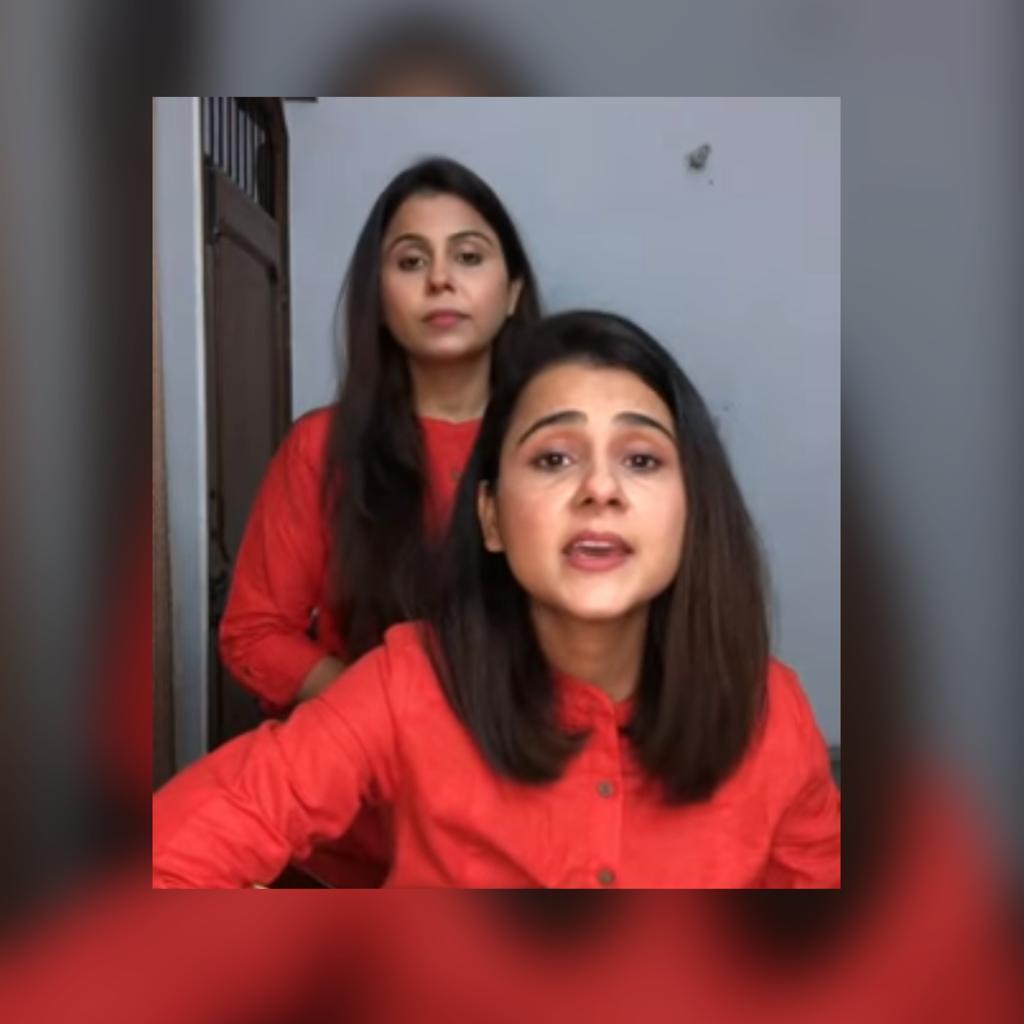
A screen grab of the video.

New Delhi, January 17

Even as “Sun Dilliye Ni Sun Dilliye”, a song written, composed and sung by the two young sisters on the ongoing farmers’ agitation continues to grab thousands of hits on social media from people across the world, the duo maintains that while all the praise has been extremely encouraging, what matters most is that people across barriers have been able to relate to it.

http://

“We never thought that the song (https://www.youtube.com/watch?v=0kEkwK5zS5A) would become so popular. The feedback from everyone has been very kind. However, what is most heartening is the fact that even those involved in the agitation—from leaders to protesters have liked it immensely,” says Simrita.

While both Simrita and Ramneek have post-graduate degrees in Hindustani classical music, the duo admits that they are not essentially lyricists. “But these circumstances were different. We were deeply troubled by the fact that thousands of farmers were out in the open at a time when we were sitting comfortably in our quilts,” says Ramneek.

The duo, residents of Mohali, whose parents come from an agricultural background insist that they (parents) have been very quite encouraging. “They have been extremely supportive and happy that we have been singing in support of the protests. In fact, ever since childhood, they have pushed us to find our place in our chosen field,” Simrita adds.

They feel that the most striking aspect of the movement for them has been the fact that Punjabi mothers have been encouraging their children to go out in this cold and join the protests. “And that says so much — about their spirit and heart,” feels Ramneek.

Feeling that social media has been instrumental in making youngsters’ join the agitation, Simrita adds that considering its deep penetration among youngsters, it has been successful in presenting multiple facets of the agitation. “It has given so many new perspectives unlike the mainstream media which is struck on a single narrative. Most people of our generation are heavy social media users. It has definitely succeeded in bringing about a very different level of awareness and engagement,” stresses Simrita

For them, the agitation has ‘grown’ in different ways in a short while.

“While during the initial days, we mostly saw the elderly protesting, very soon, a large number of youngsters joined the protests. Interestingly, one sees a sizable number of women protesters,” says Ramneek.

Talking about the perfect coordination between them, Simrita smiles that it is not limited only to music. She loves to cook, and “I am a foodie,” she says. — IANS