Sanjha Morcha

Centre offers suspension of agri laws for a mutually-agreed period; farmers say will discuss proposal

http://

Vibha Sharma
Tribune News Service

New Delhi, January 20

In a major development on Wednesday, the BJP-led Centre offered to suspend implementation of the three contentious farm laws for “one to one-and-a-half years” or a period “mutually decided by the two sides”.

Agriculture Minister Narendra Singh Tomar said the government is also ready to give an affidavit in the Supreme Court to dispel any doubts on the proposal.

On the issue of MSP, the government offered a committee but farmers rejected it, according to the Samyukta Kisan Morcha.

However, agitating unions said they are firm on their demand for a complete repeal of the three laws but will still discuss the government’s proposal on Thursday.

Their next meeting with the three union ministers is now scheduled for January 22.

Briefing the media, Tomar said he was “hopeful of positive result (in other words farmers taking up the offer of the government) in the next meeting”.

“It will be a victory for Indian democracy the day farmers end the agitation,” he added.

Tomar said being the ‘parkash utsav’ of Guru Gobind Singh, it was an important day and it was the effort of the government to arrive at some decision today.

“While the farmers, as usual, were stuck on their demand for a repeal, the government, with a big heart, was willing to offer amendments. Today’s day is dedicated to Guru Gobind Singh. We began by extending our wishes to unions and gave them the proposal to setup a joint committee to discuss all issues related to agitation and find solutions.

“I am glad they have decided to discuss the matter (amongst themselves). I am sure that the matter is reaching towards a conclusion. I am hopeful of a positive result on January 22,” he said.

Regarding the Supreme Court order on the laws, Tomar said the government will honour its decision as also of the committee set up by it to look into the matter.

Samyukta Kisan Morcha leader Darshan Pal said just because unions have agreed to discuss the government’s proposal tomorrow does not mean that they have given up the demand of complete repeal of the three laws.


Rafale to feature in Republic Day parade for first time Single aircraft to carry out ‘Vertical Charlie’ formation

Rafale to feature in Republic Day parade for first time

A total of 38 IAF aircraft and four planes of the Indian Army will participate in the flypast on January 26. PTI file

New Delhi, January 18

The newly-inducted Rafale fighter aircraft will feature in India’s Republic Day parade on January 26 and culminate the flypast by carrying out the ‘Vertical Charlie’ formation, the Indian Air Force (IAF) said on Monday.

In the ‘Vertical Charlie’ formation, the aircraft flies at low altitude, pulls up vertically and conducts rolls before stabilising at higher altitude.

“The flypast will culminate with a single Rafale aircraft carrying out a ‘Vertical Charlie’ formation,” said Wing Commander Indranil Nandi.

A total of 38 IAF aircraft and four planes of the Indian Army will participate in the flypast on January 26, he said. PTI


Bhawana Kanth, First Woman Fighter Pilot To Take Part In R-Day Parade

Bhawana Kanth, First Woman Fighter Pilot To Take Part In R-Day Parade

Flight lieutenant Bhawana Kanth will be a part of the Republic Day parade this year to become the first woman fighter pilot to take part in India’s biggest ceremonial event on January 26, officials said on Monday. She will be a part of the Indian Air Force’s (IAF’s) tableau that will showcase mock-ups of the light combat aircraft, light combat helicopter and the Sukhoi-30 fighter plane. She is currently posted at an airbase in Rajasthan where she flies the MiG-21 Bison fighter plane.

Kanth is also one of the first women fighter pilots in the IAF. She, along with Avani Chaturvedi and Mohana Singh, was inducted into the IAF as the first women fighter pilots in 2016. Ten women have been commissioned as fighter pilots after an experimental scheme for their induction into the IAF’s combat stream was introduced in 2015, a watershed in the air force’s history.

Kanth, who belongs to Darbhanga in Bihar, was born and brought up in the Refinery Township, Begusarai, where her father worked as an engineer in IOCL. She did her schooling from Barauni Refinery DAV Public School and completed her bachelor of engineering in medical electronics from BMS College of Engineering in Bengaluru.

She loves playing badminton, volleyball and adventure sports and is also interested in photography, cooking, swimming and travelling. After clearing Stage I training, she got the opportunity to opt for the fighter stream. Kanth had said after her induction in the IAF, while recalling her first experience of the spin solo on fighter aircraft Kiran, that as she entered the aircraft into a spin and recovered it all by herself at 20,000 feet, doubt started creeping into her mind as to what if the aircraft didn’t recover.

“I told myself that if I don’t do it now, I will always be afraid of it. I spun the aircraft and to my surprise, the spin was more vicious or so it seemed. But the fighter pilot in me took over and I told myself come what may I will recover. And the aircraft recovered from spin and so did my confidence,” she had said.

This year, Rafale fighter jet will also take part in the Republic Day parade for the first time. The Indian Air Force has inducted 11 of the 36 Rafale jets ordered by New Delhi at a cost of ₹59,000 crore. Seven more fighters have been handed over to India by Dassault but these are being used for training IAF pilots in France. The third batch of three fighter jets is scheduled to land on January 27.

Rafales, Su-30s and MiG-29s, the fighter jets which are part of the IAF’s muscular posture in the Ladakh theatre, will be among 45 aircraft taking part in Republic Day flypast.

Also Read: Two Newly Inducted Rafale Fighters To Be Part Of Republic Day Flypast


Do these farmers look like secessionists, terrorists: Capt to Centre over NIA notices

Do these farmers look like secessionists, terrorists: Capt to Centre over NIA notices

Farmers watch a Kabaddi tournament during the ongoing protest at Ghazipur Border, in New Delhi, on Monday, January 18, 2021. PTI

Tribune News Service

Chandigarh, January 18

Condemning the issuance of NIA notices to several farmers and their supporters in the midst of the anti-Farm Laws agitation, Punjab Chief Minister Capt Amarinder Singh on Monday said such arm-twisting tactics would not weaken the resolve of the farmers to fight for their rights and their future.

“Do these farmers look like secessionists and terrorists?,” asked the Chief Minister, slamming the BJP-led government at the Centre for resorting to such reprehensible and oppressive tactics in their desperation to undermine the peacefully protesting farmers’ fighting spirit. But these measures will not succeed in destroying the resolve of the farmers, rather the Centre will only end up provoking them into stronger reaction, he said, questioning the intent of the Government of India, which he said seemed bent on pushing the farmers over the edge through such intimidatory actions.

Amarinder warned that BJP’s most powerful minds will not be able to control the situation if things get irretrievably out of hand.

Instead of resolving the crisis triggered by the draconian legislations, the Bharatiya Janata Party (BJP) led central government was resorting to victimisation and harassment of the protesting farmers and their supporters, the Chief Minister pointed out, dubbing it a regressive step that would lead to further hardening of the farmers’ stance.

It was obvious, said the Chief Minister that the BJP-led NDA government neither cared for the farmers and their concerns, nor understood their psyche. “Punjabis are fighters by nature, they are imbued with the fighting spirit which makes them among the best warriors in the world,” he said, adding that the Centre’s coercive actions will only provoke the farmers from Punjab to react negatively.

Amarinder expressed shock over the Government of India’s unrelenting opposition to the farmers’ genuine and justified demands and its total failure to empathise with the cause and concerns of the farmers who have been braving the record cold of Delhi, with many of them succumbing to the harsh weather and prolonged exposure. Not only had the Centre been standing on ego in its adamant refusal to repeal the black Farm Laws, it was actively and shamelessly indulging in strong-arm tactics to suppress the voice of the farmers, he said, pointing to the IT notices issued to several big Arhtiyas of Punjab about a month ago and now the NIA notices that were clearly aimed at pressurising the farmers into withdrawing their stir.

These low-level actions will not suppress the voice of the farmers, or those millions of Indians who are supporting the ‘annadaatas’ in their battle for survival, said the Chief Minister, adding that if the Centre had any shame left it should immediately withdraw the Farm Laws and sit down across the table with all the stakeholders, especially the farmers, to usher in an era of genuine agricultural reforms.


Constitutionally, farm laws on shaky ground

Makers of the Constitution didn’t assign any agriculture law-making responsibility to the federal government or Parliament, owing surely to the country’s vastness and diversity of agricultural produce, soil, farming methods etc. Hence, of the 97 subjects under the Seventh Schedule of the Union List, not once has ‘agriculture’ been mentioned, or referred to, for law-making purpose.

Constitutionally, farm laws on shaky ground

Legal crux: The Constitution has allotted agriculture to the states, not to the Centre. PTI

Abhijit Bhattacharyya

Advocate, Supreme Court

IN Minerva Mills vs Union of India (1980) and BR Kapur vs State of Tamil Nadu (2001), it was held by the Supreme Court, “People of the country, organs of the government, legislature, executive, and the judiciary, are bound by the Constitution, which is the paramount law of the land and nobody is above or beyond the Constitution”. In the light of the ongoing debate on the farm laws, is it time for the apex court to suo motu examine the law and the spirit of the law? Do these Acts fall under the ambit of the “basic features of the Constitution”?

Unlike the unwritten British Constitution, the Indian Constitution isn’t the creation of Parliament — it is the other way around. “We, the people of India” created the Constitution on November 26, 1949. And the Constitution created Parliament. Hence, the Constitution is sovereign, supreme and superior to all laws created by Parliament. A fact subtly, and succinctly, reminded by the Supreme Court: “The Constitution is the mechanism under which laws are to be made and not merely an Act which declares what law is to be” (M Nagaraj vs Union of India, 2006).

Thus, the Constitution is the “philosophy, polity, society and law, all in one”, thereby making the supremacy thereof indisputable; it cannot be challenged in any court of law. This unique status and exalted position, however, isn’t available to other laws made by Parliament. To quote Justice DD Basu from his 15-volume magnum opus Constitution of India (Volume 1): “Since the people constitute the ultimate sovereign who set up the Constitution and the government established thereunder, the law laid down by the Constitution must necessarily be superior to the laws made by the legislature, which is an organ created by the Constitution itself.”

In Indian Constitutional Law (6th edition, 2010), Constitution expert MP Jain writes: “The Constitution, being written, constitutes the fundamental law of the land. This has several implications. It is under this fundamental law that all laws are made and executed: all government authorities act and validity of their functioning adjudged. No legislature can make a law and no government agency can act contrary to the Constitution.”

That brings us to a legal and constitutional look at the new farm Acts, the introductory part of which runs thus: “As the agriculture sector has immense potential to make a significant contribution to the economic growth, there is a need to find long-term solution…” It’s “an Act…on farming agreements… to engage with agri-business firms… and for matters connected therewith or incidental thereto.”

The peculiarity of the issue needs a revisit in the light of various factors considered by the Constitution makers, who collectively, consciously and conscientiously didn’t assign any agriculture law-making responsibility to the federal government or Parliament, owing surely to the country’s vastness and diversity of agricultural produce, soil, farming methods, management and ancillary acts connected to it. Hence, of the 97 subjects under the Seventh Schedule of the Union List, not once has ‘agriculture’ been mentioned, or referred to, for law-making purpose.

The word ‘agriculture’ has been mentioned four times — for the purpose of not ‘touching’ the issue; Item 82 of the Union List pertains to “taxes on income other than agricultural income.” Item 86 is about “taxes on capital value of the assets, exclusive of agricultural land…”; Item 87 is on “estate duty in respect of property other than agricultural land,” while Item 88 deals with “duties in respect of succession to property other than agricultural land.”

Clearly, agriculture, the mainstay of a majority of India’s demography, was given a special status owing to it being the traditional pivot, feeding millions of people every day. The wise men of the Constituent Assembly, who sat from 1946 to 1949, must have had in mind the recurring famines of India owing to reckless profiteering and loot by traders, merchants and monarchs of England that devastated the Indian population first in 1770, within five years of the arrival of the British East India Company, and ending with the famine of 1943 that killed three million people.

Unsurprisingly, therefore, the makers of the Indian Constitution clearly and categorically put ‘agriculture’ as item 14 of State List II: “Agriculture, including agricultural education and research, protection against pests and prevention of plant diseases”, thereby assigning agriculture to the states, and not to Parliament or the federal government.

And, that is legal crux of the matter. Whereas Items 82, 86, 87 and 88 of the Union List specifically deny Parliament or the federal government any role, Items 46, 47 and 48 of List II, under the State List, give full responsibility to the provincial/state legislatures/government. They read thus: Item 46: Taxes on agricultural income; Item 47: Duties in respect of succession to agricultural land; Item 48: Estate duty in respect of agricultural land. Then there is Item 18 that refers to “transfer and alienation of agricultural land…and agricultural loans”, followed by Item 30 on “relief of agricultural indebtedness.”

All those referred to above are covered by the State List, not the Union List. Thus, the Constitution allotted agriculture to the states.

The Concurrent List has 47 items. ‘Concurrent’ implies that both federal government/Parliament and state/legislatures can make laws on these listed items. Strikingly, however, both the Centre and the state have to contend with Item 6: “Transfer of property other than agricultural land…”

Further, the only instance when both the Centre and the state are assigned work on ‘agricultural land’ is Item 41: “Custody, management and disposal of property (including agricultural land) declared by law to be evacuee property.” In other words, Item 41 of the Concurrent List pertains to the refugees’ agricultural land; not the vast swathes of agricultural land and millions of people directly or indirectly connected to agriculture for their livelihood.

That brings us back to the Constitution: “We, the people of India… In our Constituent Assembly, this twenty-sixth day of November 1949, do hereby adopt, enact, and give to ourselves this Constitution.”

The point is loud and clear. In case a law made by Parliament or state legislature is not in consonance with the spirit of the Constitution, it’s the duty and responsibility of the Supreme Court to give a verdict.

 As judged by the Supreme Court in AK Gopalan vs State of Madras (1950), “The Constitution has imposed definite limitations upon each of the organs of the state, and any transgression of those limitations would make the law void. It is for the courts to decide whether any of the constitutional limitations has been transgressed or not.” Because the Constitution is the organic law, subject to which ordinary laws are made by the legislature, which itself has been set up by the Constitution.


NIA notices to farmers show BJP’s desperation, says Capt Amarinder Singh

NIA notices to farmers show BJP’s desperation, says Capt Amarinder Singh

Punjab Chief Minister Captain Amarinder Singh – File photo

Chandigarh, January 18

Condemning the issuance of notices by the NIA to several farmers and their supporters in the midst of the anti-farm laws agitation, Chief Minister Capt Amarinder Singh today said such arm-twisting tactics would not weaken the resolve of farmers to fight for their rights and their future.

Capt Amarinder Singh, Chief Minister

Don’t provoke them

These measures will not succeed in destroying the resolve of the farmers, rather the Centre will end up provoking a stronger reaction from them.

“Do these farmers look like secessionists and terrorists?” asked the Chief Minister, slamming the BJP-led government at the Centre for resorting to such reprehensible and oppressive tactics in their desperation to undermine the peacefully protesting farmers’ fighting spirit.

“These measures will not succeed in destroying the resolve of the farmers, rather the Centre will only end up provoking a stronger reaction from them,” Capt Amarinder said and warned that BJP’s most powerful minds would not be able to control the situation if things got irretrievably out of hand.

It was obvious, said the Chief Minister, that the BJP-led NDA government neither cared for the farmers and their concerns, and

nor understood their psyche. “Punjabis are fighters by nature. They are imbued with the fighting spirit which makes them among the best warriors in the world,” he said, adding

that the Centre’s coercive actions would only provoke the farmers from Punjab to react negatively.

Capt Amarinder expressed shock over the Government of India’s unrelenting opposition to the farmers’ genuine and justified demands and its total failure to empathise with the cause and concerns of the farmers who have been braving the cold in Delhi, with many of them succumbing to the harsh weather and prolonged exposure. — TNS


MLAs, farmer unions to boycott MP Sunny Deol MP hasn’t visited his constituency since Sept

MLAs, farmer unions to boycott MP Sunny Deol

Kisan Sangharsh Samarthan Committee members burn an effigy of the IMF in Bathinda. Tribune photo

Ravi Dhaliwal

Tribune News Service

Gurdaspur, January 19

Barely 19 months after winning the seat by a margin of 70,000 votes, BJP MP Sunny Deol is finding the doors of his constituency shut. Seven Congress MLAs, the lone SAD legislator and four farm unions have made their intentions clear of keeping Deol out. The constituency has a total of nine Assembly seats.

Sunny Deol, BJP MP from Gurdaspur

The actor-turned-MP has been missing in action since September last year. A senior police officer said CID reports signaled that the MP was sure to face the fury of farmers if he made an appearance.

The farm unions are Kirti Kisan Union, Punjab Kisan Union, Jambhoori Kisan Sabha, Ex-Sainik Sangharsh Committee and the Kisan Mazdoor Sangarsh Morcha. Dr Dharam Pal, convener of the All India Kisan Sangarsh Coordination Committee, said if the actor came to Gurdaspur, he would not only be boycotted but protests would also be held outside his office in Pathankot.

In a related development, Cabinet Minister Sukhjinder Singh Randhawa has sent an invitation to BJP MP Hema Malini asking her to come to Punjab “on an all expenses paid trip and enlighten the farmers on what are the exact benefits of the farm laws.” She recently claimed “the laws are good but farmers have failed to understand the benefits.”


Will present views of all sides with fairness, says SC-appointed panel on farm laws Committee holds its first meeting; farm unions tell cops tractor march route for Jan 26 non-negotiable

http://

Vibha Sharna

Tribune News Service

New Delhi, January 19

Ahead of the tenth round of talks between agitating farmers and union ministers, members of the Supreme Court-appointed committee to deliberate with stakeholders concerned the three contentious farm laws on Tuesday held their first meeting.

The three members, Ashok Gulati (former CACP chairman) Anil Ghanwat (president of the Shetkari Sanghatana) and Pramod Joshi (former Director for South Asia, International Food Policy Research Institute), said personal views on the three laws notwithstanding, they will do their assignment (which is to present views of all sides to the SC) with complete objectivity and impartiality.

“We will try to convince the agitating farmers (who have already rejected the committee) to depose before them,” Ghanwat said

The fourth member appointed by the SC, BKU’s Bhupinder Singh Mann, had recused himself from the committee following widespread criticism. Today the members discussed the road-map of activities for the Committee for two months to prepare recommendations. Members said they will hold discussions with farmers and farmer organisations, both pro and against the farm laws.

The committee will send invitations to farmers unions and associations to discuss their views. Individual farmer can also submit his/her views on the portal to be notified soon. It will also hold discussions with State Governments, State Marketing Boards and other stakeholders like Farmer Producer Organisations, and Cooperatives, etc. Those who cannot meet personally can post suggestions on the website.
The committee is keen to understand the opinion on the subject of all concerned so that it can give suggestions which will definitely be in the interests of the farmers of India. “It will be a ‘nishpaksh’ (unbiased) committee. We have not been asked to give our views. Our responsibility is to present the views of farmers and stakeholders which we will do with complete impartiality,” they said.

Meanwhile, farmers also made it clear that they will hold a peaceful tractor rally on January 26 “inside Delhi” and that there is no scope of compromise on the issue. Jagmohan Singh Patiala of BKU (Dakaunda) said they told the Delhi police that farmers are preparing for a peaceful march (of tractors and trolleys with tricolours and unions’ flags and tableaux portraying lifestyle of farmers) on the Outer Ring Road and that there will be no change in the route plan.

Another meeting is planned with Delhi police officials tomorrow. The Delhi police are believed to have asked unions to choose an alternative route, citing traffic and other constraints.

Samyukta Kisan Morcha leader Yogendra Yadav said the day will go down in the history of the movement as an example of a peaceful protest and strength and resolve of farmers. “We are clear on three points, one, the parade will be on the planned route and there is no scope for a change in that; two, it will be inside Delhi; and three, it will be completely peaceful,” he said.


101 yrs on, ‘official’ list of 492 Jallianwala martyrs out

101 yrs on, ‘official’ list of 492 Jallianwala martyrs out

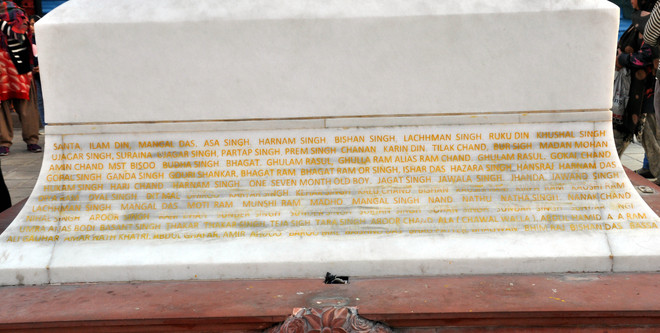
Martyrs’ names inscribed on the memorial at Jallianwala Bagh.

GS Paul
Tribune News Service
Amritsar, January 19

Over a century after the Jallianwala Bagh massacre, an official list of 492 martyrs has been revealed amid a debate over its authenticity.

The list has been uploaded on the Amritsar administration’s website. The relatives of martyrs have been asked to submit documents to ascertain their antecedents. Today, 11 persons submitted relevant documents, claiming to be the descendants of the martyrs.

Confusion over exact number

  • Confusion over the number of deaths remains. Historian VN Datta has mentioned that around 700 persons were killed
  • The list made by the British then had 501 persons as dead or injured with many “unidentified”. It was revised to 492
  • A board standing in the precincts of the Jallianwala Bagh earlier put the death toll at 379 and around 1,500 injured

A state-level function has been scheduled to honour the martyrs’ kin on January 25 at Anand Park in Ranjit Avenue where a separate memorial would be unveiled.

The administration has appealed to the public to approach the Deputy Commissioner’s office by January 22 if they have information about the martyrs’ kin. Besides, all MLAs, councillors and sarpanches have been approached with the list.

DC Gurpreet Singh Khaira said efforts were being made to ascertain the list’s genuineness. “We are trying to reach out to the kin of the martyrs. It was quite a cumbersome process to identify all, given the fact that the list didn’t have proper contacts and addresses,” he said.

However, confusion over the number of deaths and the uncertainty over their names remains with multiple lists projecting different figures. Historian VN Datta, who authored the pioneering work on Jallianwala Bagh (1969), has mentioned that around 700 persons were killed.

His daughter and associate professor Nonica Dutta, Department of Historical Studies, Jawaharlal Nehru University, said her father had zeroed in on this estimate on the basis of local police records. Quoting Dutta’s research, she said at the meeting of the Imperial Legislative Council held on September 12, 1919, Congrerss leader Madan Mohan Malaviya had stated 1,000 persons had been killed in the massacre. “My father had also questioned both the official and Congress estimates. There is no clarity on the number of martyrs to date,” she said.

The list of the dead and injured prepared by the British then for the purpose of awarding compensation has several discrepancies. Lying at the DC’s office, the list has 501 individuals with many marked as “unidentified”. The list was pruned to 492, as several serial numbers were left blank.

A recent study by the Partition Museum Trust put the number at 547 with the names of 45 not known. A board in the precincts of the Jallianwala Bagh earlier put the death toll at 379 and around 1,500 injured. This was published by the Jallianwala Bagh National Memorial Trust. Also, it was inscripted at the martyrs’ well from where 120 bodies were recovered later on.


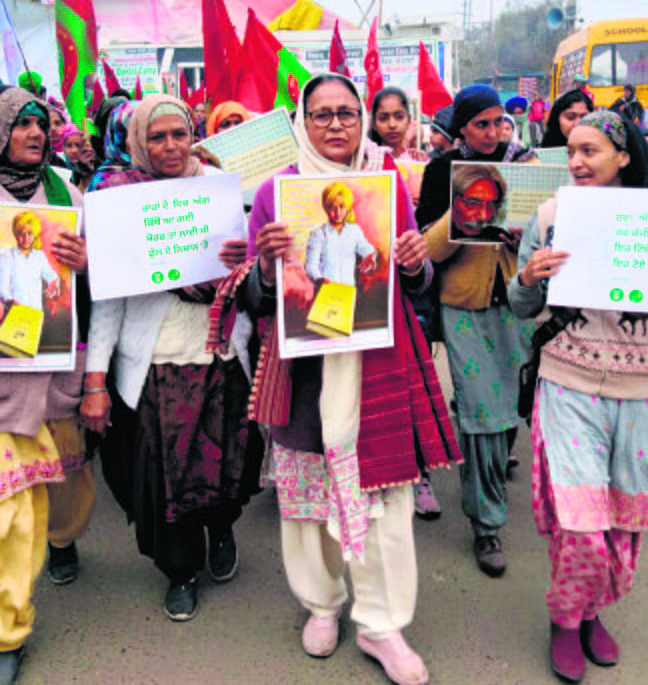
Bhagat Singh’s niece leads protesters to Singhu border

Bhagat Singh’s niece leads protesters to Singhu border

Gurjit Kaur leads a jatha from Ambala Jattan in Hoshiarpur to Singhu border. Tribune photo

Aparna Banerji

Tribune News Service

Jalandhar, January 18

“Sade buzurg larde si. Angrezan ne sadi property zapt kar lai. Andolan vele offer ditti property vapas kar denge. Par buzurgan ne keha – property rakho, desh naal gaddari nahi kar sakde. (Britishers seized our property. They offered to return it during the movement. But our elders told them: Keep the property, we won’t betray our nation.)”

Gurjit Kaur Dhatt, the 68-year-old niece of Bhagat Singh, said this, reminiscing about the rich legacy of the freedom struggle, on Mahila Kisan Diwas today.

Gurjit Kaur, Bhagat Singh’s niece

History repeating itself after 100 yrs

My grandmother Mata Vidyawati (Bhagat Singh’s mother) used to tell us about the charged atmosphere at home during the Pagri Sambhal Jatta movement… it’s after 100 years a similar movement (farmers’ protest) has risen.

She is leading a jatha of 150 women from Ambala Jattan, Mangarh and Garhdiwal among other villages in Hoshiarpur which set out for the Singhu border from the Ambala Jattan village as part of the nationwide initiative of women to express solidarity with the protesters.

Gurjit Kaur is the daughter of Bhagat Singh’s sister Bibi Parkash Kaur who died on September 28, 2014, the day Bhagat Singh attained martyrdom, at Toronto.

“This is a very important occasion for us. My grandmother Mata Vidyawati (Bhagat Singh’s mother) whom I lived with until I was four, used to tell us about the charged atmosphere at home during the Pagri Sambhal Jatta movement. My mamaji (Bhagat Singh) and nanaji all worked only for the country. It is after 100 years that a similar movement has risen. At that time, my family was fighting against a similar set of black laws from the British. When mamaji died, my mother was 10 years old, but until her last breath she remained passionate about the movement and sacrifices. If she were alive, mother would have been here.”

Harbhajan Singh Dhatt, the husband of Gurjit Kaur, said: “I have visited the Delhi border several times. My wife too was keen on visiting the protest sites, especially on Mahila Kisan Diwas. The revolution is in her blood.”