Sanjha Morcha

Major shoots himself dead

Major shoots himself dead

An Army officer allegedly shot himself dead at a forward post in the Tangdhar sector along the Line of Control in Jammu and Kashmir, officials said on Monday. Photo for representation only.

Srinagar, January 18

An Army officer allegedly shot himself dead at a forward post in the Tangdhar sector along the Line of Control in Jammu and Kashmir, officials said on Monday.

The deceased has been identified as Major Fayazullah Khan, a company commander of 6 Jammu and Kashmir Rifles, they said.

The officials said the reason behind the officer taking such an extreme step was not immediately known. — PTI


Rijiju to be MoS Defence, MoS Ayush till Naik recovers Naik had met with a serious accident that killed his wife

Rijiju to be MoS Defence, MoS Ayush till Naik recovers

Kiren Rijiju. PTI file photo

Tribune News Service

New Delhi, January 19

Minister for Sports and Youth Affairs Kiren Rijiju was on Tuesday given additional charge as MoS Defence and Ayush till the time incumbent minister of these portfolios Shripad Naik recovered after a serious accident.

Rashtrapati Bhavan as advised by the Prime Minister directed that Rijiju serve additionally as the junior minister for defence and Ayush till Naik recovered at a Goa hospital.

Naik had met with a serious accident in Karnataka. His wife and private secretary had died in the accident.


Over 130 have died since Nov 26 during farmers’ agitation: BKU

Over 130 have died since Nov 26 during farmers’ agitation: BKU

Farmers protest the agri laws at Ghazipur border on Tuesday. PTI

Sanjeev Singh Bariana
Tribune News Service
Chandigarh, January 19

More than 130 farmers from Punjab have lost their lives during the ongoing farmers’ agitation, said Balbir Singh Rajewal, president, Bhartiya Kisan Union (Rajewal) while talking to The Tribune today.

Rajewal said, “We have asked farm leaders from other states, too, to provide us with the number of farmer deaths in their respective areas along with their names and complete background. We will release this data nationwide to show how the government has turned a blind eye towards the farmers’ woes. The entire world is already watching us,” said Rajewal.

“During a meeting with the central team engaged in discussions with us recently, I gave them the figures of 125 martyrs. There was not even a whimper of acceptance or regret, showing the insensitive behaviour of the officers dealing with the issue. The number of deaths has increased and our team had collected the data of deaths on Delhi borders. We will now be collecting the figure from all districts in our state.”

Assigned the duty of collecting the data from the state, farmer leader Pargat Singh said, “We have the data of about 85 farmers who died on Delhi borders since the first day we came here on November 26 last year. After initiating the exercise of collecting data from across the state, we have got a rough figure of more than 130. We are preparing a detailed list with the help of our workers in different districts.”

“Besides deaths due to suicide, other common reasons for casualties are cold weather, particularly during night, pneumonia and cardiac arrests,” said farm activist Gurdev Singh.

Two protesting farmers die at Tikri border in past 24 hours

A Punjab farmer died of cardiac arrest while a Rohtak farmer had consumed some poisonous substance and succumbed during treatment


Manish Tewari | Bolstering corporates was intent of farm laws

Manish Tewari is a lawyer and a former Union minister. The views expressed are personal. Twitter handle @manishtewari
When the Supreme Court finally does decide to hear the farm laws matter, for many petitions that deal with equally contentious decisions taken by the current government continue hanging fire in the apex court. (PTI)

The recent Supreme Court decision staying the farm laws, protecting the minimum support price regime and directing that no farmer would be dispossessed of his land is appropriate under the given circumstances. Perhaps if the committee appointed by the Supreme Court could also have also been constituted in consultation with the protesting farmer unions, it would have inspired far greater confidence.

When the Supreme Court finally does decide to hear the farm laws matter, for many petitions that deal with equally contentious decisions taken by the current government continue hanging fire in the apex court, it must keep in mind that agriculture, with its allied sectors, are the largest source of livelihoods in India.

A total of 70 per cent of our rural households still depend primarily on agriculture for their livelihood. Of them, 82 per cent of farmers are small and marginal. On the whole, about 60 per cent of the Indian population, i.e. 81 crore people, are agriculture-dependent.

They can be called small entrepreneurs, for they mostly own the land they till and it is their labour on that small patch, varying from one to five acres, that keeps the home fires burning. The average size of a land holding in India is 1.16 hectares. This is roughly 2.8 acres. Moreover, these farm laws also have the added potential of making us import-dependent bringing back the spectre of ship-to-mouth that the green revolution finally surmounted in the early 1970s.

 These farm laws are actually intended to give Corporate India a legal licence to muscle in on these small guys who have unequal or no bargaining power.

Look at what has happened to the Indian economy over the past 80 months. The chairperson of the Competition Commission of India in a recent interview stated, “The Commission has now decided to undertake market studies in pharmaceutical sector, telecom sector and digital market sector… The Commission has received cases with allegations of anti-competitive conduct by market players in these sectors as well as reviewed various combination notices in these sectors…” The goal is to ensure that competition remains “vibrant” and “there are enough players who are able to participate in the award of concessions”.

 A classical example of this is the aviation sector where the government despite opposition from both the department of economic affairs (DEA) ministry of finance and the Niti Aayog allowed the Adani Group of companies to take six key airports and also acquire a controlling stake in both the Mumbai and the upcoming greenfield Navi Mumbai Airport. These seven airports, namely Ahmedabad, Mangalore, Lucknow, Jaipur, Guwahati, Thiruvananthapuram and Mumbai, roughly handled 80 million passengers during the last fiscal (2019-20). This converts into nearly one-fourth of the 340 million odd domestic air passenger traffic.

On the 11th of December 2018 when the NDA/BJP government’s public private partnership appraisal committee (PPPAC) considered the civil aviation ministry’s privatisation pitch, the DEA in a note ostensibly red-flagged it, stating, “These six airports projects are highly capital-intensive projects, hence it is suggested to incorporate the clause that not more than two airports will be awarded to the same bidder duly factoring the high financial risk and performance issues. Awarding them to different companies would also facilitate yardstick competition.”

 Niti Aayog also surprisingly demonstrated spine and, in a note, opined, “A bidder lacking sufficient technical capacity can well jeopardise the project and compromise the quality of services that the government is committed to provide.”

Brushing aside these concerns, the government still went ahead and allowed one company with no previous experience in airport management to take control of all these airports albeit through a public auction.

However, therein lies the problem. Even if it is through the bidding route allowing monopolies to develop in sector after sector of the economy tantamount to creating economic oligarchies and chaebols.

 An oligarchy is a country or industry that is controlled by a small group of powerful people while a chaebol denotes a “wealth clique” in Korean. They are popularly assumed to have been influenced by the Japanese zaibatsu — both sharing the same Chinese characters and meaning. Like chaebols, zaibatsus were also family controlled conglomerates that dominated the Japanese economy until they were finally extinguished by the United States during its occupation of Japan post World War II.

Country after country has had to deal with these oligarchies and chaebols for ultimately they start influencing the politics of nation in the most pernicious manner possible. The US had to bring the Sherman Anti-Trust Act way back in 1890 to curb concentrations of power that interfere with trade and reduce economic competition. The unsaid part of it was that do not allow corporations to become so powerful so that they start “controlling by influence” the policy frameworks and governance of the state. However, where the government is itself engaged in facilitating the development of these oligarchic chaebol-like structures it becomes even more sinister to put it mildly.

 The US has used its anti-trust laws to reign in various entities, including Standard Oil, AT&T, Kodak and Microsoft in the twentieth century, to name a few.

Way back in 1909, the Department of Justice of the US government filed a federal anti-trust lawsuit against Standard Oil arguing that the company restrained trade through its preferential deals with railroads, its control of pipelines and by engaging in unfair practices like price-cutting to drive smaller competitors out of business.

On May 15, 1911, the Supreme Court ordered the dissolution of Standard Oil Company, ruling it was in violation of the Sherman Anti-Trust Act. The court’s decision forced Standard to break into 34 independent companies spread across the country and abroad. Many of these companies have since split, folded or merged today. The primary descendants of Standard include ExxonMobil, Chevron and ConocoPhillips. Recently, the US government has gone after Big Tech companies with a wave of anti-trust law suits for it considers their market dominance among other things as dangerous for democracy.

 Similarly, South Korea has for long grappled with the malevolent influence of chaebols on their politics. Russia is a typical example where a noxious combination of big business and entrenched political interest are controlling that country since the exit of Boris Yeltsin at the turn of the millennium.

The Supreme Court, therefore, must be mindful of the true intent of these farm laws. It is to further the agenda of further consolidating these oligarchies and chaebols that control a significant part of the Indian economy already and, therefore, are, through their financial, media and other muscle, disproportionately significant players in our democratic and governance ethos.



Capt Amarinder slams SAD and AAP over false claims on farm laws being approved by committee

Capt Amarinder slams SAD and AAP over false claims on farm laws being approved by committee

Punjab Chief Minister Amarinder Singh. File photo

Tribune News Service
Chandigarh, January 20

With an RTI response exposing the lie of the Centre’s claim on the farm laws having been approved by the high-powered committee on agricultural reforms, Punjab Chief Minister Amarinder Singh on Wednesday said it was now obvious that the Akalis and the Aam Aadmi Party (AAP) had been spreading a carnage of lies at the behest of the BJP-led government.

Media reports citing a reply by the Planning Commission to an RTI query suggest that the Farm Ordinances were promulgated and introduced in Parliament in June 2020 without the report of the chief ministers’ committee being ever appraised by the Governing Council of NITI Aayog.

This, said the Punjab chief minister, was in stark contrast to the claims of the Central government, which both Shiromani Akali Dal (SAD) and AAP had been shamelessly parroting in an apparent bid to promote the Bharatiya Janata Party’s anti-farmer agenda.

It may be recalled that Minister of State for Food Danve Raosaheb Dadarao had claimed before Lok Sabha that the high-powered committee had approved the Essential Commodities (Amendment) Bill, which Capt Amarinder had categorically rejected and which has now been proved wrong by the RTI reply.

Far from basing the farm laws on the discussions and decisions of the committee, the fact, as validated by the RTI response, was that the committee report had not even been placed till now before the Governing Council of the NITI Aayog, Capt Amarinder pointed out.

Once the report is made public, everyone will now know who said what in the committee meetings, where Punjab was not even a part in the first one, while the second discussed some financial issues with Manpreet Badal in attendance and the third was only attended by Secretary-level officials, he added.

The chief minister lambasted the Punjab opposition parties over their campaign of lies, deception and misinformation to promote their collective agenda of instigating the people against the democratically elected Congress government in the state.

“Their bundle of lies have been completely exposed by the RTI response,” he added, slamming the BJP, the SAD and AAP for shamelessly misleading the nation on such a sensitive issue which had triggered massive unrest and had the potential of disturbing the peace of his state and the country.

Lashing out at former Union minister Harsimrat Kaur Badal for questioning Rahul Gandhi on the basis of this false propaganda, the chief minister said the extent of the SAD leader’s shamelessness was evident from the fact that she continued to spread the lie even after the RTI response was extensively published in the media.

More than two days after the media reports on the RTI, Harsimrat had on Tuesday continued to brazenly allege that Capt Amarinder had consented to the farm laws as part of the committee.

Demanding an unequivocal apology to the people of Punjab by Harsimrat, the chief minister further took a dig at the ex-Union minister for pretending to be concerned about the cause of the farmers.

“Why did you not stop your ally from shoving these draconian laws on the farmers? Why did you and your party support the laws wholeheartedly all these months?” he asked Harsimrat and the SAD.

Dubbing the SAD as a fake champion of the farmers, the chief minister said unlike the Akalis, who had been playing double games on the farm laws’ issue, Rahul and the entire Congress had been steadfastly fighting for their rights from the outset.

“You should be ashamed of playing with the emotions and the lives of the farmers, without none of us can survive a day,” he remarked, asserting that his government will not allow the interests of the farmers to be trampled by the likes of the power-seeking Badals and Kejriwal.


Galwan martyrs’ names put up at war memorial

Galwan martyrs’ names put up at war memorial

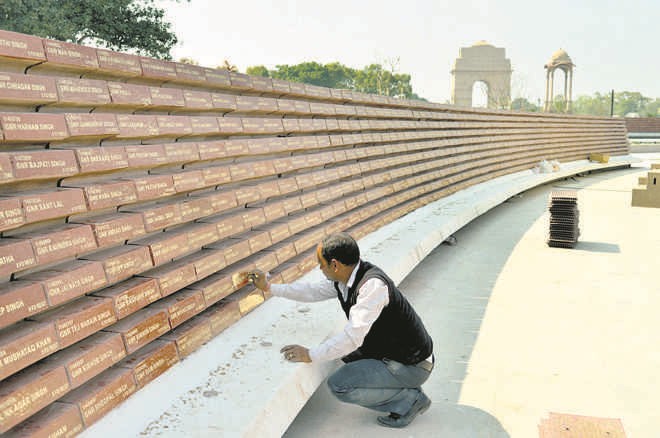
The names 20 soldiers killed in the Galwan valley clash on June 15, 2020, have been put up at National War Memorial here following the intervention of the Ministry of Defence. – File photo

Tribune News Service

New Delhi, January 19

The names 20 soldiers killed in the Galwan valley clash on June 15, 2020, have been put up at National War Memorial here following the intervention of the Ministry of Defence.

The Tribune highlighted the issue in its columns on January 7 on how a long official procedure had delayed the process of putting up the names of 90 soldiers who died in action, including 20 of Galwan action against China.

The names were inscribed yesterday after the Ministry of Defence pulled up the tri-services for getting bogged down with the tendering process to get each name and rank etched on a granite tablet. Each tablet is arranged in a circular pattern on one of the 16 walls of the memorial. The pattern symbolises ancient Indian war formation “Chakravyuh”.

A panel of the three services had cleared the names of the soldiers who died in various operations from October 2019 to September 2020 for inscription on the memorial wall.

A functionary questioned the annual update of names instead of a quarterly update.


3 Punjab farmers who came from Singhu detained in Shimla; watch video The farmers, hailing from Mohali, were explaining to locals ‘harms’ of agri laws

http://

Bhanu P Lohumi

Tribune News Service

Shimla, January 19

Three Punjab farmers who had come to Shimla from the Singhu border near Delhi to explain to the locals the motive of their agitation and the ramifications of the central farm laws were detained by the police from the historic Ridge here.

Their detention led to commotion as the farmers, hailing from Mohali, were agitated over the police action and sought to know under which law they had been rounded up.

“We are only three persons and talking about the black farm laws. We didn’t even raise any slogans. This is violation of our right to freedom of expression. Is this democracy? Are we living in a free country?” they shouted while being dragged away by the police.

Shimla SP Mohit Chawla said the Ridge and Mall Road were core areaa where any kind of procession or meeting was prohibited as per tge High Court orders. The detained farmers had not sought any permission from the administration or the police, he maintained.

“We had inputs about the arrival of some farmers but their credentials could not be verified. They have been detained as a preventive measure,” he added.

The three were taken to Sadar police station.

The farmers holding banners, were detained under the Sections 107 and 150 of the Indian Penal Code.

“We are going to all the state capital to make the farmers aware about the farm bills, but this is the only place where we are being dragged and not allowed to speak,” said Harpreet Singh, a farmer.

Meanwhile, the Congress leaders termed the action as “illegal” and have gathered outside the Sadar Police station where the farmers were detained.


DRDO, MoRTH join hands for geo-hazard management on national highways

DRDO, MoRTH join hands for geo-hazard management on national highways

Photo for representation.

Vijay Mohan

Tribune News Service

Chandigarh, January 20

Defence Research and Development Organisation (DRDO) and the Ministry of Ministry of Road Transport & Highways (MoRTH) have joined hands to strengthen collaboration in the field of technical exchange and co-operation on sustainable geo-hazard management.

Both establishments will co-operate in the areas of mutual benefit, including, conceptual planning of integrated avalanche and landslide protection schemes for all weather connectivity in snow bound areas of the country.

The scope include pre-feasibility study of tunnels and viaducts, planning and designing of various avalanche and  landslide control structures, association in preparation of proposals and detailed project reports for tunnels, undertaking geological, geotechnical and terrain modeling, as well as other related aspects of tunnel construction.

A Memorandum of Understanding (MoU) in this regard was signed today by Satieesh Reddy, Chairman DRDO and Secretary MoRTH, Giridhar Aramane. This initiative will ensure safety of road users on national highways against the adverse effects of landslides and other natural calamities.

The areas of collaboration listed out in the MoU include detailed investigation of the existing critical avalanches and other geo hazards such as landslides, slope instability and sinking problems, planning, designing and formulation of sustainable mitigation measures for geo-hazards for national highways, and the supervision or monitoring during implementation of the mitigation measures.

Both establishments are also free to initiate any other services as may be required.

DRDO’s Defence Geo-Informatics Research Establishment (DGRE) based at Chandigarh is the leader in the development of critical technologies for enhancing combat effectiveness of the armed forces with a focus on terrain and avalanches. The role and charter of this establishment is mapping, forecasting, monitoring, control and mitigation of landslides and avalanches in Himalayan terrain. DGRE was recently formed with the merger of two existing DRDO labs, the Defence Terrain Research Laboratory at New Delhi and the Snow and Avalanche Study Establishment at Chandigarh.

It has been agreed by DRDO and MoRTH to utilise the expertise of DGRE in providing sustainable mitigation measures to damages caused by landslides, avalanches and other natural factors on various national highways.


Only 5 people had Balakot info, must probe who leaked it to Arnab: Rahul ‘Both source and recipient of IAF strike information must be booked’

n the first official reaction to the explosive Arnab Goswami chats, the Congress on Tuesday demanded a probe into the leakage of sensitive Balakot strike information to the Republic TV editor and said both the source and recipient of the official secret must be booked.

Congress leader Rahul Gandhi addressing a press conference at AICC Headquarters in New Delhi on Tuesday. Tribune photo: Manas Ranjan Bhui

Congress leader Rahul Gandhi led the offensive on the issue and said only five people knew of the strike and one of them shared it with Goswami.

“Both the person who gave the secret information and the one who received it must be booked. Sensitive defence information before Balakot was given to a journalist. Even the pilots get such information at the last moment. Top five people (the prime minister, the defence minister, the home minister, the IAF chief and the NSA) had this information. Someone out of them gave him this information. This is criminal. We must find out who gave and the process of the probe should begin but it will not because the PM must have given the information,” alleged Gandhi.

He also attacked Goswami for saying after the Pulwama attack that “it is good for us.”

“I do not like that language. It is the reflection of the PM’s thought process that 40 people have died and we will now win the elections,” said the former Congress chief.

Addressing a press conference here, Gandhi said, “The law will take its own course, but I have an observation. This was top-secret information, this was not provided to anybody else.”

“Giving official secret information to a journalist is a criminal act, both on the part of the person who accepted it and on the part of the person who gave it,” he said.

Adding that the law would take its course, Gandhi said: “People in the government call themselves patriotic but there is nothing patriotic about giving out official secret information about our Air Force striking Pakistan. If Arnab Goswami knew, I believe Pakistan also knew.”

Referring to the contents of the purported chats, Gandhi said the distressing thing is that after the 2019 Pulwama attack, the journalist said that “this is good for us”.

“This is a reflection of the mind of the prime minister that it is good that 40 of our people have been killed and we will win the elections,” he alleged.

Gandhi’s remarks can trigger a massive political backlash from the BJP that is yet to react to leaked Goswami’s chats with the ex BARC chief Partho Dasgupta.

On February 26, 2019, India had launched airstrikes on what was said to be JeM’s training camp in Pakistan’s Balakot. With PTI inputs