



Sanjha Morcha

Masks, 6-ft distance in public places: Centre issues guidance for COVID-time festivities

Masks, 6-ft distance in public places: Centre issues guidance for COVID-time festivities

A worker sprays disinfectant in the premises of Ram Temple in Ranchi. PTI

Aditi Tandon

Tribune News Service

New Delhi, October 7

Ahead of the festive season starting soon, the Centre on Wednesday issued detailed guidelines asking people to wear masks and maintain 6-ft compulsory physical distance when they participate in public gatherings and events.

The Centre has also asked people above 65 years, children below 10 and pregnant women not to venture out.

Besides, the guidelines mandate that there should be no mass festive events in containment zones and people living there should be encouraged to observe festivals at homes.

“The months of October to December are time for festivities that witness gatherings of a large number of people in specified locations for religious worship, fairs, rallies, exhibitions, cultural functions and processions, etc. These events may last a day or a week or more. To prevent spread of COVID-19 infection, it is important that necessary preventive measures are followed for such events,” said the Centre in the SOPs which require states to identify spatial boundaries and prepare detailed site plans to facilitate compliance with thermal screening, physical distancing and sanitisation to venues.

“In case of events that run for days or weeks, the crowd density doesn’t remain the same and usually peaks around certain hours and previously known auspicious days. Planning for the event should specifically factor this so that crowds are regulated and managed to ensure physical distance and frequent sanitisation,” the Centre said.

The guidance adds that in case of rallies and immersion processions the number of people should not exceed a prescribed limit and physical distancing and wearing of masks must be ensured.

Visitors to venues are to be allowed only after thermal screening.

Among generic preventive measures the guidelines require everyone to maintain a minimum distance of 6 feet in public places; wear masks; practice frequent hand washing with soap and follow respiratory etiquette.

The guidelines bar touching of statues, idols and holy books in religious venues and add that, “In view of potential threat of spread of infection, as far as feasible recorded devotional music and songs may be played and choir or singing groups should not be allowed.”

The guidelines come at a time when Kerala has suddenly reported a massive surge in new cases linked to Onam festivities.

Of the over 72,000 new cases reported today, Maharashtra, Karnataka and Kerala accounted for more than half.

India’s total cases neared 6.8 million today with 1.05 lakh deaths.

Although recovery rate has surged to 85 pc, much of the recent gains in keeping active infections below 10 lakh for 16 straight days would depend on how India fares during festivals and if people exercise precautions.

Of the 6.7 million cases as of today, over 5.7 million have recovered.


Have no such indication’: Army commander on reports of China helping set up missile sites in PoK

‘Have no such indication’: Army commander on reports of China helping set up missile sites in PoK

Lt Gen B S Raju. File photo

Srinagar, October 10

Amid reports that China is helping Pakistan set up sites for surface-to-air missiles in Pakistan-occupied Kashmir (PoK), a top Army commander here on Saturday said there is no indication of any tactical help being extended by Beijing to Islamabad.

Corps Commander of the Army’s Srinagar-based Chinar Corps Lt Gen B S Raju, however, said there is military cooperation between Pakistan and China in terms of equipment.

Amid the continuing standoff between Indian and Chinese troops in Ladakh, media reports quoting intelligence inputs have claimed that China is helping Pakistan set up sites for surface-to-air missiles in PoK as soldiers of their armies have been carrying out joint patrols in the region.

Gen Raju said there has not been any such indication.

“I have seen the reports in the media. Whether Pakistan is helping China or China is helping Pakistan, we have no such indication,” he told reporters on the sidelines of a passing out-cum-attestation parade at the Jammu and Kashmir Light Infantry Regimental Centre on the outskirts of the city here.

“But because of the CPEC (China-Pakistan Economic Corridor), there is the presence of China in Pakistan. The military cooperation in terms of equipment is there, but we are not seeing any tactical help,” he said.

According to the reports, the construction work for the installation of surface-to-air missile defence system is being carried out by the Pakistan army and China’s People’s Liberation Army at Pauli Pir near Lasadanna Dhok of PoK.

Pakistan army personnel and dozens of civilians are working at the construction site, the reports stated. — PTI


Chinese mission asks Indian media not to call October 10 ‘Taiwan National Day’

Chinese mission asks Indian media not to call October 10 'Taiwan National Day'

For representation only. File photo

Sandeep Dikshit
Tribune News Service
New Delhi, October 7

Taiwan has sent a “get lost” message to the Chinese Embassy, which has cautioned Indian journalists from calling October 10 as “National Day of Taiwan’’.

“India is the largest democracy on earth with a vibrant press and freedom-loving people. But it looks like communist China is hoping to march into the subcontinent by imposing censorship. Taiwan’s Indian friends will have one reply: GET LOST,” tweeted Taiwan’s Ministry of Foreign Affairs.

This was in reply to a “letter” from the Chinese embassy emailed to en masse to Indian journalists, “reminding” Indian journalists that there is “only one China in the world, and Taiwan is an inalienable part of China’s territory. These facts are recognised by UN resolution and constitute the universal consensus of the international community”.

“All countries that have diplomatic relations with China should firmly honor their commitment to the One-China policy, which is also the long-standing official position of the Indian government,’’ e-mail from the Chinese Embassy’s Press Section said.

It then hoped the Indian media could stick to Indian government’s position on the Taiwan question and not “violate the One-China principle”.

It went on to ask the Indian media not to refer to Taiwan as a “country” or “Republic of China”. Its leader should not be called President, “so as not to send the wrong signals to the general public”.

Earlier in June when border tensions with China were peaking, Indians living in Taiwan had come out on the streets of Taipei for the first time to thank its government for containing the COVID epidemic. The event had Taiwan government’s indirect blessings. It had nudged companies to sponsor the rally and the top local official graced the opening ceremony.

The Galwan Valley clash occurred two days after expatriate Indians gathered New Taipei City and took out a roadshow for around 120 km. At that time, this gesture was read as a riposte to China for blocking Taiwan’s presence as an Observer at the World Health Assembly, WHO’s marquee event. (EOM)


A mother’s heart knows no peace

A mother’s heart knows no peace

Col PS Randhawa (Retd)

She is not able to sleep. It has been five days since her son spoke to her for a brief two minutes. It was a long-distance call put through by the Army exchange operator. Before her instructions to her son could finish, the call was abruptly cut. It has been like that since he got deployed on the China border, since mid-June. The calls were erratic and brief, mostly at the mercy of the operator. Gone are the days when she could pour her heart out to her only son through mobile phone calls and give him all possible instructions, mostly aiming at his well-being, safety and security, eating timely and of course her favourite topic of making up his mind to get married.

The son, like a true fauji, does not talk about ‘what is happening there’. She tries to gather information from TV channels and social media but seeing the shoddy display of jingoism, war cries, and sabre-rattling by anchors shuts it off, cursing them that maybe none of their near and dear ones is in the Army and deployed on the border. Her husband advises her not to watch TV and not to believe what appears on Facebook and WhatsApp. Any news about ‘meeting’ on the border with the Chinese is keenly read, watched, and heard by her. ‘Their mothers must be equally worried,’ she muses about enemy troops.

She had been an Army wife and suffered long separations from her husband in the prime of her life. Those days there were no mobile phones and letters were the only means of communication. By the time a letter reached her husband and elicited a reply, a lot would get changed. Some minor problems could get mitigated or she could overcome single-handedly. In the absence of her husband, she miraculously played the double role of father and mother for her kids. Quite naturally, they did not want their son to join the Army and suffer long separations from his family. But fate decided otherwise. The son won’t listen and he followed in the footsteps of his father and forefathers; went to the IMA and joined his father’s battalion. Though proud of her son’s achievement, she cannot help being over-worried about his well-being. Her husband, at times, feels irritated and tells her that she wasn’t even half as much worried about him as she worries about her son. She tells him that he does not know about a mother’s heart.

Her son has given a civil number of his unit Adjutant, away from his location, to be used in exceptional cases. She insists on using that number but the old man is reluctant. He doesn’t want to ‘interfere’ in unit routine, and also does not want to sound ‘too worried’. ‘It is warlike,’ he tells her, ‘leave it to God. Everything will be fine.’ He assures her but she insists. Seeing her restlessness, he gives in. Almost apologetically, he calls the Adjutant and enquires about his son. The officer assures him all is well. Thanking him, he disconnects the call. Mother, having heard everything, is happy and thanks God. ‘I can now sleep peacefully,’ she says.


7th India-China military commanders’ meet on 12 October, MEA rep will attend too

Representational image | Soham Sen | ThePrint

New Delhi: Top military commanders from India and China will hold another round of talks on 12 October as both sides prepare to stay dug in at the Line of Actual Control (LAC) in Ladakh through the winter, which has already started setting in.

Sources in the defence and security establishment have ruled out any possibility of troop presence being thinned during the winter. All steps, they added, will be mutual and “taken after proper verification process”.

This will be the first round of talks after China raked up the 1959 claim line issue this week.

Sources said that if during the talks the Chinese raise the issue, Indian Army will reject it as always.

The Ministry of External Affairs this week rejected China’s attempt to project the 1959 claim line as the LAC, saying India has never accepted the “so-called unilaterally defined 1959 Line of Actual Control (LAC)”.

The 12 October meeting will be the last involving 14 Corps Commander Lt Gen. Harinder Singh, who will then take over as the Commandant of the Indian Military Academy after handing over the charge to Lt Gen. P.G.K. Menon on 14 October.

This will be the seventh commanders’ meeting aimed at resolving the current India-China standoff in Ladakh. Participants will include Lt Gen. Menon and Joint Secretary (East Asia), Ministry of External Affairs, Naveen Srivastava.

The two were also present at the first India-China military-diplomatic meeting last month, which was held as tensions between the two sides continue to simmer at the border. That meeting ended in a stalemate.

At the next meeting, sources said, India will stick to its stand that disengagement should happen at all friction points, and not just at the southern bank of Pangong Tso, as China is insisting on.

China has been peeved with India’s move on the intervening night of 29-30 August, when specialised units and regular soldiers outflanked the Chinese and occupied crucial heights along the southern bank of the Pangong Tso.


Also read: Modi govt removes spending cap on defence for Q3 amid tensions with China

Forward deployment during Ladakh winter first for India, China

The fresh round of talks comes at a time when the winter has already started to set in in Ladakh.

Forward deployment through the region’s freezing winter will be a first for India and China, which have posted over 50,000 troops each near the LAC in Ladakh backed by artillery, tanks and other equipment.

While there was no forward movement on the ground, both India and China issued a joint statement after the 21 September meeting, saying they have agreed to stop sending more troops to the frontlines in Ladakh, refrain from unilaterally changing the situation on the ground, and avoid taking any actions that may complicate the situation.

A joint statement is also expected to be issued after the talks on 12 October.


Also read: Underground fuel dumps, freeze-proof fuel, mobile ATCs — How Army is prepping for Ladakh winter


Ladakh standoff: India insists on early disengagement by China at 7th round of military talks

Ladakh standoff: India insists on early disengagement by China at 7th round of military talks

New Delhi, October 12

India on Monday insisted on restoration of status quo ante of April and comprehensive disengagement of troops by China from all the friction points in eastern Ladakh to resolve the border standoff, government sources said, as the two countries held a seventh round of military talks.

The Corps commander-level talks began at around 12 noon in Chushul on the Indian side of the Line of Actual Control (LAC) in eastern Ladakh and continued beyond 8:30 PM, they said.

As the border standoff entered the sixth month, an early resolution to the row appeared dim with close to 100,000 Indian and Chinese troops remaining deployed in the high-altitude region and showing readiness for a long-haul.

There is no official word on the talks yet but sources said the agenda was to finalise a roadmap for disengagement of troops from all the friction points.

The Indian delegation is led by Lt Gen Harinder Singh, the commander of the Leh-based 14 Corps, and includes Naveen Srivastava, Joint Secretary (East Asia) in the Ministry of External Affairs(MEA). It is learnt an official of the Chinese foreign ministry is also part of the Chinese delegation.

The sources said India pressed for an early and complete disengagement of troops by China from all the friction points besides demanding immediate restoration of status quo ante in all areas of eastern Ladakh prior to April. The standoff began on May 5.

The China Study Group (CSG) comprising Defence Minister Rajnath Singh, External Affairs Minister S Jaishankar, National Security Advisor Ajit Doval, Chief of Defence Staff Gen Bipin Rawat and the three service chiefs on Friday finalised India’s strategy for the military talks. The CSG is India’s key policy making body on China.

Ahead of the talks, sources said India will also strongly oppose any demand by China for withdrawal of Indian troops from several strategic heights on the southern bank of the Pangong lake to kick-start the disengagement process.

During the sixth round of Corps commander talks on September 21, the Chinese People’s Liberation Army (PLA) insisted on withdrawal of troops by the Indian Army from several strategic heights in Mukhpari, Rezang La and Magar hill areas around the southern bank of Pangong lake.

Indian troops had occupied the strategic heights after the PLA soldiers attempted to intimidate them in the southern bank of Pangong lake on the intervening night of August 29 and 30.

India has been maintaining that the disengagement process has to start simultaneously at all the friction points.

At the talks, the two sides were expected to further explore steps to maintain stability on the ground and avoid any action that may trigger fresh tension in the region where troops from the Indian army and the PLA will be facing difficult conditions in the next four months due to harsh winter, the sources said.

Following the sixth round of military talks, the two sides announced a slew of decisions including not to send more troops to the frontline, refrain from unilaterally changing the situation on the ground and avoid taking any actions that may further complicate matters.

The military talks were held with a specific agenda of exploring ways to implement a five-point agreement reached between Jaishankar and his Chinese counterpart Wang Yi at a meeting in Moscow on September 10 on the sidelines of a Shanghai Cooperation Organisation(SCO) conclave.

The pact included measures like quick disengagement of troops, avoiding action that could escalate tensions, adherence to all agreements and protocols on border management and steps to restore peace along the LAC.

Days after the military talks, the two sides held diplomatic parleys under the framework of the Working Mechanism for Consultation and Coordination (WMCC) on border affairs, but no concrete outcome emerged from the negotiations on September 30.

After the diplomatic talks, the MEA said it was agreed that the next round of the meeting of senior commanders should be held at an early date so that both sides can work towards an early and complete disengagement of the troops along the LAC in accordance with the existing bilateral agreement and protocols.

Naveen Srivastava, who has been leading the Indian side at the WMCC talks, also attended the military parleys on September 21 for the first time.

It is Lt Gen Singh’s last round of talks with the PLA in the current standoff as he is due to take charge as head of the prestigious Indian Military Academy(IMA) this week. His successor at the 14 Corps Lt Gen PGK Menon is also part of the Indian delegation.

At the previous six rounds of military talks, the Indian side insisted on complete disengagement of Chinese troops at the earliest, and immediate restoration of status quo ante in all areas of eastern Ladakh prior to April.

The situation in eastern Ladakh deteriorated following at least three attempts by the Chinese soldiers to “intimidate” Indian troops along the northern and southern bank of Pangong lake area between August 29 and September 8 where even shots were fired in the air for the first time at the LAC in 45 years.

As tensions escalated further, the foreign ministers of India and China held talks in Moscow on September 10 where they reached a five-point agreement to defuse the situation in eastern Ladakh. The agreement was the basis for the sixth round of Corps commander-level talks.

In the last three months, the Indian Army rushed tanks, heavy weaponry, ammunition, fuel, food and essential winter supplies to various treacherous and high-altitude areas of the region to maintain combat readiness through the harsh winter of around four months starting around mid-October. PTI


Not just Arjun, DRDO looking to get indigenous anti-tank missile on Russian T-90 tanks too

Main Battle Tank (MBT) Arjun firing the anti-tank guided missile (ATGM) | DRDO

Main Battle Tank (MBT) Arjun firing the anti-tank guided missile (ATGM) | DRDO

New Delhi: Plans are afoot to make the indigenously developed laser-equipped anti-tank guided missile (ATGM), successfully fired twice from the Main Battle Tank (MBT) Arjun over the last fortnight, capable of being used on the Russian-origin T-90 tanks that have different guns, ThePrint has learnt.

With two successful tests, the Defence Research and Development Organisation (DRDO) is aiming for user trials of the ATGM by February next year.

Sources in the defence and security establishment said the trials so far have been carried out on the Arjun tanks, with a range of 3-4 km. The DRDO wants to test the ATGM at a 5km range to evaluate its efficacy.

“In the next stage, we will also be test-firing the missile with a warhead before the user trials, which should take place by February,” a source in the know said.

While the first two tests — on 22 September and 1 October — took place at the K.K. Ranges in the Armoured Corps Centre and School (ACC&S), Ahmednagar — the next would be at a bigger range, sources added.

The ATGM employs a tandem heat warhead to defeat explosive-reactive-armour (ERA)-protected armoured vehicles in ranges between 1.5 and 5 km.

It has been developed with a capability to launch from multiple platforms. The ATGM is currently undergoing technical evaluation trials through the 120mm rifled gun of MBT Arjun, and the DRDO also seeks to make it compatible with the 125mm smoothbore gun of the T-90s.

“Right now, it is meant for the 120mm rifled gun of the MBT Arjun. The plan is to make it compatible with the 125mm smoothbore gun of the T-90s,” a source said.


Also Read: Rifles, missiles, ammunition, drones — armed forces on shopping spree amid LAC tensions


The Arjun saga

An order for 118 indigenously manufactured Arjun Mark 1-A ‘Hunter Killers’, with all-weather capability and better firepower and stability than the Arjun MBT, is yet to fructify.

Sources in the know said that the decision has been made and the process is on, despite the Covid-19 pandemic delaying it and the focus shifting on account of the ongoing tensions with China at the Line of Actual Control (LAC).

While the Army started inducting two regiments of Arjun MBTs in 2004, in 2010, it proposed an improved version, to be called the Mark II and equipped with over 80 improvements, including 15 major ones.

As reported by ThePrint earlier, in 2012, the DRDO offered the Arjun for trials with all the major enhancements, except one — a cannon-launched guided missile (CLGM).

The Army had insisted on having that capability, since other tanks like the T-90 also had it.

The DRDO engaged the Israelis and sourced the Lahat CLGM, which could conclusively hit targets between 2 and 5 kilometres away. The trials validated the CLGM’s laser designator.

The Army, however, wanted a missile that could hit targets as close as 1.2 km.

The Israelis, who were first offered to develop this capability, took about a year to decide on producing it, but, by then, the DRDO had decided to go in for an indigenous CLGM.

Talks between the DRDO and the Army continued until March 2018, and it was finally agreed that the next batch of Arjuns, to be called Mark 1-A, would be supplied without the missile-firing capability.

However, V. Balamurugan, the director of the DRDO’s Chennai-based Combat Vehicles Research and Development Establishment (CVRDE), had said in March that the missile could actually be integrated onto the Mark 1-A as the tanks start rolling out.


Also read: ‘Like lighting a match in cyclone’ — Beauty of India’s hypersonic flight tech is in its engine


IAF will evolve, ready to safeguard India’s sovereignty and interests: Bhadauria

IAF will evolve, ready to safeguard India's sovereignty and interests: Bhadauria

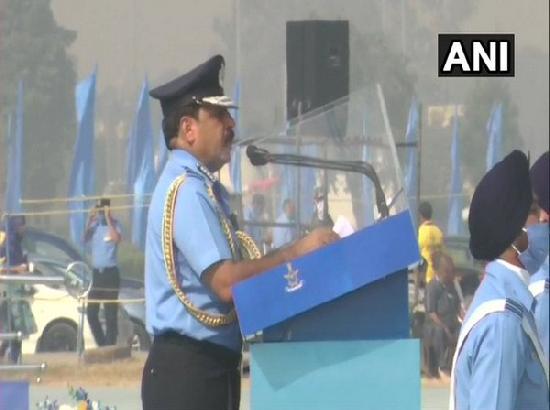
Ghaziabad, October 8, 2020: On the occasion of Indian Air Force Day, 2020 Indian Air Force (IAF) chief Air Chief Marshal Rakesh Kumar Singh Bhadauria on Thursday assured the nation that the Indian Air Force will evolve and be ever ready to safeguard India’s sovereignty and interests in all circumstances.

“I want to assure the nation that the Indian Air Force will evolve and be ever ready to safeguard our nation’s sovereignty and interests in all circumstances,” said Bhadauria at Hindon airbase.

“As we enter the 89th year, the IAF is undergoing a transformational change. We are entering an era which will redefine where we employ aerospace power and conduct integrated multi-domain operations,” he added.

Bhadauria further stated that this year has indeed been an unprecedented one. As COVID-19 spread across the globe, our nation’s response was firm.

“The tenacity and resolve of our air warriors ensured that IAF continued to retain its capability to undertake full-scale operations throughout this period,” said IAF Chief.

“I commend all air warriors for quick response in the recent standoff on the northern frontiers when we deployed our combat assets at short notice to handle any eventuality and provided proactive support to all requirements of deployment and sustenance for Indian Army,” he added.

Chief of Defence Staff General Bipin Rawat, Chief of Army Staff, General Manoj Mukund Naravane and Chief of the Naval Staff Admiral Karambir Singh attended the 88th Indian Air Force Day celebrations at Hindon airbase in Ghaziabad.

Bhadauria inspected the 88th Indian Air Force Day parade here.

Nishan Toli being led by Squadron Leader Shivangi Rajawat marched at the Hindon Air Force Station in Ghaziabad on the occasion.

Two Chinook helicopters also took part in the flypast to mark 88th Indian Air Force Day here.


IAF set to place orders for 21 MiG-29 jets from Russia by Dec to shore up aircraft strength

Representational image of an IAF MiG-29 | Photo: Wikipedia

New Delhi: The Indian Air Force (IAF) is set to place an order with Russia for 21 twin-engine MiG-29 jets by December, ThePrint has learnt.

Of the 1980s vintage, the jets are no longer in production but 21 airframes built then remain in Russia. Top sources in the security and defence establishment said the jets purchased by India will be upgraded to the latest version before they arrive here.

The purchase comes as the IAF faces a depleting force strength due to its fleet of legacy aircraft and budgetary constraints.

The IAF, the sources said, will first place orders for the MiG-29, and then go in for another 12 Su-30 MKI, which are being manufactured by the Hindustan Aeronautics Limited (HAL) under licence from Russia.

The IAF is also expected to soon place a long-pending order for the indigenous 83 Light Combat Aircraft (LCA) Tejas Mark 1A.

“We have completed the discussions with Russia. We are getting the MiG-29s at a very good price. We will soon finalise it. The order for the 12 additional Su-30 MKI will be placed with HAL after this,” a source said, refusing to get into the pricing details.

India and Russia have been in talks for the purchase of more MiG-29 jets since last year.

The Mig-29 airframes have been lying with Moscow since the late 1980s but have never been flown. The sources said a study conducted on the airframes had found them in good condition.

“The airframes are in good quality. They will now fit all the equipment and other systems as part of the deal,” the source quoted above said.


Also Read: IAF gets night-flying capability at Leh for MiG-29s, force sees it as a ‘game-changer’


Dwindling numbers

The decision to purchase the aircraft comes amid a dwindling fighter aircraft strength in the IAF and budgetary constraints that make it difficult for the force to get new aircraft in the numbers it wants.

While the sanctioned strength of the IAF is 42 squadrons of fighters, the current strength is 30.

At his annual press conference Monday, IAF chief Air Chief Marshal R.K.S. Bhadauria said even if all acquisition plans are put in motion with strict timelines, he would be happy if the strength reaches 36-37 squadrons in the next decade.

He was also very candid about the challenge of budgetary constraints, saying their effect may not be felt immediately but will be in the future.

“Budgetary constraints will be there. It is not affecting us today. It will have an effect in due course if we don’t put the contracts in place,” he had said.

India currently has three squadrons of the MiG-29 — a twin-engine single-seat air superiority fighter aircraft. One squadron comprises 18 aircraft and all of them are currently being upgraded in-house by the IAF.

The aircraft is undergoing structural as well as avionics upgrade, besides being equipped with a new weapons package.

With the new air-to-air refuelling feature, an upgraded MiG-29 can cover larger distances compared to the previous aircraft, something the IAF is keen on, keeping in mind the possibility of a two-front war scenario.

The upgraded MiG-29s have all the latest features, including a glass cockpit with digital screens.

The upgraded aircraft can also do air-to-ground, air-to-air and even anti-shipping operations.


Also Read: Defence ministry approves purchase of 33 fighter aircraft for IAF, 248 indigenous missiles


CRPF jawan killed by terrorists cremated, CM offers kin Rs 1 crore, govt job

Madhya Pradesh CM Shivraj Singh Chouhan pays tribute to the mortal remains of CRPF jawan Dhirendra Tripathi.

Madhya Pradesh CM Shivraj Singh Chouhan pays tribute to the mortal remains of CRPF jawan Dhirendra Tripathi.(PTI Photo)

The mortal remains of CRPF jawan Dhirendra Tripathi who died in a terrorist attack in Jammu and Kashmir’s Pulwama on October 5 was consigned to flames with full state honours at his native village Padiya in Madhya Pradesh’s Satna district on Wednesday, as per government officials.

Prior to the cremation, chief minister Shivraj Singh Chouhan paid tributes to Tripathi after reaching the village and announced a ‘shraddha nidhi’ of Rs one crore and a government job to a family member.

“Shraddha Nidhi of Rs 1 crore will be provided to the family of martyr Tripathi, the true son of Bharat Mata. He cannot be brought back but the state government stands with his family. Any one member of the family will be given a government job as per the wish of late Tripathi’s wife or family. A school or an institution and a road of the village will be named after the martyr. His statue will also be installed in a government school or at any other appropriate place,” Chouhan said.

Also Read: Inquiry into land sale by Indore trust begins after HC held it to be illegal

A state government statement also referred to the circumstances of Tripathi’s death.

“CRPF jawan Dhirendra Tripathi was at the front during operational duty at around 5pm two days back. At about the same time, an Indian Army jawan was seriously injured in a cowardly attack by terrorists. Dhirendra Tripathi was martyred in this attack. The attack was carried out when the jawans were successfully finishing their duty and coming back to the camp. Apart from Tripathi, Shailendra Pratap Singh of Rae Bareli, Uttar Pradesh was also martyred in the attack. Three other soldiers were seriously injured in this incident.”

 tags