Emphasising that there was neither any intrusion into India’s territory nor any of its posts was under occupation, Prime Minister Narendra Modi today said the country’s armed forces were doing what was required for its defence.
Ensure status quo is restored: Cong
The country wants assurance from the government that the status quo ante will be restored along the LAC and China will revert to original position. — Sonia Gandhi, Congress president
Stating that the armed forces were given a free hand to take the necessary steps to defend the borders, he said be it deployment, action or counter-action, the country’s forces were doing whatever was required across land, sea and air.
This was the first interaction of PM Modi with leaders of political parties following the violent clashes in the Galwan valley in Ladakh earlier this week. The video-conference meet came with its share of controversy with the Rashtriya Janata Dal and the Aam Aadmi Party taking exception for not being there under a yardstick of limiting participation to parties with at least five MPs.
The PM said the country had the capability and no one could dare to eye even an inch of India’s land. During the past few years priority was accorded to fortify the borders with special emphasis on infrastructure.
It was because of this infrastructure that the capacity to patrol had increased, which in turn allowed increased vigil and knowledge about activities on the LAC. The Indian forces were now patrolling areas not possible earlier. The soldiers were carrying out confrontations in such areas, leading to rise in tension, he said. The boycott of Chinese goods, prevention of dumping of low-quality merchandise by China and a mood of intense anger against things Chinese were flagged by three participants with one suggesting Covid-19 as a possible biological weapon, sources privy to the discussions said.
Hailing the bravery of armed forces, leaders of the political parties expressed commitment to the government stand. The meeting was not without its share of strong questions coming from the Congress, with Sonia Gandhi urging the PM to ensure status quo was restored and China moved back. She sought to know the way forward. Seeking to know the sequence of events leading to the loss of 20 Indian soldiers, she asked if the government thought of the development a failure of intelligence.
Bengal CM Mamata Banerjee said her party stood strongly in solidarity with the government. Nitish Kumar said that there should be no differences amongst the leaders and parties should not allow any disunity which could be exploited by other nations. The Communist Party of India (Marxist) said the government should initiate talks so that steps were taken to clearly demarcate the LAC to maintain peace on the border. Party general secretary Sitaram Yechury said the party favoured extending support to the stand taken by India in talks between the two Foreign Ministers that neither side would take any action to escalate matters and instead ensure peace and tranquillity as per bilateral agreements and protocols.
The Uddhav Thackeray government is having second thoughts about going ahead with the Memoranda of Understanding (MoUs) signed with Chinese companies for investing more than Rs 5,000 crore in the state’s automobile sector earlier this week.
The Congress party, which is part of the Maha Vikas Aghadi government in the state, has demanded that MoUs signed hours before 20 Indian soldiers were killed by the Chinese People’s Liberation Army on Monday be scrapped.
Congress party’s ministers in Thackeray’s Cabinet have told the chief minister’s emissaries that the government should not go ahead with the MoUs, sources said.
Industries Minister Subhash Desai too has indicated that the Maharashtra Government was awaiting further clarity on the matter from the Central government.
“The MoUs were signed before the clash between the Indian and Chinese forces in Ladakh. We will now abide with the Central government’s directives,” Desai told reporters here.
Under the MoU, China’s Great Wall Motors is to invest Rs 3,770 crore for taking over General Motors’ facility at Talegaon near Pune.
The company has also announced plans to gradually increase its investment to USD 1 billion to upgrade the factory.
Another Chinese company, PMI Elector Mobility Solutions has agreed to invest Rs 1000 crore in another factory at Talegaon while Hengli Engineering proposed to up a unit at an investment of Rs 250 crores.
State government officials say foreign investments in India have to be cleared by the Foreign Investments Promotion Board of the Central government.
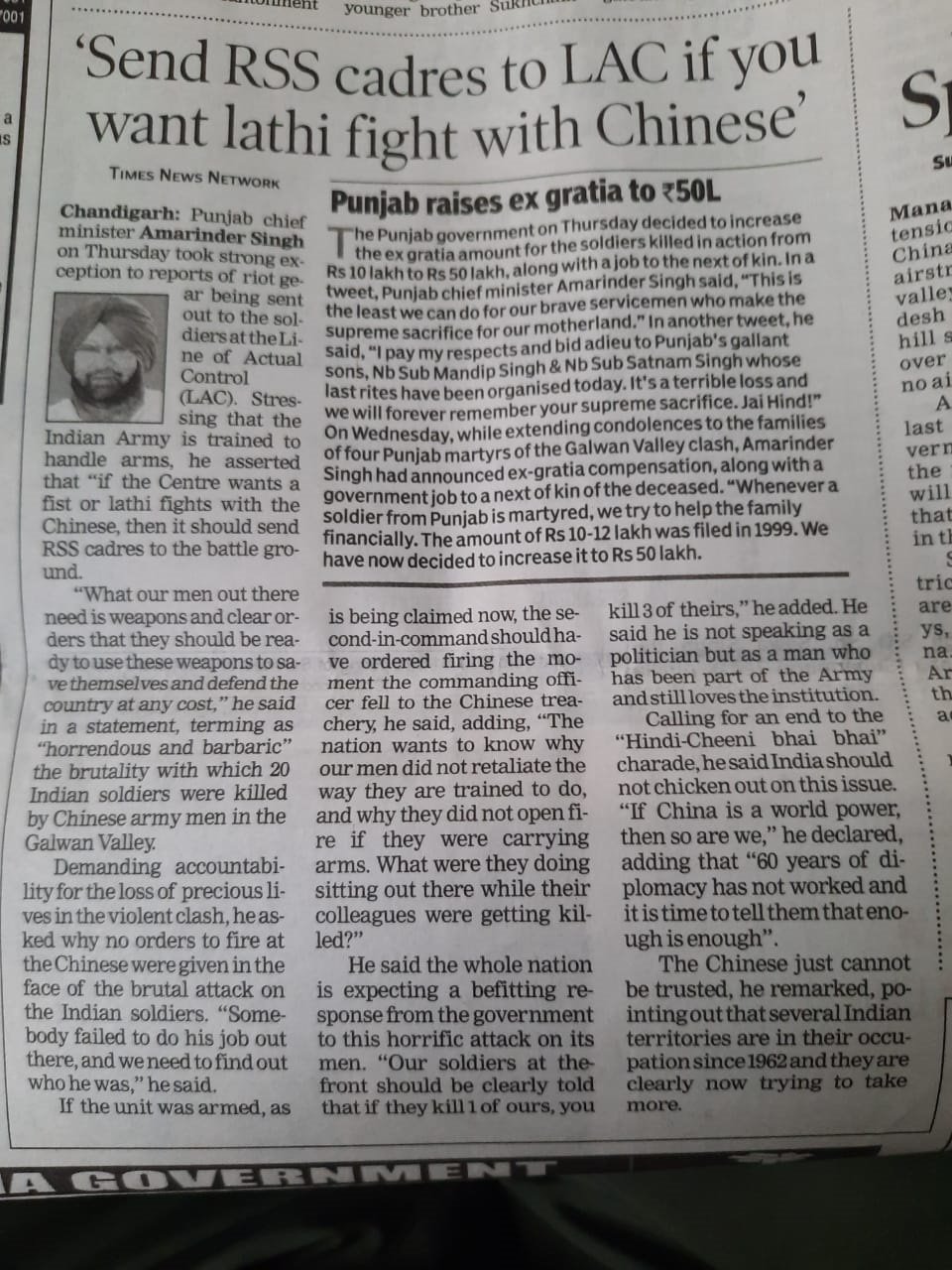
Send RSS cadres to LAC if you want lathi fight with Chinese:
What next, what is the way forward? Was there intelligence failure’: Congress president bombards Centre with questions
Congress president Sonia Gandhi addresses on Indian Army face-off with Chinese troops at Galwan valley in Ladakh via video link. PTI photo
Aditi Tandon Tribune News Service New Delhi, June 19
Congress president Sonia Gandhi urged Prime Minister Narendra Modi on Friday to assure the nation that status quo ante along the LAC will be restored and China will move back from the current positions.
“The question is, what next? What is the way forward? The entire country would like an assurance that status quo ante would be restored and China will revert back to the original position on Line of Actual Control,” she said in her remarks at an all-party meeting the prime minister had called on Friday to discuss the volatile situation.
Gandhi also asked the government to explain the sequence of events leading up to the death of 20 Indian soldiers and asked the government of it thought there was a failure of intelligence.
The Congress chief said the meeting should have come earlier in the day and asked the prime minister a series of questions.
Gandhi asked: “On which date did the Chinese troops intrude into our territory in Ladakh? When did the government find out about the Chinese transgressions into our territory? Was it on May 5th, as reported, or earlier? Does the government not receive, on a regular basis, satellite pictures of the borders of our country? Did our external intelligence agencies not report any unusual activity along the LAC? Did the Military Intelligence not alert the government about the intrusion and the build-up of massive forces along the LAC, whether on the Chinese side or on the Indian side? In the government’s considered view, was there a failure of intelligence?“
Gandhi said there was lack of clarity on the ground situation and that valuable time was lost between May 5 and June 6, resulting in the deaths of Indian soldiers.
“Even at this late stage, we are still in the dark about many crucial aspects of the crisis. We in the Congress Party believe that valuable time was lost between May 5 and June 6, the date on which the Corps Commanders meeting took place. Even after the June 6 meeting, efforts should have been made to talk directly, at the political and diplomatic levels, to the leadership of China. We failed to use all avenues, and the result is the loss of 20 lives as well as dozens injured,” Gandhi said, urging the PM to share with all the facts and the sequence of events beginning April this year till date.
On the way forward Sonia Gandhi said: “The entire country would like an assurance that status quo ante would be restored and China will revert back to the original position on Line of Actual Control”.
She also sought a briefing on the preparedness of defence forces to meet any threat.
“In particular, I would like to ask—what is the current status of the Mountain Strike Corps, with two mountain infantry divisions, that was sanctioned in 2013? Should the Government not treat it with utmost priority?” she asked.
HARD HITTING FACTS : HOW FAR ONE CAN HIDE THE TRUTH: EFFECTS MORALE OF SOLDIERS:HOW THEY ARE TREATED BY THE NATION
Responding to the continuing Chinese aggression, India has added Apache attack copters, Sukhoi fighter jets, infantry men and tanks to defences along the Line of Actual Control (LAC).
Ajay Banerjee
Tribune News Service
New Delhi, June 19
Responding to the continuing Chinese aggression, India has added Apache attack copters, Sukhoi fighter jets, infantry men and tanks to defences along the Line of Actual Control (LAC).
A division of the Indian Army, kept ready for contingency, has been acclimatised over the past two weeks for war fighting at more than 14,000 feet. Earlier, in the first week of May, the defences in Ladakh were bolstered by moving another division (some 15,000 troops).
Also, the 3rd Division of the Army, tasked for Ladakh under normal circumstances, is already there. Three divisions now form an arc and are ready to respond. This comes in response to the massive buildup by China along the LAC opposite Indian positions in Depsang, Galwan, Hot Springs, north bank of the Pangong Tso, Koyul, Fukche and Demchok.
The Chinese have been relentless in adding to their military capabilities across the LAC, as confirmed by the latest satellite imagery.
The IAF has moved the latest Apache attack 64 helicopters to Ladakh. The bases at Adampur and Pathankot are on alert and are doing patrolling. A navy surveillance plane, Boeing P8I, has been used to capture high-resolution imagery and videos. It can stream videos to war-rooms of the forces in Delhi.
ndia becomes a factor in US talks with China Border dispute clubbed with South China Sea and Hong Kong
The US has said it would like to hear more from China about its land border disputes with India. For the first time in recent years, China’s tensions with India are openly figuring in American calculus for the region.
‘PLA invaded same area in 2015 too’
The PLA invaded this contested area deeper and longer in 2015, with more people, than ever before historically. We don’t have a lot of visibility and we don’t have a lot of open dialogue with our Chinese counterparts — David Stilwell, Senior US Official
Speaking on the India-China border clashes immediately after high-level talks between US Secretary of State Mike Pompeo and Chinese Communist Party Politburo member Yang Jiechi, a senior US government official wondered whether the Chinese incursions into the Indian territory since 2015 were a negotiating tactic or “just a punch in the nose to demonstrate their superiority”.
However, the US has clubbed China’s friction with India along with its other long-standing regional disputes such as South China Sea and Hong Kong issues to assert that “the actions that we’ve seen out of China have been not really constructive”, according to Assistant Secretary for East Asian and Pacific Affairs in the US State Department David Stilwell.
The US is watching the India-China border dispute “very closely” and finds the current activity at the Galwan valley and Pangong Tso as similar to the activity in the past on border disputes. In this respect, he mentioned Xi Jinping’s India visit in 2015 when the PLA invaded the same contested area “deeper and longer, with more people, than ever before historically. Then we saw the Doklam issue down near Bhutan, where we saw similar concerns”.
“We don’t have a lot of visibility and we don’t have a lot of open dialogue with our Chinese counterparts, and honestly I’d like to see more of that if we can,” he added.
For the most part India was however a footnote as the US-China dialogue in Honolulu revolved around safeguarding American interests, including full transparency to combat the ongoing pandemic, implementing phase one of the Indo-US trade deal, North Korea, Hong Kong, South China Sea and provocative behaviour around Taiwan.
Stilwell described the US-China relationship overall as intense. “This is terra incognita for the Chinese. They never had a US government actually stand up and insist that they follow through on their commitments,” he said.
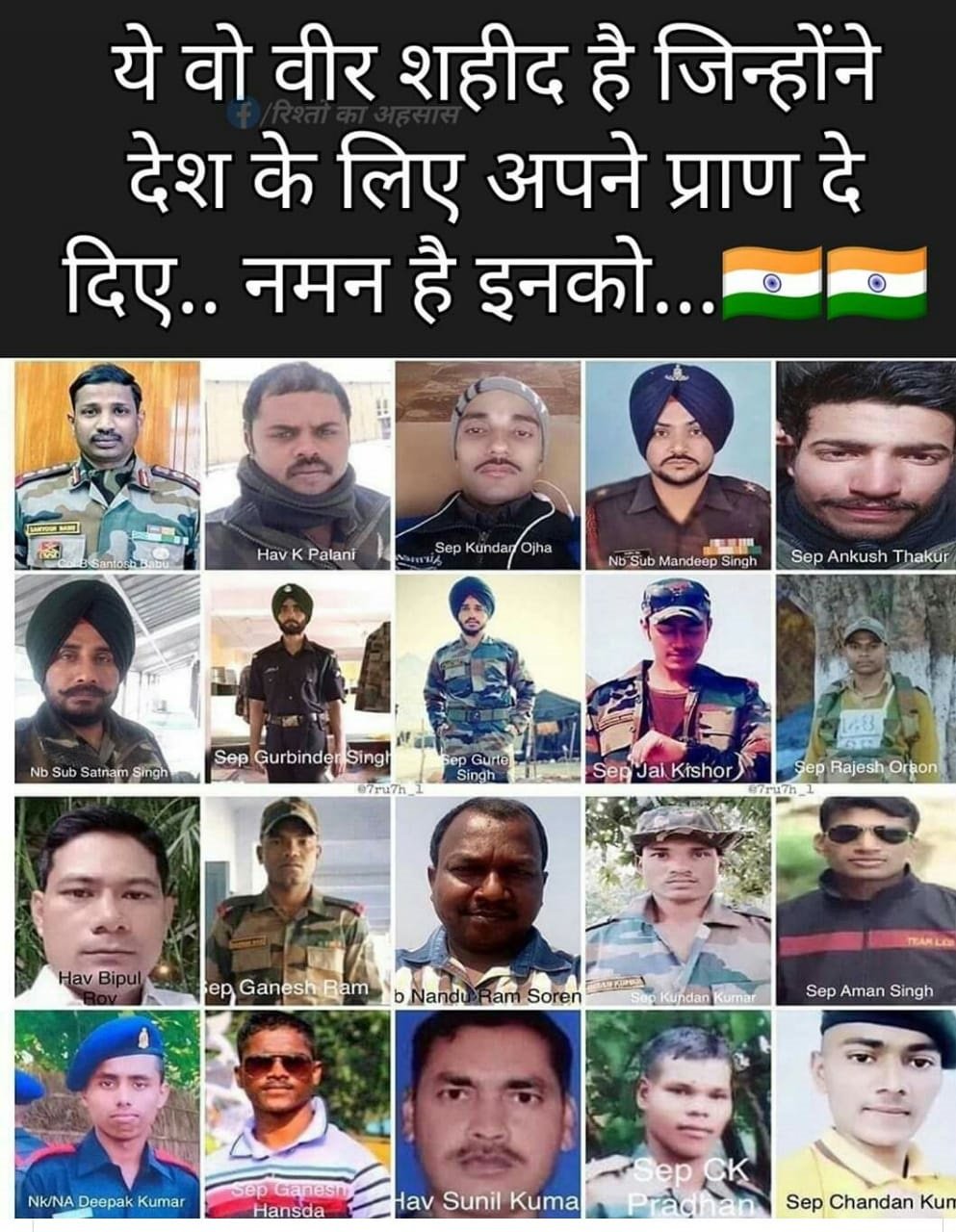
These are the 20 soldiers ‘killed in action’ in Galwan after clashes with Chinese troops
The Indian Army released the list of the 20 soldiers who were killed in the violent clashes with Chinese troops late Monday night in Ladakh’s Galwan Valley.
(Clockwise from left) Colonel Santosh Babu, Sepoy Ojha and Havildar Palani, who were killed during a clash with Chinese troops in Ladkah on 15 June 2020 | PTI
New Delhi: At least 20 Indian soldiers, including a commanding officer posted in Galwan Valley along with subedars, havildars and sepoys, were “killed in action” following a skirmish with Chinese troops Monday night.
The Indian Army initially released a statement Tuesday afternoon, noting that three officers had died in action during the violent face-off. However, later at night, the Army said 17 more soldiers had succumbed to their critical injuries since they had been exposed to sub-zero temperatures in the high altitude terrain.
The skirmish, which took place late Monday, is the first time in 45 years that a soldier has died along the Line of Actual Control (LAC), which is undefined in Ldakh.
In its statement, the Army noted that it was “firmly committed to protect the territorial integrity and sovereignty of the nation”.
There has been speculation that some soldiers are missing, since some had fallen into the freezing river in the valley, but the Army neither addressed this in its statement nor mentioned the injuries or deaths sustained by the Chinese side.
The clash occurred after Commanding Officer Col Santosh Babu found out that Chinese soldiers did not entirely follow through on the de-escalation process agreed upon by both side during earlier talks.
ThePrint had reported that the face-off took place on a narrow slope and some soldiers fell into the confluence of the Galwan and Shyok rivers. The face-off included stone pelting and physical clashes with barbed wire and iron rods. The soldiers who fell into the river died of hypothermia.
The bodies of the soldiers were taken by a military aircraft from Leh Wednesday afternoon and will be carried by road to their respective hometowns.
The Indian Army released details of all 20 soldiers declared killed in action. Among them was Ankush, a 21-year-old sepoy born on 4 November 1998. Sepoy Ganesh Hansda was even younger at 20 years. Sepoy Kundan Kumar Ojha died just days before his 27th birthday on 18 June.
Sepoys Gurbinder, Chandan Kumar and Gurtej Singh were 22 years old, while Sepoy Rajesh Orang had just turned 26 on 5 April. Sepoy Ganesh Ram had turned 27 on 28 April and Sepoy Chandrakanta Pradhan was 28 years old.
Here is the full list of the soldiers killed
Commanding Officer Colonel Bikumalla Santosh Babu from Hyderabad, Telangana
Naib Subedar Nuduram Soren from Mayurbhanj, Odisha
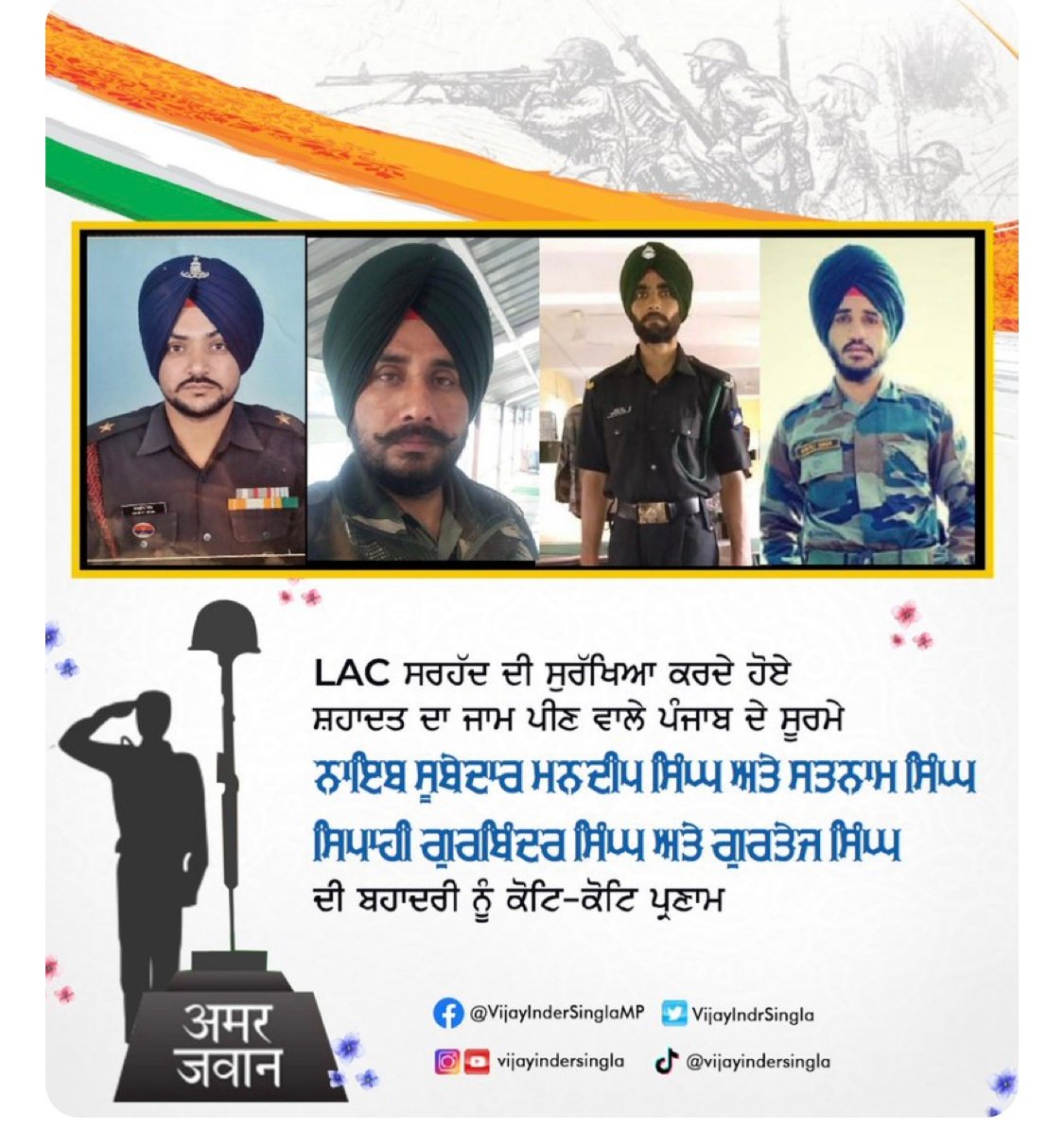
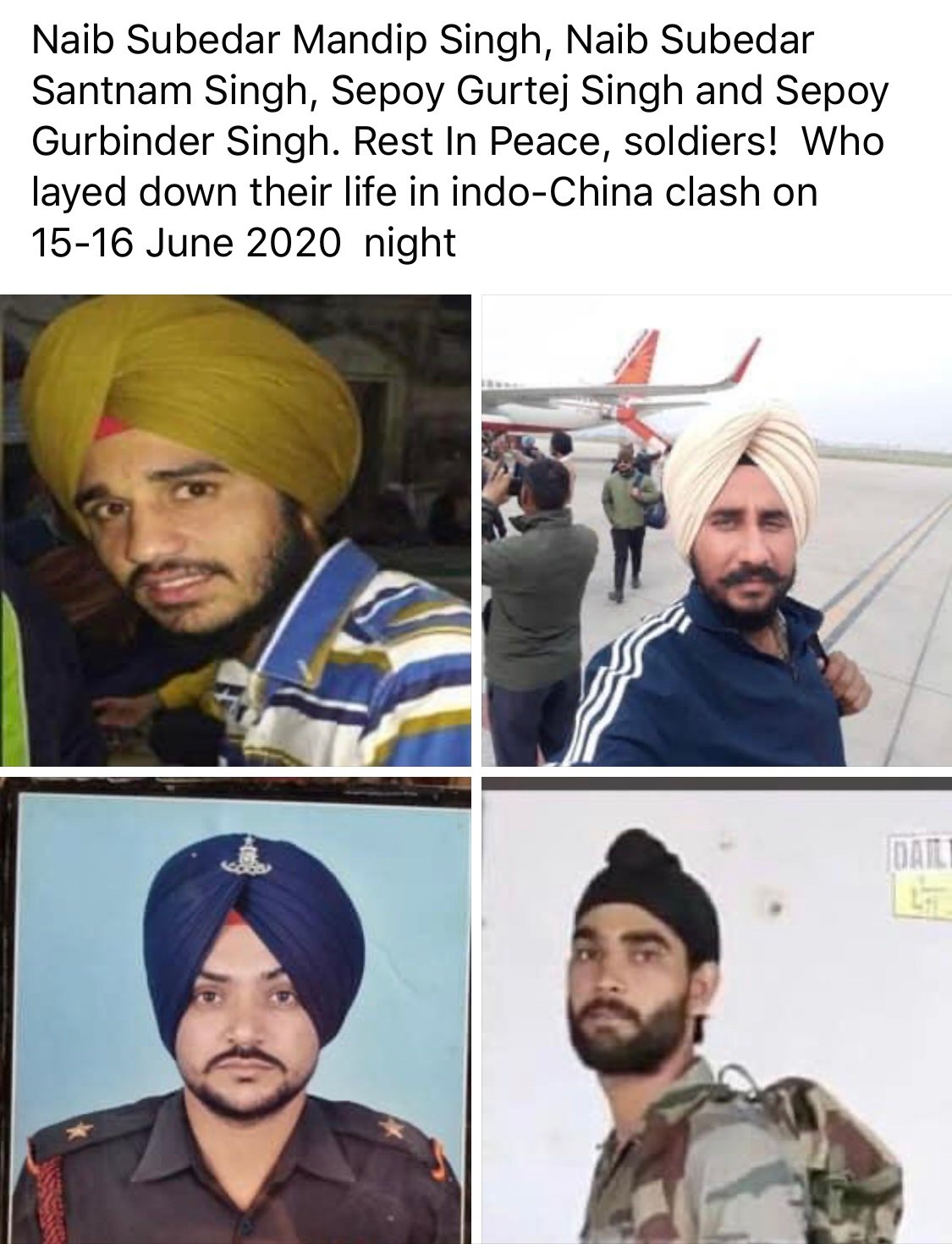
Naib Subedar Mandeep Singh from Patiala, Punjab
Naib Subedar Satnam Singh (driver) from Gurdaspur, Punjab
Havildar (gunner) K Palani from Madurai, Tamil Nadu
Havildar Sunil Kumar from Patna, Bihar
Havildar Bipul Roy from Meerut City, Uttar Pradesh
Naik (Na) Deepak Kumar from Rewa, Madhya Pradesh
Sepoy Rajesh Orang from Birbhum, West Bengal
Sepoy Kundan Kumar Ojha from Sahibganj, Jharkhand
Sepoy Ganesh Ram from Kanker, Chhattisgarh
Sepoy Chandrakanta Pradhan from Kandhamal, Odisha
Sepoy Ankush from Hamirpur, Himachal Pradesh
Sepoy Gurbinder from Sangrur, Punjab
Sepoy Gurtej Singh from Mansa, Punjab
Sepoy Chandan Kumar from Bhojpur, Bihar
Sepoy Kundan Kumar from Saharsa, Bihar
Sepoy Aman Kumar from Samastipur, Bihar
Sepoy Jai Kishor Singh from Vaishali, Bihar
Sepoy Ganesh Hansda from East Singhbhum, Jharkhand
Defence Minister Rajnath Singh will visit Russia and attend the Victory Day Parade at Red Square, Moscow, on June 24.
Tribune News Service
New Delhi, June 19
Defence Minister Rajnath Singh will visit Russia and attend the Victory Day Parade at Red Square, Moscow, on June 24.
The visit comes in the backdrop of the Indian Air Force looking to buy additional MiG-29 and Sukhoi-30 fighter jets. The visit also comes amid a war-like situation when India and China are locked in a tense situation along the Line of Actual Control (LAC).
In addition to attending the parade, Singh will be meeting top officials of the Russian Federation, said sources.
The parade will commemorate the 75th anniversary of the victory in World War-II (1939-45). India is a key ally of Russia and before that the Soviet Union.
From India, a tri-services contingent of the Indian armed forces comprising 75 personnel, led by a Colonel-rank officer, will participate in the parade. The marching contingent will be led by a Major-rank officer of the Sikh Light Infantry Regiment. The Regiment had fought in the World War-II and has the distinction of earning four Battle Honours and two Military Cross amongst other gallantry awards.
Indians took part with the British Indian Armed Forces during World War-II and were one of the largest Allied Forces’ contingents, which took part in the North and East African Campaign, Western Desert Campaign and the European Theatre against the allies. More than 87,000 men lost their lives.
Linked to WW-II
The parade will commemorate the 75th anniversary of the victory in World War-II
Indians participated in the war as part of the British Indian Armed Forces
More than 87,000 men lost their lives
India learnt the wrong lesson from 1962 China war. Modi govt must be more open
PM Narendra Modi with Chinese president Xi Jinping at the Wuhan Summit | Photo: @narendramodi | Twitter
The first Indian casualties on the disputed India-China boundary since 1975 should be occasion to reconsider several long-held beliefs and methods of dealing with the relationship that successive governments in New Delhi have adopted over the years.
This essay will deal with just one trope – that foreign policymaking in India cannot be an open, public or democratic exercise and that ‘quiet diplomacy’ is the way to go in dealing with China. There are two central problems with such a position – both of which have been on view during the ongoing crisis on the LAC and which have severely constrained the Indian government’s ability to assess the situation as well as to find options to deal with it.
First, the desire to keep decision-making on China within the strict confines of the government has much to do with the run-up to the 1962 Sino-Indian conflict. The lesson learned following India’s defeat seemed to be that discussing matters openly in Parliament or with the general public tended to limit the freedom of manoeuvre for the Indian government to engage in negotiations with the Chinese side that would require compromises by New Delhi in order to have a realistic chance of a resolution that at least broadly met India’s interests.
If this tendency has continued within the Indian government, it has to do with a second reality valid until quite recently, which was that expertise on the border areas or on what went on there was limited to the Army and various paramilitaries – the Indo-Tibetan Border Police and previously, also the Assam Rifles, both under the Ministry of Home Affairs – that had manned the borders and/or with the diplomats and other civilian officials who held administrative charge of these areas.
There are good reasons why neither position is tenable any longer.
One, as under Mao Zedong, so also under present Communist Party (CPC) General Secretary Xi Jinping, China is a power that not only takes maximalist positions but also makes no effort to couch these in polite language or to even discuss alternatives. It is also a China that seeks to distract from internal strife and the leadership’s inability or incompetence in handling domestic crises with a shrill, victimhood-based nationalism. It is doubtful that Nehru’s India could have avoided eventual conflict with China given the Dalai Lama’s decision to flee Tibet to India or the need for Mao to both counter criticism for and distract attention from the Great Leap Forward, whose disastrous effects – tens of millions dead by starvation – the rest of the world would only come to know many years later.
Today, Xi Jinping faces a similarly fraught internal situation with an economy hammered by the COVID-19 pandemic and the long-aspired for goal of a ‘moderately well-off society’ by the CPC’s 100th anniversary next year, looking ever more distant. Meanwhile, Xi’s policies since his ascension to power in 2012 – his centralization of power and his hard-selling of the ‘Chinese dream’ of nationalism, and of being a natural challenger to the United States –has had the implication of painting other countries as weaker than or less important than China. Thus, when a Vietnam or Indonesia or India decides to challenge China’s bad behaviour, the Chinese tendency has been to view such reactions with surprise as if the smaller country were being both unreasonable and arrogant.
While the incidents – whether in the South China Sea or on the LAC might be localized and the tactics used by military commanders shaped by local factors, they are sanctioned by the larger set of goals and objectives under Xi’s plans for ‘national rejuvenation’. Thus, whatever ‘strategic guidance’ he might have imparted to his military commanders following the Wuhan informal summit with Indian Prime Minister Narendra Modi in April 2018, it certainly was not aimed at maintaining peace and tranquillity on the LAC but ensuring dominance and constraining Indian behaviour.
Given this reality, the Indian government actually gains nothing from keeping its own public in the dark about goings on along the LAC or by infantilizing its citizens by portraying them as being unable to understand India’s international interests. On the other hand, open and accurate dissemination of information by the political leadership on the general state of relations with China as well as at the LAC specifically, would have helped with the current situation. In fact, if instead of being buried deep in various government reports, news about the numbers and nature of transgressions on the LAC had been actively disseminated and explained at least from 2017 when the Doklam standoff took place, if not earlier still, this would have created an iterative learning experience for the Indian public – including possibly its own soldiers – who would then have been both better informed about what is at stake and prepared for the troughs in the relationship.
Instead, what we have is a situation where Doklam has almost completely disappeared from public memory and the larger pattern of increasing Chinese assertiveness that has been underway for years already has been missed. The evidence for this last would have been available from Doklam itself if the government had been so minded to keep the media and the public focused on the area that Bhutan claims for its territory but which the Chinese have today more or less occupied entirely save for the exact spot of the original standoff itself. Instead, New Delhi diverted attention by the so-called ‘informal summits’ in Wuhan (2018) and Mamallapuram (2019) that departed from the norm of even minimal transparency by providing neither a joint statement nor any clearly defined set of commitments that the two sides had agreed on.
Meanwhile, the Chinese have begun to claim that they too, now have to acknowledge ‘public opinion’ on their side, while India which is a democracy enters the negotiating room with one hand tied behind its back simply because it cannot leverage its public opinion.
What is more, the deaths of Indian soldiers on the LAC will probably now also set off great confusion about how such a situation could come to pass when the average Indian thought all this while that the only real existential threat came from Pakistan. In fact, even without the Indian casualties on the LAC, it could be argued that the Modi government had created an unintended consequence in the form greater Indian public attention on China precisely by focusing frequently and loudly on its tough responses to Pakistani provocations and claiming that it had done what previous governments had failed to do. In terms of responding to Chinese provocations, therefore, ‘yeh dil maange more’ (the heart wants more) might now well become the attitude of the average Indian on China, too.
Two, it is no longer the case that expertise on China or on India’s border areas with China are limited to only within the Indian government, even if this expertise has gone up considerably and continues to grow especially among the middle and junior rungs of the military leadership. Despite consistent lack of government support, there is today a whole generation of young Indians who, ironically, have the Chinese government to thank for some extremely generous – by Indian standards – scholarships to study in China and have, as a result, developed significant expertise as well as niche areas of specialisation on that country. Also to be thanked is the Taiwanese government that has for over 15 years run its own set of scholarships and fellowships for Indian students and academics as part of its outreach to India and a desire to diversify its options in global politics and economy – a move that New Delhi itself has failed to reciprocate in substantive measure.
One might also add that China’s Belt and Road Initiative and its attempt in the opening years of the project to gain India’s support also meant invitations to conferences for Indian scholars, including of older generations – opportunities for travel and discussion that they simply had not had in all the years past owing to lack of money for field trips in Indian universities and think-tanks. These occasions served to open Indian eyes and minds to the scale of just what the Chinese were up to in the Xi era. While scholars who were not specialists of China were justifiably impressed with glitz and ambition of a conference even in a mid-size Chinese city, they too, eventually came around to observing and highlighting what Indian students in China as well as China specialists in India soon perceived to be Beijing’s zero-sum approaches in foreign policy and economic globalization.
It has been easy for both serving and former Indian government officials to tar Indian scholars and students who have studied in China as being soft on the country or having their heads turned by Chinese inducements. The chances of this happening are about the same as the chances of Indian diplomats or intelligence officers posted in China selling their country short. But one reason why such statements continue to have currency is a desire by sections within government to protect the government’s imaginary ‘freedom’ of manoeuvre, from criticism that if they acknowledged as valid would require uncomfortable changes of course and loss of turf and privilege. It is time to bury this ostrich mentality within the government and to both move faster to tap expertise outside its four walls as well as to open the purse-strings to more generously fund China studies in the country.
The deaths of Indian soldiers along the LAC at Galwan is a watershed moment in the India-China relationship. If the relationship is not to spin out of control and if India needs to develop the muscle – military, economic and intellectual – to tackle the long-term China threat on the borders as well as the challenges that Beijing poses in the region and globally, not only will New Delhi have to adopt transparency and openness to questions as a central plank of the reworking of its China policy but also partnership with and support for expertise on China in India’s universities and think-tanks. The first is a policy change that can be achieved practically overnight if the government wills it. The second is currently available from sections of the government episodically but needs to become more widespread and sustained. Together, these changes could well ensure that the tragedy on the LAC is not for nothing.
Jabin T. Jacob is Associate Professor, Department of International Relations and Governance Studies, Shiv Nadar University, Uttar Pradesh. Views are personal.
State Stalwarts
DEFENCES FORCES RANKS
ARMY, NAVY, AIRFORCE RANKS
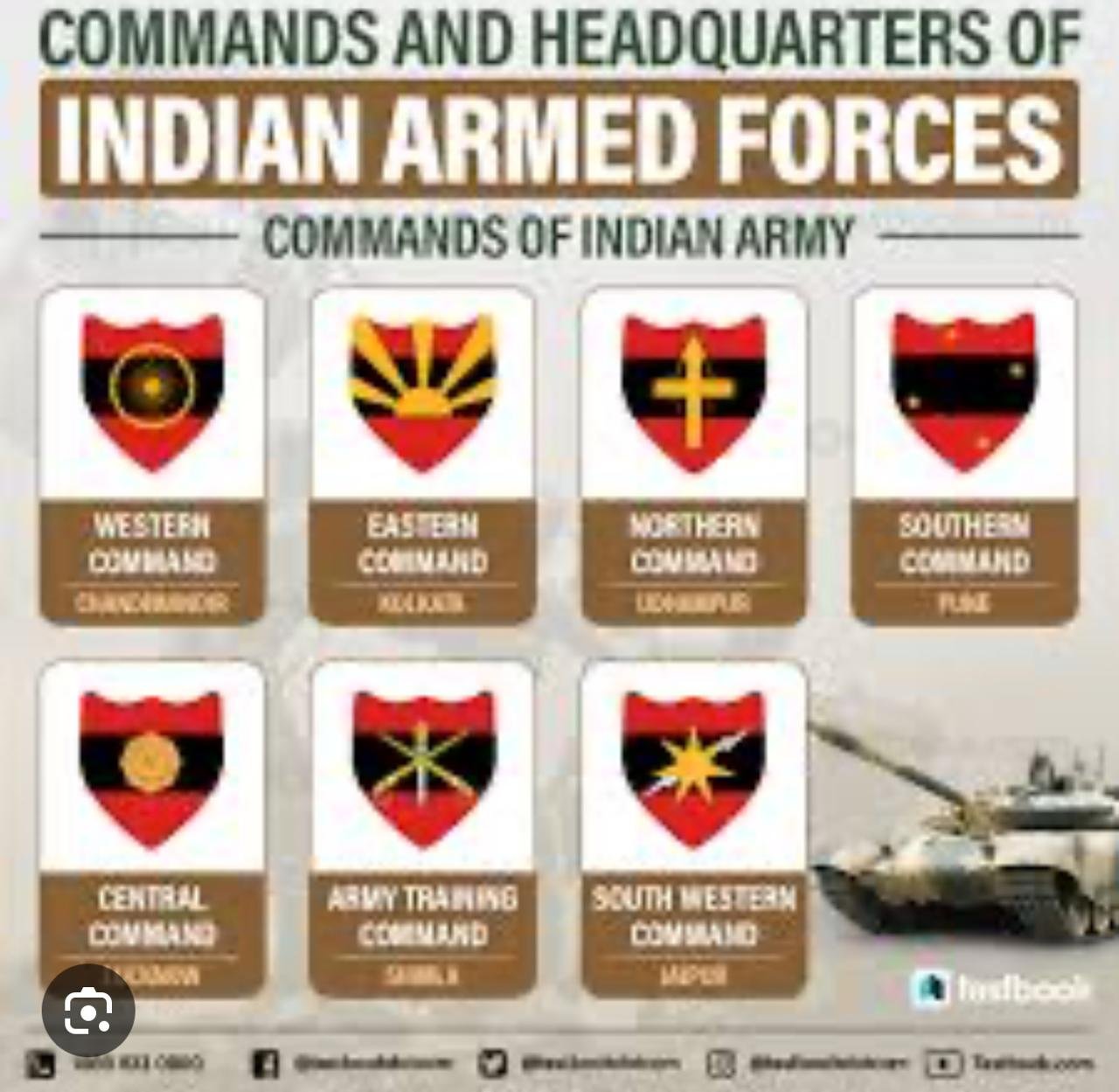
FORMATION SIGNS
FORMATION SIGNS
ALL HUMANS ARE ONE CREATED BY GOD
HINDUS,MUSLIMS,SIKHS.ISAI SAB HAI BHAI BHAI
CHIEF PATRON ALL INDIA SANJHA MORCHA
LT GEN JASBIR SINGH DHALIWAL, DOGRA
SENIOR PATRON ALL INDIA SANJHA MORCHA
MAJOR GEN HARVIJAY SINGH, SENA MEDAL ,corps of signals
.
.
PATRON ALL INDIA SANJHA MORCHA
MAJ GEN RAMINDER GORAYA , CORPS OF
sanjhamorcha303@gmail.com
PRESIDENT HARAYANA STATE CUM COORDINATOR ESM
BRIG DALJIT THUKRAL ,BENGAL SAPPERS
PRESIDENT TRICITY
COL B S BRAR (BHUPI BRAR)
PRESIDENT CHANDIGARH ZONE
COL SHANJIT SINGH BHULLAR
.
.
PRESIDENT PANCHKULA ZONE AND ZIRAKPUR
COL SWARAN SINGH
PRESIDENT SAS NAGAR (MOHALI)
COL BALBIR SINGH , ARTY
INDIAN DEFENCE FORCES
DEFENCE FORCES INTEGRATED LOGO
FORCES FLAGS
15 Th PRESIDENT OF INDIA SUPREME COMMANDER ARMED FORCES
Droupadi Murmu
DEFENCE MINISTER
Minister Rajnath Singh
CHIEF OF DEFENCE STAFF (2nd)
General Anil Chauhan PVSM UYSM AVSM SM VSM
INDIAN FORCES CHIEFS
CHIEF OF ARMY STAFF(29th)
General Upendra Dwivedi, PVSM, AVSM (30 Jun 2024 to Till Date)