



Sanjha Morcha

China’s 1960 claim acknowledges Galwan Valley is India’s, says retired General Narasimhan

In an interview with ThePrint, National Security Advisory Board member retd. Gen Narasimhan says India’s response to China doesn’t mean it will only be military, but could be diplomatic, economic as well.

Representational image | Soham Sen | ThePrint

Representational image | Soham Sen | ThePrint
New Delhi: A “befitting reply” to Chinese actions in the Galwan Valley, as talked about by Prime Minister Narendra Modi, doesn’t necessarily mean “it is going to be only in the military domain, it could also be economic or diplomatic”, according to retired General S.L. Narasimhan, member of India’s National Security Advisory Board (NSAB).

In an interview with ThePrint, Gen. Narasimhan talked about the various aspects of the on-going military stand-offs between India and China.

“Even if you go by the claim lines put out by China in 1960, the Galwan Valley is our territory,” said the General. However, the Chinese foreign ministry, which put out a statement Friday detailing their account of last week’s violent face-off, said the Galwan Valley was on China’s side of the Line of Actual Control (LAC).

 When asked about any Indian soldiers missing from after the clashes, Gen. Narasimhan said, “Officially, we don’t know…We need to wait and watch. If there are further people missing, official communications will come.”

The NSAB member said that from the Indian perspective, the bottom line is that the “status quo ante” needs to be restored.

“The Chinese need to go back to locations they were holding before the month of May. Character of the LAC (Line of Actual Control) would not change unilaterally, even if they try, they won’t succeed,” remarked the general.


Also read: India uses AIR Chinese service to broadcast commentary on Galwan ‘transgression’ by China


Indian options going ahead

The NSAB member clearly stated that military action against China was definitely the last option.

When asked to elaborate on Prime Minister’s remark regarding India’s ability to provide a befitting reply when provoked, he said, “Military option is the last option. We need to exhaust all other options that are available to us before we go down that path. And I think there is still space available before we take a call about that (military action).”

According to Narasimhan, the “available space” means that when responding to Chinese aggression, India has a lot of options. He said India has diplomatic, ground level, foreign minister related options available.


Also read: Army rubbishes media claims of 20 Indian soldiers missing in Galwan valley


Events at Galwan were ‘pre-meditated’

According to the NSAB member, at the lieutenant general-level talks that took place on 6 June, a “consensus was arrived” that “disengagement would take place”.

Moreover, at the places where these face-offs are taking place, it was decided that further discussions would take place to discuss the “modalities of disengagement process”.

But the Chinese went back on the 6 June agreement to facilitate disengagement, according to Narasimhan.

“On the evening 15th June, as a unit of Bihar Regiment patrol went to see if disengagement process was on (at the LAC in Galwan Valley) … they found probably a structure kind of thing built by Chinese on the Indian side. When the Indian side asked them to go back, they did. But then they came back and that’s when the scuffle seems to have taken place,” he said.

The general further elaborated on Minister of External Affairs S. Jaishankar’s statement to his Chinese counterpart, that the action by People’s Liberation Army forces at Galwan Valley was “pre-meditated”.

“When Chinese went back and came back again, that indicated that it was premeditated action,” he explained. “I think they wanted to ensure that particular place is with them. Given that didn’t happen, that must have upset their plan and they decided to come back.”

Here Narasimhan is referring to how the Bihar Regiment patrolling forces had pushed back PLA troops on 15th June evening, but the latter decided to come back again.

‘Casualties would have been higher if there was firing’

In terms of the nature of violence between the two sides, Narasimhan said, “the level of violence seems to be varying between pushing and pulling and less than opening firing”.

“It happened sometime in the evening. Some stone pelting had taken place and batons were used. What I can say for sure is there was no firing. If there was firing, casualties would be even higher,” he said.

When talking about Chinese casualties, he said that he was certain the Chinese side had suffered casualties, but it was not possible to know the exact numbers.

When pressed to provide a ballpark figure, Narasimhan said, “I get a feeling it would be around the same number as our side or little more than that. It is possible that they suffered more.”


Also read: China has an Achilles’ heel. India must take the battle there from LAC


Galwan different from recent Chinese aggressive behaviour

As the general tried to analyse how the current standoff was different from the ones in the past, he listed four points of departure.

“It is happening simultaneously at multiple places. What is happening can’t be attributed to a local commander this time. Their numbers are much larger than before. And the aggressiveness is also more than the previous time,” explained Narasimhan.

When the NSAB member — who also speaks Mandarin and is a close observer of Chinese behaviour — was asked about what explains the recent aggressive Chinese behaviour, he pointed towards a pattern.

“This aggressive behaviour with China has been around for some time. Look at what they are doing in South China Sea, look at the aid they are front loading to cover their initial mishandling of the pandemic,” Narasimhan said.

He said this behaviour could be explained by the comprehensive growth in China’s national power and the country is now trying to spread its influence across the board.


Also read: India working to restrict Chinese goods, investments since before Galwan, Covid: Officials


New bridge over Shyok river in Galwan Valley now functional amid tension with China

The bailey bridge holds strategic significance for the Indian Army as it helps movement of men and material closer to the Line of Actual Control.

Trucks carry essential commodities in Ladakh | Representational image | ANI

Trucks carry essential commodities in Ladakh | Representational image | ANI
New Delhi: A strategically important bridge in the Galwan Valley of Eastern Ladakh has been made “functional” amid the ongoing tensions with China in the region, ThePrint has learnt.

This means that while minor works carry on, vehicles can now pass on the bridge which replaces an already existing wooden structure.

Army sources said that the 60-metre bridge is on the Shyok River and is very close to the confluence of the Shyok-Galwan rivers.

“It links Daulat Beg Oldie (DBO) and is not on the track moving to Patrol Point 14 (PP14) and neither on Galwan river,” a source explained.


Also read: Why the remote Galwan Valley is a flashpoint between India and China

Bridge over river Shyok

The bailey bridge, built on four concrete pillars and comprises of metal trusses (beams), can be used for movement of men and different kinds of vehicles.

It was made functional Thursday and vehicles crossed it as part of trials.

This gives strategic heft to the movement of men and material closer to the Line of Actual Control (LAC).

ThePrint had reported on 12 June that the work on the bridge was on and had sped up amid the ongoing stand-off with China.

India had made it clear to the Chinese that it will carry on with border infrastructure development.

The Print had also reported that China’s main concern in the Galwan Valley was the construction of a bridge.

The bridge is about 7.5 kilometres from the LAC and the construction had started late last year. It is also about 3-4 kilometres away from the spot where Indian and Chinese troops clashed on 15 June.

Sources said that there is no presence of Chinese troops on the Indian side of the Galwan Valley.

China had erected two tents within Indian territory close to PP14, which is at the mouth of the Galwan Valley, ThePrint had reported.

The violent face-off happened when the Chinese did not fully implement the terms of agreement decided upon during a 6 June meeting between 14 Corps Commander Lt Gen. Harinder Singh. At these talks, bot sides had agreed to move back from the area by about 2 kilometres.


Also read: Galwan clash was a result of China trying to build structures across LAC, says PMO


The China factor in Indian politics

The BJP — by disengaging with Pakistan — has projected itself as a nationalist force. Its advice to the Opposition not to “politicise” the national security issue may go unheeded, for if the BJP has benefited from weaponising security for electoral ends, the Opposition will seek to emulate the same.

The killing of 20 Indian Army personnel on June 15 has made the threat of China real and tangible for two generations of Indians and placed the relationship at the centre of public consciousness. It will shape the politics of nationalism

The killing of 20 Indian Army personnel on June 15 has made the threat of China real and tangible for two generations of Indians and placed the relationship at the centre of public consciousness. It will shape the politics of nationalism(HTPHOTO)

The brutal killing of 20 personnel of the Indian Army, including a colonel-level officer, by China’s People’s Liberation Army (PLA) in the Galwan Valley on the night of June 15 will reverberate across India for a long time to come. Indian security personnel — from the armed forces, paramilitary forces, and the police — have often given their lives in the quest to defend India’s territorial integrity, sovereignty and the Constitution. And as often, their contribution is forgotten.

But Colonel Santosh Babu and the 19 other men killed in the line of duty will stay on in public memory for three reasons. First, this was the first time since 1975 that Indian blood was shed defending the border against China. Two, the nature of the killing was brutal — PLA, in what India has called a “pre-meditated” attack, violated norms of war. And India and China are not even officially at war. And finally, their killing has highlighted the place of Ladakh in general, and Galwan Valley in particular, as essential to India’s territorial imagination.

This, then, can make June 15 — or Ladakh 2020 — the moment when, for two generations of Indians, the security threat from China has become tangible and real. It can make it the moment when discussions about the “competitive-cooperative” relationship with China and how to navigate great power politics will move beyond the rarefied seminar circuits of elite analysts and assume a strong place in public consciousness. And it can make it the moment when China becomes an issue in Indian domestic politics, strongly tied to public opinion, partisan positions, and the idea of nationalism.

The intersection of domestic politics and foreign policy is old. Indeed, a lot of scholarship suggests that foreign policy itself is the extension of domestic politics and is shaped substantially by it.

In India’s case too, this has been true. But barring the 1962 war, and the criticism that the then Prime Minister Jawaharlal Nehru faced, the most critical foreign policy issue has been Pakistan. This is not surprising. The tragedy of Partition, Pakistan’s support for Khalistan, the Kashmir question, its sponsorship of terrorism in India which has cost thousands of lives, four wars (1948, 1965, 1971 and 1999), and the manner in which the external enemy (Pakistan) is often used in political discourse to demonise an internal constituency (Indian Muslims) lends the India-Pakistan relationship particular political salience. Indeed, as the saying in South Block goes, the real joint secretary in charge of the Pakistan desk at the ministry of external affairs is the Prime Minister of India. And that is because each decision on Pakistan is a political, not a bureaucratic, one.

The Indian strategic community has long recognised China as a threat. The border dispute and Beijing’s efforts to change the facts on the ground by its consistent incursions; its claim over Arunachal Pradesh, particularly Tawang; the large trade deficit; China’s firm support to its “all-weather friend”, Pakistan, now buttressed by the China-Pakistan economic corridor; its efforts to box in India by encouraging regimes hostile to New Delhi in the neighbourhood; its moves to thwart India’s legitimate ambitions (such as permanent membership of the Security Council or entry into the Nuclear Suppliers Group); and its ambitions to establish new style imperialism through the Belt and Road Initiative have all been closely noted and are a part of the institutional memory of the government of India.

But along with this, there is also a recognition of the power asymmetry between the two countries. India’s economy is much weaker; its military and technological capabilities don’t match up to China; its State capacity is more limited; and in the maze that is international politics, China is a more significant player and India cannot rely on partnerships and external bandwagoning. Along with it, India — at this stage of its economic development — needs foreign capital and investment, and deepening economic interdependence with China has been seen as a way to both neutralise the competitive elements and aid Indian development.

This measured policy approach worked because China was not an issue that animated public opinion. But it will now face a challenge. This is both because of China’s aggression (not unique to India — just ask Vietnam, Japan, Australia and others in its neighbourhood) and because in Indian democracy, policies cannot be completely out of sync with popular sentiment.

The killings of June 15 have suddenly woken a large number of citizens to the fact that Pakistan is an important, but perhaps not the most important, security challenge India confronts. The Chinese willingness to assert itself abroad under President Xi Jinping, and the power differential with India, makes it a more serious adversary. The calls for boycotting Chinese goods may be populist and rooted in ignorance of economic realities but they reflect the emerging mood about China, which is going beyond suspicion to a degree of loathing.
The evolution of public opinion is bound to have an impact on political discourse. And that is why even a prime minister such as Narendra Modi — who has proudly worn the badge of nationalism and presented himself as a security hawk — had to face tough questions, not just from critics but also more independent observers, about his claim on Friday night that there is no external presence in Indian territory. The Prime Minister’s Office, on Saturday, came up with a clarification. But the response to his initial statement is instructive. Indian public opinion is not in the mood to tolerate even the hint of a territorial concession to China anymore.

This, then, will have an impact on the politics of nationalism in India. The Bharatiya Janata Party (BJP) — by disengaging with Pakistan till it acts on terror and through the surgical and air strikes under its term in office — has projected itself as a staunchly nationalist force. But now, it will have to be accountable for its actions on China too. The well-meaning advice to the Opposition not to “politicise” the national security issue may go unheeded, for if the ruling dispensation has benefited from weaponising national security for electoral ends, the Opposition will seek to emulate the same. Expect the BJP to talk about Pakistan, and expect the Opposition to counter it with China from now on. Ladakh 2020 has introduced the China factor into Indian politics. Its consequences will be long-lasting.


Punjab CM Amarinder Singh reaches Chandigarh Air Force station, pays tribute to Galwan martyrs

Punjab CM Amarinder Singh reaches Chandigarh Air Force station, pays tribute to Galwan martyrs

Tribune News Service
Chandigarh, June 19

http://VIDEO-2020-06-20-10-47-24 (1) (convert-video-online.com)

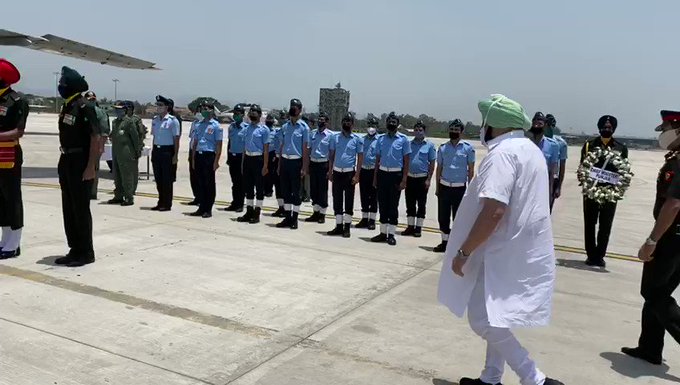
Punjab Chief Minister Captain Amarinder Singh on Friday reached Chandigarh Air Force Station to pay tribute to the soldiers who were martyred in a violent face-off with the Chinese at the Galwan Valley.

The mortal remains arrived here from Leh.

The Chief Minister laid wreaths on the coffins of the fallen soldiers.

Among the 20 troops, four soldiers were from Punjab, including a Colonel, who was killed in the fracas.

While the mortal remains of Nb Sub Satnam Singh of Gurdaspur and Nb Sub Mandeep Singh had arrived on Thursday, the mortal remains of Sep Gurbinder Singh of Sangrur, Sep Gurtej Singh of Mansa and Sep Ankush Singh of Hamirpur were airlifted to Chandigarh on Friday.

However, the mortal remains are being sent to their respective homes by road.

Earlier, the Chief Minister had the act of killing Indian soldiers as “horrendous” and demanded accountability for the loss of lives.

On Thursday, Captain Amarinder had announced that the state government has hiked the ex-gratia payable to martyrs from Rs 10 lakh to Rs 50 lakh.

Capt.Amarinder Singh

@capt_amarinder

Laying a wreath on the mortal remains of Sepoys Gurbinder Singh from Sangrur, Gurtej Singh from Mansa & Ankush from Hamirpur, HP at Chandigarh. Salute their supreme sacrifice at this young age. The nation is forever indebted. Jai Hind! 🇮🇳

 Embedded video

Ready to counter any situation at LAC in Ladakh, says IAF chief In departure from norms, no break for new pass-outs, told to gear up to join frontline units

Ready to counter any situation at LAC in Ladakh, says IAF chief

hina, the IAF Chief said, had breached all existing agreements at LAC. File photo

Ajay Banerjee

Tribune News Service

New Delhi, June 20

Indian Air Force Chief Air Chief Marshall RKS Bhadauria on Saturday morning said the IAF was full prepared to counter any situation along the Line of Actual Control (LAC) with China.

He was speaking after reviewing the combined passing-out parade of officers at the IAF academy in Dundigal, 40 km from Hyderabad.

Also read: Sukhois, tanks stacked up along LAC

China, the IAF Chief said, had breached all existing agreements at LAC. “All efforts are underway that the current situation is resolved peacefully. We are well prepared and suitably deployed to counter any situation,” he said.

Referring to the death of 20 Indian Army soldiers in the Galwan Valley clash on the night intervening June 15-16, he said, “We are determined that we will not let the sacrifice of the Galwan braveshearts go in vain.”

During his speech, the IAF Chief said, “I salute the act of Col Santosh Babu and his men in defending the LAC. It shows our resolve.”

To  the passing-out officers he said there would be no  break (as was the norm after passing out). “You will soon have to join the frontline units”. The developments along the LAC in Ladakh were a snapshot of what could be required to be done at short notice, he advised the newly commissioned officers.

The Tribune has reported in its edition dated June 20 that the IAF has deployed the Sukhoi-30 MKI fighter jets, the Apache attack helicopters among other assets to defend the 826 km of LAC in Ladakh.


JUN 19 Wuhan to Galwan : The Chernobyl Factor by Lt Gen P R Shankar (R)

CHINA IS CAUGHT BETWEEN A ROCK AND A HARD PLACE 

WITH ITS BABY IN ITS LAP, ‘THE WUHAN VIRUS’ CRYING FOR MORE

Do not trouble the trouble until the trouble troubles you. This is common sense and not Sun Tzu. I suppose that is why the Chinese have not heard of it. At Galwan they did trouble the trouble and they have ended up with more trouble than they have bargained for. Despite all their lies, deception, attempting to change facts on ground, disregard for a rules-based order, presenting themselves as an injured party and more, no one believes them since everyone knows the truth.  They have got a taste of what India can mete out to them.  They will get more if they continue to ask for it. Ladakh is not South China Sea and India is not a Vietnamese fishing boat which can just be run over.

I will not get into the intricacies of the faceoff incident at Galwan. There is an overload of information about that. There is live action going on. The situation is tense between two nuclear powers at loggerheads. This is a wider assessment of how the Chinese cards are stacked. At the outset, China has miscalculated at each step and achieved results just opposite to what it set out to do. In this sequence, the Galwan clash is a watershed event. If Corona was the Chinese Chernobyl  , the Galwan incident is like inserting enriched Uranium rods into the reactor. From here to criticality is a matter of time. After that, who knows?

The situation on the Indian front is ugly. While there were plenty of reasons for China to undertake a premeditated widespread offensive against India from Sikkim to Ladakh using Pakistan and Nepal as its catspaws, it has played a high-stake hand. Fundamentally it has attempted to shut its far Western ‘Rear Door’ in a preemptive offensive when the sea facing Eastern ‘Front Door’ is still intact due to weakness in USA and incoherent global strategic response. It planned this misadventure in end April. China embarked on it on 05/06 May as a low-cost low threshold, muscle flexing, demonstrative and non-tactical operation. Its strategy was Belligerent War Avoidance using classic inner lines. It has not worked. It has hit the Indian Wall. As matters stand tensions have heightened and thresholds are fast rising. This is no more a low-cost affair. There are heavy casualties on both sides. China has not disclosed the numbers in its typical secretive manner. When it does, it will like its virus numbers – vastly underreported. Its attempt to obfuscate and alter facts has fallen flat. Both armies have mobilized and built up. Suddenly, China is in a situation that it cannot militarily force the issue across the Himalayas. It does not have the strength to do so. Any reinforcements to rachet up the stakes must come from the mainland. It will be equally matched by India. That will open the East Coast! More importantly China might have to dip into reserves which are meant for internal control. This rod is highly enriched.

The flareup with India will remain heightened and long drawn. In attempting to tie India down on its land borders China will achieve the opposite effect. It will force India to relook at this dormant border through a different lens. China has unlocked its vulnerable rear door inadvertently. Xinjiang, Tibet, Shaksgam Valley and CPEC are waiting to be exploited in the long term. This line of action can start alongside the present situation.  Incidentally, the longer this situation, the greater the problem for China. Its troops are not available for other situations. By the way have you noticed – all that ‘Wolf Warriorism’ has suddenly disappeared from Chinese Diplomacy! They are playing things down.

What is the situation in the South China Sea? Three US aircraft carriers have entered the area. They are going to pivot around Taiwan, which in my opinion is the fourth unsinkable aircraft carrier. Against this formidable force the Chinese have one recently operationalized aircraft carrier and a yet to be operational carrier. Total outmatch. Despite this, the Chinese are still carrying out some aggressively dicey air maneuvers. One of these days an incident will occur, and they will get their comeuppance in the East Coast also.  Regionally, there is no succor for China. Vietnam, Indonesia, Japan, Malaysia, Brunei, Philippines, Singapore, and S Korea are all victims of Chinese aggression and Salami Slicing tactics. They will push back at the slightest opportunity. Indications from them point that way. Taiwan and Hong Kong are hot thorns in the Chinese flesh. Any day the front door might go on fire. One is seeing a hammer and anvil at play. Where is the hammer and where is the anvil? Ladakh or South China Sea? Take your pick. This rod is getting enriched as days go by.

Where is our friendly neighborhood Chinese virus? It has either jumped from Wuhan to Beijing through Norwegian salmon or taken the direct route. Does not matter. It has hit Beijing and forced the typical draconian Chinese lockdown in large parts of the city and countryside. There is a pattern emerging. We will continue to see an outbreak of about a hundred odd cases in some part of the country. China, like a cat on a hot tin roof will jump and stomp that outbreak by extensive testing and draconian lockdowns.  Then another outbreak will start somewhere. Another cycle will begin.  There will be a perpetual lockdown somewhere or the other. Compare this with other countries. They might have suffered but have learnt to live with the virus and continue life. They will eventually recover faster and stronger.  China has used draconian communist methods against a very democratic and bipartisan Virus, which does not differentiate its masters from others. It will extract its pound of Chinese flesh over a longer period at greater expense. I have said it earlier that the longer this virus lasts, the more difficult it will be for China and its economy, internal politics, geopolitics, and diplomacy to recover. My views are reinforced. The longer the Virus lasts, the longer the world will remember Wuhan and Chinese bungling, complicity, delayed response, aggression, censorship, greedy mask diplomacy, wet markets, pangolins, and bats. This Stigma is for life. This rod is weapon grade and highly enriched. It could push China into super criticality.

Who wants Chinese global leadership? Barring some parts of Africa, South America, Serbia, Pakistan, North Korea and some parts of Italy, the China story is unraveled. One sees Russia also being evasively neutral. The G7 Plus, QUAD, Five Eyes Intelligence etc are bad news for China and they are gaining strength. The sentiment in USA is steely across the board and it is anti-Chinese. In the forthcoming presidential election there is a good chance that President Trump and the Democratic contender Joe Biden will outdo each other in their anti-China plans. Let us also not forget that US is putting in place a denial regime encompassing educational opportunities for Chinese, operation of Chinese firms,  technology control, banning flights from China, restricting access to financial systems, visa restrictions on Chinese and many more  measures to hurt China. US resolve and ability to bounce back from disasters is phenomenal. History has shown that every time USA is hit by a disaster it has come back stronger. Analyze the Civil War, Pearl Harbor, attack on World Trade Center and Lehman’s Brothers initiated global melt down. Counting out USA post this pandemic will only be foolish by China and many more.  Where does China stand geopolitically? Isolated. Fourth rod under fast enrichment.

Economically things are not exactly rosy. Exports are under shock therapy. Imports are down indicating low consumption. Growth is staring at negative zones. Factories are losing orders. CPEC and BRI? Almost collapsing. The alternate Health and Digital Silk Roads are merely sops. The Made in China 2025 plan stands derailed.  Yuan as international tender? Even Cambodia, a Chinese beneficiary has continued with the US Dollar and said no to Yuan! Mask industry? Collapsed. Unemployment and job situation grim. People are working even at ¼th of their original salaries. Internal consumption – weak and going down. There is another reality. Deglobalization, decoupling and relocation of industry and supply chains will happen. It could be around 30% or more in the next five years. The Indian push back will be especially hard. Take any index. It is down. If China had displayed a better attitude and been less predatory, there could have been a huge surplus dividend. China has killed its own dream.  China might not collapse. However as things stand and with the current trajectory, Chinese economy might not overwhelm as hitherto fore. This fifth rod is unpredictable but might catalyze other rods in enriching them.

The overall picture is that China has a Navy which is hemmed in the South China Sea. PLA cannot force the issue against India. The Virus is active in the center. Its geopolitics and diplomacy are not working. Its economy is misfiring. Internal tensions could surface and spill over soon. The Chinese are stretched and under pressure. If this continues, they will reach criticality faster than anticipated. If they do not, there will be loss of face internally.

So where does it leave the current Sino Indian Equation?  Our PM has made a clear statement. We will not blink. The Galwan incident is overshadowing the limited disengagement which was underway. The mobilsed forces have even staged forward. Will we see de-escalation or escalation? Depends on the next few days. However my feeling is that we are in for the long haul. In this period we must expect Chinese Propaganda, Threats, Psychological Warfare, Twisted Legalities, Violation of Agreements, Altering Facts, Lies and Deceit. China has played its hand and it is our turn now. We need to leverage to get back to status quo ante as of 04 May. That must be led politically. Our response must be politically firm since China has been conducting this entire operation politically. A whole of the nation approach is the need of the hour. The Indian Armed Forces, in the vanguard, have upheld the honor nation repeatedly. I have full faith that they will deliver again. India does not want armed conflict with China. However if it is thrust on us, China will get more than a bloody nose.

What are the options available to India? In my last article I did mention some options. The gallant and brave action of 16 Bihar and the nearby Gunners at Galwan have opened our options further. What is the worst-case option for China? India opening the old silk route with all its insidious implications and a resurgent USA establishing an Island base in South China Sea. That is now on the table and could be a reality in the long term. If we do not do that it will be a wasted sacrifice by Col Babu and all those who laid down their lives at Galwan defending India. We owe it to them. We owe it to them to also to weaponize ourselves. If each of us spend a rupee less in buying Chinese items that will be a rupee well saved to honor our gallant soldiers. It is up to us – the people of India to push back against China.   In between these options there are a range of options in the political, diplomatic, military, and economic spheres. That will come in my next article.

In conclusion, there is something fundamental. Everyone says that China takes a long-term civilizational view and is always strategic in approach. That is a myth. In the past Century there are four distinct periods where China has changed course from Chiang kai Shek’s Nationalism, to Mao’s Revolutionism, to Deng’s Consolidation to Xi’s Revisionist Expansionism. There is no evidence that China derives its strategy from the Middle Kingdom. Which civilization are we talking of? The last generation Chinese Communists led by Mao revised and jettisoned every facet of Chinese civilization. The current generation communists have not revitalized the Chinese civilization which was inclusive. They have done exactly the opposite by incarcerating minorities and promoting Han nationalism. They have simply been overtaken by myopic greed to become a superpower at any cost ever. Ever since the Corona has made its appearance in Wuhan, they are in some illusion that this is a golden opportunity to attain their dreams in in double quick time ignoring the world or a rules-based order. All they have achieved is to put themselves in a nuclear reactor about to go critical. Why are the Chinese committing strategic Hara Kiri? Ask the Chinese! They are suddenly realizing that they were never ten feet tall.


10 Indian soldiers returned to India from Chinese custody after negotiations

India China Ladakh border

Shikha Chaurasia
Pune, June 19, 2020: After three rounds of intense negotiations between the Indian Army and the People’s Liberation Army (PLA) of China, 10 Indian soldiers who were under Chinese custody were returned to India.

The soldiers were handed over at the Line of Actual Control (LAC) on Thursday evening. After the violent faceoff between the two countries on Monday night in the Galwan river valley region of Ladakh, 10 Indian soldiers were taken into Chinese custody.

The Indian Express newspaper reported that after three hectic rounds of negotiation at the Major General level from Tuesday to Thursday, these soldiers were finally returned to India. According to officials, during previous negotiations, both the sides had agreed to create a ‘buffer zone’ between the LAC and the junction of Galwan and Shyok rivers. The Indian side agreed to stay towards the west of the buffer zone while the Chinese side would stay towards the east of the LAC.

The standoff and clashes had arisen because the Chinese side had started to erect a post on the southern side of the Galwan river in the ‘buffer zone’. The consequence of the clash was the death of 20 Indian soldiers and around 76 were injured.

After the 1967 Sikkim clash and the 1975 Arunachal Pradesh ambush, this is the first time in the last 45 years where the Indian and the Chinese side have suffered casualties on the LAC, which marks the border between the two countries.


Indian soldier regains consciousness after 15 hours, recalls fight with Chinese soldiers 20 hours ago

Surendra Singh Alwar Ladakh Galwan Valley

Shikha Chaurasia

Alwar (Rajasthan), June 19, 2020: After violent clashes between the Indian and the Chinese armies on the night of 15th June, Surendra Singh who was injured by a Chinese soldier regained consciousness after 15 hours at a hospital in Leh. The clashes happened in the Galwan valley in eastern Ladakh along the Line of Actual Control (LAC) which marks the border of India and China. Over 1000 Chinese soldiers attacked 250 Indian soldiers. The battle lasted for around 5 hours in the freezing cold water and sub-zero temperature conditions.

Surendra Singh (40) from Naugawa in Alwar district in Rajasthan was attacked by the Chinese soldiers. He was attacked with rods and sticks which were wrapped with barbed wire. He suffered from a blow on his head with a rod wrapped with barbed wire and soon fell unconscious. He was attacked from behind.

He told his family members that as soon as the Chinese soldiers saw an Indian patrolling team coming towards them, they started running away and thought that he had succumbed to his injuries.

The Indian soldiers took Surendra Singh to a military hospital in Leh where he received 12 stitches. He also has a fractured arm. He regained consciousness in the hospital after 15 hours.

Surendra said that the Chinese soldiers had attacked them like cowards if they would have come straight at them, the Indian soldiers would have shown them their true might and pushed them away. He also added that the Indian soldiers are very capable and are specially trained in combating enemy soldiers.

After regaining consciousness, Surendra called his brother Resham Singh on Thursday evening and informed him about his injuries. He told his brother that after being attacked he fell in the water and was rescued by his fellow soldiers. He told his brother that his phone and some papers had fallen into the river.

Resham Singh told mediapersons that his brother has been in the army for 19 years. Because of his posting, they are not able to talk much. Phones are not available all the time due to which his brother is not able to contact the family frequently. After regaining consciousness on Wednesday, the army officers contacted the family and made them talk with each other.


Modi’s ‘No Intrusion’ by China Claim Contradicts India’s Stand, Raises Multiple Questions

Does the prime minister’s assertion mean the MEA was wrong to accuse the PLA of crossing the LAC and trying to alter the status quo? In turn, does this mean that India has now handed over the Galwan valley and estuary to the Chinese?

Modi's 'No Intrusion' by China Claim Contradicts India's Stand, Raises Multiple Questions

 New Delhi: Prime Minister Narendra Modi’s assertion that “no one has intruded into our territory” contradicts statements issued by the Indian government about the circumstances in which 20 Indian soldiers were killed in physical combat with the Chinese army at Galwan, Ladakh this week.

Modi made his statement at the all-party meeting called by the government on Friday to discuss the violence on the India-China border that has taken the relationship between the two countries to their lowest level in over five decades.

Na koi wahan hamari seema mein ghus aaya hai aur nahi koi ghusa hua hai, na hi hamari koi post kisi dusre ke kabze mein hain (No one has intruded and nor is anyone intruding, nor has any post been captured by someone)”,  he said in closing remarks that were carried on television.

PMO India

@PMOIndia

पूर्वी लद्दाख में जो हुआ, इसको लेकर आपने रक्षा मंत्री जी और विदेश मंत्री जी को सुना भी और Presentation को भी देखा । न वहां कोई हमारी सीमा में घुस आया है और न ही कोई घुसा हुआ है, न ही हमारी कोई पोस्ट किसी दूसरे के कब्जे में है: PM @narendramodi

Modi’s statement that there had been no intrusion by the Chinese contradicts the press note of the Ministry of External Affairs issued after external affairs minister S. Jaishankar spoke to his Chinese counterpart, state councillor and foreign minister Wang Yi.

“[The] Chinese side sought to erect a structure in Galwan valley on our side of the LAC [line of actual control],” the press release dated June 17 said. “While this became a source of dispute, the Chinese side took pre-meditated and planned action that was directly responsible for the resulting violence and casualties. It reflected an intent to change the facts on ground in violation of all our agreements to not change the status quo.”

It is clear that if the Chinese sought to “erect a structure” on “our side of the LAC”, it would need to cross the de-facto border.

Modi’s assertion also flies in the face of the first statement issued by the MEA on June 16 right after the Galwan incident in which it said the “violent face-off” had “happened as a result of an attempt by the Chinese side to unilaterally change the status quo there.” (emphasis added).

The MEA’s reference to unilateral attempts to change the status quo at Galwan makes it obvious the territory in question either falls on the Indian side of the LAC or is in an area where Indian and Chinese claim lines overlap.

There are around 23 such ‘areas of differing perception’, or ADPs, along the entire length of the India-China boundary from Ladakh in the west to Arunachal Pradesh in the east but Galwan has not been one of them. Until now, when China has begun making sovereignty claims over the entire valley. Which is why Modi’s claim that Chinese soldiers had not intruded is being seen by the strategic community as not just wrong but also damaging.

Speaking to The Wire, former national security advisor Shivshankar Menon expressed his puzzlement over the prime minister’s choice of words, calling it “an ill-considered and inaccurate statement that concedes territory and the gains of aggression.” “If this is so”, he added, “why and where were our soldiers killed?”

Also Read: In Talks, China Takes Hard Line, Claims All of Galwan Valley, Chunk of Pangong Tso

Pravin Sawhney, editor of FORCE magazine said India would have to pay “a heavy price for the appeasement of China, and soon…. The Chinese see appeasement as a sign of weakness which they will exploit to the fullest.” Like Menon, he too saw the prime minister’s assertion casting a shadow over the clash at Galwan. “How did 20 unarmed Indian soldiers die?” he asked. “Why were 10 soldiers taken captive by PLA? If no one has intruded into our territory, did India transgress into Chinese territory?”

“I can’t figure out why [Modi] should have done this, contradicting his own army top brass and external affairs minister,” a former Indian diplomat with extensive experience dealing with China  told The Wire on condition of anonymity. “There will be a domestic political price to pay no matter how they try and spin it. So there must have been a bigger price to be paid to justify this utterly pathetic climb down. What is that? I can’t believe this was inadvertent.”

Does the prime minister’s assertion that “no one has intruded and nor is anyone intruding” mean the  MEA was wrong to accuse the PLA of crossing the LAC and trying to alter the status quo? In turn does this mean that India has now handed over the Galwan valley to the Chinese?

Already, on June 16, the Chinese PLA western theatre command’s spokesperson, while claiming that Indian soldiers had crossed the LAC and “launched provocative attacks” had also asserted Chinese sovereignty over the Galwan valley area.

The region is, of course, named after the Galwan river, which is named after a Ladakhi explorer, Ghulam Rasool Galwan who discovered a route through the region. His descendants still live in Ladakh. There is no Chinese name for the valley, with Chinese statements also using this nomenclature. The Chinese army claim is also controverted by China’s own maps which draw the boundary/LAC hundreds of metres short of the Galwan river’s confluence with the Shyok river, thus rendering a part of the Galwan valley on the Indian side of the LAC.

After the Chinese foreign ministry also reiterated the claim over the entire Galwan valley, the MEA spokesperson described this as “exaggerated and untenable”.

Also Read: ‘Chinese Behaviour Has Been Very Different From Anything in the Past’: Former NSA Shivshankar Menon

The LAC, the de-facto border, between India and China has never been demarcated or delineated. When India attempted to exchange maps for the western sector in 2012, China brought the process to a halt.

However, the Indian and Chinese sides have had a perception of each other’s claim line based on observing decades of patrolling patterns and border meetings. In the areas of different perception (ADP) on the LAC, where the claim lines of the two sides overlap, Chinese and Indian soldiers regularly come face-to-face, before withdrawing back as per an elaborate system of drills.

In Indian official language, when Chinese soldiers come into these ADPs, this is not considered an “intrusion” but a “transgression” of the LAC. The PM’s statement, however, does not use that term for Chinese actions either.

In any case, Galwan had not been part of this list of ADPs, as India had considered the LAC to be settled as per the withdrawal line of the Chinese after the 1962 war.

China now wants India to keep off Galwan estuary

On Friday, the Chinese foreign ministry published a document that makes it clear Beijing’s claim over Galwan has extended beyond their withdrawal points as depicted in Chinese maps from 1962.

A few hours after the all party meeting where Indian PM made the statement no one had intruded into Indian territory, the Chinese embassy’s spokesperson tweeted a link of a publication that gave China’s “Step-by-Step Account of the Galwan Valley Incident”.

It began by stating that “Galwan Valley is located on the Chinese side of the Line of Actual Control in the west section of the China-India boundary”

Galwan’s strategic important is that its heights have a dominating position over the Darbuk-Shyok-Daulat Beg Oldie road built by India.

China claims that the since April, India has been building infrastructure in Galwan, which led to “representations and protests on multiple occasions”.

On May 6, Indian troops crossed the LAC by night, China alleged, and impeded patrol movements by “building fortifications and barricades”, which led to the first confrontation. The Chinese foreign ministry’s account states that India agreed to withdraw and demolish its “facilities”.

A month later, the senior commander level meeting on June 6 reached a “consensus”, the Chinese foreign ministry claims, that Indian patrols “would not cross the estuary of the Galwan river”.

Also Read: China’s Galwan Valley Gambit is Attempt to Extend Official Claim Line, LAC Westward

This means that the Chinese have extended their claim upto the confluence of the Galwan and the Shyok rivers, near which India’s road to Daulat Beg Oldie passes.

While India has also repeatedly stressed that the understanding reached at June 6 should be implemented, Indian statements don’t provide further details and stated that the agreement was for a process of de-escalation.

Chinese deployments at Pangong lake

Among the three areas of contention in the ongoing tensions, Pangong Tso lake has always been the most volatile and is also in the list of ADPs.

The Indian claim line crosses ‘Finger 8’, one of the mountainous spurs jutting into the lake, while the Chinese states that the LAC lies at Finger 2. Previously, India has patrolled till Finger 6.

This time, the Chinese came down to ‘Finger 4’, where they scuffled with Indian troops on night of May 10-11. As per satellite images, China has changed the status quo at the Fingers and built “substantial’ structures.

According to Nathan Ruser of Australian Strategic Policy Institute (ASPI), the Chinese have constructed 500 structures, fortified trenches and a new boatshed over 20 kilometres between Fingers 4 and 5.

At Hot Springs, Ruser analyses that satellite imagery from late May shows that there are two dirt tracks that go into “Indian-controlled territory”. “There are no PLA positions on the Indian side of the LAC; however, these tracks suggest that PLA forces are regularly making incursions into Indian territory, at a remote part of the LAC that is 10 kilometres from the nearest Indian positions,” he claims.