Sanjha Morcha

Naidu orders review of marshals’ uniform

Naidu orders review of marshals’ uniform
Rajya Sabha chairman M Venkaiah Naidu addresses Parliament during the winter session in New Delhi on November 18. Ani file

HT Correspondent and Agencies

letters@hindustantimes.com

New Delhi : Rajya Sabha chairman M Venkaiah Naidu on Tuesday ordered a review of the new military-style uniform of marshals in Parliament’s upper House amid criticism including from former Army chief General Ved Prakash Malik, who called the attire illegal and a security hazard.

The marshals appeared in the Rajya Sabha on the first day of its 250th session on Monday in the deep blue winter uniform and peak caps similar to those senior army officers wear on ceremonial occasions. The uniform also has an aiguillette and braided cord similar to military uniforms. Earlier, the marshals wore bandhgala suits and turbans during winters and safari suits in summers.

“The secretariat of Rajya Sabha, after considering various suggestions, came out with a new dress code for the marshals. But we have received some observations from some political as well as some well-meaning people. So, I have decided to ask the secretariat to revisit the same” Naidu said.

Malik objected to the new uniform in a tweet on Monday. “Copying and wearing of military uniforms by non-military personnel is illegal and a security hazard.” Malik, who led the Army during the 1999 Kargil War, hoped Naidu and defence minister Rajnath Singh will take “early action”.

A Rajya Sabha official, who did not wish to be named, said that the request for the change in uniform came from the marshals, who complained that it was too cumbersome to “maintain their stiff turbans”.

“Several senior officials discussed it over time, and from a range of options, we choose one [new uniform],” said the official. The design, the official added, was finalised in-house and no external agency was involved.

The marshals were to wear a white uniform in summers similar to that of navy personnel as per the new dress code, according to people aware of the development. The green uniforms were meant for the winters. The new uniform also has epaulettes with stripes depicting the seniority of the marshals.

Congress leader Jairam Ramesh sought to speak about the change of the uniform in the Rajya Sabha on Monday. “It is a very significant change,” Ramesh said when the House was in the middle of a condolence motion for former Union minister Arun Jaitley, who passed away in August. Naidu stopped Ramesh, saying it was not the right time to make the point. “You always make significant points at an insignificant time,” Naidu told Ramesh on Monday.

Former vice Army chief Lt Gen AS Lamba welcomed the move to review the decision on the uniforms. “The sanctity of military uniform has to be preserved. It is good that it is being revisited.”


Rajnath holds talks with US Defence Secy; focus on Indo-Pacific region

Rajnath holds talks with US Defence Secy; focus on Indo-Pacific region
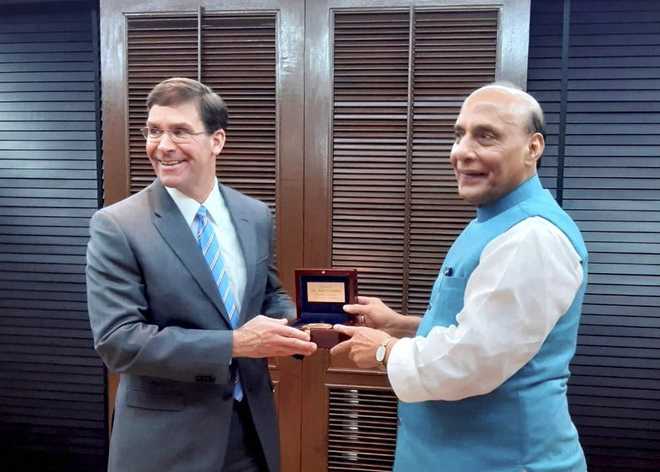
Defence Minister Rajnath Singh with US Secretary of Defence Mark T Esper on the sidelines of ADMM-Plus in Bangkok, on November 17, 2019. — Twitter/PTI photo

New Delhi, November 17

Defence Minister Rajnath Singh held talks with US Defence Secretary Mark T Esper in Bangkok on Sunday on a range of issues of strategic importance, including situation in the Indo-Pacific region and ways to further bolster bilateral security cooperation.

The meeting took place on the sidelines of the ASEAN Defence Ministers’ Meeting-Plus (ADMM-Plus), a platform comprising ASEAN and its eight dialogue partners including India, officials said here.

The Defence Minister also held a separate meeting with his Japanese counterpart Taro Kono with a focus on adding further momentum to bilateral defence cooperation.

In the meeting with Esper, Singh reaffirmed New Delhi’s vision for a free, open and inclusive Indo-Pacific region based on a rules-based order and respect for sovereignty and territorial integrity.

China has been fast expanding military and economic influence in the Indo-Pacific region, triggering concern in various countries of the region and beyond.

Singh said there has been a growing convergence between India and the US on the Indo-Pacific, adding the 10-member grouping of Association of Southeast Asian Nations (ASEAN) is central to New Delhi’s vision for the region.

“Had an excellent meeting with US Secretary of Defence, Dr. Mark T Esper in Bangkok today. We talked about ways to expand defence cooperation between India and the United States,” he tweeted.

Singh conveyed to his American counterpart that he was looking forward to have substantial discussions during the deliberations under the ‘two-plus-two’ foreign and defence ministerial dialogue between the two countries in Washington later next month, the Defence Ministry said in a statement.

The inaugural Indo-US ‘two-plus-two’ talks took place here in September last year.

Expressing happiness on the growing Indo-US ties, Singh said the cooperation between the two sides has grown across a wide range of sectors, including defence and security, economy, energy, counter-terrorism and people-to-people relationship.

Singh and Esper also discussed a number of key issues concerning regional security and bilateral defence cooperation.

The ADMM-Plus is also likely to review the evolving security scenario in the region, particularly in the maritime domain.

The inaugural ADMM-Plus was convened in Hanoi in 2010. The Defence Ministers then had agreed on five areas of practical cooperation to pursue under the new mechanism, including maritime security, counter-terrorism, humanitarian assistance and peacekeeping operations. PTI


Pall of gloom descends on village of jawan killed in avalanche

Pall of gloom descends on village of jawan killed in avalanche

HT Correspondent

letterschd@hindustantimes.com

BATALA : A pall of gloom descended on Fatehgarh Churian as the news of death of constable, Maninder Singh,28, of Punjab Regiment reached here late on Tuesday evening. Maninder Singh was among the four soldiers after an avalanche hit army positions in Siachen Glacier on Monday.

Gurvinder Singh, brother of deceased army jawan, said that his brother was recruited in Punjab Regiment around 12 years back and was deputed at Siachen Glacier from the past four months. On Tuesday evening, Gurvinder got a call from army headquarters that Maninder was hit by avalanche while escorting an ill Dogra regiment to the base camp.

The deceased is survived by his wife Akawinder Kaur and five-year-old son Ekamjot Singh. His body will be brought to his village from the Rajasansi airport on Wednesday afternoon. Another soldier from Punjab, sepoy Veerpal Singh was also killed.


What the Army Mess Taught Me About Life, Etiquette & Tipsy Pudding

A good read.  It transcends time and gets one into nostalgic memories of dinner nights, supper nights and  guest nights in defence academies  and officers’ messes.Tapshi is daughter of Maj Gen Deepak Dhanda.

Pineapple-cheese-cherry on a toothpick, too-thick rajma, and sweet cold coffee. Tapshi Dhanda finds the predictable uniformity of army mess food around the country a comforting anchor to life on the road.

I dunked three fingers into my father’s clear, fizzy drink while he chatted with a fellow officer at an army mess in Ambala. I reached for the small, pale-white, perfectly round onion that sat at the bottom of the glass and it bounced ever so slightly a few times, before I caught it and popped it whole into my mouth. It was tart. Vinegary. A bit salty. Curious, I took a sip of the drink and remember my eyes widening as I licked my lips. What was that! The year was 1994 and I was six.

I later learnt it was a gin cocktail, made army-style:
1 peg of gin
Half of that volume of lime cordial
Soda
A pinch of salt
Two drops of bitters
A cocktail onion or two

I never forgot that first taste. I still look for it in every bar I visit, but I’ve only ever found it in an army mess; in fact, I find it every army mess that I visit. Over the years and across the country, I’ve found it in a mess in Baramulla, Deolali, Mhow, Secunderabad, Ahmedabad, Pune, Shillong, Jalandhar, and Delhi. And once at a retired army officer’s home in Zirakpur, even there, made perfectly.

As a child, I believed the world operated like an army mess — everything had order, parties have dress codes, different cuisines demand their own cutlery, and gin is drunk with bitters and cocktail onions.

While the world may not in truth, work like this, every army mess in the country, reliably, does.

I’ve often tried to decode the ‘sameness’ that is present in the army, achieved almost effortlessly. This sameness was most apparent to me in the food that army messes served across stations in the country. I found it both fascinating and comforting that no matter which part of the country I was in, the food in the mess there tasted like food in any army mess anywhere. I began to reason that perhaps, like most things in the army, food is a matter of tradition and precision – neither of which is achieved by introducing change.

An army mess, home base for a regiment and its officers, is a magnificent institution whose walls are lined with glimpses of the operations of that unit, photographs of those who lead and serve the regiment, and mementos of valorous victories. An army mess is also where (dining) officers eat and stay. Every mess has dining and non-dining members – the former includes unmarried officers or those whose families are not in the station, while the latter comprises of officers posted in the station with their families. The mess caters for daily breakfast, lunch, evening tea, drinks and dinner for the dining members. On Sundays, breakfast and lunch are replaced by brunch, chhole bhature or ildi-dosa, complete with three types of chutneys and a thick, tangy sambar.

The menu in an army mess is set, not à la carte. The everyday menu usually includes two vegetables or a vegetable and meat dish, a dal, chapatis, rice, green salad and dessert or fruits. If it is a continental menu, expect macaroni, roast chicken, baked beans, garlic bread, dinner rolls, Russian salad and pudding. And on the rare days that a fauji will make an à la carte order, it will most certainly be anda bhurji and paranthas — nothing makes him happier.

As a child, before I understood the whys and hows of eating in an army mess, I would ask for my curry to be served in a bowl. The steward was always thrown off; he would pause, restrain his confusion, then return with one that was somehow never the right size. I noticed that nobody else ever asked for a bowl! You see, there is no concept of using a bowl for curry in an army mess. The dals and gravies are a thick-ish consistency on purpose. A no-bowl policy is essentially a no-fuss policy, so one can stand and eat if one needs to socialise, and one always needs to socialise in the army. It also prevents the cacophony of clanging and scraping that children and cutlery almost inevitably produce.

All chefs and stewards in the Indian army receive their training at the Army Service Corps (ASC) Centre in Bangalore. This has been the case for nearly 14 years now, before which the training centre was located in Gaya, Bihar. While there was a shift in the base, there has largely been no change in curriculum.

Chefs and stewards go through three levels of training. The 6-month long Level 1 course for chefs teaches them the basics of cooking and hygiene. Those who excel in Level 1 go on to become mess chefs and are immediately enrolled into a 3-month Special Training course where they learn to cook different types of starters, soups, mains and desserts that fall under Indian, Continental and Chinese cuisines. After the completion of the Special Training course, they are ready to return to their respective regiments, and join army messes situated across the country.

Sometime between 2-10 years of their tenure as a mess chef, they return to the ASC centre for training at Level 2 and 3. Each of these courses lasts 28 days, and teaches the chefs more about Continental, Chinese and regional Indian cuisines. Nearly every mess chef in the army can turn out dosa, sambar, biryani, noodles, fish curry, kadhi and rajma with the same amount of confidence, if not skill.

The stewards, in a similar training drill, are taught skills related to steward duties and responsibilities — how to make basic cocktails and mocktails; the many ways of folding a napkin; knowledge of cutlery and glasses, along with each specific purpose; how to serve beverages (always from the right) and food (from the left); whom to serve first (always the lady); how to set a table for an Indian, Continental or Chinese meal; nuances on the placement of cutlery if an officer wants to be served, is waiting for his senior to finish, or is done eating and hence has ‘closed the plate’, and so on.

Some of the most important lessons shared between the chefs, stewards and their instructors are about the formal parties that are organised every so often in an army mess. The quintessential example of elegance, tradition, order and precision, formal parties in the army are all the charm one needs to experience to be mesmerised by this life. The menus for these parties are curated with thought, the dishes named with ingenuity and the tables laid out with skill. The pristine white china is framed with a delicate gold border and, in some cases, stamped with the regiment monogram. The glasses are crystal. The menu is often continental; a tradition that was started during the British rule for the simple reason that it’s the least messy cuisine to eat with cutlery. Everyone closes their plate when the senior most officer is finished eating. And finally, dessert is served.


Army mess menu_1 (1).jpg
Army mess menu_2 (1).jpg

The menu for a formal party holds a special place in most army messes, as they represent craft and knowledge on the part of the mess committee that designs them. Sometimes old menus are referred to, to commemorate victories, recreate a bygone special dinner, or simply to please a guest. The menus are a matter of pride — even keepsakes. If you take a walk from one end of the dining hall in the National Defence Academy (NDA) to the other, you will see menus from pre-independence times and special occasions that hosted important dignitaries, kept safe on a bed of taut velvet and covered with glass.

It is how most ex-army men and their families keep their memories too, of their time in the Indian Army.

My lived experiences as an army kid, my interactions with officers and ladies who are now retired, and my conversations with those who continue to serve the organisation tell me that this sameness in food and otherwise, this consistency, becomes a collective memory. The shared landscape of our nostalgia translates into a sense of belonging so strong, it transcends age and geography. All army personnel and their families carry the same taste and culinary vocabulary. We navigate all the unknowns of a new station by stepping inside the familiarity of the army mess there. And we never quite forget any of it. Not the pineapple-cheese-cherry on a toothpick, not the too-thick rajma, not the sweet cold coffee, not the Tipsy pudding and definitely not the gin with bitters and cocktail onions.

Tapshi Dhanda is a freelance writer, essayist and editor based in Bangalore. She is interested in the everyday simplicities of life and hopes to someday compile a book of essays around the same theme.


Telephone Numbers LO Cell in PCDA Allahabad

पूर्वसैनिकों के लिए कुछ महत्वपूर्ण मोबाइल नंबर दे रहा हूँ CDA इलाहाबाद के यदि आपकी पेंशन या अन्य किसी प्रकार की कोई भी शिकायत होतो इनसे सम्पर्क कर सकते है।
 LO Cell in PCDA Allahabad. Any issues related to ur PPO, Pension, etc. U may contact them directly or msgs on WatsApp also can be sent with details of the issue. The Offr is *Lt Col Palani*, OIC of the Cell and a few NCO clks.
*Hav Clk Dharmendra Yadav* LO Cell PCDA Allbad
Mobile +917020363799

*Hav N Patil* LO Cell PCDA Albad
Mobile +919444867516

*Lt Col Palani* LO CDA Allbad
Mobile +919606847313
ज्यादा से ज्यादा संख्या में पूर्वसैनिकों को मैसेज को फारवर्ड करे।
धन्यवादI

Successful night trial of Agni-II carried out

Successful night trial of Agni-II carried out

HT Correspondent

letters@hindustantimes.com

New Delhi : India’s strategic forces command carried out a successful night trial of the Agni-II, a nuclear-capable surface-to-surface missile that can hit targets up to 1,500km away and is seen as among the mainstay weapons in India’s arsenal.

According to officials who asked not to be named, the missile was fired at 7:30pm from the Integrated Test Range (ITR) on the Dr Abdul Kalam Island, off the coast of Odisha. The missile hit the target with accuracy and its trajectory was as planned, the officials added.

‘Agni-II’, an intermediate range ballistic missile (IRBM) has already been inducted into the armed forces.

According to one of these official, the night trial was part of routine testing that is carried out at different times of the day/

The trajectory of the trial was tracked by a battery of sophisticated radars, telemetry observation stations, electro-optic instruments and two naval ships located near the impact point in the down range area of Bay of Bengal, news agency PTI quoted a Defence Research and Development Organisation (DRDO) source as saying.


Was always sure deal was above board: IAF ex-chief

HT Correspondent

letters@hindustantimes.com

New Delhi : Former Indian Air Force (IAF) chief BS Dhanoa on Thursday said that the IAF was absolutely sure that the ~59,000 crore Rafale fighter jet deal with French military planemaker, Dassault Aviation, was above board.

“The price negotiations [for the deal] were done by the then deputy [IAF] chief [Rakesh Kumar Singh Bhadauria] who is now the chief of air staff. We were absolutely sure the deal was above board, “ said Dhanoa, explaining why the IAF countered allegations of irregularities in the deal. “…When we defended the deal, we were criticised for making a political statement. We were, however, defending the deal on merit,” said Dhanoa, who retired in September.

The Supreme Court on Thursday rejected a batch of petitions seeking a review of its December 2018 verdict that dismissed pleas seeking a court-monitored probe into alleged irregularities in the deal. “I am happy the Supreme Court has stood by its earlier judgement,’’ said Dhanoa. “I sincerely hope [the Supreme Court’s ruling on Thursday] lays to rest all controversy and allows the IAF to do its duty and to acquire new platforms that are required.”

Dhanoa said the Rafale fighters are superb. “We must understand that the fighters are critical for India. The two squadrons of Rafale, an additional Russian made Su-30MKI and two more squadrons of indigenously-made Light Combat Aircraft [Tejas] will give us the required muscle.”

In October last year, Dhanoa had defended the deal amid sharp attacks from the Congress and other opposition parties.


Rohtang Pass opens to traffic

Rohtang Pass opens to traffic
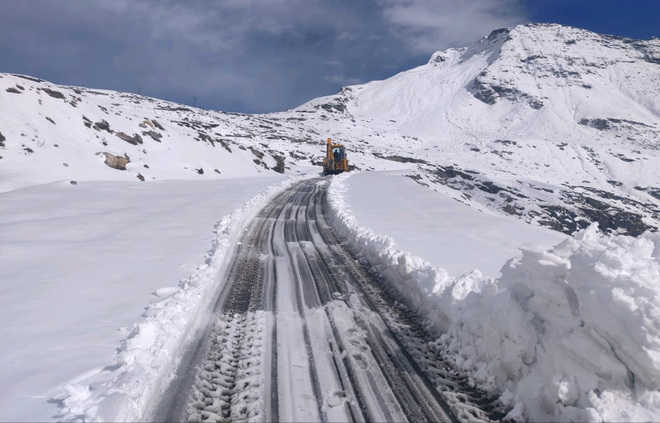
Snow being cleared at the Rohtang Pass on Tuesday.

Tribune News Service

Mandi, November 12

The Border Roads Organisation (BRO) has restored the 13,050-foot-high Rohtang Pass, the gateway to Lahaul on the Manali-Leh highway, to traffic on Monday night. The road was blocked on Saturday after a heavy snowfall.

The BRO had engaged its workforce and machinery for the snow clearance work. BRO Commander Colonel Uma Shankar told The Tribune, “Despite tough geographical conditions, the BRO workforce had worked round the clock in the below zero temperature to restore traffic on the pass. There was over 4 feet snow on the road near Rohtang.”

Sub Divisional Magistrate, Manali, Raman Gharsangi said around 30 vehicles were crossed from the Lahaul side to Manali, which stranded near Rohtang. A rescue team of the local administration was sent to the spot to move the stranded vehicles out of the area.

He said the movement of vehicles from Manali to Lahaul on Wednesday will depend on weather conditions in the region.


Sidhu skips state event, celebrates in his segment

Sidhu skips state event, celebrates in his segment
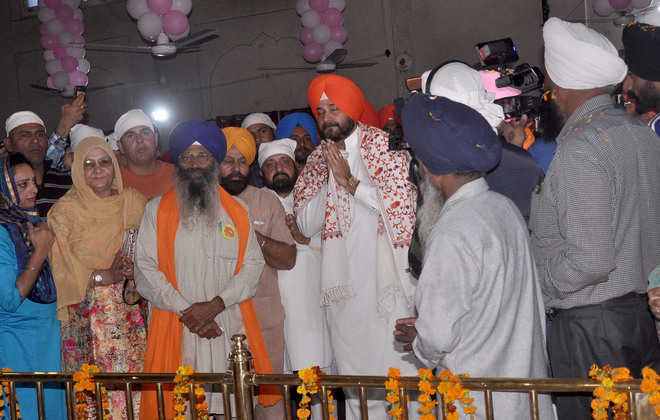
Cong leader Navjot Sidhu offers prayers at Gurdwara Nanaksar in the East constituency of Amritsar on Tuesday. Photo: Sunil Kumar

Amritsar, November 12

Skipping the state government’s grand celebrations at Sultanpur Lodhi, former Cabinet Minister Navjot Singh Sidhu preferred to commemorate the 550th birth anniversary of Guru Nanak today with the residents of the East constituency, represented by him as a lawmaker.

After attending the Kartarpur gurdwara function from Pakistan side, this was Sidhu’s first public appearance with his supporters here.

As his cavalcade reached his constituency, his supporters welcomed him declaring him to be the real “hero owing to his contribution in opening the corridor”.

A huge garland weighing around 1.5 quintal was specially arranged to welcome Sidhu, who paid obeisance at Gurdwara Nanaksar located in the Verka area.

Earlier, his supporters had erected huge billboards in the holy city, giving credit to him whose association with his old-time cricket pal and Pakistan PM Imran Khan had helped in pushing the much-sought-after project. —TNS


Festivities all across to mark Gurpurb

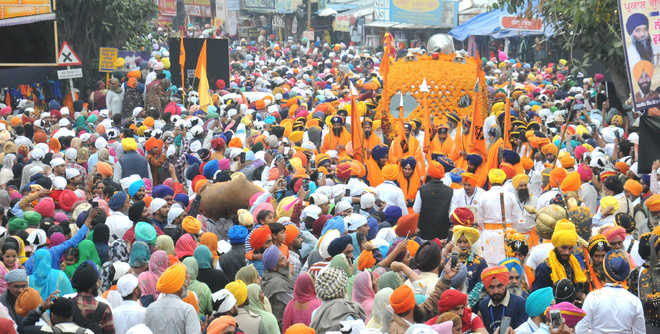
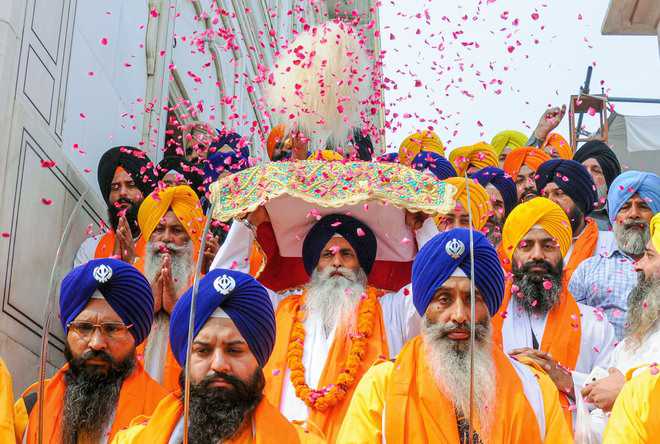
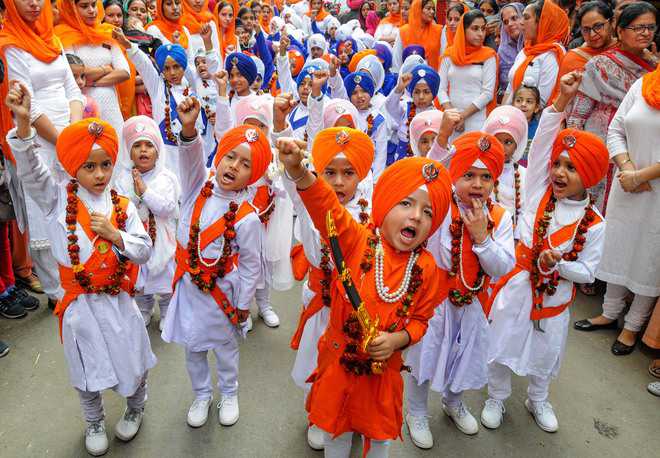
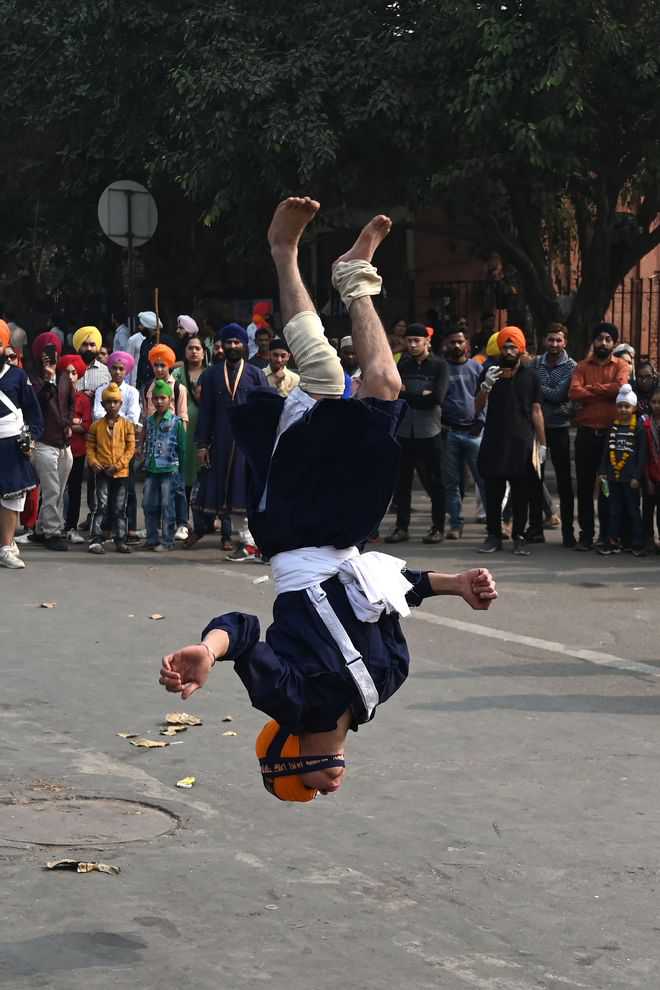
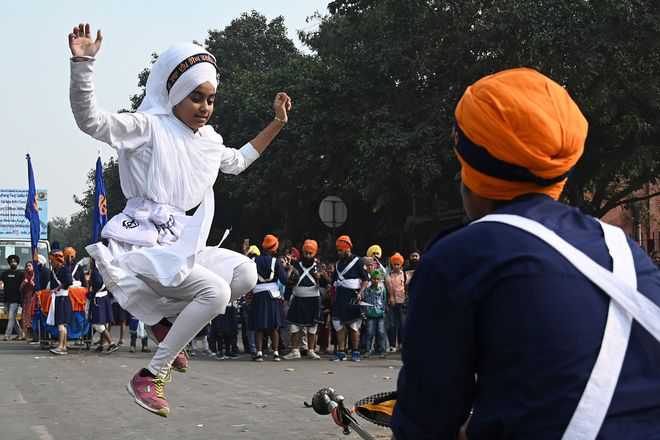
Amid chanting of ‘Dhan Guru Nanak’ and hymns like Kal taaran Guru Nanak aaya, religious processions were taken out across the state, including Sultanpur Lodhi and Amritsar, on the 550th Gurpurb eve on Monday.

On the 550th Gurpurb eve, thousands of devotees take part in religious processions in Amritsar and Sultanpur Lodhi on Monday. Tribune photo/PTI

In Sultanpur Lodhi, the nagar kirtan started with traditional fervour from Gurdwara Sant Ghat in the morning and culminated at Gurdwara Ber Sahib in the evening.

Several gatka teams showed their skills. A gatka team of the UK-based Sikh girls’ jatha stole the limelight.

Huge trumpets and traditional instruments were played. Jathas sat on tractor-trailers to recite shabads from Gurbani. Flowers were showered upon the sangat at various historical gurdwaras. TNS