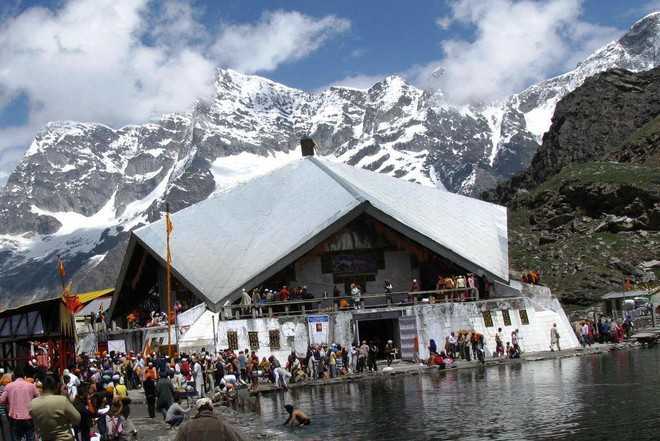
Gurdwara management committee officials said over 2.5 lakh people visited Hemkund Sahib this year. File photo
Gopeshwar, October 10
The portals of Hemkund Sahib, a high-altitude Sikh shrine in Garhwal Himalayas, were closed on Thursday for the winter season.
Over 3,000 Sikh devotees braved the chill to pay obeisance at the temple located at a height of 14202 feet before its ceremonial closure in the afternoon after recital of prayers.
Gurdwara management committee officials said over 2.5 lakh people visited Hemkund Sahib this year.
Doors of the temple will be reopened in May, they said. — PTI
Wishful thinking: Pakistan hopes that major powers would not only condemn Indian ‘repression’, but also ultimately compel India to accept mediation on J&K.
Vivek Katju Ex-secretary, ministry of external affairs
THE intense media attention in India and Pakistan over the presence, approaches and statements of PM Narendra Modi and his Pakistani counterpart Imran Khan at the high-level segment of the recent session of the United Nations General Assembly (UNGA) in New York has receded. Consequently, for the time being, the decibel level surrounding bilateral ties has also come down, providing opportunities for sober assessments and prognosis. This is never an easy task for policy-makers and analysts on account of the relationship’s historical baggage and inherent emotion.
Pakistan’s aggressive, if not irrational reaction to the constitutional changes in J&K on August 5 has ensured that bilateral relations have entered a new and particularly difficult phase. This period is marked by aggressive Pakistani attempts to divert international attention from its policy of using terrorist proxies in J&K to Indian ‘irresponsibility’ which could result in violent confrontation between two nuclear- armed countries. Another feature of this phase consists of Pakistan’s desire to convince the international community that India is ruthlessly crushing a ‘freedom struggle’ and in the process brutally violating human rights. To make the global community receptive to its messages, Pakistan has ensured that terrorist groups based on its territory have not undertaken any major attacks in the Kashmir valley or elsewhere, though it is infiltrating terrorists into J&K. Pakistan hopes that the major powers who naturally do not want an India-Pakistan armed conflict would not only condemn Indian ‘repression’, but also ultimately compel India to accept mediation on J&K.
Pakistan has not achieved any of its post-August 5 objectives. Pakistani leaders have accepted as much when they expressed their disappointment at the international community’s indifference to the Kashmir situation. The UN Security Council, UNGA and the UN Human Rights Council have remained virtually unmoved by the Pakistani push. Some countries, including the US, have called for the removal of movement and communication restrictions in J&K and the release of political leaders and workers. While these demands may grow, they have not developed any real international traction as yet. This is largely because of the absence of large-scale demonstrations or damage to life and property in the Valley since August 5. It is, of course, desirable that the situation should return to normal in J&K in the shortest possible time. Naturally, the security situation will play a major role in determining the timing of the government’s moves.
Pakistan has been particularly distressed by the largely continuing indifference of the Islamic ummah to its all-out diplomatic campaign on J&K. Only Turkey and Malaysia were critical of India in their UNGA statements. The Arab peninsular states, including Saudi Arabia, have steered clear of the issue. It has, though, been difficult for them to do so because all have close ties with Pakistan and Saudi Arabia, and the UAE has significant connections with the Pakistani army. These two countries engaged India and Pakistan after the Pulwama terror attack. Such engagements are undertaken with the aim of defusing tensions.
After August 5, the Saudi minister of state for foreign affairs and the UAE foreign minister jointly visited Pakistan to assuage its hurt over their not going along with it on the J&K developments. Imran Khan visited Saudi Arabia on his way to New York for the UNGA. He would have undoubtedly raised the Kashmir situation with the Saudi leadership in a big way. Now, Modi is scheduled to visit Saudi Arabia. While the primary focus of his discussions will on bilateral ties, the issue of India-Pakistan tensions would undoubtedly come up.
Pakistan has pushed itself into a corner in the present phase of bilateral relations. It took very aggressive steps against India immediately after August 5. It asked the Indian High Commissioner in Islamabad to leave and stopped trade. Later, Pakistan gratuitously insulted India by denying President Ram Nath Kovind and PM Modi the use of its airspace on their way to the West. Further, it laid down the condition that India would have to reverse its August 5 steps before Pakistan would agree to the resumption of talks. The decisions were directed at the major powers to get them more actively engaged with India-Pakistan relations.
As the Pakistani civilian leadership and the generals watch their moves fail, they confront two basic questions: should they pursue their present policy of holding back their terrorist groups in the hope that continued Indian restrictions on communications and movement in J&K would lead to the major powers and liberal sections of international opinion putting India under greater scrutiny and possibly pressure? Or should they unleash the terrorist groups to undertake terrorist attacks in J&K and elsewhere in India in expectation that a kinetic Indian response will precipitate a crisis and immediately draw in the major powers not only to defuse the crisis but hopefully compel India to accept mediation on J&K? It is difficult to predict which path Pakistan will take in the near future but there is no doubt that the default preference of the Pakistani army has been to pursue the path of violence and terror against India. The chances are that Pakistan would seriously consider to undertake terror strikes in J&K. No doubt India’s security managers would be aware of this possibility.
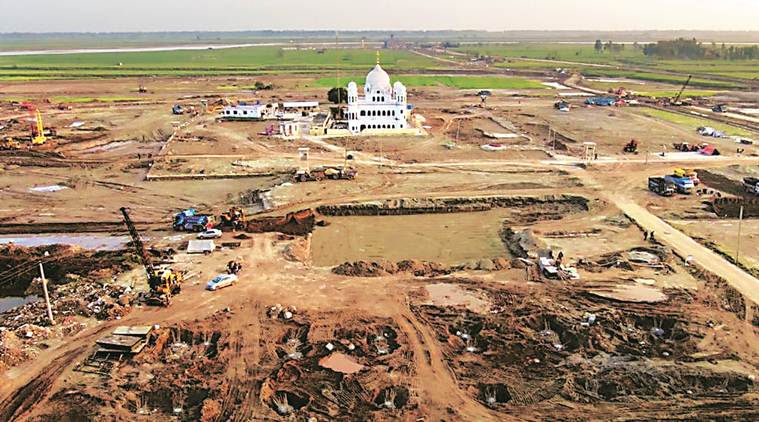
Where does the Kartarpur corridor’s inauguration, scheduled for next month, figure in this bleak bilateral landscape? It is unlikely to positively impact bilateral ties because for Pakistan, the Kartarpur initiative is a gesture not to India but to the Sikh community in India and outside. Pakistan has for long desired to attract Indian Sikhs. It has not succeeded and never will, but it will never stop trying.
War exercises in Arunachal on, Xi Jinping may put off India visit
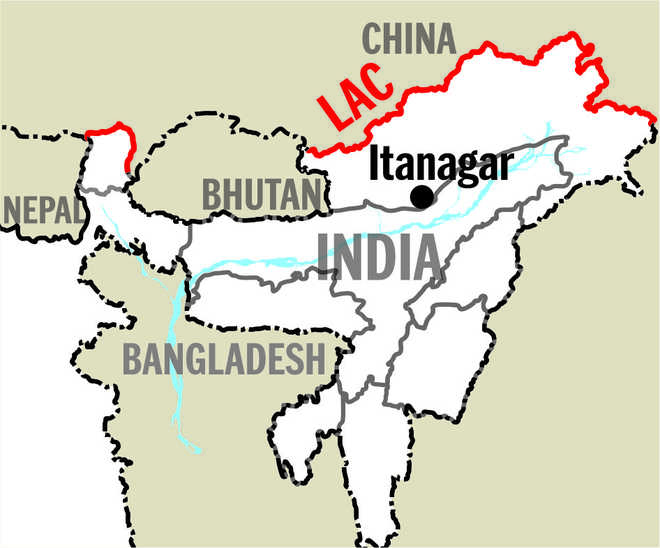
Chinese President Xi Jinping may put off his India visit till the dust settles down on the reorganisation of Jammu and Kashmir. Xi was to arrive here next week for the second summit with PM Narendra Modi in the informal settings of Mamallapuram in Tamil Nadu, without the trappings of formalities and bureaucratese. In 2018, the two leaders had interacted for more than 10 hours in the sylvan surroundings of Wuhan on the banks of the Yangtze.
It may be awkward for the Chinese President to visit India when the Army is staging one of its biggest war exercises in Arunachal Pradesh, an area of extreme sensitivity for Beijing, with recently bought American equipment.
“One can’t expect Xi to visit when Indian troops are doing a war exercise in Arunachal Pradesh. The Chinese have even objected to visits by our Prime Ministers and Presidents,” said strategic analyst Pravin Sawhney.The Army exercise, HimVijay, does conform to two Sino-India agreements and one protocol on peace and tranquility on the Line of Actual Control (LAC) with China. As per this arrangement, the Chinese would have been notified in advance about the size, scope and duration of the exercise. Yet Xi would not like visuals of him attempting normalisation of ties with PM Narendra Modi while the Indian Army conducts war games in Arunachal.
A bigger sticking point though could be J&K. “The boundary in the western sector (Ladakh) was never defined. There is no boundary,” says Sawhney, disagreeing with External Affairs Minister S Jaishankar’s observation that China had misinterpreted New Delhi’s decision to bifurcate Jammu and Kashmir into two Union Territories — J&K and Ladakh. “We are sort of reformatting this within our existing boundaries,” Jaishankar had told the Chinese.Explaining his position, he had said, “I went a few days after the legislation (removal of Article 370 and reorganisation of J&K) to China and explained to them that as far as they were concerned, nothing had changed. India’s boundary had not changed, the LAC had not changed.” — TNS
Name of IAF officer killed by JKLF militants in 1990 to be added to war memorial
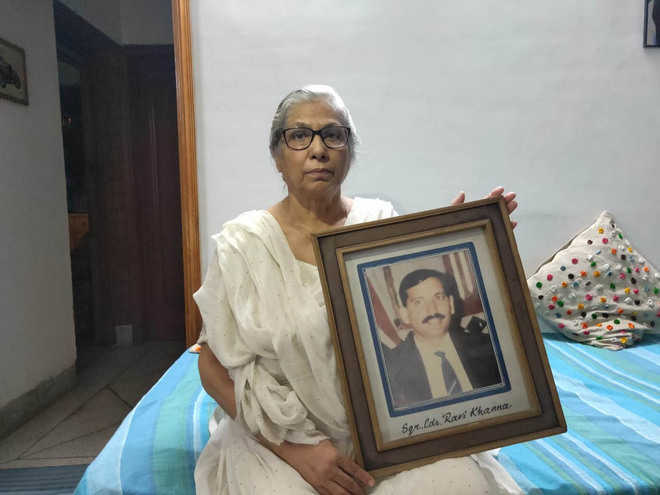
Nirmal Khanna, wife of late Squadron Leader Ravi Khanna with his photograph. Tribune file photo
New Delhi, October 5
The name of Squadron Leader Ravi Khanna, who was killed by JKLF militants in 1990, will be added to the National War Memorial after it was approved by the Indian Air Force, sources said.
Khanna, along with three other IAF personnel, was killed in January 1990 in Kashmir allegedly by Yasin Malik.
Twenty-seven bullets were pumped into Khanna’s body.
An Air Force official said the Khanna’s name was missed out in the National War Memorial and the error has now been rectified.
The National War Memorial at the India Gate is dedicated to the defence personnel who laid down their lives for the country. The NWM has names of such defence personnel with details of their acts.
The three armed services approve the names of the soldiers after which they are included in the NWM.
The trial against Malik had resumed last month in Jammu. — PTI
IAF to support HAL on 5th generation fighter aircraft
The IAF has shelved its plan of developing fifth-generation fighter aircraft in collaboration with Russia and importing more Pilatus basic trainer from Switzerland. Instead, the thrust is to handhold the HAL and DRDO in a big way on the AMCA (Advance…
Read more at: https://www.deccanherald.com/national/iaf-to-support-hal-on-5th-generation-fighter-aircraft-766380.html
Srinagar: Over 200 turn up after Army holds recruitment drive
More than 200 youths from Jammu and Kashmir turned up in Srinagar fort the two-day recruitment rally by the Indian Army.
The recruitment rally commenced here on Thursday for inducting candidates into the Jammu and Kashmir Light Infantry (JKLI) regiment is being held at the JKLI Centre at Rangath in Srinagar.
“The recruitment rally is scheduled for October 3 and 4. This rally is part of the overall process to select 2780 recruits for the JKLI regiment,” SR Sharma, Commandant, JKLI regiment said.
Opening of Kartarpur corridor will show us it is possible to leave behind the past, walk to the future
It will be just a small step forward on a long and difficult road, which our two nations can only traverse together if Islamabad gives up its negative posturing vis-a-vis India
The corridor, I believe, has shown us that it is more than possible to bridge the differences that have assumed unnaturally grave proportions in these seven decades, writes Punjab CM Amarinder Singh.
My connect with Kartarpur Sahib goes back to my childhood. I still remember how the gurdwara, just about 235 km from my hometown of Patiala (that’s less than the Chandigarh-Delhi distance), was always spoken of with great reverence in our family. Of course, that was majorly because of the historic importance of the site, where Sri Guru Nanak Dev ji died on September 22, 1539. But part of it was also because of the personal connection my family had with the gurdwara, whose present building was built in 1925 at a cost of Rs 1,35,600, donated by Maharaja Bhupindar Singh, the then ruler of Patiala and my grandfather, after the existing structure was ravaged by floods.
The desire to visit the revered gurdwara has always been strong within me. Today, just days before I see the cherished aspiration transform into enviable reality, I bow before the Great Guru for granting me this experience, and that too during his 550th Prakash Purb celebration.
I recall my personal meetings, in my previous term as chief minister, with former Pakistan President, General Pervez Musharraf, during which I had spoken extensively about the deep-rooted urge in every Sikh to visit the historic Kartarpur Sahib Gurdwara. Though he had responded positively to my request, which our former Prime Minister, Dr Manmohan Singh, had also subsequently pursued actively, things did not really move forward till November 2018, when the Government of India conveyed its decision to build the Kartarpur Sahib Corridor from Dera Baba Nanak in Gurdaspur district to the International Border (with Pakistan), in coordination with the Government of Punjab.
It was a momentous day for all of us here in Punjab, and we wasted no time in initiating the process of getting things in place for the construction of the corridor and the infrastructure around it. It took us less than two months to make the land required for the project available to the central government. The work on the corridor (4.190 km) was started on December 13, 2018. In addition, a Passenger Terminal Building Integrated Check Post (ICP) is also being constructed at the International Border in an area of about 50 acres by the Land Port Authority of India (LPAI), which will become operational before the corridor opens for pilgrims.
Working closely with the Centre, my government, I am pleased to state, has ensured that the corridor is ready to be inaugurated by the prime minister on November 9, and to receive the first jatha of pilgrims to Sri Kartarpur Sahib on the same day. That, with the blessings of Wahe Guru, I will have the honour of being a member of this jatha gives me a deep sense of joy and satisfaction.
What makes this achievement truly remarkable is that both India and Pakistan stuck to their deadlines against all odds, in the face of many disturbing and disruptive developments in the last one year, to fulfill their ends of the bargain. This gives me, and I am sure it gives the people of both countries, a powerful sense of optimism about the future.
However, the fructification of this optimism would depend, to a great extent, on how soon, and how effectively, Pakistan leverages the opportunity it has got in the shape of the Kartarpur Corridor. From where I see it, the corridor has the potential to stand out as a historic symbol of peace and hope of a better tomorrow for Indo-Pak relations.
The recent decision of the Union Ministry of Road Transport & Highways to name the stretch from the Indo/Pak Border-Dera Baba Nanak-Amritsar-Tarn Taran-Goindwal Sahib-Kapurthala Sultanpur Lodhi National Highway as “Sri Guru Nanak Dev Ji Marg” in the state of Punjab has further added to the aura of the corridor, which in many ways is a bridge of faith between India and Pakistan.
But the opening of the corridor next month will be just a small step forward on a long and difficult road, which our two nations can only traverse together if Islamabad gives up its negative posturing vis-a-vis India. As long as the Pakistan Army continues to support and sponsor cross-border terrorism, as long as our soldiers are killed by the men from across the border, and as long as the climate of mistrust and fear remains, there can be no real progress in easing the perpetual tension between our countries.
However, with my unwavering faith in the ideology of universal love and tolerance propagated by our revered first Guru, I am strongly of the view that the corridor will eventually pave the way for harmony between our two nations, whose people share common roots and a common aspiration for the future. It is my dream to see India and Pakistan connect with each other at an even deeper level, to walk beyond the 4.5 km of the Kartarpur Corridor and find new ways of burying the past, in my lifetime.
One small way of building on the trust that the corridor promises to nurture between the two countries is for Islamabad to waive the $20 fee it has imposed on pilgrims visiting the revered gurdwara. A gesture like that would really prove that Pakistan respects the sentiments of India’s people, and wants to strengthen people-to-people relations between the two nations.
The corridor, I believe, has shown us that it is more than possible to bridge the differences that have assumed unnaturally grave proportions in these seven decades. All that is needed is the will to do so. Let this corridor, then, become an icon of our collective future, and a beacon to show us the way to do it. Let it be the burial ground for hatred and mistrust, and for all those inimical forces that have obstructed peace between the two nations all these years. Terror and violence have no place in this Corridor of Peace — a truth that I am sure Islamabad realises, and hope it is ready to acknowledge.
What is needed now is the intent to bury the hatchet, which, in the given circumstances, is more the responsibility of Pakistan than of India. And now is the best time for the Imran Khan government to make the next move.
This article first appeared in the print edition on October 30, 2019 under the title ‘Journey to a beginning’. The writer is chief minister of Punjab.
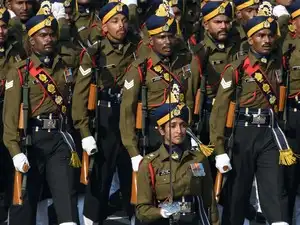
Indian Army wants more manpower for operations, plan to get troops from Army Service Corps
The supply company and the supply depot provide supplies to an army division and the brigades under it in both peace and field locations. The combined strength of the supply company and depot is about 200 troops, officials explained.
NEW DELHI: The Indian Army is working towards ensuring that it has more manpower available for operations and related tasks by picking out troops from one of its services.
The army is working on a new model that involves combining the strength of the sole supply company of a second line transport battalion of the Army Service Corps under a division and a supply depot in peace stations. The supply company and the supply depot provide supplies to an army division and the brigades under i ..
Mohali : Students of the Army Institute of Law (AIL), Sector 68, on Monday submitted their response to the decisions announced by the institute over the eight demands raised by them.
Over 300 students have been protestingagainst the college administration since last week. College chairman Major General ML Aswal had met them and announced the decisions taken by the management over the row.
To the first demand as per which the students asked for the appointment of a democratically chosen interim students’ body, the chairman had said that the body would continue to be nominated. To this, the students, citing Lyngdoh Committee Report, replied that Supreme Court says elections can be conducted to form student bodies in colleges and universities.
To the demand of revoking the provisions of the code of conduct, the college management had recommended a review in consultation with the students and their parents. To this, the students highlighted several codes and demanded their revocation.
To the demand of mandating a system of mock lecture for fresh recruitment of faculty members and inviting anonymous feedback, the students said, “Such lectures in the presence of senior and experienced faculty members will help gauge the abilities and style of teaching of the candidates.” The AIL management had refused to abide by this demand. On the complaints of overpricing and low quality of food served at the college cafeteria, they urged the authorities to seek their suggestions before giving contract to anyone.
DEMAND PERMANENT BOARD OF INQUIRY
To their demand seeking the composition of a board of inquiry, the students asked for a permanent body in place. “We recommend having a permanent body, wherein members may change periodically over an academic year to prevent organisational hassles for students and authorities alike,” they said.
Submit Your Life Certificate in November.If your age is 80 years or above, Life Certificate can be submitted w.e.f. 1st October and will be valid till 30.11.2020. To see DLC (Digital Life Certificate) process, click the Movie Link https://www.youtube.com/watch?v=nNMlkTYqTF8 on Pensioners Portal.