Sanjha Morcha

Record 19 Punjabi MPs in Canada

Deepkamal Kaur

Tribune News Service

Jalandhar, October 22

As many as 20 Indian-origin politicians have scripted history by making it to Canadian parliament — House of Commons — in this year’s general election. Of these, 19 are Punjabis. As many as 19 Indians, including 18 Punjabis, got elected in the 2015 elections.

Ontario alone has sent as many as 12 Indo-Canadian leaders to parliament, while British Columbia (BC) has elected four, Alberta three and Quebec one (Liberal Party’s Anju Dhillon). Like last time, Liberal Chanderkanth Arya of Karnataka is the lone non-Punjabi Indian to make it from Napean (Ontario).

While Barnala-origin Jagmeet Singh, whose National Democratic Party (NDP) won 24 seats and may turn out to be the kingmaker, won from BC’s Burnaby South, no other Punjab-origin candidate of the party could win a seat.

As expected, the Punjabi community has clearly gone with Prime Minister Justin Trudeau’s Liberal Party, repeating the 1993 scenario. As many as 14 of the 18 Punjabi candidates fielded by the party registered wins.

These include three ministers — Hoshiarpur’s Harjit Sajjan (Vancouver South), Ludhiana’s Bardish Chagger (Waterloo) and Navdeep Bains (Mississauga Malton) — Sukh Dhaliwal (Surrey Newton), hockey legend Baljit Sikand’s son Gagan Sikand (Mississauga Streetsville), Jalandhar’s Rameshwar Sangha (Brampton Centre), Randeep Sarai (Surrey Centre), Maninder Sidhu (Brampton East), Kamal Khera (Brampton East), Ruby Sahota (Brampton North), Sonia Sidhu (Brampton South), Anju Dhillon (Lachine Lassalle) and Raj Saini (Kitchener Centre) and Anita Anand (Oakville).

Conservatives fielded 19 Punjabi candidates, but only four sailed through — former MP Tim Uppal (Edmonton Mill Woods), third-timer Bob Saroya (Markham Unionville), first-timer Jasraj Hallan (Calgary Forest Lawn) and Jagdeep Sahota (Calgary Skyview).

The most prominent candidate to lose is former minister Amarjit Sohi, who lost to Uppal, a native of Raikot’s Bassian village in Ludhiana and the brother-in-law of Jalandhar Cantt Congress MLA Pargat Singh.

Khera gets 2nd term, makes Kharar proud

Khera gets 2nd term, makes Kharar proud

Our Correspondent

Kharar, October 22

Kharar MLA Kanwar Sandhu has hailed Kamal Khera, having ancestral links with nearby Bhago Majra village, who has been re-elected as an MP from Canada’s Brampton West seat.

Hailing from Liberal Party, it will be her second term. Her first election came in 2015 in Ottawa. Khera is a practicing nurse and the first generation immigrant whose family came to Canada when she was a child. Kanwar Sandhu said when she came to India in December 2018 on a private visit, he took her to her ancestral village where she was honoured by people. She visited her ancestors’ haveli and also a gurdwara to which her grandfather Mansa Singh had given donation. The MLA had given her memento.

Sandhu said her father was a scientist and mother a teacher. They shifted to Delhi due to her father’s job. Her grandfather Mansa Singh was a prominent person of the village. “We are proud of her,” he added.

After her win, Khera told Canadian media, “The last four years have been the greatest honour of my life, representing the great people of Brampton West. We accomplished a lot together.”

When she was first elected in 2015, she was the youngest Liberal MP in Ottawa and second-youngest of any party, at just 26 years old.


Parliamentary panel to examine accidents involving defence assets, assess defence procurement policy

1

NEW DELHI: A parliamentary panel headed by former Union minister Jual Oram will critically examine the cases of accidents involving defence assets and also assess the defence procurement policy. The Parliamentary Standing Committee on Defence has selected a number of subjects for examination, which include reviewing the selection procedure of officers in the armed forces, according to the Lok Sabha secretariat’s bulletin.

“Accidents involving defence assets – a critical review, an asse ..

Read more at:
//economictimes.indiatimes.com/articleshow/71675182.cms?from=mdr&utm_source=contentofinterest&utm_medium=text&utm_campaign=cppst

China’s influence poses a strategic challenge by Gurmeet Kanwal

Gurmeet Kanwal

Despite a stable relationship at the strategic level, China is annoyed with India and the reasons are not difficult to discern. China thinks of itself as a great power and, as part of its grand strategy, seeks to dominate the region and gain geopolitical influence. India, poised at a breakout moment, looks at itself as a co-equal power in Asia and a rising power.
China’s influence poses a strategic challenge

Gurmeet Kanwal
Former Director, Centre for Land  Warfare Studies (CLAWS), New Delhi

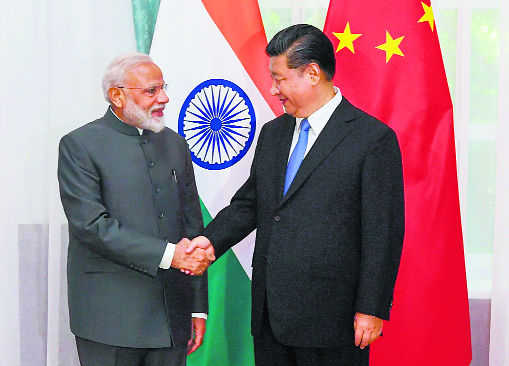
APART from the formation of a ministerial-level group to discuss bilateral trade issues, the only positive development of the Narendra Modi-Xi Jinping summit meeting was that it was held in a cordial atmosphere and that one more will follow next year. None of India’s core concerns, like the resolution of the territorial dispute, were addressed.

China opposes India with a vengeance at international fora. It has repeatedly blocked India’s application for membership of the Nuclear Suppliers Group (NSG). China’s technical hold on Masood Azhar, head of the Pakistan-based terrorist organisation Jaish-e-Mohammad (JeM), being designated an international terrorist by the United Nations sanctions committee was recently lifted very reluctantly. Although India was finally admitted as a full member of the Shanghai Cooperation Organisation (SCO) at the Astana summit on June 9, 2017, China made sure that Pakistan was given the same status simultaneously.

In the past, China has objected to India’s Oil and Natural Gas Commission (ONGC) prospecting for oil off the coast of Vietnam, even though the area was within Vietnam’s territorial waters. China, of course, claims the complete South China Sea as its territorial waters in complete disregard of the Law of the Sea Treaty.

China’s leadership loses no opportunity to show its annoyance with India over even inconsequential issues. In March 2017, the Chinese Foreign Ministry issued a statement saying that it was ‘strongly dissatisfied’ with India for inviting the Dalai Lama to open an international Buddhist conference in Nalanda, Bihar. Beijing protested even more loudly when the Dalai Lama visited Tawang in Arunachal Pradesh a few weeks later. China claims the state of Arunachal Pradesh as its own territory.

Chinese state-controlled media have made it a habit to periodically warn India of dire consequences on one pretext or the other. Global Times, a Communist Party-controlled English language newspaper, has led the charge. A commentary in the paper in 2017 warned India not to ‘meddle’ as China’s Defence Minister visited Nepal and Sri Lanka.

Around the same time, an editorial threatened to engage India in a ‘geopolitical game’: “With a GDP several times higher than that of India, military capabilities that can reach the Indian Ocean and having good relations with India’s peripheral nations, coupled with the fact that India’s turbulent northern state borders China, if China engages in a geopolitical game with India, will Beijing lose to New Delhi?” ‘Turbulent northern state’ clearly refers to Jammu and Kashmir (J&K).

China showed no concern for Indian sensitivities while finalising plans for the China-Pakistan Economic Corridor (CPEC) that will pass through Gilgit-Baltistan, an area that is part of J&K, but under Pakistani occupation. India’s refusal to participate in President Xi Jinping’s Belt and Road Initiative prompted Global Times to once again warn India that its shortsighted attitude could damage Sino-Indian relations.

On other occasions, Global Times has advised India not to play the Taiwan card. After India had tested the Agni-4 ballistic missile, an editorial pointed out ominously that if the development of long-range missiles by India continues, “the range of Pakistan’s nuclear missiles will also see an increase.”

Commenting on the establishment of the India-Afghanistan direct air freight corridor (Pakistan denies India access to Afghanistan through the land route), Global Times called the plan India’s ‘stubborn geopolitical thinking’. China is deeply suspicious of the growing Indo-US strategic partnership and on the eve of Prime Minister Modi’s meeting with President Donald Trump, it put out that a close watch would be kept on what is discussed.

Clearly, despite a stable relationship at the strategic level, China is annoyed with India and the reasons are not difficult to discern. China thinks of itself as a great power and, as part of its grand strategy, seeks to dominate the region and gain geopolitical influence. Also, the Chinese leadership believes in China’s “political, social and cultural superiority over its neighbours.” In short, the Chinese believe that their civilisation is far superior to the civilisations of China’s neighbours.

According to a Chinese saying, “One mountain can accommodate only one tiger.” The Chinese look at themselves as the tiger on the Asian mountain and, in their view, there is no place for a second tiger like India. If India were to play second fiddle, if Prime Minister Narendra Modi were to carry a platter of gold coins and pay obeisance to ‘King Emperor’ Xi Jinping every year, the Chinese would welcome their Indian brothers with open arms and radiant smiles. There would be more shouts of the deceptively enthralling slogan of the 1950s: Hindi-Chini, bhai-bhai.

Unfortunately for China, that is not how the script plays out in India’s scheme of things. India is conscious that China’s growing power and influence pose a long-term strategic challenge, not only for India but also for the entire Indo-Pacific region. However, India is itself growing at a rapid rate and is confident of closing the gap.

Resurgent India, poised at a breakout moment in its history, looks at itself as a co-equal power in Asia — a rising power that is conscious of its regional responsibilities and increasingly more willing to contribute positively to peace and stability in the Indo-Pacific region and the security of the global commons.

The China-India geopolitical standoff is a clash of two competing world views. China is engaged in the strategic encirclement of India through its proxies like Pakistan and its ‘string of pearls’ strategy in the northern Indian Ocean. In the South China Sea dispute as well, China has exhibited a remarkably high order of belligerence. To counter China’s increasing military assertiveness, India should join hands with the United States and other strategic partners, such as Australia, Japan, Singapore, South Korea and Vietnam, to establish a cooperative security framework for peace and stability in the Indo-Pacific.

Finally, as long as the territorial dispute with China is not resolved and transgressions by patrols from the People’s Liberation Army (PLA) continue across the Line of Actual Control, India should keep its powder dry.


Mobile app ‘Parkash Utsav 550’ launched to facilitate pilgrims

Tribune News Service

Jalandhar, October 15

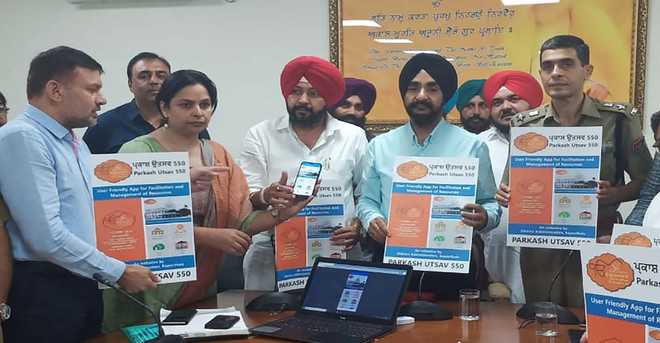
In a major step towards facilitating pilgrims at Sultanpur Lodhi during the 550th Gurpurb of Guru Nanak Dev, the district administration has launched a feature-enriched ‘Parkash Utsav 550’ mobile app today. The app was also stated to work offline, as the one-time download of the data on the app would be permanent which won’t require internet connectivity, after its download.
Launching the app, MLA S Navtej Singh Cheema, Deputy Commissioner DPS Kharbanda and SSP Satinder Singh said the app had been launched with an aim to aware pilgrims from across the globe about traffic routes, railway connectivity, accommodation facilities, security, historic gurdwaras, medical facilities and places to visit in nearby areas.Cheema said android users would be able to download the app from Google Play Store and in the next three days iPhone users would also be able to download it from Apple Store.

Talking about the features of the app, he said it would provide a single-click information about historical gurudwaras, healthcare management, food and water management, toilet and waste disposal, police check- post management, IT information centres, May I help you desk, parking management, missing tracking management.The pilgrims would also be able to get information about the 37 langars at various places as GPS locations of all three tent cities and nine parking areas were provided on the app so that people coming from various roads would be able to choose their parking lot and allotted tent city.

Besides, panic alert management (in case of any emergency) and all kind of helplines and ATM points are also mentioned in the app.

Kharbanda said to tackle any critical situation, locations of all 44 hospitals at Sultanpur, Lohian, Kapurthala and Jalandhar were also given in the app. Deputy Commissioner (DC) also made it clear that besides facilitating devotees, the app would also be helpful in management of human resources and deployment of officials in all 15 sectors.

“Auto generation of I cards for officials will also be done by the app, having QR code, photo and registered mobile number. Hence, it will save energy and money of the district administration by performing the huge task, as over 9,000 employees will be deployed here from November 1 to 12. Employees on duty would be able to check his or her duty point, shift and nature of job on it also,” the DC said.

Besides, ADC Rahul Chabha said communication companies would install over 20 high-frequency towers to provide mobile signal and Internet data to cater lakhs of pilgrims against the already existing mobile signal and data for only 16,000 residents of the city.


Sedition case withdrawn Govt acts after charges found baseless

Sedition case withdrawn

It is ironical that a place that was the seat of the Licchavis in ancient India, where the first signs of democracy were evident during the time of the Mahajanpadas, should become a centre for the filing of cases against eminent personalities that are ultimately found to be baseless. The police in Muzaffarpur town of Bihar have finally recommended closure of the case against 49 eminent personalities for writing a letter to PM Narendra Modi over the rising incidents of lynching in the country for lack of evidence.

The place has been in news for the filing of cases against persons of reputation. Earlier this year, a case was filed against actor Anupam Kher for trying to malign the image of former PM Manmohan Singh, for the way he was depicted in the film The Accidental Prime Minister, and in 2013, a case was filed challenging the selection of cricketer Sachin Tendulkar for Bharat Ratna, making Deputy CM Sushil Modi remark that it was the work of a serial litigant. The decision to close the sedition case comes a day after RSS chief Mohan Bhagwat expressed his disapproval over lynching incidents in the country and the reassurance that fringe elements would be kept at bay, especially with the MM Kalburgi and Gauri Lankesh incidents serving as a backdrop.

CM Nitish Kumar has managed to assure that he can hold out on his own and not cave in to sectarian or frivolous elements. It will also come as a reprieve for his government that has been under fire for its delayed response to the deluge in the capital Patna. That it took three days to rescue the Deputy CM from his house pointed to the severity of the problem. It reminded of the 1975 floods when the then CM, Dr Jagannath Mishra, also had to be rescued. It is said Gautam Buddha visited Pataliputra when it was being built and predicted that it would face threat from three things: water, fire and intrigues. Governance and development, indeed, hinge on managing resources — natural and man-made.


Not for other countries to comment: India on Xi-Khan Kashmir talks

Not for other countries to comment: India on Xi-Khan Kashmir talks

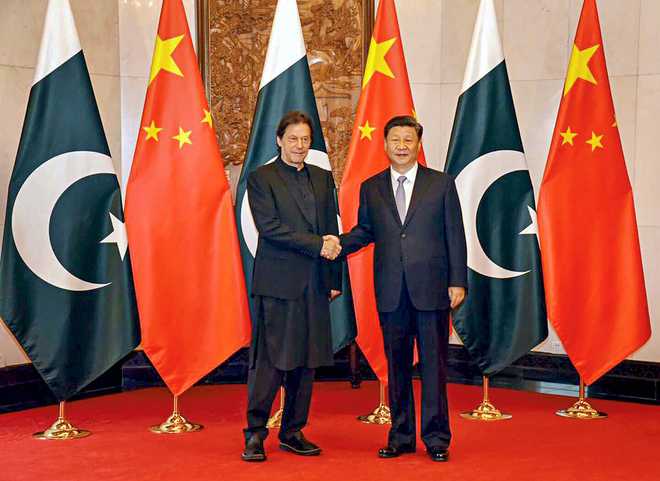
Chinese President Xi Jinping shakes hands with Pakistani Prime Minister Imran Khan, in Beijing on Wednesday, October 9, 2019. PTI

New Delhi, October 9

India on Wednesday reacted sharply to reports of Chinese President Xi Jinping and Pakistan Prime Minister Imran Khan discussing Kashmir, saying Beijing is “well aware” of New Delhi’s position and it is not for other countries to comment on its internal affairs.

The strong Indian reaction came after the Chinese state media quoted Xi as telling Khan during the meeting that China has been “observing” the situation in Kashmir, and hoped that the “relevant parties” can solve the issue through peaceful dialogue.

Read: China’s Xi says he’s watching Kashmir, supports Pak’s core interests, says report

“We have seen the report regarding meeting of Xi with Khan which also refers to their discussions on Kashmir. India’s position has been consistent and clear that Jammu & Kashmir is an integral part of India. China is well aware of our position. It is not for other countries to comment on the internal affairs of India,” Ministry of External Affairs Spokesperson Raveesh Kumar asserted.

Xi, who is scheduled to hold 2nd informal summit with Prime Minister Narendra Modi on Friday, assured Khan during a meeting here that the friendship between China and Pakistan is “unbreakable and rock-solid” despite changes in the international and regional situation.

Khan’s visit to China comes amidst high tensions between Pakistan and India after New Delhi abrogated Article 370 to end the special status of J&K on August 5. — PTI


All-clear at Ambala IAF station by Wg Cdr JS Bhalla (retd)

In October 1962, a full-fledged war broke out between India and China. Though McMahon Line was far away from Ambala, orders were received to dig out trenches and to be ready for any enemy air attack .The Air Force Station activated a night ORP and the Vampire aircraft (the only night fighter Indian Air Force had at that time) would fly in from Palam before dusk and fly back from Ambala at dawn after providing night cover to the northern sector.

The phase of the Chinese war was over with political turmoil and shake-up in the ministries in New Delhi. War historians worked on the lessons learnt from the unprovoked attack by China and India’s retaliation. The Indian Air Force was not used during the 1962 war due to the fear of the unknown.

It was only in September 1965 that the IAF actually participated in a conventional war lasting three weeks. Much before the actual operations began, we had moved to our operational locations. The Air Traffic Services were moved to a wooden hut near Runway 30 L where one could barely squeeze in with the equipment neatly stacked, and the supporting manpower in the open. Trenches were dug all around to jump in during air raids. A mobile control room on wheels, concealed by the foliage of trees, was made operational to control the air traffic in case the wooden hut was destroyed.

The section had a dedicated Class IV employee, Chottay Lal, a devoted worker who besides serving tea would look after the needs of the section boys who were not allowed to go out of the camp owing to operational reasons. He was a part of the duty roster of the section.

It was in September 54 years back that Ambala witnessed an air attack by Pakistan air force. Around 0230 hours, the tranquillity of the night was destroyed by air raid warnings. Chottay Lal, who was on duty that day, was positioned next to me in the trench. He was slowly whispering his story and his faith in Almighty. “Sir, there is a mazzar inside the airfield which is providing a shield to the Air Force Station. Let Pakistan send any number of aircraft, nothing will happen to the unit.”

This was his faith in Pir Baba, whose mazzar he was referring to. I listened to his story, ignoring the content. I was looking at the horizon trying to locate the enemy aircraft.

After a while, we could hear the sound of an aircraft. It appeared that the aircraft was approaching the airfield from the west. The sound became louder as the aircraft came close. The B57 was visually spotted from the trench. It dropped a bomb which hit St Paul’s Church adjoining the airfield. The airfield was safe and so was the runway and hangers, which housed critical war equipment.

“Sir, I told you Pir Baba is protecting this airfield,” he said, a grin on his face, when the all-clear was announced.

When I visited the Air Force Station a couple of years back, a senior officer enquired if I had heard about the story of Pir Baba during the1965 operations. I had no hesitation in sharing the story of Chottay Lal with the audience.

The truth is that Ambala was attacked on September 20 and 22 and on both days no serious damage was caused to the airfield and vital installations. Flight operations continued unabated from this airfield. Could we call it the incompetency of the B57 pilots? Chottay Lal’s answer we know already.


IAF Chief bets big on indigenous jets

http://

Tribune News Service
New Delhi, October 4

The new Indian Air Force Chief, Air Chief Marshal Rakesh Kumar Singh Bhadauria, today laid out a major indigenous plan that will involve quick induction of more variants of the Tejas fighter aircraft, designing and building of a new fifth generation fighter jet in India and getting the next lot of trainer aircraft from the Hindustan Aeronautics Limited (HAL).

Addressing mediapersons ahead of the Air Force Day on October 8, the IAF Chief who took over on September 30 said: “We are putting all efforts on AMCA (advanced medium combat aircraft) and have okayed the plan.” The AMCA is a fifth generation jet, which the DRDO is designing.

The first prototype will be ready by 2025.

Asked if the option of fifth generation jet like those in collaboration with Russia or other countries was being explored, the IAF Chief said: “No… the AMCA will be given priority.” On the threat of drones dropping arms in Punjab, the IAF Chief said: “It’s a new threat and it’s serious. We have some procurement in the pipeline to will deal with such drones.”

Air Chief Marshal Bhadauria, a Tejas test pilot during the days of sanctions imposed by the US in 1998, said an order for 83 jets of the next generation Tejas Mark 1A will be placed soon. These will carry a more powerful engine along with better weaponry than Tejas Mark 1, the existing version, 40 of which are being made.

The cost negotiation committee will soon give its report, he said, adding if Tejas Mark 2, also known as the medium weight fighter, is ready in a few years, these will be inducted.

“Indigenisation and modernisation will be the key pillars of the IAF… We have to ensure that indigenous products remain the focus and we will work to reduce dependency on foreign equipment,” said Air Chief Marshal Bhadauria.

On depleting fighter jet fleet, he said steps had been initiated to add 21 more MiG-29. The Sukhoi-30 will be upgraded for which the IAF had initiated the process. Process for acquiring 114 fighter jets was on, he said, while dismissing questions if 36 more Rafale jets are being purchased besides the 36 already on order. While engine upgrade of the Jaguar jets has been shelved, the Mi-17 and Mi-17 IV helicopters are being upgraded.

Shooting down of copter ‘big mistake’

  • The IAF Chief admitted that downing of an IAF Mi-17 helicopter at Budgam on February 27 was a ‘big mistake’ & that steps had been taken to avoid a repeat
  • “Have taken administrative action. Disciplinary action is being taken against two officers… Victims will be treated as battle casualty,” the IAF Chief said

AFT stays retirement of Brigadier till his result for promotion is declared

Legal experts conversant with the issue said that there have been numerous instances where officers have retired from service while awaiting their promotion board results that were inordinately delayed.

Indian Army, Indian army ACR, Junior officers Indian Army, JCR Indian Army, Bipin Rawat, indian express

cting on the petition of Brig IM Lamba of Artillery, a bench of Justice Sunita Gupta and Lt Gen Phillip Campose, stayed his retirement till the time the result of his promotion board is not declassified.

The Armed Forces Tribunal (AFT) has stayed the retirement of a Brigadier whose selection board for the rank of Major General was conducted by the Army in July but the result could not be released before his superannuation on September 30.

Acting on the petition of Brig IM Lamba of Artillery, a bench of Justice Sunita Gupta and Lt Gen Phillip Campose, stayed his retirement till the time the result of his promotion board is not declassified. If he is approved for promotion, then he would be promoted to the rank of Major General. In case his promotion is not approved, then he would be deemed to have retired on September 30, 2019 and will return any pay and allowances that may have been paid to him for the period thereafter.

The Brigadier had moved the AFT aggrieved by the fact that the results of the selection board in the Artillery Stream, which was conducted in July this year, in which he was considered as a ‘First Review’ case, has not been pronounced as yet. He feared that, in case he had been approved for promotion in the said selection board, he will not be promoted due to the fact that he would have superannuated on September 30 despite being fully qualified for promotion.

The officer contended that, in such an eventuality, it would be a travesty of justice.