Sanjha Morcha

What leaving the IAS portends for steel frame

It is a matter of national concern if the higher bureaucracy feels slighted or believes that the space for independent thinking and action — within the reasonable limits — is getting shrunk. Is that the case here? No doubt, life is getting increasingly difficult for non-performers and the corrupt elements.

Amitabha Bhattacharya
Former Bureaucrat

Resignation from the Indian Administrative Service (IAS) has not been uncommon, but that by young officers within the first decade of service is rare. In the last few weeks, S. Sasikanth Senthil (2009 batch), Kashish Mittal (2011) and Kannan Gopinathan (2012) have put in their papers. Balwinder Singh Dhaliwal (2004 batch) followed suit on September 24. Earlier this year, Shah Faesal (2010 batch), the IAS topper, had quit. At the secretary level, Subhash Chandra Garg (1983) decided to seek voluntary retirement.

The present spurt of resignations has evoked a predictable response from certain sections, partly because what Senthil and Gopinathan publicly stated as their cause to quit and largely because the critics of the political dispensation noted it as a protest against state action in J&K, alleged by them as undemocratic, dictatorial and against constitutional norms. “All is not well with the civil services,” commented a retired vigilance commissioner.

While Shah Faesal’s intention to join politics and his conviction that the cause of Kashmiris can be better served through politics than the civil service was rather evident, the case of the latest ones was rather sudden. What could be the real cause of their action?

When candidates, after a stiff competition, join the IAS and other high civil services, they are broadly aware of the challenges and opportunities, as also the limits of freedom — in speech and action — that lie ahead. The conduct rules, oath of secrecy and the like impose reasonable restrictions on their work and conduct. They also know the political environment under which their mettle will be tested. In the training academy at Mussoorie, the IAS motto Yogah Karmasu Kaushalam (proficiency in action is yoga) reminds them continuously of the path they are to follow.

IAS officers have in the past left their jobs for a variety of reasons — better financial prospects in intergovernmental bodies like the World Bank or multinational private organisations, lure of lifelong social service through NGOs, teaching and research in  universities (mostly in the West), heady attraction of active politics, or to avoid facing disciplinary action by the government. There have also been instances where officers felt humiliated on being transferred to a remote place or to a posting perceived as beneath their stature.

Exceptions apart, such decisions are often taken after a cool cost-benefit analysis, in monetised term or otherwise. Tears are hardly shed for such resignations.

However, it is a matter of national concern if the higher bureaucracy feels slighted or believes that the space for independent thinking and action — within the reasonable limits — is getting shrunk. Is that the case here? No doubt, life is getting increasingly difficult for non-performers and the corrupt elements. However, the efficacious officers with a clean reputation should feel encouraged by the steps being undertaken to weed out the undesirable ones from the bureaucracy.

As per newspaper reports, while Gopinath (electrical engineer from BIT, Mesra) and Senthil (electrical engineer from REC, Tiruchirapalli) alluded, directly and indirectly, to the recent action in J&K and to how “the fundamental building blocks of our diverse democracy are being compromised in an unprecedented way”, Kashish Mittal (computer engineer from IIT, Delhi) was not happy to be transferred from Delhi to Arunachal Pradesh. All three are engineers from reputed institutions and, being rather young with a good service background, may not find it difficult to pursue an alternative career, if their resignations are accepted. However, the real reason or motive behind their action requires to be ascertained by the government authorities.

While the citizenry that includes all thinking members of the higher echelons of the civil service is entitled to their opinion about any state action, the linking of resignations to that cause raises questions. Did the officers find it difficult to work where they were posted? Didn’t the IAS provide them enough opportunity to serve the underprivileged, improving the delivery systems of health, education and social justice to millions of people?

The IAS tradition has been enriched by many illustrious members who added immense value to their jobs wherever they worked and made a substantial difference to the lives of the disadvantaged, sometimes under the most adverse political circumstances. SR Sankaran, BN Yugandhar, BD Sharma, NC Saxena and many others served tirelessly within the fold of the IAS, refining and expanding the sphere of action in areas they held dear to their heart.

Understandably, one should leave the service if one thinks that the decision would provide one with a greater sense of satisfaction and actualisation of one’s potential. But couching such decisions under lofty moral or ethical principles can be problematic. There are umpteen cases where officers had to suffer in their career for ‘writing truth on files’ or for disagreeing with the superior, political or bureaucratic. But they rarely contemplated resignation as a way out. For it is possible, though not easy, to tread a fair path, remain loyal to the Constitution and committed to public service, while remaining a respected member of the IAS.

David C Potter quoted the famous administrator LP Singh, ICS, addressing the IAS trainees in 1971: “…many of the grievances of the civil servant about the functioning of our political system arise from too idealistic a view of public affairs and in non-recognition of the fact that, after all, politics is concerned with power.” Singh also lamented that bemoaning of political interference by thousands of civil servants tended to deflect them from going more deeply into what he broadly described as the professional problems (India’s Political Administrators 1919-1983, Clarendon Press, Oxford, 1986). The situation does not appear to have changed much.

In a young democracy like ours, it has always been difficult for a civil servant to pursue excellence in action on a sustained basis under adverse conditions. Does a resignation provide any key to addressing this systematic challenge? Does it serve any major purpose? Only time will tell.

Cong criticises Rafale ‘shastra puja’, BJP hits back with Bofors jibe

Cong criticises Rafale ‘shastra puja’, BJP hits back with Bofors jibe

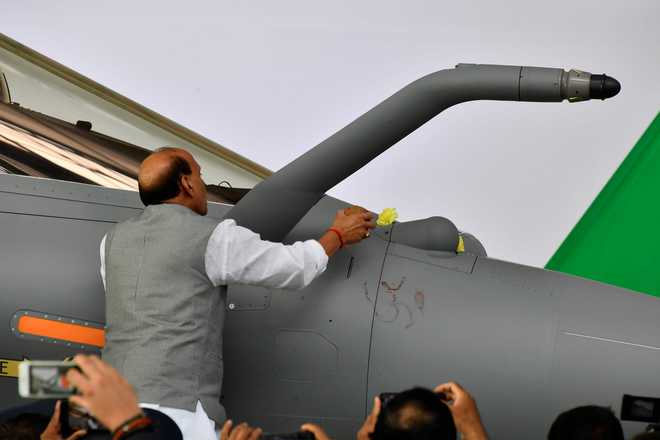
Defence minister Rajnath Singh inaugurates the first of 36 Rafale fighter jets on October 8, 2019 at Dassault Aviation plant in Merignac. AFP

Vibha Sharma
Tribune News Service
New Delhi, October 9

By leading the charge on criticism of the ‘shastra puja’ performed by Defence Minister Rajnath Singh on India’s new acquisition—the Rafale fighter jet—the Congress appears to have walked right into a trap.

Responding to senior Congress leader Mallikarjun Kharge’s comment calling the Rafale ceremony a ‘tamasha’ (drama) while referring to how his party never made a show when the UPA led by it acquired the Bofors gun, the ruling BJP tweeted from its official handle: “Congress has problems with Air Force modernisation. Indian customs and traditions. For a party used to worshiping Quattrocchi, ‘shastra puja’ is naturally a problem. And, Kharge Ji, thank you for reminding us about the Bofors scam.”

“Not just Kharge, many Congress leaders have registered objection to the ‘shastra puja’, which defence officials say is very much a part of the ceremony whenever any new acquisition is made. It is not just about the ‘shastra puja’ on ‘Vijayadashmi’, whenever a new aircraft is inducted into a squadron a religious ceremony is part of the tradition,” they said.Home Minister Amit Shah also hit back at the Congress for its criticism over the ‘shastra puja’ by Rajnath Singh during the handover ceremony of the Rafale jet in France on Tuesday. “Rajnath Singh performed ‘shastra puja’ of Rafale yesterday in France. The Congress did not like it. Is ‘shashtra puja’ not performed on Vijayadashmi? They should ponder over what needs to be criticised and what not,” the BJP chief was quoted as saying at an election rally in Haryana which goes to the polls on October 21.

In the run-up to General Elections, the Congress had tried to make the Rafale deal finalised by the Narendra Modi government an election issue, alleging corruption in the deal negotiated by the BJP-led dispensation. Finding Kharge’s criticism and opportune moment to hit back at the Congress, the saffron party thanked it for reminding the nation once again about the scandal related to illegal kickbacks paid in the multi-billion deal between the Swedish arms manufacturer Bofors with the then Congress-led government for the sale of 410 field howitzer guns.“For a party used to worshipping Quattrocchi, ‘shastra puja’ is naturally a problem,” the BJP said.

Italian businessman Ottavio Quattrocchi was named by the Central Bureau of Investigation (CBI) as the conduit for the Bofors bribe.

Kharge called the whole Rafale ceremony a “tamasha (drama)” and compared it to how his own party never did such a thing when buying weapons. “There is no need to do such ‘tamasha’. When we bought weapons — like the Bofors gun — no one went and brought them while showing off,” Kharge was quoted as saying.

The Bofors howitzer payoff scandal is one of the biggest corruption scandals in India in which Congress’ PM Rajiv Gandhi and many others were accused of receiving kickbacks from the Swedish gun manufacturer. It was called India’s ‘Watergate’ by a New York court after it led to the fall of the Rajiv Gandhi government. Defence minister Rajnath Singh performed “shastra pooja” at the induction ceremony in line with the Hindu tradition of warriors worshiping their weapons and arms on Dusehra. BJP’s ideological fountainhead RSS also holds a ‘shastra puja’ ceremony on the day.


Buying sensors to thwart drone attacks: IAF Chief

Amidst rising tension between India and Pakistan and reports indicating that the Balakot terror camp, which was destroyed by the IAF aerial strikes on February 27 and other such launch pads have become active again, IAF chief RKS Bhadauria said here on Friday if the Government decides they will carry out the necessary action. Asked about the threat potential of drones especially in the aftermath of such an attack on oil refineries in Saudia Arabia recently as part of the new way of asymmetric warfare, the IAF chief had anticipated such a challenge and we are also procuring sensors and other equipment to thwart any attack. He said the IAF is also aware of incidents in Punjab where drones were used to drop weapons by Pakistan. Sounding this warning to Pakistan without naming it, the IAF chief, however, said it is not the IAF strategy to use such strikes as the first step but if any incident takes place, in obvious reference to Pulwama attack, the Service is ready if the Government decides. He also said it was wrong to assume that despite the Balakot air raids, terrorist camps were now thriving. If Balakot strikes had not taken place, the level of terrorism would have been much more, he pointed out.  The Air Chief was addressing the annual Press conference ahead of the Air Force Day on October 8 and responding to Army Chief General Bipin Rawat’s recent statement about Balakot reviving. On China rapidly ramping its infrastructure especially along the Line of Actual Control (LAC) and modernising its air force, he said, “We know what exactly is happening there (China).” Responding to queries about IAF’s modernisation, he said the focus is on indigenisation and modernization besides acquiring critical weapons and spares to maintain operational preparedness.  In one of the major steps towards indigenisation, the IAF is backing the design and production of advanced medium combat aircraft (AMCA) by DRDO.  It will be a fifth generation fighter aircraft (FGFA). Bhadauria ruled out importing a new aircraft of such generation “now or in foreseeable future.” Incidentally, India and Russia have been working on the joint project to develop FGFA since 2007. Both sides had signed only a preliminary $295 million design contract for the co-development of the FGFA in 2010. He also dismissed reports about procuring 36 more Rafale fighter jets from France and said the process of selecting the suitable fighter for the 114-jet project is on.  These jets will be manufactured within India as part of the Strategic Partnership.  The proposed deal is worth over 10 billion dollars. Bhauduria said IAF will soon place an order for 83 more indigenously designed and manufactured Tejas light combat aircraft (LCA). The cost negotiations were in an advanced stage, he said adding besides these projects, the IAF will soon procure 21 more MIG-29s and 12 more SU-30s. About the induction plane of 36 Rafale jets as per the government to Govt deal with France worth over Rs 58,000 crores, he said the first four Rafales manufactured as per the Indian specifications will come to India in May end next year. Bhadauria as deputy chief of air staff was instrumental in the Rafale jet negotiations with the French Government and Dassault Aviation, manufacturers of the fighter jet.  As tribute to him, the first Indian Rafale aircraft is having tail no RB-01.

idrw.org .Read more at India No 1 Defence News Website https://idrw.org/buying-sensors-to-thwart-drone-attacks-iaf-chief/ .


Aiming for self-reliance in defence: Rajnath

Aiming for self-reliance in defence: Rajnath

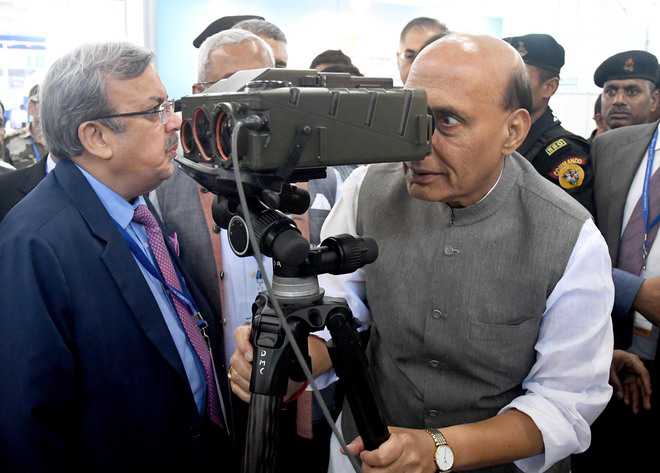
Defence Minister Rajnath Singh at a security expo in New Delhi.

New Delhi, October 4

Defence Minister Rajnath Singh on Friday called for an increased and active participation of the private sector in defence manufacturing to achieve the Government’s target of making the Indian defence industry worth $26 billion by 2025.

He was addressing the captains of industry at the 22nd India International Security Expo, 2019 (Defence & Homeland Security) here today. The defence sector will play a pivotal role in achieving the goal of 5 trillion dollar economy. “Our aim is to make a world class domestic defence industry that is self-reliant and less dependent on imports”, the minister said.

He hoped that the industry partners would come up with concrete investment and technological intervention proposals related to defence and avail the business opportunities present in the sector.

Rajnath assured the defence industry that the government was open to new ideas and remained committed to harness the entrepreneurship spirit and energies of the private sector. He invited domestic as well as foreign defence manufacturers to participate in DefExpo 2020 to be held in Lucknow in February next. He said the corridors were being established to provide state-of-the-art infrastructure for defence production facilities. — TNS


China’s new missile is a wake-up call for India by Pravin Sawhney

China’s new missile is a wake-up call for India

With the People’s Liberation Army having showcased hypersonic missiles, India ought to take the bull by the horns. A way forward is to seek Russian cooperation through the successful BrahMos supersonic cruise missile programme. It could be the ideal vehicle for the development of hypersonic cruise missiles and strengthening bilateral relations.

Cutting edge: Hypersonic missiles will be the new disruptive game-changing technology in this century.

Pravin Sawhney
Strategic affairs expert

AT China’s National Day Parade on October 1, the military might of the People’s Liberation Army (PLA), in full display, was watched closely by the world. The commander-in-chief of the PLA, Xi Jinping, inspected the parade which featured 15,000 troops, 160 aircraft and 600 pieces of equipment.

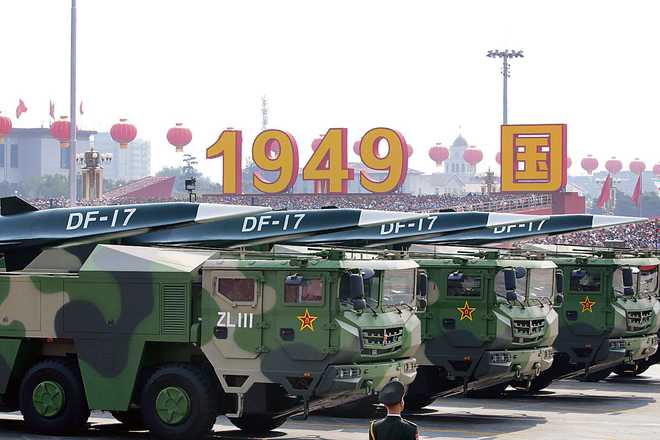
What caught the attention of discerning observers were the new missiles which are a part of the 2016-raised rocket force (People’s Liberation Army Rocket Force, PLARF): The Dongfeng DF-41 Inter-Continental Ballistic Missile (ICBM) with a range of 15,000 km, travelling at seven km per second, approximate speed Mach 20 (Mach is the speed of sound), and 500 meters accuracy; the Dongfeng DF-100 hypersonic cruise missile; and the Dongfeng DF-17 medium range ballistic missile fitted with Hypersonic Glide Vehicle (HGV) — DF-ZF — with a range of 2,000 km.

While western analysts focused on DF-41 ICBM, which would play a critical role in strategic counterbalance, deterrence and in winning war, for India, the DF-100 and DF-17 fitted with HGV — DF-ZF — should be a cause of concern. Hypersonic missiles will be the new disruptive game-changing technology in this century which would — between India and China — replace nuclear deterrence with non-nuclear deterrence, reshape the rules of conventional war-fighting and transform geopolitics. Only three countries — the US, Russia and China — have made credible strides in procuring, harnessing and 

exploiting this technology.

Hypersonic missiles are radically different from ballistic and cruise missiles. Ballistic missiles boosted by powerful rocket engines leave the atmosphere (the dividing altitude between atmosphere and space is 100 km) to enter space, reach the apogee and then re-enter atmosphere to hit the designated target. These missiles follow a defined elliptical trajectory, which helps the Ballistic Missile Defence (BMD) system to intercept and neutralise their warhead before it causes damage. The US since over four decades has invested heavily in BMD systems. Inspired by it, India too has invested in indigenous BMD since 2000.

Cruise missiles stay within the atmosphere, fly at low altitude to evade ground-based radars, and are powered and guided throughout the flight in a defined near-flat trajectory until its designated target. Cruise missiles powered by air-breathing jet engines have sub-sonic speeds, except India’s BrahMos missile, which powered by ramjet engine, has a supersonic speed of Mach 3. To defeat cruise missiles, there are technologies like the Russian S-400 Air Defence Missile System (ADMS), amongst others.

Hypersonic cruise missiles with two peculiarities are a class apart. One, they have speed upwards of Mach 5 — their kinetic energy (derived from motion) itself is enough to destroy hardened and underground facilities.

Two, they fly at low altitudes, though higher than cruise missiles, and are difficult to detect by terrestrial or land-based radars because of their ability to change course rapidly. Unlike ballistic and cruise missiles which follow a defined trajectory, hypersonic missiles are highly manoeuvrable, thereby giving very little reaction time to the opponent to judge which target is being hit. This delayed detection makes timely response extremely difficult.

HGV are fitted on ballistic missile rocket engines like DF-17, DF-21, DF-26 and even DF-41 ICBM and boosted. After a certain boost phase, the HGV detaches itself from the rocket and glides towards its target 2,000 km away in a wayward rather than a defined low flight trajectory.

Senior officials from Raytheon Company of the US recently told this writer at an international air show that meeting the hypersonic cruise missile challenge would require new sensors for early detection. Since terrestrial sensors alone would not work, the need would be to have a mix of space-based and terrestrial sensors. The entire hypersonic missile defence architecture, they said, would require huge investments, patience, technology and technical expertise.

Given the new missile’s characteristics, the DF-100 and DF-17 with HGV in PLA inventory would be a powerful asymmetric capability. For instance, it would be a national humiliation if the HGV were to hit and destroy India’s aircraft carrier. Since India — familiar with PLA’s nuclear weapons inventory — is unlikely to raise the stakes, China’s new deterrence as well as disruptive war-fighting capability would reside in its useable non-nuclear HGV. India’s nuclear weapons, purportedly delivered by its submarines, Agni series ballistic missiles, and aircraft, would, on the other hand, be rendered useless against China.

Such a possibility deserves an urgent review, both of India’s nuclear deterrence against China, and the indigenous BMD, which despite the infusion of huge funds has, unfortunately not demonstrated satisfactory results. In 2011, the then Defence Research and Development Organisation (DRDO) chief, VK Saraswat, had spelt out the timelines to this writer for the accomplishment of the BMD programme. He had said that by 2013, phase one of the project, which involved successful interception of hostile missiles with 2,000-km range, would be achieved. Phase two of the programme, which required neutralisation of 5,000-km range ballistic missiles, would be done by 2015, the same year when the ballistic missile shield would become available for impregnable defence of the capital city of Delhi, and major metropolises. The purchase of five units or regiments of Russian

S-400 ADMS in 2016 is evidence that Saraswat was doing kite-flying.

Even the military should take its portion of the blame. Many DRDO scientists have told me that the military leadership, unable to find or understand operational employment of hypersonic missiles, has shown little interest in their presentations. With PLA having showcased these missiles, the Defence Minister ought to take the bull by the horns. A way forward is to seek Russian cooperation through the successful BrahMos supersonic cruise missile programme. Given that BrahMos is India’s most successful defence programme, has consistently met its timelines, has been accepted by the three defence services, and has generated employment and wealth, it could be the ideal vehicle for the development of hypersonic cruise missiles and strengthening bilateral relations between India and Russia.


Army gives befitting reply to Pak’s ceasefire violation

Our Correspondent

Rajouri, October 1

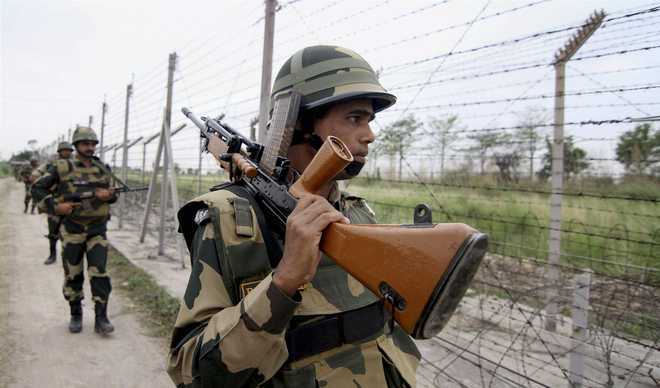
The Army has given befitting reply to Pakistan for intense unprovoked heavy mortar shelling and firing on the Army’s forward locations and civil areas in Poonch district since morning. The Pakistan army on Tuesday violated the 2003 truce agreement twice at about 8 am and again at about 3.15 pm that continued till 7.15 pm in Kirni and Shahpur areas in the Poonch sector.

On Sunday, 8 persons, including two soldiers, a minor boy and two women were injured in the cross border shelling in forward villages of Balakot sector in Mendhar tehsil.

“The Army is retaliating to the ceasefire violation by the Pakistan army effectively” said Lt Col Davender Anand,PRO Defence.

Inhabitants of the area said many mortar shells had landed in the forward villages

People living in the border villages have expressed their resentment against frequent firing and heavy shelling on the LoC alleging it had badly hit their harvesting season as well as their domestic life.

“As Pakistan has failed to counter India at every platform after the abrogation of Article 370, it has started targeting civil and forward locations in the district to continue the tension” said a senior police officer.


Pakistan hands over body of BSF trooper who drowned in river along IB

Pakistan hands over body of BSF trooper who drowned in river along IB

File photo for representation only.

Jammu/New Delhi, October 1

Pakistan on Tuesday handed over to India the body of a Border Security Force (BSF) sub-inspector who had drowned in a river along the International Border in Jammu last week, officials said.

The body of Paritosh Mandal was found “deep inside” the neighbouring country’s territory and the Pakistan Rangers informed the BSF about the recovery, they said.

Mandal, 54, went missing in the Aik Nallah in Arnia sector on September 28 when he and two other troopers were patrolling along the India-Pakistan International Border.

Villagers joined hands with the BSF and the State Disaster Response Force (SDRF) to trace him but to no avail, they said.

As the Aik Nallah flows into Pakistan, the BSF informed their counterparts—Pakistan Rangers about it. On Tuesday the Rangers informed the BSF that Mandal’s body has been recovered, officials said.

The BSF sub-inspector was a native of West Bengal’s Nadia district.

A spokesperson said the IG of BSF Jammu has conveyed his deep regrets for the unfortunate loss of life of the brave and dedicated soldier. The BSF, Jammu, also thanked the SDRF, villagers and Pakistan Rangers for their efforts. —PTI


J&K, Ladakh officially UTs

New Delhi : Jammu and Kashmir (J&K) was formally bifurcated into two Union territories with the swearing in of lieutenant governors in Srinagar and Leh on Thursday, in a historic move that was celebrated in Ladakh, cautiously welcomed in Jammu, but drew a muted response in the Kashmir valley.

STEPPING INTO HISTORY First lieutenant governor of Union Territory of Jammu and Kashmir Girish Chandra Murmu (left) and his Ladakh counterpart Radha Krishan Mathur take oath of office in Srinagar and Leh, respectively, on Thursday. AFP

Girish Chandra Murmu took oath as the first LG of J&K in a low-key ceremony at Srinagar’s Raj Bhavan at around 12.30pm that was televised across India, bringing the curtain down on the formerly princely state that enjoyed special provisions and constitutional protections for 72 years. Earlier in the day, RK Mathur was sworn in as the first LG of Ladakh in Leh. Chief justice of the J&K high court, Gita Mittal, administered the oath of office to both LGs.

The event was hailed by Prime Minister Narendra Modi and home minister Amit Shah, with the former saying the decision to nullify Article 370 and bifurcate the state will bring political stability and end corruption in the region. “The new system in Jammu & Kashmir and Ladakh is not meant to draw a line on the land but to build a strong link of trust,” Modi said at a ceremony in Gujarat to mark the birth anniversary of Vallabhbhai Patel, the first home minister of India.

Modi said Patel inspired him to effectively revoke Article 370 and added that unity in diversity was India’s strength.

“The country took the decision to scrap Article 370, which had only given separatism and terrorism to that state,” he added.

Shah said that Article 370, which gave special status to J&K, and 35A, which gave special privileges to its residents, were gateways of terrorism that had now been closed.

The Jammu & Kashmir Reorganisation Act, passed in Parliament in early August, says J&K will be a UT with an elected legislative assembly and a chief minister, while Ladakh will be governed by the LG and have two hill development councils.

related reports, P8


Police, law and order to be under Centre in new UT of JK, land under elected govt

Police, law and order to be under Centre in new UT of JK, land under elected govt

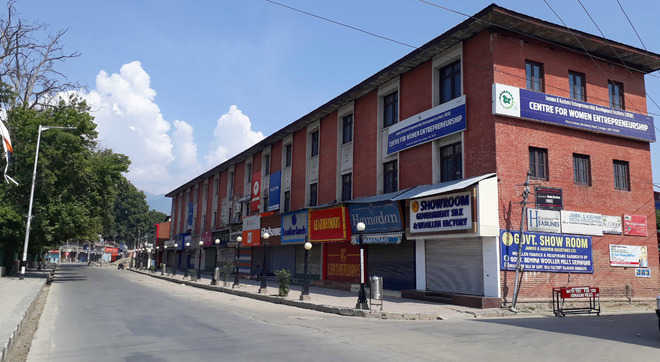
A deserted Residency Road near Lal Chowk in Srinagar. Photo: Amin War

New Delhi, October 30

The Centre will be in direct control of the police and the law and order in Jammu and Kashmir from Thursday when it becomes a Union Territory, while the land will be under the elected government there.

According to the Jammu and Kashmir Reorganisation Act, 2019, the land—the rights in or over it—will be with the elected government of the Union Territory (UT) of Jammu and Kashmir, unlike in Delhi where the LG exercises control through the Delhi Development Authority (DDA), a central government entity.

The Act says the Legislative Assembly of the UT of Jammu and Kashmir may make laws for the whole or any part of the union territory with respect to any of the matters enumerated in the state list of the Constitution except the subjects mentioned in entries one and two—‘public order’ and ‘police’ respectively—or the Concurrent List in the Seventh Schedule of the Constitution.

Police, and law and order in Delhi and Puducherry, both of which have their own legislative assembly, is controlled by the Centre through the Lieutenant Governor (LG).

All India Services like the Indian Administrative Service (IAS) and the Indian Police Service (IPS), and the Anti-Corruption Bureau (ACB) will be under the control of the LG and not the elected government of the UT of Jammu and Kashmir.

The services and the ACB have been among the key reasons for frequent tussle between the Arvind Kejriwal-led Delhi government and the Lieutenant Governor.

The Jammu and Kashmir Reorganisation Act says matters related to land, that is to say rights in or over it, land tenures, transfer and alienation of agricultural land, land improvement and agricultural loans will be under the domain of the elected government of the UT of Jammu and Kashmir.

Land revenue, including the assessment and collection, maintenance of land records, survey for revenue purposes and records of rights, and alienation of revenues will also come under the purview of the elected government of UT of Jammu and Kashmir.

Police, law and order, and land in the UT of Ladakh will be under the direct control of its LG, through whom the Centre will administer the high-altitude region. According to the Act, Ladakh will not have a legislative assembly.

On and from the appointed day, that is October 31, when the two new UTs will come into existence, the High Court of Jammu and Kashmir shall be the common high court for the UTs of Jammu and Kashmir, and Ladakh            The judges of the high court of J-K will become the judges of the common high court from Thursday.

The Act says the cadres of the IAS and IPS for the existing state of Jammu and Kashmir, on and from the appointed day, shall continue to function on the existing cadres.

However in future, the all India service officers to be posted to UTs of Jammu and Kashmir or Ladakh shall be borne on the Arunachal Pradesh, Goa, Mizoram and Union Territory cadre, more popularly known as UT cadre.

The total strength of the UT of Jammu and Kashmir assembly is 107 elected MLAs, which will be enhanced to 114 after delimitation. Twenty-four seats of the Assembly will continue to remain vacant as they fall under Pakistan-occupied Kashmir (PoK). —PTI


New-age weapons set to add to India’s arsenal

security boost Tests for ballistic missiles, futuristic weapons to be conducted in 2020

Shishir Gupta

letters@hindustantimes.com

New Delhi : India is set to test its ballistic missile defence (BMD) Phase II interceptor missiles and other futuristic weapons next year with its first floating test range (FTR) in place to allow trials at different ranges without a land mass limitation or threat to the population. Only a select group of nations has FTR capability .

Designed by the Defence Research and Development Organization (DRDO), the new FTR is a 10,000 tonne ship, 200 metres long and 60 metres wide, equipped with state-of-the art electro-optical missile tracking (EOTS), S-band radar tracking and telemetry devices apart from a launch pad, a launch control and mission control centre.

While the missile establishment is tight-lipped about the FTR, Hindustan Times has learnt that the ship will be able to launch conventional missiles upto a range of 1,500 kilometres from a distance of 400 to 500 nautical miles in the sea without fear of the weapons threatening any populated area on India’s east coast.

The FTR will not be used for testing the Agni series of ballistic missiles as it is not designed to handle the thrust of a long-range weapon. “ The FTR has all the capabilities of Interim Test Range (ITR) with the capability to test missiles in deep sea with minimum safety precautions as the latter allows only a cone of two to three degrees to launch a missile. It is for testing all missiles including BMD,” said a senior official who didn’t want to be named.

According to authoritative sources, the idea behind FTR is to test missiles from a range of 100 kilometres to 1,500 kilometres without any land mass or sea lanes limitations. This means that the FTR will be used for the BMD Phase II system, which is designed to destroy enemy missiles mid-air at different altitudes and different ranges with a long-range DRDO missile.

Phase II of BMD envisaged intercepting and destroying enemy missile with a range of 2,000 kilometre. The FTR will be also used to test tactical missiles like Prahar and other futuristic missiles.

With the FTR allowing live tests, not simulations, to interdict long-range missiles fired from the APJ Abdul Kalam Island off the Odisha coast, the Indian BMD system will become more efficient with improved single -hot kill probability (SSKP) ratio, a term used for surface-to-air weapons.

“The FTR will speed up missile projects as it provides a ready-made safety corridor without getting caught into the advances notices to ships and aircraft flying in the area as well as the fear of hitting populated areas while testing BMD system. With this we can use interceptor missile to interdict enemy missiles both endo and exo-atmosphere,” said a second senior official.