Sanjha Morcha

Ignored by govt, villagers on zero line building their own bunkers

Srishti Jaswal & Idrees Bukhtiyar

letterschd@hindustantimes.com

Uri  : Three days ago, a splinter of a mortar fired from across the border pierced the foot of eight-year-old Rabia Bano, leaving her mother Naksha Begum of Mothal village in a shock. “My daughter will die. Please do something for us,” the mother cried for help.

The cross-border shelling, which spiked after August 5 when the Centre revoked the special status of Jammu and Kashmir, has been giving sleepless nights to over 4,800 families in 40 villages along the Line of Control (LOC) in Uri tehsil.

In absence of any help from the government, the families, who have been living in constant fear, have started building bunkers on their own .

“The shelling begins at any time of the day, killing humans and cattle, and damaging our houses. We have been demanding bunkers from the government but to no avail,” said Naksha Begum.

The sarpanch of Charunda village, Lal Din Khatana, said the cross-border shelling has claimed lives of over 17 people and left 22 injured since 1990.

“We have been demanding underground dugouts for safety. We had approached sub-divisional magistrate as well as deputy commissioner but there was no help from them,” he said.

Uri sub-divisional magistrate (SDM) Reyaz Ahmad Malik said the authorities have sent a proposal to the government last month in this regard. “We are expecting an approval anytime in the coming days,” he said.

In September, three mortars were fired of which two exploded on the premise of a primary school in Fatawali of Nambla village.

A similar case was witnessed in October at a primary school in Kareri Thapla . There are 14 schools near the Line of Control.

In June, a protest was organised by local leader Sajad Shafi Uri in the area, in which thousands of villagers from across 40 villages participated. A memorandum in this regard was also submitted to then governor Satya Pal Malik.

“The administration had promised to provide us with bunkers within a month. We are still waiting,” said Uri.

Ishrat Begum, 22, of Danna Balkote village said it has become more difficult to raise the issue in the absence of an elected representatives in the wake of abrogation of Article 370.

“Whom shall we demand from?” she said.

There are days when the cross-border firing goes on for hours with bullets whizzing over our heads several times, said 55-year-old Saaja Begum of the same village who has made a bunker for her family.

“The cost of making a bunker goes in lakhs which is unaffordable for a poor family like ours. We have made a makeshift bunker with wood which protects us from light shelling, but it will also be damaged during heavy shelling,” she said.

The average cost of a bunker construction ranges from Rs 1 lakh (wooden) to Rs 3 lakh (concrete). “We are daily wagers, we spend whatever we earn in a day. For making these bunkers, I sold my cattle and invested all the money I got from the walnut trade,” said 39-year-old Nasir Ahmed Mir of Tilawari village.

Saaja Begum says there are times when the firing goes on for hours.

“On October 13, there was a constant barraging on both sides of the border. After 1998, this was the heaviest shelling we faced. We thought the war has begun between India and Pakistan,” she said.

“Gunfire, mortar shells as well canons were shot at us,” Shabbir Ahmad Awan, 36, of Badgran village said.

Post August 5, as many as 22 ceasefire violations have been observed in three sectors of Uri.

“Our tin roof is entirely damaged by shells. How will we manage in snow and rain? Our walnut trees are mostly damaged and our cattle are either dead or injured,” said Awan.

Manzoor Ahmed Bhatt, 36, of Mothal village said, “I have a family of 12 people. The administration is asking us to camp in a high school. How can I relocate there with my family and cattle?”

The SDM said there are two camps in Uri and one in Boniyar area where people are provided with food, shelter and medical facilities during emergencies.

“What will they do when schools will re-open?”questions Bhatt.

‘NO OPTION BUT TO FLEE’

Manzoor’s father Kadir Bhatt, 70, said, “If the firing continues like this, we will have to flee. When Indian government does nothear us, we will have to go toPakistan.”

In 1998, residents of an entire village in Uri, Samali, migrated to Pakistan when the conflict between India and Pakistan was at its peak.

Last month, Latifa Begum and her 10-year-old child Bilal Ahmed, of Mothal village were injured when a splinter pierced through the roof and fell on bed, injuring her thigh and the head of her child.

“If India and Pakistan are constantly going to fight, how will we live in Uri?” she said.


Army unit distributes clothes to poor people

Army unit distributes clothes to poor people

Army personnel distribute clothes to poor people in Jalandhar Cantonment on Tuesday. Tribune photo

Tribune News Service

Jalandhar, October 29

At a time when people are busy celebrating the festival of lights, a unit of the Indian Army, 2 Army Dog, in Jalandhar Cantt was busy in distributing clothes and sweets to poor and underprivileged people of this area.

The 2 Army Dog unit here in Jalandhar Cantt celebrated Diwali in a different way. The unit distributed clothes to around 250 poor, handicapped and underprivileged people. The chief guest on the occasion was Col Pradeep Poonia. He appreciated the efforts of the unit and extended Diwali greetings to everyone.

The 2 Army Dog is the same unit, which conducted Yoga with Dogs this year on International Yoga Day. 2 Army Dog is the only dog unit in the Western Command area of responsibility. It is the oldest and highly decorated dog unit of the Indian Army. The unit along with their handlers has been awarded 2 Sena Medal Gallantry (Posthumous), Chief of Army Staff Commendation, Vice Chief of Army Staff Commendation, Army Commander Commendation and GOC Corps appreciation.


Three-day Naval Commanders Conference concludes

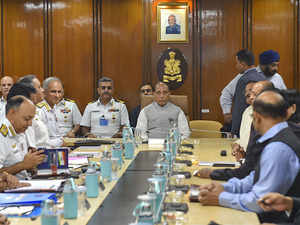
The second edition of the Naval Commanders Conference concluded on Thursday where several critical subjects related to effective conduct of operations in a futuristic joint service environment were examined and an action plan was arrived at.
Three-day Naval Commanders Conference concludes

NEW DELHI: The second edition of the three-day Naval Commanders Conference concluded on Thursday and it saw deliberations on several issues pertaining to functional reorganisation of the Navy and harnessing emerging technologies as well as use of artificial intelligence and big data.

In addition to discussing intra-Navy issues, several critical subjects related to effective conduct of operations in a futuristic joint service environment were examined and an action plan was arrived at, a ..

Read more at:
//economictimes.indiatimes.com/articleshow/71751632.cms?from=mdr&utm_source=contentofinterest&utm_medium=text&utm_campaign=cppst

Don’t link Aadhaar with social media accounts

It will enable commercial surveillance, restrict free speech, curb privacy, and it defies the SC’s own orders
Free speech sometimes requires anonymity on social media. Stop its abuse. But don’t curb it altogether Getty Images

In September 2018, while upholding the constitutional validity of the Aadhaar programme to a limited extent, the Supreme Court (SC) made two important observations. First, it held that Aadhaar could be mandated only in a limited set of circumstances, where it was necessary and proportionate to do so. In particular, mandating Aadhaar for banking and using mobile phones was categorically rejected as unconstitutional. Second, the SC warned against the use of Aadhaar for commercial surveillance, and, therefore, barred private players from accessing the Aadhaar database.

However, an ongoing case before the SC — brought to it through a “public interest litigation” — asking for the mandatory linking of Aadhaar with individuals’ social media accounts risks undermining both these crucial observations — and ironically, through the SC itself. The linking of Aadhaar with social media accounts represents an insidious form of function creep, where a digital ID originally touted as streamlining welfare delivery has now begun to colonise vast swathes of daily life — without thought of, or heed to, the consequences.

What are the justifications being advanced for such a move? In court, the Attorney-General for India apparently advocated for the move on the basis that it would help to check the spread of fake news, hate speech, and other forms of illegal content.

The underlying idea seems to be that illegal content exists on the Internet because of how it allows for anonymity. Once an individual’s actual identity was linked to their online identity, we would have a situation of perfect traceability, where illegal online content could immediately be traced to its source in the physical world.

To start with, the argument’s premise is mistaken. It is, by now, well established that the Aadhaar database contains a significant number of ghost accounts. Mandatory linking may, therefore, enable greater fake news — now with the veneer of authenticity — instead of combating it.

Furthermore, this argument misunderstands how the Internet works in general, and how social media accounts work in particular. To start with, it is extremely easy to circumvent. Indians intent on avoiding Aadhaar linking can simply create accounts by reporting themselves as non-resident.

On the other hand, a majority of ordinary, law-abiding Indians will end up providing a rich trove of personal data to social media networks. The linking of online and real identities will only facilitate and ease targeted advertising by social media networks — the very kind of commercial surveillance that the SC warned against in its Aadhaar judgment. In fact, it is important to note that even after all these years, India still does not have a data protection law, with the move towards enacting one seemingly stuck in an interminable limbo.

Second, the move appears intent on throwing the baby out with the bathwater. As in any large community, there are persecuted and marginalised voices, whose participation in the public sphere is fraught with the risk of abuse and even physical violence. For these voices, anonymity is crucial to being able to speak at all, as it provides a necessary shield. Courts all over the world have acknowledged how anonymity is an integral aspect of the right to free speech and expression — as well as, of course, an integral aspect of the right to privacy. As with any other right, there are those who can — and do — abuse its protection. But that does not — and cannot — provide a justification to withdraw the right altogether.

Both these aspects make clear that not only is the mandatory linking of Aadhaar to social media accounts a bad idea, but also, it is a complex issue fraught with risks of various kinds. This brings us to the last point. If at all such a move ought to be considered, it should be done through an open, consultative procedure, and ultimately, through legislation enacted by Parliament, the constitutionality of which can then be reviewed by a court.

The PIL route, which attempts to accomplish this through judicial fiat, is profoundly dangerous for citizens’ rights, and for democratic participation. In the past, it has led to rushed orders that have not been properly thought through — from a judicial attempt to have certain keywords “auto-blocked” from online search engines in order to combat the purchase of sex-selection kits to attempts to regulate pornography — which have ultimately had to be modified or recalled, once their unworkability becomes clear. Even in this case, the court’s offhand and casual references to the “dark web”, as reported during oral arguments, are troubling. It is to be hoped that better sense will prevail, and that this misguided PIL will be swiftly dismissed.

Gautam Bhatia is a Delhi-based advocate

The views expressed are personal


Ex-serviceman accused of drug peddling

Amritsar, October 22

The Amritsar rural police today said an ex-serviceman was reportedly involved in the drug racket in which 7.5 kg of heroin was seized yesterday.

The suspect has been identified as Prabhjit Singh of Kakkar village. He retired from the Indian Army around two months ago. The accused is still at large.

Gurdev Singh, alias Sonu, and Major Singh, who have been arrested, confessed that Prabjit assisted them, the police said. SPS Parmar, IG, Border Range, said Gurdev had links with a Pakistan-based smuggler, Khodar.

They allegedly used the Prabhjit’s tractor to cross the fence in the guise of tilling land. They used to bring heroin, kept in their fields by Pakistan smugglers, by hiding it in a cavity of their tractor’s battery. — TNS


Battle of Midway: Second World War II-era Japanese carrier apparently found in Pacific

Deep-sea explorers and historians on Sunday announced they apparently found a second World War II-era Japanese aircraft carrier that sank during the Battle of Midway.

A review of sonar data captured Sunday showed either the Japanese carrier Akagi or the Soryu resting in nearly 18,000 feet of water in the Pacific Ocean more than 1,300 miles northwest of Pearl Harbor, Hawaii, Vulcan Inc. director of undersea operations Rob Kraft said.

The researchers used an autonomous underwater vehicle, or AUV, equipped with sonar to find the ship. The vehicle had been out overnight collecting data, and the image of a warship appeared in the first set of readings on Sunday morning.

In this June 4, 1942 file photo provided by the U.S. Navy, the USS Astoria (CA-34) steamed by USS Yorktown (CV-5), shortly after the carrier had been hit by three Japanese bombs in the Battle of Midway. 

In this June 4, 1942 file photo provided by the U.S. Navy, the USS Astoria (CA-34) steamed by USS Yorktown (CV-5), shortly after the carrier had been hit by three Japanese bombs in the Battle of Midway.  (U.S. Navy via AP, File)

The crew planned to deploy the AUV for another eight-hour mission where it will capture high-resolution sonar images of the site to measure the ship and confirm its identity, officials said.

GROUP SCOURS PACIFIC FOR SUNKEN WWII BATTLESHIPS, LOST WAR GRAVES

The finding came on the heels of last week’s discovery, another Japanese aircraft carrier, the Kaga, which U.S. forces also sank during the Battle of Midway in June 1942.

Until now, only one of the seven ships that went down in the air-and-sea battle — five Japanese vessels and two American ships — had been found.

CLICK HERE TO GET THE FOX NEWS APP

The crew of the research vessel Petrel was hoping to find and survey all lost ships from the 1942 Battle of Midway, which historians considered a pivotal fight for the U.S. in the Pacific during WWII.

https://www.foxnews.com/science/warship-wwii-battle-of-midway-pearl-harbor-second-japanese-carrier?cmpid=prn_msn


In 1944, The U.S. Navy Captured Its First Enemy Warship In 122 Years

And Adolf Hitler was not happy about it.

Key point: A Nazi submarine was captured fully intact.

“Frenchy to Blue Jay—I have a possible sound contact,” squawked from USS Guadalcanal’s bridge intercom at 1110 hours. It meant that “Frenchy,” codename for the Destroyer Escort USS Chatelain, had located something during a sonar sweep.

But Captain Daniel V. Gallery, commander of the escort carrier Guadalcanal (BlueJay) was not going to get excited, at least not yet. The sound contact could be a whale, a layer of cold water, or any number of other things. On the other hand, a “possible” was always treated like the real thing until found out to be otherwise.

“Left full rudder,” Captain Gallery ordered. “Engines ahead full speed.” He also sent two other destroyer escorts (DE) in to assist Chatelain, put two of Guadalcanal’s Grumman F4F Wildcat fighters over the sound contact, and “got the hell out of there at top speed.” Gallery knew that an aircraft carrier, even a small escort carrier, would only be in the way if the contact turned out to be a U-boat. “A carrier smack on the scene of a sound contact is like an old lady in the middle of a bar room brawl!” he once remarked. “She’d better move fast and leave room for the boys who have work to do.”

Captain Gallery knew about these things from experience. On his last cruise, Gallery and his hunter-killer group had sunk two U-boats, U-68 and U-515, within the space of 12 hours. He was well versed on how German submarine commanders behaved. This trip had begun on May 15, 1944, when Gallery departed Norfolk, Virginia, aboard Guadalcanal with five destroyer escorts: Chatelain, PillsburyPopeFlaherty, and Jenks. His orders were to take his U-boat hunting group, officially known as Task Group 22.3, out into the Atlantic to look for more enemy submarines.President Warren G. Harding delivers the first speech by a sitting U.S. President against lynching in the deep South.

 George Melford’s silent film, The Sheik, starring Rudolph Valentino, premiers.

This time, though, Captain Gallery had something different in mind. During the last cruise, U-515 surfaced right in the middle of the task group. The escorting destroyer escorts hit the U-boat with every caliber gun they had, from five-inch to .50-caliber machine guns, before the boat sank. This gave Gallery an idea. “Suppose we hadn’t been so bloody minded about sinking her,” he thought. Before leaving Norfolk, Gallery assembled the captains of all the escort ships in his group and told them that they would try to capture a submarine, if possible, on this cruise.

If a U-boat came to the surface, as U-515 had done, everyone was to assume that the captain had come up to save the lives of the crew. Instead of sinking it, the destroyer escorts would open up with .50-caliber machine guns. This would keep the crew away from the U-boat’s deck guns and would also “encourage them to get the hell off that U-boat.” After the crew had abandoned the submarine, a boarding party would be sent over to disarm any booby traps, close all scuttling valves, do everything possible to keep the boat afloat, and rig it for towing back to the United States.

From the expression on their faces, Captain Gallery could see that some of the destroyer escort captains thought he must be crazy. Everyone present kept their mouths shut. They all organized boarding parties as ordered and waited to see what might happen.

Throughout the month of May, the possibility of capturing a U-boat remained a moot point. Captain Gallery’s hunter-killer group looked for submarines in the vicinity of the Cape Verde Islands, but could not find a thing. The results were “unproductive,” Gallery wrote with disgust in his report. Naval Intelligence sent word that a submarine was within 300 miles of the group, and Guadalcanal picked up radio transmissions on the U-boat frequency, but there had been no contacts. By May 30, the ships were all nearing the safe limit of their fuel. Gallery had no choice but to leave the area and head for Casablanca to refuel.

The task group started for Casablanca but kept a lookout for submarines along with way. On the night of June 2, radar contacts were reported about 50 miles east of the group’s position. Encouraged by these reports, Captain Gallery decided to spend another day on the search, even though it meant stretching his fuel.

When the Chatelain reported a possible sound contact at 1110 hours on June 4, Gallery gave the order to investigate the contact. As Guadalcanal left the area, Pillsbury and Jenks rushed over to help ChatelainChatelain’s captain fired a salvo of 20 hedgehogs, small, forward-firing depth bombs, and missed the target—if there was a target. At 1116 hours, all doubts ended abruptly. The pilots of the two Wildcat fighters positively identified a submarine running below the surface and advised Chatelain to reverse course toward it. The fighter pilots also fired bursts of machine-gun fire to indicate the submarine’s position.

The captain of the Chatelain followed the pilot’s advice and, aided by the machine-gun fire of the two planes, fired a full pattern of shallow-set depth charges. From the bridge of his flagship, Captain Gallery felt the deck underneath him rock as the depth charges exploded and a dozen geysers sprouted into the air. A minute later, after the explosions subsided, one of the fighter pilots shouted, “You’ve struck oil, Frenchy, sub is surfacing!” As personnel from every ship in the group looked on, the U-boat broke the surface 700 yards from Chatelain. Captain Gallery could see white water pouring from the submarine’s deck and conning tower. He had his quarry.

The reaction of the destroyer escorts was to start shooting as soon as soon as the boat came up. No one knew for certain whether the U-boat captain had come up to surrender or to fire a spread of torpedoes. Gunners aboard ChatelainPillsbury, and Jenks opened fire with a murderous barrage of .50-caliber machine-gun fire along with 20mm and 40mm shells. Larger caliber guns also began shooting but missed their target. The circling Wildcats came down to strafe.

“I Want to Capture That Bastard if Possible.”

Shortly after coming to the surface, the U-boat began to circle to the right, making it look as though she was maneuvering to bring her torpedo tubes to bear. After about two minutes of machine-gun and cannon fire, men began popping out of hatches and jumping into the sea. It was obvious that the submarine had no intention of fighting it out with the group and was getting ready to surrender. Captain Gallery did not want the gunners to sink his prize. He broadcast to the escort ships, “I want to capture that bastard if possible.”

The submarine that Captain Gallery’s task group brought to the surface was U-505, commanded by 40-year-old Oberleutnant Harald Lange. U-505 was a Type IX-C submarine, commissioned at Hamburg on August 26, 1941. It was also the unluckiest boat in the Atlantic force. In fact, U-505 was the Typhoid Mary of Admiral Karl Dönitz’s entire U-boat fleet. Since its commissioning day, the submarine seemed to have developed the knack for having things go wrong.

Actually, U-505’s career had begun on a bright note. In November 1942, just after setting out on her first war patrol, she sank a 7,200-ton British freighter, and she eventually sank a total of eight Allied ships during her operational lifetime. Just two days after sinking her first freighter, however, she attacked another ship with four torpedoes—all four missed and her target got away. This was only the beginning of her bad luck. On the afternoon of November 10, she was depth-bombed by twin-engined aircraft and badly damaged. The captain managed to bring her back to France, but U-505spent the next seven months in the repair dock.

Her luck did not improve during her second cruise. Under the command of 24-year-old Peter Zschech, U-505 left Lorient on June 30, 1943, but had come out of the repair dock too soon and was not yet ready for the open sea, forcing a return to Lorient.

Captain Zschech set sail once again on July 3, but three days later the submarine was attacked by three British destroyers off Cape Finisterre. U-505 survived the attack but once again returned to Lorient for major repairs. Her next attempt at a war patrol came in September 1943, when U-505departed Lorient for the Atlantic shipping lanes. Two days out, one of her diesels locked up. The crew managed to repair the engine, but the main trim pump broke down three days later. Because no spare parts were on board for the pump, Captain Zschech had no choice but to return to Lorient on September 30.

The next cruise was probably the worst of all. With Captain Zschech on board, U-505 sailed for the Caribbean in October 1943. On October 9, the submarine was detected by unidentified Allied warships and attacked with depth charges. During the depth charge barrage, Zschech committed suicide with a handgun. The strain of the attack and the frustration of his failure as captain of U-505 had finally taken their toll. The executive officer assumed command and, as his first duty, buried Zschech at sea. U-505 returned to Lorient on November 7, damaged and without a commanding officer.

Oberleutnant Lange was assigned as U-505’s captain in December. U-boat command hoped that an older and steadier commander might help settle the crew after Captain Zschech’s suicide. Shortly after leaving port, the submarine picked up survivors from a German torpedo boat, T-25, and returned to France. Although this patrol was not nearly the fiasco of the previous cruise, it was still another aborted start. The crew was becoming highly frustrated with aborted war patrols, depth charges, and repair docks.

Captain Lange did not take U-505 to sea again until March 16, 1944. He patrolled the western coast of Africa for Allied shipping but never even spotted a single ship. “The hex is still with us,” a crewman complained. Actually, U-505’s failure to find Allied shipping had nothing to do with luck, bad or otherwise. Allied naval intelligence had been tracking the submarine through her radio transmissions and had diverted all shipping away from her.

At the end of May, Lange decided to return to Lorient—yet another unsuccessful patrol. The boat was low on fuel, the crew was frustrated and in low spirits, and nothing at all had been accomplished in nearly two and a half months. Lange did not know it, but Allied codebreakers were fully aware that he was returning to France and also had a good idea of the course he was taking. Intelligence passed this information along to Captain Gallery and his hunter-killer group. It was U-505 that Guadalcanal was picking up on the U-boat radio frequency.

Captain Lange had no idea that his boat was in danger until the morning of June 4, when the noise bearings of Gallery’s approaching destroyer escorts were picked up. He brought the submarine up to periscope depth and saw what he identified as three “destroyers,” along with another ship that might be an aircraft carrier. Although he ordered an immediate crash dive, the U-boat was convulsed by five explosions before it had the chance to reach a safe depth.

“Water broke in,” Lange reported. “Light and all electrical machinery went off and the rudders jammed.” The Chatelain’s depth charge salvo had found its target. “Not knowing the whole damage or why they continued bombing me,” Lange curiously noted in his report, as though he thought that shooting at his U-boat was bad sportsmanship, “I gave the order to bring the boat to the surface by [com]pressed air.”

North Korea and the United States sign an agreement that requires North Korea to stop its nuclear weapons program and agree to inspections.

In New York City, the Solomon R. Guggenheim Museum, designed by Frank Lloyd Wright, opens to the public.

S

As soon as the boat surfaced, Captain Lange was up on the bridge. He saw four U.S. Navy vessels around him, “shooting at my boat with calibre and anti-aircraft [.50-caliber machine gun and 40mm cannon.]” The nearest destroyer escort hit the conning tower, wounding Lange in his legs and also killing his chief officer. Lange ordered a turn to starboard, swinging away from the enemy and giving the American gunners less of a target to shoot at. He also ordered the boat scuttled.

At 1126 hours, 16 minutes after the first possible sound contact, Captain Gallery ordered the task group to cease fire. Immediately afterward, he sent an order over his flagship’s intercom that had not been heard on an American warship since the War of 1812: “Away all boarding parties!”

The first ship to react was the Pillsbury. Her boarding party, led by Lieutenant (j.g.) Albert David, climbed into the ship’s whaleboat and started off for the German submarine, which was still circling to starboard at five or six knots. The event reminded Captain Gallery of a scene from Moby Dick, with a boarding party chasing a U-boat instead of harpooners chasing a whale. It did not take very long for the crew to cut inside the submarine’s circle, overtake the boat, and jump on deck.

Now that they were actually on board the submarine, Lieutenant David and two other men had to take control of it. The only German they saw was dead, lying face down alongside the conning tower hatch. With David in the lead, the three men climbed through the hatch, went down the ladder, and jumped into the control room. No one was absolutely certain if any Germans were still on board or not. Luckily for the small boarding party, the compartment was deserted and silent. The only sounds came from the machinery that kept the U-boat moving in its slow circle.

 Even if the Boat Sank, Saving the Enigma Machines Would Have Made Everything the Group had Done Well Worth the Effort.

It seemed as though the boat was about to sink. The submarine was about 10 degrees down by the stern and seemed to be settling deeper with each passing minute. So, the three men concentrated on saving the secret code books and the boat’s Enigma enciphering machines. They grabbed every secret document they could get their hands on and passed them up through the hatch and onto the bridge. Even if the boat sank, just saving the Enigma machines and the code books would have made everything the group had done so far well worth the effort.

Captain Gallery, however, was not satisfied with just the secret books and code machines. He wanted to save the submarine as well. Because Guadalcanal was no longer in danger from a torpedo attack, Gallery brought the carrier close enough to the U-boat to send a whaleboat with a 10-man boarding party to help David and his men. A wave sent Guadalcanal’s whaleboat crashing onto U-505’s forward deck, which thoroughly frightened the three men aboard the submarine. They had no idea that another boarding party had been sent.

The leader of the 10-man party was Commander Earl Trosino, an engineering officer and an expert on ships’ pipes and fittings. Before the war, Commander Trosino had been a chief engineer aboard Sun Oil (Sunoco) tankers. Although he had never been aboard a submarine, Trosino managed to solve a major problem within the first few minutes. An open seacock was allowing tons of water to pour into the U-boat, adding to the difficulty of keeping her afloat. Its cover was found nearby and was simply screwed back into place.

When Lieutenant David and his men began looking for booby traps, they found 13 demolition charges and disarmed them. Trosino made certain that all the valves were closed and did his best to keep the boat from sinking. He sent word to Captain Gallery that the U-boat would sink unless it was towed.

The captain of the Pillsbury attempted to come alongside the still-circling German submarine, pass a salvage pump over, and take the boat in tow. During the maneuver, one of the submarine’s diving planes punched a hole in the Pillsbury’s hull, flooding her engine room and forcing the ship to retire and repair the damage. After Pillsbury left the scene, Guadalcanal took over. Commander Trosino and his men attached their end of Guadalcanal’s cable to U-505’s bow, and the carrier began to pull.

On the evening of June 4, Captain Gallery set out for Dakar, the nearest friendly port, with U-505 in tow. He had to leave the damaged Pillsbury behind, with the Pope standing by. Captain Gallery had two problems to worry about. He was informed that the fuel situation was now critical. The task group could not have reached Casablanca even if Gallery wanted to. There was not enough fuel to make the trip.

The second problem was that U-505’s rudders were still turned to starboard. Commander Trosino reported that he had put the rudder amidships, but he had only succeeded in moving the boat’s electric rudder indicator. The indicator showed that the rudders were amidships, but they were actually still hard right. The only possible way of moving them was to use the boat’s manual steering mechanism, which was situated in the after torpedo room. Since the boat was already well down by the stern, adding the weight of a couple of men in that compartment would only make a bad situation worse. Also, Trosino reported that the aft torpedo room was flooded and that its hatch was booby-trapped.

Gallery said that he had been itching to get aboard the U-boat. The booby-trapped hatch gave him the excuse he needed. He was an ordnance school graduate and “knew as much about fuses and circuitry as anyone on board.” So, he designated himself officer in charge of booby traps and, along with Commander Trosino and four helpers, took a boat over to U-505 to investigate.

As he made his way into the submarine through the conning tower hatch, which was almost awash, Gallery began to have second thoughts about leaving Guadalcanal. The air stunk, the boat seemed on the verge of sinking by the stern, and the trip “through the control room, diesel engine room and after motor room seemed endless,” he recalled.

 Gallery did not believe such a connection would be made. He took a close look at the wiring and could not find anything suspicious. It seemed to him that the crew had abandoned the submarine too quickly—before they had the chance to set any charges. He thought the fuse box was harmless. As everyone held their breath, he slowly closed the cover. Nothing happened.

As soon as they opened the hatch to the torpedo room, the four men discovered that the compartment was dry. Commander Trosino had been wrong about that as well. The men entered the compartment, manhandled the steering gear to put the rudders amidships, and left as quickly as possible. The trip back to the control room was an uphill walk. As he climbed back to the bridge, Captain Gallery thought, “The fresh salt air sure smelt [sic] mighty sweet.”

Now that the U-boat was no longer turning to starboard, the next step was to pump the boat dry and bring her up to an even keel. “Junior,” as Guadalcanal’s crew now called U-505, was still half submerged, which made the boat a lot more difficult to tow. In fact, the sea was actually breaking over the conning tower hatch. When Gallery climbed through the hatch into the control room, he had to close the hatch behind him to keep from flooding the compartment.

Trosino had an idea for re-charging the U-boat’s storage batteries, even though Gallery would not let him run the diesel engines. Gallery was afraid that someone would turn the wrong valve and sink the boat. Trosino disconnected the clutch on the diesels and requested that Gallery tow the U-boat at 10 knots—quite a high speed for a tow. The forward speed turned the submarine’s propellers, which also turned the armatures of the electric motors, which, in turn, charged the batteries. With the batteries fully charged, there was enough electric current to run the boat’s pumps. The boat was pumped dry and brought up to full surface trim. U-505 was finally out of danger.

During the night, CINCLANT (Commander-in-Chief Atlantic Fleet) sent orders to Captain Gallery. He was not to attempt taking U-505 to Dakar. Although Dakar was the nearest port, it was also full of German spies who would report the U-boat capture to Berlin. Instead, he was to take his prize to Bermuda. To assist with the long trip, the fleet tug Abnaki and the oiler Kennebeck were diverted from an Africa-bound convoy to join Gallery’s task group.

Gallery rendezvoused with the two ships in the mid-Atlantic. Ships of the group refueled from Kennebeck, while Abnaki took over towing duties from Guadalcanal. On June 9, the group formed a screen around Abnaki and U-505 and headed for Bermuda, still 2,500 miles away.

All prisoners from U-505 were safely aboard Guadalcanal; 59 German sailors out of a complement of 60, including officers and Captain Lange. Gallery decided to visit Lange in the carrier’s sick bay. He described the German captain as “a big, angular man of about 35,” who looked more like a preacher than a U-boat skipper. Lange’s leg wounds had been treated, and he was sitting up in his bunk. Gallery introduced himself as the captain of the ship and told Lange, “We have your U-boat in tow.”

Lange blinked at Gallery and shouted, “No!” Because of his wounds, he had spent all of his time below decks after being rescued, and refused to believe that his orders to scuttle the submarine had not been carried out. He would not accept the fact that U-505 was still afloat and had been captured until Gallery sent a crew member over to the U-boat to retrieve family pictures from Lange’s cabin.

Seeing his personal photographs convinced him. He told Gallery in perfect English, “I will be punished for this.” After the war, Lange wrote Gallery a letter informing him that he had landed a good job on the Hamburg docks. Apparently, his gloomy prediction did not come true.

While the remaining ships of Guadalcanal’s group escorted the Abnaki and U-505 to Bermuda, the Jenks had been sent ahead at maximum speed with the U-boat’s Enigma machines and 10 sacks of code books and secret documents, which weighed about 1,100 pounds. When news of the U-boat’s capture reached Washington, it was greeted with anything but elation. The main fear was that German intelligence would find out that one of their submarines had fallen into Allied hands and that they would immediately change all the Enigma codes. If that happened, all Allied codebreakers would be plunged into darkness for many weeks. Fleet Admiral Ernest J. King, the bad-tempered chief of naval operations, was furious with Captain Gallery for jeopardizing Allied naval intelligence and their control of Enigma. He threatened to have Gallery court-martialed for bringing U-505 in as a prize.

Fortunately, no word ever reached German intelligence. Gallery told all hands attached to the task group that nothing must be said about what happened during the cruise, and amazingly the men did as they were told. The public did not find out about U-505 until after the war. Also, the Allied landings at Normandy on June 6, 1944, two days after the submarine was captured, pushed most other thoughts out of the minds of German intelligence. Berlin officially listed U-505 as sunk and made only routine changes in the naval codes.

The intelligence materials taken from U-505 allowed Allied Naval Intelligence to read U-boat signals as fast as the Germans themselves, which helped them in their already successful war against Admiral Dönitz and his submarine fleet. All the elaborate grids and tables the Kriegsmarine had been using to track Allied shipping were now used against the U-boats. Far from being the disaster feared by Admiral King, Gallery’s decision to take U-505 intact turned out to be an enormous advantage for Allied codebreakers.

On June 19, 1944, just over two weeks after Lieutenant David and his crew made their way into U-505’s control room, Gallery’s task group arrived in Bermuda. A huge U.S. flag flew above a much smaller German naval ensign on the U-boat’s flagstaff. The 59 prisoners were turned over to the commandant of the naval base. They were, in turn, kept in an isolated camp until the war ended. Absolutely no chances were being taken that might jeopardize the secrecy of U-505’s capture, including mixing the submarine’s crew with other German prisoners.

The U-boat was also turned over to the base commander, who issued a receipt: “One Nazi U-boat, U-505, complete with spare parts.” When the boat was inspected, a 14th demolition charge was found—in place and still very much alive.

For his part in the operation, Lieutenant Albert David was awarded the Medal of Honor. The two men who went down the U-boat’s conning tower hatch with him, Radioman Stenley E. Wdowiak and Torpedoman Arthur W. Kinspel, were given the Navy Cross. Captain Gallery did not receive a decoration, although he did get the Distinguished Service Medal for his work in antisubmarine warfare.

Gallery took very little credit for the success of the operation. He attributed it to thorough planning, helped along by a lot of good luck. As an afterthought, he added, “Maybe our daily morning prayers had something to do with it.”

David Alan Johnson has written extensively on World War II for more than 20 years. His book The Battle of Britain: The American Factor was well received in both the United Kingdom and the United States. He is currently working on a book about Anglo-American relations since Colonial times.

Originally Published in 2016.


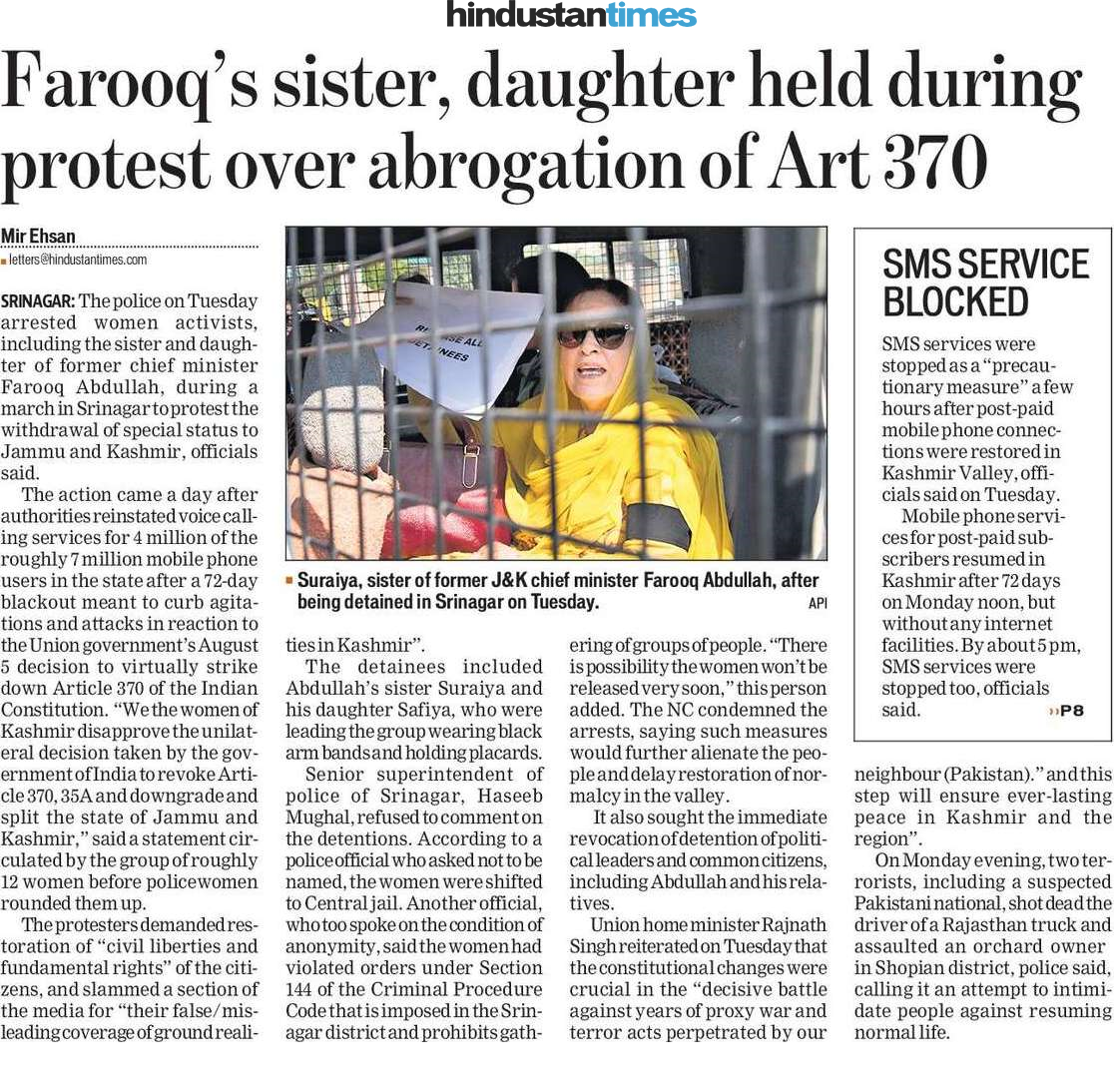
Farooq Abdullah’s sister, daughter detained after protest

http://

Srinagar, October 15  

A group of Kashmiri women led by former Jammu & Kashmir Chief Minister Farooq Abdullah’s sister Suraiya and daughter Safiya staged a protest here on Tuesday against the scrapping of Article 370.

The 20-odd women were protesting against the scrapping of Article 370 and 35A on August 5. They were carrying placards which read, ‘Kashmiri brides not for sale’, ‘Why downgrade Jammu and Kashmir state’.

Moments after the women protesters spoke to the media, the police swung into action and took them away to the nearby police station.

“We want to know the fate of those who have been detained, that’s why we are protesting,” said Muslim Jan, an academician.

“The Government of India is telling the world that we are happy, somebody should speak to us to find out how we are feeling, we are not happy, there are restrictions in Kashmir, we are highlighting those issues,” said Hawa Bashir, an academician.

“We the women of Kashmir disapprove of the unilateral decision taken by Government of India to revoke Article 370 and 35A and downgrade the status of Jammu and Kashmir,” a statement by the protesting women said.

“We feel betrayed, humiliated and violated as people. We demand restoration of civil liberties and fundamental rights of civilians. We demand demilitarisation of rural and urban areas. We demand immediate release of detainees. We express outrage against national media for their false and misleading coverage of ground realities in Kashmir.”

The Public Safety Act has been slapped against Farooq who is lodged in his house, G-40, at Srinagar’s posh Gupkar Road.

Earlier, his daughter Safiya had put up a black flag, seemingly as mark of protest against the revocation of special status of J&K outside her house.

The J&K administration has justified the slapping of PSA on the National Conference president on the grounds that he has “tremendous potential to create public disorder in Srinagar and other parts of the Valley”.

The administration has cited several instances since 2016 when he made statements in conflict with the law.

Farooq’s son and former Chief Minister Omar Abdullah is detained in Hari Niwas. Farooq’s brother and senior National Conference leader Mustafa Kamal has been detained at his home. — IANS


Pak must end support to terror groups: US Senator

Pak must end support to terror groups: US Senator

Washington, October 12

Pakistan must end support to terrorist groups, a top US Senator has said, a day after meeting Prime Minister Imran Khan and the army chief, discussing with them what more can be done to preempt terror attacks and prevent the spread of radicalism.

Senator Maggie Hassan also called for finding ways to de-escalate the tension between India and Pakistan that spiked after New Delhi revoked the special status of Jammu and Kashmir in August.

She said Pakistan has an important role to play in stabilising Afghanistan, where the US has come under increasing criticism for civilian causalities as a result of airstrikes in the recent months.

Asserting that her top priority is to keep “Americans safe” and promoting stability and ongoing counterterrorism measures are critical to that effort, Hassan on Friday said, “It was particularly helpful to discuss with key Pakistani leaders what more can be done to preempt terrorist attacks and prevent the spread of terrorist ideology.” “Moreover, it was important for us to communicate directly to Pakistan’s senior leadership that they must end support to the Taliban and other terrorist groups. In addition, amid escalating tensions in Kashmir, it’s critical that we find ways to help de-escalate the situation on both sides,” she said after concluding her trip to Pakistan and landing in India for meetings with the Indian leadership.

US Senators Hassan and Chris Van Hollen met Pakistan Prime Minister Imran Khan, Chief of Army Staff General Qamar Javed Bajwa and officials from the Pakistan-occupied Kashmir on Thursday.

Hassan and Hollen also visited Pakistani-occupied Kashmir to observe conditions on the ground and push for a de-escalation of the situation, including calling on India to end its curfew, release prisoners, and restore communications.

Ties between India and Pakistan came under severe strain after New Delhi revoked Jammu and Kashmir’s special status on August 5. Pakistan reacted angrily to the move and expelled the Indian envoy. Since then, Pakistan has been trying to rally international support against India on the issue.

India has been maintaining that the Kashmir issue is a bilateral matter between India and Pakistan and there is no scope for any third-party mediation.

In India, Hassan will meet key political and business leaders and US embassy officials to discuss the situation in Kashmir, the US-India relationship and international trade.

Before visiting Pakistan, the two senators travelled to Afghanistan and met presidential candidate Abdullah Abdullah as well as several Afghan women officials who had represented the strife-torn country in talks with the Taliban.

“We heard directly from US and Afghan officials about the threat posed to both of our countries from IS’s growing regional affiliate,” Hassan said