Sanjha Morcha

Afghan Taliban ‘releases’ 3 Indian engineers held hostage for a year

Afghan Taliban 'releases' 3 Indian engineers held hostage for a year

The prisoner swap happened on Sunday. File photo

Islamabad, October 7

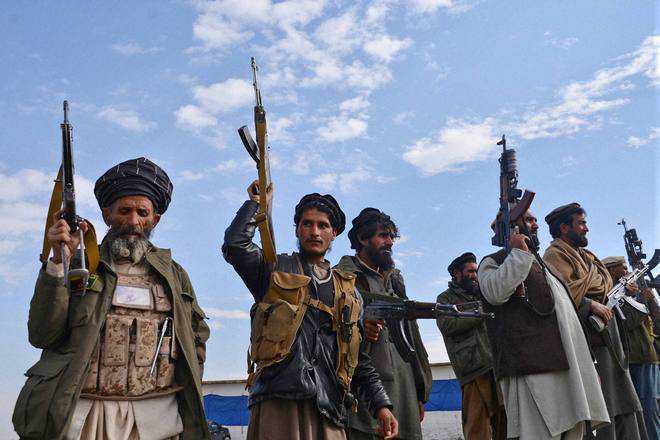
The Afghan Taliban said it had freed three Indian engineers held hostage for over a year in an exchange for securing the release of 11 of its members, including some high-ranking officials of the militant group, according to media reports on Monday.

Speaking on condition of anonymity, two Taliban officials refused to say who the militant group exchanged the prisoners with and whether the freed Taliban members were being held by Afghan authorities or US forces in Afghanistan, The Express Tribune reported.

However, the Associated Press reported that the 11 militants were released from Afghan jails.

The prisoner swap happened on Sunday, the paper quoted the Taliban officials as saying, but it did not disclose the location.

Seven Indian engineers working for a power plant in Afghanistan’s northern Baghlan province were kidnapped in May 2018.

One of the hostages was released in March, but the fate of the others remained unknown.

The identities of the released hostages were not disclosed by the militant group, the paper cited an RFE/RL report.

The officials said the freed Taliban leaders included Sheikh Abdur Rahim and Mawlawi Abdur Rashid, who had served as the insurgent group’s governors of Kunar and Nimroz provinces respectively, during the Taliban administration before it was deposed by the US-led forces in 2001.

The Taliban officials provided a photo and footage of what they said was the freed militants being greeted after their release.

There was no immediate comment from Afghan or Indian authorities, the report said.

The release follows meetings between US special envoy to Afghanistan Zalmay Khalilzad and Taliban representatives led by Mullah Abdul Ghani Baradar.

Baradar, along with a 12-member delegation, had been in Islamabad since Wednesday on the invitation of the Pakistan government.

The Taliban delegation also called on Foreign Minister Shah Mahmood Qureshi and exchanged views on peace and stability in the South Asian region and bilateral relations in their meeting.

Since his appointment in September last year, Afghanistan-born Khalilzad has met all sides in an attempt to end America’s longest war in which the US has lost over 2,400 soldiers in more than 17 years.

The US and the Taliban had agreed on draft peace plan, but the process was suspended by US President Donald Trump following killing of an American soldier in Kabul last month in a suicide attack claimed by the Taliban.

Trump stunned the world when he suddenly declared that the Afghan peace talks with the Taliban were “dead”.

He cancelled a secret meeting with the Taliban and Afghan President Ashraf Ghani at Camp David near Washington after the Taliban claimed responsibility for the attack in Kabul, in which an American soldier was among the dead.

The US has continued to push for a ceasefire in the war-torn country and the opening of negotiations between the Taliban and the Kabul government.

The Taliban, however, have repeatedly refused to meet officials of the Afghan government, whom they dismiss as “puppets”. PTI


India’s One-China policy is flawed

It can’t validate its claim over Arunachal without recognising the historical independence of Tibet
China modelled itself on the Soviet idea of a republic where nationalities are bundled together by coercion or occupation 

Whenever the president of China visits India, the Indian police locates me, no matter where I am and throws me into the nearest central jail.

This time, when the Narendra Modi-Xi Jinping Chennai Connect was happening, I went to gatecrash the party. Imagine a scene. As the two Asian leaders meet for that iconic photograph, greet each other and raise their clutched fists together in front of the legendary Krishna Butterball, all of a sudden, they hear a noise from behind the boulder. As the cameras hurriedly pan left, they see a man on the nearby cellphone tower unfurling a long red banner reading “Free Tibet” down the length of the tower and screaming the Free Tibet slogan at the top of his voice.

As with most things in life, this dream protest didn’t materialise — I was arrested days before the summit.

I had done such protest stunts earlier, successfully, twice — by climbing the Oberoi hotel in 2002 in Bombay, and the Indian Institute of Science building tower in 2005 in Bangalore. This lone act helps in raising the real issue between the “new neighbours”, India and China; the issue of 70 years of Chinese occupation of Tibet and its dangers to India. Indian security establishment officials tell me that is also why the Indian government gets the usual request from the Chinese embassy in Delhi to put me away every time there is such a visit.

The post-arrest interaction with the police is most rewarding for me. I sit with police officers, and start my chai pe charcha on Tibet. The current narrative in India is only concerned with the “China border”, which started from the 1962 Chinese aggression in the Tawang region, and it got reinforced after the Doklam stand-off. India never had any borders with China; it was only after the Chinese occupation of Tibet that China appeared over the Himalayas. Neither the media-crafted narrative nor the organised education system gives any clear picture about Tibet — what lies behind the Himalayas, the real civilisational neighbour with whom India shares a 4,085km border.

As India was emerging as an independent country, it organised the first Asian Relations Conference in the presence of Mahatma Gandhi, and Tibet was present there as an independent country. Between 1947 and until the Chinese invasion, Tibet and India shared equal status as independent countries for three years. There was even an Indian high commissioner in Lhasa.

With the founding of Mao Zedong’s People’s Republic of China in 1949, Jawaharlal Nehru’s India calculated its interest was best served by convergence with China. India became one of the first countries to recognise Tibet as a part of China, straining our previous cordial relations. Not keeping all the eggs in one basket, India continues to host the Dalai Lama and 100,000 Tibetan refugees here.

As a newly founded communist country, the rise of China was supported by India in its early stage, and later, its growth was facilitated by the United States. India’s blunt stand “Tibet is a part of China” from the 1954 Panchsheel agreement was later reiterated by Rajiv Gandhi during his 1988 Beijing visit. But Atal Bihari Vajpayee’s government brought in a nuanced articulation in its 2003 statement saying “Tibetan Autonomous Region is a territorial part of People’s Republic of China”.

Indian nationalism is often stumped when China claims Arunachal Pradesh as part of “South Tibet”. But this requires context. The Tawang region, the birthplace of the sixth Dalai Lama, was part of Tibet until the agreement in 1914 resulted in the McMahon Line. This bifurcated the entire region of Tawang and made it a part of British India, with maps drawn and documents signed. The Dalai Lama stands by this and has repeatedly reiterated it during his subsequent Tawang trips. India, therefore, has historical, legal and documentary evidence of this political move.

Where was China when this decision was made? China had recently won its independence in 1911 after being occupied by the Manchu empire for over 250 years. And under the leadership of Sun Yat-sen, the Republic of China was being established. The fact that China did not sign the Simla Agreement has no bearing on the McMahon Line — the latter was a bilateral treaty (between British India and Tibet), and the Simla Agreement was trilateral (between British India, Tibet and China). The McMahon line keeps the peace between the Chinese and Indian military even today.

In this backdrop, how does India hope to validate its claim over Arunachal without recognising Tibet, which gave away Tawang to India? Whether India supports the ongoing Tibetan freedom movement or not may be a strategic call, but without recognising the historical independence of Tibet, wouldn’t India’s control over Arunachal Pradesh look like the Chinese occupation of Aksai Chin? Perhaps, if the Chinese push comes to shove, India may be forced to recognise the Tibetan government-in-exile and the Dalai Lama as the leader of Tibet.

India and China emerged as Asian giants in the chaotic period of establishing their respective republics; India as a federal State, and China, modelled on the Soviet idea of the republic where nationalities are bundled together by coercion or by military occupation.

India and China formulated the One-China, One-India policy. Today, India is a democracy and only has to deal with the Kashmir issue. But China is facing resistance movements in Tibet, East Turkestan (Xinjiang) and Southern Mongolia. The five-month revolt in Hong Kong is also hugely significant for it shows the limits of Chinese power, and may be inspiring citizens inside China. Taiwan too remains a concern for Beijing. This makes Delhi’s One-China policy absolutely lopsided in terms of diplomacy. India has to remain silent on 60% of contested area under China’s territorial control, and also its rule over Hong Kong and claims over Taiwan, while China has to stand with India only on Kashmir. And it does this too unfaithfully, as we have seen recently at the United Nations.

The Bharatiya Janata Party government has a unique opportunity to finally carry out Sarder Vallabhbhai Patel’s policy statement that he wrote as a letter to Nehru, advising him to support Tibet, and take every precaution against “expansionist China”. Will the Modi government act on Sardar Patel’s words or remain satisfied with just his statue?

The 12-day stay in central jail in Chennai was my 16th jail term. It was a great retreat and better than the one I had in Sewagram. As a Tibetan born in India, India is as much my country as Tibet. The Dalai Lama doesn’t look at China as an enemy, but as nation afflicted with anger and greed.

Whether China quits Tibet or not, the Buddha will not abandon the suffering. China is now stuck with us, our journey together is our path to freedom.

Tenzin Tsundue is a Tibetan writer and activist

The views expressed are personal


BRO uses concrete block technique on Zojila

BRO uses concrete block technique on Zojila

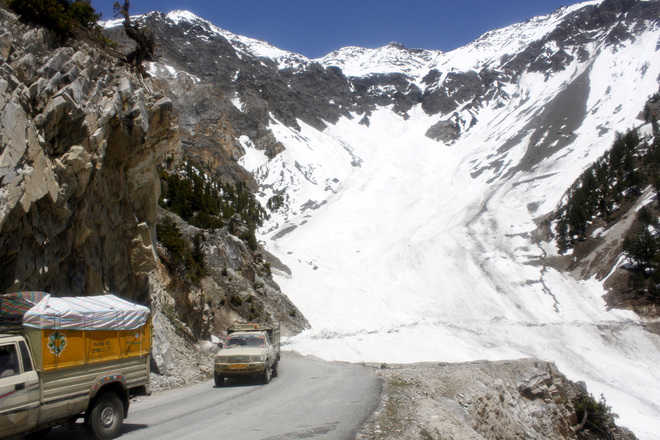
Vehicles in the Zojila area. Tribune Photo: Mohd Amin War

Tribune News Service

Jammu, October 4

The Border Roads Organisation (BRO) is laying the Srinagar-Leh road at Zojila with concrete blocks which can bear extreme weather conditions on one of the highest motorable roads.

According to a BRO official, 3-km stretch of the upper alignment of the Zojila has been completely paved with the “interlocking concrete block” on which vehicles can move smoothly.

“The laying of concrete blocks will provide smooth road access to the vehicles. As the stretch is located at a very high altitude faced with extreme weather, the blocks provide friction and can withstand extreme weather in freezing cold and icy surface. The block laying is a fine replacement for black topping, which is not possible at such an unfavourable spot,” the official said.

The official said the plan was to lay concrete blocks for 6 km of the Pass and thus far, 2.5 km had been completed.

“The pending work will be completed in the upcoming season. Because of the heavy rush of transport due to stocking time, this season won’t provide much time for the laying of blocks on the stretch,” he said.

As the road is vulnerable to landslides due to snowfall and frequent rainfall which damage the road surface, the interlocking technique of concrete blocks offers much resistance against weather and has a longer life.

“The concrete blocking is best for such conditions. Blocks will not slide or move as these are fixed on all four sides for strong and firm grip,” the official said.

The Srinagar-Leh highway remains closed for half of the year due to snow and slides during winter, and restoring and repairing Zojila is a daunting task for the BRO.

The highway sees a daily rush of hundreds of heavy truckloads and passenger vehicles from the Ladakh region, putting a lot of pressure on the stretch.


Bipin Rawat’s plan to train jawans for officer role is Army admitting staff shortage, quality idrw.org .Read more at India No 1 Defence News Website https://idrw.org/bipin-rawats-plan-to-train-jawans-for-officer-role-is-army-admitting-staff-shortage-quality/ .

Army Chief Bipin Rawat inaugurated the Young Leaders Training Wing at the Officers Training Academy in Chennai last week. The belated attention to personnel training is a laudatory effort that addresses several issues the Army is facing – the shortage of officers and stagnation. It is also an admission that despite the extra focus on nationalism, the Army is not getting, retaining and upgrading the quality of officers. The Army needs to rebrand and market itself again. Tackling twin issues The Young Leaders Training Wing (YLTW) at the Officers Training Academy (OTA) aims to better the prospects of jawans through a structured ‘personality enrichment programme’ so that they are better equipped to clear the tough Services Selection Board (SSB) and join the military academies to become officers. There are three schemes in vogue – regular entry through Army Cadet College/Indian Military Academy, Special Commissioned Officers, and Permanent Commission (Special List). For each of these schemes, there is a written examination. Selected candidates have to clear the SSB tests and interviews, which the soldiers find tough to crack, resulting in intake shortfall. Earlier, such training was being carried out in an ad hoc manner within the formations and in a semi-structured manner at the Army Education Corps Training College, Pachmarhi, Madhya Pradesh. The results were not up to the mark. The soldiers also resorted to going to private institutions run by retired officers and paid hefty fees to improve their prospects. General Bipin Rawat emphasised the dual benefit of YLTW: “We will get more officers and there will be a further promotion opportunity for JCOs (Junior Commissioned Officers) and NCOs (Non Commissioned Officers).” The Army Chief also made an interesting observation when asked about the shortage of 7,680 officers in the Army: “Promotion within the Army is very tough. This shortage is actually helpful because otherwise the promotion will become even tougher. The Army is managing very well.” The establishment of YLTA and the Chief’s observation with respect to the shortage of officers raises two important, interlinked issues – the empowerment of soldiers and junior leaders, and the management of the officers corps. Empower junior leaders, build academies For the last three decades, the shortage of officers has been a major issue within the Army, adversely affecting the operational efficiency in operational and counter-insurgency areas. The situation was such that it was made mandatory for young officers commissioned into the services to do a three-year stint with infantry/Rashtriya Rifles units in operational/insurgency areas. The Parliamentary Committee on Defence has raised this issue on several occasions. The shortage of officers is a result of rapid expansion of the Army, inadequate capacity of military academies, poor quality of candidates, an increase in authorisation of officers in units to compensate for non-empowerment of junior leaders, and poorly managed short service commission. A related problem is poor career prospect for the officer corps due to the rank hierarchy in the Army – more the number of officers, greater the frustration due to supersession. A lopsided rank-related pay structure as well as a strict premature retirement policy have only compounded the problem. Through concerted efforts on increasing the capacity of the military academies, the shortage has been reduced from an alarming 20 per cent to a manageable 15 per cent, which, as the Chief said, actually “helps the rest”. All other things being equal, and based on the capacity of military academies, it shall take 15 years at the rate of 1 per cent per year to completely wipe out the deficiency. The Army needs to have a visionary approach towards management of the officer cadre, and the linked issue of empowerment of soldiers and junior leaders. During World War 2, an infantry battalion fought the war in Burma, with 11 officers and 24 JCOs authorised in a unit. Today, we have 21 officers and 55 JCOs authorised in a unit. Similar situation persists in other arms and services. Grassroots fighting still takes place at the section and platoon level and both these are commanded by NCOs/JCOs. If officers have to step in to ‘lead them from the front’ in the battle, then it reflects poorly on the calibre of the junior leaders. We need to optimise the authorisation of officers in the units and not view them as a tool to compensate for poor junior leadership. To empower our junior leaders, we need to raise the standard of educational qualification from matriculation to 10+2 and graduation at the time of recruitment. Graduates are required for technical operations and high technology weapons and support systems. Dedicated junior leaders’ academies must be set up. No one must become a section or a platoon commander and equivalent without requisite formal training in a junior leaders’ academy. Deal with stagnation About 15 years ago, it was decided that to deal with the stagnation issue, the intake of regular and short service commissioned officers must be in the ratio of 45:55. We have failed to make the short service commission attractive. The Indian government does not absorb them laterally in the Central Armed Police Forces (CAPFs) or give them any weightage for selection in civil services. Compounding the problem, the Army itself is liberal in giving permanent commission as a ‘welfare measure’, defeating the aim of reducing stagnation. The Chennai-based OTA, which trains cadets for short service commission, has a capacity of 750 cadets but is functioning at 500 due to poor intake. This reduced capacity of 500 is itself undersubscribed by 16 per cent. Even the Indian Military Academy is functioning at 11 per cent below its capacity. There is a need to make it mandatory for students passing out of the state-subsidised Sainik schools and military schools to apply for the National Defence Academy (NDA). The Army should look at reducing the contractual liability to reduce stagnation. All western armies have taken this route – reduced contractual period with attractive incentives for a second career. There is a strong case for reducing the contractual period to 15 years in our case. Premature retirement also must be liberalised. It is not the gun but the ‘man behind the gun’ that matters. The more we invest in human resource the better would be the dividends. The shortage of officers was a bogey call. While a reformed short service commission, reduced contractual obligation and liberalised premature retirement will help, the key to better manage the officer cadre is through empowerment of soldiers and junior leaders. Posted in India


Capt meets Modi, proposes canalisation of Punjab’s major rivers

Capt meets Modi, proposes canalisation of Punjab’s major rivers

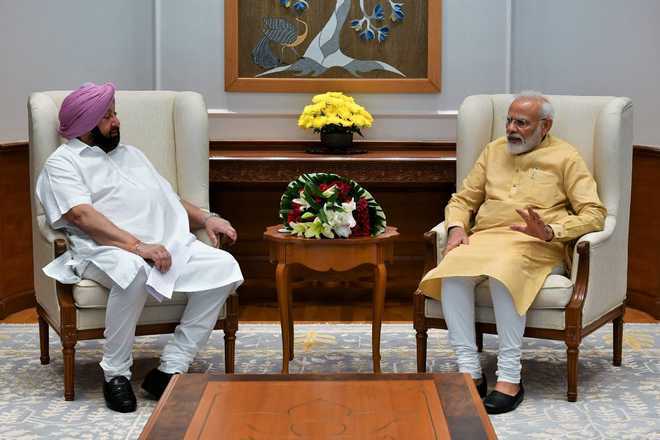
Captain Amarinder Singh and PM Narendra Modi.

Tribune News Service
New Delhi, October 3

Punjab Chief Minister Captain Amarinder Singh on Thursday urged the Central Government to take up canalisation of the state’s three eastern rivers of the Indus water system as a national project, to enable conservation of water and enhancement of the region’s economic growth.

In his proposal presented to Prime Minister Narendra Modi during a meeting here, the Chief Minister suggested construction of high-speed economic corridors on 985 km long river embankments, apart from river training works, flood protection measures and lining of internal side-slopes of the Sutlej, Ravi and Beas.

The move, Capt Amarinder said, would help the state enhance its ‘jal shakti’ (water power) to encourage diversification of agriculture, promote quality urbanisation and colonisation, and to speed up industrialisation for better and quicker economic emancipation of our citizens.

Complimenting the Prime Minister on his initiative to provide drinking water to each household in the country, through the creation of the new Ministry of Jal Shakti, and the inception of Jal (water) Jeevan (life) Mission and the “Nal se Jal” (tap water) scheme, Captain Amarinder said his government also stands committed to the cause of providing drinking water to its citizens under the initiative ‘Har Ghar Pani, Har Ghar Safai’ (water and sanitation for every household).

The Chief Minister, while expressing concern over the state’s reduction in ‘jal shakti’ at the time of India’s Partition and against during the reorganisation of the state in 1966, pointed out that the three perennial rivers of the Sutlej, Ravi and Beas irrigate only about 27 per cent of the state’s cultivated area, leading to over-exploitation of the ground water. It is apprehended, he further noted, that seven districts of the state will transform into a desert in the near future, with sure signs of poverty revisiting these areas.

Underlining the need to increase water productivity through augmentation and strengthening of water management, control and regulation infrastructure, Captain Amarinder suggested launch of the cannalisation project with the Sutlej river, which would require an investment of about Rs.4000 crore (US $ 0.7 billion) over a period of 3 to 5 years, exclusive of external incentives such as commercial exploitation of Government and private land and waiver of taxes, duties and cesses, as relevant.

The task may begin with a feasibility study that may be assigned to techno-economic experts of international repute, he suggested.

The Chief Minister assured that the state would extend its full cooperation to get the proposal realised in terms of sending a team of officers from the Punjab Government to engage and discuss the same with the officials of the Union Ministry of Jal Shakti.

Captain Amarinder also underlined the need to harness the river water which was currently flowing into Pakistan during the monsoons. Pointing out that the three rivers as of now have kutcha (earthen) embankments, measuring 945.24 km; (Sutlej 484.12 km, Ravi 245.28 km and Beas 215.84 km), covering almost over 60 per cent of state’s area, he observed that the 1/3rd of the state’s population living in the riverfront areas was also suffering due to the flooding that occurs during the monsoon period.

The canalisation of rivers and development of riverfront areas will expand activities leading to widening of the base of Punjab’s economy, diversifying economic activities and sources of livelihood for State’s rapidly growing younger generation, he added.


Vigil up, more bunkers, ‘prohibited areas’ in J&K

Vigil up, more bunkers, ‘prohibited areas’ in J&K

Srinagar, September 29

Security forces have intensified surveillance and area domination operations in Kashmir following Saturday’s militancy-related incidents, including a grenade attack on security forces in old city, a senior security official said.

Anti-insurgency operations were intensified as part of a proactive strategy to foil any plans of militants to stage any attacks on security forces in the Valley, the official said.

The official said: “As the situation has more or less normalised on the law and order front, the anti-terrorist operations have been intensified to ensure ultras do not stage any attacks.”

As part of the drill, security has been beefed up around vital installations, including the Srinagar airport and police offices. Security bunkers were being constructed in the Valley, the official said.

Extended security perimeters had been established around police offices and other vital installations, he added. — PTI


India slams China’s statement, says J-K reorganisation internal affair

India slams China's statement, says J-K reorganisation internal affair

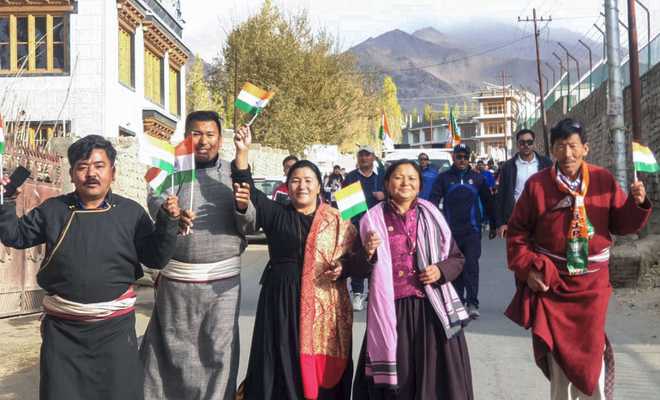
People celebrate the transition of J&K into union territories, in Leh on Thursday, October 31, 2019. PTI

New Delhi, October 31

India on Thursday hit back at China after it objected to the bifurcation of Jammu and Kashmir into two union territories as “unlawful and void”.

In a strongly-worded reaction to Bejing’s criticism, the External Affairs Ministry raised the issue of China’s continued occupation of a “large tract” of area in the Union Territories of Jammu and Kashmir and Ladakh.

Asking China not to comment on India’s internal affairs, the ministry also said the neighbouring country illegally acquired Indian territories from Pakistan-occupied-Kashmir (PoK) under the so-called China-Pakistan Boundary Agreement of 1963.  

“The matter of reorganisation of the erstwhile state of Jammu & Kashmir into the Union Territories of Jammu & Kashmir and Ladakh is entirely an internal affair of India. We do not expect other countries, including China, to comment on the matters which are internal to India, just as India refrains from commenting on internal issues of other countries,” the MEA said in a statement.

On Thursday, Jammu and Kashmir, and Ladakh became separate union territories around three months after the NDA government announced withdrawing J&K’s special status and splitting it into two union territories. 

In Bejing, China’s Foreign Ministry spokesman Geng Shuang said, “India unilaterally changed its domestic laws and administrative division challenging China’s sovereignty.”

“This is unlawful and void and this is not effective in any way and will not change the fact that the area is under Chinese actual control,” he said.

Rejecting China’s comments, the MEA said the neighbouring country continues to be in occupation of a large tract of area in the Union Territories of Jammu & Kashmir and Ladakh.

“It has also illegally acquired Indian territories from Pakistan-occupied-Kashmir (PoK) under the so-called China-Pakistan Boundary Agreement of 1963,” it said.

It said India has consistently conveyed its concerns to both China and Pakistan on the projects in so-called China-Pakistan Economic Corridor which is in the territory that has been illegally occupied by Pakistan since 1947.

Referring to the boundary question, the MEA said India and China have agreed to seek a fair, reasonable and mutually accepted solution to the issue through peaceful consultations on the basis of the political parameters and guiding principles that were agreed in 2005.

“This was reiterated also in the 2nd India-China Informal Summit between Prime Minister and President Xi in Chennai earlier this month. In the interim, the two sides have also agreed to maintain peace and tranquility in the border area,” it said. — PTI


In Kashmir, EU MPs call on 20 delegations

hutdown, clashes Four civilians and a CRPF jawan injured; European Union members also visit 15 Corps headquarters in Srinagar

Mir Ehsan

mir.ehsan@htlive.com

Srinagar : A delegation of 23 EU MPs, on a two-day visit to assess the situation in Jammu and Kashmir, arrived in Srinagar on Tuesday to a complete shutdown and clashes between people and security forces in several parts of the city and the Valley.

A convoy of security vehicles escorted the MPs, who were travelling in bullet-proof vehicles, from the airport to their hotel where a traditional Kashmiri welcome awaited them.

Jammu and Kashmir chief secretary BVR Subrahmanyam and police chief Dilbag Singh briefed the members of the European Union (EU) delegation, the first high-level foreign visitors to Kashmir after the August 5 decision of the Centre to revoke the state’s special status and bifurcate it into two union territories.

The delegation visited strategic 15 Corps headquarters and was briefed by top security officials about the situation in Kashmir and on the Line of Control (LoC). Later, the EU MPs held meetings with several delegations which had come from various parts of Kashmir.

NC Mps ‘not invited’

The delegation held separate meetings with members of urban local bodies, panchayat members, leaders of some mainstream political parties, representatives of NGO’s and newly-elected BDC chairpersons.

Officials said more than 20 delegations from Kashmir met the EU MPs and most of them arrived at the high-end hotel on the picturesque Zabarwan Mountains in cars with tinted glasses.

However, members of prominent trade bodies, politicians and civil society members and activists were not invited for the meeting with the EU delegation. Even the two sitting National Conference MP’s —Akbar Lone from Baramulla and Hasnain Masoodi from Anantnag—were not invited for the meeting.

An eight-member delegation from the Bharatiya Janata Party under the chairmanship of party spokesperson Altaf Thakur met the EU MPs. “We had a seven minute meeting with the EU members and told them about the real situation in Kashmir. We also conveyed that Article 370 was the biggest hindrance to peace, employment and development in the state, which boosted terrorism,’’ Thakur said.

A six-member delegation from Janta Dal (United) also met the EU MPs. The party’s state president Ghulam Nabi Shaheen said, “We told them we want industries and an end to unemployment and also presented facts about the situation in the Valley.”

Baramulla municipal council deputy chairman Abid Salam, who also met the delegation along with a group said they talked about how Article 370 was a hindrance to development in the state.

“They asked us about urban local bodies and panchayat elections and sought our opinion on ground realities,” he added.

Sofi Arfat, who is the councillor from Ashmuqam Municipal Council said their group told the EU delegation that after abrogation of Article 370, the onus is now on the central government. “The centre is saying that revocation of Article 370 is for betterment of the people. Now, it is time to prove it,” Arfat said.

A delegation of panchayat members led by GM Sofi, who is general secretary of Awami Panchayat Raj, said he told the EU MPs that Pakistan is spreading terrorism in Kashmir from past 30 years and EU didn’t raise its voice. “It has destroyed Kashmir. We have our Reshi culture and nobody talked about terrorism. There was no development and unemployment is at its peak besides political corruption,” Sofi said.

Srinagar MP Husnain Masoodi said, “There are three elected representatives from Kashmir in the parliament. Although Farooq Abdullah is under detention, I along with MP Akbar Lone came to Srinagar and made an attempt to approach authorities for a meeting with the EU delegation. The government didn’t respond to our request.”

Masoodi said they expected the authorities as well as the EU MPs to enquire from the government about them. “They (EU members) should have made an attempt to meet us. This impacts the credibility of the entire exercise. It has become nothing but a guided sightseeing,” he said.

The delegation will leave for New Delhi on Wednesday.

Four civilians, CRPF jawan hurt in clashes

Fresh clashes between youth and security forces erupted in the city and other parts of the Valley in which more than four people were injured after pellets were fired on the protestors. A CRPF jawan was also injured during the protests.

Since abrogation of Article 370, the Valley has been witnessing a complete shutdown against the removal of the state’s special status. However, shops that usually remained open for two hours in the morning were shut on Tuesday.

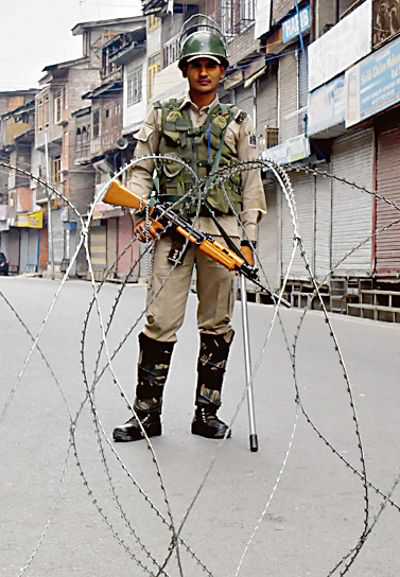
In old city, clashes erupted at many places despite heavy deployment of troops at sensitive places. Police had placed barbed wires at several places to prevent stone pelting or protests.

Official’s privy to records said more than 30 incidents of stone pelting and protests were reported from different parts of Kashmir and at some places security forces used tear smoke shells and pellets to disperse the protestors. “Four people received pellet injuries during protests at different places,” a senior police officer said.“A CRPF jawan suffered injuries on his foot. He is stable,” an official said.

CRPF spokesperson Pankaj Singh said a head constable got minor injuries in Natipora area.

With agency inputs


China’s New Aircraft Carriers Are Getting Stealth Fighters

China is steaming ahead with plans to build four large, flat-deck carriers equipped with catapults, having already launched two lower-capacity carriers with curved ski-ramp decks.

Meanwhile, the PLA Naval Air Force is already looking ahead to outfit those carriers with the gold-standard of twenty-first century military aviation: stealth fighters.

China has two designs it could have adapted for the job—and recent reports suggest it may have chosen the heavier, harder-hitting option.

The J-15 Flying Sharks currently in service are an adaptation of Russia’s Su-33 Flanker jet. On paper, the Flying Shark has marginally superior specifications compared to the FA-18E/F Super Hornets flown by the U.S. Navy.

But in practice, the J-15 still suffers from numerous flaws, particularly related to its engines. Four of the roughly fifty J-15s built have already been lost in accidents. Furthermore, the J-15 can only carry a very light payload when taking off from the curved deck of China’s first two carriers.

Though the catapults and larger flight decks on China’s next four carriers should address this problem, the PLA Navy is apparently interested in a step change to operating a stealth fighter.

Stealth technology is by no means a perfect defense, but it allows for drastically greater survivability when facing enemy fighters and air defense systems which could launch missile attacks from dozens of miles away.

For China, those threats could come in the form of U.S. or Japanese fighters armed with long-range air-to-air missiles and warships armed with the powerful, multi-layered Aegis air-defense systems.

But which jet?

China has two stealth jet options it could adapt for carrier operations: the heavier, twin-engine Chengdu J-20 Mighty Dragon stealth fighter already in service with the PLA Air Force—or the smaller, single-engine FC-31 Gyrehawk privately developed by the Shenyang Aviation Industrial Corporation.

The latter bears a strong resemblance to a slimmed-down American F-35 jet—perhaps related to the fact that F-35 design schematics were stolen from BAe computers in 2007.

The Chinese military has displayed the J-20 to the public in recent events, but it has yet to order any of the lower-end Gyrehawks—which are officially for export. The FC-31 would likely be re-designated the J-31 if it ever enters Chinese service.

Single-engine fighters are cheaper to build and operate, but typically carry less fuel and weaponry and often have lower maximum speeds. Relying on just one engine also means they are more likely to be lost in the event of an engine failure.
But space and weight are big issues when it comes to taking off and landing a huge fighter on a carrier deck. The J-31 reportedly weighs 17 tons empty and 31 tons at maximum takeoff weight, whereas a J-20 clocks in at 21 empty and maxes out at nearly 41 tons. Furthermore, the Gyrehawk is more compact at 17 meters long compared to the Mighty Drago’s 22-meters.

To be fair, however, the now-serving J-15s are already larger than both at 24 meters, so length may not be an insurmountable obstacle.

Of Fighter Jets and Economic Recessions

By mid-2019, analysts and media were increasingly convinced the slighter J-31 was more likely to find its niche as China’s carrier-based stealth jet .

But on August 27, an article in the South China Morning Post flipped the consensus on its head: according to journalist Minnie Chen, defense insiders had indicated China’s Central Military Commissions were secretly tilting towards the twin-engine J-20 over the J-31.

As the U.S. Navy has until recently relied on large twin-engine fighters (the F-4 Phantom, F-14 Tomcat, and FA-18 Hornet and Super Hornet), a larger carrier-based fighter is hardly beyond the pale. Despite the costs and disadvantages imposed by its size, the J-20’s likely higher maximum speed and capacious internal weapon bays suggest it might make a better interceptor and long-range strike plane.
The J-20’s claimed combat radius of 1,100 miles on internal fuel is more than double the unrefueled range of the American Super Hornet and beats the F-35C by nearly 66 percent. That means a Chinese carrier could theoretically launch J-20s to strike U.S. carriers or bases while remaining out of range of retaliatory strikes.

But according to Chen, the overriding factor favoring the J-20 is that it’s already in service and had matured from years of testing and operations, while only two FC-31 prototypes have been built.
PLA Navy was not confident that the funding for such an expensive process could be assured in the event of an economic recession, and that it made more sense to stick with the proven J-20. As China has assigned different designations to its Flanker-family of jets (see the J-11, J-15 and land-based J-16), it possible a carrier-based J-20 will receive a new model and name, rather than being a sub-variant of an existing design.
While Chinese defense analyst Song Zhongping is quoted as suggesting the FC-31 might still show up as a little-brother complementing the J-20 on Chinese carriers, even Beijing will probably pass on funding two stealth fighters to perform broadly similar jobs.

What Would a “Mighty Sea Dragon” Look Like?

We can reasonably forecast that a “navalized” J-20 would likely include folding wings for easier stowage inside the carrier; a tail hook to snag arrestor cables while making a landing approach; heavier, ruggedized landing gear designed to latch onto catapults and absorb the harsh shock of a carrier landing; and some form of automatic carrier-landing systems.

These modifications will add weight and decrease speed and range. Chinese engineers may try to compensate by trimming other systems, using more lightweight composite materials and/or enlarging the fuel tanks.

However, Chen’s reporting indicates that Chengdu is working on a shortened J-20 airframe to ensure compatibility with the catapult system on the forthcoming Type 003 carrier.

Another modification Chinse engineers might consider, found in the F-35C carrier fighter, is enlarged wings that generate more lift, allowing for slower speeds when attempting a tricky carrier landing. But airframe modifications could be complicated by the need to preserve the base plane’s stealthy geometry.

In early January, there were also graphics shown on Chinese media revealing Chengdu was investigating developing a two-seat J-20 variant optimized for the strike and/or electronic warfare role—and possibly capable of carrier operations. Back seaters greatly ease the load on pilots when handling guided air-to-ground weapons or jamming systems.

Again, however, stretching out a stealth jet for an additional crew member without increasing its radar cross-section could prove difficult—which explains why no one has developed a two-seater stealth fighter so far.

Both Chinese jets suffer from jet engine troubles. While China is struggling to finish development of an indigenous WS-15 turbofan engine for the J-20, it is making do with a Russian AL-31F turbofan with can produce only 77 percent of the thrust. Meanwhile, the FC-31 relies on the Russian RD-93 engine, while it awaits completion of a WS-15 turbofan also intended for use on JF-17 Thunder export fighter.

According to Chen’s sources, it will be at least a decade before China’s naval stealth fighters are operational, so the J-15 will doubtlessly take the lead on operations from China’s forthcoming flat-deck carriers. However, the question remains whether the PLAN will seek an all-stealth carrier air wing, or retain mixed wings including stealth jets and non-stealthy J-15s—similar to the U.S. Navy’s plans to mix Super Hornets and F-35C fighters.

Sébastien Roblin holds a master’s degree in conflict resolution from Georgetown University and served as a university instructor for the Peace Corps in China. He has also worked in education, editing, and refugee resettlement in France and the United States. He currently writes on security and military history for War Is Boring.

Image: Chinese medi


Naga talks likely to extend beyond Oct 31

New Delhi, October 25

With the government firm on “one flag, one Constitution”, talks between the Centre’s interlocutor RN Ravi and representatives of the National Socialist Council of Nagaland-Isak-Muivah (NSCN-IM) remained inconclusive on Thursday, hinting that negotiations on the Naga peace settlement will go beyond October 31— the deadline fixed by the Centre.

Sources in the NSCN-IM said both sides have agreed to more consultations with different stakeholders, including people. The talks were held amid the stalemate over the NSCN-IM’s demands for a separate “flag” and “constitution”.

The deadline of October 31, set by the Modi government to find a solution to the vexed and protracted Naga problem, will be extended following the recent talks, sources said, adding that the issue of a separate flag and Constitution was raised during the meeting but remained inconclusive as both sides “are holding on to their stand”.

The NSCN-IM leadership is of the view that since the Centre has recognised the uniqueness of Naga history and its political situation, Indians and Nagas will co-exist as two entities based on the principle of shared sovereignty.

The sources said there could be a possibility of the interlocutor holding the talks with other Naga insurgent groups like NSCN (Neopao Konyak/Kitovi), NSCN (Reformation) and NSCN (K-Khango) next week. — TNS