Sanjha Morcha

Gen Rawat warns Pak against repeating Kargil misadventure

20TH ANNIVERSARY Says deployment of additional force and alert troops have brought down infiltration rate in J&K

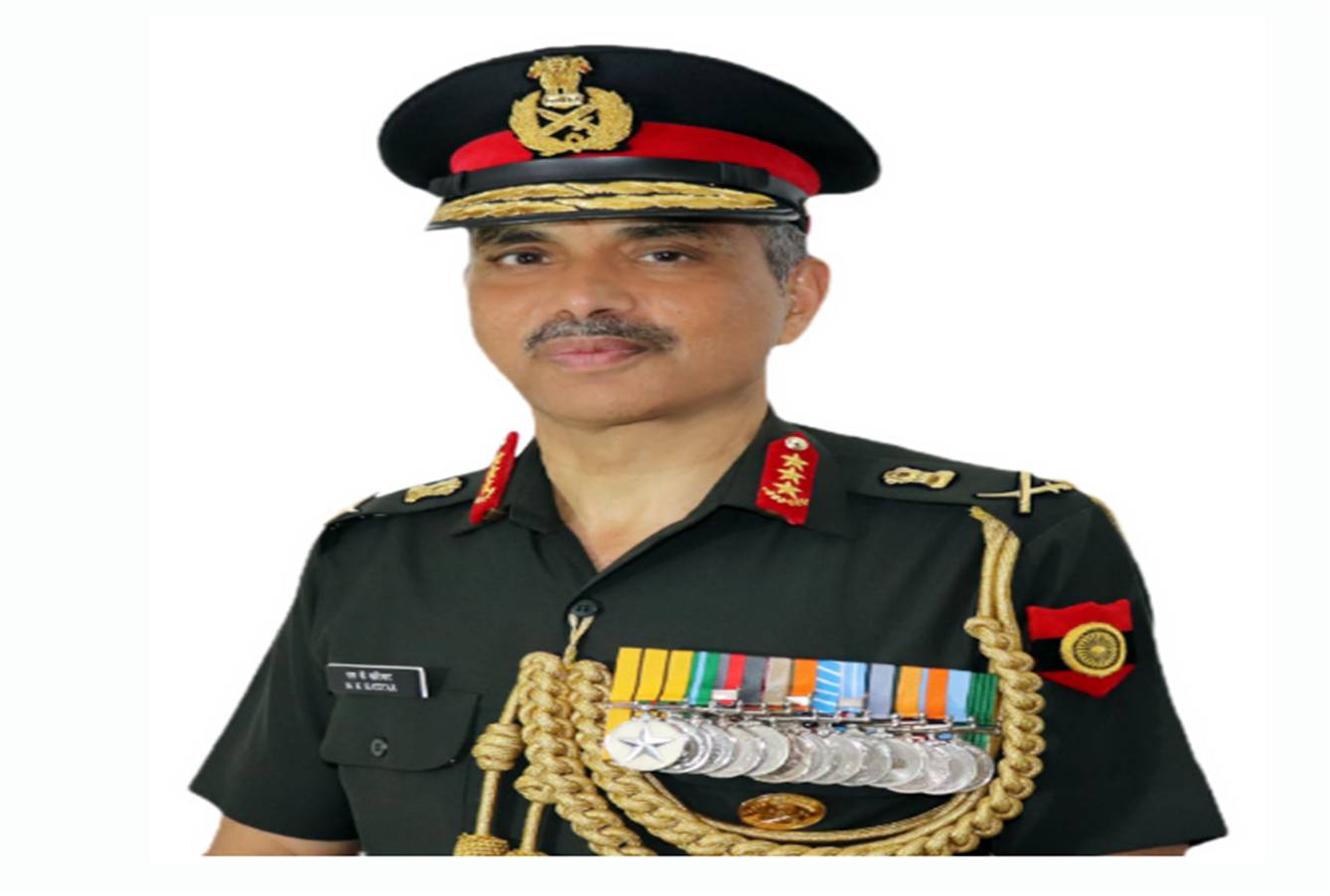
DRASS (KARGIL) : As India commemorated 20 years of Kargil war, army chief General Bipin Rawat warned Pakistan to never attempt to repeat such misadventure in future.

ANI PHOTO■ Army chief General Bipin Rawat with veteran Naik Deep Chand, who was injured in the Kargil war, in Drass on Thursday.

Speaking on the sidelines of a function in Drass sector, General Rawat said adversary (Pakistan) will never attempt to do this act again.

“I am quite sure that adversary will never attempt this again. In fact, this was a big misadventure undertaken by Pakistani army in 1999. They didn’t appreciate the will and intent of Indian political establishment and armed forces that they would never allow them to succeed,” he added.

Referring to the advantageous position Pakistani infiltrators occupied during the Kargil war, Rawat said no matter what heights they capture, the Indian Army will always get back to them and reclaim those heights.

“It was evident during the Kargil war in 1999,” the army chief added.

Commenting on the question of Pakistan’s denial about its involvement in Pulwama terror attack, Rawat said, “We are aware of the truth. So we are not carried away by any statement. Our intelligence agencies have given ample proof about what had happened in Pulwama.”

The army chief said what has happening in other places on the Line of Control in other places.

On being asked about infiltration after Balakot airstrike, Rawat said, “Infiltration has come down because of two reasons: One is because our troops are sitting alert and the second is that we have also inducted additional forces to strengthen the counter-infiltration grid.”


Glaring admission by Imran: India

Seeks credible action against terrorists on Pak soil, says half-hearted steps won’t do

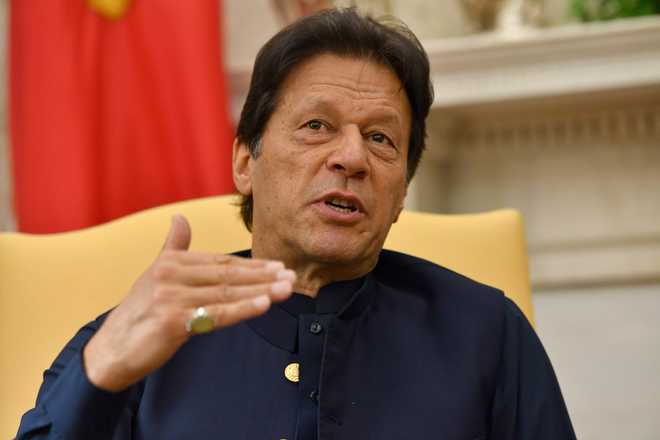
Glaring admission by Imran: India

Pakistan Prime Minister Imran Khan. — AFP

Tribune News Service

New Delhi, July 25

India today termed Pakistan Prime Minister Imran Khan’s remarks that his country was still hosting 30,000-40,000 armed men who had fought in Kashmir or Afghanistan a “glaring admission” of Islamabad’s policy of using armed extremists as an instrument of state policy.

Many of these militants were sent to India and the international community is well aware of this, said Ministry of External Affairs spokesperson Raveesh Kumar.

“It is a glaring admission by the Pakistan leadership. We have been saying repeatedly that it is time for Pakistan to take credible and irreversible action against terrorists,” he observed even as Khan, back in the country after a three-day visit to the US, said he felt like he had again won the World Cup. The Pakistan PM, while admitting that tens of thousands of people with dented records were still in Pakistan, also claimed previous dispensations had not been upfront about admitting the presence of 40 militant groups on Pakistani soil.

“They should make sure that the safe havens and sanctuaries in Pakistan should be neutralised. We feel that half-hearted measures to please the international community won’t do,” added Raveesh Kumar.

Despite Khan’s claim that his foreign trip was spectacularly successful, sources here pointed out that he had returned with no overt promises from the US of resuming aid that Pakistan desperately needs for its military and social sector. They pointed out that the overtly friendly gestures by US President were aimed at ensuring that Pakistan did not play spoilsport at a time when Washington wants to extricate itself from Afghanistan.

They also took on Khan for suggesting Pakistan had turned a corner in 2014 after the Peshawar school attack when he claimed all political parties decided to jointly combat terrorism.

The sources wanted to know why the ranks of militants had not depleted in these five years and despite this claimed political consensus, why did these militants continued with their armed depredation in India.

The sources drew attention to Khan’s entourage that included army chief Gen Qamar Javed Bajwa, and ISI chief Lt Gen Faiz Hameed to indicate the reality of rival centres of power in Pakistan. Khan was forced to be accompanied by army generals to signal to the US that Pakistan’s rival centres of power were on the same page as him. However, Kumar sought to end the controversy over Trump’s claim that PM Narendra Modi had asked him to mediate on the Kashmir issue.

“We should move on, we have moved on,” he said, while drawing attention to the depth and breadth of Indo-US ties which, he suggested, was unlikely to be shaken by a stray comment that had already been clarified by the US State Department and denied in Parliament by External Affairs Minister S Jaishankar.

The US media has already hauled Trump over the coals for undoing the achievements of his predecessors on India by “blundering” to volunteer to mediate over the Kashmir issue. Trump has committed “diplomatic malpractice of a high order” by revealing a privileged conversation with PM Modi, said the Washington Post.

‘Feels like I have won World Cup’

Islamabad: Pakistan Prime Minister Imran Khan on Thursday said the “rousing welcome” accorded to him by his supporters after his first official visit to the US made him feel as if he has won the cricket World Cup for the country. “I felt as if I came home after winning the World Cup and not from an official visit,” Khan, the former captain of the Pakistani cricket team, which won the cricket World Cup in 1992, said. pti

What Pak PM said in America

  • Pakistan still hosting 30,000-40,000 armed men who had fought in Kashmir or Afghanistan
  • Previous governments were not forthcoming on admitting presence of 40 militant groups on Pakistan soil

Mediation claim a blunder: US Media

Trump just committed diplomatic malpractice of a high order… After his trade war with India, his blundering into the Kashmir conflict further alienates an important country whose friendship the US needs to counter the rise of China. The Washington Post


Created ‘favourable conditions’ to resolve Doklam standoff: China

Created ‘favourable conditions’ to resolve Doklam standoff: China

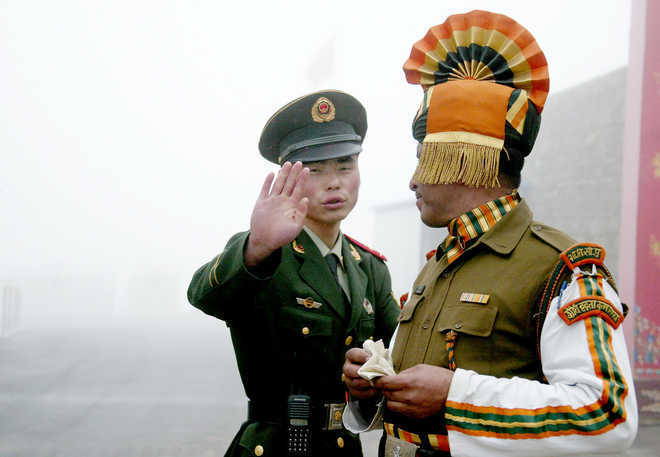
The standoff was finally resolved after the PLA stopped the road construction, following which India withdrew its troops. AFP file

Beijing, July 24

The Chinese military on Wednesday said it is striving to promote security and stability along the India-China border and has created “favourable conditions” to resolve the Doklam standoff in 2017.

A white paper titled ‘China’s National Defence in the New Era’, released by the Chinese Defence Ministry here touched upon various aspects of its military development comparing with India, US, Russia and other countries.

About the situation at the Sino-Indian border, the white paper said the Chinese military “strive to promote stability and security along the border with India, and taken effective measures to create favourable conditions for the peaceful resolution of the Donglang (Doklam) standoff”.

The reference to Doklam in the white paper was significant in the backdrop of the reports that China continued to reinforce its troops not far from the standoff site.

The standoff began when Indian troops objected to the People’s Liberation Army (PLA) building a road close to the narrow Chicken Neck corridor connecting with the North-Eastern states in an area also claimed by Bhutan.

The standoff, which led severe disruption of relations between the two countries, was finally resolved after the PLA stopped the road construction, following which India withdrew its troops.

The standoff led to both the countries revamping their ties with the first ever informal summit between Prime Minister Narendra Modi and Chinese President Xi Jinping in Wuhan in 2018 which paved the way for the normalisation of the ties.

President Xi is due to visit India later this year for the second informal summit, which is expected to further solidify the relations between the two counties.

The India-China border dispute covered 3,488 km and the two countries have so far held 21 rounds of talks to resolve the issue.

The white paper also highlighted the intensification of competition between the two million strong Chinese military with that of its counterparts in India, US, Russia and other countries.

“Global military competition is intensifying. Major countries around the world are readjusting their security and military strategies and military organisational structures. They are developing new types of combat forces to seize the strategic commanding heights in military competition,” it said.

The US, the white paper noted, is engaging in technological and institutional innovation in pursuit of absolute military superiority.

Russia is advancing its ‘New Look’ military reform, while the UK, France, Germany, Japan and India are re-balancing and optimising the structure of their military forces.

“Driven by the new round of technological and industrial revolution, the application of cutting-edge technologies such as artificial intelligence (AI), quantum information, big data, cloud computing and the Internet of Things are gathering pace in the military field,” it said.

The white paper noted that the international military competition is undergoing historic changes. New and high-tech military technologies based on IT are developing rapidly. There is a prevailing trend to develop long-range precision, intelligent, stealthy or unmanned weaponry and equipment.

“War is evolving in form towards informationised warfare, and intelligent warfare is on the horizon,” it said.

The defence white paper also sought to play down heavy military expenditure, saying that China is spending less on defence budgets in terms of GDP in comparison to India, US and other countries.

According to the Stockholm International Peace Research Institute (SIPRI), the leading international defence think tank, China, the second-largest spender of defence in the world, increased its military expenditure by 5.0 per cent to USD 250 billion in 2018 against India’s USD 66.5 billion.

The US, which is the largest spender of defence, spent USD 649 billion in 2018.

Arguing that China’s defence expenditure is reasonable and appropriate, the white paper stated that the country attends to both development and security.

“It is making an integrated effort to build a prosperous country and a strong military, and striving for the coordinated development of national defence and the economy,” it said and claimed that China’s defence expenditure is open and transparent.

Compared to other major countries, the ratios of China’s defence expenditure to GDP and to government expenditure, as well as the per capita defence expenditure of the country, remain at a relatively low level, it said.

As the only major country yet to be completely reunified, and one of the countries with the most complex peripheral security environment, China faces serious challenges in safeguarding national sovereignty, territorial integrity, and maritime rights and interests, the white paper said.

China is moving closer to the centre of the world stage, and the international community expects more international public security goods from the Chinese military, it said.

There is still a wide gap between China’s defence expenditure and the requirements for safeguarding national sovereignty, security and development interests, for fulfilling China’s international responsibilities and obligations as a major country, and for China’s development.

In step with national economic development, defence expenditure of China will maintain a moderate and steady growth, the white paper said. PTI


Union Budget tells armed forces to cut the coat as per cloth by Lt Gen K J Singh; Veteran

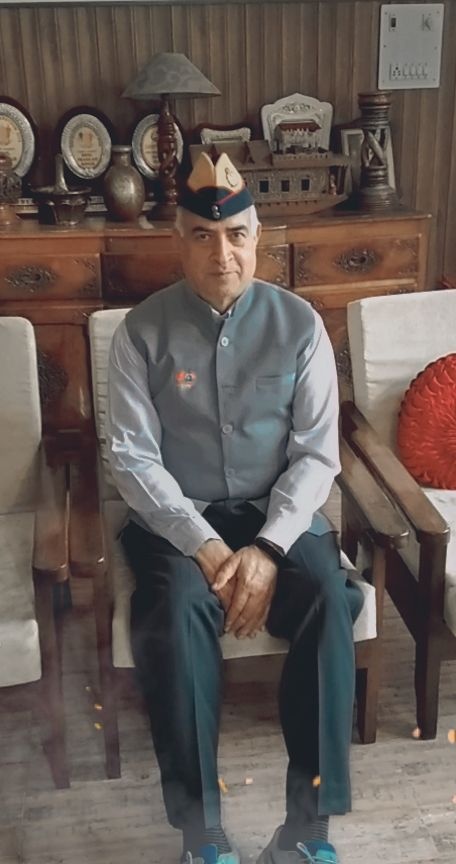
Defence outlay in the annual budget has once again belied expectations, pegged at Rs 3.18 lakh crores approximating to 1.5% of projected GDP, it is the lowest since the 1962 war. Pre-budget optimism was heightened as finance minister had piloted projections of the ministry of defence in her role as defence minister and it was natural to expect larger allocation since she knows the unsatisfactory state of inventory. Allocation marks 6.87% hike over the last budget’s revised estimates and barely caters for inflation. The only silver lining is waiving of basic customs duty on defence imports – likely to save Rs 25,000 crore, over five years. No wonder, the media has listed defence among losers’ category and treatment meted out as ‘blink and miss’ approach. Die-hard optimists can draw some solace from the government describing it as a budget with 10-year vision. It is hoped that experts will concurrently consider putting long-term defence planning and procurement back on rails to give the much-needed impetus to capability building and modernization.

The new defence minister, like his predecessors, had reiterated that financial constraints will not be allowed to impact capability building. On face value, this indeed seems very reassuring as all defence ministers and finance ministers maintain this position. While national consensus on macro issues alludes us, we have unanimity on assurances at least. The ‘feel good factor’ is further amplified with occasional booster dose provided by ill-informed media, heralding every ‘acceptance of necessity’ (AON) as induction. The AON actually is only the first step, more like starting the match. The conversion or strike rate of these for Army is as low as 30%. The Army on the average takes 30 to 40 AONs every year and every such announcement aided by media boosts ‘josh’ factor without sparing even an iota of ‘hosh’ or scrutiny for retracted and stalled AONs.

More importantly, the tortuous process between trials and price negotiations culminating into contract spans four to five years. Finally, the gestation of the equipment itself is limited by capacities and could be spread over another four to five years. Recently, an AON was granted for 464 Russian T-90 tanks leading to considerable muscle flexing on social and print media, aided by graphics, as if tanks were ready to roll down. It would have been more objective if flowchart of impending process and pitfalls were included in these reports.

In 2014, an outgoing Army Chief took a rather unprecedented step of flagging critical operational deficiencies, terming them as ‘hollowness’. Consequent to this letter and as points-man for capability building in the Army, I had to anchor hearing by Parliamentary Standing Committee on Defence (PSCOD). We were literally put in the dock with real architects of this sorry state, bureaucrats (as mandated by the transaction of business rules), attending as observers. We heard oft-repeated assurances, the budget will not be allowed to impact defence modernization. Yet, in 2018, in another hearing, the same committee was given rude reality check, which spelt out that against stipulated equipment profile of Modern-30, Current-40 and Ageing-30, existing inventory was 8-24-68 mix and funds not even adequate to service committed liabilities.

The army had traditionally followed threat-based planning, which amounts to reactionary capability building to handle our likely adversaries and manage the hybrid war. This was revised to threat cum capability building, duly supported by mandated levels of deterrence, ‘punitive’ against Pakistan and ‘credible’ against China. Net assessment models had stipulated quantified comparative ratios, stipulating building up 1.5 to 1 superiority against Pakistan. Capability-based planning is more pertinent for catering for ambiguous or emerging threats like artificial intelligence, robotics, space and cyber warfare.

Notwithstanding, stated parameters, in effect, the Army has been following firefighting approach driven by operations branch rather than perspective planning. There are occasional welcome doses of demonstrative acquisition of force multipliers like Rafale, C-130j, Apache, S-400 and ULH through strategic government to government (FMS in American parlance) route. The Army has been forced to resort to emergency induction of ammunition, sniper and other rifles. With regional power aspirations and as a net provider of security, it is high time that we make our procurement system functional graduating to genuine capability-based planning backed by periodic net assessment audits. While ambiguity seems to be the currently favoured approach and is needed for a few surprise capabilities yet for stable deterrence, it is axiomatic to build transparency and demonstrate seriousness in capability building. The much-needed reform of creating a non-lapsing fund for capital acquisitions will alleviate our problems as towards close of the financial year, it becomes process driven scramble to book expenditure with the status of schemes often an overriding priority.

The current, 13th Army plan covers the period from 2017 to 2022 and even at the mid-term stage, it is still in the discussion stage. It is also learnt that current review is driven by fiscal pragmatism, wherein a number of schemes may reflect budgetary realities. To put it bluntly, the armed forces have been told to cut the coat as per cloth. For those, who are statistically inclined, 12th Army plan had approximately 700 schemes and this one may have only 300 schemes. While drafting a new plan, mandatory pre-plan review invariably shows slippages, hence, it is prudent to remain pragmatic in projections but the overall impact on capabilities must be deliberately considered. It may be worthwhile to take plan holiday for first three years of the current plan, recast and draw a well-considered plan in next six months and apply it from 2020 to 2025 with clearly defined targets and more liberal funding.


Retd Army man ‘failed’ to prove citizenship

Retd Army man ‘failed’ to prove citizenship

Retired Army man Mohammad Sanaullah was kept at a detention camp in Assam last month as he failed to furnish evidence before a foreigners’ tribunal in the state to establish that he was Indian by birth, the Rajya Sabha was informed by Minister of State for Home G Kishan Reddy in a written reply. Sanaullah failed to furnish evidence before the tribunal to establish his linkage to his parentage on Indian soil prior to March 25, 1971, the House was informed. PTI

Increase defence outlay: Tewari

Anandpur Sahib MP Manish Tewari asked the government to allocate adequate budget for defence. He told the Lok Sabha that the spending on military was just 1.52 per cent of the Gross Domestic Product (GDP), which was the lowest in 58 years. India faces a two-front onslaught from Pakistan and China. The minister said China’s defence spending has been growing, while India’s dropping. TNS


PM shares pictures of visit to Kargil during war

PM shares pictures of visit to Kargil during war

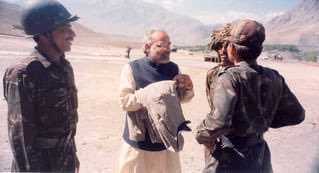
Photo tweeted by Prime Minister Narendra Modi.

New Delhi, July 26

As the nation observes the 20th anniversary of the Kargil war, Prime Minister Narendra Modi on Friday shared pictures of his visit to the area during the conflict and his interaction with the soldiers.

“During the Kargil War in 1999, I had the opportunity to go to Kargil and show solidarity with our brave soldiers,” he said on Twitter.


The prime minister said that in 1999, he was working for the BJP in Jammu and Kashmir and Himachal Pradesh.

“The visit to Kargil and interactions with soldiers are unforgettable,” Modi said.

In the photographs, he is seen interacting with army men and meeting wounded soldiers. PTI


Run for Martyrs’ marks Kargil Vijay Diwas

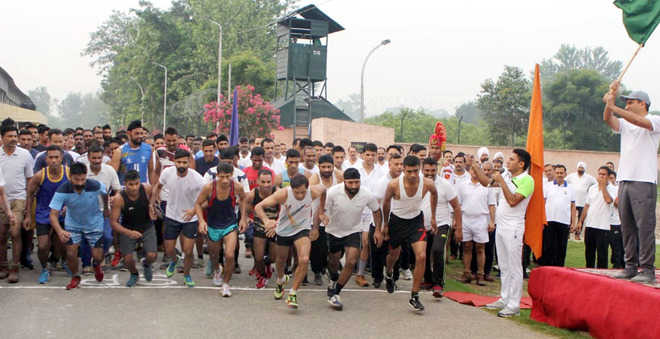
BSF and Army jawans take part in the ‘Run For Martyrs’ to mark the ‘Kargil Vijay Diwas’ in Jalandhar on Wednesday. Photo: Sarabjit Singh

Jalandhar, July 24

As a part of the week-long programme started by the BSF, Jalandhar Frontier, a five-km race, ‘Run for Martyrs’, was organised at the BSF headquarters here this morning to commemorate the 20th anniversary of the ‘Kargil Vijay Diwas’ and to pay tributes to martyrs of the Kargil War.

Mahipal Yadav, Inspector-General, BSF, Punjab, flagged off the race by waiving the green flag.

The run commenced from Ashwani Stadium via BSF Gate No 3 and reached the Army Mill Road, (main road Jalandhar to Ludhiana) and concluded at the Ashwani Stadium.

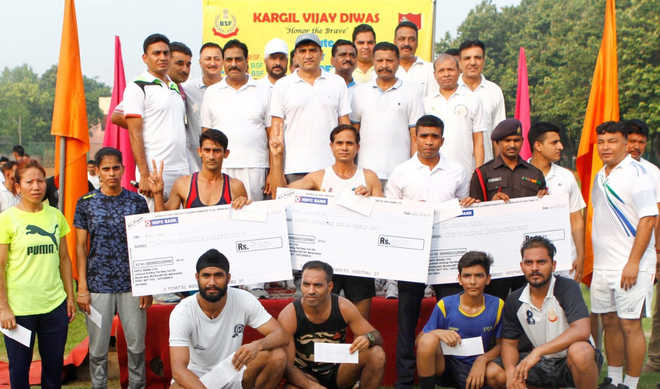
As many as 350 BSF personnel’s and soldiers of the Indian Army participated in the run. The winners were awarded by Mahipal Yadav.

Arakshak Babu Lal (BSF, Punjab) won the first positions and was given Rs 3,100. Arakshak Rajmal (BSF, Punjab ) remaind second. Sepoy Suman Sen (Indian Army, core camp) bagged the third position.


Major Shankla’s statue unveiled in Panchkula

Major Shankla’s statue unveiled in Panchkula

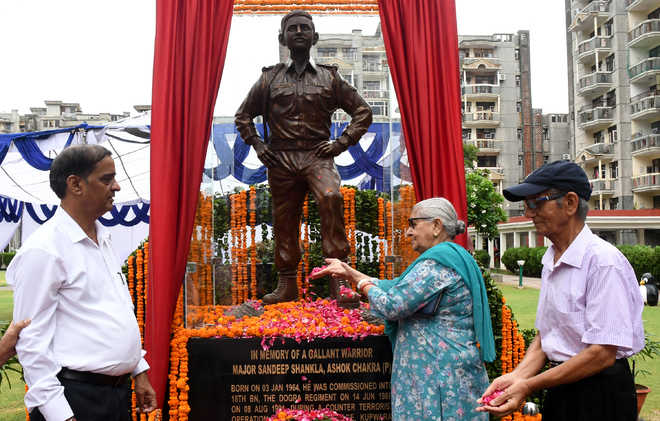
Major Sandeep Shankla’s father Lt Col JS Kanwar (retd) and mother Manju Kanwar pay floral tributes at his statue unveiled at the AWHO Society in Sector 20, Panchkula, on Tuesday. TRIBUNE PHOTO: RAVI KUMAR

Tribune News Service
Panchkula, July 9

Panchkula MLA Gian Chand Gupta unveiled the statue of Major Sandeep Shankla at AWHO Society in Sector 20 here today.

The statue has been set up by the Panchkula Municipal Corporation in memory of the martyr, who died fighting for the unity and integrity of the country.

It is pertinent to mention here that on August 8, 1991, Major Shankla’s battalion, 18 Dogra, carried out a search and cordon operation at Zafarkhani village in Kupwara district. A soldier was injured in the crossfire with terrorists and Major Shankla, unmindful of the enemy fire, crawled out to drag him to safety, killing a terrorist. The terrorists then lobbed two grenades at the officer, of which one he hurled back at them, sustaining splinter and bullet injuries in the process. But he kept fighting till he lost consciousness.

The operation had resulted in the elimination of nine terrorists and apprehension of 22. He was posthumously awarded with the Ashok Chakra, the highest peacetime gallantry award.

Addressing the gathering of Army officers and their families, Gian Chand Gupta said by setting up the statue, the Municipal Corporation had paid tributes to the martyr who made the city proud by sacrificing his life in the line of duty. Major Sandeep Shankla was a resident of Panchkula and he had laid down his life for the unity and integrity of the country.


20 yrs later, Luv journeys to ‘meet’ twin Kush

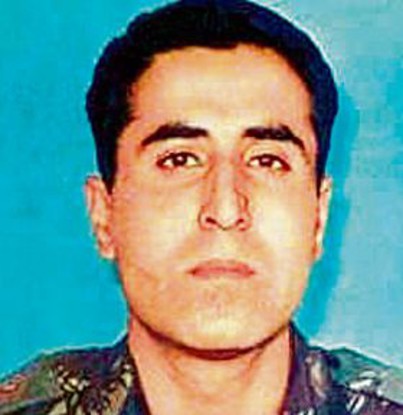
Capt Vikram Batra

Ajay Banerjee

Tribune News Service

New Delhi, July 6

It will be a journey for which Luv has waited for 20 years, to be at the same spot where his identical twin Kush sacrificed his life for the country — atop a 16,000-foot-high Himalayan massif along the Line of Control.
On Sunday, it will be exactly 20 years when Kush, Capt Vikram Batra, a resident of Palampur, Himachal Pradesh, sacrificed his life during the Kargil war (May-July 1999).

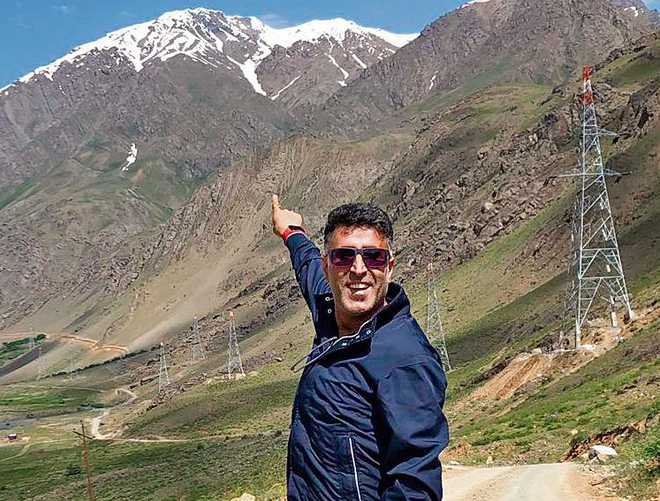
Vishal Batra, known in his family as Luv, will be there to mark his brother’s death anniversary. “I am going to ‘meet’ my brother, up there,” Vishal said just hours before he boarded a flight en route to Drass at the base of the peak in Jammu and Kashmir.
Vishal will be heli-dropped to reach Point 4875 (altitude of the peak in metres), now known as ‘Batra top’. “I had the option of climbing the peak, but the Army advised acclimatisation of at least one week, which was not possible due to time constraints,” says Vishal, who is a banker in Chandigarh.

At Point 4875, Capt Batra had led the assault by his ‘paltan’, 13 JAKRIF, to get it vacated from Pakistan army’s illegal occupation. In September this year, Capt Batra, a Param Vir Chakra recipient, would have turned 45.

Gen VP Malik, in his book ‘Kargil: From Surprise to Victory’, describes Capt Batra, who after killing four Pakistani soldiers in a hand-to-hand fight and capture of Point 5140 called his Commanding Officer and radioed the victory code: Yeh Dil Mange More…

A popular advertising jingle of the 1990s, the code was selected by Capt Batra during the pre-assault briefing by the CO, Lt Col YK Joshi (now Lt General). Point 5140, the highest occupied point on Tololing ridge, was captured on June 20. Lt Gen Joshi, awarded the Vir Chakra, will be on Batra top with Vishal. A climbing expedition of 13 JAKRIF will reach the same day.