Sanjha Morcha

IPS lobby can hurt our growth, paramilitary officers fear, seek Amit Shah’s intervention

Two letters requesting for a meeting have been written to Amit Shah by former Inspector Generals of Police (CRPF) – V.P.S. Panwar and S.S. Sandhu – on behalf of the paramilitary forces.
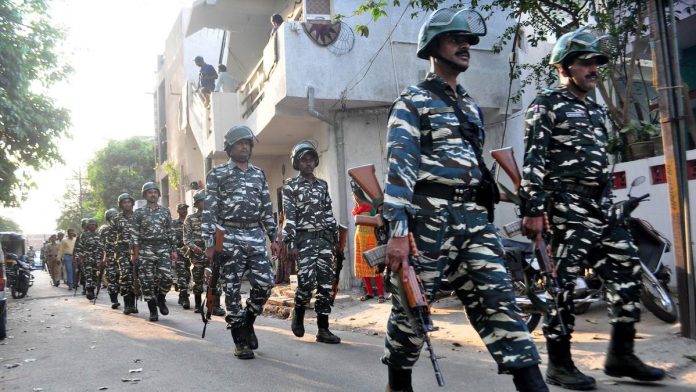
CRPF

New Delhi: The Narendra Modi-government may have approved the proposal to grant the status of organised cadre services to the Central Armed Police Forces (CAPFs), but paramilitary personnel still fear that IPS officers may circumvent the new rules to scuttle their career growth.

Worried that the ‘IPS lobby’ will not allow CAPF officers to avail benefits they are now entitled to, several retired officers from the Central Reserve Police Force (CRPF) – the oldest paramilitary force in the country – have sought a meeting with Home Minister Amit Shah.

Former Inspector Generals of Police (CRPF) – V.P.S. Panwar and S.S. Sandhu – have written to Shah requesting him for a meeting.

According to sources in the government, Shah is expected to visit the CRPF headquarters in Delhi on 29 July.

Given that serving officers in the force are bound by their service rules, and still report to IPS officers, the retired officers are in a better situation to express concerns of the forces, a serving CRPF officer told ThePrint.

“IPS officers are suddenly scared that they will lose hold over their fiefdom. They can do everything to scuttle our rights,” the senior officer said, on condition of anonymity.

‘Vested interests not inclined to execute order’

The Union Cabinet on 3 July gave its nod to the proposal to grant Non-Functional Financial Upgradation (NFFU) and other pay benefits to officers of the paramilitary forces, which their counterparts in all ‘Group A’ organised services are entitled to.

“Despite the fact that the Ministry of Home Affairs has issued directions for implementation of the above order, the general perception prevailing in the minds of the officers is that the vested interests are still not inclined to execute the orders in a holistic manner,” Sandhu, a 1976 batch officer, has written in his letter addressed to Shah.

While the Cabinet’s nod now allows CAPF officers to head their own forces, it will still require framing of new rules for the cadre. The CAPF personnel worry that IPS officers will use all their clout in the government to “delay” this.

According to the Department of Personnel and Training rules, in ‘Group A’ organised services, appointments up to the position of SDG can take place only through promotions and lateral entry or appointments through deputation is only permissible if the former is not possible.

“Efforts are still being made to deny the rightful benefits and career aspirations of these officers,” Sandhu’s letter says.

Seeking “an exclusive hearing” for the officers of the CRPF, the letter further states: “I am afraid that efforts are being made by hectic and active parlance among DGs (directors general) and senior IPS officers to find ways and means to delay the implementation of government orders according to the guidelines of DoPT.”

“According to the circulated programme of your visit to the CRPF headquarters on 29 July, even the serving cadre officers have not been included for any interaction with you lest the design of the IPS officers brought to your kind knowledge by them,” the letter further reads.


Also read: The inside story of what CRPF jawans go through to keep our marathon elections free & fair


‘Deep roots of discrimination’

Both Panwar and Sandhu have cited the absence of a proper platform for retired CAPF officers to bring forth their grievances before the government. This, CAPF officers believe, is in contrast to to the Indian Army and other armed forces, which have designated platforms to voice their protest.

According to the serving CRPF officer quoted above: “The roots of discrimination against them are so deep that the initial jubilation among CAPF officers has been shadowed by some real concerns.”

Sandhu’s letter also throws light on other specific concerns. According to it, since 2008, “not a single post of policy decision-making has ever been given to (an) experienced officer of the cadre.”

“This is a pertinent point which needs attention of the Hon’ble Home Minister.”

“The post of IG (personnel) which deals with promotions, posting and establishment matters of officers, ministerial cadre, subordinate officers, cadre reviews, disciplinary proceedings also vigilance matters have been held by an IPS officer for the last more than four decades,” the letter further contends.

“These are deliberate efforts to project the cadre officers in poor light not only before the government but also in the eyes of their own subordinates.”

Serving CRPF officers also say that they cannot transfer or post their own subordinates even after 30-35 years of service and this dampens the morale of the entire force, diminishes their authority in front of their subordinates.

Similarly, the post of inspector general (operations) – which deals with operational matters and deployment of forces – and the inspector general (northern sector) – which deals with allocation of resources such as vehicles, infrastructure and accommodation – have all been kept “under IPS control,” Sandhu’s letter states.

“The reason for this is to keep the cadre officers out of decision making and authoritative positions to run their writ and to utilise the force and its resources as per their whims and fancies,” the letter reads.

In a separate letter to Shah, Panwar, who spent 39 years in service, has said it is important that the home minister is aware of the difficulties faced by both the retired and serving officers of the force so that “privations can be adequately addressed for future generation of officers and their families…”

This would “motivate them to perform their duties and serve the country with more zeal, dedication and determination.”


Also read: Pulwama makes it to election speeches, but CRPF & its problems are left out



Remove jets or won’t open airspace: Pak India says military deployment its sovereign choice

Remove jets or won’t open airspace: PakRemove jets or won’t open airspace: Pak

Islamabad/New Delhi, July 12

Pakistan has told India it will not open its airspace for commercial flights until New Delhi removes its fighter jets from forward IAF airbases, Pakistan’s Aviation Secretary Shahrukh Nusrat has informed a parliamentary committee.

Pakistan had closed its airspace on February 26 after the Indian Air Force (IAF) fighter jets struck a Jaish-e-Mohammed (JeM) terrorist training camp in Balakot following the Pulwama attack.

Aviation Secretary Nusrat informed the Senate Standing Committee on Aviation that his department had intimated Indian officials that Pakistani airspace would remain unavailable for use by India until the country withdrew its fighter jets from forward positions, a news report said.

“The Indian Government approached asking us to open the airspace. We conveyed our concerns that first India must withdraw its fighter planes placed forward,” Nusrat told the committee. This is probably the first time a senior Pakistani official has publicly stated Islamabad’s precondition for reopening its airspace after the Balakot airstrikes.

India rejected the statement, with sources pointing to two flaws. First, military deployments are a country’s sovereign choice and no other country can demand a particular military posture. Second, it is Pakistan that had first closed the airspace and, hence, must take the first initiative towards opening closed air corridors. Pakistan had last month extended the airspace ban till July 12. — PTI/TNS


Saeed moves Court against terror cases 

  • Jamaat-ud-Dawa (JuD) chief Hafiz Saeed on Friday challenged terror-financing cases lodged against him in the Lahore High Court
  • Saeed, along with Amir Hamza, Abdur Rehman Makki, M Yahya Aziz and four others, filed a plea, naming the federal government, Punjab government and the counter-terrorism department as respondents
  • The plea urges the court to declare the FIR against them null and void and claims Saeed has no relation with the LeT, Al-Qaida or any other such outfit


Case filed against Army in Banihal

Doda, July 29

A case has been registered against the quick reaction team of the Army in Banihal for alleged beating up an engineering student who overtook an Army vehicle on the Jammu-Srinagar national highway on Monday.

Eyewitnesses told The Tribune that an engineering student, Junaid Bin Ashraf Mir, a resident of Cheril, Banihal, was beaten up by the quick reaction team of the Army when he overtook their vehicle.

“After the youth was beaten up, locals held a protest against the Army and blocked the highway,” said an eyewitness.

As things started to go out of control, the police swung into action and lodged an FIR against the Army.

This is the first such case registered against the Army since the traffic restriction was imposed on the highway. People have been facing problems as civilian vehicles cannot overtake the security forces vehicles. — TNS


Kargil martyrs remembered

Tribune News Service

Ludhiana, July 26

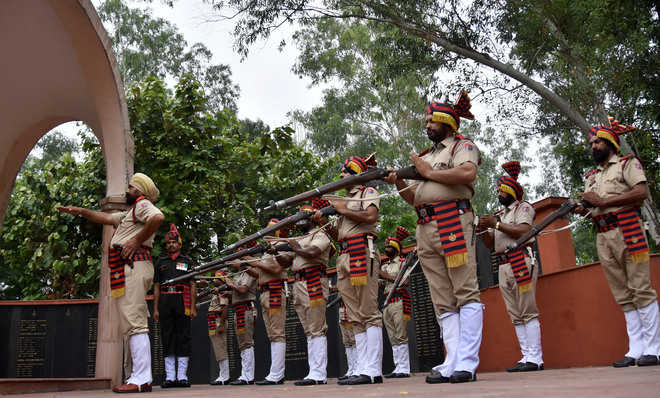
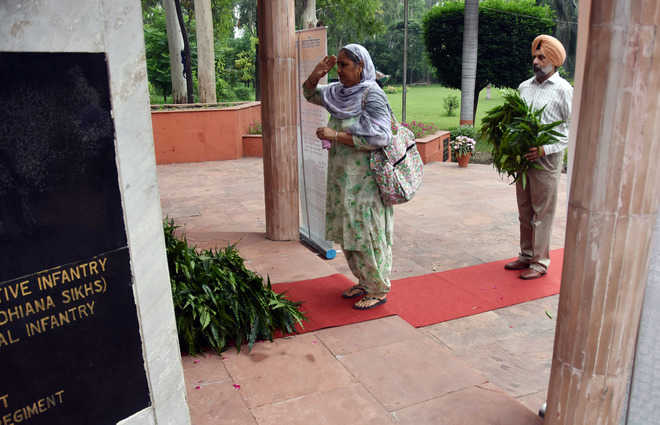
The Punjab Government remembered the Kargil martyrs, who laid down their lives for safeguarding the borders of the country, on Kargil Vijay Diwas observed at Maharaja Ranjit Singh War Museum here today.

On this occasion, the widows of martyrs “Veer Naris” and incapacitated soldiers who got wounded during the Kargil War were felicitated.

Station Commander, Dholewal Military Complex, Brigadier Manish Arora, was the chief guest of the function.

Addressing the gathering, Brigadier Arora recalled the heroic deeds of the brave sons of the country in defending the borders of the country. He said that exemplary courage shown by the Indian Army in this war despite hostile conditions, hardly finds any parallel across the globe. “Every countryman would ever remain indebted to these martyrs for their supreme sacrifice.”  

The society, administration, and nation will always remain thankful to the martyrs who defended the sovereignty of the nation, he added. The sacrifice made by the martyrs would ever act as a beacon to inspire the youth to follow their footsteps and serve the nation.

SDM West Amarinder Singh Malhi welcomed the dignitaries in the function. Wing Commander Gurpreet Singh told the gathering about the contribution of the Army and Air Force in the Kargil War.

Exemplary courage shown by the ArmyExemplary courage shown by the Indian Army hardly finds any parallel across the globe. Every countryman would ever remain indebted to these martyrs for their supreme sacrifice. — Brigadier Manish Arora


Amarinder pays tributes to martyrs of Kargil conflict

http://

Tribune News Service
Chandigarh, July 25

Punjab Chief Minister Capt Amarinder Singh on Friday paid floral tributes to the martyrs of the Kargil war on the 20th anniversary of the event.

The Chief Minister laid the wreath at the War Memorial at the Bougainvillea Garden here, with glowing tributes to the heroic acts of the soldiers, including the 54 brave sons of Punjab, who had laid their lives during the Kargil Operations.

Remembering their sacrifices on the Kargil Vijay Divas, Amarinder exhorted the youth to follow their ideals to uphold the country’s sovereignty and integration, besides imbuing themselves with a spirit of patriotism and nationalism.

Meanwhile, Director Defence Services, Brig Satinder Singh, informed the Chief Minister that such commemorative functions were also being simultaneously held at Amritsar, Jalandhar, Ludhiana, Hoshiarpur and Sangrur, to honour the next of kin and veer naris of the 54 Kargil heroes of Punjab.

The Chief Minister also interacted with the young cadets of Mai Bhago Armed Forces Preparatory Institute, Mohali.


Kulbhushan Jadhav’s case: what next? By Lt Gen Raj Kadyan; Veteran

If the maturity or fairness of a judicial order were to be judged based on the criterion that it has a takeaway both for the appellant as well as the respondent, the 17th July judgment of the International Court of Justice, aptly qualifies. Pakistan is happy – in fact gaga – that India’s demand for Jadhav’s release has not been accepted, even though this was not under the ICJ’s legal lens. On the other hand, India has much to be happy about. For one, Pakistan’s plea for rejection of India’s application on the alleged misuse of process, misuse of rights and alleged unlawful conduct was rejected right at the very start. Second, India’s demand for consular access so that Jadhav’s legal defence could be arranged, has been upheld. Third, Jadhav’s execution remains in abeyance. Fourth, a review/reconsideration of the military court’s order prescribing death sentence has been ruled. Pakistan also got a rap for her failure in informing India ‘without delay’ of arrest and detention of Jadhav.

​The ICJ has asked for ‘effective review and reconsideration of conviction and sentence’ awarded to Jadhav. While leaving the choice of means to Pakistan, the ICJ has asked them ‘to take all measures to provide for effective review and reconsideration, including, if necessary, by enacting appropriate legislation’.

​Since Jadhav continues to be in Pak custody, the onus of any further action is squarely on that country. What now are Pakistan’s options and likely course of action? They have no escape from reviewing the case that has been mandated by the ICJ. If the case is to be reviewed by Pakistani courts in the normal course, the fairness would be under doubt ab initio, given the questionable independence of Pakistan’s judiciary. Example of General Musharraf, facing the two most serious charges of treason and murder, not even appearing in the court when called to do so, and being allowed to leave the country, is too stark to ignore. In the instant case the review is of a military court order that has been approved by the Pakistan Army Chief himself. Pakistan’s troubled history where the Army still calls the shots inspires little confidence in overturning/reviewing the military court’s order. Besides, the Bar Association of Lahore High Court having resolved that no lawyer would represent Jadhav betrays the legal mood in that country and is further evidence of a prejudiced trial. To have any credibility, the trial must be in an open court and in the presence of an ICJ representative.

​In the very unlikely event of Pakistani courts overturning the military court’s order on Jadhav’s conviction, it is doubtful the Pak military would stay mute. One compromise alternative may be for the courts to uphold the conviction, while revising the sentence from death to life sentence. This would still amount to accepting civil supremacy over Pakistan Army and may face resistance in Rawalpindi. Besides, India would most likely go back to the ICJ as their demand for acquittal and return to India of Jadhav would still not be met.

​Pakistan needs to explore other options. They have been repeatedly requesting for a dialogue with India. The latter’s stand is consistent that talks and terror cannot happen together. After Balakot strike there has been a perceptible reduction in infiltration and terror activities in the Kashmir Valley. This could prod Pakistan to renew their request for a dialogue. The request could be considerably bolstered by releasing Jadhav as a ‘goodwill’ gesture, without going through the rigmarole of the civil trial, which may only expose Pakistan’s internal infirmities. Their earlier claim of having released Wing Commander Abhinandan in February 2019 as a goodwill gesture carried no conviction as the international (read US) pressure on Pakistan to release the pilot unharmed and immediately was the trigger. The present situation is different.

​Even if Pakistan adopted the option of unconditionally releasing Jadhav, there is no guarantee that India would agree to a dialogue. This is so, given the fact that terror infrastructure remains intact and terror leaders still roam free in Pakistan, notwithstanding Hafez Sayed’s cosmetic off-and-on detention to keep pace with Donald Trump’s mood. But it could be an important step and would open a window of opportunity for India, which believes in friendly relations with all its neighbours. Even otherwise, by continuing to keep Jadhav in their custody, Pakistan draws no conceivable advantage. It seems certain that the international mood will not favour Jadhav’s execution.

It is for Pakistan to play the next hand. Will they cease the opportunity?

Lt Gen Raj Kadyan (Retd)

Former Deputy Chief of Army Staffers


THE UNSUNG PATRIOTS

Kargil Vijay Diwas is a special occasion for the people of Ladakh. During the war, people of Ladakh didn’t think twice before helping the Indian Army in the war-torn areas.

The Kargil Vijay Diwas is dedicated to hundreds of volunteers who assisted the armed forces fearlessly. Let’s hear from three volunteers about their ordeal during the war.

On a pitch dark night, in the month of June 1999, when the nation was fighting its biggest battles of the 20th century, Tsering

Dorjai, resident of village Tia in Ladakh was busy taking care of his ill mother at his house. When he got a call from his village nambardar seeking volunteers for assistance of Indian Army in Kargil, Tsering Dorjai without thinking twice, volunteered to proceed towards the war zone. “I was moved to Biamah bridge alongwith twenty other volunteers from where rations, ammunition and various other war like stores were being moved forward to the fighting troops. I lifted more than 25 kgs of ration and ammunition on my shoulders till Ganasok. All this was happening in the thick of battle, under heavy shelling from the enemy side. I walked along with other volunteers for more than twelve hours, uphill on a steep nala track, and successfully delivered the stores. In addition to delivering the stores at Ganasok we also assisted in evacuation of war casualties back to the base.”

The brave duo Stanzin Nangil and Phunchok Angdu were the first ones from their village to board an army vehicle and move towards the battlefield of Kargil. “We started at around 4 am without any breakfast under heavy shelling from the enemy side. After around 14 hours of climb, we were not able to reach the forward post, possibly losing way somewhere in between. The entire group of volunteers did not eat anything as the ration which we were carrying was for the fighting soldiers and must not be consumed by us. We both decided to stay in a small broken hut and asked all others to come back again next morning. At around 6:30 am, we saw a flag being waved from the forward post guiding us in the right direction. The feeling of providing supplies to the brave soldiers of the Indian Army gave us immense pride and satisfaction, which filled us with more courage to do the same in days to come. We returned back to the base in Darsik sector at around 9 pm where we had our first meal in 40 hours.”


Kargil visit induced in me a new-found respect for Indian Army

Kargil visit induced in me a new-found respect for Indian Army

New Delhi: Defence Minister Rajnath Singh on Sunday said his recent visit to Kargil had renewed his confidence and respect for the Indian Army.

Speaking at a function organised by Veterans India here, Singh said, “During my visit to Kargil, I saw the tall peaks which our brave soldiers managed to win back after defeating Pakistani soldiers positioned on them during the Kargil war. I listened to all the stories of how our brave soldiers recaptured Kargil, I heard the names of brave personnel like Captain Vikram Batra who were ready to sacrifice their life for the nation. It made me respect them even more.”

The Defence Minister had visited the Kargil War Memorial in Drass on Saturday and paid tributes to soldiers who had laid down their lives in the 1999 war with Pakistan.

Singh was in Jammu and Kashmir for a day-long visit ahead of Kargil Vijay Diwas.

“The courage showed by the Indian Army soldiers in other wars as well to protect the integrity of the nation is unparalleled to that of any other country in my opinion,” Singh added.

He said that in his term as Defence Minister of the nation he will try to ensure that the ex-servicemen and serving personnel face no hardships.

“I will try to do whatever I can to ensure there are no questions raised on your honour and dedication and of that of the soldiers serving today,” he added.

He also spoke about his decision of going to Siachen immediately after he took charge of his post in the Union Cabinet.

“On the second day of taking charge as Defence Minister, I went on a trip to Siachen after consulting the Army Chief General Bipin Rawat. My reason for undertaking this trip was to understand what it felt like to be a soldier standing on the border before I start taking decisions for their good,” he said.

“It helped me make decisions for their welfare, it helped me keep them in the centre before taking any decision for their benefit,” Singh added.


Indian Army launches massive crackdown on personnel violating its cyber security norms

cybersecurity in India

The exercise involves sensitising Army personnel about cyber security, which will be followed by surprise checks to punish those violating the norms.

New Delhi: The Army is carrying out a month-long cyber security exercise to identify and crack down on those violating its norms for all online activities.

A communication sent out by the Army headquarters to all its units and formations last week said those found violating the norms would face “exemplary” punishment.

A set of dos and don’ts, in line with the Army’s cyber security policy, has been attached with the communication. This includes asking the troops to limit their online presence, such as on Facebook and large WhatsApp groups, and not forwarding or storing sensitive data on their electronic devices.

According to highly-placed Army sources, the exercise began last week and will continue till mid-August.

The communication comes just about a week after Army headquarters had issued a directive on information security, where it warned its personnel about the leak of sensitive information about the armed forces and the increasing use of personal devices, especially smartphones, and messaging apps like WhatsApp to exchange official information.

A top Army source had earlier told ThePrint that about a hundred personnel were under close watch for their online activities, but that is not related to this particular exercise.

While directions are issued from time to time, the sources said, this is the first time that such a formal exercise is being carried out on cyber security.

Sensitisation & stringent checks

The exercise will first involve sensitising the troops across the country about ways to ensure cyber security within the Army and the use of social media platforms by personnel, which will then be followed by surprise checks to punish those violating the norms.

While the Army declined to comment on the move, a senior officer said such checks are carried out periodically to ensure the troops comply with the rules laid down for cyber security.

The officer said the Indian Army is ensuring stringent checks so that no person falls prey to “inimical agencies and their devious designs”.


Also read: On new Modi govt’s digital agenda — securing cyber space and a crackdown on cyber crime


The instructions

The instructions given out as part of the exercise reiterate the basic rules of online behaviour that should be exercised by the armed forces.

The Army wants sensitive data not to be stored or forwarded through electronic devices, and also wants troops to be sensitised on the ways adopted by enemy operatives, as well as other cyber security matters.

It wants personnel not to accept friend requests from unknown entities, or chats with unknown people on social media. It also says only known people should be added to social media groups, and troops should ensure they are not giving out any sensitive information while posting pictures on social media.

In addition, the Army has asked personnel to keep their identities secret — not post pictures of themselves in uniform or identify themselves with their ranks, avoid being part of large WhatsApp groups, avoid opening unknown email links and suspicious websites, or commenting and criticising the government on topics which can have a “subversive effect”.

Personnel say instructions lack clarity

The new exercise has alarmed Army officers and personnel, droves of whom have quit WhatsApp groups, even those they shared with known Army veterans.

Another Army officer told ThePrint that such an exercise is rare and hence they lack clarity on the exact grounds they may be penalised for.

“The reason can be just a harmless banter on the government. So, no one wants to take a risk. Many have been withdrawing from Facebook and WhatsApp groups in droves for now,” this officer said.

The Army had earlier said that such instructions are given out in the wake of increasing cases of ‘honey-traps’ laid down by enemy agencies, which several personnel had fallen prey to.

“Recently, an Army jawan was honey-trapped by a woman operative of Pakistan’s ISI and was found to be sharing sensitive information with an enemy agency. He was arrested by the police in Haryana’s Narnaul,” the first Army officer quoted above said.


Army Backs Disability Pension Tax: Why ‘Mass Punishment’ Is Unwise by Lt Gen Syed Ata Hasnain

With increasing frequency, issues related to the administrative aspects of the Indian Armed Forces seem to be regularly coming to the fore, due to the lack of understanding of the service conditions, and the challenges soldiers face during their careers.

Mostly these are perceived as the direct result of the awkward civil-military relationship which has existed since 1947, and the supposed ever-readiness of civil servants to divest the armed forces cadre of service privileges granted over time. However, this time, a strange case has arisen.

It relates to those armed forces personnel who superannuate at the end of their service contract with injuries sustained in war, internal service duties or accidents, which are attributable to service conditions.

Included in this segment are those whose lifestyle ailments too are aggravated by such service conditions. All these personnel, as per procedure, appear before a duly constituted medical board which classifies their percentage of disability, which in turn entitles them to a disability pension, which along with the service element of the pension is not taxable.

It’s a privilege not reserved for the personnel of the armed forces alone, but for various other government servants retiring from Central Government Departments and regulated by the Central Civil Services (Pension) Rules, 1972; an example are the central armed police forces (CAPF).

Too caught up to read the whole story? Listen to it here instead:

Also Read : Dear Soldiers, Don’t Think You’re Alone, You Are in our Thoughts

‘Favouring’ Civil Servants Over Armed Forces: A Strange Paradox

So what is the problem now? The Central Board of Direct Taxes (CBDT) through a circular in end June 2019, decided to do away with the tax exemption for disabled soldiers.

There is a caveat however: this tax exemption doesn’t include those soldiers who get invalidated out of service due to attributable reasons, and did not complete their contracted service.

The impact of the decision is that all those who decided to continue in service till the age of retirement, even after being injured and placed in a low medical category, on exit will not be exempt from income tax. The tax exemption on disability pension is a privilege enjoyed by many government services, with not an iota of the type of physical threats faced by soldiers.

Yes, indeed, soldiers both on the field, and during peace conditions face stress and strain – due to the regimented life away from family, and always having to be available for duty 24×7, 365 days. Thus, by the implementation of the order, a strange thing will be prevalent in India and perhaps nowhere else in the world.

Disabled soldiers will be taxed for the pension they earn, and disabled civil servants will be exempted from tax – a strange paradox indeed.

Also Read : ‘Can’t Trust the Army’: Kargil War Hero Recounts Fight for Pension

Why Did Army Back Disability Pension Tax Proposal?

When the CBDT circular was released, it created tremendous consternation among the veteran soldier community all over India, because it was perceived to be the outcome of yet another case of civil-military discord, which has been steadily increasing to the level of virtual animosity today.

One of the most respected disabled veterans of the armed forces, Major General Ian Cardozo (retd), speaking on a TV news panel, laid out the responsibility for the strange decision at the doorstep of the bureaucracy, which he strongly felt hated the armed forces.

However, as the week progressed and the armed forces were silent, it started to become evident that the decision was not a standalone one initiated by civil servants or anyone from the political leadership; it was the Army’s leadership which had quietly forwarded the proposal. It is not even known whether the other two services (Air Force and Navy) were on board, and whether detailed analysis and consideration had been looked at in terms of impact. The facts came to light after the Finance Minister’s office released an unsigned statement which included the reasons, and clearly alluded to the fact that the proposal had come from the Service Headquarters itself.

Also Read : Soldier’s Mother Awaits Pension for 9 Years – Govt Apathy at Play?

What Armed Forces Leadership Has Done Is Unbecoming

Why did the Army leadership decide to shoot its own personnel in the foot, that too for a privilege which not they alone but the entire central government services enjoy? This needs thorough analysis. It’s also important to point out that the government need not have acted with such alacrity on an issue which was bound to have a deep negative impact, that too on an element of society that is revered across most parts of India.

The same alacrity was not evident when the nonfunctional upgradation (NFU) proposal was forwarded to the government by the armed forces, nor were the observations and anomalies of the 7th and 6th Pay Commission treated such.

In fact, a major part of the 6th Pay Commission anomalies are still languishing, with no apparent intent to rectify them. That is where the perception about bureaucratic antipathy comes from.

Procedurally what the armed forces leadership did was, in the perception of the veteran community, something unbecoming. Recommending the removal of a privilege, without an iota of consultation with those affected and no evidence of deep understanding and institutional study, is not something taken kindly in a profession where camaraderie and brotherhood, from womb to tomb, are considered pillars of organisational effectiveness.

Also Read : Modi 2.0: Indian Army’s Wish List Should Be Fulfilled Under NDA-3

From The Army’s Perspective

One can perceive the problem from the Army’s point of view. The judiciary has been kind to the litigants from the armed forces and other organisations regarding individual cases of disability. Besides that, the broad banding of disability percentages has given the disabled personnel much greater financial advantage.

As a consequence, disability has become an ‘attractive’ aspect of government service, at least for those who have the intent of manipulating financial advantages for themselves.

It hardly matters to civil servants, who mostly serve in a sedentary environment, or at least nothing even close to the kind of challenging conditions in which Army personnel have to serve. However, the Army must have maximum physically fit personnel who have no restrictions on their employment. The challenge for the Army emerges when personnel in later stages of their service and especially after being overlooked for promotion, prefer to serve in a safe and stable environment in peace stations.

This can be done by seeking low medical category (LMC) status, or persistence in the category even after overcoming an originally genuine medical problem. It gives the chance also to seek disability status at the time of retirement. The above statement must not be taken as a generalisation, and is actually applicable to just a few who attempt to acquire such category and status for personal gain without moral considerations. The Army leadership is particular concerned about the number of LMC personnel because it reflects on ‘bayonet strength’, and therefore wishes to dissuade its personnel from seeking or remaining in LMC status leading to eventual disability, for the sake of overall efficiency.

A ‘Brash & Insensitive’ Move By Army Leadership

The unfortunate thing is that in its hurry to find solutions, the Army leadership has been brash and insensitive, and the government, instead of balancing that approach with the wisdom of 360-degree consideration, has added fuel to the fire. For the sake of a few culprits, an entire community of genuinely disabled soldiers, whether battle casualties, battle accidents or simply cases of aggravated lifestyle diseases, has been stigmatised. It’s an old adage of leadership in the Army: ‘never implement mass punishment for the sake of a few, because the blow back from it will always singe you’.

By implementing mass punishment, the Army’s leadership is only admitting its administrative incapability.In an organisation which boasts of finding solutions to the most intractable challenges, surely, identifying a few culprits in an already well set out system of boards, reviews and approvals at different levels should not be a problem.

Nothing is lost, not even pride. Mistakes are made and also admitted. Ego must not stand in the way of rectifying them. With our sage and mature political leadership, and by all means, a bureaucracy which can be convinced of the ills of such a decision, the Army leadership must display its ability to rise above the ordinary, to be counted.

https://www.facebook.com/danvirs/videos/10217784018765795/

(The writer, a former GOC of the Army’s 15 Corps, is now the Chancellor of Kashmir University. He can be reached at @atahasnain53. This is an opinion piece and the views expressed above are the author’s own. The Quint neither endorses nor is responsible for the same.)

(The Quint is now available on Telegram. For handpicked stories every day, subscribe to us on Telegram)