



Sanjha Morcha

Pakistan fits into China’s bold naval plans byLt Gen Syed Ata Hasnain (Retd

Lt Gen Syed Ata Hasnain (Retd)

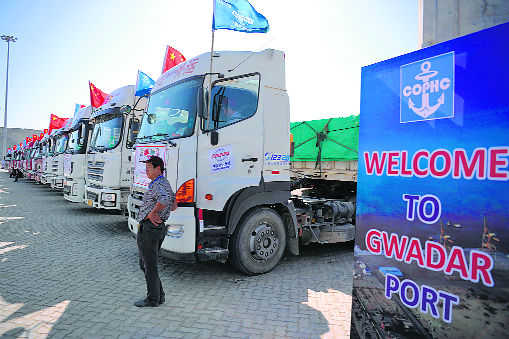
Pakistan seeks acquisition of military power beyond its economic sustainability. It lacks maritime capability essential to secure its ports at Gwadar and Karachi. With an aircraft carrier, it can have a chance of contesting the much superior Indian Navy’s expected attempts at a blockade of Karachi.
Pakistan fits into China’s bold naval plans

Caution: Development of the Gwadar Port and the Chinese navy’s westward move can pose a threat to India.

Lt Gen Syed Ata Hasnain (Retd)
Former GOC, 15 corps, Kashmir

THE maritime zone in India’s neighbourhood is now strategically significant and falls in the zone of connected security. That is why the news that China could sell an aircraft carrier to Pakistan, without a timeline attached to the proposal, needs a holistic examination, not from a maritime angle alone.

Why is an aircraft carrier important? As part of a carrier group, it is an instrument for power projection and extends airpower to the distant oceans where an adversary’s flotilla can be contested away from one’s own shoreline or areas of interest. Its presence along with the vessels of the carrier group caters to deterrence and provision of security to sea lanes crucial for the undisturbed conduct of freedom of navigation.

The US dominates the holding of aircraft carriers, with a total of 19; 11 of these are Nimitz-class nuclear-powered ships. Only 12 more carriers exist around the world. Till recently, India had two of these — INS Viraat and INS Vikramaditya. However, INS Viraat has since been decommissioned, leaving the Indian Navy with a single carrier, like the Russian navy. In two years, India will have its second carrier, indigenously designed and constructed. China’s PLA navy (PLAN) is reported to have two carriers with a third under construction. It is likely that China has decided to build five carriers and launch them by 2025-30, bringing the number to six or seven. One of the current holdings, the Liaoning, a refurbished erstwhile Russian ship, is the one which China’s official media says will be handed over to Pakistan.

Will Pakistan pay for the carrier? Given its cash-strapped economy and the fact that debt servicing of CPEC (China-Pakistan Economic Corridor) loans commences this year, and annually could amount to $4 billion, it is doubtful that it will pay anything. However, the idea of giving Pakistan a carrier must strategically appeal to China. The reason can be traced to China’s power deficit in the Indian Ocean. For commencement of deployment of a capable blue-water navy, China needs a carrier group on either side of the Straits of Malacca. The power deficit is an outcome of a major but erroneous decision taken at the foundation stage of modern China. Deng Xiaoping, who fathered China’s modernisation and rise, accorded the lowest priority to modernisation of the military, placing more emphasis on agriculture, technical education and industry.

Within the military, the PLA was placed at the higher rung. What the leadership did not realise then were two facts. First, to maintain China’s growth rate, it needed a continuous flow of energy to keep the industrial production increasing year on year. Second, the economy could only flourish if the flow of goods from the thousands of factories could be continuously ensured to markets far abroad. For both, secure sea lanes of communication (SLOC) were required, right from the Suez and the Persian Gulf to the Straits of Malacca and through the South China Sea to China’s eastern seaboard. Deng and the subsequent leadership made the cardinal error of not commencing the early modernisation of PLAN, which could ensure balanced contestation against potential adversaries whose combined naval power could block China’s energy and container traffic, thus starving its growth. That would be a major red line against China’s tolerance, but no sensible nation ever wishes an adversary to come near a potential sensitivity such as a red line.

Domination of both the East and South China Seas is not as big a challenge because of the proximity of Chinese naval bases. It is the security of the SLOC in the Indian Ocean which could pose a problem, should the standoff against potential adversaries reach such a contingency. The Andaman and Nicobar Islands, just west of the Straits of Malacca, combine to bring about the Malacca effect, a deep perception of insecurity in the Chinese strategic matrix. Although China has been making attempts at securing bases in South Asia to overcome this disadvantage, the fructification of these to a level of placement of naval assets has yet to be reached. It has, however, secured for itself a foothold in Djibouti by leasing the Port of Doraleh.

With perceived anti-China security equations in the making (‘Quad’ being one of them), China is looking at options. Deployment of a carrier group off Djibouti will be perceived as a naked show of strength, although the US has recently moved a carrier group into the Middle East to threaten Iran and secure its assets against Russian threats. This is a momentary development; in the long run, China needs partnerships with navies that can extend its interests in the west Indian Ocean. For this, the Pakistan navy fits the bill.

Pakistan seeks acquisition of military power beyond its economic sustainability. With a 6.5 lakh-strong army and a reasonably powerful air force, it lacks maritime capability, essential to secure its ports at Gwadar and Karachi. With a carrier, it can have a chance of contesting the much superior Indian Navy’s expected attempts at a blockade of Karachi. It could also draw out the Indian Navy further into the Arabian Sea and even threaten a part of Indian trade, energy traffic and offshore assets.

Pakistan’s submarine capability of five diesel-powered vessels is being bolstered by the reported sale of eight submarines (none nuclear-powered) by China, four of which are likely to be provided by 2023 and four more by 2028. India has 15 submarines (two nuclear-powered), and two more conventional ones are likely to be inducted. However, it is not the immediate future that India needs to be concerned about. It is with the further development of Gwadar Port and creeping boldness of the PLAN to move westwards with fuller capacity that will pose a greater threat.

Lastly, while the strategic partnership with the US looks upon the extended Indo-Pacific region, the relationship appears more centred on the Pacific segment and less on the Indian Ocean. This potential fructification should spur India to more meaningful security in the west Indian Ocean.


Relief to CAPF officers, apex court paves way for NFU To get same financial benefits as in other govt cadres

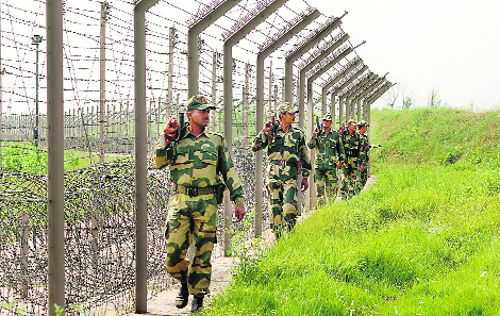
Relief to CAPF officers, apex court paves way for NFU

Supreme Court today Ruled that CAPFs — CRPF, BSF, ITBP, CISF, RPF and SSB — are part of the Organised Group-A Services
Vijay Mohan
Tribune News Service
Chandigarh, February 5

The Supreme Court today paved the way for grant of Non-Functional Upgradation (NFU) to officers of the Central Armed Police Forces (CAPFs) that function under the Home Ministry, thereby giving them the same financial benefits as are being enjoyed by officers in other government cadres.

Ruling that CAPFs — CRPF, BSF, ITBP, CISF, RPF and SSB — are part of the Organised Group-A Services (OGAS), a Bench comprising Justices Rohington Fali Nariman and MR Shah upheld an earlier order of the Delhi High Court that had directed the Centre to grant NFU to officers of these uniformed forces.

The NFU scheme, implemented in 2008, entitled IAS officers and other designated OGAS officers to get pay scale of the highest promoted officer of their batch even if they were not promoted. The affected non-promoted officers are given the higher grade two years after their batchmates are elevated.
While almost all government organisations received the benefit of NFU, it was denied to members of the defence forces and CAPFs. Officers from the defence forces, too, have sought judicial intervention and their case is also pending before the SC. Dismissing appeals filed against the HC order, the apex court held that from the material on record, more particularly the monographs published by the Department of Personnel and Training right from 1986 to date, CAPFs have been shown to be a part of the Central Group “A” Services after conducting the exercise of cadre review, etc.

The SC observed that the purpose of NFU was to give relief to Group “A” officers facing the problem of stagnation as fallback option when regular promotions do not come into various factors. “It has come on record that CAPFs are facing a huge problem of stagnation. On one hand, they are not being granted the promotion as most of the promotional posts are filled in by deputation and, on the other, they are denied NFU,” the Bench said.
The Centre had contended before the Supreme Court and the High Court that CAPFs could not be considered as OGAS because they did not fulfill the stipulated criteria, but it was overruled. Earlier orders issued by the Home Ministry denying NFU to CAPFs have also been quashed. In the same judgment, the apex court also granted similar relief to officers of the Railway Protection Force.

Non-functional upgrade

  • 2008 Non-Functional Upgradation scheme entitled IAS officers, other designated OGAS officers to get pay scale of highest promoted officer of batch even if they were not promoted
  • Affected non-promoted officers are given the higher grade two years after their batchmates are elevated
  • While almost all governmentorganisations received benefit, it was denied to members of the defence forces and CAPFs

Armyman among two arrested for attacking ASI with swords, rods

The ASI was managing traffic at a roundabout, when six inebriated men attacked him for stopping them

› When ASI Balwinder Singh and his team reached the spot, they saw the accused attacking Jassa. The accused were unrelenting in their attack and let go of Jassa only after Balwinder fired in the air.
PARAMPAL SINGH, senior superintendent of police

AMRITSAR: A serving Army man and his five aides attacked an assistant sub-inspector with swords and rods following an argument over traffic at Gehri Mandi chowk on Sunday.

On Saturday, the victim ASI Jassa Singh, who is in-charge of Gehri Mandi police post, was on his way to work around 8pm, when he noticed a traffic jam around the Gehri Mandi chowk and began managing the traffic. Jassa observed that the accused Gurpreet Singh of Khela village, who is posted as an army jawan at Chandimandir cantonment, was drunk and asked him to park his motorcycle on the side. Gurpreet began arguing with Jassa and drew out a sword. Five of his aides also joined in the attack and began thrashing Jassa with swords and rods, police said.

“When ASI Balwinder Singh and his team reached the spot, they saw the accused attacking Jassa. The accused were unrelenting in their attack and let go of Jassa only after Balwinder fired in the air,” the SSP Parampal Singh. “The accused intended to kill him.”

Gurpreet and his aide Sukhjinder Singh of Bhangwan village were arrested while the others fled the spot.

Jassa was rushed to a hospital and doctors say he is out of danger.

A case was registered under Sections 307 (attempt to murder), 353 (assaulting a public servant), 186 (obstructing a public servant), 332 (voluntarily hurting a public servant to deter him from performing his duty), 427 (mischief causing damage to the amount of ₹50), 148 (rioting, armed with deadly weapon), 149 (unlawful assembly) of the Indian Penal Code (IPC).


Tololing win turning point in Kargil war: Ex-Army Chief

Tololing win turning point in Kargil war: Ex-Army Chief

General VP Malik (retd)

Tribune News Service

Solan, February 22

“The battle of Tololing was a major turning point during the Kargil war,” said former Army chief General Ved Prakash Malik during his interaction with students at Shoolini University here today. Gen Malik delivered a talk on leadership and motivation based on his personal experience as the Chief of the Army Staff.

Addressing students and faculty members, he said initially the confusion about the true identity of the enemy was the biggest challenge for them but capturing Tololing gave them the confidence to come out victorious.

He also disclosed that the Army was ready to attack Pakistan within six days.

As an Army chief, he couldn’t share his stress with anybody else.

The zest among soldiers to fight for the nation and their attempts to stay positive even in the face of war was his biggest source of inspiration during the Kargil war.

General Malik had been awarded Param Vishisht Seva Medal and Ati Vishisht Seva Medal. He has served two terms on the National Security Advisory Board and is also a member of the advisory board of various companies in the corporate sector, including the Indian Advisory Board of Coca-Cola. He was also accompanied by his wife Dr Ranjana Malik.

He agreed that the motivation of the Tricolour is a much stronger inspiration. But, in the battle, the Tricolour was always there at the back of his mind but the rest that he did in the battlefield was because of his team.


TSD could have prevented Pulwama massacre if not sabotaged by Abhinandan Mishra

New Delhi: Media reports alleging that two highly sophisticated “off-air interceptors” were being used to monitor the conversation of ministers and other senior UPA government functionaries in South Block and North Block, sounded the death knell of the Technical Support Division (TSD). As this newspaper reported earlier, TSD was a tiny specialised unit of the Indian Army and was formed in May 2010 after General V.K. Singh became the Chief of Army Staff. The TSD was painted as a rogue unit by these media reports, which led to its disbanding in May 2012. The TSD had carried out several operations that prevented 26/11 Mumbai-type attacks from taking place. The TSD was exactly the sort of highly specialised intelligence unit needed to pre-empt Pulwama type clandestine terrorist preparations. Its sabotage by vested interests has led to a critical gap in military intelligence capability, say defence experts.

The media reports, quoting Army “sources”, terrorised the political dispensation of the time by claiming that the TSD was using these interceptors to spy on the phone calls of even the Defence Minister. But there was a “slight” problem to such claims—the military does not have any record whatsoever of the purchase of these interceptors. And this when the record books of the military log in even the purchase of the boots of a soldier in multiple places. The existence of these interceptors was also not mentioned by the Army when it carried out court-martial proceedings of one of the officers who was a part of the TSD.

“The interceptors and the rogue nature of their work existed only in media reports. The Army, even during its internal proceedings which were started post May 2012, never mentioned anything about the existence of any such interceptors,” a government official told The Sunday Guardian.

“Imagine a Defence Minister reading in newspapers that an Army unit was intercepting his calls and that the same unit was also trying to topple a state government. And when the Defence Minister goes to the Army Chief (not General V.K. Singh) to seek answers, the Army Chief too says that this unit is a ‘rogue’. What would the Defence Minister do? He will not interfere when the unit is shut down. And that is what happened with the TSD,” a senior government source told The Sunday Guardian.


Highly placed sources said that the formation of TSD was approved, in writing, by the then Defence Minister, A.K. Antony when he signed the operational directive to develop covert capability of the Indian Army so that it could take pre-emptive and retaliatory action against terrorist groups.

“It was a covert unit, not a clandestine unit dealing primarily in humint (human intelligence). A clandestine unit carries out the operation and claims the success or the failure of the operation. A covert unit does not exist in the eyes of the public. It neither claims its success nor its failure. TSD was a covert unit. It cannot claim that two high ranking terror group leaders were picked up and brought to India by the TSD, nor how this unit was very close to taking out a head of a terrorist group who has brought innumerable sufferings to the country by way of terrorist strikes and killing of Army soldiers,” a senior Army officer stated. Even Pakistan’s own covert units, including Lashkar-e-Tayyaba had raised the “issue” of TSD in multiple circles.

Sources who are aware of the matter said that TSD was mandated to target high ranking terrorists by penetrating deep into the enemy territory, carrying out psychological warfare, both internally and externally and pre-empting terror strikes by whatever means necessary. “No Army Chief, traditionally wants to have a unit like TSD under him since it has never been done before. V.K. Singh, however, when he became the chief, decided to go with it. Now, I don’t think any Army Chief will ever raise any such unit because of the baseless controversies that were stuck to it,” another senior Army officer said.

According to officers, the TSD successfully managed to thwart the supply of arms and ammunition that the Naxals in Chhattisgarh and Andhra Pradesh were getting from Northeast based insurgents.

“Such arms supply to the Naxals via this route had virtually dried up when the TSD was there, as TSD officers were very ‘strong’ and active in the Northeast. Once the TSD was disbanded, Naxals started getting the weapons again, and in May 2013 the Naxals killed almost the entire leadership of the Chhattisgarh unit of the Congress by using the weapons that they had received from Northeast based insurgent groups. One can ask a hypothetical question: would the Congress leaders in Chhattisgarh have survived if the TSD was there? The answer is not that difficult to guess,” stated the officer.

Another senior Army officer, who is aware of the details regarding the TSD, said that fictitious reports were leaked from Army Headquarters regarding the “rogue” nature of the TSD to the media.

“Media carried reports that the TSD had paid money to an MLA in the state of Jammu and Kashmir to topple the state government. Can one Independent MLA topple any state government? Each and every penny that was used by the TSD was accounted for and when the dust settled the Army too found that there was no discrepancy. It was a concerted effort launched at various levels, in a planned manner, to destroy the TSD,” the Army officer recalled.

The officer, who was a part of the establishment which was working closely with the TSD when it was brought down, recalled, “The TSD was doomed the day Lt General D.S. Suhag, Brigadier Abhay Krishna and Colonel Srikumar were given show-cause notices in the ‘Jorhat Dacoity’ case that took place in December 2011, and the media linked it as V.K. Singh trying to break the line of succession. The media forgot that it was V.K. Singh who had recommended Suhag for promotion to Army Commander. Suhag was show-caused for his failure to control a rogue unit and the dacoity that took place under his watch. Later, a joint secretary in the Ministry of Defence got into a personal fight with V.K. Singh and took the TSD down. The leaks to the media were made at the behest of this joint secretary,” he stated.

The value of TSD and the damage its closure cost the Indian Army in the long run, can perhaps be best summarised by the observations of the then Deputy Chief of Army, Lt General D.S. Thakur, who while appearing before a related Army proceeding, said, “It is sad to see that the witch hunt against the Intelligence Corps Officers who put their careers and lives on the line and took grave risks in conducting these operations in the service of the nation, still continues. It is also sad that, we don’t realise what damage we have been doing to the overall morale and effectiveness of our Intelligence Corps. By pursuing such inquiries we are only sending message to our Intelligence Corps personnel not to take risks and play safe. It is our officers at the apex level who should squarely take the blame for this state of affairs as without vibrant Intelligence Corps operations, we will be blinded in the Army.”


One Reply to “TSD could have prevented Pulwama massacre if not sabotaged”


Students feel safe after Amarinder’s assurance

Jammu/Srinagar, Feb 18

Kashmiri students who are staying in Mohali on Monday said they felt relieved by the assurance given by Punjab CM Capt Amarinder Singh regarding their security.

“We are staying inside our hostels and rented accommodation,” students studying in Mohali said.

A student said there were several gurdwaras in the vicinity which made them feel safe. “Also, our landlords are nice people so we do not feel threatened,” he said.

The students said the situation was calm but tension prevailed due to reports from other states, where Kashmiri students were harassed.

Another student in Mohali said “lots of Kashmiri students” from Dehradun had arrived in Mohali and were staying at gurdwaras. —TNS

Cops to escort Kashmiri students on way home, says Mohali DC

Akash Ghai

Tribune News Service

Mohali, February 18

Kashmiri students, who want to return home, will be sent to the Punjab-Jammu border under police cover.

An assurance in this regard was given to a two-member delegation of Kashmiri students by the Mohali administration here today.

Confirming the development, Mohali Deputy Commissioner Gurpreet Kaur Sapra said a police team would be sent with the Kashmiri students who wanted to return home.

“Directions in this regard have been issued to the local police. The police team would accompany the students in their vehicle up to the Punjab-Jammu border,” said Sapra.

She said around 30 students, who had arrived here from other states post-Pulwama terror attack, wanted to go home as soon as possible.

“Though the youngsters have several apprehensions for obvious reasons, we assured them of full support and assistance of any kind,” said Sapra.

Earlier today, a two-member delegation, including the president of the Jammu and Kashmir Students Association, Khwaja Itrat, met the Deputy Commissioner with certain concerns.

Around 125 Kashmiri students have been putting up at different locations here. Nearly 50 students from Jammu and Kashmir have been staying at Gurdwara Singh Shaheedan where four rooms have been allotted to them. The gurdwara management is also providing food to the students. Sapra said though there was no need to panic, the local administration was concerned about their safety and well-being.


City-Srinagar airfare jumps

Post-Pulwama terror attack, the airfare from Chandigarh to Srinagar has witnessed a substantial rise, especially in the past couple of days. The airfare has crossed the figure of Rs 25,000. Several Kashmiri students were planning to book flights to return home, but due to the high airfare, they had to postpone their programme. “We are looking for other safe options,” said one of the students.

Gurdwara, NGO come to students’ rescue

Gurdwara, NGO come to students’ rescue

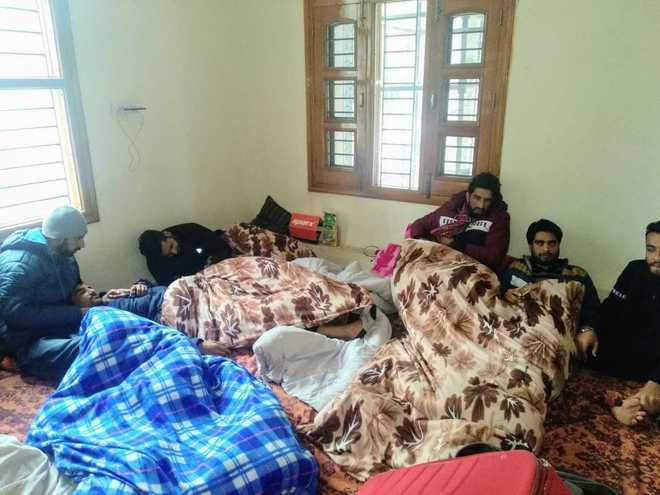
Kashmiri students at Gurdwara Singh Shaheedan, Sohana. Tribune photo

Amarjot Kaur

Tribune News Service

Mohali, February 18

More than 40 Kashmiri students took refuge at Gurdwara Singh Shaheedan, Sohana, here on Monday. While the gurdwara authorities allotted four rooms to the students, Khalsa Aid, an international non-profit aid and relief organisation, made arrangements for their commute to Jammu.

Heaving a sigh of temporary relief, mainly on the Mohali DC’s word of assurance about their safety, the Jammu and Kashmir Student Organisation has mobilised over 160 students from Mullana in Ambala and Dehradun to Jammu. While boys are putting up at the gurdwara, about 10 girls have been allotted a room in an undisclosed residential area in Mohali.

The students, who arrived here from Dehradun, shared terrifying tales of ostracism by the locals and how they were locked up in their rooms for two long days. 

“Some 200 Kashmiri students study at the BIFT Group of Institutes in Dehradun. We were locked up in our rooms, fearing the protesters who raised slogans against Kashmiris and reached here famished,” said a 24-year-old Muzamil Ahmad. His friend, Shahid Sultan, 27, claimed that the atmosphere of animosity enveloped the university campus on the day of attack.

He said: “Some landlords were very helpful, but in some cases they weren’t. A group of friends were kicked out by their landlords. We condemn the attack too, but how are we responsible for it? Why are we, as innocent students, being subjected to this backlash?”

While the students have been demanding the government to decrease the airfare, their pleas have fallen on deaf ears. In this crucial moment, the volunteers of Khalsa Aid are ensuring that the students are dropped to Jammu safely.

“We have provided the students with three tempos for Jammu and two buses for students coming from Uttarakhand. We stand for humanity. No other organisation has come for their help so far,” said Amarpreet, a volunteer with Khalsa Aid. Meanwhile, a member of the Jammu and Kashmir Student Organisation said he had a word with the Mohali DC. “We were assured protection, but the maximum relief we sought was from the gurdwara authorities and Khalsa Aid,” a student said.


Ex-Air Force official shoots himself dead

Ex-Air Force official shoots himself dead

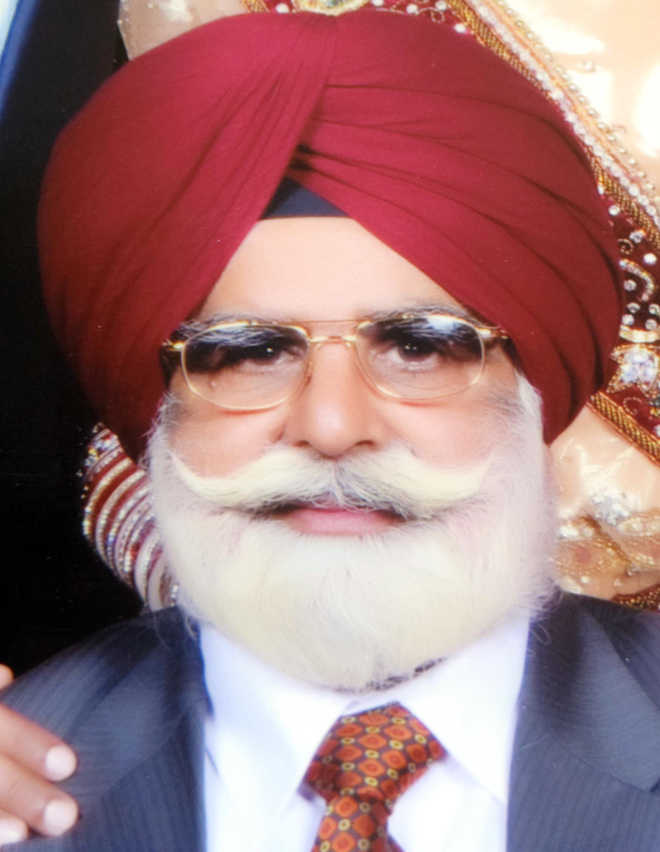
arnail Singh

Tribune News Service

Mohali, February 16

A retired official of the Indian Air Force allegedly shot himself dead with a .12 bore rifle at his rented accommodation in Sector 69 here today.

The victim, Karnail Singh (74), who hailed from Raipur village near Chamkaur Sahib, was said to be unwell. According to the police, the incident took place this afternoon.

“He shot himself in his abdomen with the help of his foot. The police recovered two shells from the spot. They have ruled out any foul play in the incident. The victim suffered two bullet injuries in his abdomen,” said Inspector Rajiv Kumar, Station House Officer of the Phase 8 police station here.

The police claimed that the victim could not hear and speak due to some accident, which took a few years ago.

The victim is survived by his wife and three children. All of his children are settled abroad. According to Inspector Rajiv Kumar, the body has been kept in the mortuary.


Army orders fresh probe against Colonel for ‘suicide’ by officer’s wife in unit

Documents accessed by The Indian Express reveal that the new Court of Inquiry has been ordered by the Jodhpur-based HQs 12 Corps on January 29, 2018.

Army sources inform that there had been considerable upheaval in the battalion over the death of the officer’s wife and a spate of allegations had been levelled against the then CO. (Representational)

Army sources inform that there had been considerable upheaval in the battalion over the death of the officer’s wife and a spate of allegations had been levelled against the then CO. (Representational)

The Army has ordered a re-investigation into the role of a former Commanding Officer (CO) of a battalion of the Brigade of Guards, in the rank of Colonel, with regards to the alleged suicide committed by the wife of the second in command of the unit deployed in Rajasthan in October 2018.

In a move that has raised eyebrows, the Army has set aside the first Court of Inquiry held into the incident in November 2018 and has ordered a fresh Court of Inquiry with explicit instruction to look into any possible acts of moral turpitude which the CO may have indulged into. The previous inquiry has been set aside on the plea that it did not have proper composition.

Documents accessed by The Indian Express reveal that the new Court of Inquiry has been ordered by the Jodhpur-based HQs 12 Corps on January 29, 2018. A Brigadier has been appointed the presiding officer of the inquiry along with two officers of the rank of Colonel and a lady officer of the rank of Major. The lady officer has been detailed because it is felt that during the course of the inquiry ladies may be asked to come and depose before the inquiry.

The incident pertains to October 26, 2018 when the wife of a Lt Colonel allegedly committed suicide in Pokhran. The CO of the battalion, who was later removed from command, is alleged to have been in consistent touch with the lady, who was the wife of his immediate subordinate, and hence his role is being examined.

As per the orders issued by the Army, the Court of Inquiry shall take the opinion of the medical authorities regarding the cause of the death of the lady. “State of physical and mental health of the lady be also taken on record through competent witnesses such as husband and doctors who may have examined her,” the order reads.

It goes to direct that phone call records of the known telephone numbers of the lady may also be obtained and examined to find out whether the former CO had made calls, messages, WhatsApp communication to verify the allegations made against him.


Pak lawmaker says ‘atmosphere beginning to thaw’ after his meetings with Indian leaders

Lahore, February 24

A Pakistani lawmaker from Prime Minister Imran Khan’s party has met top Indian leaders, including Prime Minister Narendra Modi, as Islamabad started backdoor contacts with New Delhi to defuse tensions between the two sides in the wake of the Pulwama terror attack, a media report said on Sunday.

“The government has begun backdoor contacts with India and the ruling Pakistan Tehreek-e-Insaf (PTI) leader Ramesh Kumar Vankwani, who was in India last week, has met Prime Minister Modi and External Affairs Minister Sushma Swaraj,” the Express Tribune reported.

“I have communicated a positive note to the Indian leaders and I hope there will now be a change in their behaviour,” Vankwani said on Saturday while talking to the paper over telephone.

He also met Minster of State for External Affairs General VK Singh, who has also served as the chief of the Indian Army.

The Sindh-based PTI leader, who is a lawmaker on minority seat, is in India as part of a 220-member delegation from 185 countries who attended the Kumbh Mela on an invite of the Indian Government.

His visit comes amid heightened tensions between the two countries in the wake of February 14 suicide attack by Jaish-e-Mohammad that killed at least 40 CRPF soldiers in Jammu and Kashmir’s Pulwama district.

Days after the Pulwama attack, Prime Minister Modi said security forces have been given free hand to avenge the dastardly act.

Vankwani said he met Modi during an event and the Indian prime minister met him warmly, the paper reported.

He said he told Modi that he had come with a positive message and wanted to return with a positive message. He said later on Modi’s directive, Swaraj also held a 25-minute-long meeting with him, the paper said.

“I told the Indian foreign minister that in Pakistan its captain’s (Imran Khan) government now; he is a Pathan and he does what he says. We assure you that no Pakistani institution is involved in Pulwama attack. If India provides evidence, we will facilitate the investigation,” the paper quoted Vankwani as saying.

According to the PTI leader, he told Swaraj that the two countries need to take lessons from past and not to hold on to it.

“Enmity can be brought to an end by befriending the enemy,” he said, adding that he himself has returned after Ganga Ashnan (ablution) and never tells lies.

“I told them that we need to get out of politics of accusations,” he was quoted as saying by the paper.

According to Vankwani, after the meeting he “felt that the atmosphere was beginning to thaw.”

“Indian PM during his Rajasthan rally has hinted at holding dialogue with Pakistan,” he added. — PTI


IAF pilot cremated with full military honours

Wg Cdr Sahil Gandhi was killed in mid-air crash in Bengaluru | Five-year-old son lights the pyre

IAF pilot cremated with full military honours

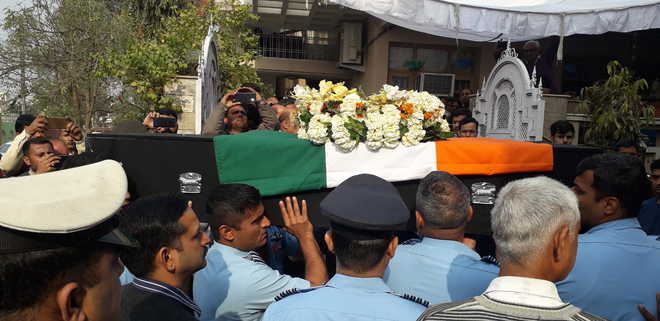
he mortal remains of IAF pilot Sahil Gandhi at his residence in Hisar on Thursday. Tribune photo

Deepender Deswal

Tribune News Service

Hisar, February 21

The Indian Air Force pilot, Wing Commander Sahil Gandhi, who lost his life in Tuesday’s mid-air crash of two Surya Kiran planes in Yehlanka, Bengaluru, was cremated with full military and state honours in his native town on Thursday.

A large number of people from all walks of life attended the funeral. The pyre was lit by his five-year-old son Riyan.

Earlier, Sahil’s body was brought to Hisar via a helicopter in the morning. He is survived by his father Madan Mohan Gandhi, mother Dr Sudesh Gandhi, elder brother Nitin, wife Himani and son Riyan (5).

Sahil’s father is a retired bank official while mother Dr Sudesh recently retired as a principal scientist from Ch Charan Singh Haryana Agricultural University, Hisar. His brother is based in Switzerland.

Sahil had joined the NDA after completing his Class XII from Campus School, HAU, Hisar, in 2000. He was commissioned into the Indian Air Force in 2004.

Local MP Dushyant Chautala, MP DP Vats, MLA Kamal Gupta, IAF officers and district officials were also present.