



Sanjha Morcha

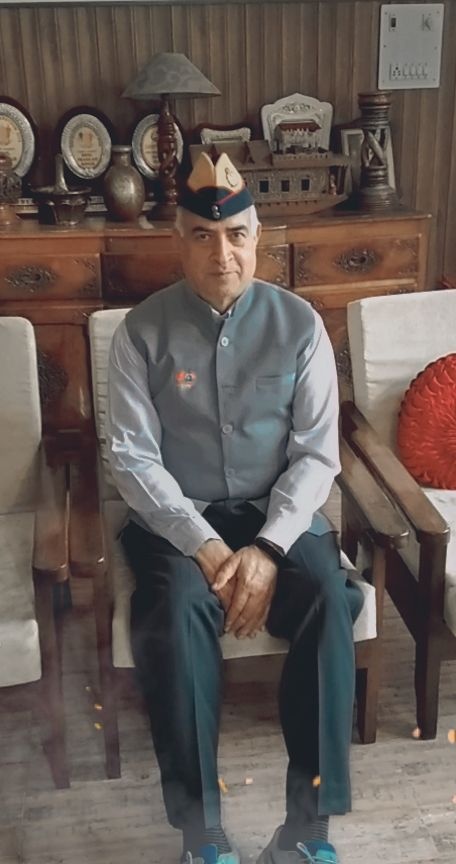
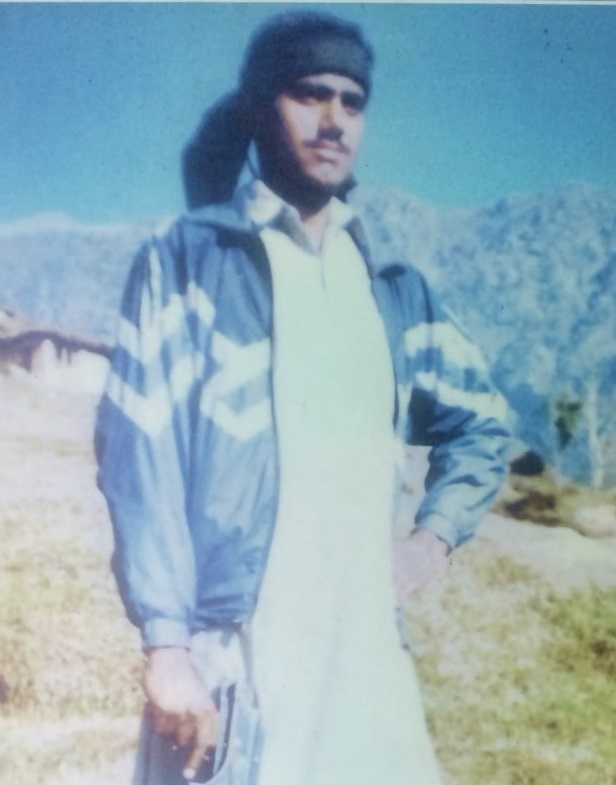
Grenadier Bhati — youngest Shaurya Chakra awardee He sacrificed his life gallantly fighting terrorists in Udhampur in 2000

Col Dilbag Dabas (Retd)

Grenadiers Infantry Regiment, one of the oldest Sword Arm, has the distinction of giving to the Indian Army five bravest among the braves; three of them were awarded the Param Vir Chakra and two Ashok Chakra. Even peace-time gallantry award tally of the Grinders (as Grenadiers are commonly referred to) speaks volumes of these brave men. One of its Grinders Naik Jardish Ahmed is among the very few in the Indian Army to have been awarded the Shaurya Chakra twice and another Grinder Devinder Singh Bhati is the youngest Shaurya Chakra awardee in the Indian Army till date.

Devinder was the fourth generation soldier; the earlier two generations were also Grenadiers. He grew up listening to the stories of valour of Indian jawans from his father and grandfather and knew he was destined to follow into their footsteps. And he chose to be a Grinder like his grandfather and great grandfather.

 Devinder, son of Havildar Giri Raj Singh, was born in Kaurali village of Faridabad district on June 10, 1980. He was so impatient to join the Army that he didn’t even complete his senior secondary education and passed all preliminaries to become an Army jawan. And on October 28, 1998, he became Grenadier Devinder Singh Bhati of 14 Grenadiers. 

The Kashmir valley has been the hotbed of militancy in Jammu and Kashmir but the Jammu region has also not remained unaffected. Areas around Poonch, Mendhar, Riasi and Udhampur have often been used by militants to cross over to the Kashmir valley. 14 Grenadiers Battalion was deployed near Udhampur in 1999 when militants were suspected of having their hideouts in hamlets around there. It was during one cordon and search operation around Udhampur that Grenadier Devinder Singh Bhati of 14 Grenadiers laid down his life while gallantly fighting the militants, an act of valour for which he was awarded the Shaurya Chakra posthumously. The battle account of his bravery is recorded in digest of service of 14 Grenadiers.

Bhagwan Devi, mother of Devinder Bhati, recalls: “Jatey jatey mera beta mujhe mere doodh ki taqat ka ahsas kara gaya. Bola maa, maine tera doodh piya hai, dekhna ugrawadion pe main kitna bhari padta hun”. 

Havildar Giri Raj Singh, father of Devinder, had only this to say to his son while seeing him off at the Kaurali bus stop: “Beta nirbhay hokar apni duty karna. Pura Kaurali gaon tere saath hai”. And the last words of Devinder to his father were: “Pita Ji, main Bhati Rajput hun, voh bhi chodah Grenadier ka. Aisa kuchh karke lautunga ke gaon ke mere sarey dost mujhe salute marenge”.

And not only his friends, the entire Kaurali village lined up and saluted the mortal remains of Grenadier Devinder Singh Bhati, the youngest Shaurya Chakra awardee in the Indian Army.

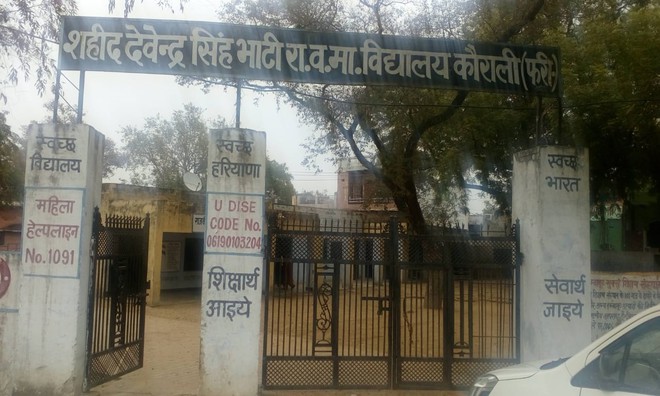
As a mark of respect, the alma mater of this brave heart is now Saheed Devinder Singh Bhati Government Senior Secondary School, Kaurali, Faridabad.


The account of his bravery in digest of service of 14 Grenadiers reads…

Grenadier Devinder Singh Bhati was part of a column, which was carrying out a cordon and search operation in Thinmarg village near Udhampur in Jammu and Kashmir on October 12, 2000 .The area of operation was extremely rugged and with steep gradients at an altitude of over 13,000 feet. Grenadier Devinder’s column reached its location after an arduous march in extreme cold conditions and deployed its stops during daylight hours. After it got dark, a group of six terrorists attempted to break through Devinder’s portion of the cordon. The stops came under intense and automatic fire by the terrorists from a dominating position. The terrorists even lobbed hand grenades to silence the stops. Grenadier Devinder rushed to cover the stops but in the process was hit by bullets and splinters of grenades. Ignoring his grave injuries, he asked his cordon to take cover and engaged the terrorists in a fierce combat, killing two of them.

Though Devinder had sustained severe injuries, he remained alert and proceeded to dislodge the terrorists who were bringing down devastating fire. Defying apogee of human endurance, Grenadier Devinder Singh Bhati charged towards the terrorists and sprayed the area with bullets, killing one more. Despite sustaining mortal injuries, the super human effort of Grenadier Devinder Bhati ensured that all the terrorists were killed in this operation. He attained martyrdom after sustaining 22 bullet injuries.

For his raw courage, exemplary determination and supreme sacrifice in the best traditions of the Indian Army, Grenadier Devinder Singh Bhati was awarded the Shaurya Chakra posthumously.

(The writer is a veteran Gunner, 6 Field Regiment)



Punjab soldier on guard duty at Jammu army camp shoots self

Punjab soldier on guard duty at Jammu army camp shoots self

Sepoy Sandeep Singh, a resident of Punjab, was on guard duty at a post in a transit camp at Panama Chowk where he shot himself in the head on Tuesday, the official said.

Jammu, February 13

A 30-year-old soldier allegedly committed suicide by shooting himself with his service rifle at an Army camp here, a police official said on Wednesday.

Sepoy Sandeep Singh, a resident of Punjab, was on guard duty at a post in a transit camp at Panama Chowk where he shot himself in the head on Tuesday, the official said.

His colleagues rushed to the scene on hearing the gunshot and found him dead on the spot, he said.

The body was handed over to the Army for last rites after completion of the legal formalities, the official said. The motive behind Singh taking the extreme step is yet to be ascertained, he said. PTI


COAS calls on Governor

Nation’s sovereignty intact because of Indian Army: Mishra

ITANAGAR, Feb 3: Governor BD Mishra hailed the role of the Indian Army in defending the nation’s sovereignty.
“It is because of the Indian Army that the sovereignty and the territorial integrity of the nation are intact,” said Mishra during a meeting with Chief of the Army Staff (COAS), Gen Bipin Rawat, at the Raj Bhavan here on Sunday.
The governor conveyed the goodwill of the people of Arunachal Pradesh to the general for the latter’s gesture to increase
vacancies for Arunachalee youths in the army. He also mentioned the initiative of the 17th battalion of the Rajputana Rifles in Gelemo village in Upper Subansiri, where they opened a primary school.
Handing over a report about the Pay Back to Society Group (PBSG), Mishra commended Gen Rawat’s good gesture to help the PBSG.
The COAS praised the people of Arunachal Pradesh, saying they have always helped the Indian Army in a big way. He also said there are many “very good” officers from Arunachal in the armed forces.
The army chief felicitated four meritorious students, Mihin Ronya (Rajiv Gandhi Government Polytechnic College), Miti Perme (DNGC), Rajiv Ranjan Ray (NERIST) and Joychen Kenglang (NIT).

The governor’s wife Neelam Misra presented a short film on loin loom weaving to Army Wives Welfare Association president Madhulika Rawat, for the benefit of the army wives.
Students from the Donyi Polo Mission School for the Hearing and Visually Impaired, RGU, the NERIST and the NIT, and artist Mibi Nyodu presented colourful cultural programmes depicting the cultural heritage of Arunachal.
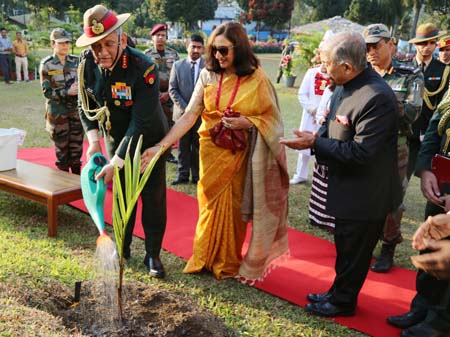
Earlier, in the afternoon, the general and his wife planted a palm tree in the Raj Bhavan premises. (Raj Bhavan)


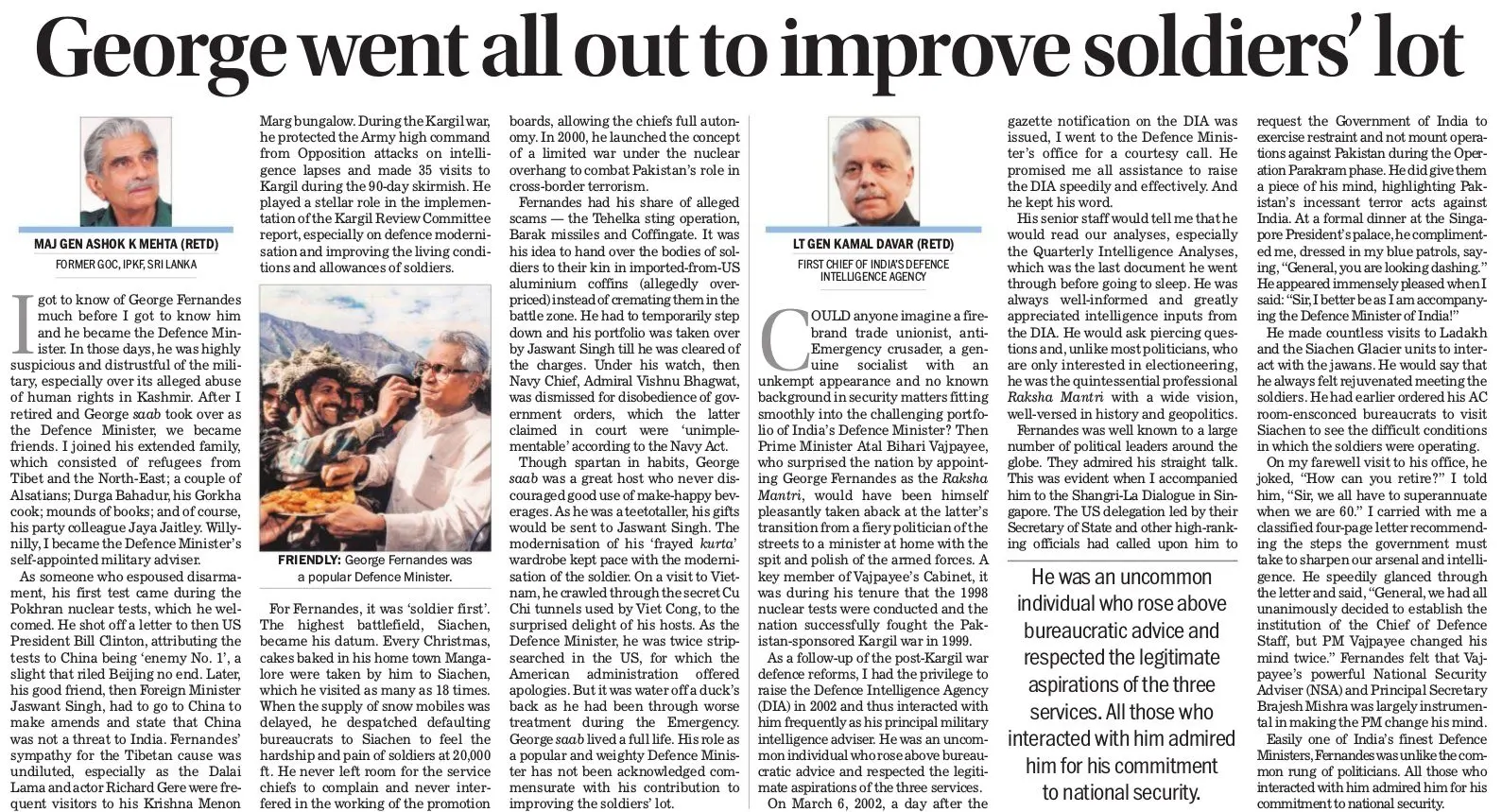
Gorge went all out to improve soldiers lot by Maj Gen Ashok K Mehta (Retd) & Lt Gen Kamal Davar (retd)

Maj Gen Ashok K Mehta (Retd) & Lt Gen Kamal Davar (retd)

Maj Gen Ashok K Mehta (Retd) & Lt Gen Kamal Davar (retd)


George went all out to improve soldiers’ lot

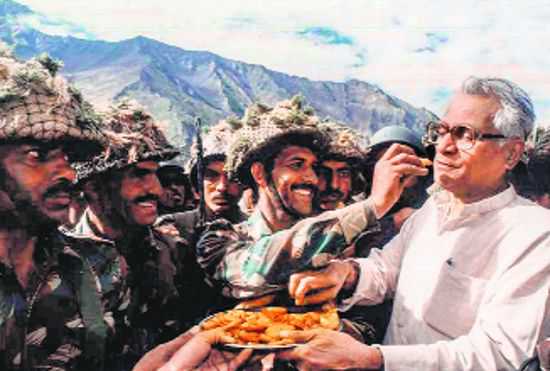
Friendly: George Fernandes was a popular Defence Minister.

Maj Gen Ashok K Mehta (Retd)
former GoC, IPKF, Sri Lanka

I got to know of George Fernandes much before I got to know him and he became the Defence Minister. In those days, he was highly suspicious and distrustful of the military, especially over its alleged abuse of human rights in Kashmir. After I retired and George saab took over as the Defence Minister, we became friends. I joined his extended family, which consisted of refugees from Tibet and the North-East; a couple of Alsatians; Durga Bahadur, his Gorkha cook; mounds of books; and of course, his party colleague Jaya Jaitley. Willy-nilly, I became the Defence Minister’s self-appointed military adviser.

As someone who espoused disarmament, his first test came during the Pokhran nuclear tests, which he welcomed. He shot off a letter to then US President Bill Clinton, attributing the tests to China being ‘enemy No. 1’, a slight that riled Beijing no end. Later, his good friend, then Foreign Minister Jaswant Singh, had to go to China to make amends and state that China was not a threat to India. Fernandes’ sympathy for the Tibetan cause was undiluted, especially as the Dalai Lama and actor Richard Gere were frequent visitors to his Krishna Menon Marg bungalow. During the Kargil war, he protected the Army high command from Opposition attacks on intelligence lapses and made 35 visits to Kargil during the 90-day skirmish. He played a stellar role in the implementation of the Kargil Review Committee report, especially on defence modernisation and improving the living conditions and allowances of soldiers.

For Fernandes, it was ‘soldier first’. The highest battlefield, Siachen, became his datum. Every Christmas, cakes baked in his home town Mangalore were taken by him to Siachen, which he visited as many as 18 times. When the supply of snow mobiles was delayed, he despatched defaulting bureaucrats to Siachen to feel the hardship and pain of soldiers at 20,000 ft. He never left room for the service chiefs to complain and never interfered in the working of the promotion boards, allowing the chiefs full autonomy. In 2000, he launched the concept of a limited war under the nuclear overhang to combat Pakistan’s role in cross-border terrorism.

Fernandes had his share of alleged scams — the Tehelka sting operation, Barak missiles and Coffingate. It was his idea to hand over the bodies of soldiers to their kin in imported-from-US aluminium coffins (allegedly overpriced) instead of cremating them in the battle zone. He had to temporarily step down and his portfolio was taken over by Jaswant Singh till he was cleared of the charges. Under his watch, then Navy Chief, Admiral Vishnu Bhagwat, was dismissed for disobedience of government orders, which the latter claimed in court were ‘unimplementable’ according to the Navy Act.

Though spartan in habits, George saab was a great host who never discouraged good use of make-happy beverages. As he was a teetotaller, his gifts would be sent to Jaswant Singh. The modernisation of his ‘frayed kurta’ wardrobe kept pace with the modernisation of the soldier. On a visit to Vietnam, he crawled through the secret Cu Chi tunnels used by Viet Cong, to the surprised delight of his hosts. As the Defence Minister, he was twice strip-searched in the US, for which the American administration offered apologies. But it was water off a duck’s back as he had been through worse treatment during the Emergency. George saab lived a full life. His role as a popular and weighty Defence Minister has not been acknowledged commensurate with his contribution to improving the soldiers’ lot.


Lt Gen Kamal Davar (retd)
First chief of India’s Defence Intelligence Agency

Could anyone imagine a firebrand trade unionist, anti-Emergency crusader, a genuine socialist with an unkempt appearance and no known background in security matters fitting smoothly into the challenging portfolio of India’s Defence Minister? Then Prime Minister Atal Bihari Vajpayee, who surprised the nation by appointing George Fernandes as the Raksha Mantri, would have been himself pleasantly taken aback at the latter’s transition from a fiery politician of the streets to a minister at home with the spit and polish of the armed forces. A key member of Vajpayee’s Cabinet, it was during his tenure that the 1998 nuclear tests were conducted and the nation successfully fought the Pakistan-sponsored Kargil war in 1999.

As a follow-up of the post-Kargil war defence reforms, I had the privilege to raise the Defence Intelligence Agency (DIA) in 2002 and thus interacted with him frequently as his principal military intelligence adviser. He was an uncommon individual who rose above bureaucratic advice and respected the legitimate aspirations of the three services.

On March 6, 2002, a day after the gazette notification on the DIA was issued, I went to the Defence Minister’s office for a courtesy call. He promised me all assistance to raise the DIA speedily and effectively. And he kept his word.

His senior staff would tell me that he would read our analyses, especially the Quarterly Intelligence Analyses, which was the last document he went through before going to sleep. He was always well-informed and greatly appreciated intelligence inputs from the DIA. He would ask piercing questions and, unlike most politicians, who are only interested in electioneering, he was the quintessential professional Raksha Mantri with a wide vision, well-versed in history and geopolitics.

Fernandes was well known to a large number of political leaders around the globe. They admired his straight talk. This was evident when I accompanied him to the Shangri-La Dialogue in Singapore. The US delegation led by their Secretary of State and other high-ranking officials had called upon him to request the Government of India to exercise restraint and not mount operations against Pakistan during the Operation Parakram phase. He did give them a piece of his mind, highlighting Pakistan’s incessant terror acts against India. At a formal dinner at the Singapore President’s palace, he complimented me, dressed in my blue patrols, saying, “General, you are looking dashing.” He appeared immensely pleased when I said: “Sir, I better be as I am accompanying the Defence Minister of India!”

He made countless visits to Ladakh and the Siachen Glacier units to interact with the jawans. He would say that he always felt rejuvenated meeting the soldiers. He had earlier ordered his AC room-ensconced bureaucrats to visit Siachen to see the difficult conditions in which the soldiers were operating.

On my farewell visit to his office, he joked, “How can you retire?” I told him, “Sir, we all have to superannuate when we are 60.” I carried with me a classified four-page letter recommending the steps the government must take to sharpen our arsenal and intelligence. He speedily glanced through the letter and said, “General, we had all unanimously decided to establish the institution of the Chief of Defence Staff, but PM Vajpayee changed his mind twice.” Fernandes felt that Vajpayee’s powerful National Security Adviser (NSA) and Principal Secretary Brajesh Mishra was largely instrumental in making the PM change his mind.

Easily one of India’s finest Defence Ministers, Fernandes was unlike the common rung of politicians. All those who interacted with him admired him for his commitment to national security.


clip


Pakistan army gets PM Imran’s go-ahead to ‘respond decisively’

Country to notify Hafiz Saeed’s JuD and FIF as banned groups

From page 01 ISLAMABAD: Pakistan Prime Minister Imran Khan on Thursday authorised the military to “respond decisively and comprehensively to any aggression or misadventure” by India as the government denied any involvement in the Pulwama terror attack that has sent tensions soaring.

ANI■ VHP activists burn an effigy of Pakistan Prime Minister Imran Khan in Bhopal on Thursday during a protest against the February 14 suicide bombing in Pulwama that killed 40 troopers.A meeting of the National Security Committee chaired by Khan in Islamabad also decided to “accelerate action against proscribed organisations” and to notify Hafiz Saeed’s Jamaat-utDawah (JuD) and Falah-e-Insaniat Foundation (FIF) as banned groups, an interior ministry spokesman said.

There was no official word on action against the Jaish-e-Mohammed, which claimed the February 14 suicide bombing in Pulwama that killed 40 troops. The action against the JuD and FIF appeared to have been taken with an eye on the meeting of the Financial Action Task Force in Paris that is reviewing Pakistan’s steps to counter terror financing.

India has pledged a response to the Pulwama attack and dismissed Khan’s earlier offer to aid investigations into the attack and to take action if New Delhi provides “actionable intelligence”.

The National Security Committee meeting was convened to discuss the situation arising from the Pulwama attack, and the “forum noted that the state of Pakistan is not involved in any way, means or form in the said incident”, an official statement said.

The “incident was conceived, planned and executed indigenously”, the statement added, reiterating Pakistan’s offer to investigate the attack and of “dialogue on the issue of terrorism among other disputed issues”.

“At the same time, the Prime Minister authorised armed forces of Pakistan to respond decisively and comprehensively to any aggression or misadventure by India,” the statement said.

Pakistan will take action against anyone found using it soil on the basis of “the investigation or any tangible evidence provided”. The statement said India needs introspection “to realize that why people of (Jammu and Kashmir) have lost fear of death”.

Khan told the meeting that “this is a new Pakistan and we are determined to demonstrate to our people that the State is capable of protecting them and believes that monopoly of violence stays with State”. He added that terrorism and extremism had affected Pakistan and the region, and that was why Islamabad framed a National Action Plan in 2014 to counter terrorism.

After addressing the “direct threat” to Pakistan, the government is acting to ensure that militancy and extremism are rooted out from society. In this regard, Khan directed the interior ministry and security institutions to “immediately accelerate actions on ground”, the statement said.

As part of this accelerated action, the meeting decided the JuD and FIF “be notified as proscribed organisations by the ministry of interior”, the spokesman said.

In February 2018, former president Mamnoon Hussain had promulgated an ordinance to amend the Anti-Terrorism Act to ban terrorists and organisations sanctioned by the UN’s 1267 Committee. The move had resulted in the outlawing of JuD and FIF but the ban ended when the ordinance lapsed. Before the official ban, the two groups were only on a “watch list” of the interior ministry.


21-year-old bomber joined JeM last year

21-year-old bomber joined JeM last year

Lethpora (Pulwama), Feb 14

The local militant, Adil Dar (21), who rammed his car into the CRPF convoy had joined the Jaish-e-Mohammad (JeM) in April last year, police sources said.

Dar is the second Kashmiri militant to have been involved in a suicide bomb attack on troops. In 2000, a JeM militant from Srinagar, Aafaq Shah, had blown up an explosive-laden vehicle outside the Army’s 15 Corps headquarters.

A JeM spokesperson later claimed responsibility for Thursday’s attack and identifed the suicide bomber as Adil Ahmad, alias Waqas Commando, of Pulwama. Before the attack, the militant recorded a video statement, which was later released on the social media.

Police sources said Dar, a Class X passout, was listed as a ‘category C’ militant. “He used to work as a band saw machine operator before joining militancy,” a police officer said. Dar’s family claimed he had left home last year.

“We have had no contact with him ever since,” said Aarif, his younger brother.

Jaish has been declared a terrorist organisation by the UN Security Council.

However, the India-led proposal to put a ban on Jaish supremo Masood Azhar continues to be blocked by veto-wielding China.  Sources say a fresh attempt at moving the proposal is unlikely. — TNS

Explosion was heard 10 km away

The explosive used in the attack was so strong that the blast was heard 10-12 km away, locals said. Some of the bodies were so badly blown up that officials feel it may take some time to identity them. This was the first suicide car bomb strike in Kashmir since the 2001 attack on the Assembly that left 41 persons, including three suicide attackers, dead.


Soldier, Pakistan militant Naveed Jutt’s aide killed

Soldier, Pakistan militant Naveed Jutt’s aide killed

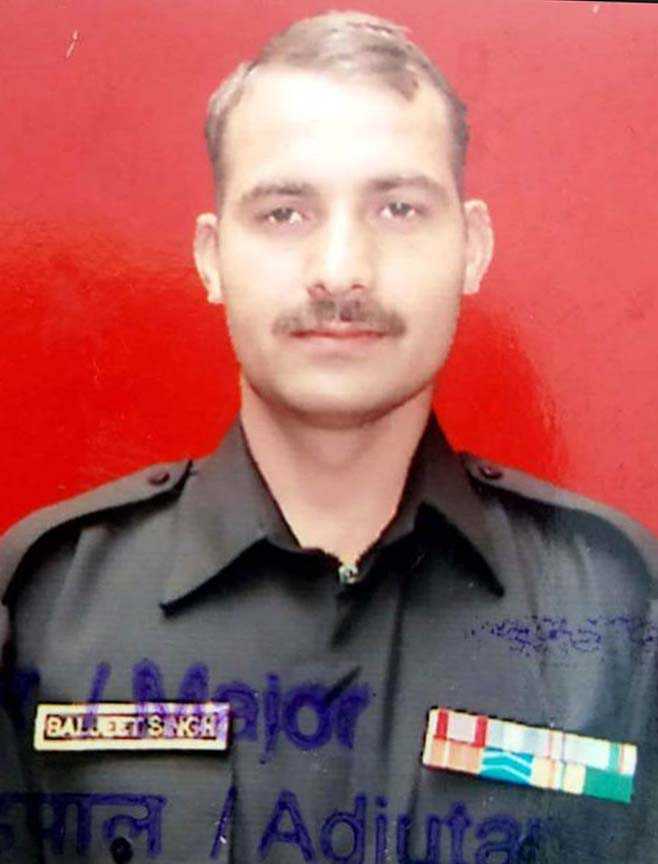
Havildar Baljeet Singh

Suhail A Shah
Anantnag, February 12

A soldier along with a local militant — who helped LeT commander Naveed Jutt flee a Srinagar hospital — was killed in a gunfight in Pulwama district of south Kashmir today. Two Army men were injured.

An Army officer identified the slain soldier as Havildar Baljeet Singh, 35, a resident of Karnal district of Haryana. Singh had joined the force in 2002.

The two injured personnel were taken to the Base Hospital, Srinagar, where they are undergoing treatment.The militant, Hilal Ahmad Rather, a resident of Begum Bagh area of Pulwama, was associated with the Hizb-ul-Mujahideen.

“He had helped Pakistan terrorist Naveed Jutt escape police custody at the SMHS hospital in Srinagar on February 6 last year. Two policemen were killed in the incident,” said a senior police official. Jutt was killed in an encounter on November 28, last year.The gunfight started around 3.30 am in Ratnipora when security forces were cordoning off the area following inputs of militants’ presence.

Later, clashes erupted prompting the security forces to use tear smoke shells and pellet guns to disperse youths.


Jallianwala was ‘calculated move to strike terror’ New book says the 1919 massacre in Amritsar was in continuity of the British policy since 1857

Jallianwala was ‘calculated move to strike terror’

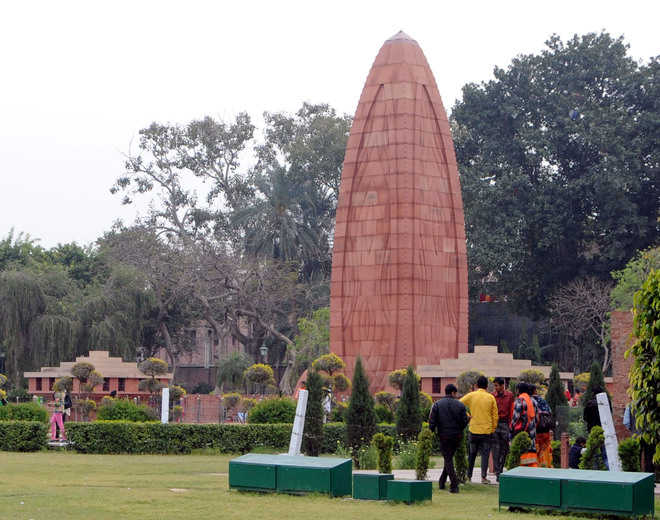
Jallianwala Bagh in Amritsar

Vishav Bharti
Tribune News Service
Chandigarh, February 10

The 1919 Jallianwala Bagh massacre in Amritsar was not an isolated incident or the outcome of a brutal mindset, but a “calculated move to strike terror” among the masses, says a new book by a British historian.

To be released on Tuesday, Jallianwala Bagh: An Empire of Fear and The Making of A Massacre by Kim A Wagner argues that demonstrations of violence were intrinsic to the colonial encounter not just in British India, but also Asia, Africa and the Middle East.

The book is based on a range of material from diaries and letters to court testimonies. Wagner observes that the story of Jallianwala Bagh is also the story of a particular colonial mindset haunted by the spectre of the ‘Mutiny’ or the First War of Independence.

“After 1857, the British in India did not respond to local unrest as much as to what they imagined that unrest was or could become — hence the consistent disproportionality of violence on the part of the colonial regime. The Amritsar massacre was accordingly both retributive and pre-emptive: Dyer took revenge for the attacks on Europeans, including Miss Sherwood [a missionary teacher attacked in Amritsar], during the riots three days earlier, but he also acted to prevent a much bigger outbreak that he believed to be imminent.”

He writes that at Amritsar, Dyer had simply followed the example of so many colonial officials before him, including Frederick Henry Cooper, Amritsar DC during the 1857 rebellion, or L Cowan, who ordered Kukas to be blown from guns in 1872.

Both had resorted to “exemplary and indiscriminate violence when faced with rebellion and anti-colonial unrest”. Wagner says that rather than an exceptional episode, “in singular and sinister isolation”, the Amritsar massacre revealed the inner workings, and the imagined vulnerability, of the British colonial rule in India.

Colonial punishment, Wagner observes, had little to do with justice, and that the suppression of the unrest in Punjab in 1919 exposes the fundamental lie about the pre-eminence of the rule of law in British India in the most glaring fashion.

“A week after the massacre at Jallianwala Bagh, on 21 April 1919, Lieutenant Governor Michael O’Dwyer made a remarkable statement when defending Dyer’s actions to Viceroy Chelmsford: ‘The Amritsar business cleared the air, and if there was to be a holocaust anywhere, and one regrets that there should be, it was best at Amritsar. O’Dwyer was here using the word ‘holocaust’ in its literal sense of a ‘burnt offering’ – as a sacrifice. The crowd at Jallianwala Bagh, in other words, had to be sacrificed to produce the necessary effect, ‘clearing the air’, and preventing a second ‘Mutiny’.”

The book finds that Amritsar massacre was just in continuity of what the British were doing to the local populations, variously described as ‘tribal’, ‘savage’ or ‘fanatic’, on the North-West Frontier in Afghanistan, in Sudan or throughout parts of Africa and elsewhere.

They routinely massacred locals with machine guns, drove off cattle and burned villages in demonstrative displays of power. “What became known as ‘savage warfare’ was not simply shaped by the tactical necessities of asymmetric fighting against irregular enemies, but was based on deeply encoded assumptions concerning the inherent difference of local opponents.”


Indian Air Force’s Latest Innovation: To Integrate British AASRAM Missile System With Russian Su-30 MKI Jets

Indian Air Force’s Latest Innovation: To Integrate British AASRAM Missile System With Russian Su-30 MKI Jets

The Indian Air Force is all set to deploy ASRAAM heat seeking close combat air-to-air missile in its Sukhoi Su-30 MKI Fighters, Livefist has reported. The IAF is currently in the final stages of the programme to mate the British missile system with Russian-origin Sukhoi fighter jets.

A pair of HAL-built Su-30 MKI jets have gone through required modifications in software to deploy the MBDA ASRAAM missile, top IAF sources were cited in the report as saying.

The move comes after IAF successfully integrated the missile system with its Jaguar deep penetration strike jets. The ASRAAM integrated Jaguars are part of IAF’s £250 million contract with United Kingdom’s MBDA in July 2014. The modified Jaguars are to be declared operation ready this year.

According to the report, the IAF is intending to fully replace the Su-30 MKI’s current close combat missile, Russian Vympel R-73, with the ASRAAM in a phased manner.

The ASRAAM-armed Su-30 would be reportedly declared ready around the same time as the Jaguars, and will make use of the same test cycle.

National Aerospace Laboratory (NAL) was tasked with the checking the stability of the ASRAAM on the Su-30 airframe at its Bengaluru wind-tunnel.


Defence Ministry may invite private companies to bid for Rs 21,000 crore naval chopper deal

Defence Ministry may invite private companies to bid for Rs 21,000 crore naval chopper deal

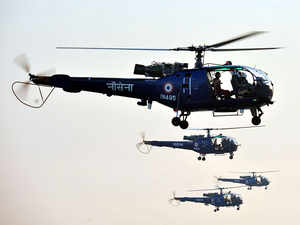
NEW DELHI: The defence ministry is set to invite private sector companies to participate in the Rs 21,000 crore deal for new naval utility helicopters, which will be the first project to kick off under the strategic partnership (SP) policy under the ‘Make in India’ initiative.

Sources said that the first ‘expression of interest’ (EoI) to the private sector under the policy will be issued for the helicopter deal in the coming days while others like a mega plan to manufacture submarines,  ..

In-the-works

Read more at:
//economictimes.indiatimes.com/articleshow/67763566.cms?utm_source=contentofinterest&utm_medium=text&utm_campaign=cppst