Sanjha Morcha

Government waived anti-corruption clauses in Rafale deal

It also overruled Financial Advisers’ recommendation for an escrow account after PMO forced a waiver of sovereign or bank guarantee

The €7.87-billion Rafale deal between India and France involved major and unprecedented concessions from the Indian government, with critical provisions for anti-corruption penalties and making payments through an escrow account dropped days before the signing of the inter-governmental agreement (IGA). This has significant political implications for the Narendra Modi government which has claimed that eliminating corruption is a major plank of its agenda for governance and promised action against alleged corruption in defence deals struck during the United Progressive Alliance Government.

It is significant that neither this nor other important information published by The Hindu on the “parallel negotiations” conducted by the Prime Minister’s Office and the National Security Adviser seems to have found a place in the material submitted by the government to the Supreme Court of India.

Financial Adviser Sudhansu Mohanty’s observations in an official note, in facsimile

Financial Adviser Sudhansu Mohanty’s observations in an official note, in facsimile

The high-level political intervention meant that standard Defence Procurement Procedure (DPP) clauses on “Penalty for use of Undue Influence, Agents/Agency Commission, and Access to Company accounts” of Dassault Aviation and MBDA France were dropped by the Indian government in the supply protocols. Under the terms of the IGA signed between India and France in Delhi on September 23, 2016, Dassault is the supplier of the Rafale aircraft package while MBDA France is the supplier of the weapons package to the Indian Air Force.

Official documents available to The Hindu reveal that the Defence Acquisition Council (DAC) chaired by the then Defence Minister, Manohar Parrikar, met in September 2016, and “ratified and approved” eight changes in the IGA, supply protocols, offset contracts and offset schedules (see Box 1). This was done after the IGA and associated documents had been approved by the Cabinet Committee on Security (CCS), chaired by Prime Minister Modi on August 24, 2016.

Box 1: The DAC ratified and approved the following:
  • Revised Article 5 of the IGA.
  • Revised Clause 21 (Arbitration) of the Supply Protocols.
  • Non-inclusion of the Standard DPP Clauses related to ‘Penalty for Undue Influence’, ‘Agents/ Agency Commission’ and ‘Access to Accounts’ in the Supply Protocols.
  • Inclusion of additional Articles 9 to 17 of Offset Contracts to those specified in model Offset Contract of DPP 2013.
  • Revised Article 9 of the Offset Contracts aligned with the xx clause of the Supply Protocols.
  • Revised Article 12 of the Offset Contracts aligned with the Contract.
  • Revised Offset Schedules of DA and MBDA.

The most significant among these eight changes, recorded in a note signed by Vice Admiral Ajit Kumar, DCIDS (PP&FD) who was the member-secretary of the DAC, is at sub-para (c). This states: “Non-inclusion of the Standard DPP Clauses related to ‘Penalty for Undue Influence,’ ‘Agents/Agency Commission’ and ‘Access to Company Accounts’ in the Supply Protocols.”

It is highly significant that these clauses were dropped by the Indian government from the supply protocols. While the IGA was the overarching agreement between the governments of India and France, the supply protocols were to be executed by Dassault and MBDA, the two private companies.

This direct dealing with the commercial suppliers, under cover of an IGA, was highlighted in a detailed note of dissent signed by three members of the Indian Negotiating Team — M.P. Singh, Adviser (Cost), A.R. Sule, Financial Manager (Air), and Rajeev Verma, Joint Secretary and Acquisitions Manager (Air). The document, which is available to The Hindu, reveals that these three members took a strong stand against what was being rammed through. On the direct dealing with the two companies, they noted: “Notwithstanding the fact that the procurement is on Government-to-Government basis, the IGA involves ‘Transfer of Rights and Obligations’ relating to supplies of equipment and related industrial services by French Government to the French Industrial Suppliers, and the payment is also being made to the French Industrial Suppliers and not to the French Government; therefore, it is not advisable to sacrifice the basic requirement of financial prudence.”

Sections on penalties

The Rafale deal was signed between India and France under the terms of DPP-2013. The Standard Clauses in Contract are mentioned in Enclosure 8 of DPP-2013. This has sections on penalties for the use of undue influence, an integrity pact, agents/agency commission and Access to book of accounts. Paragraph 37 of Request for Proposal (RFP) in DPP-2013 states that “the Standard Contract Document at Chapter V of DPP2013 [bit.ly/DPP-2013] indicates the general conditions of contract that would be the guideline for all acquisitions.”

Despite the DPP stating explicitly that the Standard Contract Document “would be the guideline for all acquisitions”, the Indian government chose to remove these clauses from the supply protocols with the two private defence suppliers. This assumes particular importance as the government also chose to do away with a sovereign or bank guarantee from France and settled for a letter of comfort, which is not legally binding, from the French Prime Minist

The letter of comfort issued by the French Prime Minister on September 8, 2016 (put out by ANI) states that “assuming that Dassault Aviation or MBDA France meet difficulties in execution of their respective supply protocols and would have to reimburse all or part of the intermediary payment to Government of the Republic of India, the Government of the French Republic will take appropriate measures so as to make sure that said payments or reimbursements will be made at the earliest.”

Govt. intervention

This letter of comfort came after another last-minute intervention by the Indian government in September, when the Cabinet Committee on Security chaired by the Prime Minister issued a corrigendum to the note forwarded by the Defence Ministry for the CCS, doing away with the requirement for an escrow account operated by the French government to make payments to the two companies. This proposal to amend the IGA, which had been approved by the CCS on August 24, 2016, was moved by Smita Nagaraj, Director General Acquisition, in the Defence Ministry.

Safeguards

The proposal, which states that “this issues under the direction of Raksha Mantri,” asked the CCS to issue a corrigendum to the minutes, amending Para 50(b) of the note giving approval to the IGA. It reads: “Raksha Mantri has directed that attention of Secretariat is drawn to the fact that in the context of the proposal contained in Para 50(b) of the CCS Note, stated that in the event of payment into escrow account is not found feasible, MOD shall work out alternative safeguards in consultation with the French Government, in which an assurance will be obtained from the French Government to provide effective oversight of utilization of payments released to the French industrial suppliers.”

The amended Para 50(b) of the CCS Note approving the IGA [see Box 2] did away with the need for ensuring that the payments made by the Indian government were done through an escrow account operated by the French government. The escrow account was a measure of financial prudence: the payments would be released by the French government to Dassault and MBDA with the concurrence of the Indian government.

Government waived anti-corruption clauses in Rafale deal

The proposal to have an escrow account operated by the French Government was recommended by Sudhansu Mohanty, Financial Adviser (DS) on January 14, 2016. It was in Note-263, which begins with this qualification, “I wish I had sufficient time to go through the entire file and mull over the various issues raised. However, in view of the fact that the file has to be submitted to RM immediately, I would like to make the following quick observations from the Finance point of view.”

Important observation

One of Mr. Mohanty’s important observations was: “In the absence of a sovereign/bank guarantee, in a case like this where an IGA is to be signed, it would be prudent to involve the French Govt. as far as releases are concerned. This possibly could be done through an Escrow account or a variant of the same where the money released by the buyer (Govt. of India) is paid to the Escrow account held under the charge of French Govt. to make further payments to the firm as per terms & conditions agreed to by the Indian and French Govt. through IGA. This would make French Govt. morally and materially responsible for the procurement so proposed. Since they are one of the parties to the IGA and also jointly and severally responsible for the execution of the supply protocol, they should not be having any reservation about it.” Evidently, the French government did.

Mr. Mohanty’s note, it is now known, came after the Prime Minister’s Office (PMO) and National Security Adviser Ajit Doval chose to waive the sovereign or bank guarantee from France. As reported by The Hindu on February 8, 2019, Defence Ministry officials had objected to the “parallel negotiations” being conducted by the PMO, which was “undermining the process of formal negotiation with the French side… may be detrimental to our interests as the French side may take advantage of same by interpreting such discussions to their benefit and weakening the position taken by the Indian Negotiating Team. This has precisely happened in this case.” The Defence Ministry note, which was dated November 24, 2015, cited as “a glaring example” how the parallel negotiations had undercut “the position taken by MoD and conveyed to Indian Negotiating Team that the commercial offer should be preferably backed by Sovereign/Government Guarantee or otherwise by Bank Guarantees.”

Contrary positions

Another example cited in the note was the contrary positions taken on the arbitration arrangement.

The then Defence Secretary, G. Mohan Kumar, who now says “there were no parallel negotiations” and that the Rafale deal was negotiated in the “most transparent way”, had endorsed the protest note in his own hand on November 24, 2015: “RM may pl. see. It is desirable that such discussions by avoided by the PMO as it undermines our negotiating position seriously.”

The need for a sovereign or a bank guarantee was also highlighted by the Ministry of Law and Justice in its communications to the Defence Ministry, documents available to The Hindu show.

Active push

As for the part played by Mr. Parrikar in the Rafale deal, what has been established is this. From a stance of being non-committal, as evidenced by his hand-written notation of January 11, 2016, he shifted later that year to actively pushing for the changes, giving the financial experts little time to study the proposals.

He chaired the September 2016 meeting of the Defence Acquisition Council that “ratified and approved” the eight changes, including the decision to drop the provision of penalties for corruption in the supply protocols with the private companies.

In his official capacity, he also directed the issue of a proposal that led to doing away with the provision for an escrow account as a financial safeguard.
NDA’s Rafale deal 2.86% cheaper than UPA’s: CAG report

http://

Ajay Banerjee
Tribune News Service
New Delhi, February 13

In a major boost to the Narendra Modi government, the Comptroller and Auditor General (CAG), in its report on the purchase of the 36 Rafale jets, has said the overall price of fighter jets is 2.86 per cent cheaper as compared to the UPA-era deal.

The 36 jets are being purchased for Rs 59,000 crore under a contract from Dassault Aviation of France.

The CAG report, however, mildly questions why the government did not accept a 20 per cent discount offered by the Eurofighter, which, along with Rafale, had been initially found technically fit during the UPA regime (2004-2014).

The CAG has used a price “alignment formula” to compare the pricing of the two deals offered by Dassault Aviation in 2007 and 2015. The report was tabled in the Rajya Sabha and Lok Sabha.

Comparing this deal with the 126 aircraft deal, which was later scrapped, the CAG says the Modi government saved 17.08 per cent on the India-specific enhancements. It paid 6.54 per cent more for engineering support package and performance-based logistics. Overall, it saved 2.86 per cent.

The report says the delivery schedule for the first 18 aircraft is better by five months than the proposed 126 aircraft deal. However, in terms of delivery of 36 planes, it is better by just one month.

The CAG says there are no comparable costs, but in view of the Indo-French statement of 2015 that said the Inter-Government Agreement would be signed for supply of aircraft on terms that would be better vis-à-vis ‘price’, ‘delivery’ and ‘maintenance’ than the ones in 2007, a comparison has been made.

The Indian negotiating team aligned the quantities (36 planes) in the 2015 bid with that in the 2007 bid and then the price of 2007 was brought to the 2015 price level by applying the price escalation formula, which used the industrial cost indices published by the French National Institute of Statistics and Economic Studies.

This was the aligned price (price of 36 flyaway aircraft in 2015 if the prices were the same as the bid of 2007).


REPORT SAYS…

17.08% The NDA saved on India-specific enhancements

6.54% more paid for engineering support package and performance-based logistics

2.86% overall savings by NDA govt


Silent on dissent note, PMO parallel parleys

  • CAG report says nothing on the dissent note of the MoD officials, who had objected to the price formula and also to the PMO’s parallel negotiations
  • Sources say the dissent notes have been studied and are part of the 400-odd files on the subject but not added in the report

It cannot be that SC is wrong, CAG is wrong and only the dynast is right. Satyameva Jayate. CAG report reaffirms dictum. How does democracy punish those who consistently lied to the nation? Arun Jaitley, Union Minister 

Even if we accept CAG findings which we don’t, NDA deal is only 2.86% cheaper than UPA’s. This nails lie of Defence Minister and FM, who said it’s 9 to 20%  cheaper. Rahul Gandhi, Congress President


5 Hizb-LeT militants gunned down in Kashmir’s Kulgam

SRINAGAR : Five militants of the Hizbul Mujahideen and Lashkare-Taiba were killed in a gunfight with security forces in south Kashmir’s Kulgam district in the deadliest encounter in the Valley this year, the police said on Sunday.

PTI■ Armymen near a house where militants were hiding during an encounter in Kashmir’s Kulgam district on Sunday.

A joint party of the army, police, and the Central Reserve Police Force (CRPF) launched a cordon and search operation early on Sunday after information about the presence of militants in Kellam area of the district. SSP Harmeet Singh Mehta said that they had information about militants hiding in a house which was cordoned before sunrise.

“Since they were locals, we asked them to surrender. They did not pay heed and opened fire after which we retaliated. The encounter continued for around eight hours. Five militants were killed and five AK 47 rifles and other ammunition was recovered. The house in which they were hiding was also damaged,” the SSP said.


A police spokesperson said that the militants were part of a combined group of proscribed terror outfits—Hizbul Mujahideen and Lashkar-e-Taiba. They were identified as Waseem Ahmad Rather, Aqib Nazir Mir, Parvaiz Ahmad Bhat , Idrees Ahmad Bhat and Zahid Ahmad Parray. Locals said Waseem had done a masters degree and was pursuing higher studies when he joined militancy last year.

The spokesperson said Waseem, Aqib and Parvaiz were involved in the killings of a civilian, Mohammed Iqbal Kawaq and a local army personnel Mukhtar Ahmad. “The group of terrorists was also involved in various grenade attack across Anantnag and Kulgam districts,” the spokesperson said.

20 CIVILIANS INJURED IN PELLET FIRE

Clashes broke out near the encounter site between forces and local people, who allegedly pelted stones. Authorities stopped internet services in the area to stop further escalation of tension. Rafi Ahmad Salati, Kulgam’s block medical officer, said about 20 people were injured by pellets.


Army Generals discuss state security issues with Governor

Army Generals discuss state security issues with Governor

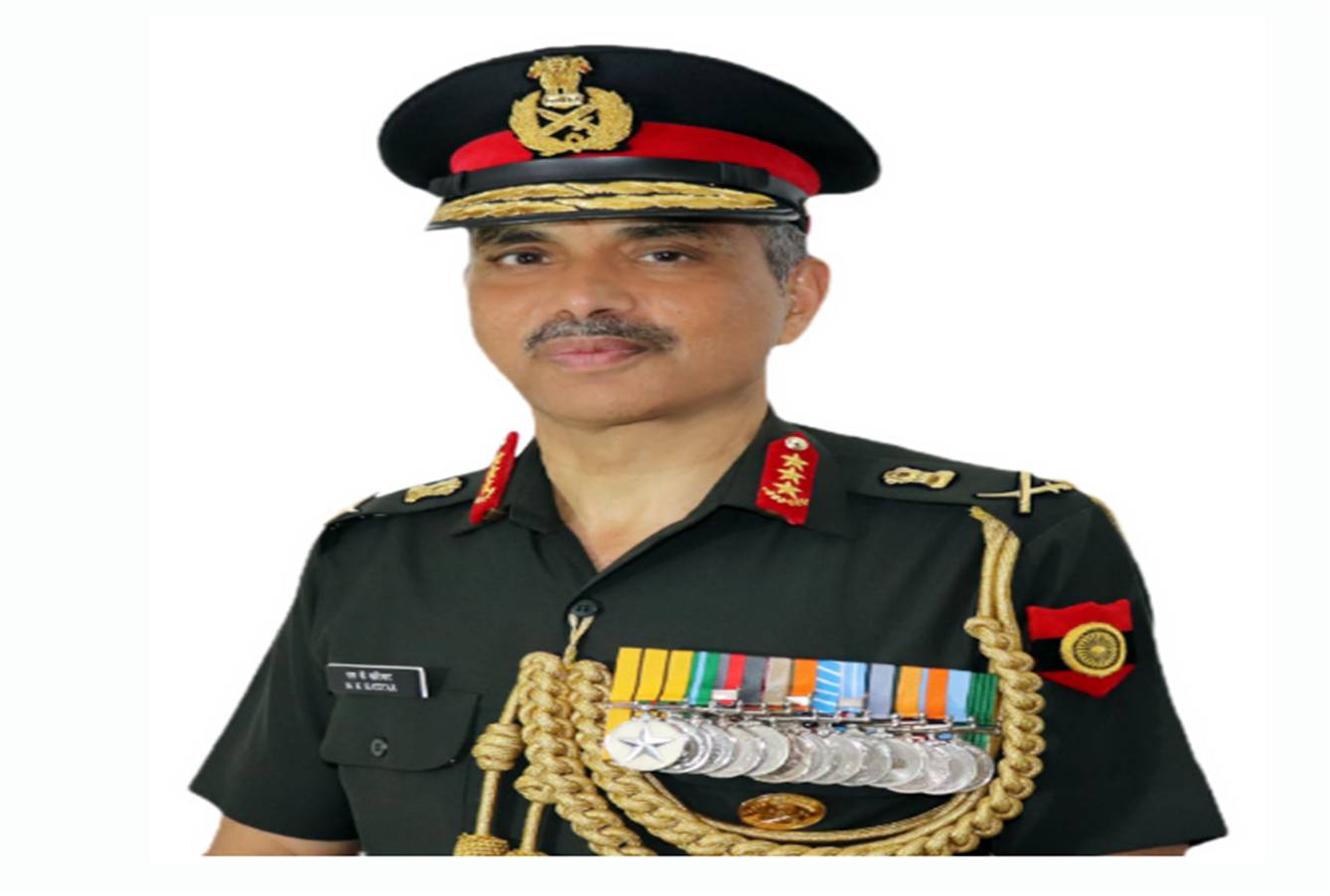
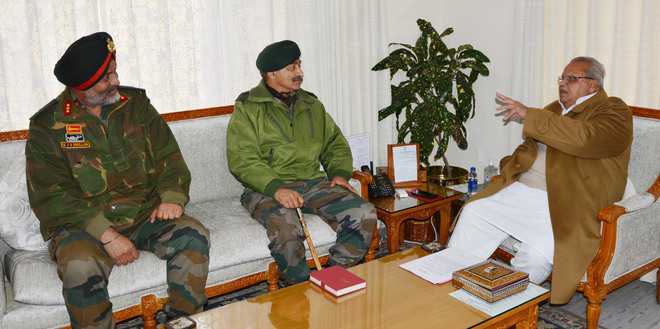
Governor Satya Pal Malik with Lt Gen AK Bhatt and Lt Gen KJS Dhillon at Raj Bhawan in Jammu. Tribune Photo

Tribune News Service

Jammu, February 4

Lt Gen AK Bhatt, GOC of 15 Corps, met Governor Satya Pal Malik at Raj Bhawan here on Monday and briefed him on the security situation in the Kashmir valley. He was accompanied by Lt Gen KJS Dhillon, GOC, 15 Corps (designate).

The Governor appreciated Army’s strong support to the security forces in carrying out counter-terrorism operations in the Valley.

He bade farewell to Lieutenant General Bhatt, who will soon be joining as the Military Secretary in the Army Headquarters, New Delhi, and wished him a successful tenure ahead.


Director, defence services, visits city

Tribune News Service

Jalandhar, January 30

Newly-appointed Brig Satinder Singh (retd), Director, Defence Services Welfare, inspected the Jalandhar office of Defence Services Welfare.

District Defence Services Welfare Officer, Major Yashpal Singh (retd), briefed him about various programmes, including planned budget, non-planned budget, Punjab State War Memorial, Sainik Rest House, Central Sainik Board, Flag Fund, Punjab, Amalgamated Fund, Staff Welfare Fund, Training and others.

The director was informed that the district office had received 3,055 applications from widows of ex-servicemen, or the dependents regarding the change of addresses, duplicate discharge book, AGI scheme, pension cases, identity cards, tubewell connections, CSD indent and all applications had been settled timely.

District Defence Services Welfare Officer Major Yashpal Singh (Retd) said the director asked the employees to accord top priority to the applications.

The director also distributed Rs 1.90 lakh among the beneficiaries of ‘Flag Day’ fund.


OFB gets Defence Ministry’s nod for producing 114 long-range artillery gun ‘Dhanush’

OFB gets Defence Ministry’s nod for producing 114 long-range artillery gun ‘Dhanush’

OFB gets Defence Ministry's nod for producing 114 long-range artillery gun 'Dhanush'

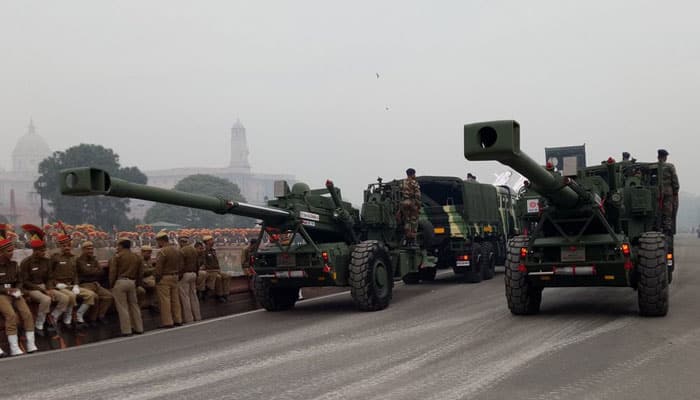
NEW DELHI: The Ordnance Factory Board (OFB) has received a bulk production clearance from the Indian Army and the Defence Ministry for production of 114 ‘Dhanush’ artillery guns, officials said Tuesday.

‘Dhanush’ is the first long-range artillery gun to be produced in India and it is a major success story of the ‘Make in India’ initiative, the defence ministry said in a statement.

The OFB has received a bulk production clearance from the Army and the Defence Ministry for production of 114 first-ever indigenous artillery gun ‘Dhanush’, it said, adding, the clearance was received on Monday.

“The gun is equipped with inertial navigation-based sighting system, auto-laying facility, on-board ballistic computation and an advanced day and night direct firing system. The self-propulsion unit allows the gun to negotiate and deploy itself in mountainous terrains with ease,” the ministry said.

‘Dhanush’ has been mechanically upgraded to fire standard NATO 155 mm ammunition and can accommodate the bi-modular charge system (BMCS) which has resulted in increasing the range, it said.

It has also been electronically upgraded to enhance the firing accuracies, laying speeds of the existing gun and to provide compatibility with various kinds of ammo as well, the statement said.

The performance of the gun has been evaluated under arduous conditions in several phases.

“The guns travelled extensively in towed and self-propelled mode in all terrains viz desert and high altitude with each gun clocking over 1600 km. Such an extensive exercise was carried out by the user for the first time for any gun system under the process of induction,” it added.

The manufacture of a 155 mm modern artillery gun was initially a challenge for the OFB. This was due to change in the vision parameters from 155×39 calibre to 155×45 calibre.

The OFB received the Transfer of Technology (ToT) documents pertaining to 155×39 calibre and then converted it to 155×45 calibre successfully, the statement said.

‘Dhanush’ is the product of joint efforts by the OFB and the Army with contributions from the DRDO, DGQA, DPSUs such as Bharat Electronics Limited, PSUs such as SAIL and several private enterprises.


IAF may place order for improved Tejas variant: HAL chief

BENGALURU: The Indian Air Force could place a ₹50,000-crore order for an advanced version of the indigenously produced Light Combat Aircraft, Tejas, in the next two to three months, Hindustan Aeronautics Limited (HAL) chairman R Madhavan said at Aero India 2019 on Thursday.

Madhavan said the first flight of LCA Mk-1A was likely to take place three years after the contract was signed, followed by production a year later. The air force plans to buy 83 Mk-1A jets, taking the total number of LCA variants ordered to 123.

Of the 123 planes on order, 20 each are in the initial operational clearance (IOC) and the more advanced final operational clearance (FOC) configurations. The LCA Mk-1A will come with additional improvements over the FOC aircraft, making it the most advanced Tejas variant so far. The Tejas received FOC for induction into the IAF as a combat-ready fighter at a ceremony held here on Wednesday.

The Mk-1A will come with digital radar warning receivers, external self-protection jammer pods, active electronically scanned array radar, advanced beyond-visual-range missiles and significantly improved maintainability. Madhavan said HAL was exploring opportunities to export the LCA to countries in north Africa and the Asia Pacific. The IAF plans to order more than 210 LCA Mk-2 fighters in the long term.

Madhavan said the stateowned plane maker was also expecting an order for 18 more Sukhoi-30 fighters from the IAF. Compared to an optimum strength of 42-plus units required to fight a two-front war, the count of the IAF’s fighter squadrons has shrunk to 31, the lowest in over a decade. The IAF is planning to buy 21 MiG-29 fighters from Russia to arrest the steep decline in its combat potential.

Asked to comment on Congress president Rahul Gandhi’s allegations that the government had ignored and ill-treated HAL, Madhavan said that was not the case. “Had we been ignored, we wouldn’t have got orders. And we look forward to more orders,” he said. Amid a flurry of reports that HAL was facing a financial crisis and had been borrowing from banks, the company said it was financially stable.

HAL’s director (finance) CB Ananthakrishnan said the firm’s reserves were healthy and the only issue was pending payments from the armed forces. “That is being sorted out,” he said.

On the controversy surrounding the Rafale fighter jet deal, Madhavan said the issue was a fight between others and HAL didn’t want to be dragged into it.


Indian Army’s new sniper rifle paired with old improvisation tactics will turn tables at LoC by LT GEN SYED ATA HASNAIN (RETD)

The media has repeatedly said over the last few months that sniping is a new modus operandi at the Line of Control between India and Pakistan and the Army is losing this new war due to ageing equipment.

Out dated equipment is a concern, and therefore the Indian Army has just bought new deadly sniper rifles for the Northern Command – .50 Calibre M95 by Barrett and the .338 Lapua Magnum Scorpio TGT by Beretta – to replace the Russian Dragunov.

But contrary to media’s claims, sniping is not a new phenomenon, and is in fact a tried-and-tested way of achieving moral ascendancy along the Line of Control (LoC) and the Indian Army hasn’t fared poorly. Improvisation has largely made up for lack of adequate equipment.


Also read: Deadly new sniper rifles are here for Northern Command soldiers along LoC


A force-multiplier

The Soviet-era Dragunov sniper rifle has been the mainstay of the Indian Army in conventional operations along the LoC as well in counter-terror missions. However, the 800-metre effective range offered by the Dragunov is now insufficient for modern-day warfare.

Yet, the Indian Army through improvisation, correct training and selection has created an environment wherein sniping has become a force multiplier. The adversary too hasn’t been static on this front.

I recall on the first day of my command at Siachen in 1995, we lost an outstanding young officer, keeping vigil on his post from behind a four-feet wall, to a single shot fired by the enemy. Investigation showed that the shot was fired by a medium machine gun (MMG) from a range of 4,200 metres. It is definitely not a range from which an MMG is fired, but improvisation made it possible.

Sources within the Indian Army say that there is no despair over inadequate sniping equipment because improvisation has made up for it, with even anti-material rifles being used for sniping now. However, improvisation alone cannot ever be a permanent solution to fighting the adversary; soldiers won’t say it but they know it.

The purchase of new sniper rifles, with enhanced range of 1500-1800 metres, was much-needed, but their arrival doesn’t guarantee overnight success. Some degree of improvisation and innovation will again be the key to ensuring optimum utilisation.


Also read: The new danger in Kashmir: Cold, calculating snipers who are wary of close contact


How to maximise effectiveness

The effectiveness of a weapon can be maximised when the user is confident about it, its technical characteristics including faults have been well-understood, and the required talent pool has been created for it among the fighting units.

All this can happen fast, given the Indian Army’s penchant to pursue an aim with utmost focus. But it also needs to add institutional weight behind the effort, through reintroduction of the sniper training course and sniper competitions, which stopped several years ago. Those who acquire requisite skills after rigorous training must be suitably rewarded.

Introducing the Sniper Badge is the first such step and only those meeting the stringent standards must earn the right to display it. Shooting ranges of 1,800 metres and beyond are not available along the LoC. There is little scope for the troops deployed to train with the equipment unless select batches are sent for training at the ranges in desert areas or central India. The best training ground, of course, is the LoC itself and there is no doubt that a simultaneous on-the-job training, while fighting the adversary, can continue there.

But we need more than just a gung-ho approach to streamline the creation of a talent pool that once existed in the Infantry units.

Sniping war will continue

It is important to know why sniping is a difficult operation at the LoC and yet easy enough to grab opportunities when they present themselves. Recently, a one-star rank officer of the Pakistan Army was seriously injured in an exchange of fire in the Lipa sector. It led to the Pakistanis targeting two JCOs on our side in the Kupwara sector. Both operations, the Pakistani and ours, involved the use of snipers. Many more exchanges have been reported over the last year. The LoC posts are virtual citadels with a labyrinth of deep communication trenches to afford movement within the post without enemy observation, but there are a number of other places where any movement is under observation.

Terrain domination in some areas give either side the advantage of observation, and vegetation is not available everywhere for cover. A quid pro quo situation exists at most places along the LoC where there are mutual vulnerabilities that prevent risk taking by either side. He who has the ability and confidence to prevent exposure of potential targets becomes the psychological winner, a major contribution to moral ascendancy at the LoC. It forces a lot of movement by night.


Also read: The enemy at the gates has a new weapon and Indian Army needs to wake up


At the LoC, the Indian Army will always be forced to offer more targets than the adversary not only because of the higher quantum of deployment, but also due to the nature of it. Deployment in small detachments in tactically unsound positions along the LoC to prevent infiltration is common; tactically unsound may seem strange to older soldiers, but the fact remains that in counter infiltration the aim is to prevent terrorists getting across and not the defence of some real estate. This increases vulnerability especially when the LoC fence is under reconstruction or maintenance.

The idiom ‘two can play this game’ is applicable all along the LoC. While ceasefire will remain on paper, violations will take place. Sniping exchange, however, is largely unreported and therefore remains outside the purview of public gaze.

The sniping war, therefore, will continue even as other means of moral domination emerge. The arrival of new sniper weapons, combined with improvisation and a return to the old-world sniper training culture, will definitely help in turning the tables on the adversary to a greater extent.

The author, a former GOC of Srinagar-based 15 Corps, is associated with the Vivekanand International Foundation and the Institute of Peace and Conflict Studies. He is the Chancellor of Central University of Kashmir.


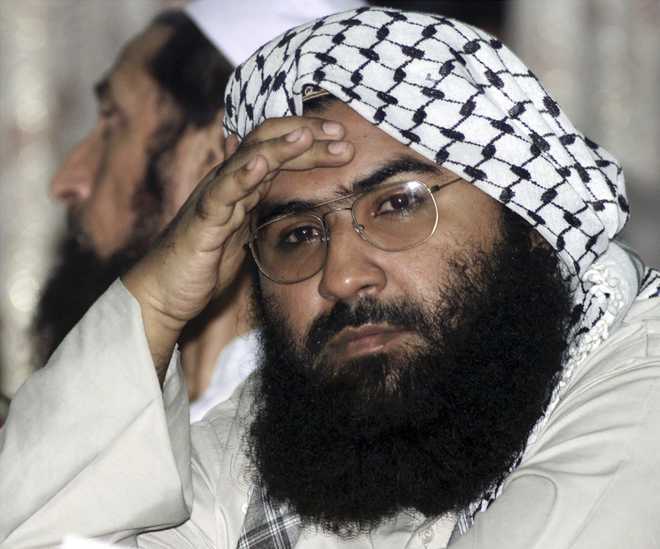
‘Just one slap from army man rattled Jaish chief Masood Azhar’

'Just one slap from army man rattled Jaish chief Masood Azhar'

Masood Azhar. — File photo

New Delhi, February 18

Maulana Masood Azhar, the dreaded architect of some of India’s biggest terror attacks, was an “easy man” to handle in custody with one slap enough to make him blurt out details of his movements, says a former police officer who interrogated him several times.

Azhar, who used a Portuguese passport to enter India through Bangladesh and reach Kashmir, was arrested in February 1994 in Anantnag in South Kashmir.

In custody, intelligence agencies did not have to use “coercive method” against Azhar to extract information as he started speaking after the “first slap” from an army officer and gave deep insights into the functioning of terror groups operating from Pakistan, the officer said.

“He was an easy man to handle and a slap from an army officer shook him completely,” former Director General of Sikkim Police Avinash Mohananey, who interrogated Azhar many times during his two-decade tenure in the Intelligence Bureau, told PTI.

After his release in exchange of passengers of hijacked IC-814 flight of Indian Airlines in 1999 by the then BJP government, Azhar formed Jaish-e-Mohammed and scripted many audacious terror strikes in India, including on Parliament House, Pathankot air force base, army camps in Jammu and Uri, and the latest suicide attack on CRPF in Pulwama which claimed the lives of 40 personnel.

While in custody, Azhar, in his early 50s now, shared information about recruitment process and functioning of terror groups in Pakistan at a time when the intelligence agencies were still grappling to understand the proxy-war unleashed by Pakistan’s espionage agency ISI, said Mohananey, a 1985-batch IPS officer who headed the Kashmir desk in the agency at that time.

“There were several occasions when I met him in Kot Balwal jail and interrogated him for hours together. We did not have to use any coercive method as information flowed consistently from him,” he said.

Azhar gave the Indian agencies vital insights into diversion of Afghan terrorists into Kashmir Valley and merger of Harkat-ul-Mujahideen and Harkat-ul-Jehad-e-Islami (HuJI) into Harkat-ul-Ansar, represented by him as its general secretary, the officer said.

After his arrival in India from Bangladesh in 1994, Azhar travelled to Saharanpur before reaching Kashmir where he held meetings of warring factions of HuM and HuJI to formulate a common policy, Mohananey said.

“I came on a forged Portuguese passport for ensuring that HuM and HuJI are together in the valley. It was not possible for me to cross the Line of Control on foot,” the police officer recalled Azhar telling them.

A man of mannerism and etiquette during interrogation sessions, Azhar used to give detailed answer to any question that was asked to him, he said.

The Jaish chief, during his stint as a journalist with ‘Sada-e-Mujahid’, a tabloid published from Karachi, had in 1993 travelled with a group of Pakistani scribes to some countries, drumming up support for “Kashmir cause’, he said.

Mohananey recalled that Azhar would often boast that police could not be able to keep him in custody for long as he was important for Pakistan and the ISI.

“You are underestimating my popularity. The ISI would ensure that I am back in Pakistan,” the police officer recalled him as saying.

Surprisingly, some foreigners were kidnapped from Delhi 10 months after his arrest in February 1994 and the kidnappers had demanded his release.

The plan failed with the arrest of Omar Sheikh, who was also released in the 1999 exchange, and was later involved in the gruesome beheading of Wall Street Journal reporter Daniel Pearl in Pakistan.

Another attempt to free him was made by a shadow group of Harkat-ul-Ansar, Al-Faran, which demanded his release in exchange of five foreigners kidnapped in Kashmir in July 1995.

Before shifting out to another posting, the officer said, “I met him again in 1997 when he was in the same jail. I informed him that I was proceeding to a new posting to which he wished me good luck.”

“I was at new posting when I heard about his release on December 31, 1999 in exchange for passengers of IC-814. He really meant it when he said that we would not be able to keep him for long,” he said.

The JeM chief is now believed to be in his native Bahawalpur in Pakistan’s Punjab province.

The then BJP-led NDA government had released Azhar, along with Omar Sheikh and Mushtaq Ahmed Zargar alias ‘Latram’, in exchange of passengers of Indian Airlines flight IC-814 from Kathmandu to New Delhi which was taken to Kandahar in Afghanistan.

After the negotiations failed with hijackers, the government succumbed to their demands and the then external affairs minister Jaswant Singh took the three terrorists to Kandahar in Afghanistan in a special plane to ensure the release of passengers of the hijacked plane. — PTI


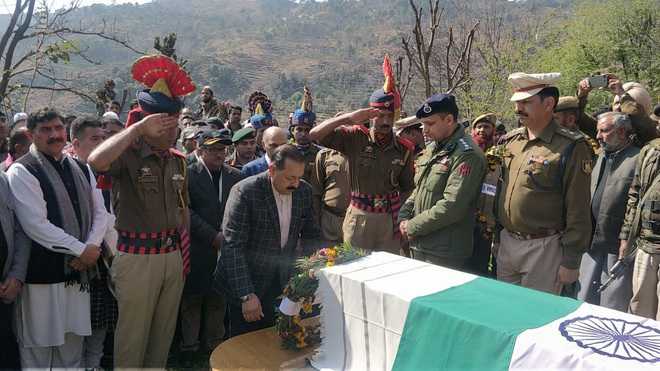
Pulwama martyr laid to rest with state honours in Rajouri

Pulwama martyr laid to rest with state honours in Rajouri

Jitendra Singh pays tributes to CRPF Head Constable Nasir Ahmed at Dodassan Bala village in Rajouri on Saturday. Tribune photo

Shyam Sood

Rajouri, February 16

Head Constable of the Central Reserve Police Force (CRPF) Nasir Ahmed, who was killed in a suicide attack in Pulwama district on Thursday, was laid to rest with full state honours at his native Dodassan Bala village in Rajouri district on Saturday.

Themartyr was posted in Jammu and was deputed as the commander of the CRPF convoy, which had left Jammu for Kashmir on Thursday.

Minister of State in the PMOJitendra Singh, former Deputy CM Nirmal Singh, state BJP president Ravinder Raina, MP Jugal Kishore, CRPF IG B Chouhan, CRPF DIG Nitu Bhatacharya, Rajouri DC MA Asad, Rajouri SSPYougal Manhas and senior Army officers paid homage to Head Constable Nasir at his village.

Thousands of people had gathered in the village to pay their last respects to the martyr.

The coffin draped in a Tricolour was brought in a procession about 12.30 pm and the martyr was laid to rest in the presence family members, relatives and dignitaries.

Jitendra expressed his condolences to the family of the martyr, who is survived by wife, minor daughter and a son.

The minister also interacted with Sehraj-ud-Din, elder brother of the martyr, who is a head constable in the J&K Police and at present posted in Jammu. He directed the senior officers to get him posted in Rajouri, if he wanted, so that he could take care of the family.

“The CRPF will always stand by the side of Nasir’s family and we are thankful to the entire nation for showing solidarity with the family,” said CRPF DIG Nitu Bhatacharya.

‘Establish school in Nasir’s name’

  • Thousands of people had gathered in Dodassan Bala village of Rajouri district to pay their last respects to Head Constable Nasir Ahmed
  • Minister of State in the PMO Jitendra Singh paid tributes to the martyr in the village. He also met the family and expressed his condolences to them. He asked the Rajouri Deputy Commissioner to establish a school in the name of martyr