Sanjha Morcha

Indian Army shows its artillery firepower during ‘Exercise Topchi’

Indian Army shows its artillery firepower during 'Exercise Topchi'

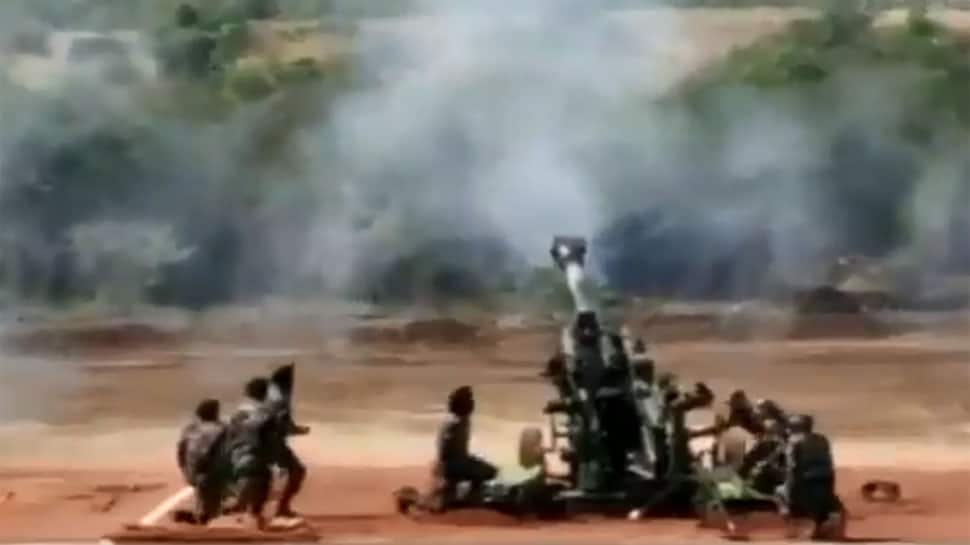
NASHIK: Using ultra light Howitzers and indigenous Swathi weapon-locating radar, Indian Army Tuesday demonstrated its artillery firepower at the annual ‘Exercise Topchi’ held near here.

The event took place at the vast firing ranges at Deolali Camp in the morning. It not only showcased the artillery firepower, but also the aviation and surveillance capabilities.

In addition to the gun fire, the display of rockets, missiles, surveillance and target acquisition radars, remotely piloted aircraft and hi-tech equipments was awe-inspiring. The precision of delivering the explosives in the target area, the coordination and timings of the firepower stunned all those present.

Latest ultra light Howitzer M-777, self-propelled gun K-9 Vajra and indigenous Swathi weapon-locating radar is testimony to the increasing lethality and technical threshold of our Army, a defence release said.

The Army’s aviation assets included the indigenous advanced light helicopter, light combat helicopter, Cheetah & Chetak helicopters, it added.

Lt Gen YVK Mohan, Commandant of Defence Service Staff College (DSSC), Wellington, near here, Lt Gen R S Salaria, Commandant, School of Artillery and Colonel Commandant Regiment of Artillery and other Army officials were present on the occasion.


Defence Ministry protested against PMO undermining Rafale negotiations

Defence Minister Manohar Parrikar exchanges documents with his French counterpart Jean-Yves Le Drian after signing an MoU on the purchase of 36 Rafale fighter aircraft in the presence of French President Francois Hollande and Prime Minister Narendra Modi at Hyderabad House in New Delhi on January 25, 2016.

The French side took advantage of parallel parleys by the PMO that weakened Indian team’s position.

At the height of the negotiations over the controversial €7.87 billion Rafale dealbetween India and France, the Defence Ministry raised strong objections to “parallel negotiations” conducted by the Prime Minister’s Office (PMO) with the French side. Stating that it was clear that such parallel discussions by the PMO had “weakened the negotiating position of MoD and Indian Negotiating Team,” a Defence Ministry note dated November 24, 2015 brought this to the attention of the then Defence Minister, Manohar Parrikar.

Stating that “we may advise PMO that any Officers who are not part of Indian Negotiating Team may refrain from having parallel parlays [parleys] with the officers of French Government,” it suggested that “in case the PMO is not confident about the outcome of negotiations being carried out by the MoD, a revised modality of negotiations to be led by PMO at appropriate level may be adopted in the case.”

According to the government’s submission to the Supreme Court of India in October 2018, the negotiations over the Rafale deal were conducted by a seven-member team headed by the Deputy Chief of Air Staff. There was no mention of any role for the PMO in these negotiations.

Official documents available to The Hindureveal, however, that the Defence Ministry protested that the position taken by the PMO was “contradictory to the stand taken by MoD and the negotiating team.” The then Defence Secretary, G. Mohan Kumar, made this official notation in his own hand: “RM may pl. see. It is desirable that such discussions be avoided by the PMO as it undermines our negotiating position seriously.”
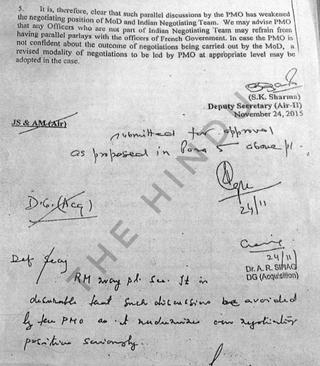
The Defence Ministry's internal note dated November 24, 2015, in facsimile

The Defence Ministry’s internal note dated November 24, 2015, in facsimile

Firm opposition

His firm opposition was recorded on November 24, 2015 on a note prepared by S. K. Sharma, Deputy Secretary (Air-II), and endorsed by the Joint Secretary & Acquisition Manager (Air) and the Director General (Acquisition) in the Ministry.

The new Rafale deal, which bore little resemblance to the original deal under prolonged negotiation, was announced in Paris by Prime Minister Narendra Modi in April 2015. This was followed by the signing of a Memorandum of Understanding between India and France when President Francois Hollande visited Delhi on the occasion of Republic Day in 2016. The inter-governmental agreement for 36 Rafale fighter jets was eventually signed on September 23, 2016.

According to the Defence Ministry note, the details of the parallel negotiations conducted by the PMO came to the Ministry’s notice only from a letter of October 23, 2015 from General Stephen Reb, the head of the French Negotiating Team. The letter “made mention of a telephonic conversation between Shri Jawed Ashraf, Joint Secretary in the Prime Minister’s Office and Mr. Luis Vassy, Diplomatic Adviser to the French Minister of Defence, which took place on 20.10.2015.”

General Reb’s letter was brought to the notice of the PMO by the Defence Ministry. The head of the Indian Negotiating Team, Air Marshal S. B. P. Sinha, AVSM VM, Deputy Chief of Air Staff, also wrote to Mr. Ashraf.

In his reply to Air Marshal Sinha on November 11, 2015, Mr. Ashraf “confirmed that he had held discussion with Mr Luis Vassy, Diplomatic Adviser to the French Minister of Defence,” adding that Mr. Vassy “spoke to him on the advice of the French President’s office and the issues referred to General Reb’s letter were discussed.”

President Hollande had told AFP, as reported by Le Monde in September 2018, that “asked by Agence France-Presse on the sidelines of a conference in Montreal on Friday, he said that the name of Reliance Group had appeared as part of a ‘new formula’ in negotiations over the Rafale deal, decided by the Modi government after it came to power.” The reference was to the Anil Ambani-owned Reliance Defence.

The Defence Ministry note also stated that “the discussions between Diplomatic Adviser to the French Defence Minister and Joint Secretary to PM tantamount to parallel negotiations while the Indian Negotiating Team constituted by the Ministry of Defence is undertaking the process of formal negotiations with the French side.”

Detrimental to interests

“Such parallel negotiations may be detrimental to our interests as the French side may take advantage of same by interpreting such discussions to their benefit and weakening the position taken by Indian Negotiating Team. This has precisely happened in this case,” the note added.


Defence Ministry protested against PMO undermining Rafale negotiations

Citing “a glaring example”, the Defence Ministry note pointed out that General Reb in his letter had stated that “taking into consideration the outcome of discussions between Diplomatic Adviser to the French Defence Minister and Joint Secretary to PM, no Bank Guarantee is provisioned in the supply protocol and the letter of comfort provides sufficient assurances of the proper implementation of the supply protocol by the industrial suppliers.”

This, the note stated, was “contrary to the position taken by the MoD and conveyed by Indian Negotiating Team that the commercial offer should be preferably backed by Sovereign/Government Guarantee or otherwise by Bank Guarantee.” Another instance of a contrary stand taken in the parallel negotiations was on the arbitration arrangement, the note pointed out.

This is not the only instance of “parallel negotiations” in which the Indian side took contrary positions. It has already been reported elsewhere that the National Security Adviser, Ajit Doval, negotiated with the French side in Paris in January 2016 and The Hindu has access to documentation that confirms this. Mr. Doval’s advice to Mr. Parrikar on doing away with a sovereign guarantee or bank guarantee for the Rafale deal was also recorded by the then Defence Minister in a file noting.



Kargil was Mush ploy to topple Pak govt: Sharif aide

Kargil was Mush  ploy to topple Pak govt: Sharif aide

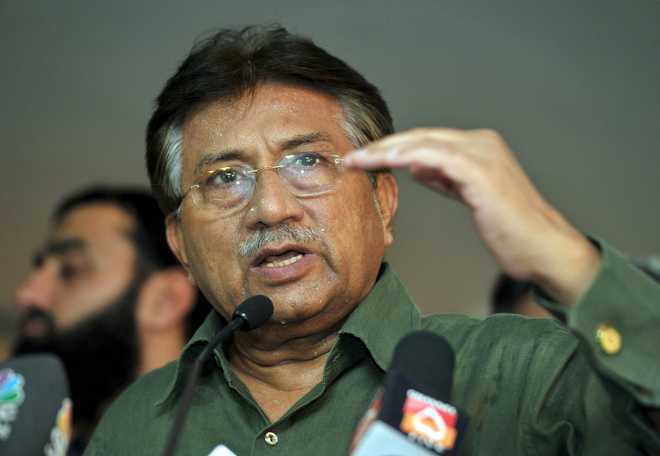
Gen Pervez Musharraf. file photo

Lahore, February 4

Pakistan’s former dictator Gen Pervez Musharraf was responsible for no breakthrough on the Kashmir issue as he launched the Kargil operation without the civilian government’s approval to “sabotage” the talks with India and topple the Nawaz Sharif government, a close aide of the then Prime Minister said on Monday.

Pakistan Muslim League-Nawaz leader and Senator Pervaiz Rashid told reporters that “Sharif and the Indian leadership were holding talks on Kashmir and the latter was ready to resolve it, but Musharraf launched the Kargil operation to sabotage the talks and topple the Sharif government”.

General Musharraf, 75, who lives in Dubai, is facing several cases, including a treason case for suspending the Constitution in 2007. The former military ruler left for the UAE in 2016 for medical treatment and has not returned since. He was the Pakistan army chief during the Kargil War in 1999.

“Gen Musharraf is responsible for the blood of Kashimiris. Musharraf was the reason behind the suffering of Kashmiris as he did not let this issue resolved,” he said, terming the Kargil operation a “misadventure”.


Five Times The Fire Power: Indian Air Force’s Sukhoi Su-30 MKI Now Capable Of Carrying Up To Five Brahmos Missiles

Five Times The Fire Power: Indian Air Force’s Sukhoi Su-30 MKI Now Capable Of Carrying Up To Five Brahmos Missiles

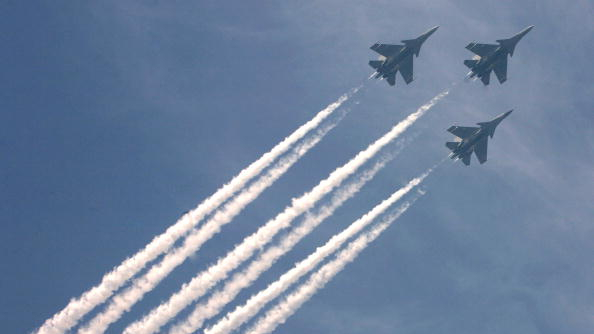
The Russian-origin Sukhoi Su-30 MKI fighter jets of the Indian Air Force (IAF) will be capable of carrying up to five new BrahMos missiles that are being developed by the BrahMos Aerospace – a joint venture of India and Russia.

BrahMos is a medium-range ramjet supersonic cruise missile that can be launched from submarine, ships, aircraft, or land. It is the fastest cruise missile in the world.

At present, the Su-30 MKI can carry one BrahMos missile under its fuselage. However, with the introduction of the BrahMos NG (Next Generation), the IAF fighter jet will be capable of carrying up to five BrahMos missile.

“We proceed from the fact that it will be possible to furnish Su-30 MKI fighters with as many as five new BrahMos NG missiles, which are being developed for light fighter jets. We are planning that a Su-30 MKI plane will be capable of carrying two missiles under each wing and one missile under the fuselage,” BrahMos Aerospace’s chief manager for marketing and exports Praveen Pathak said, as reported by Russian news agency TASS.

BrahMos NG is a mini version based on the existing BrahMos, and will have the same 290 km range and mach 3.5 speed, but will be lighter and shorter than its predecessor.

“Currently, Su-30 MKI planes carry only one missile under the fuselage. The new missiles will considerably boost the aircraft’s capabilities,” he added.


Time for return gift: Kashmiris open heart for Sikhs

SRINAGAR: It’s raining love for Sikhs in Kashmir. The locals are reciprocating the community’s heartwarming gesture of helping Valley students and businessmen who came under attack in many parts of the country after the Pulwama terror strike.

In the past many days, posts and photographs of Sikh youths and voluntary organisations helping Kashmiri students in Jammu, Punjab, Haryana and Uttarakhand have been doing the rounds on social media.

Some students, who reached the Valley, also told their relatives and friends how Sikhs came to their rescue when things turned hostile for them. “The Sikhs guarded the hostels during night when they were threatened by mob and offered free accommodation, food and transportation,” they said.

As a goodwill gesture, the locals are now reaching out to the Sikh community by offering free admission, discount at shops, free tours and stay in hotels. Some advocates have even offered not to charge any money for legal consultations. At present, more than 80,000 Sikhs live in the Valley.

“If any Sikh brother needs legal aid, I will provide him free assistance till disposal of the case,’’ wrote advocate Hilal Ahmad Dar in a social media post. Another message, posted by Usmania Coaching Centre, Srinagar, offered free coaching to Class 10, 11, and 12 Sikh students. In another post, the owner of a hotel in the city said: “If any Sikh brother needs accommodation in Srinagar he will get it free.’’

In a Facebook post, Mateen Banday from Handwara in Kupwara said: “My sale and service centre near old fire service station, Handwara, will be giving 15% discount to Sikhs on generator sets, invertors and power spray motors.’’

The owner of a shop at Bijbhera town in south Kashmir has promised free school uniform to Sikh students.

Shaheen Ahmad Lone, who owns a private school in north Kashmir’s Kanispora area where around 500 Sikh families live, has offered free admission and free education to Sikh students from nursery to Class 10.

Nirmal Singh, a retired engineer and now a social worker, said the gesture of so many Kashmiri Muslims in offering free and concessional services to the Sikh community was appreciable. “These kind deeds will deepen our bonds,’’ he added.

J&K Sikh Coordination Committee chairman Jagmohan Raina said: “It is not the first time that the people in Kashmir have shown goodwill towards the community. We have been living here for decades and have seen how communities help each other in the time of distress. Whatever Sikhs have done outside the state for stranded Kashmiri traders or students is not something new.”


Recce by two IAF copters

Recce by two IAF copters

File photo

Dalhousie, February 20

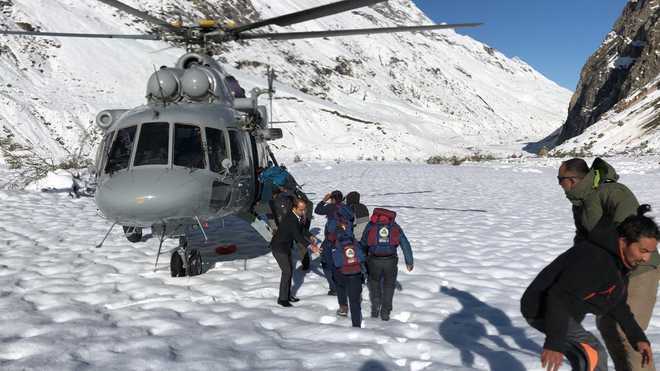
In view of an avalanche advisory issued by the Snow and Avalanche Study Establishment (SASE), Manali, in Pangi and Bharmour of Chamba district in 24 hours, two helicopters of the Indian Air Force (IAF) today took off to carry out a recce of the valley.

DC Harikesh Meena said the recce was part of the recent discussions held with military officials to extend help for rescue operations during avalanche-like situation and other natural calamities, especially in the snowbound areas of the district. The helicopters, however, could not be able to land in the Pangi valley due to bad weather conditions.

The district administration was in constant touch with officials. — OC


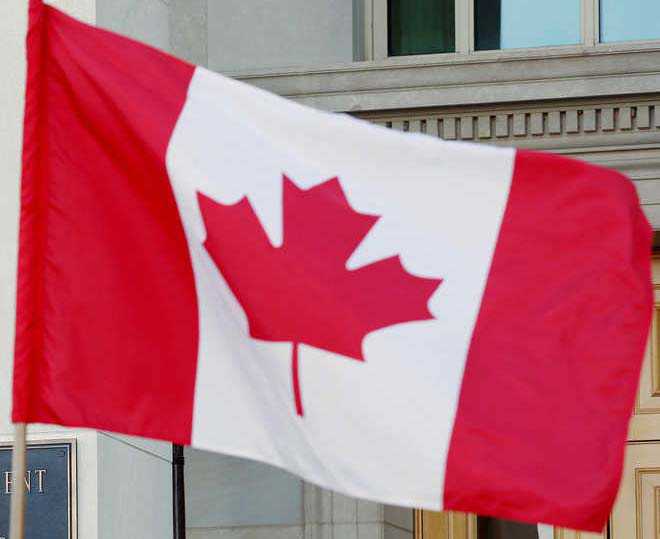
Canada advises its citizens against travelling to Punjab, J&K

Canada advises its citizens against travelling to Punjab, J&K

ndia tops the list of countries where Canadians should exercise a high degree of caution while travelling, as per the advisory.

Varinder Singh
Tribune News Service
Jalandhar, February 21

Without naming Punjab directly, the Government of Canada has advised its citizens to stay away from “border with Pakistan” in view of escalating tensions between India and  Pakistan.

India has jumped to the top of the list of countries prepared by the Canadian government and where Canadian citizens have been advised to either exercise a high degree of caution owing to constant threat of terrorist activities “throughout the country at all times”.

The Canadian government has advised its citizens to ‘avoid non-essential travel’ to a number of Indian states and areas including, the border with Pakistan (it means Punjab and Rajasthan), the border with Bangladesh, Jammu and Kashmir, Nagaland, Meghalaya, Mizoram, Manipur, Assam and Arunachal Pradesh.

The reason for travel advisory against travelling to these states has been cited as “due to conflict”. The government of Canada has regularly been updating its list of travel advice and advisories so as to keep its citizens aware about changing threat perceptions and circumstances prevailing in other countries.

One of the reasons for issuing and updating the travel advisories was that a lot of Canadians venture out on travel to other countries at the outset of spring season over there and the Canadian government wants that that the Canadians should themselves apprised about travel risks before chalking out any travel plans.

If India has spiralled to the top of the list of “dangerous places” for Canadians, China figures at its end after France, Madagascar, Indonesia, Haiti, Venezuela, Philippines, Jordan, Brazil, Tunisia, Jamaica and Thailand.

In case of France, the Canadian government has advised its citizens to “exercise a high degree of caution” mainly owning to the “current elevated threat of terrorism” apart from the ongoing large gilets jaunes protests on Saturdays in that country.

The Canadian government has asked its citizens to exercise a high degree of caution in Indonesia for “political and social tensions” and has advised them against travelling to Venezuela for “significant level of violent crime and unstable political and economic situations”.

Similarly, the Canadian authorities fear high crime rates and regular gang-related and other violence in Brazil could harm its citizens travelling to that country.


Polemics over Pulwama by Rajesh Ramachandran

Polemics over Pulwama

The ‘Kashmiris as terrorists’ equation is framing the attack in a communal context

ON THIN ICE: A Pulwama may win an election for some but at what cost? Isolating Kashmiris because of their religion will only further push them away.

Rajesh Ramachandran

The more Meghalaya Governor Tathagata Roy continues in office and attacks Kashmiris, the greater the damage to the nation. Unfortunately, his is not a lone voice. He merely lends a face, a name and the stamp of constitutional authority to a divisive agenda. The ‘Kashmiris as terrorists’ equation is a deeply dividing political ploy, which frames the Pulwama attack in a communal context instead of what it really is — a terrorist attack backed by an inimical neighbour. The Pulwama attack has suddenly replaced Ram temple or triple talaq as a political tool to gather mobs in the name of Hindutva. The processions exhibiting muscular nationalism being taken out in the wake of the Pulwama attack in residential colonies in many parts of North India have a communal ring to their slogans. The question now being asked is not why such anger over one terrorist attack, but whether this would turn into a landslide support for the BJP in the General Election round the corner.

Pulwama has been so completely politicised and communalised that the primary Opposition party feels compelled to question the Prime Minister for hugging the visiting Saudi Arabian Crown Prince. The underlying communal message is not lost on anyone. Sure, the Saudi prince chose to visit Pakistan before touching down in New Delhi, but the reaction would not have been the same had it been a European leader. The entire polity is allowing itself to get communalised. The Kashmiri terrorist is no longer just a terrorist but a Muslim, and all victims of terrorist attacks are being seen as Islam’s victims. There cannot be a worse proposition for a diverse, multi-religious nation than this agenda. When a Kashmiri is boycotted because he or she is a Muslim by a person occupying a high constitutional office, it is almost as if the British policy of a separate electorate for Muslims — which led to the creation of Pakistan — is getting re-enacted again, this time with the active help of Hindutva politicians.

Sure, religious secessionism and the two-nation theory are at the heart of the Kashmiri insurgency. It is impossible for India to accept another Partition, particularly when Hindus and Muslims live together all over the country. So, any attempt to divide the nation yet again in the name of religion will not get contained in just one province of the country. What is applicable to Kashmir will be applicable to the rest of the country. In that context, the Kashmiri religious secessionism has to be defeated ideologically, politically and militarily; whereas isolating Kashmiris because of their religion will only exacerbate their alienation and help in strengthening their resolve to claim separate nationhood in the name of that very religion.

Have these so-called Hindutva ideologues ever thought about the politicians of the Valley who carry the Indian flag, the policemen on the ground who procure valuable intelligence to defeat the next terror attack, the local bureaucrats who run the government, and those who join the armed forces to fight their own neighbours and the foreign jihadis? Of course not! With just one tweet, all of these Kashmiris have been equated to their own enemies. And all of them, already under pressure at home, have lost their credibility. While their wards, studying in Dehradun or Chandigarh or Gurugram or Jaipur, are forced to return home, they still have to fight the Islamist terrorists every day, all day. Our ruling dispensation and dominant political shouting matches have become so shrill that there is no interlude of sanity to listen to the wails of an ordinary Kashmiri caught among the foreign jihadi, Pakistani spymasters and Hindutva zealots.

India is not Israel. We are a composite culture or a compost dump of communities, where the more divisive we get the more difficult it is to forge a nation. A Pulwama may win an election for some but at what cost? There is every possibility of an Islamist radical from Karnataka or Assam triggering a similar attack. How would that attack get framed? Well, cartoonists have a great way of explaining these complex situations. R Prasad, in one of his recent cartoons in The Economic Times posed the question: Why should Kashmiris be treated differently from Chhattisgarhias? The biggest attack on the CRPF happened in April 2010 at Chintalnar village in Dantewada in Chhattisgarh, when 76 paramilitary soldiers were brutally killed by the Maoists. There was no exhibition of anger or public outpouring of grief or disbursal of relief by Bollywood to the families of the martyrs. In fact, they were not even being hailed as martyrs across the nation. Why?

Former PM Manmohan Singh had termed Maoists the gravest threat to national security. In fact, they have a history of undermining the nation even in 1971, when they supported Pakistan because China — their source of all wisdom — was supporting the rape and murder of lakhs of people of East Pakistan. Maoists are the ones who have always supported religious secessionism on various campuses, including the JNU. They made Afzal Guru fashionable and have continuously extended legal help to secessionist terrorists in jail. They had also openly worked for the Tamil Tigers all through the last Eelam war. Since universities have always been recruitment centres for all kinds of spy agencies, some of them could even have been working for one agency or the other.

Yet, they were never collectively treated as Andhraites (most of their leaders are from Andhra) or Telugus or Brahmins or Velamas because of Ganapathy’s caste or of Kishenji’s. Someone who wants to overthrow the Constitution should be dealt with as an insurgent. Let not his innocent neighbour be targeted, lest there should be no one to protect the neighbourhood.


Army accepts ‘Mark1-A’ version of Arjun tanks

Army accepts ‘Mark1-A’ version of Arjun tanks

Ajay Banerjee

Tribune News Service

New Delhi, February 17

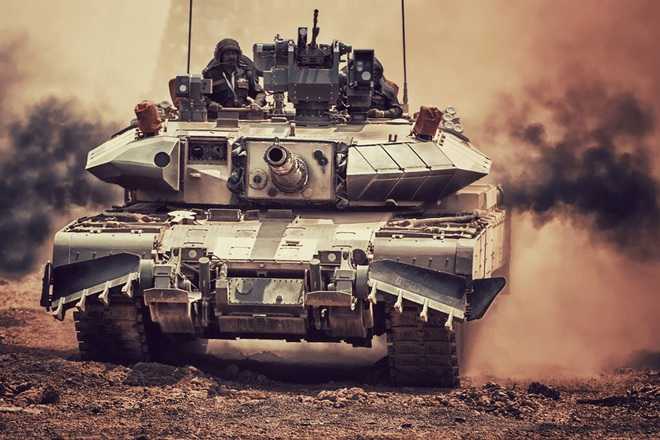
An upgraded version of the Arjun tank, having better firing and mobility, has been accepted by the Army following month-long validation trials in Rajasthan.

The trials were completed in December last and a report has followed. The Army is looking at 118 pieces of the new version. In 2010-11, the first version of the Arjun had joined the Army and 124 pieces had been ordered.

The production of the new version, dubbed as Arjun ‘Mark 1-A’, is likely to commence within this year at the existing facility at Avadi in Tamil Nadu. It has a total of 14 upgrades over the existing version. These include an auto-target tracker, automatic gear system and improvement in suspension.

Only the missile firing ability remains to be validated, which will be done once the missiles, being developed by the DRDO, are ready. The DRDO missile programme has been a major success and firing of missile from a tank is being fine-tuned.

As part of the arrangement with the Army, the DRDO has promised to set up a system to maintain the Arjun within India. It will be an annual maintenance contract with one of the PSUs such as Bharat Earth Movers Limited.

The tanks, as part of the trials, have already done some 4,000 km of run. The upgraded Arjun has a 120mm rifled gun capable of firing a full range of high explosives, laser homing anti-tank (LAHAT) missile that had a tandem warhead, which is capable of defeating all types of modern armour.

In December last year, the Ministry of Defence had informed Parliament that the ‘Arjun Mark 1-A’ was being validated at trials. This was the first official confirmation that the ‘Mark 1-A’ will be an additional version of the tank till the ‘Mark 2’ version, somewhat lighter in weight, is readied and accepted.

The development shows that the MoD is ready to keep on improving the Arjun, be addition of more power or wanting the weight to be reduced. The Army was okay with the ‘Mark 1-A’ version, but wants the next version to be lighter than its present weight of 68 tonne. Most modern European tanks are of the same weight, and tank-transporters (specialised trucks) for Arjun are available to ferry it.

The ‘Mark 2’ will have to be lighter by some 3 tonne. This may require some modification in the hull of the tank for the final contours to emerge.


Pulwama terror attack J&K needs governance beyond rhetoric

Pulwama terror attack

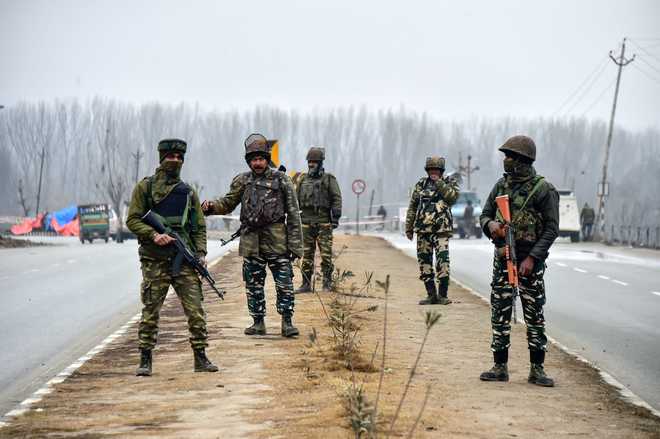
A shroud of sadness descended on the country as the news came in of the death of 40 CRPF men in a suicide bomb attack. The nation as one joins the shattered families in their hour of grief. But repeated rhetoric of a muscular kind has now been shown to be inadequate in addressing national security concerns. The daily kill count in the Kashmir valley and the extended political celebration of the surgical strikes, recently made into a testosterone-laden blockbuster movie, were insufficient to neutralise the consequences of a disastrous coalition experimentation, repeated governance failures and the sidelining of alternative political voices in the Valley.

The unrelenting security operations with no political solution on the horizon may well have given way to complacency in the Kashmir’s security infrastructure, leading to a grave intelligence lapse that permitted the accumulation of several hundred kilograms of explosives used in the attack. Pakistan is, of course, behind this attack. But we cannot forget that it was a local youth who rammed the car into the CRPF convoy. Continuing counter-insurgency strikes in the Valley are creating a contrarian conflict, which can only be addressed through a political process. The government and people of India cannot win this battle without winning the hearts and minds of the local population.

If the huge cache of explosives establishes the scale of intelligence failure, we need to ask how could 2,500 security personnel be ferried without following the standard operating procedure? We cannot afford to shed more blood in vain. If choppers are the answer, let the government bring in a more expensive alternative. The maximum losses of security forces have happened on the Anantnag-Brijbehara-Pampore axis, yet there has not been sufficient surveillance to deter this murderous mayhem that reduced the CRPF bus to a mangled heap. Pakistan’s deep state will try every dirty trick in its book but we should be militarily prepared to stop, expose and hit at its resources like Masood Azhar. Simultaneously, we should create an atmosphere of political engagement to address the angst of the Valley’s youth.