



Sanjha Morcha

Self-inflicted wounds on terror frontby Ajai Sahni

Terrorist and insurgent threats across India have substantially been contained. Where a measure of escalation is being registered, it is abundantly clear that this is the result of intentional destabilisation with a view to achieving short-term, partisan political gains, principally as a result of communal polarisation.
Self-inflicted wounds on terror front

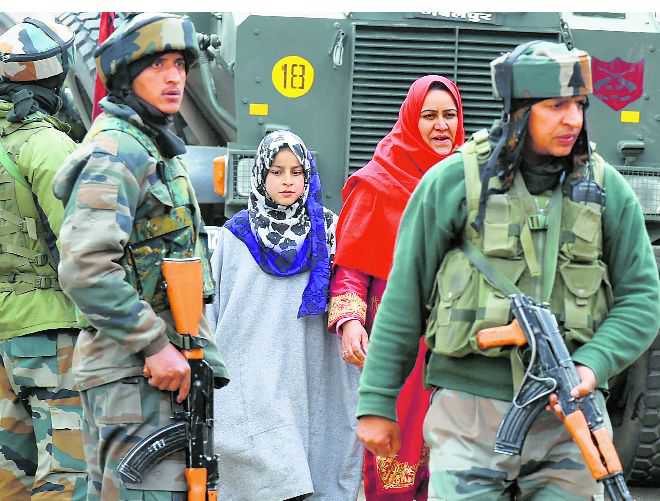
Bloodbath: 451 people were killed in terror-linked violence in J&K in 2018, the highest figure in a decade.

Ajai Sahni
Executive Director, Institute for Conflict Management

THE year 2018 was an uncertain one for India with respect to terrorism. Sharp gains were registered in several theatres, and significant reverses in others. More dangerously, an undercurrent of growing potential risk enlarged in wide areas, including many that had seen sustained state consolidation over the past years.

At least 941 terrorism and insurgency-linked fatalities were recorded by the South Asia Terrorism Portal (SATP) across the country last year, against 805 in 2017. The surge in casualties was principally in Jammu and Kashmir, up from 358 in 2017 to 451 in 2018. In the Maoist belt, the toll rose from 332 to 415. The North-East, with a multiplicity of degraded insurgencies continuing to provoke occasional violence, witnessed 72 deaths in 2018, while these were 103 in 2017. Punjab, which had seen no Khalistani terrorism-linked fatalities between 2008 and 2015, has registered deaths in this category each year since, with three persons killed in 2018 (one incident), six in 2017 (five incidents) and three in 2016 (three incidents). However, 34 persons have died in Pakistan-backed Islamist terrorism-linked incidents in Punjab in recent years — 10 in the Dinanagar (Gurdaspur) attack of 2015; 22 in the 2016 Pathankot airbase attack; and two infiltrators in 2017.

The sustained escalation in J&K, after violence bottomed out with 117 fatalities in 2012, has largely been the consequence of polarising politics and continuous policy failures, primarily on the part of the present dispensation at Raisina Hill, culminating in the imposition of President’s Rule. It is significant that recourse to this desperate measure has been considered necessary in the state after over 22 years. The state was under President’s Rule between 1990 and 1996, at a time of enveloping chaos. 1996 saw as many as 2,903 terrorism-linked fatalities in J&K, the highest figure till that point. The situation worsened in 2001-03, with deaths exceeding 3,000 each year, and peaking at 4,507 (2001), and yet President’s Rule was not considered necessary. While the casualties have been rising steadily since 2013, the state is nowhere near the conditions of breakdown that could have justified this move. 

Other indices of policy failure in J&K are in evidence. With 451 killed in terror-related violence in 2018, this is the highest number in a decade (the figure was last exceeded in 2008, with 541 killed). Civilian fatalities at 86 are the highest last year since 2007, when 164 civilians were killed. While the government is eager to highlight the rising number of deaths of terrorists in the state (259 killed last year), the security forces lost 95 personnel in 2018. With constitutional politics in suspension, partisan mischief led by the ruling party in New Delhi is mounting. With Assembly and parliamentary elections due in a few months, disruptive politics can only intensify, with a concomitant escalation in violence.

While the total fatalities in Maoist-affected regions did register a significant escalation between 2017 and 2018, rebel casualties accounted for the entire increase (from 150 to 231). Both civilian and security forces’ deaths registered a marginal decline, from 109 to 108, and from 76 to 75, respectively. Unsurprisingly, the Union Ministry of Home Affairs (MHA) has reduced its list of ‘worst Maoist-affected’ districts from 36 in 2017 to 30 last year, and of Maoist-affected districts from 126 to 90. There has, moreover, been a growing number of surrenders and arrests, indicating increasing demoralisation among Maoist forces. By and large, the process of consolidation against the Maoist insurgency is continuing apace, though the rebels retain capacities to inflict occasional and devastating attacks on the security forces.

According to the SATP database, with just 72 fatalities, 2018 recorded the lowest figure in the North-East since 1992. The previous low of 103 deaths was registered in 2017. At its peak, the North-East accounted for 1,696 insurgency-linked deaths in 2000. The toll in 2018 included 18 civilians, the lowest registered in this category since 1992. The maximum number of civilians killed in a year, 946, was in 2000. Nevertheless, polarisation on religious and linguistic lines has sharpened in Assam in particular and the region at large ever since the Supreme Court-monitored exercise of updating the National Register for Citizens (NRC) was initiated in 2015 to identify bona fide residents of Assam. The final draft NRC, published on July 30, 2018, has tentatively identified over four million persons whose nationality is suspect. Earlier, the first draft NRC, published on December 31, 2017, had left out 14 million people. Tension had mounted further due to the Centre’s ill-conceived move to push through the Citizenship (Amendment) Bill, 2016, which would legalise citizenship of ‘persecuted minorities’ — specifically including Hindus, Sikhs, Buddhists, Jains, Parsis and Christians — from Pakistan, Bangladesh and Afghanistan who had entered India before December 31, 2014. The Bill has already provoked significant mass political mobilisation and has been picked up by the militant United Liberation Front of Asom-Independent (ULFA-I) as a bone of contention. Any destabilisation in this sensitive region can only be bad news for the future.

Islamist terrorism outside J&K has been on the wane since 2008, though a rash of arrests across Delhi and Uttar Pradesh by the National Investigation Agency on December 26, 2018, revived the spectre of the Islamic State (IS, aka Daesh). The discovery and neutralisation of the incipient Harkat-ul-Harb-e-Islam (Movement for the War of Islam) underlines two sharply contrasting realities: first, that Daesh, with its apocalyptic vision and startling public brutality, retains some power to seduce elements on the extremist fringes of the Muslim community in India; and second, this mobilisation is of exceptionally poor quality, with conspiracies exposed at incipient stages, and with rudimentary capacities to do harm. Partial data compiled by the SATP indicates that at least 310 persons from India connected to Daesh have been identified since 2014. Of these, 88 have travelled to Iraq and Syria; 153 have been arrested; another 69 have been ‘detained’, counselled and released. 2018 recorded 41 arrests in connection with Daesh activity.

Terrorist and insurgent threats across India have substantially been contained. Where a measure of escalation is being registered, it is abundantly clear that this is the result of intentional destabilisation with a view to achieving short-term, partisan political gains, principally as a result of communal polarisation. These are self-inflicted wounds for which private citizens and security personnel pay the highest price, even as the most unprincipled of political players secure transient profit.


Lt Gen Ranbir visits forward posts in Rajouri

Lt Gen Ranbir visits forward posts in Rajouri

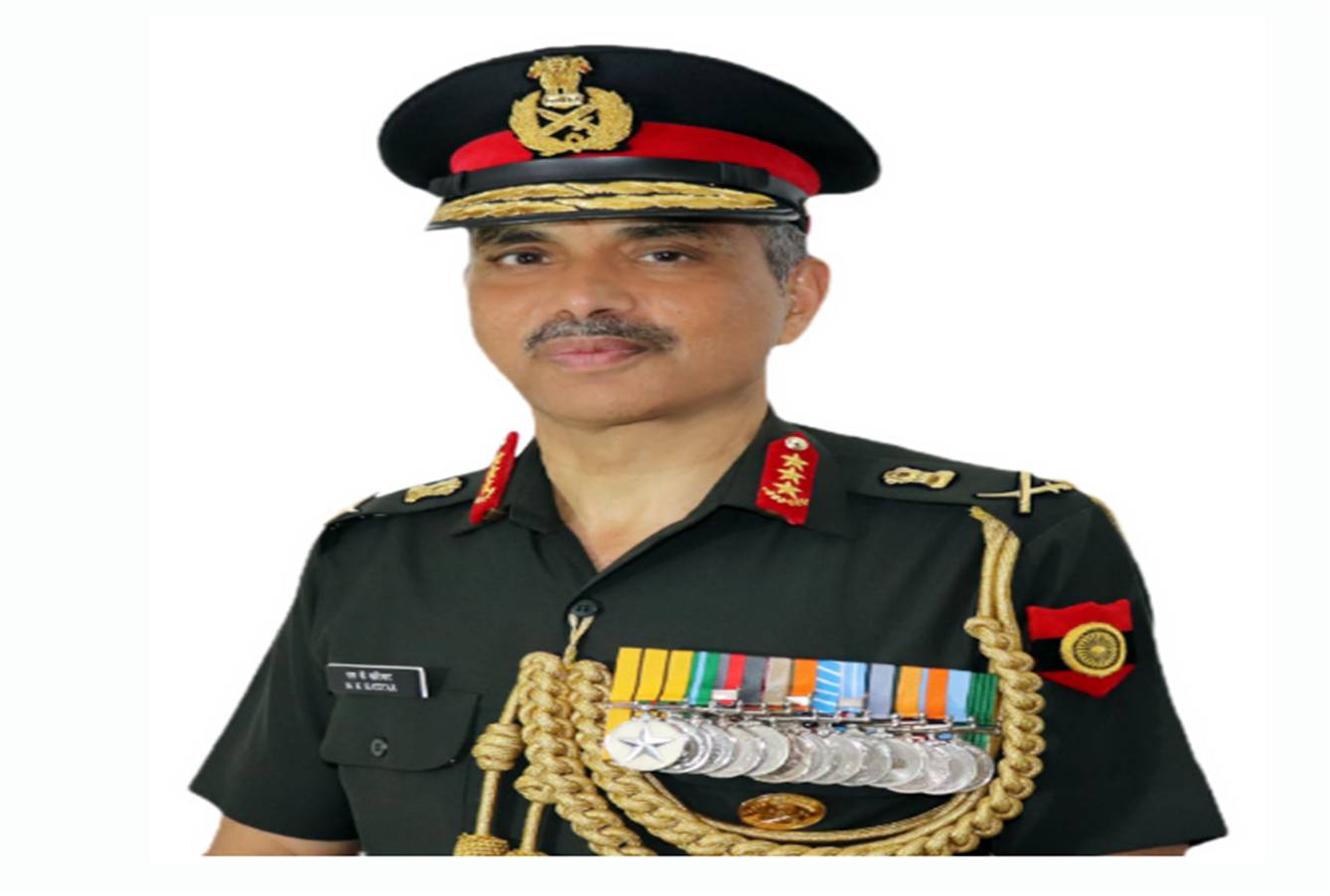
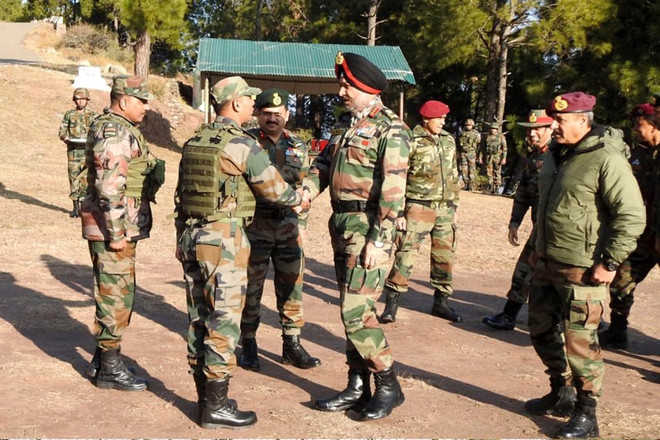
Lt Gen Ranbir Singh and Lt Gen Paramjit Singh at a forward post.

Tribune News Service

Jammu, January 7

Northern Command chief Lt Gen Ranbir Singh accompanied by White Knight Corps GOC Lt Gen Paramjit Singh on Monday visited the forward posts of Rajouri and Akhnoor sectors to review the operational preparedness and prevailing security situation.During the visit, Lieutenant General Ranbir was briefed by the commanders on the ground about the prevailing security situation and the operational preparedness of the formations in dealing with the same.

He was also briefed on the actions being taken to ensure a robust counter-infiltration and counter-terrorist grid to enable continued peace and stability in the region.Giving details, a defence spokesman said the Northern Command chief interacted with the soldiers and complimented them for their unwavering dedication to duty, selfless devotion and high standard of professionalism. “He was appreciative of the measures and standard operating procedures instituted by the units and formations in their area of responsibility to minimise the casualties due to ceasefire violations and infiltration bids,” the spokesman added.

He said General Ranbir also appreciated the synergy between security forces and the civil administration. “The need to be prepared for effectively meeting emerging security challenges was also reinforced. He exhorted all ranks on the need to remain vigilant to counter the nefarious designs of the enemy and anti-national elements,” the spokesman added.


Pakistan targets Indian posts in Poonch district of Jammu and Kashmir

Pakistan targets Indian posts in Poonch district of Jammu and Kashmir

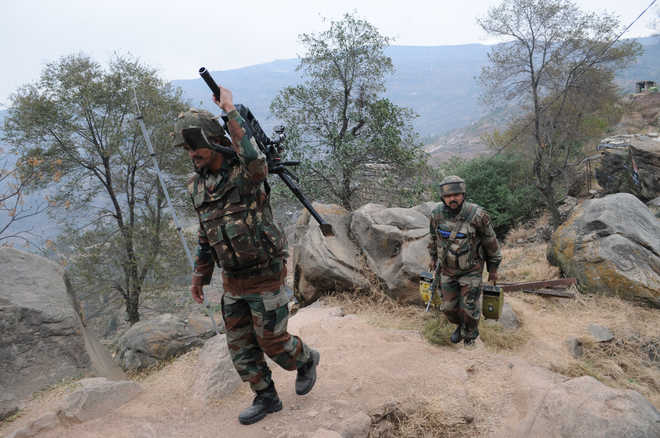
The firing took place in Khari Karmara and Gulpur forward areas along the LoC.

Jammu, January 1

Pakistan Army on Tuesday opened fire on forward areas along the Line of Control in Poonch district of Jammu and Kashmir, officials said.

The firing took place in Khari Karmara and Gulpur forward areas along the LoC, they said.

Indian troops guarding the border retaliated.

No casualty has been reported.

Despite repeated calls for restraint and adherence to the ceasefire understanding of 2003, there have been 1,600 incidents of ceasefire violations by Pakistan last year till October 2018. PTI


Nagaland declared ‘disturbed’ for 6 more months under AFSPA

Nagaland declared ‘disturbed’ for 6 more months under AFSPA

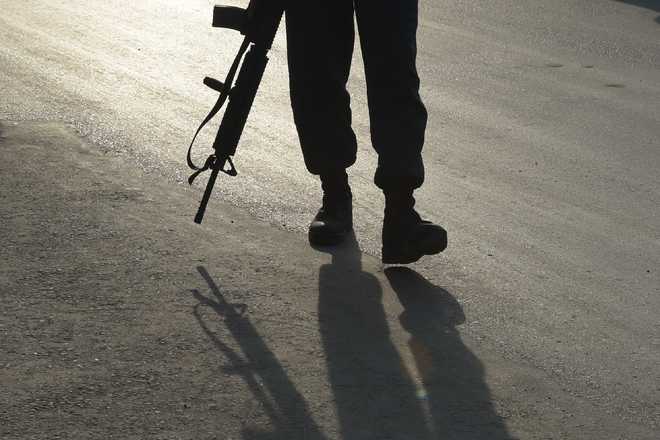
File photo for representational purpose only. AFP

New Delhi, December 31

The entire state of Nagaland has been declared “disturbed area” for six more months, till June-end, under the controversial AFSPA, which empowers security forces to conduct operations anywhere and arrest anyone without any prior notice.

In a notification, the Home Ministry said the Central Government is of the opinion that the area comprising the whole of state of Nagaland is in such a disturbed and dangerous condition that the use of armed forces in aid of civilian power is necessary.

“Now, therefore, in exercise of the powers conferred by Section 3 of the Armed Forces (Special Powers) Act, 1958 (No. 28 of 1958), the central government hereby declares that whole of the said state to be a ‘disturbed area’ for a period of six months with effect from December 30, 2018, for the purpose of that Act,” the notification said.

A Home Ministry official said the decision to continue the declaration of Nagaland as “disturbed area” has been taken as killings, loot and extortion have been going on in various parts of the state which necessitated the action for the convenience of the security forces operating there.

There have been demands from various organisations in the Northeast as well as in Jammu and Kashmir for repealing the controversial Armed Forces (Special Powers) Act (AFSPA), which, they say, gives “sweeping powers” to security forces.

The AFSPA has been in force in Nagaland for several decades. It has not been withdrawn even after a framework agreement was signed on August 3, 2015 by Naga insurgent group NSCN-IM general secretary Thuingaleng Muivah and government interlocutor R N Ravi in presence of Prime Minister Narendra Modi.

The framework agreement came after over 80 rounds of negotiations spanning 18 years with the first breakthrough in 1997 when the ceasefire agreement was sealed after decades of insurgency in Nagaland. PTI


South African Prez Ramaphosa witnesses R-Day Parade at Rajpath

South African Prez Ramaphosa witnesses R-Day Parade at Rajpath

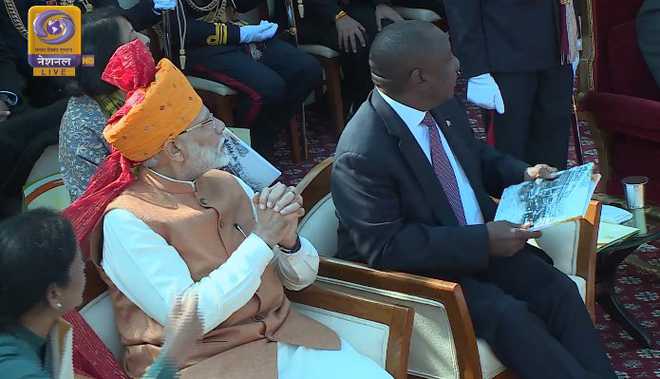
South African President Cyril Ramaphosa and Prime Minister Narendra Modi watch the Republic Day Parade. Photo: Twitter/DDNews

New Delhi, January 26

South African President Cyril Ramaphosa on Saturday joined a select group of world leaders to have graced India’s Republic Day celebrations in the past few decades.

Ramaphosa , as the chief guest at the 70th Republic Day celebrations, watched the colourful parade at the majestic Rajpath along with President Ram Nath Kovind, Prime Minister Narendra Modi and a host of other leaders.

He is the second South African President after Nelson Mandela to be the chief guest at India’s Republic Day celebrations.

Last year, leaders of all 10 ASEAN countries attended the Republic Day celebrations.

In 2017, Crown Prince of Abu Dhabi Sheikh Mohamed bin Zayed Al Nahyan was the chief guest at celebrations, while then French President Francois Hollande graced the occasion in 2016.

In 2015, then US President Barack Obama watched the parade.

In 2014, Japanese Prime Minister Shinzo Abe was the chief guest at the celebrations, while Bhutan king Jigme Khesar Namgyel Wangchuck attended the parade in 2013.

The heads of state and government who have attended the Republic Day celebrations include Nicolas Sarkozy, Vladimir Putin, Nelson Mandela, John Major, Mohammed Khatami and Jacques Chirac.

The then British Prime Minister John Major had attended the celebrations in 1993, Mandela participated as South African President in 1995 while South Korean President President Lee Myung Bak witnessed the parade in 2010.

In 2008, Sarkozy participated in the celebrations as French President, while another French President Chirac graced the occasion in 1998.

The world leaders who attended the celebrations include Russian President Putin in 2007, Nepal’s King Birendra Bir Bikram Shah Dev in 1999, Brazilian President Luiz Inacio Lula da Silva in 2004, Iranian President Mohammed Khatami in 2003, Indonesian President Susilo Bambang Yudhoyono in 2011 and President of Maldives Maumoon Abdul Gayoom in 1991.

In 2009, South Korean President Lee Myung Bak had graced the occasion as the chief guest, while Kazakhstan President Nursultan Nazarbayev witnessed the parade here in 2010. PTI


Five claims in The Hindu’s Rafale report that don’t quite add up

Yesterday, The Hindu published a report on the Rafale deal—claiming that the price settled for was too high, that the government violated laid-down procedures and guidelines, and that an opportunity to negotiate a better price by leveraging a competing offer from a competing vendor was foregone. The report contains some glaring assertions that are not borne out by the facts. What follows is a breakdown of five major goof-ups.

Claim 1:

“Modi’s decision to buy 36 Rafales shot the price of each jet up by 41%”

Fact:

The 2007 bid price is not directly comparable with the 2016 contract owing to the price inflation and exchange rate variation that occurred in the nine intervening years. In order to account for these risks, the original bid contained an escalation clause that steadily raised the price of the aircraft every year. If the value of the 2007 bid, on a per aircraft basis, were adjusted to 2016—the year the Rafale agreement was formally signed—it would have resulted in a price of €100.85 million for each bare-bones aircraft. This was higher than the €91.7 million that was negotiated by the government in 2016. Thus, the government’s claim of a 9% discount makes economic sense, while The Hindu’s claim of 41% escalation does not.

Moreover, the debate over raw numbers neglects a vital pointthat the comparison isn’t really apples-to-apples. Dassault’s 2007 bid was for an F3 standard Rafale. The current deal is for a more advanced variant, as well as India-specific enhancements that boost its effectiveness. Claiming a 41% price escalation between the two would be equivalent to comparing the 2007 price of a Maruti Swift LDi with the 2016 price of a customised Swift ZXi, and concluding that the price of the car has shot up.

Claim 2:

The F3-R Rafale possesses “practically the same configuration and capabilities” as the older F3 model . . . “Dassault claimed a €1.4 billion cost for the ‘design and development’ of . . . additional capabilities in the form of hardware as well as software that had been specified by the Indian Air Force all along.”

Fact:

We know from earlier reports on the topic that the additional capabilities went beyond the Indian Air Force’s specifications in the MMRCA tender. The Economic Times reported in February that “The Rafales being procured under the current deal has a better weapons suite such as the game-changer METEOR missiles”. This was also corroborated by a report published in India Today in the same month.

Also, the F3-R standard Rafale represents a vast improvement over the F3. It can carry the long-range Meteor air-to-air missile (which significantly outranges the MICA missile that the F3 could carry, as well as boasts superior terminal-phase kinematic performance), upgraded AASM smart bombs which can be guided via in-built infrared seekers (in addition to the inertial and GPS guidance the legacy versions had), and the Talios laser designation pod; whereas the F3 could not. It also sports improved avionics, upgraded software, improved flight controls and other enhancements that give it a significant edge over the F3 standard Rafale. These enhancements were so significant, that the French government budgeted  €1 billion for the research and development that went into them in 2014.

It was also reported earlier that the India Air Force’s Rafales would not be restricted to the F3-R standard. The agreement makes provision for further improvements that are slated to be implemented under the F4 standard to be transferred to the Indian fleet as well.

Claim 3:

“Big increase in Rafale’s price came because a deal bypassing mandated procedures and made in the face of official objections”

Reality:

Not a single example of any arm of the government “bypassing mandated procedures” has been presented in the report. The author has portrayed a majority decision by the Indian Negotiating Team (INT) in the face of objections by a minority of the team’s members as a violation of procedures, and guidelines, but this is not true. As the Ministry of Defence states in its reply, the views and objections of individual committee members are always recorded, and committees vote on the final decision. Far from being a violation of procedure, this is collective decision-making, done in the best traditions of a democratic set-up.

Claim 4:

“Mr Parrikar shied away from his responsibility and . . . passed the buck, to the Cabinet Committee on Security”

Reality:

The progression of the final agreement—from the INT’s approval to the DAC’s review to the CCS’s—ratification is what we call “following the process”, as outlined in the 2013 Defence Procurement Procedure (DPP). The Defence Minister did not “pass the buck”. Had he decided to unilaterally override any committee’s (which he was empowered to do, but chose not to) it would have been seen as improper, and only prompted further allegations of wrongdoing and dictatorial decision making.

Claim 5:

“The opportunity to make full use of the leverage provided by the new offer from the Eurofighter Consortium was lost.”

Reality:

The DPP makes no provision for “leveraging” one bid against the other, and could very easily be interpreted as prohibiting it. Equipment is to be purchased either by soliciting competitive bids from multiple vendors, or directly from friendly foreign countries via an Inter-Governmental Agreement (IGA). The latter route was chosen for the Rafale deal considering the Air Force’s urgent needs. There was no path to leveraging an offer from Eurofighter (a vendor) against one from the government of a friendly nation (France).

Disclaimer : Newslaundry.com is determined to include views and opinions from all sides of the spectrum. This doesn’t mean we agree with everything we publish. But we do support their right to the freedom of speech. In case of columnists and non-Newslaundry staff articles, the information, ideas or opinions in the articles are of the author and do not reflect the views of Newslaundry.com. Newslaundry.com does not assume any responsibility or liability for the same.


Pak Rangers violate ceasefire along IB in Kathua

Pak Rangers violate ceasefire along IB in Kathua

Northern Command chief Lt Gen Ranbir Singh had on Thursday said the Army was replying befittingly to the Pakistani aggression. Tribune file

Jammu, January 18

Pakistan Rangers on Friday violated ceasefire by resorting to firing along the International Border (IB) in Jammu and Kashmir’s Kathua district, officials said.

Pakistan Rangers resorted to small arms fire on border outposts (BoPs) in Hiranagar sector at around 11 am, they said.

BSF troops, guarding the borderline, retaliated strongly, the officials said.

On Thursday, a civilian was injured when Pakistani troops violated ceasefire and resorted to firing and mortar shelling along the Line of Control in Rajouri district.

Northern Command chief Lt Gen Ranbir Singh had on Thursday said the Army was replying befittingly to the Pakistani aggression.

Pakistani troops resorted to firing and shelling along the LoC in the Jammu region of the state for 13 days of this month, the officials said.

The year 2018 had witnessed the highest number — 2936 — of ceasefire violations by Pakistani troops in the last 15 years along the Indo-Pak border.

The continuous Pakistani shelling and firing targeting villages has set in fear psychosis among the border dwellers.

On Monday, Border Security Force (BSF) Assistant Commandant Vinay Prasad was killed in sniper firing by Pakistan Rangers along the IB in Hiranagar-Samba sector of Kathua district.

On the same day in another incident, Pakistani troops resorted to firing and shelling along the LoC in Sunderbani sector of Rajouri district.

On Sunday, an Army jawan was injured in ceasefire violation along the LoC in Keri sector of Rajouri.

On Friday last, an Army porter was killed when Pakistani troops resorted to firing in Nowshera sector of Rajouri district.

On the same day, an Army Major and a soldier were killed in an IED blast on the LoC in Laam sub-sector of Rajouri.

On Thursday last, Pakistani troops resorted to firing and shelling in two sectors of Rajouri and Poonch resulting in injuries to an Army Major and a BSF jawan in the Tarkundi forward area of Balakote sector. PTI


Why Gen Rawat is right on talks with Taliban by Maj Gen Ashok Mehta (Retd)

At least three countries attending the Raisina Dialogue recently asserted that India should engage with the Taliban and offered to facilitate a conversation. India has inexplicably tied itself in knots over the issue. Unlike the Americans, New Delhi has not fought with the Taliban in Afghanistan.

Why Gen Rawat is right on talks with Taliban

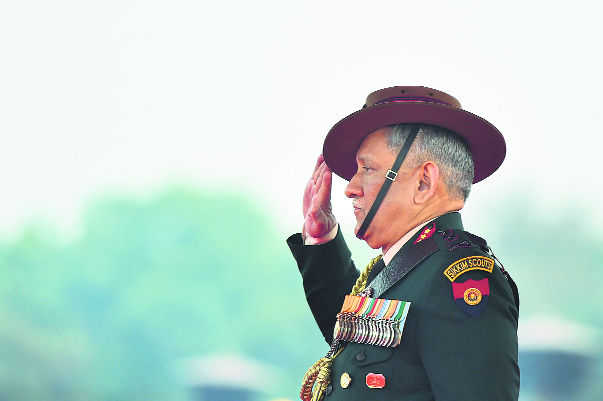
Controversy: Army Chief Gen Bipin Rawat’s stand is perfectly valid, but it has stirred a hornet’s nest.

Maj Gen Ashok Mehta (Retd)
Former GOC, IPKF, Sri Lanka

Gen Bipin Rawat has a penchant for hitting the bull’s eye, making headlines and retaining the spotlight. It’s one of the avoidable hazards of his job where he can, like most of his predecessors, choose to remain mum. But Rawat — one of the most fearlessly articulate Army Chiefs in recent memory — is made of sterner stuff, which he demonstrated at the 4th edition of the Raisina Dialogue in New Delhi recently. A disparate session alliteratively titled ‘Amoebic, Asymmetric and Anarchic: Counter Terrorism as it evolves’ saw the heavily bemedalled General seated among three senior counter terrorism experts being quizzed by BBC’s blue-blooded Afghan Yalda Hakim. Afghanistan, the regional hotspot, dominated the Raisina discourse, given the surfeit of Afghanistan experts and Afghan luminaries — former President Hamid Karzai, Gen David Petraeus (retd) and the latest American (Afghan Pashtun) to have a crack at the peace process with Taliban, the firebrand former envoy to Afghanistan, Zalmay Khalilzad.

Answering the question from Hakim on whether India should talk to the Taliban, Rawat — contradicting the official stand of the Indian Government — replied in the affirmative with the proviso that the Taliban do not place pre-conditions. He cited the example of Pakistan, which considers Afghanistan as its backyard, adding: “they would want a situation in Afghanistan that is more favourable to them even if it means speaking to the devil.” Rawat’s stand was perfectly valid, but it stirred a hornet’s nest. India’s position on Taliban has waxed and waned. To start with, New Delhi rejected the reintegration and reconciliation policy of US/Afghanistan after the ouster of the Taliban from Kabul in 2001. Subsequently, reintegration was accepted, though the distinction between good and bad Taliban was rejected. Later, India found the reconciliation process kosher as long as it was within the parameters of the Afghan constitution, the Taliban shunned violence, and the peace process was Afghan-owned and Afghan-led. To this, India has now added ‘Afghan-controlled’.

Rawat’s advocacy of a dialogue with the Taliban has not come a day too soon. The ‘talking to Taliban’ analogy to Kashmir, though, is not acceptable to him. He rejected unconditional talks with militants and separatists, emphasising that any talks on the Valley would be ‘on our terms’. What is good for the goose is good for the gander. Still, his justification for contact with the Taliban is perfectly valid, though former Army Chief Gen VK Singh, now a junior minister in the Ministry of External Affairs, on the sidelines of the Raisina, passed off his comments as a ‘personal view’. India has inexplicably tied itself in knots over engaging the Taliban even as two retired government officials joined the Moscow format of the peace process as observers. At least three countries attending the Raisina dialogue unequivocally asserted that India should engage with the Taliban and offered to facilitate a conversation. 

Karzai advised India to talk to the Taliban, saying that it should have done this a long time ago. Unlike the Americans, New Delhi has not fought with the Taliban in Afghanistan. The Taliban have appreciated India’s developmental assistance which US President Donald Trump comically compared with “building a library and like five hours of what we spend”. Russian Deputy Foreign Minister Sergev Ryabkov said it was Moscow that invited India to the peace talks. He said, “We are ready to help India start direct talks with the Taliban.” Not to be left behind, Iran’s Foreign Minister Javed Zarif admitted that his country has influence over the Taliban and would be happy to facilitate engagement with India. It is a mystery, therefore, that when all regional and extra-regional players have direct or back-channel contact with the Taliban, India has persisted with the policy of maunvrat (vow of silence).

Under CinC Trump’s watch, Khalilzad is engaged in the most comprehensive direct talks with the Taliban without any signs that he would persuade the latter to talk with Kabul any time soon. India should firm up its contingency plans in the event of a sudden and accelerated exit of the US and foreign forces before 2020 just as then President Barack Obama did before the elections in 2016. Protection of its strategic assets, including 5,000 Indian citizens, prevention of destabilisation of the Kabul regime and conversion of its goodwill into influence are key Indian missions. Any large-scale law and public order problem could lead to spillover of the Taliban into Jammu and Kashmir, which would be a nightmarish situation. Along with regional partners and members of the international community, notably the US and EU/NATO, financial commitments of $12-15 billion annually will be required for the Afghan government and security forces to keep their heads above water. An increase in India’s security assistance package will need to be adjusted against developmental assistance. Additional ITBP personnel for the protection of strategic assets at Chabahar and the consulates at Herat and Mazar-e-Sharif (after maybe closing down Jalalabad and Kandahar) will be needed. Further, India could establish a training depot and a military field hospital in nearby Tajikistan which will please Trump more than India building another library.

In the event of a deal, the Taliban will be a key component of any future Kabul government and hugely indebted to Pakistan. Either way, it is imperative that India, to start with, opens a back channel with the Taliban, followed by joining the official Peace and Reconciliation Process, in its national interest. Rawat is spot on in recommending India engage the Taliban in unconditional talks.


Terror chief killed in J&K’s Kulgam carried reward on head

HT FILE■ Police said both militants were affiliated to Al-Badr and were wanted for many terror-related incidents.

In a statement, police said Zeenat-ul-Islam, 31, who was also an IED expert, was killed along with his accomplice Shakeel Ahmad Dar. The slain militants were from Shopian district.

The statement said Zeenat had a “long history of terror crimes” since 2006. It added he was earlier affiliated with the Hizbul Mujahideen. Zeenat allegedly helped militants as an over ground worker before his arrest in 2008. He got married upon his release in 2010 before joining LeT in 2015. He then switched to the HM.

Zeenat is believed to have been behind a 2017 ambush in which three soldiers were killed.

HIZBUL MILITANT ARRESTED IN SHOPIAN Police of Delhi and Jammu and Kashmir in a joint operation have arrested an alleged Hizbul Mujahideen militant and apprehended a juvenile in Jammu and Kashmir’s Shopian district.

Police said the two militants were in touch with Naveed Babu, a policeman who turned militant and heads the outfit as its “area commander”. The duo was allegedly trying to establish a contact in Delhi NCR for a regular supply of weapons here, police said.

Kifayatullah Bukhari, 22, a resident of Shopian and his accomplice were picked up from near Narwaw village, said deputy commissioner of police (special cell) Pramod Kushwah.

“After receiving inputs last week, we had been working on identifying a module that is ISISinspired, and was trying to procure weapons from north Indian states. We learnt that the terror module was also strengthening itself in J&K and trying to expand their activities in Delhi and nearby areas,” the DCP said.

On Friday, tracing the movement of the suspects, a trap was laid and Bukhari was arrested. He is a school drop-out and used to work for a transport company. The 22-year-old had recently applied for a visa to Pakistan, to undergo “militancy training ”. The juvenile is a student of a madarsa, police added.

“A pistol and 14 cartridges were seized from them. They were in contact with Naved Mustaq, 30, alias Naveed Babu, a resident of Nazneenpora in Shopian. Babu had joined J&K Police in 2012 as a constable before he joined the militant group in 2017,” Kushwah said.

A case has been filed in Jammu and Kashmir and the state police are probing into the matter.