Sanjha Morcha

Punjab, Haryana, Union Territory of Chandigarh celebrate Republic Day

Punjab, Haryana, Union Territory of Chandigarh celebrate Republic Day

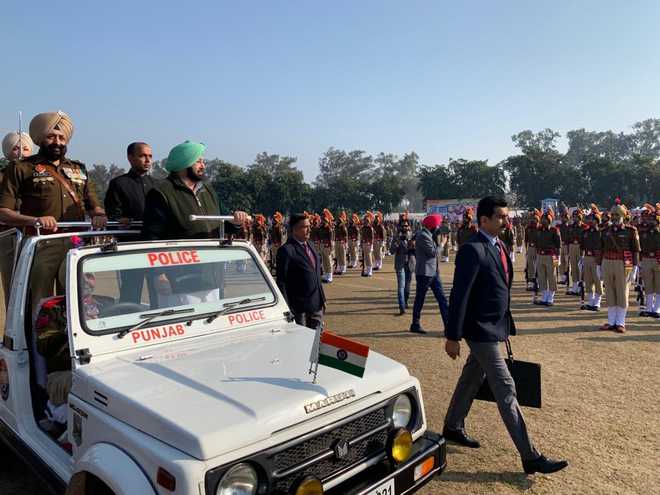
Punjab CM Capt Amarinder Singh takes the salute at state-level function at Polo Ground, Patiala, to celebrate R-Day. Twitter/RT_MediaAdvPbCM

Chandigarh, January 26

Punjab, Haryana and the Union Territory of Chandigarh on Saturday joined the nation in celebrating the 70th Republic Day, amid tight security arrangements.

Police, home guards and NCC contingents were among other participants in the parades held in district headquarters in the two states and their joint capital Chandigarh.

School students presented colourful programmes and tableaux exhibited development of the states at the parades at several places in the region.The Republic Day celebrations at most places in the two states were held under tight security arrangements.

VP Singh Badnore, the Punjab Governor and Administrator of Chandigarh, unfurled the national flag in a state-level function in Hoshiarpur.Haryana Governor Satyadeo Narain Arya unfurled the national flag at Panchkula.

Punjab Chief Minister Amarinder Singh unfurled the national flag in Patiala, while Haryana Chief Minister Manohar Lal Khattar unfurled the Tricolour in Bhiwani, officials said.

Various events were held in district headquarters in Punjab and Haryana, including Ludhiana, Amritsar, Jalandhar, Moga, Bathinda, Panchkula, Karnal, Sonepat, Gurdaspur and Rupnagar.

Ministers of Punjab and Haryana presided over the celebrations in district headquarters.

Security had been stepped up across Punjab, Haryana and Chandigarh in view of the Republic Day programmes. PTI


Rafale: Can’t become pawns in corporate warfare, Sitharaman says to Oppn

Rafale: Can’t become pawns in corporate warfare, Sitharaman says to Oppn

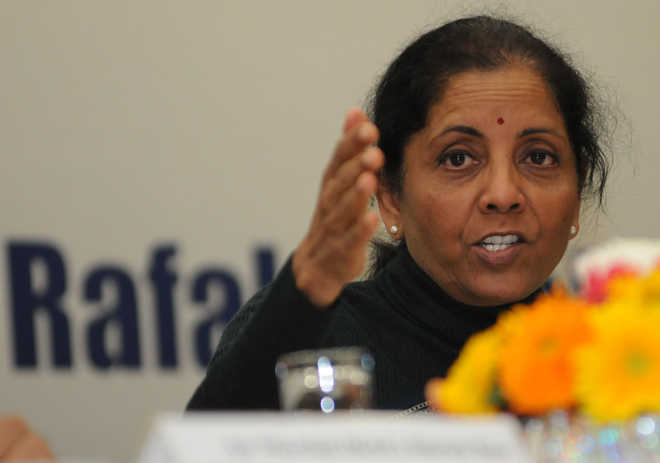
Defence Minister Nirmala Sitharaman. Tribune photo: Mukesh Aggarwal

Ravi S.Singh
Tribune News Service
New Delhi, January 19

Defence Minister  Nirmala Sitharaman on Saturday accused opposition parties of “playing into” corporate hands. “The questioning of the deal should be guided only by this country’s strategic and security interests, and to clear doubts on process of procurement and transparency,” Sitharaman said.

“I want every strand of this debate to be explained, as much as it can be, without any of us playing into the hands of international corporate warfare. None of us should play party to any corporate warfare. We cannot become pawns in the hands of the corporate giants to constantly bully the government, to constantly throw misinformation at the public, to misinform the public,” she said.

Sitharaman, who was speaking about ‘India’s Strategic interest in the context of the Rafale deal’, organised by Foundation For Public Awareness and Policy—a think tank— she said the controversy over Rafale deal was now beyond reasonable questioning.

“They have knocked at every door, including Supreme Court, but still continue with the questions. The answers to their questions have also been given during a discussion in Parliament on the issue. But they’re deliberately not trying to understand, and continue to misread and misconstrue Supreme Court’s verdict on these issues.”

She wondered whether the procurement of 36 fighter jets was being “sabotaged”.

“There is a growing sense that efforts are still being made to scuttle the Rafale deal. This would be the greatest disservice to the country,” she said, adding that ever since the Modi government came to power, there was a conscious effort to keep middlemen at bay from the corridors of the Defence Ministry.

“Rafale will act as force-multiplier to country’s defence capability,” she added.

Referring to opposition members playing with paper aeroplanes in Parliament when Union Finance Minister Arun Jaitley was speaking during a discussion on Rafale issue, Sitharaman wondered if the opposition seriously wanted to hear the answers.

She said their “hardwiring to corruption” was making it hard for them to believe the “above board” deal.

“The country cannot wait anymore to upgrade its air defence preparedness, considering the disturbances at its borders, and the neighbouring countries scaling up their preparedness at a fast pace,” she said.


Ocean storm survivor wants to return to sea

Ocean storm survivor wants to return to sea

Naval officer Abhilash Tomy

New Delhi, January 17

Naval commander Abhilash Tomy was left incapacitated in a sail boat after it was hit by a massive storm in the choppy waters of the Indian Ocean, but even the rough seas could not drown his will to survive against the odds.

Tomy, 39, the “only Asian” to participate in the Golden Globe Race 2018 — a 30,000-mile solo circumnavigation of the globe — that kicked off from Les Sables-d’Olonne, a seaside town in France in July, was rescued from his location late September by French vessel ‘Osiris’.

A pilot in the Navy, he shared his experiences and challenges faced during the gruelling contest at a media interaction held at the Kota House here on Thursday.

“After being rescued by ‘Osiris’, which incidentally is named after the (Egyptian) god of afterlife, I was sent for treatment at a hospital in Amsterdam Island (in southern Indian Ocean). And, a few days later, INS Satpura arrived and evacuated me,” he said. The naval officer had circumnavigated the globe in 2012-13, and was a special invitee at the race, which commemorates 50 years of the Sunday Times Golden Globe Race 1968-69.

Survival was challenging for Tomy and other sailors, as the commemorative race had disallowed use of any modern equipment manufactured after 1968, in a bid to authentically recreate the race held half-a-century ago. — PTI


Army recruitment rally in February

Tribune News Service

Jammu, January 13

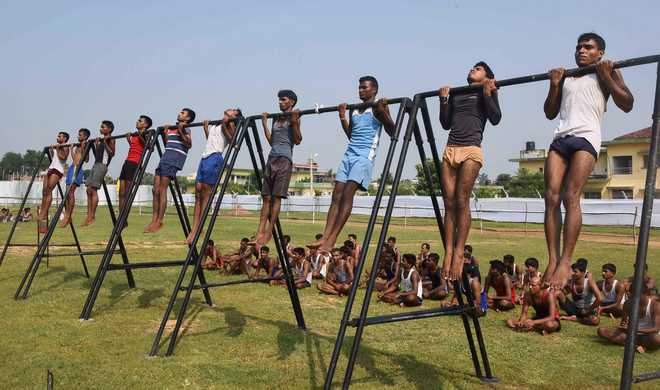
The Army is organising a major recruitment drive for youth in the Territorial Army in Doda, Kishtwar and Ramban districts.

The recruitment will be done for the 159 Infantry Battalion (Territorial Army), Dogra, which will commence on February 12 at the sports stadium, Doda, and will culminate on February 20.

The recruitment drive will be for the youth between the age group of 18 and 42 of Udhampur, Kishtwar, Ramban and Doda districts for the posts of soldier (general duty), clerk and tradesman. The minimum qualification for soldier is matric with 45 per cent marks whereas for clerk, it is Class XII in any stream with minimum 60 per cent marks in aggregate and 50 per cent marks in every subject with computer knowledge.

Last year, militant activity in Doda, Kishtwar and Ramban districts was witnessed and a few youth also joined the militant ranks which brought focus back on the region. There were also intelligence inputs that Pakistan is trying to push in militants through the International Border and is sending them to these districts with a plan to recruit more youth.

At this time, providing educated youth a job opportunity will prove detrimental to the plans of militant outfits and youth will get their desired jobs at their doorsteps.


Sorting wheat from chaff The Army Chief needs to guard his flanks

Sorting wheat from chaff

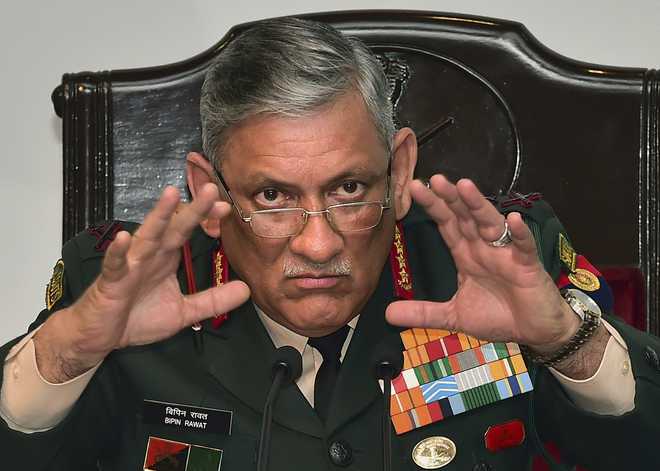
The Indian Army currently has its hands full with two restive borders, internal insurgencies and the need to trim its fat. It has done a good job of all the three. When the Army Chief dwells on these aspects, and even if some observations step on civilian toes such as the one about J&K’s school education system, he still operates within his envelope of expertise. His concern on the two-map system in J&K schools, for instance, hints that this perception of separateness opens the door for radicalisation. Social scientists can contest the perception, but for an Army combating recurring bouts of militancy, the Chief cannot be faulted for airing his conceptual worldview about the root of the trouble.

However, Gen Bipin Rawat left his crease by seeking to draw a distinction between the traders of violence in Kashmir and Afghanistan. Talks with the Taliban are at a fragile juncture and India is treading a very fine line; which the Army Chief sought to enlighten the audience about and ended up sending a tangential message. Dissimulation has never been a soldier’s forte; it is a task best left to the diplomat. India needs a course correction in its approach towards Afghanistan, which has witnessed some forward movement. It demands complex political manoeuvring and also picking and choosing of allies, which are beyond the pale of an institution that has less to do with international relations.

General Rawat was on familiar turf when he dealt with the restructuring of the Indian Army to make it a weapon-intensive, manpower-lean force. The Army also has the more painful task of integrating the command and control of all the three services for the armed forces to integrate with the times. By all accounts, the General is up for the task. His men have also performed uniformly well in manning the borders and tamping down on insurgencies. The Army needs to retain focus on its task in Kashmir and leave the categorisation of militancy in faraway lands to domain specialists.


India to lose out in new-era wars by Manoj Joshi

India to lose out in new-era wars

China’s Xi exhorting PLA to expedite reforms, Indian political leadership unenthused

IDEATION MISMATCH: The Chinese strategic goal is to be ready to fight and win ‘informationised’ wars, whereas India is still firming its postulates.

Manoj Joshi
Strategic affairs expert

WE  need to take a balanced view of Chinese President Xi Jinping’s ‘order’ to the People’s Liberation Army (PLA) to continue strengthening its combat capabilities and be always ready for battle. This is the kind of message that leaders all over the world are expected to give to their militaries, so it should not be taken to mean that the PLA is about to embark on a new wave of aggressive behaviour.

In his speech, Xi did emphasise that China faced unprecedented risks and challenges and so China’s armed forces needed deeper “preparation for war and combat” to ensure an effective and efficient response “in times of emergency”.

Though probably aimed elsewhere, there is a message there for the Indian military, which confronts China across a 4,000-km disputed border and is learning to cope with the PLA Navy movements across the Indian Ocean. Since the Doklam episode in 2017, the land border has been more active than ever; in the past year, there have been reports of the PLA upgrading its posture across its length. 

Xi’s remarks came two days after he raised the temperature on Taiwan by calling for ‘peaceful reunification’, while asserting that his government made “no promise to renounce the use of force” in relation to the issue. The ‘Taiwan contingency’ remains the premier focus of the PLA’s deployments, followed by the South China Sea. On both accounts, it must contend with the fact that its premier adversary is the US, by far the much stronger power in the western Pacific.

 Overall, the message seems to be that the PLA needs to double down on reform and restructuring that began in 2013. This is more so when Beijing is confronting an unprecedented political challenge from the US, which has now categorically designated China as a strategic challenger. Technology has emerged as a major area of this rivalry and the US is convinced that China has been systematically working to acquire western technology through acquisitions, forced transfers and thefts to gain strategic advantage.

The threat of an all-out war between, say, the US and China, or India and China is remote. But what is real is the jockeying for advantage in which both sides worry that emerging technologies could provide the other with some as yet unknown battle-winning edge. However, as of now, the PLA is still in the midst of its restructuring and reform process that has led to considerable disruption through its reduction of numbers, as well as reorganisation into theatre commands.

For obvious reasons, the PLA is emphasising the reform of military education and training to accompany the acquisition of new equipment. The PLA’s joint operations research and experimentation has revealed weakness in its military training institutes, joint proficiency of its officer cadre, joint training, doctrine and tactics and logistics, and command structures, all of which are being addressed in the current reform.

The key thrust of the reform process has been jointness. Over the years, the PLA has been moving from ‘coordinated joint operations’ to ‘integrated joint operations’. It took a major step under the 2013 reforms, with the creation of theatre commands and the establishment of joint headquarters to create optimal joint operational capability.

The foundation of integrated joint operations lies in developing an effective system of systems capability. This, in essence, is the fusing of various components-weapons, equipment, units beyond their individual capacity to provide synergy. At the heart of this lies the development of integrated command, control, communications, computer intelligence, surveillance and reconnaissance (C4ISR) structure which will not just link the systems and forces, but also enhance their joint operational capacity.

The PLA’s Strategic Support Force (PLASSF), set up on December 31, 2015,  has sought to integrate capabilities in space, cyberspace and the electro-magnetic spectrum into the PLA’s combat arms. Its goal is to meet the PLA’s military strategic guidelines of being ready to fight and win ‘informationised’ wars.

The SSF has been involved since 2016 in the PLA’s key annual Stride exercises. But, say observers, it is still some way from developing its fifth generation of operational regulations (the previous set was issued in 1999) that will guide its operations in space and the cyber domains.

The shift of the PLA from being a continental force to one capable of integrated joint operations within China’s borders and without could easily span a generation. Clearly, at present their capabilities remain far behind those of advanced countries like the US and Japan. In that sense, Xi’s injunctions and those of the PLA Daily are by way of being exhortations to do better. Under Xi, the deadlines have been advanced. In the 19th Party Congress, Xi announced that modernisation of the PLA would be complete by 2035. Earlier, the third stage of the plan was for it to be completed by 2049.  However as Xi himself noted, the PLA is not likely to become a world- class military till the mid-century. The US will remain the dominant global military power for the foreseeable future and can look after itself.

The big questions are for India, which has failed to push through any significant reform and reorganisation in its defence system. The political leadership seems to be uninterested in it. Meanwhile, its component force (Army, Navy, Air Force) leaders periodically boast about capabilities they don’t have and so, we are simply not ready for the new generation of warfare.

Distinguished Fellow, Observer Research Foundation, New Delhi



Pakistan army shells border posts, civilian areas in J&K’s Poonch

Pakistan army shells border posts, civilian areas in J&K's Poonch

Pakistani army also fired mortar bombs at forward posts. Tribune file

Jammu, January 5

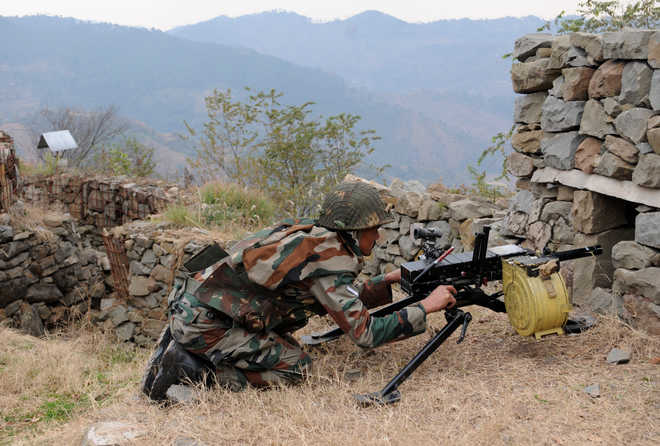
Pakistan army fired mortar shells at forward posts and civilians areas along the Line of Control (LoC) in Poonch district of Jammu and Kashmir on Saturday, in violation of the ceasefire for four consecutive days, officials said.

The number of ceasefire violations by Pakistani troops along the LoC and the International Border (IB) in Jammu and Kashmir in 2018 was the highest at over 1,600.

Pakistani army also fired mortar bombs at forward posts and civilian areas in Poonch sector on Friday, they said.

They targeted Mankote, Khadi Karmara, Gulpur areas without any causality or injury to anyone. The firing and shelling continued till late into the night, they said.

Indian troops guarding the border retaliated strongly, they said.

Pakistani troops shelled forward posts and civilian areas in Poonch on the previous three days as well.

Despite repeated calls for restraint and adherence to the ceasefire understanding of 2003, Pakistani forces had launched unprovoked attacks along the LoC and the IB, they said. PTI


Sonia, Rahul didn’t interfere in any defence deal, BJP is lying: Antony

Sonia, Rahul didn’t interfere in any defence deal, BJP is lying: Antony

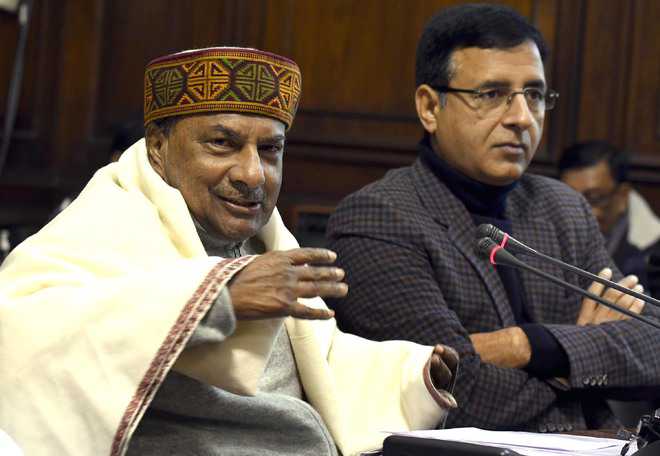
Former Defence Minister and Congress leader AK Antony and Randeep Singh Surjewala in New Delhi on Monday. MR Bhui

Tribune News Service

New Delhi, December 31

Former Defence Minister AK Antony on Monday accused the Narendra Modi government of going soft against Anglo-Italian helicopter maker AgustaWestland and asserted that then Congress president Sonia Gandhi and the present party chief, Rahul Gandhi, never interfered either in the defence deals or in the functioning of the Defence Ministry during his tenure (October 2006-May 2014).

The issue of the AgustaWestland has cropped up as Christen Michel, a UK national, is in custody in India and for allegedly acting as the middleman in the purchase of the 12 VVIP helicopters for Rs 3,600 crore. The purchase was scrapped by the Congress-led UPA regime following allegations of corruption in Italy, the headquarters of AgustaWestland’s mother company Finmeccanica (now named Leonardo). Antony accused the BJP of misusing ‘agencies’ and spreading lies. 

“If we had anything to hide (in the AgustaWestland deal) would we have cancelled the contract, would we have ordered a CBI probe, would we have moved international arbitration to encash the back guarantee?” he questioned. Listing out that the deal was scrapped by him after allegations in Italy, he said in February 2013 the process of black listing was started but the company could not be blacklisted till we encashed our bank guarantee.

Antony questioned the functioning of the Modi government which in July 2014 blacklisted Finmeccanica and in August that year removed the same company from the blacklisting. 

“Were you acting against the accused or were you helping them?” Randeep Surjewala questioned the BJP. Surjewala asked the BJP to clarify how Goa Chief Minister and former Defence Minister Manohar Parrikar had reportedly told his Cabinet colleagues about being in possession of a file on the Rafale jet deal.

Meanwhile, in the Lok Sabha the Congress said it was ready for a debate on the Rafale jet deal on January 2.

“Jaitley ji has thrown a challenge … we are ready for a debate on January 2. Please decide a time,” Congress Leader in Lok Sabha Mallikarjun Kharge said.


Call of duty

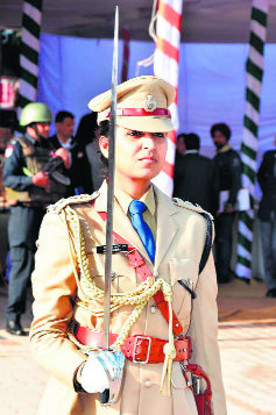
They are the women who don the khaki uniform. They are the custodians of Constitutional values. On Republic Day, here’s catching up with some women police officers from tricity

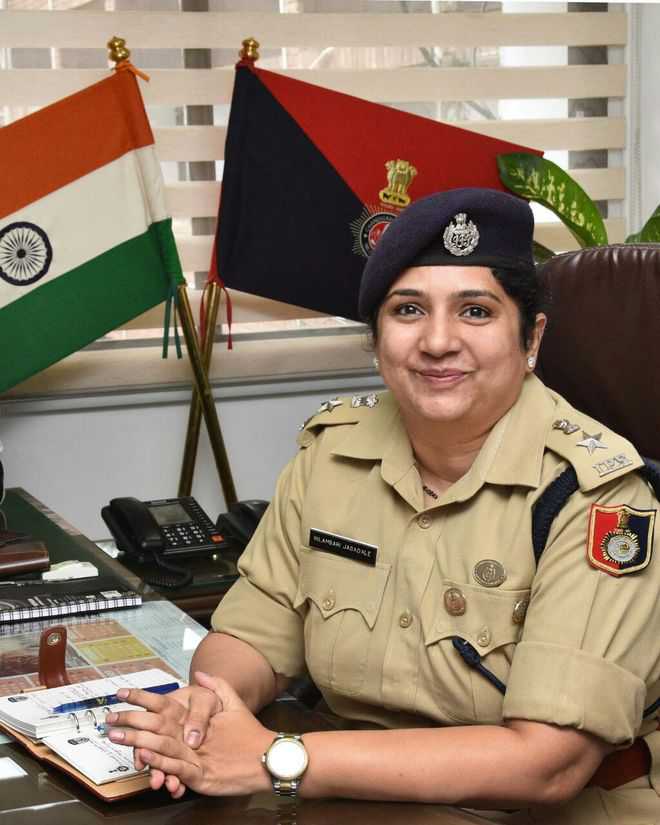
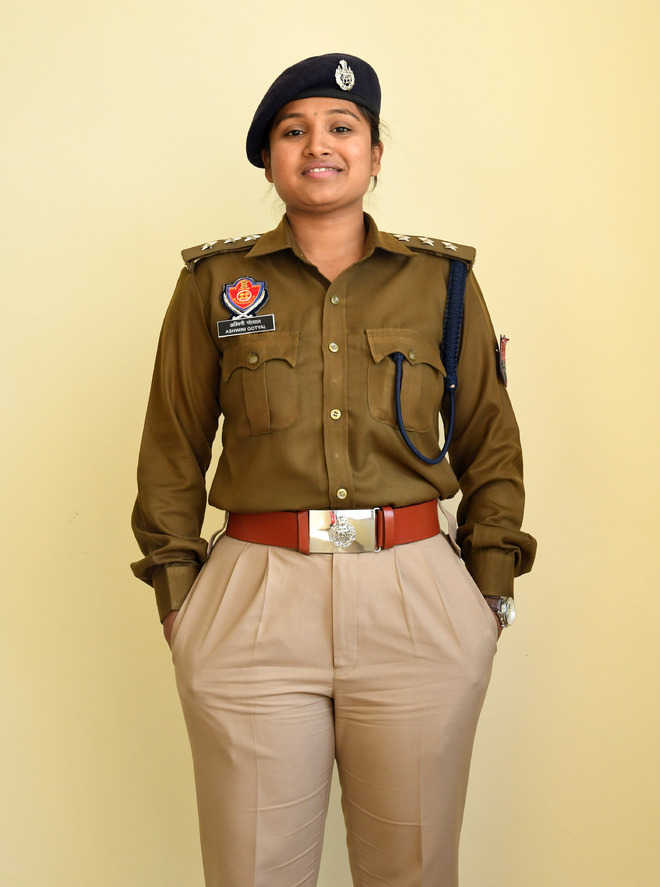
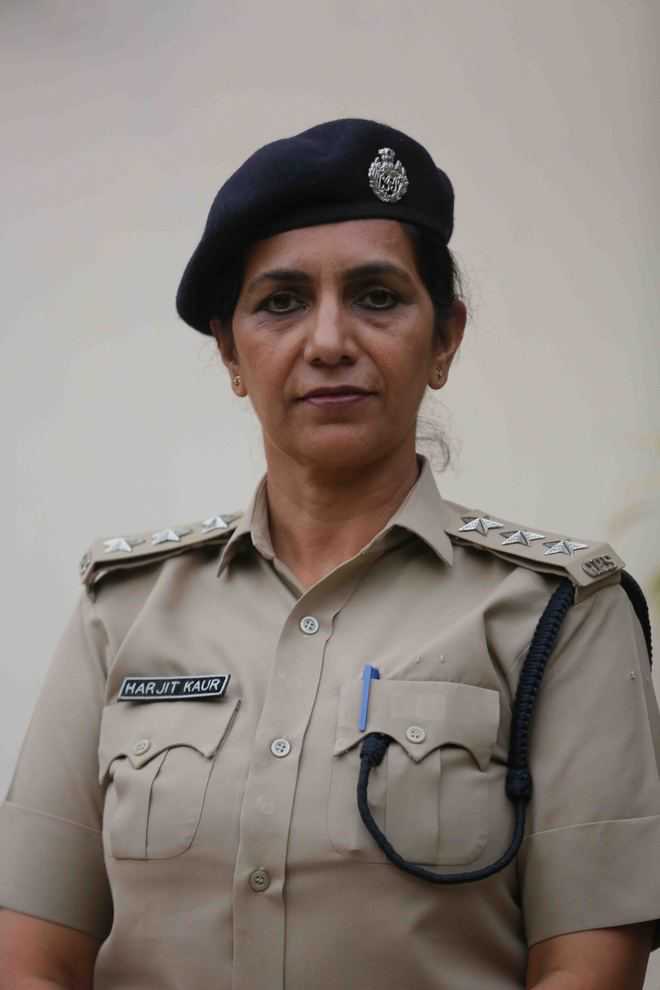
SSP Nilambari Jagadale,ASP Ashwini Gotyal,DSP Harjit Kaur,ASP Niharika Bhatt

Mona

As we, the people of India, celebrate our 70th Republic Day with a resolve to constitute our country into a sovereign, socialist, secular, democratic, republic, our forces carry on with their duties. We talk to tricity cops and know their thoughts on donning the vardi.

Big responsibility

Senior Superintendent of Police, UT, Chandigarh, Nilambari Jagadale, picked up this field due to the huge exposure it offers; an opportunity to deal with each strata of society — poor, middle class, upper class, elites. “Every strata has different problems and we get to solve them. Such exposure and opportunities are not possible except in government job. Challenges are that we need to have vision and foresee future problems. Then solve them,” says the cop, who enjoys being in uniform. It gives her a distinct identity. But at the same time, she finds it a constant reminder of serious responsibilities towards the law of the land and citizens. “The kind of opportunity police service offers, none other does.”

Dream job

“As the shine on the shoulders increases, the responsibility grows,” ASP Ashwini Gotyal puts it straight. Happy taking the typical South-Indian, middle-class family route, she had her engineering degree and IT job when her father inspired her for a bigger dream — to don the uniform. “This uniform literally takes your sweat and blood,” says the ASP with three shining stars on her shoulders. Vividly remembering her first day at National Police Academy, she avers, “They literally sculpt you to befit this uniform.” As she dons it day after day with pride, its courage and responsibility that becomes her armour. “Also you are just an officer in it; one gender neutral position,” she says.

High spirits

Donning a uniform was Niharika Bhatt’s childhood dream. ASP,  South Sub-division, Chandigarh, who would also be leading the parade this Republic Day, she recalls her rigorous training, “Goes without saying that the National Police Academy training is challenging, I value it because it made me mentally stronger to tackle any challenge on field.” A pride, an identity is what her vardi stands for her, “Seeing a lady officer in uniform, people approach with their problems and solving them is a responsibility, a duty I cherish.” While all government servants are serving according to our Constitution, Republic Day for her stands for a day that celebrates our country’s spirit.

Total faith

‘Mera vajood, meri pahchan meri uniform hai,” says DSP Harjit Kaur. In service from 1989, she has donned the khaki and fulfilled the responsibility that comes with this power all these years. A person in problem may repose more faith in a woman cop and she feels even more responsible to live up to that trust. Republic remains an important day for our country and the citizens; she says, “While rights we know, fundamental duties too should be known; only then can India become a country unparalleled in the world.”


Ropar cops bust Army job racket

Ropar cops bust Army job racket

With the arrest of five persons, the district police claim to have busted a statewide Army recruitment racket being run in Punjab for the past more than five years.

Those arrested have been identified as Amit Kumar and Manoj Kumar of Ferozepur Cantonment area, Manjit Singh and Sunil of Jind in Haryana and Yogesh Kumar of Ludhiana.

SSP Swapan Sharma said 29 Aadhaar cards, fake document sets of 48 individuals and Rs 8 lakh in cash were recovered. Sixtyeight attestation stamps, including of the designation of SHO, tehsildar and municipal councillor, were seized too.

“The gang had secured the recruitment of at least 26 persons in the Sikh, JAK and Artillery regiments on the basis of fake caste and domicile certificates. They would charge between Rs 3 lakh and Rs 5 lakh from every recruit,” the SSP said.

The police official said clerical staff at the Army recruitment centres in Patiala, Ferozepur and Ludhiana were allegedly hand in glove with the accused. Initial investigations revealed that Yogesh of Salem Tabri in Ludhiana was the kingpin of the gang, which had so far prepared fake documents for 150 persons, mostly from Haryana.

The police said Manjit and Sunil would allegedly make youths from Haryana appear in recruitment drives in Punjab, where the competition was “less”. Manoj and Amit would allegedly hunt for aspirants in Fazilka, Moga, Faridkot and Ferozepur.

The SSP said the names of several non-commissioned officers posted in Ludhiana, Gwalior, Ferozepur and Bhubaneswar too had figured in the scam. — TNS

Would charge Rs 5 lakh

The recruitment gang charged Rs 3 lakh to Rs 5 lakh from every successful job aspirant

Gang had secured ‘at least 26 recruitments in Sikh, JAK and Artillery regiments’

On basis of fake documents, Haryana youths were made to appear in job drives in Punjab where competition was less