Sanjha Morcha

Two militants killed in south Kashmir’s Kulgam

Two militants killed in south Kashmir's Kulgam

Srinagar, January 12

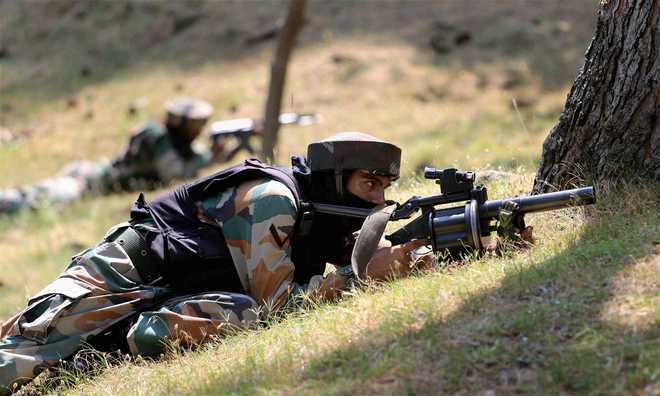
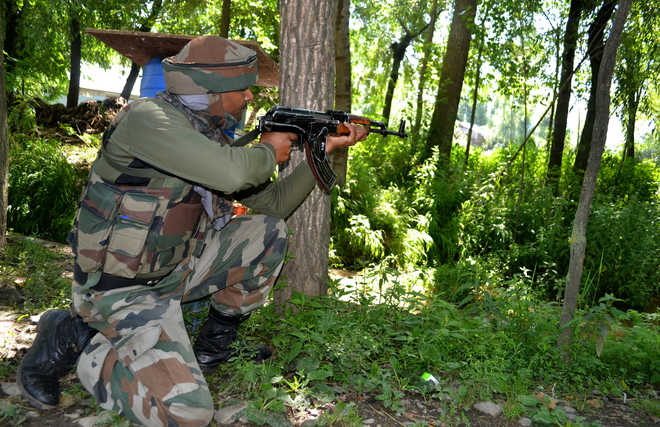
Two militants were killed in a gunfight with the security forces on Saturday in south Kashmir’s Kulgam district.

Police sources said the militants were killed in Katapora village of Yaripora area in Kulgam.

“The identity of the slain militants is being ascertained,” a source said.

Clashes between stone-pelting youth and security forces have started near the site of the gunfight, sources said.

Security forces are using tear smoke to quell the protesters.

Security forces started a cordon and search operation in Katapora village following information about the presence of militants there, sources said.

“As the cordon around the hiding militants was tightened, they fired at security forces, triggering an encounter,” police said.

Mobile internet services have been suspended in Kulgam and Shopian districts, sources added. – IANS


SC shocked at continued prosecutions under unconstitutional Section 66A

SC shocked at continued prosecutions under unconstitutional Section 66A

Tribune News Service
New Delhi, January 7

Taking strong exception to people still being prosecuted under Section 66A of the Information Technology Act three years after it was declared unconstitutional, the Supreme Court on Monday warned of strong action against errant officials.

“It’s shocking that people are still being prosecuted for a provision that was scrapped by this court in 2015. If that is the case then we will send all those concerned officials to jail,” a Bench headed by Justice Rohinton F Nariman said.

The Bench, which also included Justice Vineet Sharan, gave the Centre four weeks to respond to a Public Interest Litigation filed by People’s Union for Civil Liberties (PUCL).

PUCL’s counsel Sanjay Parikh said more than 22 prosecutions had taken place under the provision since the Supreme Court’s March 2015 verdict. The court has sought issuance of appropriate circulars and advisories to all states and union territories for immediate full compliance of the verdict.

Acting on a PIL filed by Shreya Singhal, the Supreme Court had on March 24 declared unconstitutional Section 66A of IT Act—a provision that gave sweeping powers to the police to arrest people for posting “annoying” or “offensive” comments online.

Justice Nariman was part of the Bench that read down the provision because it violated a citizen’s constitutional to free speech.

Section 66A of the IT Act made sending such messages a crime, punishable by up to three years jail.

“We hold the section unconstitutional on the grounds that it takes within its sweep protected speech that is innocent in nature. It is liable to have a chilling effect on free speech and, therefore, has to be struck down,” the top court had said then.

The provision hit headlines after two girls—Shaheen Dhada and Rinu Shrinivasan—were arrested in Palghar in Maharashtra’s Thane district for posting something online against the shutdown in Mumbai following Shiv Sena leader Bal Thackeray’s death.

“Despite the clear and unequivocal holding of this Court in Shreya Singhal case, Section 66A of the IT Act continues to be applied in the legal system. A recent working paper by the Internet Freedom Foundation demonstrates that pending prosecutions under Section 66A of the IT Act have not been terminated, and further that it continues to be invoked by police across India in FIR registered after the verdict,” the PUCL said in its petition.


Gunfight in erupts in Pulwama district

Gunfight in erupts in Pulwama district

he encounter is under way. Tribune file

Srinagar, January 3

A gunfight erupted on Thursday between the security forces and holed-up militants in Jammu and Kashmir’s Pulwama district, officials said.

The police said security forces started a cordon and search operation in Gulshan pora village of Tral area after receiving information about the presence of militants there.

“As the cordon around the hiding militants was tightened, they fired at the security forces, triggering an encounter which is under way,” a police officer said. IANS


State to showcase tableau on Jallianwala Bagh massacre

State to showcase tableau on Jallianwala Bagh massacre

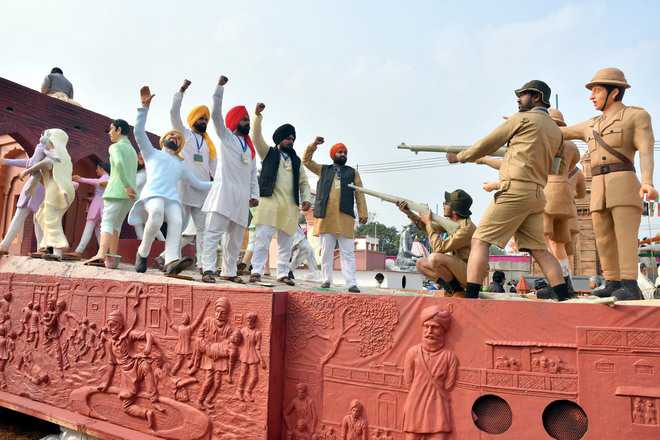
The trailer portion of the tableau will depict the scene when Gen Reginald Dyer had ordered firing on innocent people gathered at Jallianwala Bagh. File photo

GS Paul

Tribune News Service

Amritsar, January 25

Dedicated to the ensuing centenary of Jallianwala Bagh massacre, a special tableau will feature on the 70th Republic Day at Rajpath, New Delhi.

It is for the third time that a presentation from Punjab has found a place in the ceremony. An official said in 2017, it was ‘jaago tradition’, followed by ‘sangat te pangat’ in 2018. “Fortunately, this time among the 16 states and union territories participating in the highly patriotic parade at Rajpath, Punjab will be represented with the evocative presentation on the 100th year of Jallianwala Bagh massacre,” he said.

It is learnt that the trailer portion of the tableau will depict the scene when Gen Reginald Dyer had ordered firing on innocent people gathered at Jallianwala Bagh. Another portion will display a replica of the memorial built to commemorate the sacrifice of the martyrs.

A separate section has been built to showcase the ‘martyrs well’. The grille-mesh-covered well stands as a proof to the brutal killings on April 13, 1919, when hundreds of innocents had jumped into it in panic during the firing. As per records, 120 bodies were recovered from the well.

The Union government has also planned year-long celebrations to observe the massacre’s 100th year. Rajya Sabha MP Shwait Malik, who is also a trustee of the Jallianwala Bagh National Memorial Trust, said a special package had been spared by Prime Minister Narendra Modi to spruce up the historic place.

Malik said the development plan was on the tendering stage and the work would be started soon.

“It is probably for the first time that Jallianwala Bagh theme has been introduced in the parade. The Union government too has proposed to introduce coins and postal stamps to inculcate a feel of patriotism during the centenary celebrations. Another proposal is to introduce programmes like 7-D documentary depicting the massacre and its real-time feel through a light and sound show at the site.

Kanwar complains of breach of protocol

  • Chandigarh: Kharar MLA Kanwar Sandhu has complained of the breach of protocol regarding the members of the Punjab Legislative Assembly (MLAs) at the flag-hoisting ceremonies organised by the state government on the occasion of Republic Day on Saturday.
  • In a letter to Chief Minister Capt Amarinder Singh, Kanwar Sandhu stated that the elected members of the Punjab Legislative Assembly (MLAs) continue to be ignored and overlooked during the celebrations of Republic Day, Independence Day and other such official functions.
  • He said he had also made a reference to this during his earlier letter to the CM, dated December 10, 2018, on the role and responsibility of MLAs. TNS


Air Force organises 5-km mini-marathon

Air Force organises 5-km mini-marathon

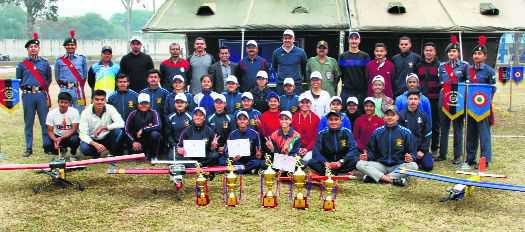
NCC cadets with their aero models and trophies during a mini-marathon at the No. 3 Base Repair Depot in Chandigarh on Sunday. Tribune photo

Tribune News Service

Chandigarh, January 20

As part of the Republic Day celebrations, a mini marathon was organised by the IAF at the No.3 Base Repair Depot (BRD) here today. A large number of Air Force personnel, including their families, NCC cadets as well as school and college students of different age groups participated in the event.

The marathon, covering a distance of 5 km, was flagged-off by Air Commodore Sanjiv Ghuratia, Air Officer Commanding, 3 BRD. 

Around 50 cadets, including girls of No.1 Chandigarh Air Squadron also participated in the marathon and bagged five trophies.

In the girls’ above 16 years category, the first three positions were bagged by Shivani Sharma and Sushma Soni, both of Post Graduate Government College (PGGC), Sector-11, and Himani Joshi of DAV College, Sector 10, respectively, while in boys’ above 16 years category, the first and third position were bagged by Sachin Kumar and Kush Malik, both of the PGGC.

A static display of Air Force equipment was also organised by the IAF to familiarise and motivate students, while NCC cadets organised an aero-modeling show and held demonstration of remote controlled flying models.


Nirmala Sitharaman Approves Proposal To Provide Legal Aid To War Widows

Official sources said the existing framework of the Kendriya Sainik Board and Zila Sainik Boards will assist the Defence Ministry in its effort.

Nirmala Sitharaman Approves Proposal To Provide Legal Aid To War Widows

NEW DELHI: 

Defence Minister Nirmala Sitharaman on Wednesday approved the proposal to provide legal advice and support to veterans and war widows in a meeting attended by the top hierarchy of Defence Ministry and the Chairman Armed Forces Tribunal.

Official sources said the existing framework of the Kendriya Sainik Board and Zila Sainik Boards will assist the Defence Ministry in its effort.

2 COMMENTS

They said the decision is expected to greatly help the veterans and war widows.


Army jawan detained after being honey trapped

Army jawan detained after being honey trapped

he FB profiles of some more jawans are under watch.

Ajay Banerjee
Tribune News Service
New Delhi, January 13

An Army jawan from Rohtak has been detained after he was allegedly honey trapped by a woman posing as ‘Anika Chopra’ on Facebook and claiming to be a ‘Captain’ in the Army Medical Corps.

The jawan is deployed with the Tank unit in Jaisalmer. 

The woman used to talk to him and send lewd messages and even pictures.

She was in touch with him since 2016.

A unit of the Military intelligence detained the jawan when he was allegedly caught sending pictures and location of exercise and other things, including Arjun Tanks, to the woman.

Army Chief General Bipin Rawat had on January 10 spoken about the misuse of social media and had made it clear that it would attract action.

Sources said that the Army has found fake profiles of leading Bollywood actresses used to woo jawans. The FB profiles of some more jawans are under watch.


Ex-IAF Chief Wrongly Charged By Agencies: Agusta Middleman Haschke

“As far as Tyagi is concerned, that thing is really dead. In the sense that there is absolutely no way it can be said that he took money, because he did not.”
Guido Haschke, Middleman of AgustaWestland Case

In an exclusive interview to The Quint, Guido Haschke speaks on the various issues related to the AgustaWestland case – he clears doubts on the controversial budget note mentioning ‘AP’ and ‘Fam’, his relationship with Christian Michel as a middleman of the VVIP chopper deal, and the former IAF chief, SP Tyagi, who was chargesheeted by the CBI and ED in the case under bribery charges in 2016.

Haschke says that the Italian court failed to produce any evidence of bribery against Tyagi during the AgustaWestland hearing.

“When I was last interrogated in the court that was in October 2017, I was there as a pure witness under oath and I was asked, again for the umpteenth time, ‘did you make any payment to Shashi Tyagi, did you do any corruptive act?’. And I confirmed again and again that I didn’t pay anybody.”
Guido Haschke

To buttress his point, Haschke pointed out that he could have been arrested by the Italian court had his statement been found to be false.

“As I was under oath, if for some reason there had been opposing evidence or statements by some of the witnesses, or whatever else, I would have been arrested in court for making a false statement. In fact, the court took my statement as true and made it the basis of the judgment.”
Guido Haschke, AgustaWestland Middleman

Also Read : Agusta case: Indian authorities fail to produce evidence against Michel in UAE court

‘Tyagi Did Not Take Money’

As far as Tyagi is concerned, that thing is really dead. In the sense that there is absolutely no way it can be said that he took money because he did not. And it’s a shame that they (agencies) blew it up to the point where each and every newspaper every now and then – because the guy did not do anything inappropriate at all.
Guido Haschke

Haschke said that he met Tyagi several times in Delhi to negotiate with him on the VVIP chopper deal, but insisted that the former IAF chief never said anything ‘inappropriate’ to him.

“Never even once had anybody hinted at any help that could come from him, zero. I was there in Delhi. I was there so many times when we were negotiating. I met the Air Chief a few times, and like I said, never, ever was anything said or done that was inappropriate in the slightest.”
Guido Haschke

Tyagi got bail from a Delhi lower court after being arrested and held for almost a month. Though the CBI and ED have filed a chargesheet against Tyagi, the agencies have so far failed to establish a money trail proving bribery.

(The Quint is now on WhatsApp. To receive handpicked stories on topics you care about, subscribe to our WhatsApp services. Just go to TheQuint.com/WhatsApp and hit the Subscribe button.)


Policy a must to reform defence entities Bhartendu Kumar Singh

Many defence PSUs have become victims of incompetent management, as evident from the falling standards of production, exports and project management. The business process is bureaucratised and politicised. There is a tendency to take the nomination route in securing procurement orders rather than competing in the open market.
Policy a must to reform defence entities

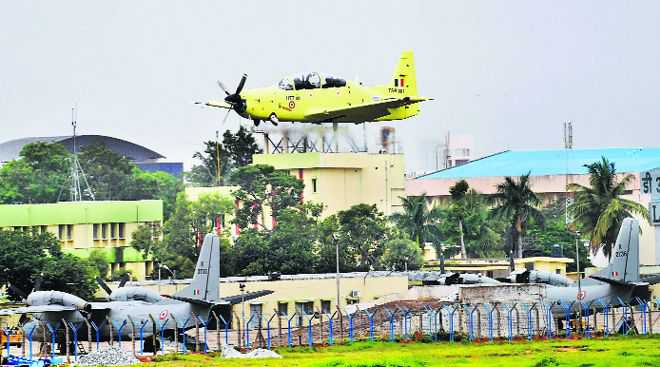
Drop: Hindustan Aeronautics Limited (HAL) registered a negative growth of 0.9 per cent in 2017 over the previous year.

Bhartendu Kumar Singh
Indian Defence Accounts Service

IN the recent SIPRI (Stockholm International Peace Research Institute) list of top-100 arms-producing companies, four Indian firms found a place. India’s annual arms production in 2017 grew by 6.1 per cent against the global figure of 2.2 per cent. However, Hindustan Aeronautics Limited (HAL) registered a negative growth of 0.9 per cent over the previous year’s figure. Also, the surge in India’s defence production is due to domestic demand. Media optimism about Indian defence companies going global is, therefore, misplaced. Indeed, a major public policy issue challenging India’s rise as a military power is the absence of arms production companies with global sales outreach.

HAL’s regressive performance is not a new phenomenon. In the past five years, its sales figures have almost stagnated. During this period, Lockheed Martin Corporation (US), the No. 1 arms company in the world, increased its sales figures by 25 per cent. HAL’s highly publicised claim of inbuilt capability of assembling state-of-the-art fighter jets (such as Rafale) notwithstanding, its own performance has been dissatisfactory with regard to Tejas and other aircraft and helicopters. Its export figures are laughable. A large section of its manpower is staring at potential joblessness due to reduced procurement and repair orders. It does not have sufficient cash in hand to pay January salaries to employees. The chain of ordnance factories, hitherto departmental undertakings, have done no better and continue to show a pathetic performance in SIPRI rankings.

Together, HAL and ordnance factories represent the larger problem: inability of Indian defence companies under government control to create global standards and outreach despite a basketful of policy supports, secured orders and favourable monopolistic treatment vis-a-vis private sector companies. All these days, they have been competing with themselves since the public policy preferences for public sector enterprises in the fifties and sixties gradually perpetuated monopolisation of production activities through the reserve list that still exists, albeit on a reduced scale. They often act as an extended bureaucracy having little interest in corporate governance. Further, many defence PSUs have become victims of incompetent management, as evident from the falling standards of production, exports and project management. The entire business process is bureaucratised and politicised. They can only boast of huge estates leased to them at throwaway prices, posh amenities for their top management and an inbuilt tendency towards the nomination route in securing procurement orders rather than competing in the open market.

Globally, few public sector entities have done well on a recurrent basis. Most have been glaring examples of what has often been called the ‘theory of public incompetence’. Additionally, in the Indian context, at least three sets of systemic obstacles prevent defence PSUs from performing better. First, there still is public policy preference for PSUs and departmental undertakings, though these ‘white elephants’ have been sitting on huge public resources and produce peanuts as deliverables. Perhaps the basketful of control mechanisms leaves very little functional autonomy for these entities. One example would suffice. In any ordnance factory set-up, the General Manager is supposed to deliver. However, he can’t even suspend a Group B employee without clearance from the Ordnance Factory Board (OFB) in Kolkata. He has several categories of small offices working alongside him, but not under his chain of command, such as audit, accounts, security and inspection. He does not have operational freedom to fix the prices of items; rather, this is done by the OFB that also dictates on supply chain and annual targets. He has to contend with inflated man-hours that eat into profits. Other than an ‘Ayudh medal’, he does not get any incentive for good performance.

Second, despite proven underperformance of defence PSUs and ordnance factories, a graduated, implementable and acceptable reform package is yet to be evolved. This is partly because these defence entities have managed to portray a collective image as ‘protector general’ of defence production activities in India, grabbing a major portion of domestic procurements among them. Together, they have encouraged the perpetuation of ‘licence raj’ and oligopoly, leaving very little space for the private sector to compete. Every now and then, newspapers are flooded with sponsored advertisements singing paeans to their production milestones. Such artificial constructs may lead to opinion in their favour, but deprive the nation of a competitive military industrial complex (MIC).

Third, despite an early start, our defence PSUs and ordnance factories have fossilised research and development (R&D) arrangements and have shown little interest in front-end military innovation over the years. A significant budget of R&D goes to inspection tours and logistics arrangements. There is little to show in terms of patents and designs despite a basketful of incentives. Little wonder they have not been able to move beyond ‘screw driver or assembly garage’ economy and have become laggards in revolution in military affairs (RMA). These entities also suffer from high levels of institutional isomorphism and refuse to learn from best global practices and advances in weapons production.

Reforming these defence entities and making them perform is a key policy challenge, more so since huge public financial investment is at stake. Learning from leading defence companies in the US, Russia, China and Israel is one way. Reducing government and bureaucratic control could be another step. Equal space for domestic private sector in defence production and procurement is also necessitated for competition and cost efficacy. Preference to domestic procurements vis-a-vis foreign ones is also desirable to shore up the performance of Indian firms. The armed forces, on their part, need to overcome their institutional preferences for foreign weapons and make long-term commitments to domestic MIC.

These steps could become a reality by redrafting the defence production policy that is still at the draft stage. The SIPRI report shows that small nations such as Turkey have done well in defence production through right policy choices and we can learn from them. Probably, there lies some hope for having world-class defence companies.

Views are personal



Indian, Chinese troops hold border meetings in Ladakh

Indian, Chinese troops hold border meetings in Ladakh

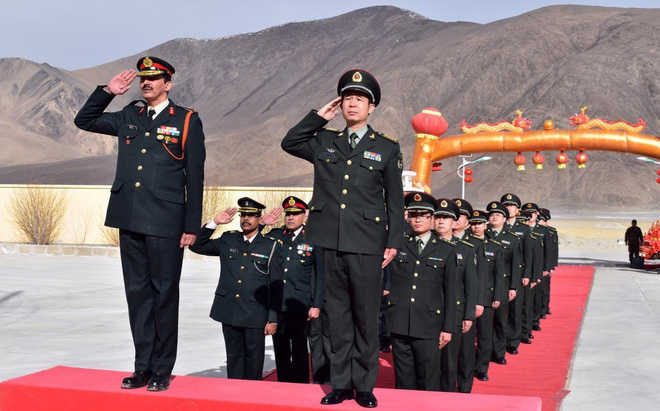
A ceremonial border meeting in Ladakh. Tribune Photo

Tribune News Service

Jammu, January 1

To celebrate New Year, Indian and Chinese armies held two ceremonial border personnel meetings (BPMs) at Chushul-Moldo and Daulat Beg Oldi-TWD meeting points in eastern Ladakh.

The meetings were organised on the invitation of the People’s Liberation Army, China.

The Indian delegation was led by Maj Gen Sanjiv Rai and Col SS Lamba and the Chinese delegation by Senior Col Liu Hou Jie and Col Song Zhang Li. Giving details, a Northern Command spokesman said the ceremonial meetings commenced with the delegation members saluting the national flags. “This was followed by the ceremonial address comprising of exchange of greetings, wishes and vote of thanks. The address reflected the mutual desire of maintaining and improving relations at functional level at the border,” he said.

Thereafter, a programme showcasing Chinese culture and traditions was organised, the spokesman added.

The ceremonial BPMs were held in the backdrop of successful conduct of exercise at Chengdu in China wherein troops of both the countries interacted, participated in joint exercises and shared experiences. The spokesman said both the delegations interacted in a free, congenial and cordial environment. “The delegations parted amid feeling of friendship and commitment towards enhancing the existing cordial relations and maintaining peace along the border. Both sides also sought to build on the mutual feeling to maintain peace and tranquillity along the border,” he said.