



Sanjha Morcha

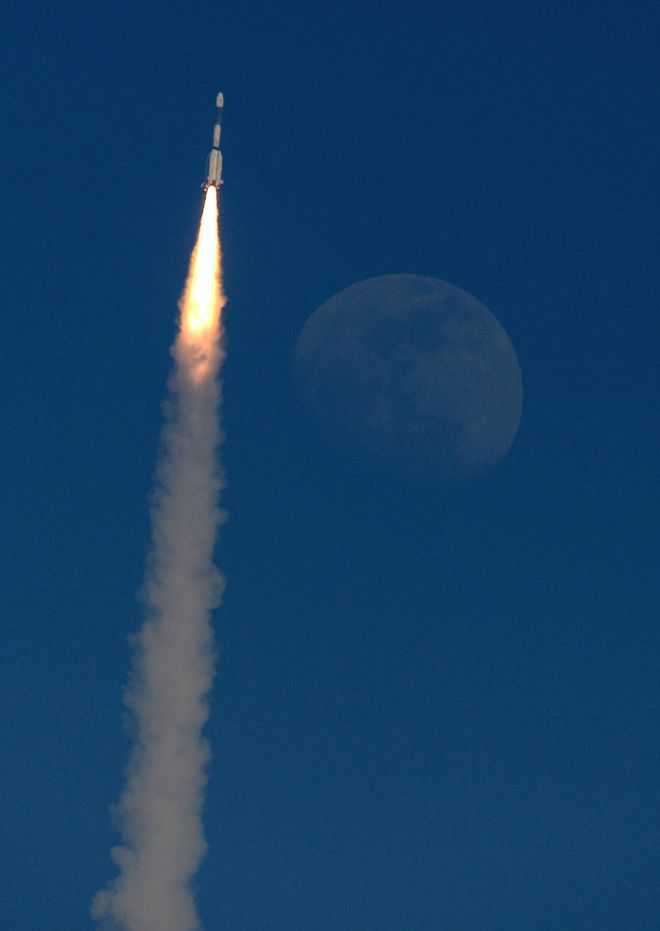
GSAT-7A to extend Army, Air Force’s reach Will help inter-link ground radar stations, provide real-time pictures of areas not within range

GSAT-7A to extend Army, Air Force’s reach

Tribune News Service

New Delhi, December 19

In a development that will provide greater reach to the Indian Air Force and the Army, the Indian Space Research Organisation (ISRO) today launched a military communication satellite, the second one since Rukmini — GSAT-7 — was launched in September 2013.

Besides these two, there are a dozen other satellites that are doing surveillance and sending only pictures and videos.

GSAT-7A will be for the use of Indian Air Force (IAF) and partially for the Army. A communication satellite enables live feed and can connect aircraft flying hundreds of miles away.

The Rukmini is for the use of the Navy and it scans the Arabian sea, the Bay of Bengal and also the strategic choke points like the Straits of Malacca. The GSAT-7A will enable the IAF to interlink different ground radar stations, ground airbase and airborne early warning and control (AWACS) aircraft.

The satellite will also help satellite-control the military unmanned aerial vehicles (UAVs) of the IAF even as the Army (that still awaits its own satellite called the GSAT-7B) will be using 30 per cent of GSAT-7A.

Operating a UAV is a challenge beyond a certain range. It is possible to control and also relay visuals using a satellite. It will provide communication capability to users in Ku-band over the Indian region, the space agency said.After the successful launch of the satellite meant for the IAF, Air Chief Marshal BS Dhanoa said the launch would enhance the networking and communication capabilities of the Air Force.

The GSAT 7-A will extend the range of operations of the IAF aircraft by providing real-time pictures of areas not within range.

Launch to open new avenues

  • We have several platforms (military word for aircraft) which have capabilities of communication through satellite. The communication through the satellite will be made possible with this launch. —BS Dhanoa, Air Chief Marshal

Touching new heights

  • GSAT-7A is a military satellite that will enhance Indian Air Force’s networking ability
  • 2,250 kg satellite’s weight, the heaviest lifted by the launch vehicle
  • GSLV-F11 is geosynchronous launch vehicle that put the satellite into the intended orbit
  • 8 yearslife span of the 35th communication satellite that has been built by ISRO
  • 19 minutesafter the lift-off, the GSLV-F11 injected GSAT-7A into the orbit

Its significance

  • Will enable IAF to link its ground radar stations, its airbases and ‘airborne early warning and control system’ planes. The satellite may also control IAF’s unmanned aerial vehicles and drones. It is second satellite since Rukmini (GSAT-7) was launched in Sept 2013

3 witnesses whose perseverance led to the conviction

NEW DELHI: “When the chowki in-charge asked the mob, ‘kitne murge bhun diye’ (how many chickens had been roasted)… I felt I had lost faith in humanity,” Jagdish Kaur, whose husband, son and three cousins were killed in Palam Colony’s Raj Nagar in 1984, told a Delhi court on July 2, 2010. Jagdish — witness number 1 in the Palam Colony case — also said that around 9 pm on November 2, 1984, when she went to the police post to lodge a report, she heard Sajjan Kumar delivering a provocative speech, telling the public to “murder Sikhs and kill Hindus who shelter them”.

Eight years later, her account served as clinching evidence in the conviction of Kumar and five other accused by the Delhi High Court on Monday.

The high court said the accused were brought to justice primarily because of “the courage and perseverance of three key eyewitnesses” — Jagdish Kaur, her cousin Jagsher Singh and Nirpreet Kaur.

All three in their statements said they had seen Sajjan Kumar inciting the mobs to attack Sikhs.

According to Kaur’s statement, around 2 pm on November 1, 1984, a mob entered her house with weapons, pounced on her son Gurpreet Singh and dragged her husband Kehar Singh, who died of head injuries. An injured Gurpreet ran some distance before he was set on fire.

Jagdish performed their last rites three days after their deaths, after making a pyre of the furniture and items left in the house.

Jagdish said the police post incharge threatened her when she was filing a report. She claimed the cop tried to intimidate her by saying the people she was naming were too powerful and she wouldn’t be able to protect the rest of her family.

Nirpreet Kaur told the court she had seen a gurdwara being burnt down and her father Nirmal Singh being burnt alive by the mob. Nirpreet said her father was taken out of their Raj Nagar home by two accused — Balwan Khokhar, who used to introduce himself as Sajjan Kumar’s nephew, and Mahender Yadav.

Nirmal Singh, who ran a taxi stand in Anand Niketan, was president of the gurdwara.

Nirpreet said around 5.30am on November 1, 1984, a mob attacked the gurdwara and caught her father when two men took him out for a compromise.

She said one Ishwar Sharabi sprinkled kerosene on her father and a policeman gave the mob a matchbox. “…From his name plate, I could gather his name was Inspector Kaushik. He gave a matchbox to Kishan Khokhar, who set my father on fire. My father jumped into a nearby nala (drain) to save himself. They pulled him out and set him on fire again,” she said in her statement.

The third witness, Jagsher Singh, said he survived as he was not a keshdhari (a turbaned Sikh) unlike his three brothers – Narender Pal Singh, Raghuvinder Singh and Kuldeep Singh – who were killed. “Between 10pm and 11pm on November 1, 1984, a vehicle stopped at our gali at Shiv Mandir Marg… 30-40 people collected there. Sajjan Kumar, MP, came out (of the car) and asked if they have done the work assigned … one of them told him they were helpless as the thekedars ) were being saved by Hindus… Sajjan Kumar told them to kill those Hindus and burn their houses,” he said in the statement.


Son of Mujahideen commander to carry on father’s legacy

DEHRADUN: Among the 80 foreign gentleman cadets (FGC), who passed out on Saturday from IMA, there was a 24-year-old Afghan soldier, who is eager to carry forward his father’s legacy.

HT PHOTO■ Raheb Rashid with his father at IMA in Dehradun.Father of Mohammed Raheb Rashid, who was among 49 Afghan gentleman cadets, fought as a Mujahideen commander against Soviet forces during Soviet Union’s invasion of Afghanistan in 1979.

Raheb said: “I was always determined to join the army after listening the heroic tales of his father and former Mujahideen commander, Mohammed Zarif Rashid, on how he fought the invading Soviet forces with his AK47 and a Rocket Propelled Grenade (RPG) on his soldier.”

“It was always my father’s dream to see me joining the army and I have grown up while listening to the tales of his valour and courage while fighting the Soviets in our country. I am happy that I have been able to live his dream and don the uniform,” said Raheb who was earlier in National Defence Academy, Pune before joining IMA.

Remembering the tales that his father used to narrate while he was a kid, he said, “I was always fascinated with the war tales which he used to narrate to me during childhood. I can remember, how he used to get passionate about our Afghanistan while narrating the tales of fighting against Soviet Union forces.

He wanted me to join the army, because he knows the importance of a country’s sovereignty.” Speaking to HT, he also claimed that one of the major reasons behind him joining the army, “is the fact that serving country is taken as matter of pride in our religion and country”.

“My father lived that pride while fighting against the enemy for the country. Also, many of his cousins and men were martyred in the war against Soviets.

He always wanted that there should be someone in his family to take the pride forward after him for which he wanted me to join the army and I proudly did. I am fully determined to fight them.

They are not Muslims as they are killing innocents in the name of Islam. I will fight them till the last drop of blood in my body,” he said.

To witness him becoming an army officer, his father Zarif, 63, had come all the way from Kabul to Dehradun along with his (Raheb) two cousin brothers. Zarif said: “I always wanted to see his son become an army officer and serve Afghanistan.”


MILITARY LITERATURE FESTIVAL From WW-II to Indo-Pak wars, three chiefs have diverse literary choices

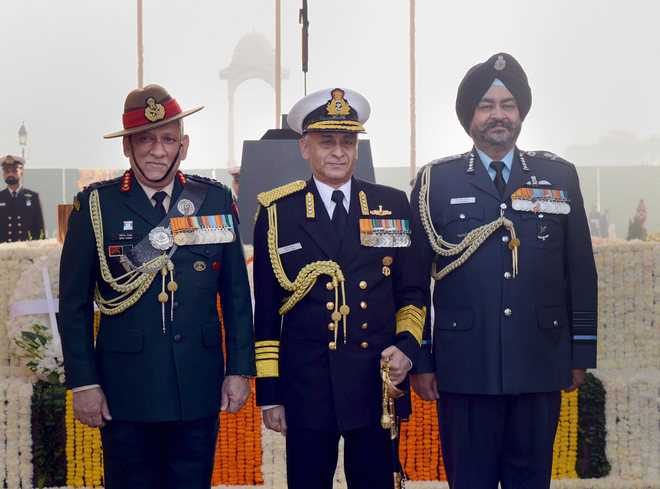
(L-R) Army Chief Gen Bipin Rawat, Navy Chief Admiral Sunil Lanba and Air Force Chief Air Chief Marshal BS Dhanoa. File photo

Ajay Banerjee
Tribune News Service
Chandigarh, December 6

As the three-day Military Literature Festival kicks off in Chandigarh on Friday, a look at the literary interests of the three service chiefs shows they have diverse preferences, almost like the forces they command.

Army Chief Gen Bipin Rawat’s favourite book is ‘The Battle of Dien Bien Phu’, which is based on the French-Vietnam war and was authored by Jules Roy (first published in 1963).

Navy Chief Admiral Sunil Lanba, currently the senior-most military commander, marks ‘The Cruel Sea’ as his favourite book. It is based on a British naval fleet in the North Atlantic during the World War-II (1939-45) and was authored by Nicholas Monsarrat (first printed in 1951).

IAF Chief Air Chief Marshal BS Dhanoa’s preference is more recent, the 2016 released ‘India’s Wars: A Military History, 1947-71’, authored by Air Vice Marshal Arjun Subramaniam (retd). The author was a fighter jet pilot, so is the IAF Chief. The book is detailed and has insider viewpoint and provides some lessons for military planners. A Ph.D in Defence and Strategic Studies from the University of Madras, the Air Vice Marshal is said to be researching for a sequel to his book and will cover the 1972-2015 period.

Monsarrat served in the Royal British Navy during WW-II and rose to the rank of Lt Commander. He served on warships in the North Atlantic. His book is a portrayal of ordinary men learning to fight and survive in a battle with German U-boats (submarines). The book went on to be made into a movie by the same name in 1953.

‘The Battle of Dien Bien Phu’ is considered a decisive battle. The Vietnamese rebels led by Ho Chi Minh fought against the French and attacked their garrison, something considered as turning point in the first Indo-China War (1946–54). The term Indo-China was used for former French colonies Vietnam, Cambodia and Laos.

After WW-II, French forces tried to re-occupy the area and camped at Dien Bien Phu valley in late 1953. Vietnamese commander Vo Nguyen Giap amassed troops and placed heavy artillery in caves of the mountains overlooking the French camp. Boosted by some Chinese help, Giap mounted assaults, eliminating use of the French airfield. The Vietnamese forces overran the base, which led to the signing of the Geneva Accords of 1954.


Why Does India Need So Many Warships, Submarines and Aircraft Carriers ?

According to a recent report, the Union government has approved the induction of 56 new warships and six submarines for the Indian Navy. This has apparently been done to augment the Indian Navy’s overall prowess while the country’s first indigenous aircraft carrier Vikrant has entered its final phase of construction.

Addressing a press conference on the eve of Navy Day, Navy chief Admiral Sunil Lamba said on Monday that “a great deal of progress” had been made on ensuring synergy and “jointness” among the three services. He also listed the various steps being taken to modernize his force including the induction of a large fleet of military jet planes and helicopters, adding that the construction of a second aircraft carrier is expected to start within three years.

Admiral Lamba’s statements on the expansion of the Indian Navy could well lead people to wonder whether the Indian Navy was expecting an attack from some enemy country. All world leaders had realized the futility of war in an age when so many countries had acquired nuclear weapons. There was every reason to believe that the entire world had learnt its lessons from Nagasaki and Hiroshima.

So why does a country like India need 56 additional warships or an additional aircraft carrier? Fifty-six new warships and six more submarines are going to cost the kind of money that could fund a few hundred health centres and schools.


Pakistan opens immigration centre at Kartarpur border

Pakistan opens immigration centre at Kartarpur border

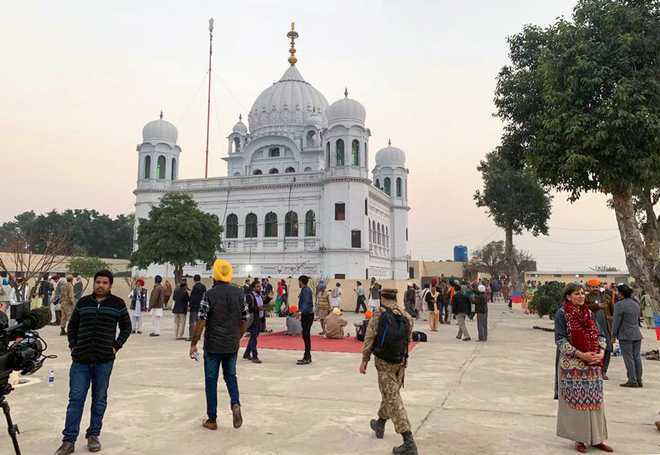
A view of the shrine of Sikh leader Guru Nanak Dev in Kartarpur, Pakistan. PTI file

Lahore, December 3

Pakistan has established an immigration centre at the Kartarpur border following the groundbreaking of the landmark corridor for Sikh pilgrims.

The corridor will connect Sikh faith’s founder Guru Nanak Dev’s final resting place in Pakistan’s Kartarpur to the Dera Baba Nanak shrine in Punjab’s Gurdaspur district in India, fulfilling a long-pending demand of the Sikh community.

Since the border crossing could be an easy target for “terrorists, human traffickers and drug dealers”, a strong mechanism was required to keep the situation under control on both sides of the border, Federal Investigation Agency (FIA) Deputy Director (Punjab) Mufakhar Adeel said.

“The FIA has set up an immigration office at Kartarpur border in Narowal (some 120 kms from Lahore) in connection with the opening of Kartarpur corridor,” Adeel told Dawn news.

“The FIA officers will play the role of boarding officers and check the documents of Sikh pilgrims and identify them through biometric technology. Sikh pilgrims having visas will be allowed to enter the city while those with permits will be given access to Gurudwara Darbar Sahib only,” he said.

On November 28, Prime Minister Imran Khan laid the foundation stone of the Kartarpur corridor.

On November 26, Vice President M Venkaiah Naidu and Punjab Chief Minister Amarinder Singh laid the foundation stone for the Kartarpur Sahib corridor in Gurdaspur.

Khan said that his government and the army wanted a “civilised relationship” with India, declaring that Islamabad would move two steps forward if New Delhi took one step.

Khan cited examples of France and Germany which fought many wars but eventually came closer for the welfare of their people.

Pakistan assured that it will keep improving the Kartarpur corridor and provide maximum facilities to the pilgrims when they visit in November, 2019 to celebrate Guru Nanak’s 550th birth anniversary.

The much-awaited corridor will connect Darbar Sahib in Pakistan’s Kartarpur  with Dera Baba Nanak shrine in India’s Gurdaspur district and facilitate visa-free movement of Indian Sikh pilgrims, who will have to just obtain a permit to visit Kartarpur Sahib, which was established in 1522 by Guru Nanak Dev.

The corridor is expected to be completed within six months. — PTI


o counter Chinese clout, India to gift 6 HAL Kiran jet trainers to Myanmar

In what is being seen as an effort to counter China’s growing influence in Myanmar, India has decided to ship 6 Kiran Jet trainers to Myanmar. Top government sources confirm the decision has already been taken.

India and Myanmar have close military ties and there have been times when the Myanmar Army has helped India with insurgents deep inside their territory. According to media reports, an IAF team will also be stationed in Myanmar for 2 years to service the planes and to help the Myanmar pilots with training.

Earlier, India had gifted used Mi25 helicopters to Afghanistan.

India, however, finds it impossible to counter China’s soft power approach in Southeast Asia. So far Beijing has provided development grants to Naypyidaw for education, economy, technology, and communication infrastructure.

China is currently in talks with Myanmar to develop a strategic deep-sea port in Kyaukphyu, western Rakhine state.

Kiran is a two-seat intermediate jet trainer developed by Hindustan Aeronautics Limited and has been used by the Indian Air Force for intermediate level training of pilots.

Myanmar features prominently in PM Narendra Modi’s Act East Policy and New Delhi is keen on accelerating the ongoing infrastructural projects in Myanmar to boost bilateral ties between both the countries. India is also planning to cooperate in areas such as security, economy and culture.

India has already started the construction of the 109-km road project as part of the USD 484-million Kaladan Multimodal project and it is expected to be operational only by 2019-2020.


Colleague shoots dead soldier at army camp in Doda district

Jammu, December 26

A soldier was shot dead following a verbal spat by his colleague in Jammu and Kashmir’s Doda district, police said.

“Havildar Rajesh was fired upon by his colleague inside an army camp in Bhaderwah area late on Tuesday. The injured was shifted to a hospital, where he succumbed to his injuries,” a police officer said.

The incident reportedly followed a verbal spat between the two.

“Police have sought custody of the accused soldier. The army has also ordered an internal inquiry,” the officer added. IANS


ITBP rescues 11, including 5 Delhi trekkers, in Uttarakhand

ITBP rescues 11, including 5 Delhi trekkers, in Uttarakhand

Tribune Web Desk
Chandigarh, December 26

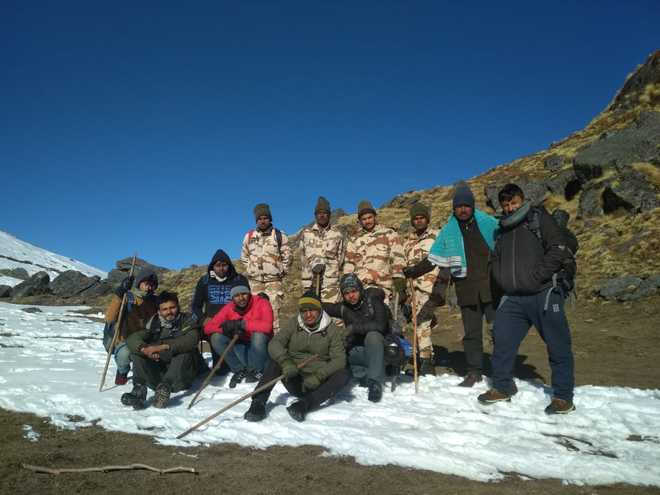
The Indo-Tibetan Border Police personnel on Wednesday rescued 11 people, including five trekkers from Delhi, a guide and five porters, from Munsiari, Uttarakhand.

They were stranded in Munsiari since December 24 when they lost contact due to snowfall in Khaliya Top in Bhainstal area.

They were rescued by the 14 Battalion of ITBP personnel. All the rescued persons are in good health.


How can entire para be typo’: Mallikarjun Kharge seeks JPC in Rafale deal

Last Saturday, the defence ministry had filed an application before the Supreme Court for the correction of a paragraph in its order on the Rafale jet fighter deal.

Mallikarjun Kharge,Rafale deal

Less than a week after the government had asked the Supreme Court for a correction in its order on the Rafale jet fighter deal, the Congress has continued to keep up the pressure on the government.

“We want a JPC as we’ll only get to know everything when Parliament members sit and look into the files. A JPC was formed in Bofors and 2G cases also. How can there be a typo? Had it been one word it would’ve been understandable, entire paragraph can’t be a typo,” Congress Lok Sabha floor leader Mallikarjun Kharge told ANI on Wednesday.

Last Saturday, the defence ministry had filed an application before the Supreme Court for the correction of a paragraph in its order on the Rafale jet fighter deal.

Though the court’s ruling effectively vindicated the government’s stand that due process had been followed in reaching the Rs 59,000 crore deal, and had said that there was no reason to order a probe by the CBI.

However, the Congress pointed out that the judgment had referred to the government’s stand that the pricing details had been shared with the Comptroller and Auditor General (CAG) of India, and that the government auditor had submitted a redacted report to parliament. It also indicated that parliament’s Public Accounts Committee (PAC) had examined the report.

That error had been picked up by the petitioners and the opposition which had claimed that the government had misled the court with its original submission.

“How does the Supreme Court judgment have this line that Rafale pricing has been examined by the PAC. Now, we have to ask the government, where is this CAG report?” Congress president Rahul Gandhi had said at that time.

The original paragraph in the order (paragraph 25) said: “The pricing details have, however, been shared with the Comptroller and Auditor General (hereinafter referred to as CAG), and the report of the CAG has been examined by the Public Accounts Committee… Only a redacted portion …was placed before the Parliament and is in public domain.”

In its submission asking for a correction, the defence ministry had said that the court seems to have misunderstood it, which was, it added, “in the form of bullet points”. According to the ministry, the “second bullet point” read: “The Government has already shared the pricing details with the CAG. The report of the CAG is examined by the PAC. Only a redacted version of the report is placed before the Parliament and in public domain”.

The petition had argued that the use of the word “is” was “a description of the procedure usually followed” and asked the court to replace “has been” in paragraph 25, which seems to suggest that the act has already taken place, with “is”.

Ideally, of course, the government’s original submission should have used “will be” instead of “is” to make things clear.

“They have given wrong information to the court and on the basis of that information, the court has given its verdict. Now, I will request all the PAC panel members to fix a meeting to summon the attorney general and the Comptroller and Auditor General. We want to ask them when did they submit the Rafale report to the House and when did it come to the PAC, when did they come to give evidence, and when did we present the PAC report to Parliament?” Kharge had said on Saturday.

Responding to Congress’ allegations of misleading the court and over which the party has been stalling the functioning of Parliament, Union law minister Ravi Shankar Prasad had said at that time that the error was a technicality.

“He is going into technicality, I am going on substance. The court verdict is in 34 para(graph)s. It has dealt with all the issues (raised by Rahul). If he (Rahul) wants to find faults to do politics, I have nothing to say,” Prasad had said.

Arun Jaitley had earlier too responded to the Congress’ demands for a JPC saying that the Supreme Court judgement was clear and that the demand for a JPC probe was intended to prevent a discussion in Parliament.

“The creators of falsehood will still persist with falsehood even at the cost of their own credibility. Only their captive constituencies will clap,” he had written in a blog post on his site.

First Published: Dec 19, 2018 14:32 IST