Sanjha Morcha

CM honours kin of 152 Punjab soldiers who fought in WW­I

Says as many as 74,000 Indian soldiers died in the four­year war

LUDHIANA :Punjab chief minister Amarinder Singh on Wednesday honoured the family members of 152 soldiers from Punjab, who fought in World War-I, in a ceremony to commemorate 100 years of the war at Amaltas village near Ludhiana city.

HT PHOTO■ Punjab chief minister Captain Amarinder Singh fetes the descendant of a World War­I soldier at a commemoration ceremony in Ludhiana on Wednesday.

Of the 152 martyrs’ kin, most of whom attended the event at the Maharaja Ranjit Singh War Museum, 15 were called on stage and handed over shawls and mementos by the CM.

Manjit Kaur Bains (66), a Mohali resident and granddaughter of Harnam Singh, a ‘dafadar’ (non-commissioned officer) in the 12th Cavalry Brigade of the British Army, said she was invited to attend the event after she shared the veteran’s picture on the Facebook page titled ‘Sikh military history’ a few months ago.

Born in 1900, Harnam was posted in Mesopotamia (now Iraq) from 1914 to 1929. He passed away in 1983 at his native village Bihala in Hoshiarpur district.

“Few days ago, I received a call from the district sainik board, Mohali. My name was shortlisted among the descendants of 152 WW-I soldiers. It was an encouraging gesture on part of the government,” said Manjit Kaur, whose husband is a retired colonel.

Rajinder Singh (70), a retired roadways employee from Rampur village near Doraha, said his grandfather Labh Singh had died fighting the enemy in the war.

The British government recognised his death and even issued a medal and a letter from the Queen. “My father was merely two- year-old when my grandfather left for war. The family was given an annual pension of ₹5 by the British,” said Rajinder.

“Recently I had learnt that some people at Baddowal onganised a programme to honour the WW-I martyrs. They were surprised to see the gallantry medals and asked me to visit the district sainik welfare board, Ludhiana. I am happy that my grandfather’s sacrifice was acknowledged,” said Rajinder.

Darshan Singh (68), a farmer from Sangrur and grandson of WW-I martyr Krishan Singh, said, “I could never imagine that I would be honoured for my grandfather’s sacrifice and get a chance to have lunch with the CM.” He was presented a shawl and a memento.

‘HISTORY DISTORTED’ “The present generation is not aware that their ancestors participated in a World War. The history has been distorted as the students are not taught about their forefathers. Around 74,000 Indian soldiers died in the fouryear-long war. The names of only 60,000 could be traced with no record of the rest.”


Light shades of sombre by Lt-Gen Baljit Singh (retd)

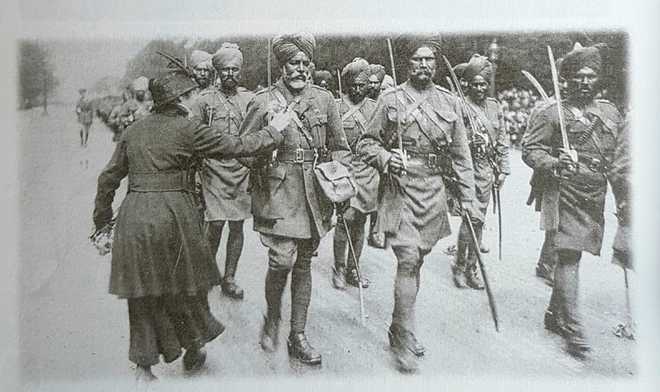
As the year-long commemorations of the centenary of the World War I come to an end today, a look at the less serious side of the lives of Sikh sepoys from Punjab who went to fight in an alien land, with their verve for life undiminished

There are never any “good” wars. According to recorded history of World War I, India alone lost 78,187 men and another 67,000 were wounded. Yet, this dreadful carnage was wiped clean from mankind’s memory a mere 21 years later, as it started yet another world war which only ended with nuclear annihilation of Hiroshima and Nagasaki.

When the news of the Great War reached India in August, 1914, the bulk of the Army were in and around the North West Frontier. In words of a subaltern of the 15th Ludhiana Sikhs, “It seemed to most that we should be stuck where we were for the whole war….missing out on active service in Europe”. But forty-eight hours later they had orders to mobilise and get down to Karachi, within 15 days. In almost all cases this seemed “an impossible task…..our outpost were stretched over sixty miles and we had to march another eighty miles to railhead…. I was sent out with a bag of rupees to hire every donkey and camel I could find…… the loyalty and fighting spirit of the battalion was more than ever manifested by the way every sick man formed up and tried to persuade me, he was fit to go.”

The subaltern (John Smyth), later brigadier, has left an endearing account of Sepoy Harnam Singh in his book, The Only Enemy (by Brigadier Sir John, VC Smyth), first published in 1959. Harnam Singh was bedridden with malaria, but “three days later, towards the end of a particularly trying march, I looked around at the men and thought I saw Harnam Singh black with sweat…but swinging along jauntily……when we got into camp later I asked the Indian officer if I had seen aright….. ‘how has he possibly marched all this way’?” Smyth was amused to learn ‘Oh, opium — he’s non-opium eater and the effect of opium on him is therefore very great…we give him a little before the march and put him to bed as soon as it is over and then do the same next day…. Harnam Singh managed to get to Karachi……and went through a year of trench warfare in France’!” The 15th Ludhiana Sikhs were among the first Indian troops to disembark at Marseilles. That being their first venture outside India, they were bewildered as they marched for several days through an environment totally alien even to their imagination.

There was little by the way of logistical support. And “The Sikh is a cleanly creature and gets under a pump at every opportunity no matter how cold the weather or the water. After the dusty march they took down their hair and beards and set about having a good wash. This absolutely brought the house down and there were delighted shrieks of “Voila les femmes Indiennes!” After a while this curiosity, good natured no doubt, became rather embarrassing and the battalion were glad to arrive at the live battle zone”.The battalion had mobilised cotton uniforms and one blanket per head. “However, the men soon got an issue of one warm vest and one long-john…. They didn’t quite understand the underclothes at first and, on the day were issued, I came out of my tent just in time to prevent the Subedar Major “walking out” clad in a thick pink vest and pink long-john!”

On 24th October, 1914, the battalion was ordered to deploy in a “gap in the line…..we had a Scottish battalion on our right and some French on our left. It was, of course, very difficult for the Indian soldier at first to distinguish between French and Germans…..I quite appreciated this difficulty and borrowed a French soldier and a German prisoner and paraded them slowly around in front of each company. Nevertheless, I regret to say that the first people we shot in the Great War were, undoubtedly, French.”

Shortly, the battalion was truly battle-blooded on 18 May, 1915, when Lt Smyth leading 10 volunteers in a near suicidal mission emerged with a VC and 10 I D S Ms (posthumous) for his comrades (including Harnam Singh of the opium episode) in the same mission. And two days later, the Czar conferred on Smyth the exceptional George Cross for “the most valorous deed” of the year. A few days later, “we had a message that an Indian maharaja (of Tikkari) was coming to spend a few days in our trenches. He rolled up in a smart uniform and beautifully polished boots with an orderly carrying his kit. He was given a dugout and retired to sleep. Early next morning, clad in a pair of blue silk pyjamas, he came and asked if he could have a place to snipe from. I gave him a little cul-de-sac where he would be in no one’s way, told him to be careful as the German trench was only forty yards from ours and then started off on my rounds and forgot about him.

“Shortly afterwards I heard some dull clangs followed by roars of rage from the German trench. I peeped over the top and saw that six of their steel loop-holes had been knocked out. This seemed rather queer as the .303 bullet generally used to ping off them. I suddenly thought of the maharaja and went along to see what he was at. There he was in his lovely pyjamas with a 500 express elephant rifle (strictly against every convention of war) chortling with joy and methodically knocking out every Boche loophole within range. I hated having to stop him but we had to go to ground in any case as the Boche put over an angry mortar concentration to register their disapproval.”

Smyth was given a five days’ leave before the battalion embarked for Egypt. As he prepared to board a return train at Victoria station, he was accosted by the wives of two newly-weds of the 15th, who asked “if they could come along with me (Smyth). With the feckless assurance of youth I said ‘yes’”. Never mind the squabbles with the railways and dodging the military police in France “but I enjoyed the whole thing enormously until we got to Marseilles and I had to report to the CO… ‘Well boy’ he grunted ‘had a good leave?’ ‘Yes Sir…but I have a confession to make’… I got the biggest telling-off … the CO, I knew, was susceptible to flattery … I managed to blurt out “They thought you might be able to fix it for them, Sir” and I saw a gleam in his eyes and he said “But tell me this. Just how the bloody hell does a subaltern, even a subaltern of the 15th Sikh, manage to bring two women right across France in the middle of a World War?”

I had read this book in 1960 but could not discover who the maharaja of the silk pyjamas was. Then in the 1990s, a frequent visitor to our home from the Kapurthala royal family traced out that the unsung hero of that episode. It was Gopal Saran Singh of Tikkari. But where is Tikkari? Again by chance, in 2003 I acquired the latest Oxford School Atlas and lo and behold, Tikkari showed up, not far from Bodh Gaya! But why had the maharaja sought out the 15th Ludhiana Sikhs only, on the Western Front? His grandson Robin Tikkari has no clue.

According to Robin, Tikkari’s jagir was conferred on the family by Alivardi Khan, the Mughal Governor of Bengal, for loyal services rendered in battles against the East India Company. And that the gentleman in silk pyjamas was, at the time, an honorary ADC to Field Marshal Douglas Haig. In recognition of material help during the war, post-Armistice he was appointed an honorary Captain in the Indian Army at a ceremony in St James Palace, on 19 September, 1919. The family still has the parchment signed by the King.

A hundred years later, as we commemorate the memory of soldiers who fought the World War I, we should also salute their grit and valour against fearful odds, driven solely by their intangible commitment to “Honour, Oath of Fidelity and Loyalty to Comrades”.




Soldier killed in truce violation by Pak troops

Soldier killed in truce violation by Pak troops

Jammu, November 12

A soldier was killed and another injured when Pakistani troops resorted to unprovoked ceasefire violation in Krishna Ghati sector of Poonch district on the Line of Control today.

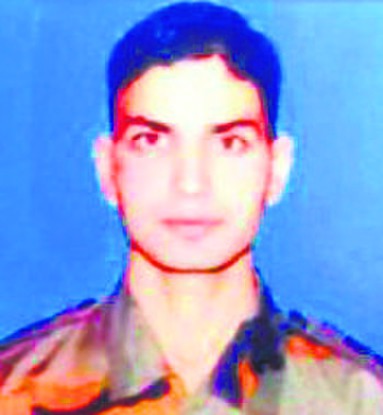
The incident occurred around 5.15 pm. A Defence spokesperson said Lance Naik Antony Sebastian KM was critically injured in the incident. He later succumbed to injuries. “Havildar Mari Muthu D also sustained gunshot injuries and was critically injured in the firing. Immediate resuscitation and medical aid was provided to the soldier. He has been evacuated to Military Hospital, Poonch,” he said.

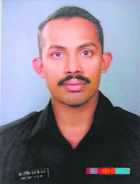
Lance Naik Sebastian KM (34) belonged to Manakunnam village of Ernakullam district in Kerala. He is survived by his wife Anna Dayana Joseph. — TNS


Lt Gen Ranbir Singh reviews Kishtwar security

Lt Gen Ranbir Singh reviews Kishtwar security

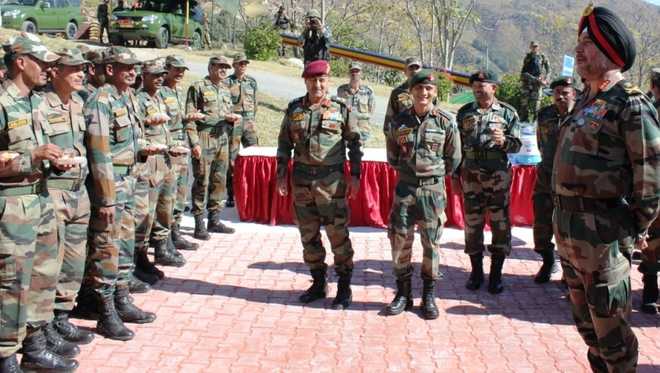
The Northern Command chief interacts with jawans in Kishtwar.

Jammu, November 8

Lt Gen Ranbir Singh, Northern Command chief, accompanied by White Knight Corps Commander, Lt Gen Paramjit Singh, on Thursday visited the hinterland posts of Kishtwar and Suigarh sectors to review the operational preparedness and the prevailing security situation in the area.

During the visit to the sectors, he was briefed by the commanders on ground about the current operational and prevailing hinterland security situation and the preparedness of the formations in dealing with it.

Lt Gen Ranbir Singh was also updated by the White Knight Corps Commander on the current internal security situation in the Kishtwar region and measures undertook by the Army and civil administration for controlling the situation.

The Northern Command chief also interacted with civil administration officials at Kishtwar who briefed him on the internal security situation in the region in light of the unfortunate incident on November 1, wherein Anil Parihar and Ajeet Parihar were killed in a cowardly act. — TNS


INDIAN AIR FORCE AIRMEN 01/2018 PSL RELEASED FOR GROUP X AND Y; ENROLLMENT LIST ON 10 DEC

The candidates whose remark column in the list has annotation “CSV”, have to appear for the document verification to the concerned ASC with all relevant documents. Such candidates can visit the ASC till November 15, 2018.

Provisional Select List for Airmen 012019

Today (October 31, 2018), Indian Air Force (IAF) has released the Provisional Selection List for Airmen Group X and Y 01/2019 at airmenselection.cdac.in. Finally, the IAF has revealed the name of the candidates who are selected after the medical examination i.e. phase III of recruitment. The list has been released for the following Group and trade  Group X (Tech), Group Y (Except Auto Tech, GTI, IAF(P), IAF(S) & Musician),  Group Y (Med Asst), Group Y (IAF-S).

The result is in the form of pdf, that contains the name, roll number, Date of Bith, merit position and medical status of the candidate. The candidates who are found medically in medical examination fit now they have to arrive for the enrollment after the publishing of the enrollment list on December 10, 2018.

Apart from this in the remark column has the CSV annotation for some of the candidates. Here CSV stands for “Certificate Subject to Verification”. Such candidates have to appear for the document verification to the concerned ASC with all relevant documents. Such candidates can visit the ASC till November 15, 2018. The candidates who will fail to appear for the document verification will be treated as the disqualified for the recruitment.

TWO LISTS PSL AND NON-PSL

Indian Air Force has released two lists Provisional Select List and Not in Provisional Select List. For each trade except Group ‘y’ Medical Assistant, has released two lists.

Clearly, Not In PSL list contains the name of the candidates, who did not secure their position in the merit list. Such candidates have cleared the selection test but due to low merit, they are not selected in PSL.

AISL V/S PSL

Earlier IAF used to release All India Select List (AISL) but from now the provisional select List will be declared. The only difference between the two lists is the AISL contained the name of the candidates who cleared any Phase I, or II, or III. While the PSL contains the name of the candidates who have qualified all the phases (i.e. Phase I, II and III) of the recruitment exam.

The selection test for the Airmen 01/2019 was held on May 03, 04, 05, 06, 2018. And the list for phase II was released on May 21, 2018. Now after enrollment, the name of the finally selected candidates will be released.

Currently in Airmen Selection of 02/2019 of Group ‘x’ and ‘y’ phase II is going on. The candidates who will qualify the Phase II will be called for the medical examination at designated Medical Board Centre (MBC).


Be Prepared To Meet Security Challenges In Kashmir: Army Commander

The Army commander complimented troops for their remarkable successes in eliminating terrorist leadership from south and central Kashmir, spokesperson said.

Be Prepared To Meet Security Challenges In Kashmir: Army Commander

Lt Genral Ranbir Singh reviewing the security situation in Kashmir.


SRINAGAR: The Army’s Northern Command chief Lt Gen Ranbir Singh reviewed the security situation in Kashmir and was briefed about the recent anti-terrorist operations in the valley, a defence spokesman said today.

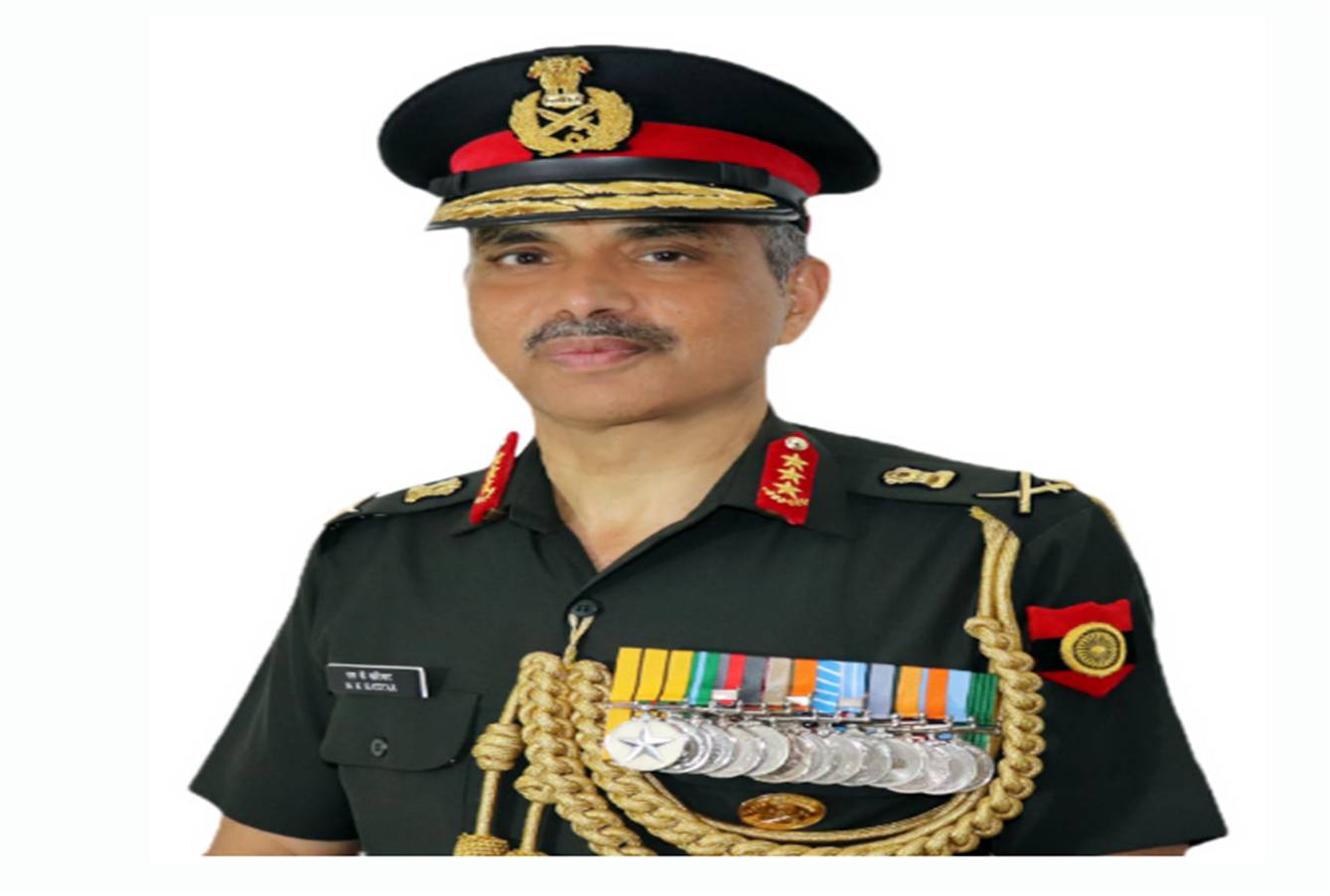
The Northern Army Commander arrived in Kashmir Valley on Thursday to review the prevailing security situation, the spokesman said. “Accompanied by the Chinar Corps Commander Lt Gen AK Bhatt, the Army commander visited units in south Kashmir and was briefed by commanders on the ground about the current situation and recent counter terrorist operations,” the spokesman said.

He said the Army commander complimented troops for their remarkable successes in eliminating terrorist leadership from south and central Kashmir.

Lt Gen Singh also commended them for their dedication to duty and high standards of professionalism and was appreciative of measures and Standard Operating Procedures instituted by units and formations to minimise civilian causalities.

COMMENT

“The need to be prepared for meeting security challenges effectively was also reinforced. Lauding the excellent synergy amongst all security forces, he exhorted all ranks to maintain a safe, secure and peaceful environment for the people of the Kashmir,” the spokesman said.


Army helps develop leadership: Gen Malik at Military Fest 2018

Tribune News Service

Chandigarh, November 25

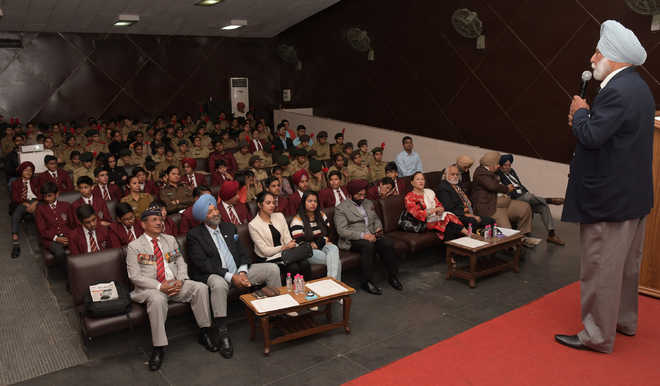
The Army, as an institution, offers unique and unparalleled opportunities to imbibe leadership qualities and develop capability for innovative thinking and finding practical solutions in tough situations.This was stated by Gen VP Malik, former Chief of the Army Staff, at a session on Combat Episodes, organised as a run-up to the forthcoming Military Literature Festival, here on Sunday. He said nurturing human relations, comradeship and team spirit was the hallmark of the Army.

Earlier, Wg Cdr DS Kler (retd), a veteran of the 1971 Indo-Pak war, gave a firsthand account of the first aerial combat that took place on November 22 over Boyra in the east, in which four IAF Gnats shot down three Pakistani Sabre jest without any loss.Brig IS Gakhal (Retd) traced the history of the Sikh Regiment, recounting its important campaigns and landmark events since its rise in 1846. He laid emphasis on the legacy and exploits of notable commanders and officers of the regiment who played significant role in wars and other operations.

Giving an overview of the famous Battle of Dograi, Brig Pradeep Sharma (Retd) of the Jat Regiment gave an insight into the psych of Jat soldiers. He also narrated several anecdotes regarding Jat soldiers in various battles.

Brig Onkar Goraya narrated the operation concerning the crossing of the Meghna River in Bangladesh by Indian forces in 1971 and the role played by the 4 Corps commander, Lt Gen Sagat Singh, in successful offensive operations.

Delving on joys and tribulations of being an Army wife, Lily Swaran narrated her varied experiences while being married to an officer.


6 militants killed in Shopian Soldier loses life in gunfight | Civilian protesting at encounter site dies

Martyr Lance Naik Nazir Ahmad

Suhail A Shah
Anantnag, November 25

An Army man, a civilian and six militants, three of them district commanders, were among eight persons killed on Sunday during a gunfight in Shopian’s Batgund village, 53 km south of Srinagar.

More than 15 civilians were injured as security forces fired bullets, pellets and tear gas shells to quell protesters at the encounter site.

“Lance Naik Nazir Ahmad of 34 Rashtriya Rifles, a resident of Ashmuji area in Kulgam district, was injured in the initial burst of fire. He later succumbed to his injuries,” a senior police official said. He identified the killed civilian, who had a bullet in his chest, as Noman Ashraf Bhat of Bolsoo village.The slain militants were identified as Umar Majeed Ganaie of Kulgam (Hizb district commander); Mushtaq Ahmad Mir of Cheki Cholan, Shopian (LeT district commander); Muhammad Abbas Bhat of Mantribugh, Shopian (Hizb district commander); Muhammad Waseem Wagay of Amshipora, Shopian (Hizb) and Khalid Farooq Malik of Aliyalpora, Shopian (Hizb).

The militants were believed to be behind the recent spate of abductions and killings in Kulgam. Hizb district commander Umar Majeed’s picture, posing in front of Ghanta Ghar in Lal Chowk area of Srinagar, had gone viral on the social media. But the police had called it “doctored”. The police official said material found at the encounter site indicated that one of the militants could be a Pakistani, “possibly a Lashkar operative”.

He said a search operation was launched by a joint team around 11.30 pm on Saturday night. “After about an hour-and-a-half, the forces zeroed in on a house where the militants were hiding and were fired upon. Lance Naik Nazir Ahmad was injured. He later died.” The gunfight lasted more than six hours. Two houses were gutted.

At the break of dawn, hundreds of residents assembled at the encounter site. The security forces opened fire, leaving more than 15 hurt, six of them with bullet injuries.

A health official at the hospital said they had received 15 injured persons, “six with bullet wounds and nine with pellet injuries, including an 18-month-old girl”. Later in the day, the bodies of the militants, barring one, were handed over to the families.

IGP (Kashmir Range) Swayam Prakash Pani said: “We have been able to make a considerable dent in terror groups.” Two days ago, a module of six militants was eliminated at Bijbehara in South Kashmir, which included a militant wanted in the assassination of journalist Shujaat Bukhari.

Prime accused of Lt Fayaz killing shot

One of the six militants killed in Shopian, Mohd Abbas Bhat, was the main accused in the abduction and killing of Lt Ummer Fayaz, police said. Lt Ummer, 22, was abducted from Batpora village of Shopian on May 9, 2017, where he was attending a marriage. His body was found the next morning.


Ahead of Army recast, veterans say don’t lose focus of two-front war

Suggest budget constraints should not be only guiding principle

Ahead of Army recast, veterans say don’t lose focus of two-front war

Ajay Banerjee
Tribune News Service
New Delhi, November 21

Retired Generals of the Army have advised that forthcoming restructuring of the forces should not lose focus of the two-front simultaneous war scenario and also budget constraints should not be the only guiding principle to re-cast the Army.

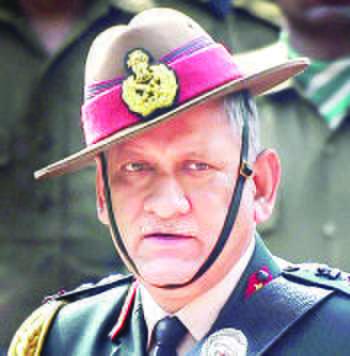
These opinions emerged after Army Chief Gen Bipin Rawat met former chiefs and senior officers to discuss the nuances of restructuring the force over a two-hour session in Delhi on Sunday.

Details emerging now indicate that the veterans — former chiefs and Lieut Generals — were informed about the forthcoming changes. Among the invitees were those retired officers who are regular on TV shows and write columns in newspapers.

Despite being retired the Generals keep in touch with their regiments for life, hence are important in conveying the “right message”.

The veterans were informed about four major in-house studies being carried out. The most important is “Reorganisation and Rightsizing of the Indian Army”, which reviews operational structures to make them efficient and future-ready by taking into account the operational situation on Western and Northern Borders. This will include creation of integrated battle groups (IBGs) fully equipped with elements of warfare.

In an interview to the Tribune on November 5, General Rawat had said how these IBGs were planned to be pre-positioned facing the western (Pakistan) and northern (China) borders.

The second study is on “Reorganisation of the Army Headquarters”, aimed at integrating various wings. The third study is on “Cadre Review of Officers”, which focuses on incorporating the proposed reorganisation and restructuring and plans to have a balanced cadre to meet the aspirations of officers. This will include longer tenures as Brigadier, Maj General and Lt General and faster promotion from Colonel to Brigadier.

The fourth study is on “Review of Terms of Engagement of Rank and File”, aimed at having a younger profile of officers. The retired Generals have been told that the IBGs are being “Test-beded” — a term in military parlance for trying out a new concept in the field under real conditions.

Army plans two types of integrated battle groups (IBGs) — smaller for mountains (China border) and bigger for plains (Pakistan border). Each border may have around 8-10 IBGs.

Each IBG may have 8,000-10,000 troops and comprise 4-6 infantry and armoured battalions, 2-3 artillery regiments, an engineers’ unit, integrated signals unit and dedicated integral logistics.

Brigadiers may command smaller IBGs and Major Generals the bigger ones. Both will be under the Corps Commander of the area.