Please tell us in detail about the Longewala Operation of 1971?
While I was busy raising 38 Cavalry in Hyderabad I was called to Khairpur on October 16, where the 18 Division Headquarters were located. There the GOC Major General B. M. Mustafa explained his concept of forthcoming operations to Lieutenant Colonel Akram Hussain Syed and me, with his Colonel Staff Colonel Wajid Ali Shah present.
The general planned to defensively hold the front south of Rahimyar Khan and outflanking the Indian left flank seize Ramgarh and Jaisalmir; 38 Cavalry was to seize Ramgarh and 22 Cavalry was to neutralise the airfield at Jaisalmir; the GOC asked for our comments about the practicability of the plan from the armour point of view.
Lieutenant Colonel Akram Syed and I said that the plan would succeed if we made an approach march to the border on one night and undertook the cross border operations the next night and air cover was made available on the first day from dawn to dusk till Ramgarh and Jaisalmir had been secured. The general said he would make arrangements for the air cover, he cautioned that the plan was ‘top secret’ and was not to be discussed with anyone.
In the first week of November, 38 Cavalry, less ‘A’ Squadron detached to 55 Brigade at Chor, concentrated at Manthar, about 25 miles on the road Sadiqabad-Rahimyar Khan. A few days after the regiment concentrated, the COAS and Air Marshal Rahim, the PAF chief came to Rahimyar Khan where the 18 Division plan was discussed and the PAF chief assured the required air support.
A few days after the Rahimyar Khan meeting, the GOC inter-changed the roles of 22 Cavalry and 38 Cavalry because he anticipated a tank battle in the Ramgarh area for which 22 Cavalry was better suited. I considered the operation, Jaisalmir was 120 miles from the rail head at Reti, I expected an engine breakdown every 15 miles and requested that 12 spare engines be provided with an EME team and a breakdown with a crane to change engines, the GOC agreed to make the necessary arrangements.
The officers of 38 Cavalry carried out reconnaissance for counter penetration covering the approaches to Rahimyar Khan and Lieutenant Colonel Akram Syed and I took our officers along the route that we were to take to the border, Reti-Khenju-Gabbar-Masitwari Bhit-border without telling them that that was the route that we were to follow in the forthcoming operations.
About the middle of November the news indicated that the attack on East Pakistan had begun and Indian aircraft started flying reconnaissance missions over Rahimyar Khan and Sadiqabad.
With war imminent I decided to let my officers and the Risaldar Major know that the mission of 38 Cavalry with an infantry battalion and mortar battery was to capture Jaisalmir and neutralise the airfield. I explained how the mission was to be conducted and that each tank was to carry 200 gallons of petrol in drums. At the division headquarters there was no preparations for the very imminent operations, on 1 December Colonel Saeed Qadir came to investigate the seizing of tank engines and ordered the removal of tank engines and cleaning of oil sumps and filters.
On 2nd December I received orders to report to the division headquarters and there the GOC told me that operations would begin that evening, that 38 Cavalry, 1 Punjab and a mortar battery would follow 51 Brigade upto Loganewala and proceed to Jaisalmir to neutralise the airfield. The GOC told me that I was not to attend the division orders but to organise my force.
I telephoned my regiment to stop the work of taking down tank engines and prepare for moving out, I next went to the AA&QMG and told him that I required 16,800 gallons of octane 80 petrol, the AA&QMG told me that he knew nothing about the requirement and had no petrol available, after a discussion with the colonel staff the AA&QMG told me that the required petrol would be made available at Masitwari Bhit, 5 miles short of the border. It was obvious that the logistics of the operation had not been planned.
When the 18 Division ‘O’ group assembled, the PAF liaison officer, a wing commander informed the ‘O’ Group that the PAF would not be able to support the operation because the Jacobabad airfield had not been activated. This announcement led the brigade commanders to ask the GOC to cancel or postpone the operation, the GOC then telephoned the CGS and discussed the lack of air, after the discussion he informed the ‘O’ Group that his orders were to conduct the operation without air support in the ‘national interest’. The brigade commanders then suggested that the GOC refuse to conduct the operation because it was very likely to fail. The GOC told the ‘O’ Group that he would conduct the operation because if did not he would be labelled as a general who had lost his nerve.
The plan made by Major General B. M. Mustafa required an approach march of about sixty mile to the border, then a forty miles advance to Ramgarh by 51 Brigade of two battalions (the third battalion was a East Bengal battalion and had to be left out of the operations) and 22 Cavalry, by passing Loganewala, to position itself to counter any reaction from the Indian 12 Division which was expected to be deployed facing Rahimyar Khan. I was to command the 38 Cavalry task force consisting 38 Cavalry less squadron, 1 Punjab ex-206 Brigade and a mortar battery, and was to follow 51 Brigade till the metal road to Jaisalmir, 20 miles inside India was reached and then continue to Jaisalmir. 206 Brigade leaving one battalion on the Rahimyar Khan front (this front was held by Hur battalions) was to follow my force and secure Loganewala to form a firm base.
After these orders were issued the 206 Brigade commander objected to 38 Cavalry being sent to Jaisalmir with mechanically unsound tanks, the GOC changed the plan and ordered 28 Baluch the divisional Reconnaissance and Support Battalion less company and a mortar battery to neutralise the airfield and placed 38 Cavalry under command 51 Brigade. I was informed about the change in the plan on the afternoon of 2 December.
The orders received from GHQ differed from the plan that had been suggested, instead of making the approach march of 60 miles to border in one night and going across the border the next night, the GHQ order stated that the approach march was to start at 1530 hours on 3 December and the border had to be crossed at 2130 hours and the advance was to continue to Ramgarh and Jaisalmir, a total march of 120 miles in one night.
On the evening of 2 December I went to the 51 Brigade Headquarters, Lieutenant Colonel Akram Syed was already there, he told me that the brigade commander was shaken and had lost his nerve, a little later the brigade commander came to the tent where the ‘O’ Group had assembled, he appeared shaken. The GSO 3 laid out the maps of the operational area, the maps covered our territory, Indian territory was blank squares, the brigade had not collected the maps of the operational area from the division headquarters. I placed my maps, which showed the terrain features on both sides of the border, on the table.
From the ensuing discussion it became apparent that the brigade commander’s mind had stopped working. Nothing was known about the Indian deployment, even the number of the Indian division was incorrectly said to be 11 whereas it was 12. As the brigade commander hesitated I told him that my guess was that an infantry battalion and a tank squadron would be protecting the Indian flank at Loganewala, that 51 Brigade with 22 Cavalry with an infantry battalion on tanks to move on the track Masitwari Bhit-Loganewal and by passing Loganewala continue to Ramgarh. 38 Cavalry with an infantry battalion to follow and secure Loganewala or wait the arrival of 206 Brigade; no one objected and the brigade commander accepted the plan.
When the ‘O’ Group dispersed the artillery regiment commander asked me for my map saying that his maps were also without terrain features across the border.
On 3 December at 38 Cavalry tanks were to move on tracks for 25 miles and entrain at Sadiqabad and arrived at Reti railway station about, 30 miles from Sadiqabad at 1800 hours. I went to Reti railway station at about 1730 hours and asked the station master at what time the tank train was to arrive, he surprised me by saying that he had no intimation of any tank train, I realised that the AA&QMG had not informed the railway about the movement. I then spoke to the railway movement controller at Sukkur and after a lot of shouting and threatening the controller agreed to move the train to Reti. At the Reti railway station a goods train was standing at the tank unloading line, there was no ‘power’ available at Reti, we were arguing about this when the station master started going through the procedure of allowing a train to pass through, I made him stop the train and use its locomotive to move the goods train. At about nine o’clock the tank train with 14 tanks whose engines had been hurriedly refitted without cleaning the filters arrived and were unloaded.
We were running well behind the divisional planned schedule, from Reti the tanks drove to Khenju along a canal bank, at Khenju my second in command Major Zia Uddin Javed was waiting with petrol and the tanks were refuelled. From Khenju the desert track started and the tanks in low gear ground their way to Gabbar 19 miles from the border, thirteen out of fourteen tanks arriving at 0100 hours on 4 December. At Gabbar I was surprised to find 22 Cavalry and the GOC who told me that 22 and 38 Cavalry were the only troops which had arrived. At 0400 hours the GOC called off the operation for that day and both regiments dispersed. On the 4 December the Indian Air Force did not show up.
On checking up I found that the lorries carrying the petrol promised by the AA&QMG were stuck in the sand near Dharki, I sent a message to Risaldar Major Mazhar Ali Khan and he commandeered the EME battalion 6×6 vehicles and we refuelled. I looked for the tank that had broken down, it was a few miles from Khenju, the Tatra crane was bellied near Khenju, that put an end to my engine replacement plan.
During the day, on the advice of the brigade commanders the attack on the Jaisalmir airfield was abandoned and 1 Punjab reverted to 206 Brigade. Just before last light a battery of 130 mm guns passed through Gabbar and 38 Baluch joined 22 Cavalry mounted their tanks moved off towards the border.
At about 2100 hours six tanks and the reconnaissance troop of 38 Cavalry reached Masitwari Bhit, 22 Cavalry was refuelling; Lieutenant Colonel Akram Syed told me that Brigadier Tariq Mir was behaving very badly and had stated that he had no intention of going beyond Loganewala, I met Brigadier Tariq Mir and he told me that he intended not to go beyond Loganewal. At about 2300 hours 51 Brigade moved off leaving the elements of 38 Cavalry, a platoon of a Punjab battalion of 206 Brigade, one lost FOO at Masitwari Bhit and Brigadier Jahanzeb Arbab joined us.
The operation so far was a movement of fiasco, civilian requisitioned 4×2 trucks could not negotiate the loose sand, 20 FF, a battalion of 206 Brigade, marched across the desert ‘to the sound of the guns’ when their vehicles failed to negotiate the desert.
At about 0200 hours on 5 December, Brigadier Jahanzeb Arbab and I decided that no one else was likely to join us and we decided to follow 51 Brigade. I ordered 2nd Lieutenant Javed Iqbal with the reconnaissance troop to lead followed by the RHQ 38 Cavalry and six tanks under Major Javed Hussain. About two miles after crossing the border I found 2nd Lieutenant Javed Iqbal coming back, when I asked him where he was going he told me that all the vehicles of the reconnaissance troop had disappeared, I realised that the NCOs had hidden their vehicles (I court martialled them after the ceasefire). Major Javed Hussain now took the lead and went 18 miles and four tanks broke down leaving two runners and we had to halt, two miles short of Loganewala, luckily on the highest ridge in the area.
At about 0730 hours, explosions were heard from the direction of Loganewala and columns of smoke started rising, I and my adjutant drove towards the smoke columns in my rover and from a ridge overlooking the Loganwala-Jaisalmir metal road we saw five tanks of 22 Cavalry and Indian tank burning, four Hawker Hunters of the IAF were circling and after firing all their rockets etc they flew away. A little later a helicopter took off, later I learnt that the GOC had come to 51 Brigade as it was out of communications with the division headquarters and ordered Lieutenant Colonel Akram Syed to capture Loganewala.
I and my adjutant drove to the 51 Brigade headquarters, I asked the brigade commander what the situation was and he said he did not know, I then drove to the base of the hill on which Loganwala was located, two companies of 38 Baluch and a squadron of 22 Cavalry were formed up to attack.
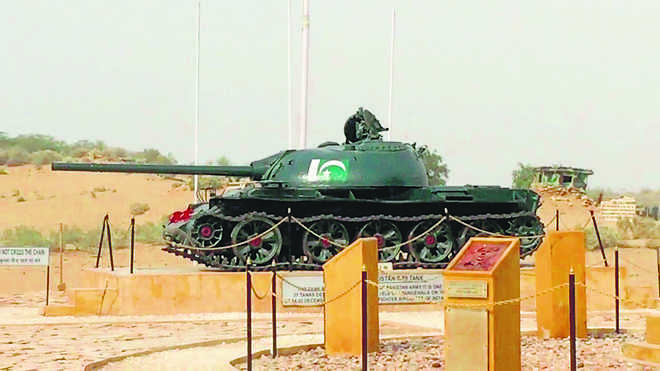
22 Cavalry reached the rear of the Indian Loganewala defences at about 0200 hours, in the absence of the brigade commander 22 Cavalry and 38 Baluch decided to attack and clear Loganewala before advancing to Ramgarh. At 0700 hours a squadron and two companies of infantry attacked and were engaged by anti-tank guns, machine guns and AMX tanks, one AMX was knocked out then 6 Hawker Hunters appeared, knocked out 5 tanks of 22 Cavalry and the Baluchis went to the ground due to straffing. Half an hour later 22 Cavalry formed up again to attack and the IAF knocked out six tanks, at about 0900 hours 22 Cavalry formed up again but after a vehement and abusive argument the brigade commander overruled the attack. 22 Cavalry had cut off the roads Loganewal-Ramgarh, Loganewala-Tanot and the road to Jaisalmir. The brigade commander ordered the concentration of the regiment around the brigade headquarters re-opening the Indian communications to Loganewala. In subsequent air attacks 22 Cavalry lost six more tanks bringing the day’s losses to 17 tanks, 10 killed and 17 wounded.
Four Hawker Hunters of the Indian Air Force circled Loganewala from 0700 hours to sunset and prevented any ground movement. 22 Cavalry fired all their 12.7 mm anti-aircraft ammunition and also tried their 100 mm in the anti-aircraft role but could not hit any aircraft that were releasing rockets and firing their guns from about five thousand metres.
After witnessing the pull back by 22 Cavalry I returned to where my tanks were, there I found Brigadier Jahanzeb Arbab, I told him of the affairs at Loganelwala and he asked me to accompany him to Loganewala. We found 51 Brigade deployed astride the Loganewala-Jaisalmir road out of contact with the Indian troops. The 51 Brigade commander told us that an Indian brigade had linked up with Loganewala.
While we were at the 51 Brigade headquarters a helicopter, flown by Captain ‘Mac’ Maqbool of 12 Cavalry, later lieutenant general, landed with orders from the GOC ordering 51 Brigade to capture Loganewal and Ghotaru, a place about ten miles on the road to Jaisalmir; on receiving the orders Brig Tariq Mir announced that he would not comply with the orders as the Indians were too strong for brigade to attack.
While we were witnessing the brigade commander’s refusal to obey the division commander’s orders, Indian aircraft again attacked and we all went into trenches, Brigadier Jahanzeb and I went to the same trench, there we discussed what we had seen and I told Brigadier Jahanzeb that it would be a shame to withdraw after coming 20 miles and convinced him to assume command as the senior brigadier; he hesitated and said I was creating trouble, but he agreed to assume control.
After the Indian aircraft departed Brigadier Jahanzeb informed Brigadier Tariq Mir that 206 Brigade would attack Loganwala and he ordered Lieutenant Colonel Shah, the CO 28 Baluch, the Reconnaissance and Support Battalion, to advance along the road Loganewala-Jaisalmir and capture Ghotaru. The CO 28 Baluch disappeared and explained after the ceasefire that he understood that he was to make a wide outflanking movement to Ghotaru by withdrawing to the Sadiqabad-Sukkur road.
Brigadier Jahanzeb returned to the point where my tanks had stopped, his brigade had concentrated there; he made an attack plan setting the H-hour at 0300 hrs 6 December, he gave out his orders and told me to go and explain the plan to Brigadier Tariq Mir and ask him to mark the “FUP” and provide a squadron of 22 Cavalry to support the attack. I reached the 51 Brigade area at about 1800 hours, I met Lieutenant Colonel Akram Syed and explained the plan, he told me that Brigadier Tariq Mir had decided to withdraw across the border. I then went to 51 Brigade headquarter and gave the requirements of 206 Brigade to the brigade commander who said that he was withdrawing across the border and remained adamant about it; at about 1900 hours the brigade started moving back.
The withdrawing 51 Brigade and advancing 206 Brigade crossed each other on Kharo Tar a high ridge line slightly ahead of where my tanks had stopped, Brigadier Jahanzeb decided to take up a defensive position on the ridge, at about 1130 hours the next day the Indians made contact with tanks and infantry. The GOC came and ordered 206 Brigade to regain the Loganewala-Jaisalmir road and 51 Brigade to prepare a depth position.
Later the GOC ordered a general withdrawal across the border and all ranks to fire small arms at the enemy aircraft. When I heard about this order, I drove to the division headquarters at Gabbar and met the GOC who confirmed his order, I told him that if there was a general withdrawal troops would not stop east of the Indus and if the order to fire small arms at the aircraft was not cancelled the troops would fire all their ammunition and run away. I asked the GOC to cancel both orders and order a fighting withdrawal with the two brigades withdrawing through each other, the GOC cancelled both his previous orders and adopted my suggestion. My motive in making the suggestion was to recover my broken down tanks lying between Kharo Tar and Gabbar and asked the GOC for recovery assistance, he arranged for WAPDA tractors which towed back most of the tanks.
While driving to the divisional headquarters I found the divisional Supply and Transport Battalion vehicles abandoned on the track on which the division had advanced, I ordered my driver to check the state of a vehicle and found that radiators had been drained and when my driver got into the driving compartment the driver of the vehicle came running, he was hiding in a bush.
By the morning of 7 December 206 Brigade was firmly established on Kharo Tar, my Quartermaster, Captain Bhatti, kept us supplied with food “meethi roti” and water from Sadiqabad and when a cry went up that 206 Brigade units were running out of ammunition, I made my Dodge Power Wagons available and ammunition was brought from Sadiqabad.
38 Cavalry squadron left at Manthar because their engines could not be refitted when the division started its movement, moved into counter-penetration positions on the approaches to Rahimyar Khan.
The GOC had complained that he was having a communication problem with 51 Brigade since the beginning of the operation, I told him I would see what the problem was. I sent my command vehicle with my adjutant to 51 Brigade Headquarters to establish communications between the brigade and the division and when my command vehicle would move the communication would break; my signal JCO could not find the reason; after the ceasefire an NCO disclosed that the brigade had kept its wireless set meant to communicate with division headquarters, switched off.
On the night 8/9 December 206 Brigade withdrew from Kharo Tar through the position prepared by 51 Brigade, 38 Cavalry after firing all the HE ammunition destroyed its two broken down tanks and moved to Masitwari Bhit. On 9 December after taking over the front, Brigadier Tariq Mir reported that two enemy tank regiments were turning his flanks to cut off the brigade, 22 Cavalry was moved from Gabbar and were attacked by the IAF and lost another tank; the two Indian tank regiments were a figment of the brigade commander’s imagination.
A little distance from my regimental headquarters the divisional gun area was located, the IAF attacked gun area and my headquarters, a cannon shot made a hole in my leather jacket and a rocket hit the open cupola flap of my tank and broke the hinge. The gun area was defended with training guns of the Anti-Aircraft School which fired single shots but kept the IAF away.
On the night 11/12 December the remnants of 38 Cavalry withdrew to Gabbar, on the morning of 12 December when I with my second in command went to find out where the ‘forward defended localities’ were, I found Major General B. M. Mustafa standing there, someone whispered that the general had been sacked and Major General Abdul Hamid Khan was in command of 18 Division.
I met the general and asked his GSO 2 (Intelligence) where the FDLs were, the general heard me and indicating the GSO 2 and himself he said that they were the FDLs and there was nothing forward of them. Major General Abdul Hamid Khan, the new GOC, on assuming command the previous day ordered a ‘general withdrawal’, both brigades took off in the ‘Gabbar Gallop’ and some men were rounded up and brought back from the Punjab Regimental Centre at Mardan.
On the night 12/13 December I established my headquarters at Khenju and collected all my broken down tanks and started engine replacement. On 16 December ‘Tiger’ Niazi surrendered, two days later, to everyone’s surprise, we ceased fire.
After the operation ‘Labbaik’ ended in fiasco everyone claimed that they were not privy to the operation though 206 Brigade commander was removed from command for objecting to the operation. The mission assigned to 18 Division was “Defend the area of responsibility in order to ensure the security of the main line of communications Karachi-Multan and be prepared to carry out the war into the enemy territory under favourable conditions.” This implied the guarding of 600 miles road and rail communications close to the border, 18 Division successfully carried out its mission. It was a classical spoiling attack which put the Indians off balance, the division’s mission was achieved.
If your allegations about the Gabbar gallop are true, why is it that no officer was taken to task?
Because the GOC Major General Abdul Hamid Khan did not allow the general withdrawal to be disclosed to the Awan Committee.