Sanjha Morcha

2 yrs post ‘surgical strikes’ , firing across LoC up 4 times

2 yrs post ‘surgical strikes’ , firing across LoC up 4 times

Ajay Banerjee

Tribune News Service

New Delhi, September 26

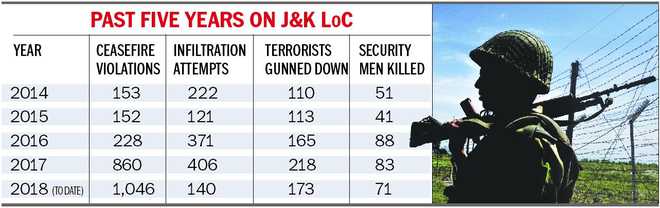
Two years after the ‘surgical strikes’, firing from across the LoC in Pakistan has risen four times while infiltration by terrorists continues unabated. A positive development is that the number of ultras getting killed at the LoC has risen.

On September 29, 2016, the Indian Army hit at multiple terror camps inside Pakistan-occupied Kashmir and destroyed terror launch pads.

To mark two years of the ‘surgical strikes’, the government has planned ‘Parakram Parv’ celebrations at 53 locations across 51 cities.  Since the ‘surgical strikes’, the LoC and the IB that divide Jammu and Kashmir with Pakistan have been “peaceful” and “quiet” only in sporadic bursts.

Army Chief Gen Bipin Rawat today said “the strikes were a message that we will not hesitate to cross (the LoC). Despite that (strikes), infiltration continues and violence is being fanned in the Valley”.

Immediately after the strikes, India-Pakistan ties, expectedly, were on a downward spiral marked with frequent exchanges of fire, prompting assessments of it being “the most tense” period since the November 2003 ceasefire along the border.

However, counting the number of ceasefire violations cannot be a benchmark to assess the level or intensity of firing from across. Even one bullet fired is a violation and a mortar, that travels up to 10 km, is also counted as same. A senior officer said modern surveillance gadgets such as night vision and thermal imagers made it difficult to physically reach an enemy post and firing, therefore, remained the most viable military reply.


Ready for war but choose peace: Pak Army

Ready for war but choose peace: Pak Army

Pakistan Army spokesperson Asif Ghafoor said the country has a long-standing record of fighting terrorism and “we know the price for peace”, The Dawn reported. Reuters file

Islamabad, September 23

The Pakistan Army said it is “ready for war” but chooses to walk the path of peace in the interest of its people, comments which came in response to Indian Army Chief General Bipin Rawat’s remark that “stern action” is needed to “avenge” the brutal killing of Indian soldiers.

In an interview to Dunya TV on Saturday, Pakistan Army spokesperson Asif Ghafoor said the country has a long-standing record of fighting terrorism and “we know the price for peace”, The Dawn reported.

Earlier in the day, commenting on the recent brutal killing of a BSF jawan and three policemen in Jammu and Kashmir, General Rawat in Jaipur said stern action is needed to avenge the barbarism by terrorists and Pakistan Army against Indian soldiers.

“We need to take stern action to avenge the kind of barbarism that terrorists and the Pakistan Army have been carrying against our soldiers. It is time to give it back to them in the same coin but not by resorting to similar kind of barbarism. I think the other side must also feel the same pain,” he said at a press conference here.

Rawat insisted that action against Pakistan was needed but not in a barbaric manner.

Refuting India’s claim of Pakistani soldiers killing the BSF jawan, Ghafoor said, “We have struggled to achieve peace in the last two decades. We can never do anything to disgrace any soldier.”

“They (India) have in the past as well laid the blame on us for mutilating the body of a fallen soldier. We are a professional army. We never engage in such acts,” he added.

“We (Pakistan Army) are ready for war but choose to walk the path of peace in the interest of the people of Pakistan, the neighbours and the region,” the spokesperson said.

The war of words between the armed forces of the two countries came a day after India called off the foreign minister-level talks with Pakistan in New York this month on the sidelines of the United Nations General Assembly.

General Rawat also said the Indian Army had carried out successful operations against the Pakistan Army whenever they did something against India along the border.

“Pakistan has suffered many casualties and we have been able to take on their defence system to a large extent, but we never resorted to barbarism. They requested for a ceasefire in May and we agreed, but if they continue to do this, we will need to take other action,” he said. PTI


Islamabad won’t mend ways: Delhi

Islamabad won’t mend ways: Delhi

Tribune News Service

New Delhi, September 21

Within 24 hours of accepting Pakistan’s talks offer, the Union Government on Friday called off a meeting between the Foreign Ministers of India and Pakistan in New York next week, citing “two deeply disturbing developments”. Sushma Swaraj and Shah Mehmood Qureshi were to meet along the sidelines of the United Nations General Assembly session.

“Now, it is obvious that behind Pakistan’s proposal for talks to make a fresh beginning, the evil agenda of Pakistan stands exposed and the true face of the new Prime Minister of Pakistan, Imran Khan, has been revealed in his first few months in office. Any conversation with Pakistan in such an environment would be meaningless,” Ministry of External Affairs (MEA) spokesperson Raveesh Kumar announced here.

Kumar said: “The latest brutal killing of our security personnel by Pakistan-based entities and the recent release of a series of 20 postage stamps by Pakistan glorifying a terrorist (Burhan Wani) and terrorism confirm that Pakistan will not mend its ways.” He pointed out that this was not in line with the “spirit reflected in the letters from the new PM and Foreign Minister of Pakistan”.

Significantly, while BSF jawan Narendra Singh’s mutilated body was found near the International Border in Jammu on September 18, two days prior to the announcement of talks, the postal stamps were reportedly released before the Pakistan elections in July this year.

“It seems the Indian Government is divided on the issue of negotiations — have never seen such a puerile statement by any Foreign Office. The world is watching: Pakistan stands for peace while Indian policies are being guided by extremist ideologies,” tweeted Fawad Chaudry, Pakistan’s Minister of Information and Broadcasting.

The Pakistan Foreign Minister alleged there was a group in New Delhi that didn’t want talks to happen. He was quoted by the Express Tribune as saying: “It seems that India is already preparing for its elections due in the country next year… Pakistan had asked for talks in the larger interest of the region.”

‘True face of imran’

Evil agenda of Pakistan stands exposed and the true face of the new PM, Imran Khan, has been revealed. — MEA spoksperson

‘World watching’

World is watching. Pakistan stands for peace, while Indian policies are being guided by extremist ideologies. — Pak Minister of Information & Broadcasting

India calling off Foreign Minister-level meet ‘unfortunate’: Qureshi
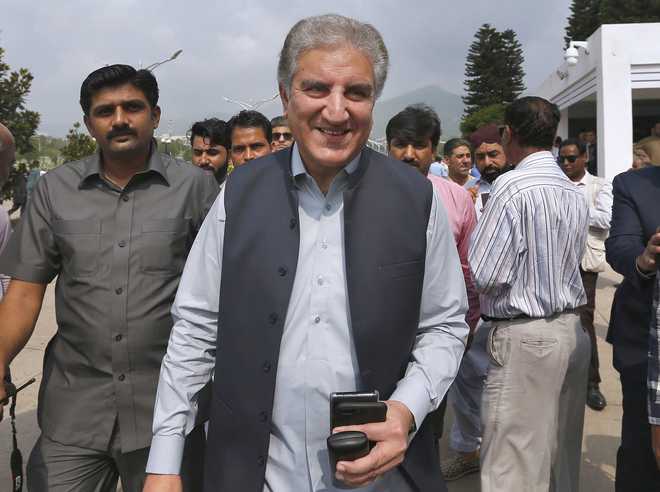
India calling off Foreign Minister-level meet ‘unfortunate’: Qureshi

File photo of Pakistan Foreign Minister Shah Mehmood Qureshi. AP/PTI

Islamabad, September 21

Pakistan Foreign Minister Shah Mehmood Qureshi on Friday expressed disappointment at India calling off a meeting between him and External Affairs Minister Sushma Swaraj in New York and alleged that “internal pressure” forced New Delhi to make the “unfortunate” move.

India cited the “brutal” killing of three policemen in Jammu and Kashmir as well as the release of postal stamps “glorifying” Kashmiri militant Burhan Wani for cancelling the meeting between Swaraj and Qureshi on the sidelines of the United Nations General Assembly in New York this month.

Qureshi expressed disappointment at the cancellation of the foreign minister-level talks, saying it was “unfortunate.” “It is unfortunate that India has not given a positive response. Indian has once again wasted an opportunity for peace,” Qureshi told the media here.

He said that it was important to sit and talk for the sake of peace and stability in the region.

“The refusal of India shows that Indian government is facing internal pressure,” he said.

“It seems that India is already preparing for its elections due in the country next year,” Qureshi was quoted as saying by the Express Tribune.

He said Pakistan sincerely wants resolution of all outstanding issues, including Kashmir, with India through negotiations.

Pakistan has always extended an olive branch to India for the resolution of problems and enhancing bilateral ties in an amicable manner, but New Delhi does not come out of its “internal politics”, state-run Radio Pakistan quoted him as saying.

The minister said Pakistan can only wish India to come to the negotiating table, but “we can neither pressurise anybody nor will accept the same for this purpose.” Qureshi said the world wants connectivity and promote regional trade, but India is creating problems.

He said India’s “stubbornness” is also adversely affecting future of the SAARC countries, the Radio Pakistan report said.

But, Qureshi reiterated that dialogue is the only way to come to the resolution of any issue.

“We said that we want dialogue – but in a dignified manner,” he added.

Announcing the cancellation of the New York meeting, External Affairs Ministry Spokesperson Raveesh Kumar said in New Delhi that the incidents “exposed” the “true face” of Pakistan’s new Prime Minister Imran Khan to the world as well as Islamabad’s evil agenda behind the proposal for talks.

“The latest brutal killings of our security personnel by Pakistan-based entities and the recent release of a series of 20 postage stamps by Pakistan glorifying a terrorist and terrorism confirm that Pakistan will not mend its ways,” Kumar said.

He noted that “two deeply disturbing developments have taken place” since yesterday’s announcement of a meeting between the foreign ministers of India and Pakistan in New York later this month.

“In view of the changed situation, there will be no meeting between the Foreign Ministers of India and Pakistan in New York,” he said.

Kumar said talks with Pakistan in such an environment would be “meaningless”.

Former High Commissioner to India, Abdul Basit said he was surprised by India’s move as New Delhi should not have agreed for it in the first place due to forthcoming elections but after agreeing for a meeting it was more surprising that it backed out.

Former advisor on foreign affairs Sartaj Aziz said that it was “unfortunate” that India cancelled the meeting as it would have created an environment for peace.

Former foreign minister Khurshid Kasuri said the cancellation reminded him of the Agra summit when everything was ready for joint statement but India backed out at the last minute. PTI



In and out of combat dress!

In and out of combat dress!

Lt Gen KJ Singh (retd)

COMBAT dress, the most visible and signature dress in the armed forces, was introduced in the Army in the 1980s. The uniform is not supplied to officers, who procure the cloth and get it stitched. The cloth is easily available despite orders restricting its sale, and is being misused for table cloths, shamiana, suitcase and seat covers! Seeing such combinations, our jawans prefer to call it ‘combined dress’. No wonder, terrorists find it easy to wear cloned versions.

The dress was adapted from foreign armies, and for many years, the shirt was worn like a tunic or bush-shirt, in line with foreign counterparts. Abroad, they use functional canvas belt but we decided to use our regulation web belt under the tunic. Trousers, till very recently, were left untucked, more like civvies. The idea was to remain comfortable, and only in operations, wear field packs and anklets. In trying to appear combat ready, we now see comic scenes of  faujis in HQ and civilian events, all ready for combat, that too on Friday, when the corporate world switches to casuals.

I was posted at Zakhama, Nagaland, in 2002 with the Inspector-General Assam Rifles. We were lined up at  a helipad for a VIP visit. All of us were wearing the combat dress with the tunic tucked in, as our IG, with the biological dividend of being slim, preferred it that way.

The first chopper, ferried our Corps Commander from Rangapahar (Dimapur). He was wearing his tunic out and with visible annoyance, he asked why we were violating Army order and not wearing dress as per regulations. We got the cue and while the IG headed to the only washroom, we found nearby bushes and re-attired appropriately. Soon, we heard another chopper and the radio operator announced: ‘Highest minus 1 Tiger approaching’. Our Army Commander arrived next. He was fit as a fiddle and liked to tuck in the tunic. The Army Commander remarked that in field areas it is good to be combat ready. Weather in Naga hills plays its own games and imposed a welcome tea-break as clouds had descended low. Break and bushes were utilised to change order, once again with the tunic tucked in. Like a good 2IC, I found a very private bush for my boss as the Corps Commander had priority right on the toilet.

As we waited and the weather cleared, the operator announced, ‘Highest Tiger approaching’. We scrambled to line up. Our Chief arrived and the first thing, we noticed was his tunic. Given his well-known sweet tooth, it called for us to again find corners and pull out our tunics. It is good that the fog of dress has since lifted and now orders are clear-cut: tuck in the tunic and trousers, wear the belt and look combat ready.


Ordnance factory begins melting truckloads of old guns to stop smuggling

KOLKATA: To stop smuggling of British-era firearms and modern army rifles rejected during the production process, Rifle Factory Ishapore (RFI) has started melting down all weapons kept in its warehouses.

HT PHOTO■ Weapons were smuggled out of Rifle Factory Ishapore on a truck that generally carried garbage and scrap metal, a probe revealed.The unprecedented exercise began three weeks ago. Hundreds of weapons have been taken to the Metal and Steel Factory (MSF) of the Ordnance Factory Board and put inside furnaces.

“The process started three weeks ago. Till Thursday, eight truckloads of weapons and parts have been sent to MSF that stands adjacent to our facility,” an RFI official said on condition of anonymity.

D K Mahapatra, general manager, RFI, refused to comment.

Firearms used during the two World Wars and the 1971 Bangladesh Liberation War as well as parts of weapons and INSAS and SLR rifles currently in use by the army and paramilitary forces, were smuggled out of RFI on a truck that generally carried garbage and scrap metal, a probe by Kolkata Police revealed in May this year.

On May 6 and 7, the Special Task Force (STF) of Kolkata Police arrested two junior works managers of RFI, Sukhada Murmu and Sushanta Basu, two contract labourers of the factory, Umesh Rai and Kartick Shaw, and two Bihar-based gunrunners, Ajay Pundit and Jaishankar Pandey. Seven firearms were seized from them.

The accused persons had smuggled out 20 INSAS and SLR rifles and sold those to Maoists and criminals over a period of 8-10 years, deputy commissioner, Special Task Force, Muralidhar Sharma, said after the arrests.

Investigations revealed that the contract labourers used to enter the factory by scaling the boundary wall at a particular location that cannot be seen by security guards manning the watch towers.

The revelation prompted the RFI top brass to seal the warehouses.

“Around a month ago, a decision was taken to melt down all weapons and parts so that nobody could ever make functional weapons out of them,” an RFI official said on condition of anonymity.

“There has been one or two minor incidents. For example, on Thursday, a century-old muzzle loading gun that still had some gunpowder in the barrel was put inside the furnace. MSF workers were su


Setback for Major Gogoi, Srinagar court orders further police probe

Setback for Major Gogoi, Srinagar court orders further police probe

Ishfaq Tantray

Tribune News Service

Srinagar, September 1

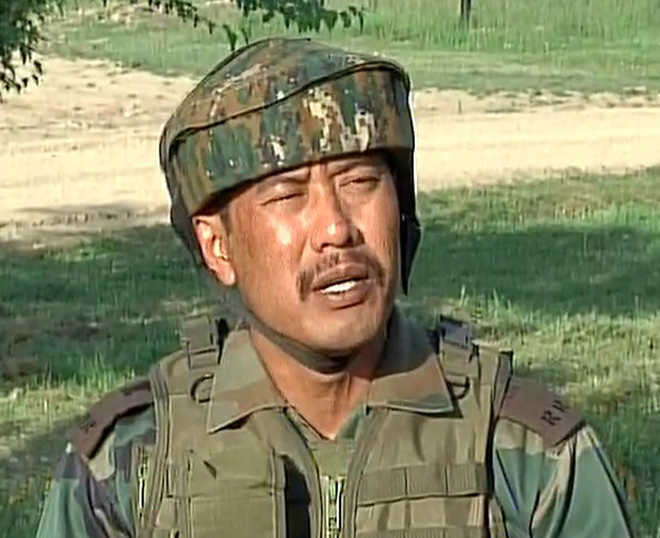
In a setback to Major Littul Gogoi, against whom an Army Court of Inquiry has already recommended disciplinary action, the Chief Judicial Magistrate, Srinagar, has directed the J&K Police to further investigate the hotel incident.

The CJM directed the police to submit the report by the next date of hearing.

The court observed that the investigation in the matter had been conducted in a casual manner without ascertaining the real facts.

Major Gogoi was detained by Jammu and Kashmir Police on May 23 from a Srinagar hotel, along with a local woman and another soldier.

The woman detained along with Major Gogoi was 19 and had gone with the officer of her own volition, Jammu and Kashmir Police had said; hence, no police case was made out.

However, the Army rules did not allow Gogoi to be let off without punishment.

After the incident, Army Chief Gen Bipin Rawat had announced exemplary punishment for Major Gogoi in case he was found guilty of any offence.

Last year, Major Gogoi had been accused of using a youth in Budgam district as a human shield. Gen Rawat had awarded him and supported his act then.


Army opens fire after Pak chopper violates Indian airspace in J&K’s Poonch

https://twitter.com/twitter/statuses/1046318954212339713

http://

http://

the Indian airspace along the Line of Control (LoC) in Poonch district of Jammu and Kashmir but turned back after it was “engaged by air sentries”, the Army said.

The chopper, which came 700 meters into the Indian air space, belonged to Pakistan-Occupied-Kashmir Prime Minister Raja Farooq Haider, sources in the Indian Army said.

Jammu-based Army PRO Lt Col Devender Anand said the helicopter violated the airspace around 12:10 pm. “Air sentries at forward location had engaged it with small arms,” he said.

He said it was most likely a civilian chopper and was flying very high.

Officials said a white-colour helicopter crossed into the Indian airspace in Gulpur sector and hovered over there for sometime before turning back.

Three forward posts fired small arms after noticing the airspace violation, the sources said. PTI

http://


Air Force Vice Chief Accidentally Shoots Himself In Thigh, Is Stable

Air Marshal Deo had taken over as the Vice Chief of the Air Staff in July. He had replaced Air Marshal BS Dhanoa, who is now the Air Chief.

Air Force Vice Chief Accidentally Shoots Himself In Thigh, Is Stable

The Vice Chief of the Indian Air Force, Air Marshal Shirish Baban Deo accidentally shot himself in the thigh on Wednesday.
Air Marshal Deo was rushed to the RR Hospital in Delhi where he underwent a surgery and his femur bone was set, say sources. He is said to be stable.

Air Marshal Deo had taken over as the Vice Chief of the Air Staff in July. He had replaced Air Marshal BS Dhanoa, who is now the Air Chief.

SB Deo, who was commissioned as a fighter pilot in the Air Force on June 15, 1979, is an alumnus of the National Defence Academy and the Defence Services Staff College, Wellington.

14 COMMENTS
He has been Air Officer Commanding (AOC) of a major fighter base and commanded a Mig-21 Bison Squadron and a Signal Unit besides being the Chief Operating Officer of a forward base. As Station Commander of the Signal Unit he was actively involved in the induction of modern assets and sensors in the Air Force.


Actually, the Indian Air Force has never been without a Dassault aircraft

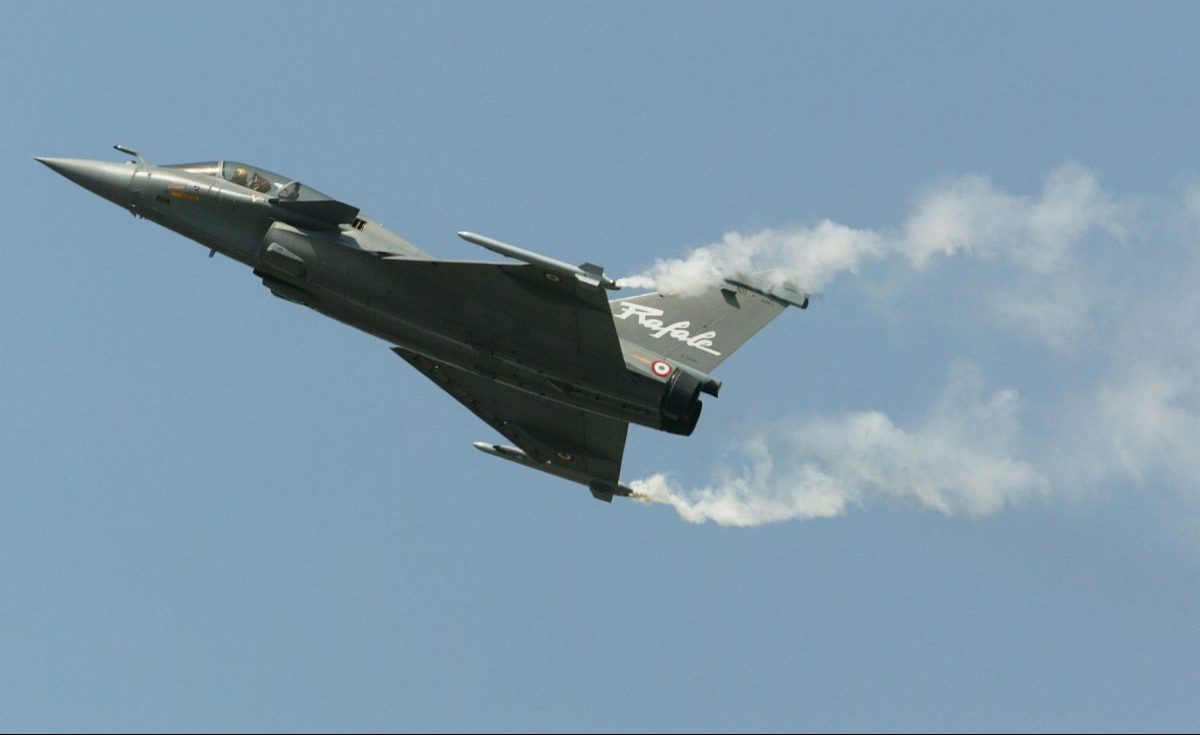
IAF has been using fighter jets made by Dassault, a French company since 1953. It deployed Mirage 2000 to drop laser-guided bombs during Kargil war.

New Delhi: As the Rafale deal comes under intense political scrutiny, history tells us that the Indian Air Force (IAF) has never been without a Dassault aircraft since 1953.

A look at some of the IAF’s flagship fighter planes over the years suggests that Dassault Aviation has been a mainstay manufacturer since early 1950s.

A ‘toofani’ start

India started purchasing Dassault’s aircraft in 1953 when the IAF decided to induct MD Ouragan 450 in its fleet. After Independence, India had bought the British fighter Vampire from the leftover sterling credit. However, the need for a more advanced jet fighter was acutely felt, which led to the decision to purchase Ouragan. India initially placed an order for 71 Ouragans but later raised it to 113.


Also read:Dassault didn’t pick Anil Ambani’s Reliance as Rafale partner: French ex-president


For the next decade or so, this aircraft, also known as Typhoon or Toofani, became the quintessential IAF fighter jet in every Indian’s imagination. In the famous 1964 movie Sangam, Raj Kapoor was shown flying an Ouragan which etched that image in public memory.

The plane acquired prominence in Pakistan’s history as well when an Indian Ouragan conducting a reconnaissance mission was captured by Pakistani forces during a border skirmish at Kutch in 1965.

Devaiah’s ‘Mystere’ mystery

By this time, however, Ouragan had become outdated and was beginning to be replaced by more advanced aircraft.

One of them was the multi-role fighter Mystere IVa, which was also manufactured by Dassault. A total of 104 Mystere IVa’s were purchased in 1957 and were extensively used during 1965 and 1971 wars with Pakistan. The plane remained in active duty until 1973.

During the 1965 war, Squadron Leader A.B. Devaiah was sent on a mission to attack Sargodha airbase in Pakistan. However, his plane was intercepted and damaged by an F-104 fighter being operated by Pakistani Flight Lieutenant Amjad Hussain. Despite taking a hit, Devaiah managed to counter-attack and shot down the F-104 whose pilot managed to eject in time.

It was initially believed that Hussain’s plane crashed after getting entangled in the debris of Devaiah’s plane and it took some time before the latter’s heroics were recognised. IAF learnt about it in 1971 when Hussain was taken as a POW by the Indian forces. Later, the account was recounted in a book, Battle for Pakistan by John Fricker. Devaiah was posthumously awarded a Maha Vir Chakra in 1988.

Kargil’s French connection

The relationship between IAF and Dassault continued when India decided to purchase Mirage 2000 in 1982. During the 1999 Kargil war, IAF used this aircraft to drop laser-guided bombs on enemy positions.


Also readThe big questions about the Rafale deal you didn’t know whom to ask


Dassault isn’t the only French company from whom India has purchased fighter jets. The Morarji Desai government had acquired Jaguar, made by French-British company SEPECAT, in 1979.