Sanjha Morcha

Imran’s mistakes perpetuate old narrative by Lt Gen Bhopinder Singh

The second sign of sovereign intransigence and policy-perpetuity were in the usual handling of the India-Pakistan relationship.

Pakistan Prime Minister Imran Khan. (Photo: AP)

 Pakistan Prime Minister Imran Khan. (Photo: AP)

Back in 2013, Imran Khan had successfully posited his conceptual “Naya Pakistan” in public imagination by way of a theatrical six-point pledge that sought to usher in an era of “change”. The fundamental changes sought in the Pakistani governance veered around the principles of probity, inclusivity and rapprochement. His six specific pledges included: “I will always speak the truth to the people of Pakistan” and “We will stand together with every Pakistani in or outside Pakistan”. While Mr Khan’s personal popularity and appeal did connect and elevated his fledgling Tehreek-e-Insaf to be the second biggest political party by way of popular votes — 16.92 per cent, Mr Khan had to wait for another five years before finally dethroning PML(N) in 2018 to shape his promise of “Naya Pakistan”. With the adequacy of winning legislatures in the National Assembly and with the most crucial backing of the Pakistani “establishment” (read, military) in tow — the situational circumstances were perfectly aligned to change the natural Pakistani instincts and essential narrative, once and for all.

Unfortunately, the proposed “change” was premised on embryonic falsehood as Mr Khan had liberally given tickets to last-minute party-hoppers from the PPP and PML(N) (termed “electables”), who personified the dynastic, vile and the notoriety of feudal-hinterlands. Twenty-three of these 46 “electables” won the day for Mr Khan and added more than four million of the total nine million additional votes (vis-à-vis 2013 national elections) garnered by the Tehreek-e-Insaf in 2018. This genealogical compromise of principles militated against the promised-purity of “Naya Pakistan” as it perpetuated the curse of biradari politics (communal-societal-sectarian grouping), clearly signifying the importance of “electables” over “deliver-ables”!

Early signs of Mr Khan’s political “reverse-swings” were questioned by his co-agitator in the landmark “Azadi March” of 2014, cleric Tahir-ul Qadri whose lament: “If electables were necessary then why 200 million population was humiliated. Why were the protests held and commotion caused” went unheeded in the convenient cover of political expediency and electoral necessity.

Mr Khan’s victory speech before his formal appointment as the Prime Minister was loaded with gratuitous homilies, religious invocations and some populist grandstanding like “embarrassed to live in PM house”, “two steps for every one step by India” and the rote reiterations on Kashmir, Afghanistan and correction of the “one way” relationship with the US! However, soon the penny of natural instincts dropped with the congratulatory phone call by US secretary of state Mike Pompeo to Mr Khan. Though a perfunctory call, it unequivocally carried the US concerns on “Pakistan taking decisive action against all terrorists operating in Pakistan” which was routinely and cavalierly denied by Islamabad. The Americans with the backdrop of Donald Trump’s opening New Year salvo of Pakistani “lies and deceit” were in no mood to entertain the Pakistani bravado and quietly released the transcript of the said call, thereby embarrassing the Pakistanis at the very outset. Given the fractious US-Pakistan equation and the forthcoming visit of Mr Pompeo to Pakistan, the matter was buried in the know that Pakistan had faltered and lied yet again, and that the instinct of dishonesty still prevailed.

The second sign of sovereign intransigence and policy-perpetuity were in the usual handling of the India-Pakistan relationship. Since his arrival onto the political centrestage, Mr Khan has expectedly played down any civil-military dissonance and had steadfastly maintained a position of perfect unison and understanding between the two institutions. If so, then his ostensibly reconciliatory tone towards India was thrashed rather immediately and publically by Pakistani Army Chief Gen. Qamar Javed Bajwa, who on addressing the 53rd anniversary of the 1965 India-Pakistan war railed: “We will avenge the blood flowing across the border” and robotically alluded to Jammu and Kashmir by provoking, “brothers and sisters in the occupied Jammu and Kashmir who are writing the history of resistance”, all this with Prime Minister Khan in attendance and obvious acquiescence. While a certain muscularity in the phraseology of the Army Chief on their “Defence Day” is normal, however, the threatening-contextualising on Jammu and Kashmir was both avoidable and augury of the continuation of the narrative.

The third blatant retraction from the postured pledges of “inclusivity” and non-discrimination were exposed in the forced resignation of Prof Atif Mian, belonging to the minority sect of the discriminated Ahmediya faith, from the newly-constituted membership of the Economic Advisory Council. The abandonment of meritocracy for the sake of pandering to religious bigotry, intolerance and continuous demonisation was reflective of the governance of yore. The same nation that had disowned its finest like the fellow-Ahmediya, Prof Abdus Salaam (first Pakistani to win a Nobel Prize) by desecrating the epitaph on his tombstone which read “First Muslim to win a Nobel Prize”, had shown that the new Imran Khan government was no different from that of the earlier dispensations. The supposed threat of a public “sit-in” by religious groups and supremacist sects in front of the visiting Saudi minister for information Dr Awwad Bin Saleh Al-Awwad was felt to be grave enough to succumb, surrender and set an early and regressive precedent of the five-year tenure.

For a first-time-at-the-Centre, Tehreek-e-Insaf’s government is saddled with 13 of the 16 elected Cabinet members, who were either part of the earlier Gen. Musharraf or PPP regimes. It will take Mr Khan more than the personal renunciation of the privileges or the sudden discovery of “dead capital” worth Rs 300 billion in the form of government land, in order to tide over its crippling socio-economic woes.

Mr Khan’s thunderous statements, grandiloquence and bravado of the quintessential “Opposition leader” was usually a lot more free-flowing, dramatic and quick-fix in nature, as opposed to the onerous task of changing the essential sovereign narrative of probity, inclusivity, austerity and rapprochement towards fructifying “Naya Pakistan”. Almost one month in the saddle have been a clumsy ride of the “sameness” that has been bereft of any brave departure from the past, and importantly the opening mistakes have been done with the full know, acceptance and perpetuation by Mr Khan.
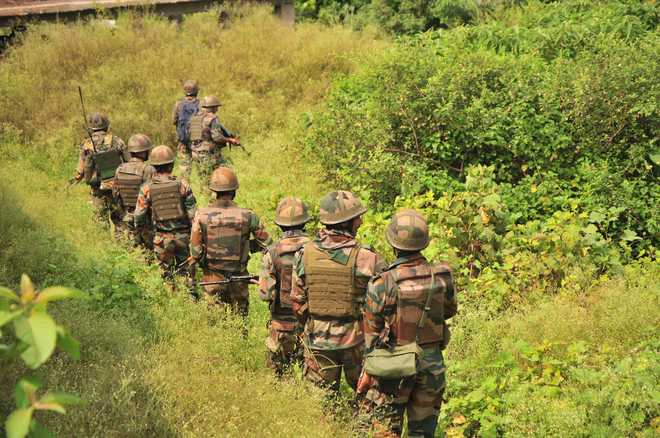
Massive search operation under way in Shopian, Pulwama dists of J&K

Massive search operation under way in Shopian, Pulwama dists of J&K

 joint team of police, Army and paramilitary CRPF launched the CASO to flush out militants from the area. Tribune file

Srinagar, September 22

A day after three policemen were abducted and killed by militants, security forces on Saturday launched a massive cordon and search operation in Shopian and Pulwama districts of Jammu and Kashmir, police said.

The cordon and search operation (CASO) was launched in at least eight villages in Pulwama and Shopian districts in south Kashmir early this morning, a police official said.

He said a joint team of police, Army and paramilitary CRPF launched the CASO to flush out militants from the area. The official said the operation was going on when last reports came in.

Three cops were on Friday abducted and later killed by militants in Shopian district.

Meanwhile, clashes broke out between groups of youth and security forces during the CASO at Shermal in Shopian, the official said.

He said youth pelted stones on the security forces carrying out searches in the area.

The forces fired tear gas shells to quell the protests, the official said, adding, clashes were going on. PTI


REMARK BY DEFENCE MINISTER :UNWARRANTED ::: DOES INDIAN ARMY MORALE DEPENDS ON HUGS

Sidhu’s act of hugging Bajwa demoralised Indian soldiers: Sitharaman

Sidhu’s act of hugging Bajwa demoralised Indian soldiers: Sitharaman

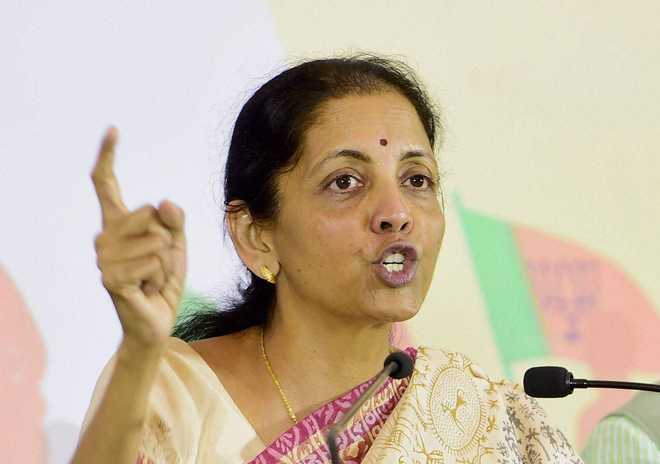
Defence Minister Nirmala Sitharaman. File photo

Tribune News Service
New Delhi, September 18

Ministers of the Bharatiya Janata Party continue to criticise Punjab Minister Navjot Singh Sidhu over last month’s visit to Pakistan where he was caught on camera hugging the country’s army general Qamar Javed Bajwa.

Defence Minister Nirmala Sitharaman said on Tuesday that Sidhu’s popularity made his action significantly worse.

“I speak as Raksha Mantri, hence with double (sic) responsibility—Sidhu should have avoided that singular gesture of hugging the Army Chief. He’s popular: his action has demoralised soldiers and people,” she said.

Sidhu visited Pakistan on August 17 to attend the swearing in ceremony of Pakistan’s new Prime Minister Imran Khan in an event that continues to haunt him a month later. A camera caught Sidhu hugging Bajwa at the function—an act that was excoriated by his critics and gave his former party the BJP ammunition to target the Congress with.

VETERNAS TO SEND THEIR COMMENTS ON EMAIL

Hope the Defense Minister should have given second thought before giving such a illogical statement . If Army gets demoralise on HUG than Pakistan will escalate HUG war against India to completely shattered Indian Army Moral. Why mix politics with forces .Is the India Army soldier mentally so weak that an act by some minister will lower their morale.

What is the govt doing to uplift the morale of soldier till date .

sanjhamorcha303@gmail.com


Barnala soldier shoots 2 seniors dead, kills self in Dharamshala

21­YEAR­OLD JASBIR, A SEPOY WHO SHOT HIS TWO SENIORS DEAD, HAD JOINED THE ARMY OVER A YEAR BACK

DHARAMSHALA: An army jawan shot his two colleagues dead before committing suicide in Dharamshala military station in Kangra district of Himachal Pradesh, police said on Monday.

HT PHOTO■ Jasbir Singh’s father Nirbhai Singh (R) being consoled by neighbours at his house in Barnala.“A soldier of 18 Sikh Regiment ran amok in the early hours on Monday shooting two of his colleagues dead before killing himself,” said Kangra assistant superintendent of police (ASP) Badri Singh.

“The incident took place at around 2.15 am inside the cantonment,” he added.

According to the information, 21-year-old Sepoy Jasbir Singh fired at Havildar Hardeep Singh, 45, and Naik Harpal Singh, 35, with his INSAS rifle before shooting self.

Jasbir was a native of village Rajgarh of Barnala, while Hardeep was from village Marhana, district Tarn Taran, and Harpal from village Thundi, district Gurdaspur in Punjab.

Jasbir had joined the army a year-and-a-half ago while Hardeep and Harpal have completed 23 and 18 years in service, respectively. “Circumstances in which Jasbir took the drastic step are yet to be ascertained,” said the ASP. “A case under Section 302 has been registered at the McLeodganj police station. We are investigating all possible angles to find out the exact reason,” said Badri, adding Jasbir fired 10 rounds on his colleagues.

He said a team of forensic experts from Regional Forensic Science Laboratory (RFSL) Dharamshala visited crime spot and collected samples.

Commanding Officer (CO) of 18 Sikh Regiment at Dharamshala cantonment Navdeep Brar said prima facie it seems that Jasbir, after coming back from the duty, had an argument with the other two soldiers and in a fit of rage he shot them and later himself. Jasbir was on sentry duty in the cantonment mess.

Army has ordered court of inquiry into the incident.

Meanwhile, bodies of the deceased soldiers have been sent to Dr Rajendera Prasad Government Medical College Tanda.

It is the first fratricide incident in the 18 Sikh Regiment. BARNALA : At Rajgarh village in Barnala district, some neighbours and relatives gathered at the house of Nirbhay Singh, a farmer, on Monday afternoon. There were curious faces all around as they knew something wrong had happened.

People came to know from some news channels that a fratricidal shooting had taken place at the Dharamshala military station in the neighbouring Himachal Pradesh, resulting in the death of three soldiers.

And the man who opened fire was Nirbhai’s younger son Jasbir Singh who also killed himself before shooting his two senior colleagues — Havildar Hardeep Singh and Naik Harpal Singh — of the 18 Sikh Regiment.

Jasbir (21), a sepoy, had joined the army only one-and-a-half-years back.

All that Nirbhay and his wife were informed by those present was that Jasbir had met with an accident and was hospitalised. But his father would not buy it. “I usually get calls from Jasbir every three days. I had spoken to him on Saturday. Today, his phone is switched off. Kitey uss di maut taan nehi ho gayi? Sach dasso mainu. (Seems like he has died. Tell me the truth).”

Also, his mother, getting suspicious, repeatedly enquires about the well-being of her son. “My nephew left his lunch even before he started having it. I got a call from my elder son Jagdeep but he did not say anything. It seems something serious has happened,” Nirbhay said further.

Jasbir’s uncle Surjit Singh, who knew about his death, said, “My son’s marriage is fixed for November. A few days back, Jasbir told me over phone that he will take leave to attend the marriage. Now, he will never come. He had left his polytechnic diploma course midway to join the army.” A MILD-MANNERED MAN, SAY LOCAL RESIDENTS Many relatives and friends of the family recalled Jasbir as a softspoken person. His elder brother, Jagdeep Singh, also in the army, is posted at Baramulla in Jammu and Kashmir.

Village sarpanch Karamjit Singh said, “Jasbir was a polite. Around six months back when came on leave, he met me. He was quite happy about his job.”

“His body will reach here tomorrow after conducting of autopsy,” added Karamjit.

Jaspal Singh, a villager who retired as havildar from the army, said, “As there are not many job options here, Jasbir opted for the army. As his brother was already in the army, the ‘relation certificate’ made it easy for Jasbir to get recruited.”

A village panch, Amrik Singh, said, “There are around 12-13 persons in army from our village. Nirbhai was brave enough to send both his sons to the army.”

The family had got no official communication either from the army or the district administration regarding the incident till filing of the report.


Army officers must serve wherever posted: SC Zoom

ARMY PERSONNEL’S OATH REQUIRES THEM TO “GO WHEREVER ORDERED, BY LAND, SEA OR AIR”

NEWDELHI: Army officers are dutybound under the oath they take to serve the country wherever they are posted, the Supreme Court has said while disposing of a petition by three army personnel challenging their posting orders.

A bench of justices RF Nariman and Indu Malhotra dismissed the plea by the Army Service Corps personnel, holding the ranks of major, lieutenant and sepoy against the transfer orders. The judges strongly disapproved of the officers questioning their transfers before a judicial forum.

Army personnel’s oath requires them to “go wherever ordered, by land, sea or air.”

The petitioners had challenged their transfer from a non-operational unit to operational areas. They relied on an earlier SC order wherein it was held that Army Services Corps, the Corps of Electronics and Mechanical Engineers (EME) and other minor corps are “non-operational units and formations.”

That case before the court pertained to promotional avenues for army personnel.

As a consequence of the top court judgement, the petitioners said, they were non-operational officers for promotional avenues. Hence, they argued, the same classification should be followed for the purpose of deployment and postings, too.

The Centre opposed the petitioners and cited the oath administered to army personnel. Transfers, the government submitted, were not only a necessary incident of service but an essential condition of service. Postings are a part of their regimental duty and not dependent on their willingness, it said.

The court accepted the Centre’s stand and held that irrespective of the service to which the officers are commissioned, personnel are duty-bound to serve wherever they are ordered to.


Welcome to the world of hassle-free passport

CHANDIGARH: From doing away with police verification and marriage or divorce deeds to enabling applicants to apply anywhere in India, the recent amendments by the Ministry of External Affairs have made obtaining a passport an easy affair.

WHERE DO YOU NEED TO APPLY FOR A PASSPORT?

Now, you can apply from anywhere in India. Choose the Regional Passport Office (RPO) and the Passport Seva Kendra where you want to submit the application even if the residential address in the form doesn’t fall in the jurisdiction of the said RPO. The police verification, if required, will be conducted at the temporary address specified in the form.

HOW CAN SINGLE PARENTS APPLY FOR PASSPORTS FOR THEIR KIDS?

The consent of both the parents is no longer required for passport. Now the applicant can furnish the name of only one parent or legal guardian in the online form.

Also, the divorcees and those separated can drop the name of their former spouse without having to provide the divorce declaration or decree.

WHAT FOR ADOPTED, ORPHANED OR THOSE BORN OUT OF WEDLOCK?

Adopted children can simply give a declaration on a plain paper declaring the adoption. Children born out of wedlock would be required to give a statement that the other parent has not given consent for the passport.

In case of orphaned kids without any proof of date of birth, a declaration on the official letterhead from the head of the orphanage or the child care home authenticating the DOB of the applicant would suffice.

DO YOU STILL REQUIRE ATTESTATION?

No, applicants can submit the required annexures in the form of self-declaration on a plain paper without any attestation or affidavits.

HOW WILL ELDERLY AND CHILDREN GET RELIEF WITH F­TOKENS?

The RPO at Chandigarh has introduced an F-token facility for four categories of applicants: 1. children below six years of age; 2. their parents; 3. senior citizens, and 4. physically handicapped. This means they have to take an online appointment, but don’t have to wait in a queue.

IS THERE ANY RESPITE FROM POLICE VERIFICATION IN PERSON?

Police verification has now been restricted to those with a criminal record. As such, no cops will visit the residence of the applicant.

IS OFFICER’S RECOMMENDATION REQUIRED FOR A TATKAL PASSPORT?

The Ministry of External Affairs has done away with the mandatory requirement of Annexure F, which entailed the recommendation of a Class I officer.

WHAT IS M­PASSPORT SEVA MOBILE APP?

The mPassport Seva mobile app available in Android and iOS platforms lets you apply, pay for, and schedule appointments for passport services.

HOW INDISPENSABLE IS THE MARRIAGE CERTIFICATE?

Married applicants don’t require to furnish the marriage certificate or the erstwhile Annexure K anymore.

WHICH DOCUMENTS CAN SERVE AS PROOF OF DATE OF BIRTH (DOB)?

Apart from the birth certificate (BC) issued by the Registrar of Births and Deaths or the Municipal Corporation or any other prescribed authority, the MEA has now allowed the following documents to be accepted as DOB proof. These include:

* Transfer/school leaving/matriculation certificate issued by the school last attended/recognised educational board, PAN Card, Aadhaar Card/ E-Aadhaar, copy of the extract of the service record of the applicant (only in respect of government servants) or the Pay Pension Order (in respect of retired government servants), duly attested/certified by the officer/in charge of the administration of the ministry/department of the applicant, driving licence, Voter Card issued by the Election Commission, a policy bond issued by the public Life Insurance Corporations/companies.


IAF pilots get feel of Rafale fighter jets

Tribune News Service

New Delhi, September 3

Even as the Congress and the BJP carry with their slugfest over the Rafale fighter jet deal, Indian Air Force pilots are now getting a feel of the French Air Force-operated jets that are presently in India on transit visit of three days.

Three Rafale are now at the IAF base in Gwalior, Madhya Pradesh, where IAF pilots and their French counterparts will do “joint flying’. Gwalior is the base of Mirage 2000 jets, made by Dassault aviation, also the makers of Rafale. Last week, IAF pilots had a feel of the Rafale in Australia at a multi-nation exercise “Pitch Black”.

India’s own 36 Rafale start arriving only in September 2019. The Rafale jets in India are a part of the French Air Force organised mission ‘PEGASE’ in the Asia-Pacific region. One Atlas A-400M military transport aircraft, one C-135 re-fuelling aircraft and one Airbus A310 cargo aircraft are also in India.

The planes are returning back to France from a detachment in Australia. “This operational mission aims to reinforce France’s presence in this region of strategic interest”, said a statement of the French Embassy here. The French team is on a three-day stopover at the Air Force Stations in Gwalior and Agra


Rain, lightning leave 16 dead, 12 hurt in UP Met dept issues warning for next two days

Rain, lightning leave 16 dead, 12 hurt in UP

Lucknow, September 2

As many as 16 people died and 12 were injured in rain-related incidents across Uttar Pradesh since Saturday, officials said on Sunday, with the meteorological department predicting rainfall throughout the state for the next two days.

Shahjahanpur bore the brunt of the weather’s onslaught on Saturday as six persons, including four children, were killed in incidents of lightning strike while seven were injured.

A statement by the office of the UP Relief Commissioner said on Sunday, “Six persons  lost their lives in Shahjahanpur while three died in Sitapur district of the state.”

“Two people died each in Auraiyya and Amethi. One person each died in Lakhimpur Khiri, Rae Bareli and Unnao. All the deaths took place yesterday,” it said.

Eighteen animals perished and 461 houses/huts were damaged, the statement said.

The meteorological department said widespread rain is predicted in eastern and western parts of the state on Monday and Tuesday.

District Magistrate Amrit Tripathi said some youngsters were grazing cattle in Shamsherpur village on Saturday when a sudden downpour forced them to take shelter under a tree where they were hit by lightning.

“Financial assistance of Rs 4 lakh is being made available to kin of the deceased,” he said. — PTI


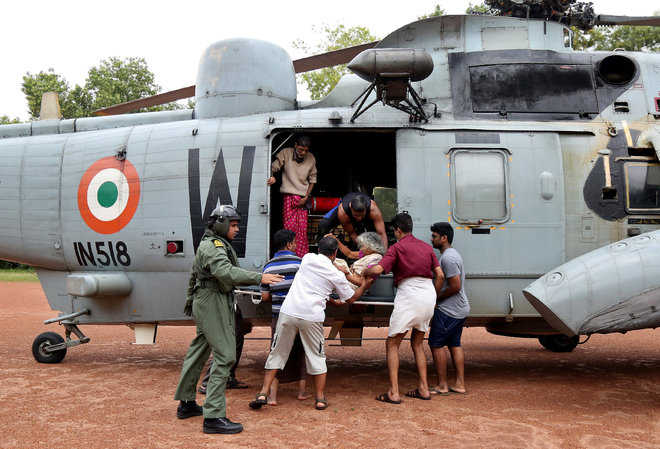
IAF rescues 14 stranded in Lalitpur, Jhansi 

Lucknow: Air Force personnel on Sunday rescued 14 persons stranded in Lalitpur and Jhansi districts of Uttar Pradesh due to heavy rain, officials said. Six people were marooned in a village of Lalitpur while eight fishermen were stranded on an island near Erech dam on the Betwa in Garautha tehsil of Jhansi.


In a first, Attari border pips Jallianwala Bagh in tourist footfall

AMRITSAR: For the first time, the Attari-Wagah border joint check post (JCP) has pipped Jallianwala Bagh in terms of tourist footfall and has become the second most-visited destination in Amritsar after the Golden Temple.

SAMEER SEHGAL/HTVisitors during beating the retreat ceremony at the Attari­Wagah border in Amritsar. The ceremony is being jointly followed by the two countries since 1959.As per the state tourism department, nearly 15,000 people witness beating the retreat, a flag-lowering ceremony, at the border check-post everyday. However, the number is around 25,000 on Saturdays and Sundays. Beating the retreat has been jointly followed by the two countries since 1959 with the Border Security Force (BSF) jawans and Pakistani Rangers displaying aggressive posturing and foot-stomping.

District tourism officer Gursharan Singh said, “Around 10,000 people visit Jallianwala Bagh daily and around 15,000 people witness the retreat ceremony everyday.”

“On weekends, the rush increases to more than 25,000. We are now considering the border as second most-visited tourist site in the city.”

Though the retreat ceremony starts at 5:30 pm, hundreds of people can be seen standing in queues from 2pm daily at the JCP. This is regardless of the scorching heat in summer.

NEW DEVELOPMENTS AT THE BORDER

Looking at the increasing footfall, a newly upgraded spectator gallery was constructed at the JCP at a cost of Rs 32 crore.

As per BSF officials, the old gallery could accommodate only 5,000 people but the new gallery gives space to around 25,000 viewers.

The new U-shaped gallery,

which seems to complement the one on the Pakistan side, has 32-meter height (equivalent to a nine-floor building). The 22 dooms constructed atop the gallery give it a heritage look.

The gallery has a conference hall, 140 public toilets, nine barracks for jawans, a medicalaid room, a meeting hall, a dining hall, a kitchen, an army weapon exhibition room and a souvenir shop.

Satinder Mahajan, owner of the gallery’s construction company said, “For security, we have installed 60 high-definition

imported cameras in the gallery, along with a high-quality fire-fighting system. We have also constructed a museum inside the gallery which is yet to be started. The museum will depict the glorious history of BSF, its achievements and weapons, among other things”.

“A big LED screen is also installed outside the gallery. When the entire gallery is packed on Saturday and Sunday, people see the retreat ceremony live on the screen by standing outside the gallery”, he added.

Mahajan said they spent Rs 21 lakh to install a new gate at the Indian side. “The new gate provides better view to Indian spectators to look across the border. A similar gate has also been put up at the Pakistan side”, he said.

As the sun sets, both the gates at the border are opened and the flags are lowered simultaneously.

The district tourism officer said since the new gallery was constructed, the border is attracting more tourists.

Though the BSF makes people sit inside the new gallery, it

is yet to be inaugurated.

On Wednesday, the gallery was to be inaugurated by BSF’s DG KK Sharma, but the ceremony was postponed till further date on Tuesday night.

GENERATING MORE JOBS

As the footfall at the border is increasing, there have been more opportunities of employment for people. Dozens of new eateries have opened near the border and it is like a fair every evening, outside the JCP.

Hundreds have been given

employment at the JCP to sell tricolor flags, umbrellas, cold drink, water and other food items to tourists.

Kulwant Singh, who sells junk food at the gallery said, “More than 200 workers of the Attari and nearby villages have recently been employed here.”

Harish Sharma, a local taxi driver, said, “I belong to Chandigarh and I get around 15 to 20 customers in a month for the Attari border itself. Around 1,000 taxis can be seen parked daily here. After Golden Temple, this site has generated employment for us.”

INSTILLS PATRIOTISM

Before the actual ceremony begins, women and children can be seen dancing to patriotic Bollywood songs at the border.

“It was my first visit to Amritsar

and also to watch the Retreat ceremony here. I have never experienced this in my life. The 25-minute spectacle touched my soul and instilled patriotism in me. I feel every Indian should come here once,” said Sanjeev Kumar, a tourist from Delhi.


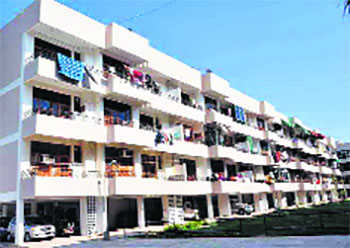
Badnore gives nod to policy for transfer of society flats Major relief for those living in over 10,000 dwelling units in city

Badnore gives nod to policy for transfer of society flats

Chandigarh, September 28

In a major relief for thousands of people living in over 10,000 flats of group housing societies in the city, Punjab Governor and UT Administrator VP Singh Badnore has approved the new policy for transfer of flats.

The new policy will allow residents to become owners by getting the conveyance deed executed, which was stopped after the Administration started the process of framing the new policy. The Administration had started the process to review the policy for the transfer of flats six months ago.

The last transfer policy was announced in 2016. Under the current procedure, the sale/purchase was allowed on the basis of a conveyance deed, which had to be executed on the payment of stamp duty at the prevailing collector rates and after getting a no-objection certificate from the society concerned.

Sources said the Governor had given relief to residents by giving a one-time relaxation in the proposed unearned profit charges and the subsequent stamp duty. The sources said the Administration would not impose unearned profit charges on those who applied under the scheme in the next one year.

The Administration is likely to make public the details of the relaxations and other conditions soon. The residents got worried after the unearned profit charges clause was included in the policy.

The proposal for imposing unearned profit charges was included in the draft policy for transfer of flats. Unearned profit is the difference between the price paid by the original allottee and the market value of the site/building at the time of permission for the transfer. The Administration has proposed to charge 1/3rd of the unearned profit.