Sanjha Morcha

Solar city a pipe dream Zoom

Find out why the City Beautiful has given a lukewarm response to the idea of generating its own electricity with the help of the sun

From page 01 CHANDIGARH: It was more than two years back on May 18, 2016 that the modified building by-laws set the stage for transforming Chandigarh into a model solar city by making it compulsory for virtually all new and old residential, commercial and government buildings to install solar power plants. Two years on, the scheme is yet to take off. Reason: ignorance about the long-term monetary and ecological benefits of the plants that may seem high-priced at first, and some technical hitches.

KARUN SHARMA■ BYE BYE BILLS: Harjit Kaur, who installed an SPV solar plant last year, has been getting zero bills ever since.Chandigarh Renewal Energy and Science & Technology Promotion Society (CREST), the nodal agency for this project, has so far set up Rooftop Solar Photo Voltaic (SPV) Power Plant Projects at nearly 260 government establishments, including 82 institutions, four hospitals, 14 colleges, 81 schools and about 78 houses with a capacity of nearly 17961 kWp (kilowatt peak).

ONLY 10% RESIDENCES

But a senior CREST official rued that so far less than 10% of residential consumers have installed these plants. “While the new constructions can’t evade SPV plants as per the building bye-laws, we are yet to change the mindset of residents at large,” said the official. There are also technical reasons like trees covering rooftops, which come in the way of harnessing solar power.

Solar power systems are rated in kilowatts peak (kWp), the rate at which the SPV system produces energy at peak performance hours on a sunny day. One kWp system generates at least 10 units a day. A kanal house with four members consumes 30 units a day.

But the few residents who have opted for the solar plants are happy with the results. Harjeet Kaur, a resident of Sector 44 who got an SPV plant on her 190 sq yards house in June 2017, beams as she says, “Ever since, my bill has been in the negative. This means that our panel is generating enough power to not only meet our requirement, but is also sending the rest of the power to the grid, which will be adjusted in our bills for days when we don’t have enough sunshine.” The plant, she said, also keeps them in a lower tariff slab. “Thanks to the solar power backup, the number of units we get from the grid supply also remain less.”

N S Randhawa, a retired police officer settled in Sector 38 West, opted for gross metering system nearly two years back. “I send all the power generated to the grid. I am paying back for what I used to get from the Bhakra Nangal all these years. I came back to city in 2014 and opted for the Solar PV plant the moment it was mandated,” says Randhawa, who believes more people will take to the SPV plant if they knew that they would be able to recover the full cost of the plant within four to five years.

Listing other advantages of these plants, he said, “It requires little maintenance, has a shelf life of 25 years and is my contribution towards a green planet.”

Experts say solar plants also bring down the heat load of top floor by generating solar power to run electrical instruments in the house.

GROSS VERSUS NET METERING

Chandigarh consumers can opt for gross metering or net metering while installing SPV plants. In net metering, a consumer after generating and using solar power, can feed excess power into the grid to be adjusted in future billing cycle till the end of the settlement period, which happens twice on September 30 and March 31.

Under gross metering, the consumer can sell the entire solar power to the power grid through the distributing company, and get a solar tariff.

At present Ministry of Non-Renewable Energy is giving 30% of the cost of the SPV plant as subsidy. The single online platform, www.solarchandigarh.com not only ensures subsidy but also gets you all the regulatory clearances within a month. The list of empanelled vendors is also available on this website.


Two militants killed in Handwara

Two militants killed in Handwara

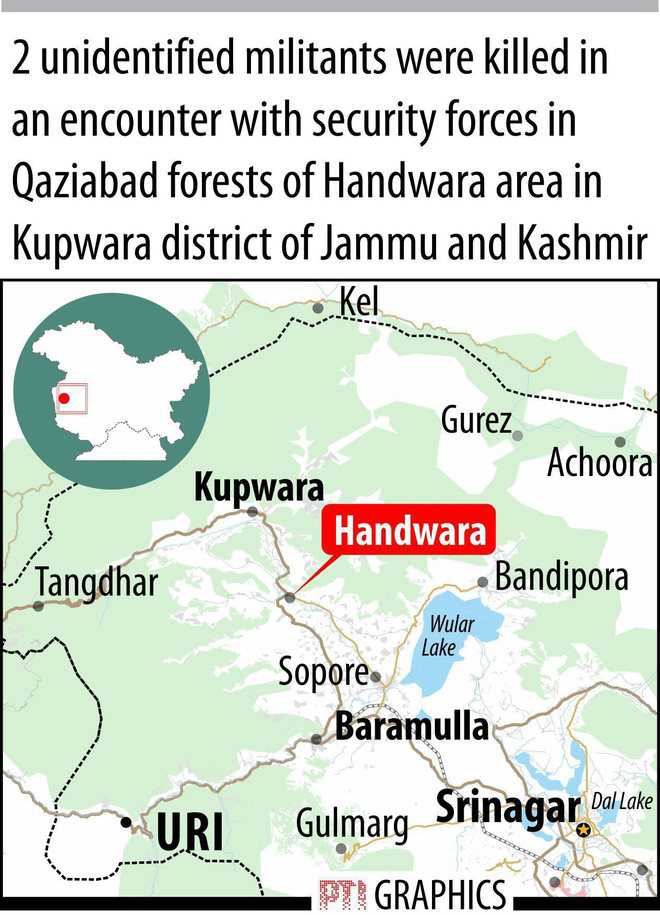
Handwara: Two militants were killed in an overnight gun battle in the Qaziabad forest of the Handwara area in Kupwara district, the Army said on Thursday. A search operation launched in the forest area on Thursday morning following the gunfight was called off this evening, a police officer said. “The bodies of the two militants were found during the searches. Their identity, however, could not be established. Some ammunition was also recovered from the forest area during the search operation,” he said. The gunfight which lasted about three hours broke out on Wednesday evening after the militants opened fire on an Army patrol, he said. OCVideo of ultras questioning SPO goes viralSrinagar: A video showing militants interrogating a Special Police Officer (SPO), who was shot at and critically injured by the ultras in Pulwama district, has gone viral on the social media. SPO Aqib Wagay was shot at in his both legs by the militants in Puchal village of the south Kashmir district on Tuesday, leaving him with critical injuries. The video was shot before he was fired upon. The 1.23-minute-long video shows that he was being questioned by the militants for being involved in supply of liquor to villages from an Army camp. Immediately after being shot, Wagay was shifted to a nearby hospital. Later, he was referred to 92 Base Hospital here. A police official said Wagay was recovering in the hospital but his leg was amputated to save his life. PTIVillager killed in landmine blast Jammu: A villager was killed in Poonch district on Thursday when he accidentally stepped on a landmine near the LoC. He has been identified as Imam Din of Bagyal Dara village. Landmines are planted by the Army near the LoC to prevent infiltration. IANS Guv congratulates Real Kashmir FCSrinagar: Governor NN Vohra has congratulated Real Kashmir, a football club in the state, for qualifying the I-League by defeating Hindustan FC in a match held in Bangalore. In a message, the Governor has wished the captain, coach and all team members success in the remaining matches. TNS


Sukhoi aircraft, on test flight, crashes; pilot safe

Sukhoi aircraft, on test flight, crashes; pilot safe

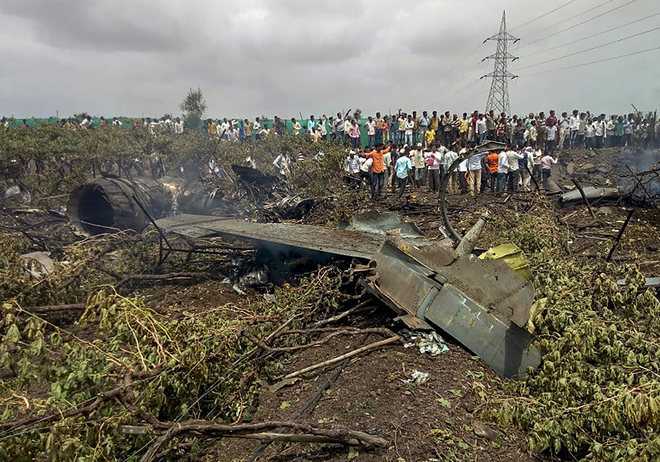
Onlookers gather near the debris of a Su-30 MKI fighter jet at Wavi-Tushi village, near Nashik, in Maharashtra on Wednesday. PTI

Nashik, June 27

A Sukhoi aircraft awaiting induction in the Air Force crashed near here on Wednesday. The pilot and a flight test engineer on board ejected safely before the plane, which was on a routine sortie, hit ground near a grape farm, 25 km from Nashik.The under-production Sukhoi Su-30MKI twinjet multirole air superiority fighter of Hindustan Aeronautics Limited (HAL) crashed shortly after taking off from the HAL airstrip near the city, police said.“It was piloted by Wing Commander Prashant Nair. He was accompanied by Squadron Leader L Biswal, Flight Test Engineer. Both ejected safely,” it said. Some labourers working in the field where the aircraft crashed, were injured after being hit by splinters and were admitted to the rural hospital at Pimpalgaon.A top official involved with the aircraft production said the crashed Sukhoi was the first of the batch produced at the Aircraft Manufacturing Division at HAL Nashik this year. — PTI


Battle of Saragarhi comes alive on stage at YPS, Mohali

› Such shows can help create the much­needed awareness about the battle as it is a vital part of Sikh history.

CAPTAIN AMARINDER SINGH, chief minister of Punjab

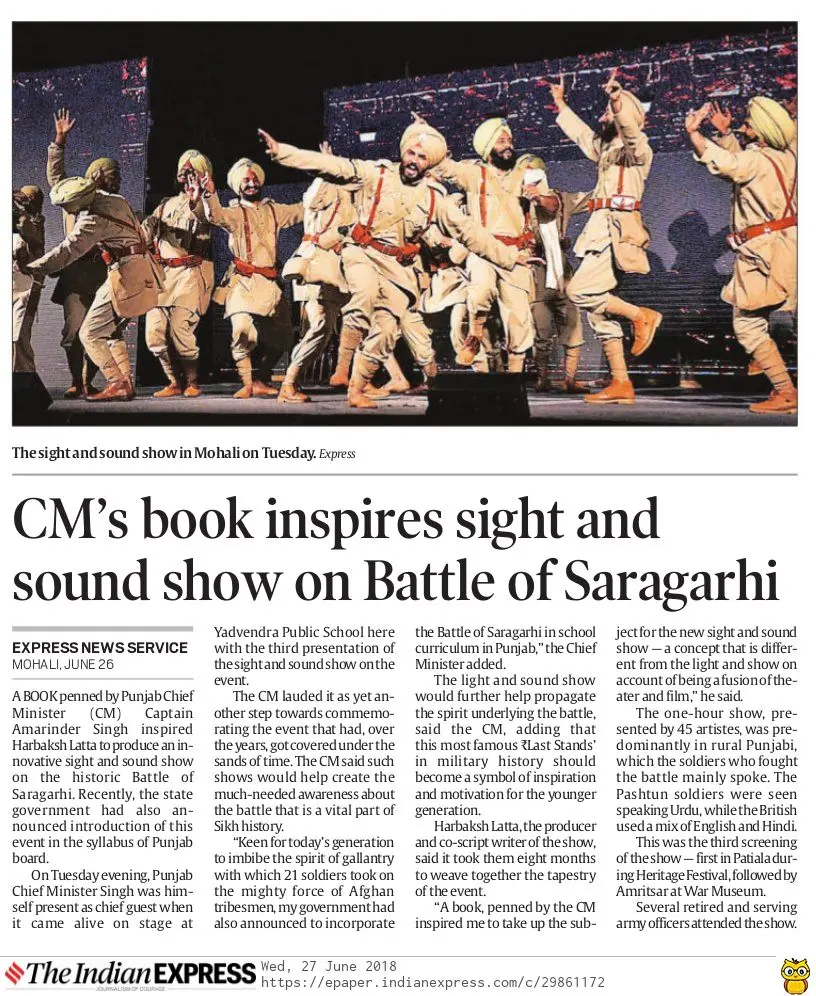
MOHALI: The sight and sound show on the ‘Battle of Saragarhi’ came alive at Yadavindra Public School, Mohali, on Tuesday evening.

HT PHOTOArtistes staging a sight and sound show on the ‘Battle of Saragarhi’ at YPS, Mohali, on Tuesday.

Set against the backdrop of a digital set, showcased on a LED screen, the show brought history to life.

The Battle of Saragarhi was fought before the Tirah Campaign on 12 September 1897 between Sikh soldiers of the British Indian Army and Pashtun Orakzai tribesmen. It took place in the North-West Frontier Province.

The show commenced with the motivational words of Havaldar Ishar Singh, underlining the call of duty that had led the 21 Sikh soldiers of the British Indian Army to their deaths while fighting the Pashtun Orakzai tribesmen.

The audience said that it appeared as though the battle of September 12, 1897, was being replayed in front of their eyes, more than a century after it was valiantly fought by the men belonging to 36th Sikhs.

Punjab chief minister Captain Amarinder Singh, who was present on the occasion, said, “It is yet another step towards commemorating the event that had, over the years, got covered under the sands of time.”

The CM, who has been instrumental in bringing the event back into the limelight with his book, said, “Such shows can help create the much-needed awareness about the battle as it is a vital part of Sikh history.”

According to Harbaksh Latta, the producer and co-script writer of the show, it took the team eight months to weave together the tapestry of the events of the momentous day.

He said the book penned down by Captain Amarinder Singh inspired him to take up the subject for his new sight and sound show – a concept that he believes is different from the light and show on account of being a fusion of theatre and film.

“The book, titled Saragarhi and the Defence of the Samana Forts: The 36th Sikhs in the Tirah Campaign 1897-98, became my chief source of research for the realisation of the concept, said Latta, who co-scripted the show with Keshav Bhrata.

The one-hour show, choreographed by 45 artistes/actors, was predominantly in rural Punjabi language.

The Pashtun soldiers were seen speaking rustic Urdu while the British used a mix of English and Hindi in the show, said one of the artistes.

This was the third screening of the show – the first show was showcased in Patiala, followed by Amritsar.

clip


NOTE BY THE FIRST MD OF ECHS.* *MUST BE CIRCULATED WIDELY.*

 I was the first MD ECHS. Have read the recent exchange of correspondence and that the RM (I believe) had ordered a study by CDM. On the face of it, there’s no harm if work study experts can bring in positive change and iron out some kinks and aberrations that may have developed over the years. In any case a 10 year revaluation & re-assessment is mandatory. The pensioner ESM (including widows & family members) strength has grown from around 23 lakhs during my time to around 70 lakhs now.
    ECHS has intrinsically no structural flaws and is one of the best medical support systems in the world for pensioner ESM. I should know because I did a study of UKs HMO and of the US Veteran Health Care system – visited latters’ centers in California, and had meetings with their administrators. The idea was to compare ours with theirs, and whether we could come up with an inter-Defence Services/inter-Govt arrangement for reciprocal treatment of our pensioner ESM residing in USA. Did not fructify because of reservations of MoD.
    Anyhow, leaving that aside, let me address current concerns that ECHS may be cash strapped, or that MoD could curtail amount of treatment of an individual etc. If, what is stated in the Study paper for CDM is reflective of govt mindset, then MoD is heading down a slippery and dangerous path. There are many other issues I could comment on but, for want of time & space, will restrict my response.
    It is obvious that neither MoD nor the Central Org has studied the original CCS paper under which ECHS was raised, nor indeed comprehended the assurances of then-PM Vajpayee and RM/FM Jaswant Singh, who categorically stated, “This scheme is given to pensioner ESMs as the nations gratitude for their selfless service to the country. The scheme shall never be found wanting for money – my Govt is committed to providing whatever funds are needed now or in the future”, or words to that effect. Get them to dig up these papers. ECHS was sanctioned on 01 April 2003, after overcoming stiff resistance by babu lok of the MoD and MoF; we have to thank Mr Jaswant Singh for almost having to issue a diktat to the Fin Secy to issue the DGL on 01 April 2003! Just for information, ECHS was finalized after detailed study (1988 – 2003) of more than six different alternatives.
   We therefore, need to protect & nurture it, and prevent any manipulation of its charter/medical cover by the executive; Pensioner ESM must hold Govt accountable to its word. While RM may order any number of studies to streamline the working etc, she has NO authority to increase subscriptions, nor curtail “Demand on Accounts” to provide for ECHS services, without referring it to Cabinet and/or CCS. To my knowledge, there never was, nor is, any shortage of funds. ADG FP factors-in ECHS demands in his annual planning – so why is this rumour being spread. ECHS contributions go into the “Consolidated Fund of India”, and are not used to fund/run the scheme – latter is run on allocation of funds in the annual Defense Budget.
   As regards the contentious issue of new Cards, it appears there’s more than meets the eye. Existing cards of 16 & 32kb have NOT even utilized 10% of their capacity, so am surprised at this introduction of a 64 kb card – it too will probably land up with unutilised capacity. Question is, will we need to replace this with a 128 kb card a few years down the line? It is up to the MD ECHS to take stock of ESM concerns and do what is best for the overall community.
      I trust RM understands that, if provisions of the scheme are diluted in any manner, pensioner anger may blow over, because of ineptness of her DESW.
Regards.


CM pays tribute to martyr Gurung

CM pays tribute to martyr Gurung

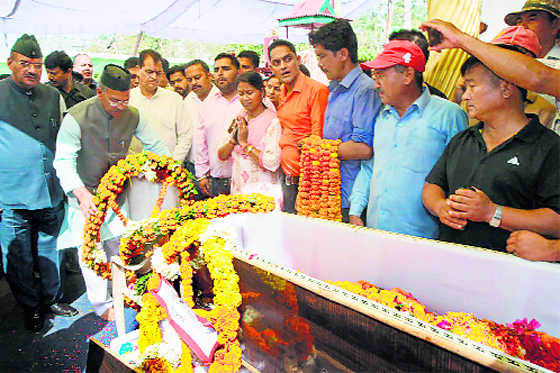
Uttarakhand Chief Minister Trivendra Singh Rawat pays a floral tribute to martyr Vikas Gurung, who was killed in a ceasefire violation by Pakistan, in Rishikesh on Monday.

Dehradun, June 18

Chief Minister Trivendra Singh Rawat on Monday paid tributes to  soldier Vikas Gurung, who was killed in firing from across the LoC in Jammu and Kashmir.Rawat went to Gurung’s home in Rishikesh to lay a wreath on the soldier’s body.Twenty one-year-old Gurung of 2/1 Gorkha Rifles was killed in firing from across the Line of Control (LoC) in Naushera sector of Jammu and Kashmir.Uttarakhand Speaker Premchand Aggarwal and MLA Ganesh Joshi also paid tributes to the soldier. PTI 


Another China Doklam drill, but India in loop

Another China Doklam drill, but India in loop

Ajay Banerjee

Tribune News Service

New Delhi, June 20

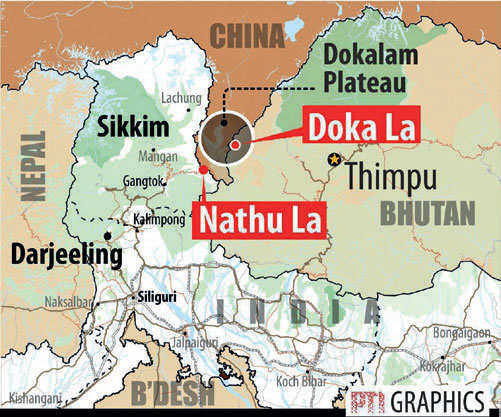
Almost a year after Delhi and Beijing were locked in 73-day intense military stand-off at Doklam, the People’s Liberation Army troops conducted a three-day tactical exercise close to last year’s confrontation point at the tri-junction of India, China and Bhutan. The only difference this time was India was informed in advance about the drill.The exercise was conducted from June 6-8 in the southern-most edge of Chumbi valley, which is a Chinese territory located between Sikkim and Bhutan. The last year’s stand-off had started on June 16 and ended on August 28.India closely watched the exercise and an assessment had been made, said sources. Some 500 Chinese troops are now permanently based in the area close to Doklam, “which is the new normal”, said a senior functionary. India has much superior defence with more than 30,000 troops and even a regiment of tanks lined up along eastern Sikkim, which literally overlooks the Chumbi valley — 25 km at its widest and 2 km at its narrowest.In the past decade or so, India has “militarily tailored” its defence set-up along the Himalayas. In early-2004, Delhi stepped up efforts to secure areas along the 3,488-km Line of Actual Control—the de facto boundary. Every possible route of ingress is now continuously “war gamed” — it’s the art of predicting future outcomes of military postures of rivals — fine-tuned by regular military exercises, study of satellite imagery and available inputs.In March, Prime Minister Narendra Modi and Chinese President Xi Jinping had, at an informal summit in Wuhan, issued “strategic guidance” to their respective militaries. “Build trust and have a mechanism to prevent incidents in the border regions,” said a statement issued from Wuhan. The local commanders of both sides have been meeting at Nathu La in Sikkim and China had informed in advance about the exercise.China’s control over Chumbi valley has an interesting anecdote. Patrick French, author of ‘Younghusband: The last of the great imperial adventurer’, writes: “The article which allowed British access to Lhasa (after the 1904 annexation) was torn up and Younghusband’s hard-earned indemnity reduced to two-thirds of a more manageable Rs 2.5 million (Rs 25 lakh). The Chumbi valley was to be vacated by 1908.”

Wuhan effect

  • After the Wuhan summit in March, Army representatives from both sides have been meeting at Nathu La in Sikkim or China.

Rifleman Aurangzeb’s last rites today

Shyam Sood

Rajouri, June 15

The last rites of Rifleman Aurangzeb couldn’t be held on Friday as the helicopter carrying his body couldn’t take off from Kashmir due to bad weather.Hundreds of people had gathered for Aurangzeb’s last rites at Salani village when the news arrived that bad weather had grounded the helicopter carrying his body. The last rites are likely to take place on Saturday now.Aurangzeb, son of ex-serviceman Mohd Hanif, had joined the Army about five years ago. He was on the way home to join Eid celebrations with his family when he was abducted.“Army men stopped a private car outside the 44 RR camp at Shadimarg (Shopian) at about 9 am and requested the driver to drop Aurangzeb at Shopian. As the car reached near Kalampora, it was stopped by the militants and Aurangzeb was abducted. Later, his bullet-ridden and mutilated body was found near Gussu village in Pulwama district,” said the police.“My last contact with Aurangzeb was at 3 am on Thursday before ‘sehri.’ While on the way to Shopian in the car, he contacted his younger brother Shabir. For a few minutes, Shabir could hear Aurangzeb requesting someone to stop the car but then the phone got disconnected,” said Mohd Hanif.Senior officers and politicians visited the aggrieved family on Friday.His father sets 72-hour deadlineRifleman Aurangzeb’s family has appealed to Prime Minister Narendra Modi to take a decisive action on the Kashmir issue. His father Mohd Hanif, an ex-serviceman, said his family would avenge Aurangzeb’s killing if security forces failed to take action against militants within 72 hours


Army Chief: Too early to talk of further truce

Army Chief: Too early to talk of further truce

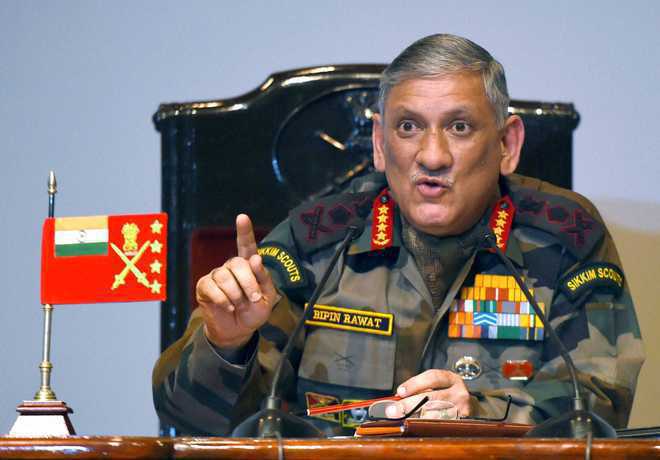
Army chief General Bipin Rawat

Ajay Banerjee

Tribune News Service

New Delhi, June 11

Emphasising that the onus of peace rests on Pakistan, Army Chief Gen Bipin Rawat on Monday said India was “waiting and watching” for quantifiable pointers to indicate if the two ongoing ceasefires in Jammu and Kashmir and on the border with the neighbour have worked.Talking to The Tribune at South Block, Gen Rawat said: “We are waiting and watching if the level of infiltration from across the border decreases manifold over a sustained period; that there are no major incidents of violence in Kashmir valley; and the Amarnath Yatra (starting June 28) goes off peacefully.” These could be the main parameters to judge the success of “peace” initiatives, he added.On May 16, India had announced a Ramzan ceasefire, suspending proactive operations against terrorists in Kashmir during Ramzan (ending June 16), while on May 29, Pakistan’s Director General of Military Operations called up his Indian counterpart and offered to abide by the 2003 agreed upon ceasefire along the LoC and International Border in J&K. India accepted the offer.On whether the ongoing “Ramzan ceasefire” could be extended, Gen Rawat said: “It is too early to say if there will be an extension.”“Let’s give peace a chance was the thought while accepting the offer (of the LoC ceasefire) made by Pakistan,” he said. Within the government, there is a stream of thought that the Army’s sustained operations in the Valley are actually making more local boys join the ranks of terrorists. The idea behind suspending the operations was to give these boys a chance, even as a political solution is found.Indications from the Army Chief are that there has to be a sustained effort from Pakistan to ensure peace along the LoC and control terrorists backed by it from crossing over into India.So far, infiltration has not stopped. The Army killed six infiltrators on Sunday morning. Within the Valley, there have been incidents of grenade throwing and a standoff attack on the 13 Rashtriya Rifles camp.WhatsApp ban in J&K? Govt to examineNew Delhi: With security agencies flagging the issue of militants and extremists using WhatsApp calling services to take directions from across the border in insurgency-hit areas, including  Jammu and Kashmir, the government has decided to examine the technical feasibility of blocking the facility. The issue came up for discussion during an inter-ministerial meeting, chaired by Union Home Secretary Raji Gauba. TNS


Rafale audit only after deal: CAG

Government auditor says it will begin inspection after ‘full execution’ of pact

NEW DELHI: The government’s auditor, the Comptroller and Auditor General of India (CAG), will audit the government’s procurement of 36 Rafale fighter jets from France for $8.7 billion, as it does all other deals, but only after the “deal is fully executed and the payments are completed,” according to a senior CAG official who asked not to be identified.

DASSAULT AVIATIONThe NDA government’s procurement of Rafale jets from France has been questioned by the Congress, which claims the pact is more expensive than a deal struck during the UPA regime.

After several media reports surfaced earlier this week about an ongoing CAG audit of the deal, defence ministry officials said they were not aware of such a development and added that deals usually come up for an audit after a contract is fully executed.

The National Democratic Alliance (NDA) government’s G2G (government to government) deal to acquire the Rafale aircraft has become controversial with the Congress party claiming it is more expensive than a deal struck during the UPA regime. The government’s response is that the two deals aren’t comparable, and that the older one had terms which would have meant it wouldn’t have gone through. The Indian Rafales are equipped with latest weapons and tailored for Indian needs.

Meanwhile, Sitharaman, in response to a question on the $8.7 billion deal, told reporters earlier this week: “I am assuring you in the company of all the senior officials that yes there is no scandal in Rafale. We are very clear on that part.” Sitharaman was highlighting the defence ministry’s achievements in the first four years of the NDA government at a press conference.

A second CAG official said that any major spending of the government automatically comes under the auditor’s radar and the Rafale will not be an exception.

“It is routine for us. But as it is a major spending, we might do it on a priority, but only after the payments are made and the deal is executed,” the official added on condition of anonymity.

CAG audits most government deals and the fact that a deal will be audited doesn’t necessarily mean there are problems with it.

In her press conference, the defence minister accused the Opposition of launching “motivated attacks” against the government and making “false price comparisons.”

She said comparing a price for Rafales that was never paid (by the previous UPA regime) with what had been arrived at by the NDA government was a “nonstarter.” The opposition party has asked the government to reveal the purchase price of each aircraft but the Centre has said details cannot be disclosed as there is a clause on “classified information” in the inter-governmental agreement.