Sanjha Morcha

GCs leave audience spellbound

GCs leave audience spellbound

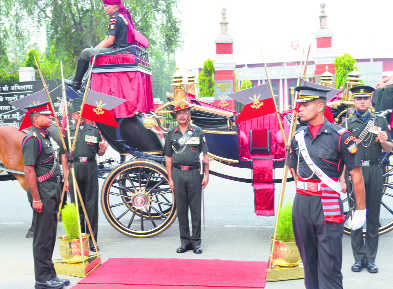
Deputy Commandant and Chief Instructor of the Indian Military Academy Maj Gen JS Nehra enters the drill square of the IMA for reviewing the Deputy Commandant’s parade. Tribune photo

Tribune News Service

Dehradun, June 5

As many as 384 Indian and 74 Foreign Gentlemen Cadets (GCs) displayed enthusiasm, vigour and zeal in drill movements in the Deputy Commandant and Chief Instructor’s parade that was conducted at the historic Chetwode drill square at the Indian Military Academy (IMA) on Tuesday. The Deputy Commandant and Chief Instructor of the IMA, Maj Gen JS Nehra, who reviewed the parade complimented the Gentlemen Cadets of the passing-out course. He said the efforts of the faculty and hardwork of the GCs were quite evident from the crisp and coordinated movements. General Nehra said he was very optimistic that the standards would further improve before the final passing-out parade on June 9.He complimented the Gentlemen Cadets for the hard work put in and for having finally reached the threshold to a world filled with challenges and responsibilities. He said the GCs had been taught repeatedly to ‘Lead by example’ so that the soldiers who would be under their command should look up to them with pride. “The duty of the IMA to train the GCs ends hereinafter, after which they will step into their units and regiments, who will groom them further and make them responsible and competent leaders”, he said.The event was a success and was witnessed by large number of schoolchildren, local residents and Army personnel. 


40 Bluestar detainees given cheques, Capt assures compensation to remaining

40 Bluestar detainees given cheques, Capt assures compensation to remaining

http://

Chandigarh, June 28

Punjab Chief Minister Amarinder Singh on Thursday awarded compensation to 40 people who were arrested and kept in a Jodhpur prison following Operation Bluestar in 1984 and assured that the remaining 325 detainees, who did not move court, would also be given financial aid.He was addressing a programme organised to distribute cheques to the 40 detainees here who were awarded compensation by district court in Amritsar last year.Singh handed over cheques of the state’s 50 per cent share of the approximately Rs 4.50 crore compensation for them. They amounted to Rs 2,16,44,900.“Those remaining (325) Jodhpur detainees who did not approach court are also entitled to compensation. We will give our share of compensation to them and will also take up with the Centre to put in its share,” Singh said.A total of 365 people were arrested and detained at Jodhpur jail following Operation Bluestar. They were eventually released between March 1989 and July 1991.Of these, over 200 detainees had appealed for compensation in a lower court, alleging “wrongful detention and torture” but they failed to get any relief in 2011.However, 40 of them appealed to the District and Sessions Court, Amritsar. They were awarded Rs 4 lakh each as compensation with 6 per cent interest (from the date of filing of the appeal to payment of compensation) in April last year.The court held that the central and state governments would be jointly liable for payment of the compensation. The total compensation, including interest, worked out to Rs 4.50 crore approximately.As many as 100 detained had died since then. Of the 40 who had gone to the court, seven passed away in the interim.The chief minister said his government was prepared to release the full compensation to the 40 detainees but he was informed by the Centre about its decision to release its share as well.He said it was a small compensation for the pain they underwent, assuring that his government would also look into their demand for jobs for their children.Congress MLA from Patti, Harminder Singh, who was also detained, thanked the chief minister for coming to the rescue of the detainees.He recalled Amarinder Singh’s gesture in visiting the detainees in Nabha prison (where they were initially kept before being shifted to Jodhpur), to give them clothes.The detainees had been kept naked in Nabha prison, claimed Harminder Singh.He said it was Amarinder Singh who gave them Rs 1 lakh each in 2006, during his previous tenure, the only compensation given to the detainees before today.It was the chief minister’s efforts and decision that had forced the Centre to agree to release its share, he added.Speaking on the occasion, one of the detainees, Jasbir Singh Ghuman said their acquittal had come after a 20-year court battle and then it had taken them seven years to win the compensation. — PTI

Jodhpur detainees who did not go to court will also get relief, says Capt

CHANDIGARH:Punjab chief minister Capt Amarinder Singh on Thursday promised compensation to the remaining 325 Jodhpur detainees on a par with that given to 40 after a court verdict. He also promised to persuade the central government to do the same. He gave the assurance while handing over cheques of the state’s 50% share of the approximately Rs 4.5 crore compensation awarded by the Amritsar district court to the 40 detainees who had sought judicial relief.

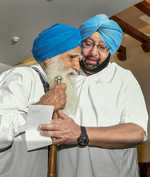
KESHAV SINGH/HT■ Chief minister Capt Amarinder Singh with persons who were illegally detained after Operation Bluestar. He gave them cheques of relief money awarded to them by an Amritsar court, in Chandigarh on Thursday.

GIVES ASSURANCE WHILE HANDING OVER CHEQUES OF STATE’S 50% SHARE OF ~4.5CR COMPENSATION TO 40 WHO HAD WON CASE

In all, 365 persons were arrested and detained at a Jodhpur jail after Operation Bluestar to flush out militants from the Golden Temple in 1984; they were eventually released in 1986 and as many as 100 have since died. Of the 40 who had gone to the court, seven passed away in the interim. The CM said those who didn’t go to court were also entitled to compensation, and his government will make the same payment to them too. He expressed the confidence that the Union government — it has appealed against the compensation verdict in the high court — will also agree to his plea to contribute its share to all detainees.

He said his government was prepared to release the full compensation to the 40 detainees but he was then informed by the central government of its decision to release its share too, the chief minister told the detainees who had come to receive the cheques here. “It was a small compensation for the pain they had undergone,” the CM said, assuring the detainees that his government will also look into their demand for jobs for their wards.

Congress MLA from Patti, Harminder Singh Gill, who was among 365 detainees, recalled that it was Amarinder who gave them Rs 1 lakh each in 2006, during his previous tenure. Speaking on the occasion, another of the detainees, Jasbir Singh Ghuman said their acquittal came after a 20-year court battle and then it took them seven years to win the compensation.


Assam Rifles jawan injured in twin blasts in Nagaland

Kohima, June 29

An Assam Rifles jawan was injured in twin IED blasts triggered by NSCN (K) insurgents in Phek district of Nagaland, an officer of the paramilitary force said.The blasts took place near Akhegwo village when a road opening party of the paramilitary force was providing security for the passage of an Assam Rifles convoy at 3 pm on Thursday, he said.The Assam Rifles jawan suffered splinter injuries on his chest and leg in the blasts, which took place within a gap of some time, he said.He was immediately evacuated to the Army Hospital in Jorhat, where his condition is stated to be stable, he said.The Assam Rifles convoy was coming from Kiphire district.The NSCN (K), in a statement, has claimed responsibility for the blasts.Two Assam Rifles personnel were killed and four others suffered injuries in an ambush by insurgents of the same outfit near Aboi in Mon district on June 17. PTI


Major arrested for alleged role in murder of Army officer’s wife

Major arrested for alleged role in murder of Army officer’s wife

Shelja and Major Nikhil Handa.

Prateek Chauhan
Tribune News Service
New Delhi, June 24Delhi Police have arrested an Army Major from Meerut for his suspected role in the murder of a colleague’s 30-year-old wife, police said on Sunday.Police arrested Major Nikhil Handa from Daurala in Meerut for having possibly played a role in murdering Major Amit Diwedi’s wife Shelja. He will be handed over to a civil court for trial.Major Handa was spotted with the victim hours before she went missing from the Army Base Hospital in Delhi Cantonment. Her body was found on a secluded road near Delhi Cantonment on Saturday.A senior investigator said that information gathered at the hospital and the victim’s phone led them to the suspect, who had also disappeared since the crime came to light.Police are still unclear about the motive, saying it could either be a love affair gone sour, or a personal enmity.An image from a CCTV showed the victim arguing with a man.“We have found that the suspect and the victim had an argument before the murder. A love triangle could be a possible motive,” the source said.

http://


The Untold Story of India’s Decision to Release 93,000 Pakistani POWs After 1971 War

The Untold Story of India's Decision to Release 93,000 Pakistani POWs After 1971 War

Indira Gandhi’s biggest worry after the surrender of Pakistan in 1971 was the safety of Mujibur Rahman. The release of Pakistani POWs was the price Zulfiqar Ali Bhutto (and the ISI) extracted for the safe return of the Bangladeshi leader.

On August 2, 1972 – eight months after the 13-day India-Pakistan war ended on December 16, 1971 – the two countries signed the Shimla Agreement under which India agreed to release all the 93,000 Pakistani prisoners of war (POW) its army had taken during the course of the war. This proved to be a controversial decision, with many in India questioning why Prime Minister Indira Gandhi had squandered a golden opportunity to bargain with Pakistan and settle the Kashmir problem on India’s terms.

What motivated Mrs Gandhi to release the POWs? What went on behind the scenes? Were there any compelling circumstances at play that have remained unreported? If there were any, ideally they should be brought into the public domain, so that future generations may benefit from the lessons of history. Since I was personally privy to these developments, as a retired diplomat I can now tell the story, even if it has been 40 years since these events transpired.

December 16, 1971 – the day when Pakistan’s armed forces laid down their arms at a surrender ceremony in Dhaka before the joint command of the Indian armed forces and Bangladesh’s Mukti Bahini – was the finest hour in both India and Bangladesh’s military histories, one old and another new.

However as the two armed forces were celebrating their military victory against an unrelenting tormentor, Mrs Gandhi was pondering the other critical issues facing India.

Apart from dealing with the enormous cost of the war, India also had to bear the financial burden of looking after the 10 million refugees who had crossed over to India from East Pakistan as they fled the Pakistani army’s horrendous atrocities, better known as the Bangladesh Genocide of 1971.

The other big challenge, which was quite complex diplomatically since it involved national security and foreign policy issues, in addition to requiring delicate handling, was the unforeseen and un-budgeted responsibility of having to look after the 93,000 Pakistani soldiers taken as POWs. India wanted to keep the Pakistani soldiers in conditions of comfort that went over and above the provisions listed in the Geneva Convention.

Indira Gandhi’s paramount concern at that moment of time was figuring out how to get Bangladeshi leader Sheikh Mujibur Rahman back to his country alive and well.

She was prepared to pay any price to save his life. This much the prime minister confided to at least one member of her so called ‘kitchen Cabinet’. That person was Ram Nath Kao. the RAW chief.

She was acutely aware of the fact that Mujib was tried by a Pakistani military court and a verdict of death by hanging on charges of treason had been handed down to the Bangladesh leader. Also, as is typical with the Pakistani military, its security services did not fail to demonstrate their morbidity in the crudest possible terms. In his prison cell, a 6.5 ft long grave was dug with a rope with a loop at the end hanging over it – serving as a warning that he could face a cruel death any moment.

It would be a nightmare for Gandhi if the Pakistan army carried out the death sentence and left Bangladesh an orphaned state. For India, which supported the Bangladesh liberation struggle with its heart and soul, his execution would be an unmitigated disaster, a dream shattered. So it was in India’s interests to leave no stone unturned to save Mujib’s life, for his sake, for the sake of his family, for the sake of Bangladesh and for its own sake.

Meanwhile, Pakistan’s defeat at the hands of its perceived arch enemy India was seen as an intolerable insult to its nationhood. To make matters worse, Pakistan lost half of its territory to Bangladesh, leaving Mohammad Ali Jinnah’s two-nation theory – the ideological foundation of Pakistan’s existence – in tatters. Stung by this catastrophe, the military dictator, General Yahya Khan, in a flash decision, took full responsibility for the national disaster and stepped down from office. He asked Zulfiqar Ali Bhutto, who was still in New York attending UN Security Council meetings, to return home. Bhutto was also informed by General Yahya Khan that he had resigned from his office and that he (Bhutto) had been appointed as the chief martial law administrator of Pakistan. However, before he took his flight for Rawalpindi, Bhutto was instructed to call on US President Richard Nixon, Pakistan’s mentor at that time, in Washington DC.

From left to right: Sheikh Mujibur Rehman, Indira Gandhi, Sheikh Mujib and Sashanka Banerjee on the flight from London to Dhaka, Durga Prasad Dhar, Zulfiqar Ali Bhutto. Credit: Wikimedia, YouTube, Sashanka Banerjee

The grand finale – an unlikely thriller

Bhutto’s Washington-Rawalpindi flight was scheduled for a refuelling stopover at Heathrow airport in London.

Having secured insider information about Bhutto’s journey home, Prime Minister Indira Gandhi called an emergency meeting of the war cabinet in New Delhi at her office in South Block. She wanted, with the utmost urgency, to secure a contact who would be present for  Bhutto’s arrival at Heathrow, so she could get the only piece of intelligence India was looking for – what did Bhutto think about Mujibur Rahman being sentenced to death by a Pakistan military court?

The meeting was attended by Durga Prasad Dhar, head of policy planning in the Ministry of External Affairs; Ram Nath Kao, chief of RAW; P.N. Haksar, the prime minister’s principal secretary and T.N. Kaul, the foreign secretary.

It was under Mrs Gandhi’s instructions that Muzaffar Hussain – the former chief secretary of the East Pakistan government, the highest ranked civil servant posted in Dhaka as of December 16, 1971 who had subsequently become a POW in India – was lodged as a VIP guest at the official residence of D.P. Dhar. His wife, Laila, who was visiting London when war broke out on December 3, 1971 couldn’t return home and was stuck there. Both husband and wife (in Delhi and London) were communicating with each other through diplomatic channels. I was assigned the job of a VIP courier. Thanks to conducting several back and forths between the two, I soon established a useful rapport with Laila Hussain.

The prime minister was very much aware that Laila and Bhutto had been intimate friends for a long time and continued to be so. It was felt at the PMO that she was well placed to play a key role in a one-off diplomatic “summit” at the VIP lounge, the Alcock and Brown Suite, at Heathrow airport.

I had met Dhar several times in London during the nine months – from 25 March 1971 to 16 December 1971 – that the Bangladeshi liberation struggle was on. It was at that time that we became friends. He was an unassuming, refined literary personality, extremely well-versed in Urdu poetry. My love of Urdu poetry from my days at Osmania University in Hyderabad was what resulted in our unlikely friendship – despite the huge gap in official hierarchy. D.P. was a cabinet minister and I was a mere bureaucrat.

Just two days before Bhutto was to arrive in London I got a telephone call from D.P. in Delhi. He wanted me to inform Laila that Bhutto had been appointed the chief martial law administrator (CMLA) of Pakistan and that he was on his way to Islamabad from Washington. His flight would be stopping at Heathrow airport for refuelling. I was supposed to persuade Laila to meet Bhutto – for old time’s sake – and ask him, in his capacity as the CMLA, if he could help in getting her husband released from Delhi. Laila knew only too well that I was aware that she had had a relationship with Bhutto in the past. Seeing how the discussions progressed would be a matter of great interest to us. India wanted to know only one thing: what Bhutto was thinking about Rahman, whether to release him to return home, or carry out the military court’s verdict of death.

I succeeded in setting up the meeting. The two long-lost friends, Laila and Bhutto, met at the VIP lounge at Heathrow airport. The meeting was marked by great cordiality. It was as convivial as could be. Without a doubt, the back-channel encounter turned out to be a meeting of great historic significance. It was well and truly a thriller, a grand finale to this narrative.

Bhutto was quick on the uptake. As he responded to Laila’s emotional appeal for help in getting her husband released from Indian custody, he also cottoned onto the fact that the lady was in fact doing the Indian government’s bidding.

With a twinkle in his eye, Bhutto changed the subject. And pulling her aside, he whispered to Laila a very sensitive, top secret message for the Indian prime minister. Sourced from Laila, I quote:

“Laila, I know what you want. I can imagine you are [carrying a request] from Mrs. Indira Gandhi. Do please pass a message to her, that after I take charge of office back home, I will shortly thereafter release Mujibur Rahman, allowing him to return home. What I want in return, I will let Mrs. Indira Gandhi know through another channel. You may now go.”

After Laila briefed me following the meeting, I lost no time in shooting out a confidential message to the PMO in Delhi reporting Laila Hussain’s input.

Not unexpectedly, Gandhi was pleased that Bhutto had sent out a positive message, although it was done unofficially through a back channel. However, she remained suspicious of whether Bhutto could be trusted. The prime minister was cautiously optimistic, but only just. Was Bhutto trying to mislead India? Was he creating a false dawn with a mischievous motive? She wanted a confirmation of Laila’s input from our diplomatic mission in Pakistan as fast as possible. Meanwhile, within hours, a report came back from Islamabad confirming the authenticity of Laila’s report. At this point, Gandhi took matters in her own hands, elevating the discourse from the bureaucratic to the political level.

At her own level, Gandhi had come to know that Rahman would first land in London and then fly from there to Dhaka, or maybe via Delhi.

She confided to one of the members of her kitchen cabinet that she now had confirmed information about what Bhutto wanted from her in return for Rahman’s impending release.

Pakistan – 1972. One hundred and twenty four civilians and Pakistani prisoners of war are repatriated to their home country in a Red Cross plane. © ICRC/François Musy

Bhutto had no option but to release Rahman first, the POWs would come later. Obviously, Bhutto was relying on Gandhi’s sense of decency to not let him down. It was starting to get clear that Indira Gandhi had made up her mind. If Bhutto personally asked her for the release of the POWs, she would not hesitate in agreeing to it. A gesture of generosity must be met with a matching gesture of grace. Nothing less.

In a show of manufactured geo-political generosity, Bhutto (read: ISI) over-ruled the death sentence handed out by a military court in Rawalpindi and released Mujibur Rahman on January 8, 1972. On his return, Mujib took charge as prime minister of Bangladesh on January 10, 1972.

Exuding a spirit of genuine gratefulness for sparing the life of Mujibur Rahman, Bangladesh’s father of the nation, eight months after he was set free, India ordered the release of all 93,000 Pakistani POWs under the Shimla Agreement of August 2, 1972. The world had never known such decency in international relations as India’s conduct with Pakistan on the POW issue.

The brutal assassination of Mujibur Rahman and his family three years and eight months later on August 15, 1975 by a batch of Abbottabad-trained army officers – who were then holding senior positions in the Bangladesh army – seemed like the belated fulfilment of the ISI’s unfinished agenda for Bangladesh. The ISI wanted to mete out severe punishment to the Bangladeshi leader for his role in unravelling Pakistan’s territorial integrity. His release from Mianwali prison on January 8, 1972 was merely a distraction.

From India’s perspective, the Kashmir problem remained unresolved; Pakistan eventually launched an unrelenting proxy war which has lasted 45 years and continues to this day.

Thousands lost their lives. The blood never dried; the tears have never stopped flowing.

I conclude with what Justice Abu Said Choudhury, who later became the president of Bangladesh, had to say in a strongly worded letter dated December 16, 1971 that he addressed to Mrs Gandhi – warning her of dire consequences if she decided to go for a unilateral cease fire on the western front. It would remain, he maintained, the half-finished business of the Bangladesh war. His concluding line was, “When you chop off the tail of a cobra, its head becomes ten times more venomous.”

The letter arrived on the prime minister’s desk a day too late.

Sashanka S. Banerjee was posted as a diplomat in the Indian mission in London in 1971-72. Among other books, he is the author of India, Mujibur Rahman, Bangladesh Liberation & Pakistan: A Political Treatise, published in the US in 2011. He was awarded a state honour, ‘Friend of Bangladesh Liberation War’ in October 2013 by Bangladesh Prime Minister Shaikh Hasina.



Fake videos on social media ‘wrongly’ project Army in Kashmir

Fake videos on social media ‘wrongly’ project Army in Kashmir

Some of these videos are not even shot in India, but are nowadays being passed-off as new ‘policy’ in Kashmir. The preferred mode of transmission is to send these videos through WhatsApp.

Ajay Banerjee

Tribune News Service

New Delhi, June 23

It’s literally a ‘war’ on social media, and unwittingly Indians have been forwarding fake and morphed videos showing ‘strong action’ by the Army in Kashmir.Some of these videos are not even shot in India, but are nowadays being passed-off as new ‘policy’ in Kashmir. The preferred mode of transmission is to send these videos through WhatsApp.Indian security establishment sees such fake videos showing ‘strong action’ as propaganda from across Pakistan which is eyeing to use these videos to dis-credit the Indian Army. The United Nations Human Right Council (UNHRC) is at present in its 38th session in Geneva.Many videos of the Army bringing down houses, mishandling people and dragging terrorists have emerged in the past one week. All of them are fake, top sources have said.These videos are a soft and oblique way to spread a false narrative of human rights violations like houses being pulled down, sources said.Nothing has changed for the Indian Army and its operations either during ceasefire declaration (May 17 to June 16) or after its withdrawal. Some of these videos are not even of India and are morphed or interpolated.Last week, a UN report on Kashmir was rejected by the Indian Ministry of Foreign Affairs terming it as “fallacious, tendentious and motivated”.


Post-truce, search ops in city

Post-truce, search ops in city

Azhar Qadri

Tribune News Service

Srinagar, June 20

The cordon and search operations – the backbone of counter-insurgency and area domination operations in the Kashmir valley – have marked a return after the month-long unilateral ceasefire during when such operations were curtailed.The security forces have initiated the cordon and search operations across the region, including the city, which had been comparatively off the grid during recent years.On Tuesday evening, police’s counter-insurgency unit sealed off a locality in the Bemina neighbourhood on the city outskirts and launched a search operation. Locals said the operation continued for more than two hours in Bemina’s Alamdar Colony and policemen searched several houses.“The cordon was laid around 9:15 in the evening and continued till late. The police went inside several houses and no one was allowed to go inside or leave,” a local resident said.A policeman accompanying the search team said there was an intelligence input about the presence of militants in the area. It was the first cordon and search operation in Srinagar, the state’s summer capital, since the end of the Ramzan ceasefire on Sunday.The Ramzan ceasefire was initiated on May 17 and had brought the counter-insurgency operations, including the cordon and search operations, to an abrupt halt.The operations were resumed on Monday, a day after the Union government announced that it was not extending the unilateral ceasefire and ordered the security forces to resume its operations against militants.Immediately after the end of the ceasefire, the cordon and search operations were launched in several parts of south Kashmir, including in Wanghama village of Anantnag district, Samboora village in Awantipora police district and Hajin Bala in Pulwama district.The security forces have so far conducted one counter-insurgency operation which led to a gunfight and the killing of militants. Three militants, including a foreigner and two locals affiliated with Jaish-e-Mohammad, were killed in the operation on Tuesday in Hayuna village of south Kashmir’s Tral sub-district.A senior police officer, who is in charge of a district in the volatile south Kashmir, said the instructions to resume the operations against the militants came immediately after the ceasefire ended.The officer, who spoke on condition of anonymity, said the preference was to launch operations on specific intelligence inputs rather than inputs about the presence of militants in any general area.The cordon and search operations in recent years have sparked violent protests with local residents throwing stones at security forces leading to clashes and also casualties, which continue to be a major worry for the security forces.Locality sealed at night 

  • On Tuesday evening, police’s counter-insurgency unit sealed off a locality in the Bemina neighbourhood on the outskirts of Srinagar and launched a search operation
  • Locals said the operation continued for more than two hours in Bemina’s Alamdar Colony and policemen searched several houses. The cordon was laid around 9:15 in the evening and continued till late

Kargil slams Pakistan’s move on Gilgit-Baltistan

Dinesh Manhotra

Tribune News Service

Jammu, June 14

Annoyed at Pakistan’s arbitrary move to declare the strategic Gilgit-Baltistan region as its fifth province, political and religious groups of Kargil have warned Islamabad against suppressing the aspirations of the “deprived and subjugated” inhabitants of the illegally occupied erstwhile Jammu and Kashmir.Gilgit-Baltistan, a part of the erstwhile princely state of Jammu and Kashmir, has been under the control of Pakistan since 1947, but now the Government of Pakistan has planned to declare it as its fifth province. The decision has evoked a strong reaction from inhabitants of Gilgit-Baltistan, who are on the warpath to oppose it tooth and nail.“We are with the agitating people of Gilgit-Baltistan due to our cultural and ethnic similarities,” Sheikh Nazir Mehdi Mohammadi, president of Islamia School Kargil, told The Tribune. He said the Government of Pakistan was trying to suppress the aspirations and wishes of the inhabitants of the illegally occupied Jammu and Kashmir. “Along with residents of Gilgit-Baltistan, we will take up this issue at appropriate international forums to expose the nefarious designs of Pakistan,” he asserted. Shias of Kargil have cultural, religious, languages and ethnic similarities with the people of Gilgit-Baltistan.“We will not be a mute spectator to the nefarious designs of the Government of Pakistan. We will support our brethren in Gilgit-Baltistan in their fight to protect their ethnic and cultural identities,” said Asgar Ali Karbalia, Kargil MLA. He said the Government of Pakistan should be exposed, adding the step would help in putting an end to the crime against humanity being committed in Gilgit-Baltistan.There is a feeling among political and religious groups of Kargil that the Pakistani establishment has been brazenly indulging in persecuting natives of Gilgit-Baltistan on one pretext or the other.“India is a stakeholder in the dispute and must play a role in bringing a solution to the issue. It has a responsibility to help open the LoC and unite divided families,” Mohammadi said and reiterated the demand for opening the Kargil-Skardu road to facilitate meeting of the divided families living on both sides of the LoC.In Kargil, there are two dominating religious institutions — Islamia School and Imam Khomini Memorial Trust. Gilgit-Baltistan was part of the Ladakh region of the Dogra dynasty of J&K before 1947. Like Poonch and Rajouri, there are many divided families in Kargil that have relatives across the LoC.Kargil residents have reasons to oppose Pakistan’s plan because forcibly declaring Gilgit-Baltistan as its fifth province would erode the ethnic and cultural identities across the LoC.Recently, a committee headed by the Adviser on Foreign Affairs Sartaj Aziz of Pakistan had proposed giving the status of a province to Gilgit-Baltistan.Balochistan, Khyber Pakhtunkhwa, Punjab and Sindh are the four provinces of Pakistan. It is believed that China’s concerns about the unsettled status of Gilgit-Baltistan prompted Pakistan to change its status.


J&K Police releases pictures of suspected Shujaat Bukhari killers

J&K Police releases pictures of suspected Shujaat Bukhari killers

rinagar, June 15

The Jammu and Kashmir Police late night released two pictures of three bike-borne men who are suspected to have killed Rising Kashmir editor Shujaat Bukhari, and sought the public’s help in identifying them.The three militants were caught on a CCTV camera, the police said.

View image on TwitterView image on TwitterView image on Twitter
The two pictures showed the three men riding a motorcycle. The attackers had their faces covered.The police released the pictures late night and asked the public to help them identify the attackers.”In connection with today’s terror attack at Srinagar, police requests general public to identify the suspects for the purpose of the police investigation,” a statement read.The name of the person providing any clue or information regarding the suspects will be kept confidential, it said.Shujaat Bukhari and his two personal security officers (PSOs) were shot dead by terrorists outside the newspaper’s office in the heart of Jammu and Kashmir’s summer capital today, police officials said.Fifty-three-year-old Bukhari, who had worked as the state correspondent for national daily ‘The Hindu’ for several years, was shot dead soon after he boarded his car from his office located at Press Enclave in the heart of the city centre — Lal Chowk. PT

6 militants killed as Army foils infiltration bid along LoC in J&K

6 militants killed as Army foils infiltration bid along LoC in J&K

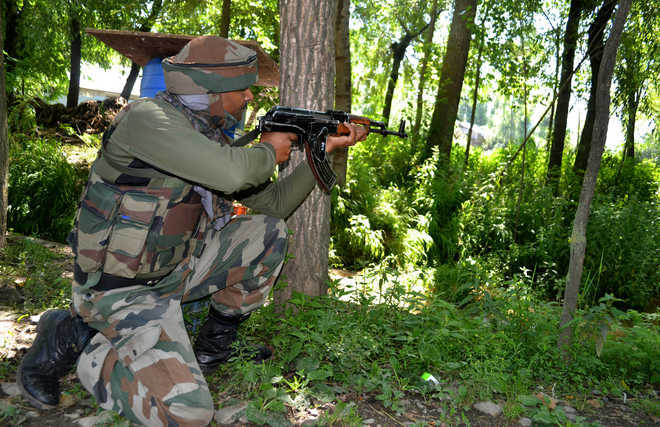
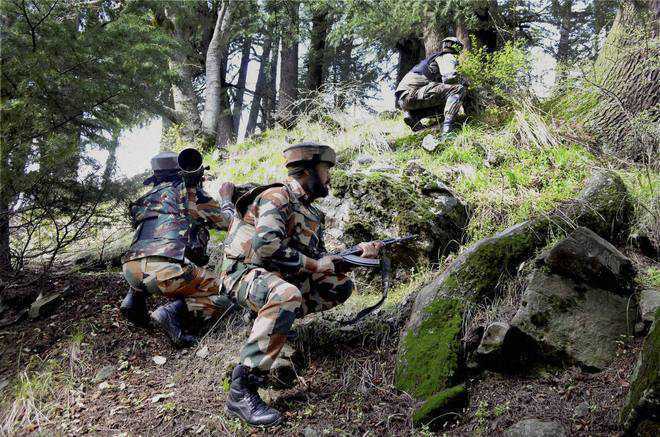
The operation is on. File photo

Majid Jahangir

Tribune News Service

Srinagar, June 10

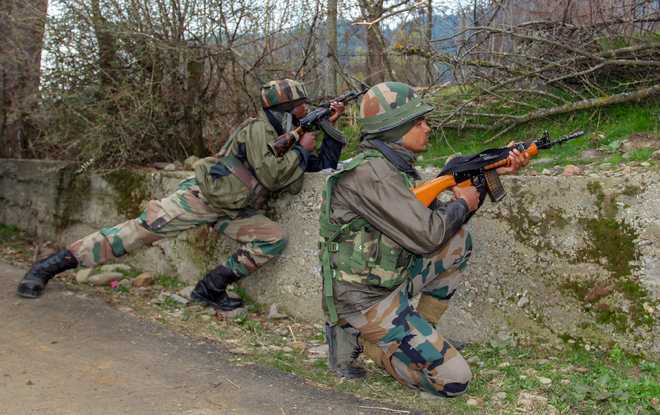
At least six unidentified militants were killed on Sunday as the Army claimed to have foiled an infiltration bid in Keran sector of Kupwara in north Kashmir.The bid was foiled close to the Line of Control in Keran sector, over 150 kms from Srinagar, when soldiers noticed suspicious movement“The group was challenged and the militants opened fire triggering a gunfight. So far, six militants have been killed,” defence sources said.The identities and the group affiliation of militants could not be established immediately.Srinagar-based defence spokesman Col Rajesh Kalia said the operation is still in progress.“Four terrorists attempting to infiltrate were killed in Keran sector. The operation is in progress,” Col Kalia said.The latest bid was foiled three days after a soldier was killed and another injured in a suspected Border Action Team (BAT) attack cum infiltration bid close LoC in Keran sector.The Army had, however, claimed the soldier was killed in “standoff fire”.