Sanjha Morcha

SC maintains status quo on DGMS appointment

New Delhi, May 28The Supreme Court on Monday issued notice on a plea of the Centre challenging the Armed Forces Tribunal (AFT) order restraining it from filling the post of Director General Medical Services (Army).The AFT had quashed the appointment of a Lieutenant General as the Director General Medical Services (DGMS) holding that his selection as the DGMS (Army) was arbitrary and discriminatory. It had also set aside the findings of the Review Promotion Board of Major General Manomoy Ganguly in March 2017 which had not found him sufficiently high in merit for the rank of Lt General.A vacation Bench of Justices L Nageswara Rao and Mohan M Shantanagoudar took note of the appeal of the Ministry of Defence against the AFT order restraining it to fill the post of DGMS (Army) by the officer of its choice.“In the meanwhile, pleadings shall be completed. Status quo, existing as on today, shall remain in force until further orders. Since we are informed that Lt General UK Sharma of the Research and Referral Hospital is officiating as DGMS (Army), he shall continue till the next date of hearing.“Needless to say, in the event of dismissal of the appeal (of the Centre), the respondent (Ganguly) would be considered for appointment to the post of DGMS (Army), without insisting on minimum of one-year service,” the SC said.Attorney General KK Venugopal, appearing for the Ministry of Defence, assailed the AFT order and said the Army worked on “certain principles” and seniority alone cannot be the sole criteria for selection of an officer as the DGMS (Army).Seniority and suitability are to be considered at the time of appointment, Venugopal said, adding, “The post in question is of a nature where extensive experience is must, as the job is to ensure spontaneous medical facility on the war front. Someone without adequate experience cannot be considered.” Advocate Ranjit Kumar, appearing for Major General Manomoy Ganguly, said, “A person who is a junior to me has been appointed. As far as seniority is concerned, there was no dispute. My file was not even sent for consideration.”Earlier, Ganguly had moved the AFT alleging that rules had been flouted in the proceedings of the board and consequently, he had not been approved for the higher rank despite being eligible. He had averred in his petition before the AFT that his non-empanelment for the rank of Lieutenant General in his Review Special Promotion Board in the Army Medical Corps was due to low figurative assessment in the board. — PTI


Worries pile up for border farmers, paddy season on, but wheat not sold

Villagers distressed as harvested rabi crop lies dumped in deserted shelling-hit villages

Worries pile up for border farmers, paddy season on, but wheat not sold

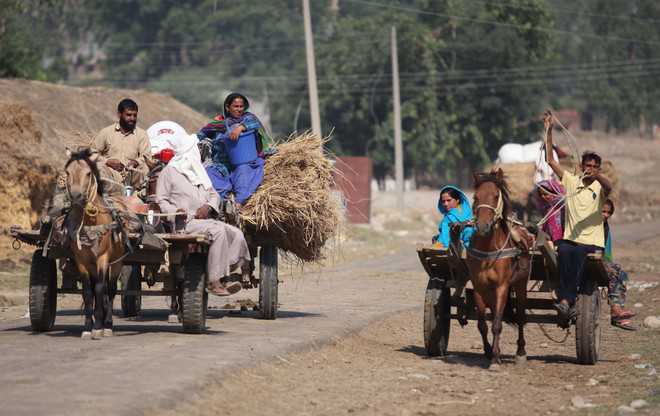
People move to safer areas after heavy shelling at Jora Farm along the International Border in Jammu. Tribune Photo

Arteev Sharma

Tribune News Service

Arnia, May 24

The recurrent Pakistan shelling and firing on Indian villages along the 198-km-long International Border (IB) have left the entire farming community in despair as farmers have been not able to carry out normal agricultural activities in their fields.During the last one week, thousands of farmers from border villages have fled their homes and taken refuge at relief camps following intense shelling on the entire border belt from Paharpur on the Kathua-Punjab border to the Chicken’s Neck area of Akhnoor in Jammu district.The agricultural land within the radius of five kilometres from the IB, measuring about 1.25 lakh hectares, falls under the firing and shelling range.The rabi crops, especially wheat, have been lying unattended in deserted houses, even as the farmers’ concern about the next paddy crop is mounting. The villagers are unable to get their fields ready to raise seedlings prior to the transplantation of paddy.Another worry is the non-availability of labour from outside the state. Labourers, particularly from Bihar and Uttar Pradesh, are not ready to work in fields under the present hostile border conditions.“We had a bumper crop of wheat this year but it is now lying unattended at our homes in Treva, a village close to the IB which has been heavily shelled by Pakistan. The situation turned volatile on the border just after we harvested wheat crop. We did not get the time to sell our produce in the market. We don’t have any other source of income, how will we sustain our families?” asked Rattan Lal, a 58-year-old farmer staying at a relief camp in Government Higher Secondary School, Salehar, Jammu.Choudhary Dev Raj, president of the RS Pura Basmati Rice Growers Association, claimed that nearly 1 lakh to 1.25 lakh hectares in the border area, known for its world-class basmati, was directly affected by Pakistan shelling.“This is the most suitable time for border farmers to start the preparation for the paddy crop. A delay of even 15 days will lead to either a low yield or just no crop. Farmers do not want much from the government, all that they seek is peace on the border,” said Raj.The rice association president said: “We had been demanding a special budget for border farmers as they come in direct line of enemy shelling. They have been facing losses forthe last three years due to the shelling, but no compensation has been paid to them so far”.Ganshyam Sharma, president, Border Kissan Welfare Union, Kathua, said: “Farmers in our areas are totally dependent on rain as there is no irrigation facility. They have migrated to safer places without any source of livelihood and if this situation continues, our worries are what will they eat?”


Tinkering with tribunals will make them useless

Armed Forces Tribunal, Indian Army, Para SF, Indian Special forces

The Armed Forces Tribunal (AFT) was established as a military tribunal under the Armed Forces Tribunal Act in 2007. This was based on the Law Commission’s 169th report of 1999, which stated that disciplinary and service matters of military personnel required quick resolution and proposed a special tribunal for para-military and armed forces. The act was steered through Parliament by the defence ministry, leaving the para-military, Assam Rifles and Coast Guard out of its purview.

The principal bench of the AFT is based in Delhi and it has regional benches at Chandigarh, Lucknow, Kolkata, Guwahati, Chennai, Kochi, Mumbai and Jaipur. Except for Chandigarh and Lucknow, which have three benches each, all others have a single bench. Each bench comprises of a judicial member, who is a retired high court judge, and an administrative member, who is a retired member of the armed forces.

In a democracy, the judiciary by nature is lenient. However, the armed forces because of their role and tasks must follow a disciplined structure, without which they would fail. Hence, the armed forces are governed by their respective acts and rules which are the Army Act of 1950, Air Force Act of 1950, the Navy Act of 1957 and the Defence Services Regulations. Disciplinary punishments, granted under respective acts, are periodically challenged in AFTs. Unless the circumstances and specific regulations are clarified to the judge, leniency in judgement would impact military discipline.

Further, vagaries and conditions of service are vastly different from any Central government organization. Hence AFTs have been liberal in approving disability pensions, which an unrelenting bureaucracy challenges in the Supreme Court to no avail. To advice the judicial member on service-specific issues and apprise him of the conditions of service, an administrative member with decades of service experience is appointed.

Till June 2017, the AFTs functioned at near full strength and was effective. After the government issued unilateral notifications incorporating changes in its composition and functioning, presently under challenge in the Supreme Court, there has been no induction of fresh members, resulting in almost non-functional courts. Thus, the very reason for creating the AFT, speedy disposal of cases pertaining to the members of the armed forces, has been lost.

On 1 June 2017, the government amended the AFT Act, amongst 19 other existing laws, enhancing its powers pertaining to the appointment and removal of members of various tribunals. Amongst the major changes which affect the functioning of the AFT is the appointment of the administrative member.

The earlier rules had stated that the administrative member could be retired major generals and above. However, the new rules state any person, ‘of ability, integrity and standing having special knowledge of, and professional experience of not less than 20 years’ in multiple fields not connected with the armed forces but ‘in the opinion of the government is useful to the AFT’ could be appointed. Thus, knowledge of service conditions and military law is not essential, making such appointments redundant. It opens doors for appointing IAS and other Central government service members, who lack even basic military knowledge.

The chairperson of the AFT was appointed by the president, hence was difficult for the government to remove. The changed rules state that he would be appointed by the government in consultation with the chief justice, thereby denuding his appointment. Earlier rules stated only a retired High Court or Supreme Court judge could be the chairperson, whereas the amended rules state ‘any person who is qualified to be a judge of the Supreme Court’ could be appointed. Thus, an advocate with ten years’ experience can be nominated as a chairperson.

The appointment of the judicial and administrative members was amended so that they would be appointed by a search-cum-selection-committee which would comprise a Supreme Court judge, chairperson of AFT (appointed by the government), defence secretary and another member of the executive. Thus, majority power would be with the executive. The Supreme Court has disagreed stating it cannot be tilted towards the executive.

The new rules place the AFTs under the defence ministry, whereas earlier based on Supreme Court directions, they were placed under the law ministry. The power to remove members has also been diluted and the MoD can constitute a committee to recommend removal. These powers were earlier with the Supreme Court.

The new rules have reduced tenure of members from five to three years. It appears, when linked up with the other amendments, aimed at opening doors for ex-secretaries of the government, who retire at 62, to be nominated to the AFT, for which they would otherwise have been barred.

These amendments, which would alter the functioning of the AFT and make it useless for the task for which it was created, angered many veterans who practice in AFTs and they approached the Supreme Court. The court’s final determination is likely in July.

The bureaucracy, worried about a possible court rebuff, advertised for vacant posts based on its amended rules. It is now seeking the court’s permission to go ahead with the selection. If it succeeds, the AFTs would become just another example of the government’s apathy to serving and veteran military personnel.

A fallout of the case has been that unless court orders are finally issued, no fresh appointments can be made. Hence most AFTs are either non-functional or those with multiple benches have just one functional bench. This has impacted clearance of cases.

The sole reason for creating the AFT is now being lost. The government which has denied the forces various facilities is now seeking to make the AFTs redundant. It will require a concerted effort by all who support the military to pressurise the government against making a mockery of an institution created to speed up justice.


The writer is a retired Major-General of the Indian Army.

comments

Till June 2017, the AFTs functioned at near full strength and was effective. After the government issued unilateral notifications incorporating changes in its composition and functioning, presently under challenge in the Supreme Court, there has been no induction of fresh members, resulting in almost non-functional courts. Thus, the very reason for creating the AFT, speedy disposal of cases pertaining to the members of the armed forces, has been lost.
On 1 June 2017, the government amended the AFT Act, amongst 19 other existing laws, enhancing its powers pertaining to the appointment and removal of members of various tribunals. Amongst the major changes which affect the functioning of the AFT is the appointment of the administrative member.
The earlier rules had stated that the administrative member could be retired major generals and above. However, the new rules state any person, ‘of ability, integrity and standing having special knowledge of, and professional experience of not less than 20 years’ in multiple fields not connected with the armed forces but ‘in the opinion of the government is useful to the AFT’ could be appointed. Thus, knowledge of service conditions and military law is not essential, making such appointments redundant. It opens doors for appointing IAS and other Central government service members, who lack even basic military knowledge.
The chairperson of the AFT was appointed by the president, hence was difficult for the government to remove. The changed rules state that he would be appointed by the government in consultation with the chief justice, thereby denuding his appointment. Earlier rules stated only a retired High Court or Supreme Court judge could be the chairperson, whereas the amended rules state ‘any person who is qualified to be a judge of the Supreme Court’ could be appointed. Thus, an advocate with ten years’ experience can be nominated as a chairperson.
The appointment of the judicial and administrative members was amended so that they would be appointed by a search-cum-selection-committee which would comprise a Supreme Court judge, chairperson of AFT (appointed by the government), defence secretary and another member of the executive. Thus, majority power would be with the executive. The Supreme Court has disagreed stating it cannot be tilted towards the executive.
The new rules place the AFTs under the defence ministry, whereas earlier based on Supreme Court directions, they were placed under the law ministry. The power to remove members has also been diluted and the MoD can constitute a committee to recommend removal. These powers were earlier with the Supreme Court.
The new rules have reduced tenure of members from five to three years. It appears, when linked up with the other amendments, aimed at opening doors for ex-secretaries of the government, who retire at 62, to be nominated to the AFT, for which they would otherwise have been barred.
These amendments, which would alter the functioning of the AFT and make it useless for the task for which it was created, angered many veterans who practice in AFTs and they approached the Supreme Court. The court’s final determination is likely in July.
The bureaucracy, worried about a possible court rebuff, advertised for vacant posts based on its amended rules. It is now seeking the court’s permission to go ahead with the selection. If it succeeds, the AFTs would become just another example of the government’s apathy to serving and veteran military personnel.
A fallout of the case has been that unless court orders are finally issued, no fresh appointments can be made. Hence most AFTs are either non-functional or those with multiple benches have just one functional bench. This has impacted clearance of cases.
The sole reason for creating the AFT is now being lost. The government which has denied the forces various facilities is now seeking to make the AFTs redundant. It will require a concerted effort by all who support the military to pressurise the government against making a mockery of an institution created to speed up justice.
MoD caps ammo annual budget hike at 10%

Tells forces to plan within existing resources and not come up with proposals that cannot fructify

MoD caps ammo annual budget hike at 10%

Ajay Banerjee

Tribune News Service

New Delhi, May 17

Striking a balance between demand of modernising the armed forces and slow growing budget, the Ministry of Defence (MoD) has come out with instructions saying an annual hike of up to 10 per cent will be assured for capital expenses meant for new equipment, weapons, ammunition, etc.However, the forces will have to plan within the expected growth of “resources” and not come up with huge proposals that cannot fructify. The MoD has said the demands should be specifically based on needs for which the capability increase is sought.The high-powered defence planning council (DPC), at its first meeting on May 3 decided that the forces will list out immediate criticality of weapons and ammunition.The plan would be enforced from now till 2022, sources said. In the present fiscal ending March 31, 2019, the allocation for capital expenses is Rs 99,563 crore. This will see an year-on-year increase of 10 per cent, says the Ministry of Defence’s new financial guidelines.Also the revenue budget (used for day-to-day running costs, salaries etc.) will get an increase of 10.5 per cent for the first year followed by 8.5 per cent the year after and so forth. The existing revenue allocation is Rs 1,95,947 crore.The MoD clearly does not want to be seeing pruning down demands of forces that run into thousand of crores as then it gets adversely reflected in various parliamentary committee reports, giving a picture as if the government was not doing enough.In other words, the three armed forces—Army, Navy and the Air Force—will have to prune the demands at their own-end, according to their own needs and not leave it to the bureaucracy in the MoD.The MoD, otherwise, gets the lions share of the country budget, almost 12 per cent of the money in the country gets spent on military, running expenses and also new equipment like warships, guns, bullet-proof jackets, etc.Despite this, a report of the parliamentary standing committee in March this year quoted Lt Gen Sarath Chand, Vice-Chief of the Army,  that Budget 2018-19 has “dashed” all hopes of modernisation of the force which is saddled with equipment of which more than two-thirds are “vintage”.He added the marginal increase in the budgetary allocation barely accounts for inflation and the Army won’t be able to pay instalments of past purchases with the money it has received.


3 Lashkar militants gunned down in Srinagar encounter

Azhar Qadri

Tribune News Service

Srinagar, May 5

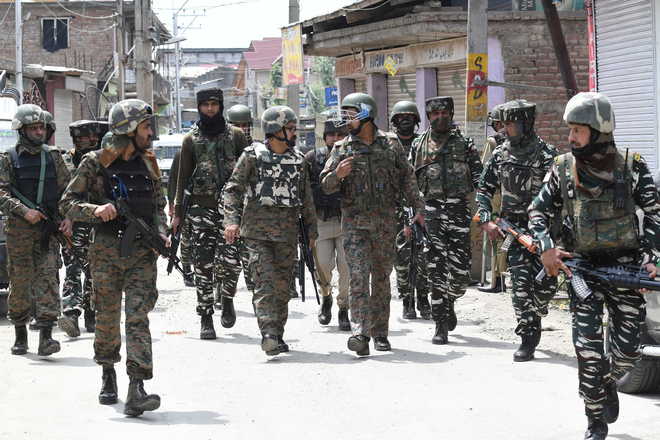
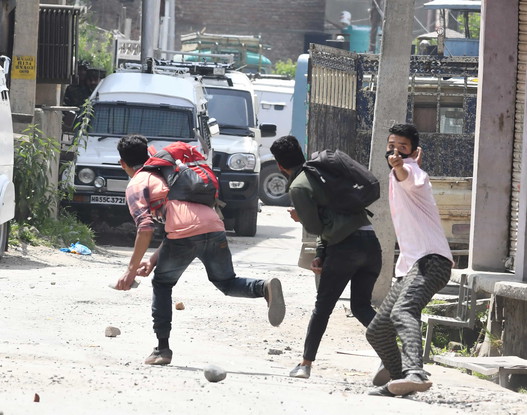
Jammu and Kashmir Police and CRPF personnel foiled a possible terror strike on Saturday killing three Lashkar-e-Toiba militants in the outskirts of the city after a five-hour operation, officials said.Four security personnel were injured in the gunfight but all of them are stated to be stable.The militants, according to the police, were planning to carry out the strike ahead May 7, when state government offices were to reopen in Srinagar after shifting from Jammu, the winter capital of the state.Protesters clashed with security forces to disrupt the counter-insurgency operation.The gunfight was triggered by a cordon and search operation launched by security forces at dawn in the city’s Chattabal locality.Locals said they heard intense exchange of gunfire in the morning as a large number of security forces rushed to the scene and sealed off the locality.The firefight continued for nearly five hours and ended with the killing of three militants. Immediately after the gunfight erupted, mobile internet services were shut down and restrictions imposed in volatile pockets of the city.The operation was swift and over in four hours with no collateral damage, Inspector General of Police (Kashmir Range) Swayam Prakash Pani said here after the operation.”On the basis of the materials recovered from the site, it was found that the terrorists belonged to the outlawed Lashkar-e-Toiba,” he added.One of the three militants was identified as Fayyaz Ahmed Hammal, who has been active for past one year.Officials said he is an illiterate, about 30 years of age and a resident of Khanka-e-Mohalla in downtown of the city. He was involved in some cases related to weapon snatching and terrorising people.Police officials believe that Hammal, who was earlier working at a printing press and an active stone-pelter, had been tasked to bring the two other militants, believed to be Pakistanis, to the city for carrying out an attack.The other two, according to doctors, were suffering from gangrene, a disease which is a result of frosbite that militants get while infiltrating from across the region in extreme cold conditions.Besides three AK rifles, a huge quantity of ammunition, including five magazines each, and a medical kit were recovered from the militants, police said.As the gunfight raged with intermittent pauses in Chattabal, a densely populated neighbourhood on edge of the city, clashes erupted between locals and security forces. The protesters tried to disrupt the counter-insurgency operation and pelted police and paramilitary forces with stones. A civilian identified as Adil Ahmad Yadoo, who was wounded in unclear circumstances at Noorbagh near the site of gunfight, was rushed to hospital where doctors declared him brought dead, the police said. The police said the youth died “due to a crush injury in a road accident”. The protesters, however, alleged that the youth was run over by a vehicle of security forces during clashes at Noorbagh.


Civilian injured in ceasefire violation in Keran sector of J&K

Civilian injured in ceasefire violation in Keran sector of J&K

The exchange of firing continued for nearly 45 minutes. PTI file

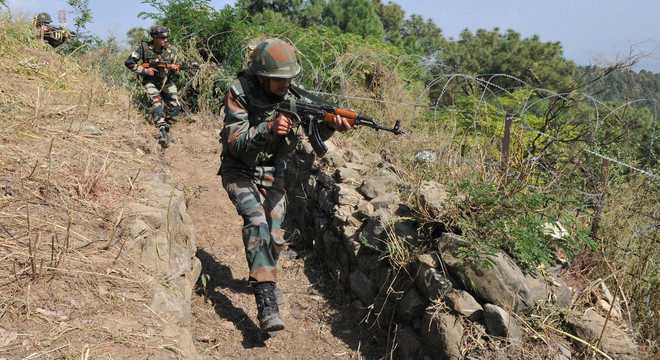
Keran (J&K), May 4A civilian was injured in ceasefire violation by Pakistan late on Thursday night in Jammu and Kashmir’s Keran sector.India retaliated to Pakistan’s firing from across the Line of Control (LoC).The exchange of firing continued for nearly 45 minutes.This comes a week after Indian Director General of Military Operations (DGMO) Lieutenant General Anil Chauhan and his Pakistani counterpart held an unscheduled hotline interaction on ceasefire violation.During the DGMO-level talk, India stood its ground regarding Pakistan-sponsored terrorism in the Kashmir Valley while the Pakistani DGMO accused Indian security forces of resorting to unprovoked firing along the LoC.In response, General Chauhan emphatically stated that retaliatory firing by Indian troops are carried out only in response to unabated support given by Pakistan Army to armed terrorists, who infiltrate across the border and target Indian Army posts with heavy calibre weapons. ANI


New defence panel holds first meet

Announces time-bound action plan

Tribune News Service

New Delhi, May 3

The newly constituted Defence Planning Council (DPC), at its first meeting on Thursday, announced a time-bound action plan for national security and long-term military planning.Headed by National Security Adviser Ajit Doval, the DPC has the mandate to come up with five drafts on various issues. It “deliberated on geo-strategic landscape,” a statement of the Ministry of Defence said. Sources said besides emerging scenarios in Asia and elsewhere, the recent development on ties with China was also discussed.The DPC, which was formed on April 18, is a permanent body. It has been tasked with preparing five drafts — national security strategic defence review and doctrines, international defence engagement strategy, roadmap to build defence and manufacturing eco system, strategy to boost defence exports, and prioritise capability development plans for the armed forces over different time-frames. It will submit its reports to the Defence Minister.As per its mandate, the DPC will operate through four sub-committees: policy and strategy, plans and capability development, defence diplomacy and defence manufacturing ecosystem. The membership and the terms of reference of the sub-committees will be finalised separately.Besides Doval, the three Service Chiefs, Defence Secretary Sanjay Mitra, Expenditure Secretary Ajay Narayan Jha, Foreign Secretary Vijay Gokhale are its members. Integrated Defence Staff Chief Lt General Satish Dua is the member-secretary.


Major who lost leg, eye in 1966 gets war injury pension benefits

Vijay Mohan

Tribune News Service

Chandigarh, May 1

For a decorated Army Major who lost a leg and an arm in demining operations along the India-China border over half a century ago, it has been a long and torturous battle spanning decades to get his rightful pensionary benefits.Badly wounded while clearing mines in the Sikkim Sector in July 1966, for which he was awarded the Sena Medal for gallantry and declared a battle casualty, Maj Jasbeer Singh was discharged from the Army in September 1978 after aggravation of his injuries made it impossible for serving further. However, he was granted disability pension instead of the higher war injury pension.After concerted efforts, the government sanctioned him war injury pension in August 2016, but implemented it with effect from July 2013, the date of one of his representations rather than from the date of his invalidation. Aggrieved over denial of arrears, the officer, now in his mid-70s, again represented before the government, but to no avail.Holding that he was entitled to arrears of war injury pension along with interest from the date of his discharge till the time it was finally sanctioned, the Chandigarh Bench of the Armed Forces Tribunal last week ruled that not only have the dues been wrongfully withheld, but it was also improper on the government’s part to plead against the claim of the soldier who would have better died than survive with 100 per cent disability.The bench, comprising Justice MS Chauhan and Lt Gen Munish Sibal, termed the government’s attitude as “stone-hearted” and “headstrong”, saying the officer had undoubtedly suffered a lot.Drawing support from a 2016 Supreme Court judgment, the bench observed that restriction of arrears to three years, as sought by the government, has been disapproved by the apex court in somewhat similar circumstances. While also awarding him costs of Rs 30,000 for unnecessary and avoidable litigation forced upon him, the bench said it was a sad commentary on how a valiant soldier had been made to run from pillar to post.AFT rues ‘complete lack of empathy’We note with regret, dismay that the authorities responsible for implementing such policies exhibit complete lack of empathy. AFT’s Chandigarh Bench 


Is new defence strategy old wine in new bottle? by PK Vasudeva

Is new defence strategy  old wine in new bottle?

NSA Ajit Doval

PK Vasudeva

Former Professor, ICFAI University, Hyderabad. The Modi government eyes a new national security strategy called the Defence Planning Committee (DPC) under the chairmanship of National Security Adviser (NSA) Ajit Doval. The DPC would define national defence and security policy by undertaking security risk assessment. The institutional set-up will also spell out the national military strategy, defence reviews, and an overall national security plan. The body that will envisage a draft national security strategy and will also formulate an international defence engagement strategy. The new strategic think tank will also oversee foreign acquisitions and sales, making defence preparedness much more than an acquisition-centric exercise.

Members of DPC

The Chairman of the Chiefs of Staff Committee (COSC), three Service Chiefs, Defence Secretary, Foreign Secretary and Secretary of Expenditure in the Finance Ministry will be the members of the committee. The Chief of Integrated Defence Staff (CIDS) to the Chairman of Chiefs of Staff Committee (COSC) will be the member secretary of the committee and the HQ of the CIDS will be the secretariat of the DPC.It will have four sub-committees. One will look at policy and strategy; the second will work on plans and capability development; third on defence diplomacy and the fourth one on defence manufacturing ecosystem and boosting of exports of indigenously produced defence products.  All reports will be submitted to the Defence Minister to ensure that they meet their desired end. The DPC will work across ministries and obtain approval from the Cabinet Committee on Security. 

Goals of DPC

The DPC has been tasked with ambitious goals. It has been established to assess the external security threat, envisage a strong defence strategy and prioritise issues based on their threat level. With the growing security threats, fueled by both direct and asymmetric means, the DPC has a huge responsibility of bridging the gap between the existing bureaucratic bodies. It is imperative for this new institutional set-up to create a mechanism wherein parties from the ministries, defence services as well as intelligence bodies work in coherence to face threats of all kinds.The last time the Government of India tried to establish a defence planning body was in 1977. However, the committee established then had not achieved the desired results. To overcome the seizures created due to the absence of a national security doctrine and lack of funds for the defence expenditure, the Group of Ministers under the NDA in 2001 had recommended that a position of Chief of Defence Staff (CDS) be created to bring in greater results in the national security matters, but it had failed to take off till today due to bureaucratic hurdles.There is need to align long-term goals with procurement and doctrines by a mandate to take up “capability development planning” and place it before the Cabinet Committee for Security for approval. Importantly, the panel will “evaluate foreign policy imperatives” and chalk out a strategy for international engagement that includes boosting ‘Make in India’ exports and foreign assistance programmes.While India does have a defence planning architecture in place, this is the first time it is creating a body that will factor in everything: from foreign policy imperatives to operational directives and long-term defence equipment acquisition and infrastructure development plans to technological developments in other parts of the world while coming up with a plan.The DPC will prepare military doctrines and, in turn, define Indian military objectives for the future. The doctrines will reflect India’s no-first-use nuclear policy as well as take into account the possibility of a two-pronged offensive from the adversaries. It will justify the Navy’s demand of two aircraft carriers and the role of Indian Air Force in the era of long-range standoff weapons and missile theatre defence.
Flaws in DCP work

There are a few serious flaws in the functioning of DPC. Most of what it is meant to achieve is a repetition of what numerous previous mechanisms were supposed to achieve and have obviously failed to do so. Will this too also meet the same fate as it is only old wine in new bottle?When there are full-fledged and well-structured professionally run ministries of external affairs, defence and finance with a full Secretary to the Government of India looking after these ministries, it needs to examined why things are not working. Setting them right is needed to be done rather than creating new structures which will override some of their functions.It is not clear whether this is an advisory or executive body. Can it override the existing procedures or direct the ministries to take actions without the concurrence of their respective ministers – can it change the rules of business of the MoD as the MoD bureaucrat will still call the shots, being superior in administration. Shouldn’t the National Security Adviser be overseeing national security – isn’t that his primary function? As the PM’s premier representative on issues of national security, he should be ensuring the collective coordinated functioning of the ministries. A glaring omission in this construct is internal security, which is the greatest security challenge at the moment. Isn’t internal security integral to national security? Can internal security be de-linked from external security – isn’t Kashmir and Northeast a common issue (external and internal)?What happens to existing organisations like the National Security Council (NSC), the National Security Advisory Board (NSAB) and the multitude of intelligence agencies — don’t they have a role in national security? The government should make all-out efforts to improve higher defence management rather than creating a new untried committee under a person who is not an expert on defence strategies.The three Service Chiefs as members of this committee do not fit in the committee as they are senior to all secretaries of the government and are equivalent to the Cabinet Secretary. In principle, the Chiefs should not be subordinated to the NSA, being heads of their services. They can be members of a committee under PMO/Raksha Mantri.In 2001, after the Kargil battle, the Subramaniam Task Force recommended the appointment of a CDS — in existence in all large democracies of the world — to do the same job as is being entrusted to the DPC under the NSA. Later, a Group of Ministers in 2002 also recommended the appointment of CDS. In 2011 again a high-powered committee under Naresh Chandra recommended a `Permanent’ Chairman of Chiefs of Staff (similar to CDS) to carry out a similar job as the new DPC. Appointing the Chief of Integrated Defence Staff (CIDS) as the member secretary further highlights the issue of avoiding appointment of a CDS. The CIDS has been unable to perform its assigned task because of non-appointment of a CDS, thus compelling all services to process their cases directly with the MoD. Placing the Chairman COSC in the DPC enables the NSA to function as a super CDS. Thus, control of the armed forces shifts from the Defence Minister to the PMO, with the NSA officiating as the CDS which is non-functionable.