Sanjha Morcha

Army captain held for molesting woman professor in Kanpur

Army captain held for molesting woman professor in Kanpur

Kanpur, April 16

An Army captain and a hostel warden have been arrested for allegedly stalking and molesting a woman professor here, the police said on Monday.  An FIR was registered against the duo under relevant sections of the IPC at Bithoor police station, SSP (Kanpur) Akhilesh Kumar said.The Army official, who is a doctor, had come to the city to attend a medicos’ meet on Friday where he met the professor, also a doctor, he said.According to a complaint filed by the professor, the official, who was in an inebriated condition, misbehaved with her and tried to pull her away from her car when she was returning to her hostel.She also alleged that the captain, accompanied by the hostel warden, followed her to her college hostel in Bithoor, and started knocking at her door. PTI


vedios : Lt Gen Ata Husnain at Kashi Manthan – 2018 (2)

http://


http://

http://

Lessons from the Rauf Khanday story: Changing the radical narrative in Kashmir is imperative

The story of Rauf Khanday, the Hizbul Mujahideen terrorist killed at Petha Dialgam village in South Kashmir’s Anantnag district on the night of 31 March, is the ideal trigger for commencement of new narratives in Jammu & Kashmir.

Rauf Khanday along with another young terrorist was located by intelligence in a safe house in the village; security forces have a standard operating procedure in such encounters. Megaphones, mobiles and even couriers are used to establish communication with terrorists holed up, especially if it is known there are local ones. They are asked to surrender failing which the encounter is progressed to its inevitable end.

Altaf Ahmad Khan, the current SSP Anantnag and a veteran JK Police officer knows the score. He set up the mechanism to communicate with both the young terrorists and convinced one of them to surrender, but Khanday refused. What Altaf Khan then felt is the stark truth that many in Kashmir and in fact all over India have hardly understood; that Khanday had a false interpretation of the Quran fed to him.

SSP Altaf Khan tried discussing with him aspects of the false interpretation but two way mobile communication under the tension of an ongoing encounter is hardly the environment in which the Quran’s message can be interpreted. “I narrated verses from Quran and advised him that whatever he was doing was against the teachings of Islam. The conversation continued for over 30 minutes during which Khanday got abusive. But I ignored all this because my intention was to save him from getting killed,” Khan is reported to have later said. Khanday’s parents were brought to the encounter site but their urgings too could not succeed; he became violent and was eventually killed.

Ever since 2012-13 new militancy has hit the Valley. Till then the narrative of extremism was led by radicalised Pakistani terrorists. The new generation of local terrorists were, however, mostly from South Kashmir. Headquartered there, in the Kulgam area, is the Jamaat e Islami (JeI) Kashmir which is not linked with JeI India.

Efforts to link the extremist movement in J&K with international extremist Islamic influence had formed a part of Pakistani grand strategy right from 1989. It was well known that bringing about such a change in Kashmir’s essentially tolerant Sufi faith would need the spread of new narratives with less tolerant interpretations of the Quranic message, which give Islam a colour of confrontation with the rest of the world.

But these new narratives really came into their own as social media hit the Valley with penetration of mobile networks and internet connectivity in 2012-13. The transformative effect came with the full throated employment of UP and Bihar maulvis who had by then replaced the Sufis in the Valley’s mosques, making a difference to the Friday sermons and everyday Islamic education of children.

The Indian state and its frontline organisations led by the army and intelligence agencies understood little of the creeping onslaught of the new Islamic narratives. The unfortunate thing is that lack of knowledge and unwillingness to go beyond search engine information – while continuously condemning all of Islam as a faith and not its negative interpretations – is only helping drive Kashmir’s youth deeper into the morass of extremism.

We need a moderate clergy to come to the assistance of the establishment. Even the clergy of Saudi Arabia is changing its stance based on the leadership of Prince Mohammad bin Salman. India is fortunate that it has major schools of Islamic jurisprudence and its Islam is considered the most moderate. Yet a one off condemnation of extremist interpretations about terrorism does not help; in fact the silence of the clergy contributes to strengthening the ongoing negative narratives.

India has many eminent Islamic clergymen who give weight to multi-faith dialogue and espouse the cause of moderate ideology. Changing the radical narrative in Kashmir cannot be a creeping effort; it has to be transformative, visible and focused. It’s a matter of putting together a campaign backed by the government which can take inspiration from similar campaigns instituted in countries such as Indonesia and Singapore. There are models of online instruction through internet imams and academics while addressing youth, parents and teachers on religious parenting and ever present threats of negative religious interpretations.


Army Chief briefed on LoC situation

Army Chief briefed on LoC situation

Amir Karim Tantray

Tribune News Service

Jammu, March 31

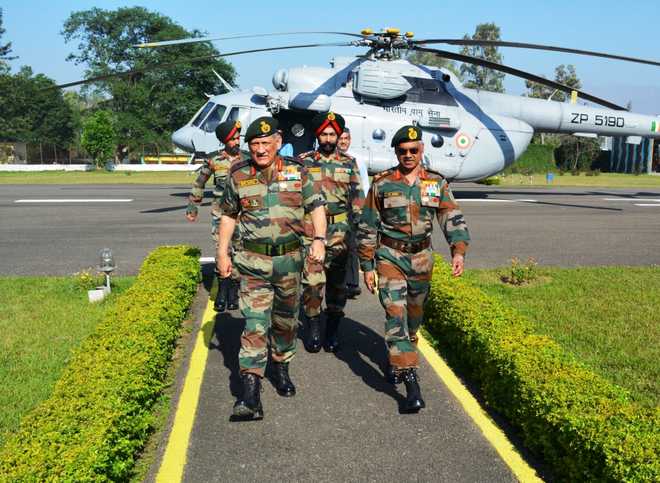
A day after visiting eastern Ladakh, Army Chief General Bipin Rawat on Saturday visited Northern Command headquarters at Udhampur.The General was briefed by General Officer Commanding-in-Chief (GOC-in-C), Northern Command, Lt General D Anbu on overall security situation along the Line of Control (LoC) and the hinterland in the command theatre.Giving details, Northern Command PRO Col NN Joshi said the Army Chief interacted with senior military commanders and got a first-hand assessment of the prevailing operational conditions and preparedness.“He appreciated the high standards of operational readiness in the difficult terrain and challenging operational environment. The General also lauded the synergy and cooperation between the Northern Command, Air Force, Central Armed Police Forces, civil administration, and J&K Police operating in the region,” Joshi said.The Northern Command looks after the entire Kashmir valley, Ladakh region and a major part of Jammu region, except Jammu plains, which fall under the Western Command. The Northern Command has to look after the security of three types of borders, 740-km LoC with Pakistan-occupied Kashmir (PoK), Actual Ground Position Line at Siachen and Line of Actual Control (LAC) with China in eastern Ladakh.This command is one of the most active operational areas of the Army which has to tackle the challenge of infiltration and ceasefire violation on the LoC, armed insurgency in hinterland of the Valley, inclement and harsh weather conditions at Siachen and unpredictable situation along the LAC.On Friday, General Rawat visited forward areas in eastern Ladakh and reviewed security situation and operational preparedness. The Army Chief had extolled all ranks for their unwavering dedication and high morale in toughest climatic conditions.


1971 war hero cremated Brig NS Sandhu (retd) was Maha Vir Chakra awardee

Tribune News Service

Chandigarh, March 31

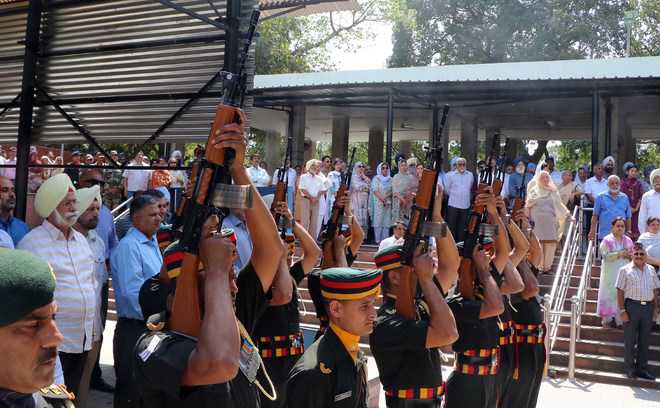
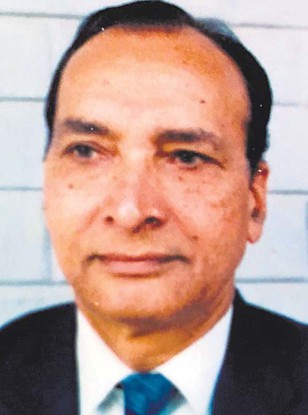
The mortal remains of 1971 war hero Brigadier Narinder Singh Sandhu (retd), a Maha Vir Chakra awardee, were consigned to the flames here on Saturday with full military honours. A large number of serving and retired officers, relatives and well-wishers bid adieu to the 85-year-old war veteran who had been battling cancer.Prominent among them were the General Officer Commanding, 1 Corps, Lt Gen AS Kler, who is Brigadier Sandhu’s son-in-law, the Chief of Staff, Western Command, Lt Gen GS Dhillon, Deputy Chief of Army Staff and Colonel of the Dogra Regiment Lt Gen Ranbir Singh, the Director Sainik Welfare, Punjab, Brig JS Arora, president and vice-president of War Decorated India Lt Gen GS Sihota and Brig KS Chandpuri, respectively, Colonel of the 65 Armoured Regiment and General Officers Commanding of several divisions based in the region. The Commanding officer of 10 Dogra, the battalion Brigadier Sandhu had commanded in the India-Pakistan war, was present too.A ceremonial guard from the Dogra Regiment and 3 Cavalry reversed arms as a mark of respect while buglers sounded the Last Post. Wreaths were laid on behalf of the Governor, the Punjab Chief Minister and the GOC-in-C, Western Command. However, no political leader or senior officer from Punjab was seen.An alumnus of Khalsa College, Amritsar, Brigadier Sandhu was commissioned into 3 Cavalry in 1953. While commanding 10 Dogra in the Dera Baba Nanak Sector in 1971, he captured a key bridge in Pakistan’s territory, aborting the enemy’s attempts to mount an offensive into Punjab. In spite of a bullet injury in his leg, he continued to lead his men.During the 1965 Indo-Pak war earlier, he had been Mentioned-in-Dispatches for gallantry in the Battle of Asal Uttar in Punjab when his lone cavalry unit destroyed several M-47 Patton tanks of a Pakistani armoured division.Pilot of AI plane hijacked in 1971 deadFaridabad: Capt MK Kachru, pilot of the Indian Airlines plane hijacked to Pakistan in January 1971, died here on Saturday after prolonged illness. He was 93. Capt Kachru was flying an Indian Airlines plane, carrying 26 passengers and a crew of four, from Srinagar to Jammu when two Kashmiris hijacked it and forced him to fly to Lahore. Zulfiqar Ali Bhutto, then foreign minister of Pakistan, turned up at the airport and hailed the hijackers, who had demanded the release of some prisoners from Indian jails. The demand was refused by India. PTI


*ASSISTANCE FOR ONLINE APPLICATION FOR NEW 64 KB ECHS SMART CARDS*

Bhopal Veterans and Family Pensioners,
The following Veterans have volunteered to help fellow ECHS Members in applying online for new 64 KB ECHS Smart Card:-
 1. Col AK Gulati.
2. Col KP Singh.
3. Veteran Javahar KP.
4. Veteran Anil Tiwari.
Javahar KP and Anil Tiwari have also agreed to help aged Veterans / Family Pensioners and anyone who finds it difficult to move out of their home by providing at home services.
In case there are more volunteers please oblige and give your willingness please.
Desirous ECHS Members please avail of this facility.
Regards,
Yours truly,
Brig R Vinayak, VSM
+918989003891

90 older Mi-17s to get electronic warfare suite

90 older Mi-17s to get electronic warfare suite

Vijay Mohan

Tribune News Service

Chandigarh, April 23

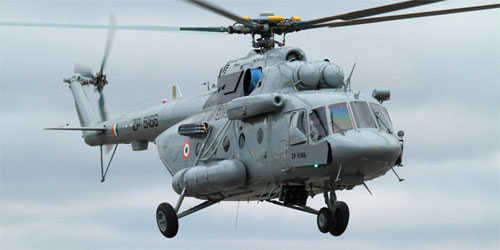
The Air Force is upgrading the older variants of its Mi-17 helicopters by equipping them with electronic warfare (EW) suite to increase their capability to operate effectively in a hostile environment.
According to IAF sources, 90 of these medium-lift helicopters — 56 Mi-17 and 34 Mi-17 1V variants — will be upgraded by No.3 Base Repair Deport in Chandigarh in collaboration with state-owned Bharat Electronics Limited (BEL). The IAF approached BEL in this regard last month.
The move to upgrade the older series comes in the backdrop of a project to retrofit the latest version, the Mi-17 V5 that entered services a few years ago, with similar EW equipment. Last year, BEL was also approached to equip some Mi-17s with advanced navigational aids.
The EW suite comprises of a radar warning receiver (RWR), a missile approach warning system (MAWS) and a counter measure dispensing system (CMDS). The RWR detects radio waves emitted by radars and electronic surveillance equipment whereas the CMDS enables the crew to imitate counter measures or evasive action against enemy radars and missiles by firing chaff or flares.
The MAWS is meant to alert the crew about any incoming ground or air-launched missile and also cue the CMDS to trigger. Mi-17 helicopters are used for special operations as well as close air support, logistic supplies and troop movement, requiring them at times to operate at low altitudes and slow speeds, thereby making them vulnerable to missile attacks.
The Air Force expects the programme to upgrade the 90 helicopters to be completed in 48 months. This includes training an initial batch of pilots, flight engineers and flight gunners to operate the new systems.

Dassault eyes more India deals

  • French aviation major Dassault Aviation held its executive committee meeting in New Delhi to reaffirm commitment to the ‘Make in India’ policy.
  • “The company’s executive committee rallies around the huge challenge to highly contribute to the ‘Make in India’ and Skill India policies that will lead to India’s self-sufficiency in the aerospace domain,” said Eric Trappier, Chairman and CEO of Dassault Aviation.
  • India is buying 36 Rafale jets from Dassault Aviation in an off-shelf purchase. The company is also in running for the 110 fighter jet tender floated by the Indian Air Force and interested in the 57 fighter jet purchase by the Navy for aircraft-carrier operations. TNS

India’s inclusion in NSG will boost global export control system: Germany

India’s inclusion in NSG will boost global export control system: Germany

New Delhi, April 16

Strongly pitching for India’s inclusion in the Nuclear Suppliers Group (NSG), Germany on Monday said the global export control system will benefit a lot from New Delhi’s participation in all its four regimes.

Out of the four export control regimes that work to keep proliferation of Weapons of Mass Destruction (WMD) in check, India is a member of the Missile Technology Control Regime (MTCR), the Wassenaar Arrangement and the Australia Group.

India’s membership to the 48-member NSG is being primarily opposed by China on the pretext that it is not a signatory to the Non-Proliferation Treaty (NPT).

“Germany has strongly supported India in its efforts to become a member of the export control regimes just as we continue to strongly support India’s membership in the Nuclear Suppliers Group,” Jasper Wieck, the Deputy Head of the German mission here, said.

“We are convinced that the global export control system will benefit a lot from India’s participation in all four regimes,” he said while speaking at the inaugural session of India-Wiessbaden Conference 2018, organised jointly by the Ministry of External Affairs in cooperation with Germany and the United Nations Office for Disarmament Affairs.

Representatives from the government and industry of 39 countries, as well as experts from the UNSC 1540 Committee and UN Office for Disarmament Affairs in New York, are participating at the two-day conference titled  ‘Securing Global Supply Chains through Government-Industry Partnerships towards Effective Implementation of UNSC Resolution 1540’              .

The UN Security Council Resolution 1540 (2004) establishes legally binding obligations on all states to adopt and enforce appropriate and effective measures to prevent the proliferation of nuclear, chemical, and biological weapons and their delivery systems to non-state actors.

It requires, therefore, that countries implement appropriate and effective measures to prevent non-state actors such as terrorists, from obtaining access to WMDs.

“We consider this initiative (the conference) as yet another example of India’s engagement with regards to international cooperation in the areas of export controls,” Wieck said. PTI


Baisakhi in the City of Bliss

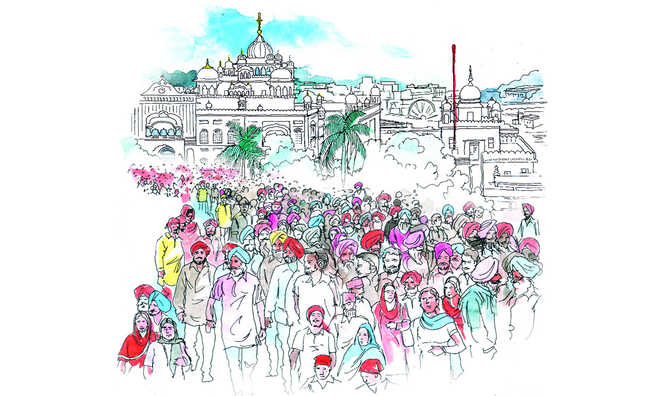
Guru Gobind Singh chose Anandpur Sahib to be the venue of a transformative movement in Punjab. Today, we see teaming masses march up to Takht Sri Keshgarh Sahib on the Baisakhi day

Baisakhi in the City of Bliss

Roopinder Singh

What is it that is raising so much dust? Is it an invading force of raiders? No, that’s just a poet blessed with wealth by Guru Gobind Singh going home after attending the darbar.The couplet attributed to one of the court poets of Guru Gobind Singh speaks of the dignity with which they were treated and also the magnificence of his gifts to the gifted. A flourishing cultural milieu came up wherever Sikh gurus set up camp. Guru Gobind Singh inherited many of the poets in his darbar from his father, Guru Tegh Bahadur, and we find compositions in Braj bhasha, Sanskrit, Persian, Arabic and Punjabi from the period in different manuscripts. The village of Makhowal became Chakk Nanki when Guru Tegh Bahadur christened it after his mother. He had bought the village and surrounding areas in 1665 and it became his headquarters. He was to live here for 10 years before undertaking the fateful journey to Delhi and facing martyrdom while defending religious freedom for the adherents of other religions, not just his own.It was this ethos that Guru Gobind Singh evoked in his fight against the repression of the day, personified by the Mughal rule of Emperor Aurangzeb. “I will make sparrows fight the hawks,” said Guru Gobind Singh, after he formed the Khalsa at Anandpur Sahib on Baisakhi in 1699.  Lakhs of Sikhs go to the birthplace of the Khalsa to celebrate Baisakhi, even as it is celebrated on a grand scale at other places too, notably at Talwandi Sabo.The collected hymns of his predecessors and his own compositions were the guiding force for all. The annual gathering at Anandpur Sahib became the focal point of a renaissance that had as much to do with the transformation of religious beliefs, a push towards an egalitarian society and a firm belief in the oneness of the Almighty, as it had with military preparation. The Baisakhi of 1699 threw up a vision of a new and regenerated humanity. Today, all those who visit Anandpur Sahib go to Takht Sri Keshgarh Sahib, and rightly so. Rich in history, the present gurdwara, however, is relatively recent. It was built in the mid-1930s. It houses a collection of relics associated with the Gurus, especially Guru Gobind Singh.These relics draw us to the magnificent heritage of the City of Bliss, as Anandpur literally translates into. It is here that the Gurus and their families lived. A thriving trade was provided for the inhabitants and visitors and the Guru’s darbar attracted the hordes, especially during festivals like Hola Mohalla and Baisakhi. Guru Gobind Singh spent some years of his childhood and later raised his family at Anandpur Sahib. It was here that he created the Khalsa. It was from here that he lost his family and his home, but never relented in his fight against tyranny. It was he who re-named Chakk Nanki as Anandpur. His Sikhs suffixed the honorific Sahib.“Redemption comes through knowledge,” said the Guru and the sheer volume and quality of literature that was created in the city became the stuff of legends. Going by what Bhai Santokh Singh says in Suraj Parkash the manuscripts weighed around 350 kg! All except the small volumes that had been taken out earlier were lost when the Khalsa forces evacuated Anandpur Sahib in December 1705. They had to go through the Sirsa stream that was in spate. The eldest two sons of Guru Gobind Singh were killed in the battle with the Mughal forces at Chamkaur Sahib. His two younger sons and his mother were separated from him, and much of the treasures, including the literature, were lost in the melee.Anandpur would later be taken over by the Raja of Bilaspur and bought by the cousins of Guru Gobind Singh whose families ran the local gurdwaras. The family’s writ ran over various institutions. One of the descendents,  and it was under Sodhi Kishan Singh, a descendant, that the town became a municipal committee in the last decade of the 19th century. The Shiromani Gurdwara Parbandhak Committee (SGPC) took over the gurdwaras in 1923 and has managed these since.Over the years, Hola Mohalla became a festival associated with the city and its people. On this day, Nihangs, resplendent in cobalt blue tunics and turbans, horses and other accruements of warriors — perform death-defying feats.Crowds gathered for Baisakhi, too, but not in such great numbers. Anandpur, the sleepy town at the foothills of the Shivalik Hills, remained out of public eye and missed much of the boom that other cities in Punjab benefited from.Having, in Giani Zail Singh, a Chief Minister who was an MLA from Anandpur Sahib, helped. The Guru Gobind Singh Marg celebration in 1973 brought focus back to the city. This route traced the 47-day journey of Guru Gobind Singh from Anandpur Sahib to Talwandi Sabo, and the joint effort of the SGPC and the Punjab Government resulted in a major up gradation of infrastructure around the area.The Anandpur Sahib Resolution, adopted by the Shiromani Akali Dal that year, lit a political fire that would soon ignite passions far beyond the town.The Singh Sabha Shatabdi Committee, led by Hukam Singh and Giani Gurdit Singh, made a concerted effort to revive the spirit of Baisakhi at Anandpur Sahib. Scholars read out research papers to massive audiences. Some of them were honoured publically for their contribution to history and understanding of religion. Like in much of Punjab, the decade between the mid-1980s and 1990s was largely lost.Celebrations to mark the tercentenary of the Khalsa in 1999 saw the city being painted white. Lakhs of people, hundreds of langars and massive functions marked the occasion on which the establishment of the Virasat-e-Khalsa museum was announced by the then Chief Minister Parkash Singh Badal.Giani Tarlochan Singh’s appointment as Jathedar of Keshgarh Sahib in 2003 was another milestone. He had spent much of this life at Anandpur Sahib, and served as a catalyst to growth till his death, in harness, in 2013.The Virasat-e-Khalsa museum, which opened in 2011, is now a major tourist attraction. Today, the celebrations have evolved too. People on horseback could well be polo players, not just Nihangs. The SGPC and the city administration play a major role in directing the festivities, with kirtan darbars and katha sessions dominating the discourse. Relative newcomers like the Anandpur Sahib Foundation and Sikh Chamber of Commerce have planned a half-marathon, a movie festival and knowledge sessions, activities reflecting an evolving spirit of Baisakhi. Baisakhi at Anandpur Sahib reflects the egalitarian ethos of the Gurus, who re-kindled the spirit of the downtrodden and the battered and made them stand up for the rights of others, as well as their own.


52 court poets

Bhai Kahan Singh Nabha’s authoritative Mahan Kosh lists the following ‘Bavanja Kavi’ in who received the patronage of Guru Gobind Singh:1 Uday Rai 2 Ani Rai 3 Amrit Rai

4 Allu

5 Asa Singh

6 Alim

7 Ishavar Dass 8 Sukh Dev 9 Sukha Singh

10 Sukhia

11 Sudama

12 Sainapat

13 Shyam

14 Heer

15 Hussain Ali 16 Hans Ram

17 Kallu

18 Kuveresh

19 Khan Chand

20 Gunia

21 Gurdas

22 Gopal

23 Chandan

24 Chanda

25 Jamaal

26 Tehkin

27 Dharam Singh28 Dhanna Singh29 Dhayan Singh

30 Nannoo

31 Nishchal Dass32 Nihal Chand33 Nand Singh34 Nand Lal35 Pindi Dass

36 Ballabh

37 Balloo

38 Bidhi Chand

39 Bulland

40 Brikh

41 Brij Lal

42 Mathura

43 Madan Singh44 Madan Giri

45 Malloo

46 Maan Dass47 Mala Singh

48 Mangal

49 Ram

50 Rawal

51 Roshan Singh52 Lakha


Gurdwaras of Anandpur

Takht Sri Kesgarh Sahib

Gurdwara Qila Anandgarh Sahib    Gurdwara Qila Fatehgarh SahibGurdwara Qila Lohgarh Sahib

Gurdwara Holgarh Sahib

Gurdwara Mata Jito Ji

Gurdwara Manji Sahib

Gurdwara Sis Ganj Sahib

Gurdwara Damdama Sahib

Thara Sahib

Gurdwara Bhora Sahib


Shirking Responsibility by Lt Gen Bhopinder Singh

Indian democracy, Rafale deal, PNB scam, Nirav Modi

Indian democracy is designed on the Westminister model, and it proximates the structural moorings of the same rules and regulations of governance. Beyond the trumpeted statistics as the ‘world’s largest democracy’, the grim reality of the dismal condition of its institutions ~ legislature, judiciary and executive ~ showcases a huge gap between the two ‘mature’ democracies. The principle of counter-balancing institutions to preserve the spirit of the Indian Constitution has been compromised because of inefficiency, overreach and factionalism. This has resulted in a ‘moral crisis’ in addition to the functional ineptitude. The foundational temper and conscience which influenced the freedom struggle and then the profundity of the Constitution envisages a certain behavioural ‘morality’ from its leadership to uphold the Constitution’s principles, directives and duties. Honest ownership of actions and responsibilities, irrespective of their implications is one of the most basic, and sadly waning attributes in the Indian narrative.

In 1956, owning ‘moral’ responsibility, the then Railway Minister Lal Bahadur Shastri had tendered his resignation following the Ariyalur train disaster. His honesty was not recognised as weakness as he later went on to become the Home Minister and then, the Prime Minister. This template of moral probity, rectitude and conscience has since then been too scarce. Not that such decisions rooted in individual ‘conscience’ can absolve the establishment from the serious allegations of neglect, wrongdoing or inaction; but it can surely sensitise, galvanise and improvise the entire value-chain of governance, into immediate course-correction. Today, the concept of ‘head-rolling’ has acquired a very sinister, undemocratic and convenient dimension. In order to assuage the public pressures of immediate action, the axe usually falls on lower-level administrative functionaries who become cannon  fodder to hide the systemic rot. The other escape mechanism is to sidestep the blame with the standard accusations of a ‘political conspiracy’.

Contrast this with the  response of the previous British Prime Minister, David Cameron who on being named (not convicted) in the Panama leaks, admitted, “I know that I should have handled this better, I could have handled this better. I know there are lessons to learn and I will learn them” and went on to accept the blame by saying, “Don’t blame Number 10 Downing Street or nameless advisers, blame me”. Later on the crucial Brexit referendum, the results of which were not legally binding and were only of persuasive import, Mr Cameron accepted ‘moral’ defeat by resigning from the post of Prime Minister. He said: “British people have made a very clear decision to take a different path, and as such I think the country requires fresh leadership to take it in this direction”. His preferred position of ‘stay’ versus ‘exit’ had narrowly lost out ~ 52 to 48. At the age of 49, Mr Cameron who had once stated that “I was the future once”, assumed ‘moral’ responsibility for his action and resigned. Today, he serves as the President of Alzheimer’s Research UK, to campaign for medical research funding!

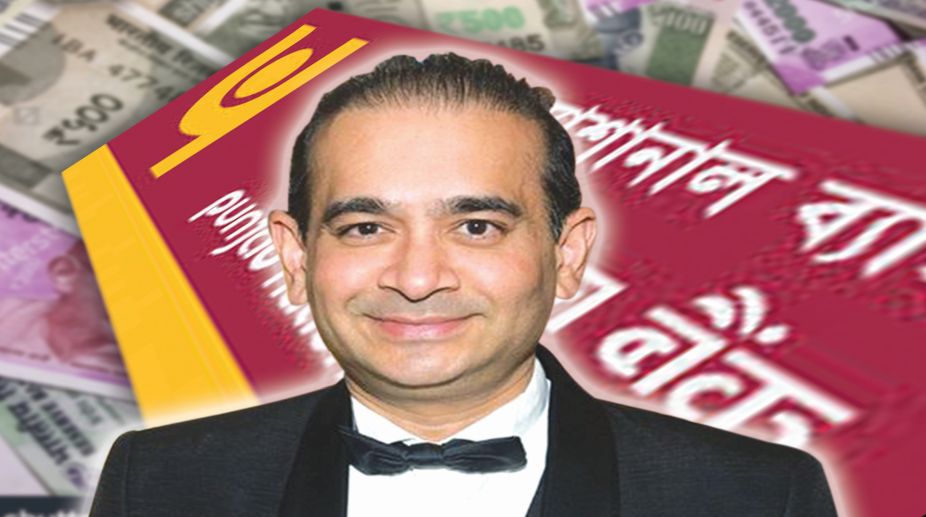
Unfortunately in India,  there seems to be no accountability or responsibility of leadership for any acts of commission or omission. From the recent PNB scam, CBSE exam leak, Rafale deal, minority-lynching and so on, the promised change by the ‘Party with a difference’ is sadly a continuum of fate for the common man. Spin-doctoring of facts and figures has been elevated to a fine art by glib spokespersons, who blunt each accusation with either a stoic silence or an aggressive counter-recital of ‘facts’ that clinically detail worse statistics and scale of misfortune during previous dispensations. The language in the accompanying social media  is  derisive and carefully couched in semantics that willy-nilly juxtapose every contrarian view into portents that are ultra-nationalistic, religious or exclusivist.

Even executive decisions on matters of economics, trade and commerce such as Demonetisation, were bizarrely contexualised and equated to questioning the ‘Indian Soldier’! The deflective dissonance and empty posturing following any fresh  scam distracts from any substantial acceptance, introspection and ‘head-roll’ on account of any dereliction in accountability and responsibility.

Certain institutions like the  Armed Forces and the Judiciary, which are (were?) relatively spared the intrusion of the politico-bureaucratic obfuscation, rise to the occasion and deliver as they have their own system of meritocracy, discipline and accountability. Often, these institutions have to outstretch beyond their defined-mandate to deliver when the other political and administrative entities betray inability, incapability or fear to do so. The operative expression in the Armed Forces is to deliver even ‘at the cost of paying the ultimate price’. Such undiluted leadership traits of ‘leading from the front’ have ensured that the institution has the highest officer-to-soldier casualty ratio in the world. However, the winds sweeping the guarded barracks or even the precincts of courtrooms are not spared the corrosive impact of the societal decay that could stymie institutional efficacy of these last government bastions of responsibility.

For India’s democracy to grow further, all political dispensations across the centre and the states have to glorify a culture of probity and transparency, instead of ridicule, jingoism and majoritarian. Democratic instincts need to be honed and strengthened like the RTI Act, instead of disempowering moves like the recently retracted order to potentially deny PIB accreditation to journalists. The modern-day terminology is replete with terms like ‘fake news’, jumlaa, presstitudes that ought to be anathema to a ‘moral’ nation which is proud to be liberal, progressive and inclusive. The promised economic revival has yet to metamorphose, the relationship with the neighbouring countries are at an all-time low with traditional allies like Nepal and Maldives alienated,  the minorities are vulnerable, and the agrarian crisis has deepened considerably.

It is true that all of this is not necessarily the creation of the current dispensation, but harping on the past can denude credibility. Neither is questioning the government of the day anti-national. Nor for that matter does it tantamount to siding with the Opposition. It is the duty of all citizens to openly ‘question’ and insist on accountability and responsibility for the good of society and the nation, irrespective of the individual’s political affiliation.

The writer IS Lt Gen PVSM, AVSM (Retd), Former Lt Governor of Andaman & Nicobar Islands & Puducherry



Why Pakistan’s Strategic Confidence Is On The Wane

China and Pakistan ... dubious friendship.

Snapshot
  • Pakistan has many things to worry about, including the FATF deadline, and its dubious friendship with China isn’t going to help.

Pakistan betters us at a couple of things. First is its outreach and ability to tell its version of every story to the world well before us. The second is its capability to exude confidence far beyond what the circumstances actually permit. Its soldiers tend to be brash and project artificial and unrealistic bravado when facing Indians; almost as if a defensive mechanism has been switched on. That can be attributed to the emotive response to its defeat in the 1971 war; something they don’t have control over.

Admittedly, in the last two years or so, I deduce from my observations and subsequent analyses, based on many conversations with Pakistani citizens that the country’s strategic confidence has been on the rise, to the point of actually adding cockiness to the national image. Without going into too much detail, the reasons for this surmise are alluded to six factors.

First, an economy which was then perceived as improving, at least till recently. Second, the enhanced strength of the strategic relationship with China arising primarily out of the flagship status given to the China Pakistan Economic Corridor (CPEC) within the Belt and Road Initiative (BRI). Third, the return to good old days with former ally Saudi Arabia; General Raheel Sharif’s appointment as head of the 42-nation Islamic Military Counter Terrorism Coalition being the facilitator. The relationship had some challenges when Pakistan refused to send troops to assist Saudi Arabia in the war in Yemen. Fourth was the Russians warming up to Pakistan although with an intent to maintain the balance of power in the subcontinent after India moved towards a strategic partnership with the US. Fifth, with an improvement in the counter terrorism situation, Pakistan believes that it had won the internal security challenge it had been confronted with since 2007. Sixth and the last was the US blowing hot and cold without ever being able to carry out its threats against Pakistan, even through the first year of the Donald Trump Administration. This is inevitable because the US is compelled to maintain its troops in Afghanistan, facilitated by Pakistan, and its lines of communication. Also, the necessity of keeping terror networks such as the Haqqanis under control obviated any meaningful coercion against Pakistan.

Now in the last few weeks as my travels bring me in contact with people from Pakistan, they appear to reflect diffidence with an almost overnight dilution of confidence in their nation. So what has happened that there was such a dramatic turnaround in self perception? I think many in Pakistan are beginning to believe less in what their government and their army tells them.

On the one hand, we hear of 5.8 per cent gross domestic product growth this year with prospects of Pakistan heading towards the 7 per cent figure. However, devaluation of the Pakistani rupee twice, taking it to an exchange rate of Rs 115 to a dollar, doesn’t appear to signal such strength in the country’s economy. With just $12 billion in its foreign exchange reserves, Pakistan was placing many eggs in the basket of the Chinese, especially after CPEC was heralded as the flagship project of BRI. Neither the Pakistani citizens nor their media appear to have any clarity about the viability of the CPEC and its profitability for Pakistan. Informed sources point out that once debt servicing of the loans received for the CPEC begins, there could be an outflow of as much as $5 billion per year. Queries and discussions elicit no intelligible responses; everyone seems to be at sea.

The spectre of what is being experienced in Sri Lanka’s Hambantota as well as the case of leasing of the naval base in Djibouti seems to be causing some consternation about what deals with the Chinese really mean. Amid brief mutterings about how well Pakistan knows about Chinese dealings, the follow up questions on other domains such as the CPEC’s effect on the psyche of the common Pakistani receive even more negatives. Pakistan’s public demands to know where the promised jobs are, everything seems to be done by the Chinese themselves. The Chinese presence in large numbers is causing security problems and the ultra radical elements which constitute a fairly large number are not happy with the infringement on Islamic culture and ways.

The fact that the Chinese are wary of Pakistani businessmen travelling to the Xinjiang area is also not going down too well with Pakistanis, who have taken the Sino-Pakistani relationship for granted all these years. The ‘deeper than the oceans and higher than the skies’ bit can get dented when Pakistanis are known to be entering Xinjiang and marrying into the Uyghur, something the Chinese are very sensitive about. And we have not even mentioned Baluchistan yet. The corridor through the Baloch territory will cause sufficient headache for the Pakistani security forces.

The domain which Pakistan seems to be the most defensive about and to which they will have no rational answers at all is the Financial Action Task Force (FATF) strictures of March 2018 and the decision to give it time till May 2018 to prepare an action plan to put an end to terror funding. This will decide whether Pakistan has to be placed on the black or the grey list. Even the Chinese voted against Pakistan after some initial hesitation. Pakistan has been under FATF monitoring before, from 2012 to 2015, and can claim to know the ropes. However, this time it may be a bit more real. President Trump did not seem to be joking with his first tweet of the New Year in 2018, when he observed how Pakistan has been reneging on its promises despite being the recipient of US largesse. A FATF stricture could be a clamp on Pakistan’s international banking system.

All this should worry Pakistan no end especially when the Line of Control (LoC) remains hot and there would be pressure from the friendly proxies for support to more operations in Jammu and Kashmir’s hinterland, where they would wish to be seen active in an election year. Whatever brave face Pakistan wishes to put on, it is clearly at wits end because the LoC pressure from the Indian Army is not easing. Knee jerk responses through breaches of ceasefire and targeting of civilian habitation have been absorbed by India, which is no longer in the mood for talks of any kind. Ratcheting terror activities will only fetch Pakistan negative dividend at the FATF.

In the light of all this, is there likely to be some change of heart in the Pakistan’s military and political leadership? This is the time India’s formal and informal diplomacy must be at a high to project how we have suffered Pakistan’s waywardness all these years. Equally, India needs to be alert to the fact that Pakistan’s continuing and increasing dependence on China could coerce it into inimical actions at the borders to support something the Chinese may have in store for the subcontinent; people do keep talking of a Doklam 2. It’s worry time and India’s political, diplomatic, military and intelligence domains need to be on a higher state of alert through this summer. Sometimes, loss of confidence can lead to wayward steps by nations; hopefully Pakistan isn’t thinking that way.