





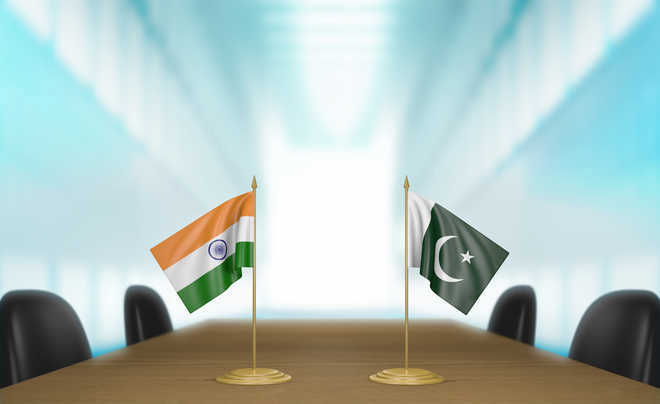
The agreement by India and Pakistan to resolve issues relating to diplomatic civility is yet another pointer of the desire by both countries to turn the page on nearly three years of hostility and acrimony. The harassment of each other’s diplomats had reached such proportions that Islamabad recalled its envoy in Delhi for “consultations”, usually signalling a near-breakdown in ties. The agreement to de-escalate tension on the diplomatic front needs to be read with the muzzling of the guns on the border for over a week and the readiness of both sides to release some prisoners on humanitarian grounds. Add to it regular confabulations between the National Security Advisers, the meeting of the Indus water panel and, finally, the Pakistan foreign minister’s readiness to resume the Composite Dialogue. These initiatives do not look like straws in the wind. Rather they appear to be building blocks to something substantial in the coming days.The Indian side will be tempted to interpret the other side’s readiness to break bread as an indication of its effectiveness in cornering Pakistan. The global Financial Action Task Force’s blackballing of Pakistan and the ever-escalating US bounty on Hafiz Saeed fortify this argument. But Pakistan is also a much sought country for its ability to bring Taliban to the negotiating table. Islamabad’s interests will also be served by tranquility on the LoC because it can then concentrate its military and diplomatic vigour on ensuring a place for its proxies on the high table in Kabul. India needs to take advantage of this window of conviviality that has opened in Islamabad. Currently Pakistan is on its best behaviour after the US pared its military assistance. US President Donald Trump too may not look kindly on diversions on the Indo-Pak border at this time. India needs to turn the corner with Pakistan also because it must be counted as a mature and influential player when the settlement takes place in Afghanistan. However, the trajectory of Indo-Pak ties is seldom without an attempt to muddy the waters. And the challenge will be to keep the ties going while thwarting attempts to put a spanner in the ties.
Sukhoi27 and J10 fleets (in Tibet) for continuous operations during winter months affords them a credible year round capability
BS DHANOA, Indian Air Force chief
NEWDELHI: Indian Air Force chief BS Dhanoa on Thursday drew attention to a “significant increase” in deployment of Chinese fighter jets in Tibet and warned against Pakistan backing more terror attacks on Indian military bases, in a frank assessment of the People’s Liberation Army Air Force’s “capabilities” and the Pakistan “scenario and strategy.”
Air Chief Marshal Dhano a also disapproved of the concept of theatre commands saying it would require creation of more assets, at a time the utility of such integrated commands is being discussed by the government.
“The deployment of Sukhoi-27 and J-10 fleets (in Tibet) for continuous operations during winter months affords them a credible year round capability,” Dhanoa said during a talk on the Role of IAF in the Changing Security Environment.
He said the “inherent operational disadvantages” that PLAAF faced in Tibet included altitude, low temperatures and lack of basic infrastructure to protect aircraft on ground.
Well-known think tank Vivekananda International foundation organised the talk.
Dhanoa said PLAAF’s modernisation plans would ensure that half of its fleet consists of advanced multi-role combat aircraft at a time the IAF is struggling with a shortage of warplanes. Compared to an optimum strength of 42-plus units required to fight a two-front war, the count of the IAF’s fighter squadrons has shrunk to 31.
Describing PLAAF as the world’s fastest growing air force that ranked second in terms of combat airpower, the air chief said China had a credible mix of multirole fighters and strike aircraft, and “adequate reserves to replenish” after attrition.
“There’s a misconception that the IAF doesn’t need 42 squadrons. That would have been true if our adversaries continued to operate 2nd and 3rd generation fighters. If they go for 4th generation jets, you also need modern fighters. You are not fighting against vacuum,” Dhanoa said.
He said China had developed a modern air force that relied on quality rather than quantity, under an aggressive aerospace capability enhancement plan. The air chief stressed that multilayered air defence systems allowed China to fight a ground campaign without the need for a decisive aerial victory.
“We need to plan as per an adversary’s capabilities, for intentions may change overnight,” he said.
On Pakistan, Dhanoa said it would keep the “Kashmir pot boiling” and back attacks on Indian military bases as was seen during strikes in Pathankot, Uri, Nagrota and Jammu. “Such attacks may have unintended consequences and lead to escalation,” he said.
The air chief said Pakistan army did not want peace as then its generals would not be able “to send their children to Ivy League universities and settle in London.”
On theatre commands, the air chief said Indian fighter jets could get airborne from Pune and engage targets across the northern frontiers with the help of airto-air refuelling.
“Compartmentalising will require more assets. We believe in one country, one theatre,” he said, pointing out the pitfalls of cherry picking concepts of western war fighting.


Group Captain Arun Marwaha, appointed as the joint director (operations) with IAF, used a hi-tech chat site “Hookup” to communicate and share classified information with ISI on various air exercises, including planning and training of para operations, a Delhi Police charge sheet accessed by Mail Today shows.
The chats on this site get deleted automatically once one logs out from the account. Moreover, a single common password is shared to login. Using this site, Marwaha allegedly shared the details of Human Aid in Disaster Relief (HADR) exercises scheduled in March 2018. It was a tri-nation exercise involving India, Sri Lanka and Bangladesh and a para drop exercise in Trivandrum.
He is also accused of sharing information on other operations like Gagan Shakti, para refresher training, basic CFF course, information regarding flypast on January 26 and beating retreat. He also supplied information on the use of radar to track the aircraft, the charge sheet says. According to the charges, on December 20 last year, Marwaha received a friend request from an account named Kiran Randhawa. Finding a former colleague as a mutual friend on her account, he accepted the friend request. Two weeks later, he received a request from another account named Mahima Patel.
The Indian Air Force official was lured into explicit sex chats in exchange of secret information. He began chatting on the Facebook IDs when he was in Trivandrum for official work. During the investigation, the IP addresses were traced to Rawalpindi and Islamabad in Pakistan. He even activated WhatsApp on their phones using his number.
Marwaha was in touch with the two ISI operatives till the day of his arrest. Finding him regularly carrying smartphones at the Air Force headquarters, Marwaha was detained by Army intelligence on February 1 after they detected his conversation, and he was handed over to Delhi Police for questioning.
According to police, Marwaha was very active on social media, especially Facebook. Posting photographs and videos of his work in IAF and family gatherings was routine for Marwaha.
Sources say after being digitally honey-trapped, three months back, Marwaha was blackmailed. He was told that his chats will be made public if he does not meet their demands. Instead of informing authorities, he succumbed to the demands.
The police recently filed charge sheet in a Delhi court which would be taken up for consideration later in the month.
With rising cases of its officers getting honey-trapped, the intelligence agencies have previously issued warnings to the forces asking them to spread awareness among their men against such attempts by enemy operatives.
Along with keeping a close eye on internet habits of officials in defence forces, those visiting porn sites or looking to form friendship with women on social media are being monitored closely.
Seoul, April 27
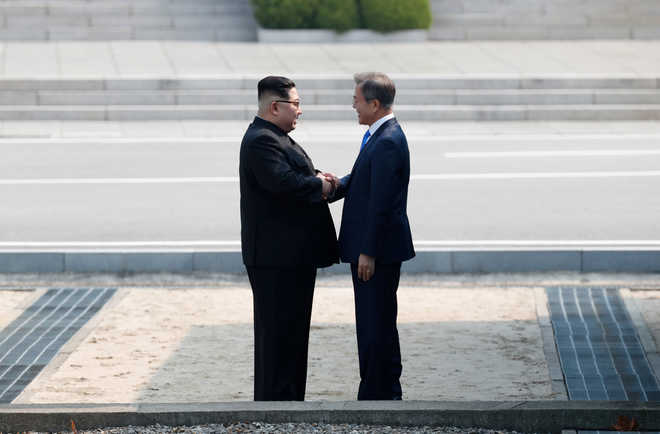
Smiling and holding hands, North Korean leader Kim Jong Un and South Korean President Moon Jae-in met at the heavily fortified demilitarised zone between the countries on Friday in the first summit for the two Koreas in over a decade.Scenes of Moon and Kim joking and walking together marked a striking contrast to last year’s barrage of North Korean missile tests and its largest ever nuclear test that led to sweeping international sanctions and fears of a fresh conflict on the Korean peninsula.The dramatic meeting, aimed at ending their decades-long conflict, comes weeks before Kim is due to meet US President Donald Trump to discuss denuclearising the Korean peninsula.”We are at a starting line today, where a new history of peace, prosperity and inter-Korean relations is being written,” Kim said before the two Korean leaders and top aides began talks at the border truce village of Panmunjom.During their private meeting, Kim told Moon he came to the summit to end the history of conflict and joked he was sorry for keeping Moon up with his late night missile tests, a South Korean official said.Kim told Moon he would be willing to visit the presidential Blue House in Seoul, and wanted to meet “more often” in the future, the official said.After talks lasting more than an hour and a half behind closed doors, Kim was driven back to the North side just before noon in a black limousine flanked by guards who ran alongside.Crossing the border, the vehicle had to drive across a lawn, as there is not a road linking the two sides at that spot.Following lunch, the two leaders are scheduled to plant a memorial tree before resuming their meeting, and then finishing the evening with dinner and a film.Just days before the summit, Kim said North Korea would suspend nuclear and long-range missile tests and dismantle its only known nuclear test site.But there is widespread scepticism about whether Kim is ready to abandon the nuclear arsenal his country has defended and developed for decades as what it says is a necessary deterrent against U.S. invasion.Two earlier summits between the leaders of North and South Korea, in Pyongyang in 2000 and 2007, failed to halt the North’s weapons programmes or improve relations in a lasting way.”Today, rather than create results we won’t be able to carry out like in the past, we should make good results by talking frankly about current issues, issues of interest,” Kim said.
First across the line
Moon greeted Kim at the military demarcation line, making Kim the first North Korean leader to set foot in the South since the 1950-53 Korean War.In an unplanned move, Kim invited Moon to step briefly across into North Korea, before the two leaders crossed back into South Korea holding hands.”I was excited to meet at this historic place and it is really moving that you came all the way to the demarcation line to greet me in person,” Kim said.The two were handed flowers by a South Korean children, residents of a village situated in the demilitarised zone, and met on a red carpet by a South Korean honour guard in historical costumes playing traditional music.Kim wore his trademark black Mao suit, while the rest of the North Korean delegation appeared in military uniforms or Western attire.”A new history starts now. An age of peace, from the starting point of history,” Kim wrote in Korean in a guest book in the South’s Peace House before talks began.Minutes before Kim entered Peace House, a North Korean security team conducted a sweep for explosives and listening devices, and sprayed apparent disinfectant in the air, on the chairs, and on the guest book.The United States is hopeful talks will make progress on achieving peace and prosperity, the White House said in a statement as the two men began their summit.The White House also said it looks forward to continuing discussions with South Korea in preparation for the planned meeting of Trump and Kim in the coming weeks.Just months ago, Trump and Kim were trading threats and insults as the North made rapid advances in pursuit of nuclear-armed missiles capable of hitting the United States.
Unending hostilities
Moon travelled to the meeting in a large motorcade, stopping briefly to greet dozens of summit supporters waving South Korean flags near the presidential Blue House in Seoul.Hundreds of demonstrators were seen gathering in downtown Seoul from early morning to protest or support the summit.The two countries expect to release a joint statement late on Friday – possibly called the Panmunjom Declaration – that could address denuclearisation and peace, and an improvement in relations, South Korean officials said.Impoverished North Korea and the rich, democratic South are technically still at war because the Korean War ended in a truce, not a peace treaty.The United States stations 28,500 troops in South Korea as a legacy of the Cold War conflict, which pitted the South, the United States and United Nations forces against the communist North, backed by China and Russia.Kim and Trump are expected to meet in late May or June, with Trump saying on Thursday he was considering several possible dates and venues.The latest Korean summit has particular significance not least because of its venue: the Demilitarised Zone, a 160-mile (260-km) long, 2.5-mile (4-km) wide strip of land created in the 1953 armistice to serve as a buffer between the South and North.
Reuters
Tribune News Service
Chandigarh, April 24
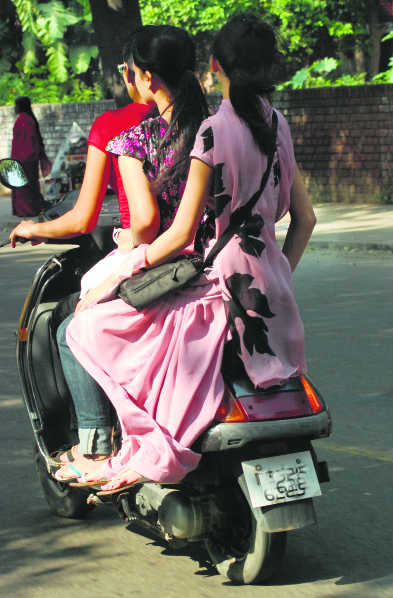
Finally, the UT Administration on Tuesday initiated the process to make the helmet compulsory for all women, including Sikhs, driving two-wheelers or riding pillion in the city. Only Sikh women wearing a turban will be exempted.The development assumes significance as the Punjab and Haryana High Court had taken suo motu notice of the issue of safety of women, including Sikhs, while riding pillion or driving two-wheelers of any class or description and exemption given to them from wearing headgear under the Motor Vehicle Rules.Taking cognisance of the matter, the Chandigarh Administration, while considering the aspect of safety of women, including Sikhs not wearing a turban, particularly in view of the fatalities in road accidents, on Tuesday issued a draft notification for amending the existing rules.According to the draft notification, the words “a Sikh woman wearing a turban” instead of the words “or a woman” are proposed to be substituted in Rule 193 of the Chandigarh Motor Vehicle Rules, 1990. This will make the headgear mandatory for all women drivers and pillion riders (except Sikhs wearing a turban) on any two-wheeler in the city. The UT Administration has invited objections and suggestions from city residents, likely to be affected by this amendment, within 30 days. “After 30 days, we will go through the objections and suggestions received and issue a formal notification to make the helmet compulsory for all women drivers and pillion riders (except Sikhs wearing a turban) on any two-wheeler in the city,” a top UT functionary told The Tribune here on Tuesday.He said, “Since the safety of women on roads is our priority, the Chandigarh Administration proposes to make changes to the Chandigarh Motor Vehicle Rules, 1990”.
Flashback
When the High Court made the helmet compulsory while issuing a slew of directions on traffic regulation and road safety in July 1998, the directions led to vociferous protests by Sikh women, who had even marched up to the High Court soon after the judgment. Following the protests, the UT Administration had exempted all women riders from wearing the helmet.What the HC saidIs there any difference between the skull of a male and a female? This was what the Punjab and Haryana High Court asked the Chandigarh Administration the other day while questioning how the Administration had exempted women from wearing the headgear while riding pillion or driving a two-wheeler. Taking suo motu cognisance of women riding away from the law by not wearing safety helmets, resulting in increasing number of fatalities and injuries to bare-headed women two-wheeler riders, the High Court had sought a status report from Chandigarh, Punjab and Haryana on the wearing of helmets by the two-wheeler riders.
New Delhi, April 23
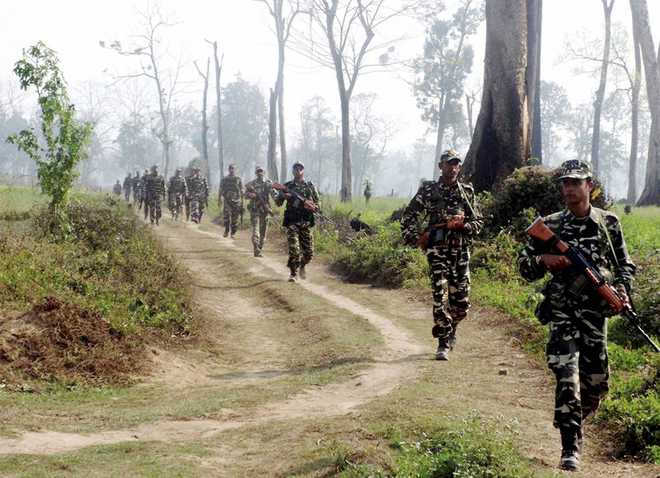
The AFSPA has been removed completely from Meghalaya and its area of operation in Arunachal Pradesh has been restricted to three police stations bordering Assam and three districts neighbouring Myanmar, officials said on Monday.The Armed Forces (Special Powers) Act, which empowers security forces to conduct operations, arrest anyone anywhere without prior notice, has been removed from all areas of Meghalaya from March 31.The decision has been taken due to a significant improvement of security situation in the state, a Home Ministry official said.In Arunachal Pradesh, areas under the controversial Act have been reduced from 16 police stations areas bordering Assam to eight besides Tirap, Changlang and Longding districts, the official said.There have been demands from various organisations in the north-east as well as in Jammu and Kashmir for repealing the Act, which, they say, gives “sweeping powers” to the security forces to act against “civilians”.The AFSPA has been in force in Nagaland for several decades and in Assam from early 1990s. — PTI

Srinagar, April 16
An Army man who had gone missing from south Kashmir earlier this month has joined the Hizbul Mujahideen terror group, police officials said on Monday.Idrees Mir, who was posted in the Army’s Jammu and Kashmir Light Infantry (JAKLI) unit, joined the group yesterday, a police official said. The official said Mir had gone missing from Shopian. He joined the group along with two locals who had also been missing.The Army maintains that he is “missing” and has no confirmation about his joining the terror outfit.According to the police, Mir was posted to Jharkhand and was unhappy about the move. — PTI
Beijing, April 9
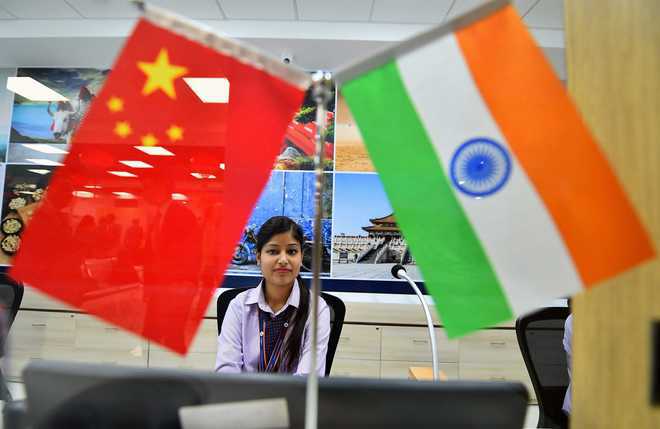
China on Monday asked India to respect the Line of Actual Control and refrain from “hyping up” the boundary issue and work with it to jointly maintain peace and tranquillity in the border areas.The Chinese Foreign Ministry’s remarks came in response to a report that China has lodged a strong protest with New Delhi, alleging “transgression” by the Indian troops in the strategically sensitive Asaphila area along Arunachal Pradesh. The Indian side has dismissed Beijing’s complaint.Foreign Ministry spokesman Geng Shuang skirted a direct response to the report and said, “I do not understand the specific state of affairs that you mentioned that happened recently on the Sino-Indian border”.“Prior to the resolution of the border issue, it is hoped that the Indian side abide by the agreement protocol, respect and obey the Line of Actual Control (LAC) and refrain from hyping up the issue and work with China to jointly maintain peace and tranquillity in the border areas,” Geng said.He, however, reiterated China’s repeated stand that Beijing never recognised Arunachal Pradesh, which it claims as part of southern Tibet.“China’s position on the Sino-Indian boundary issue is consistent and clear. The Chinese government has never acknowledged the so-called Arunachal Pradesh,” he said.“Both China and India are negotiating to resolve the boundary issue between the two countries and seek a fair and reasonable solution acceptable to both sides,” he said.Both the countries have Special Representative talks mechanism to resolve the boundary issue.The two countries so far have held 20 rounds of talks to resolve the boundary dispute and worked out different mechanisms to keep peace along the 3,488 km-long LAC.Asked about the recent visit of Chinese Vice Foreign Minister Kong Xuanyou to New Delhi on April 6 and reports of several Indian top ministers visiting China this month, Geng said, “China and India have sound momentum of exchanges and close cooperation. It is not strange to have such kind of cooperation.” Prime Minister Narendra Modi is to due to visit China in June to take part in the Shanghai Cooperation Organisation summit to be held in the Chinese city of Qingdao. — PTI