Sanjha Morcha

India, China and the Nepal transition by Bhartendu Kumar Singh

The most worrisome aspect of China-Nepal partnership for India is the emerging synergy on railway connectivity. China and Nepal are moving firmly towards finalising agreements on some key railway projects.
India, China and the Nepal transition

Bhartendu Kumar Singh
Indian Defence Accounts Service
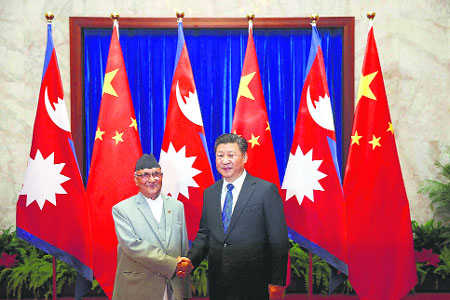
Soon after his India visit, Nepal Prime Minister KP Oli packed off his Foreign Minister Pradip Gyawali to China. While Oli returned from New Delhi with a basketful of projects and assurances, Beijing is luring Nepal with a bigger basket. Gyawali had gone to prepare grounds for Oli’s Beijing visit. Nepal, it seems, is making a clear but incremental shift towards its northern neighbour. In doing so, it is changing the geographically determined inclination towards New Delhi. At a psychological level, Nepal is integral to ‘spatial idea of Indianness’ if not the political idea of India. The border is irrelevant and incontexual in regulating each other’s citizenry’s behaviour, guided by historical and sociological connections as propellents. The psychological feeling is more confederational than international, challenging the very concept of ‘territorial consciousness’ of modern states. Cross the open border and the homogeneity of affiliations is visible in language, kinship and a cobweb of relations overriding the national barriers. It simply does not feel like a different country! However, the India-Nepal border also affirms Charles S Maier’s hypothesis (Once Within Borders; Harvard University Press, 2016) that views frontiers as ‘reflecting steep gradients of inequality and zones of differential privileges’. Unlike India, Nepal is an example of political instability and economic stagnation. Partly, it is because Nepal has not allowed easy diffusion of ideas, institutions and practices that make India a vibrant democracy and an emerging economic power. Additionally, the local politics in Nepal is fueled by anti-India semantics. India perhaps is a victim of ‘power paradox’ in Nepal where it has spent billions without achieving its larger strategic goals. This ‘relationship of paradox’ is getting wider due to Chinese geographical overtures. Whispers from Beijing indicate that China is bringing Nepal within the Belt and Road Initiative (BRI) with $7-8 billion investments. Wang Yi, Chinese Foreign Minister, has proposed a China-Nepal-India economic corridor as part of the BRI for common development of the Himalayan region. Nepal also feels that the proposed BRI encompassing cross-border roads, railways, oil pipelines, information highways, energy grids, skyways and transmission highways could improve the quality of lives in the hill state. However, from an Indian perspective, the proposal could bring Nepal under the ‘Chinese sphere of influence’ through the positioning of Chinese men, material and money on permanent basis. Probably, the most worrisome aspect of China-Nepal partnership is the emerging synergy on railway connectivity. China and Nepal are moving firmly towards finalising agreements on some key railway projects. The two foreign ministers discussed conducting a feasibility study for the proposed Nepal-China Cross Border Railway from Keyrong to Kathmandu, and from Kathmandu to Pokhara and Lumbini. One is not sure if the statement by the Nepal Foreign Minister was a pleasing one made in passing, but certain inferences deserve mention. 1First, China has the expertise to build high-altitude railways in Tibet and is gradually extending them southwards towards Nepal. Connecting Nepal should not be a major technical problem. China is also known for completing its railway projects in time; so it should not take much time once the detailed project review (DPR) is available. Beijing has already sent its first railroad freight express to Kathmandu, opening up possibilities of expanded trade and commerce between the two sides. 2Second, Lumbini is bang in the Terai zone, near the Indo-Nepal border. Any railway project with Chinese assistance may undermine India’s established influence in the southern part of Nepal. It also shows that Nepal, under Oli, a known China supporter, would not hesitate to play the China card in its southern part even if it means compromising India’s interests. Nepal is turning its geographical limitations into advantages. 3Third, in the geographical game, India is losing out to China with Nepal increasingly relying on the latter. More and more projects in Nepal are going the Chinese way with Chinese footprints everywhere. One example would suffice. The buses plying from the border cities of Nepal to Kathmandu are of ‘Higher’ company of China than the Indian make earlier. As Robert D Kaplan hypothesises (The Revenge of Geography, 2013), “India’s advantages and disadvantages as it seeks great power status in the early twenty-first century lie in its geography. India is yet to dominate its high-altitude shadow zone (ie like Nepal), so that India remains the lesser power.” New Delhi, to use Teresita C Schaffer and Howard B Schaffer’s euphemism, “can no longer exclude Chinese influence from its smaller neighbours but can instead serve its interests better by altering its tactics.” India, therefore, needs to adopt smart power narrative and forge greater convergence, making Nepal a volitional partner. For instance, while the Kathmandu Raxual railway line would take years, India can facilitate the east-west connectivity requirement of Nepal in the Terai region and link them to its own railways for mutual benefit. With the gauge conversion between Janakpur and Jainagar expected to be completed by this year-end, it should not take much effort to connect Janakpur to Sitamarhi or Darbhanga since both the cities are hardly 50 km away and are in plain lands. This is just a representative example where India can take half a dozen railway projects to connect border towns of the two countries.In dealing with Nepal, India needs to fully tap the potential of network power for propelling its agenda setting (without bothering too much for Chinese overtures) and make New Delhi an attraction for Kathmandu. A well-knit cobweb of communication linkages and combination of hard and soft power strategies would perhaps slow down further transition of Nepal towards the Chinese side.

Views are personal

ARMY TRAINING COMMAND

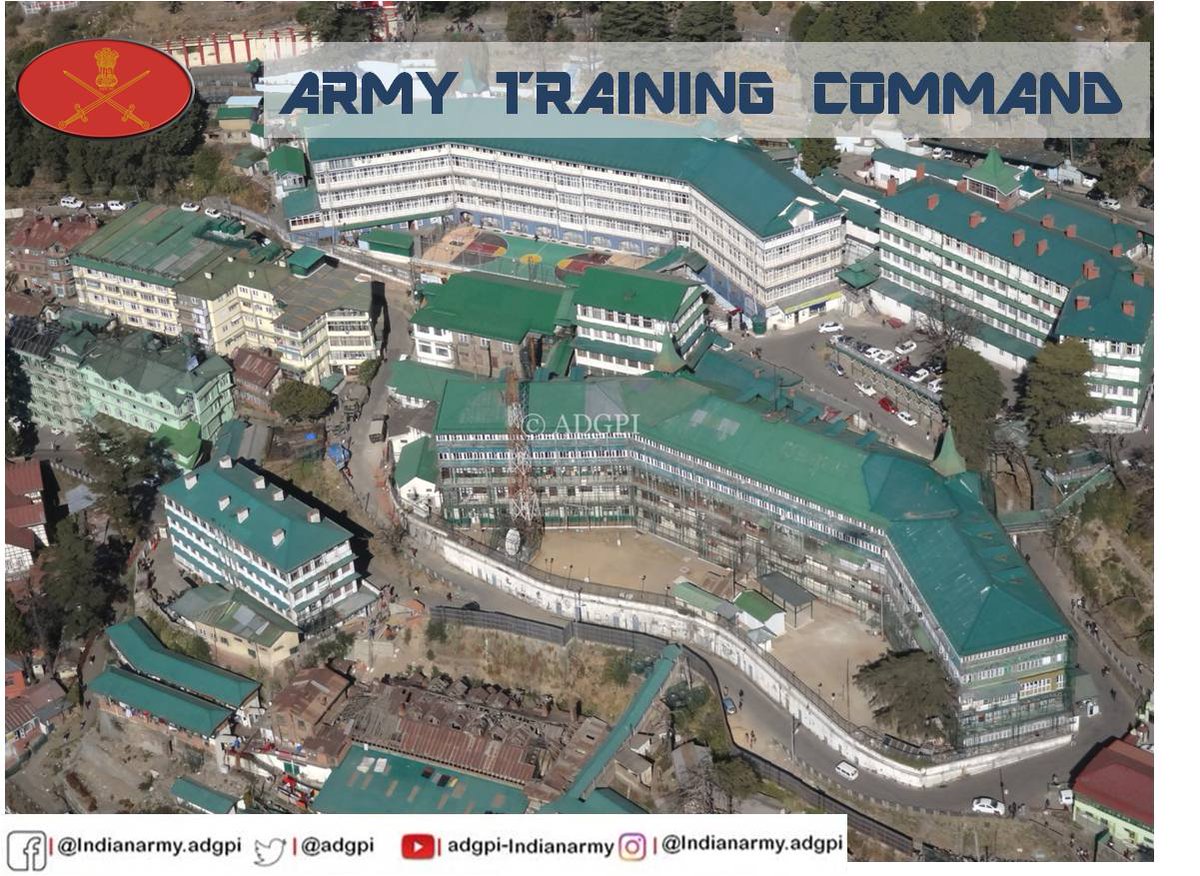
Army Training Command known as ARTRAC was raised in 1991 at Mhow and moved to Shimla in 1993 .It acts as the nodal agency for all institutional training in the Army and also evolves joint doctrines in conjunction with other services.


New defence planning panel by Lt Gen Syed Ata Hasnain (Retd)

New defence planning panel

Lt Gen Syed Ata Hasnain (Retd)Stung by the inability to draw any positive strokes to get the complex defence sector into a fast and efficient track, the government is setting up the Defence Planning Committee (DPC). No decision-making power appears to be advocated for the body, which is going to be a permanent institution more on the lines of a high-level official think tank. It is to study challenges, evolve recommendations for procedures and, more importantly, for doctrine and strategy.
8
The committee to be headed by the National Security Adviser (NSA) is likely to have among its members the Chairman Chiefs of Staff Committee (COSC), the remaining two Service Chiefs, and the Secretaries for Defence, Foreign Affairs and Finance (Expenditure). The Chief of Integrated Defence Staff to the Chairman Chiefs of Staff Committee (CISC) will also be inducted into it. A report also indicates the possible inclusion of the Principal Secretary to the PM. The domains selected to be addressed are evident from the four sub-committees that are proposed to be set up. These are policy and strategy, plans and capability development, defence diplomacy and defence manufacturing. These four domains form the crux of the core areas of concern in the field of defence. On the face of it, any such development which creates the basic means and structure to examine these challenges in an integrated way is welcome.One of the triggers for the DPC has been the deposition before the Parliamentary Committee on Defence by representatives of the three Services, bringing out how the current Budget allocation is out of sync with the needs of the Services. Two issues in particular are found galling by the Services. First, the inability over the last many years to get even a modicum of approval for the 15-year long-term integrated perspective plan (LTIPP) which spelt out their future planning needs. Second, the near impossibility of having a National Security Strategy (NSS) document approved by the government to provide, among other things, relevant guidance in the allocation of resources and to facilitate optimal support to the Services. What was really missing was a layer between the high-powered Cabinet Committee on Security at the top and the Ministry of Defence at the lower level; a body which could examine the MoD’s evaluations. Defining priorities and deciding between the competing proposals of the Services, with adequate inputs from supporting ministries, is likely to aid the acquisition process. It could be argued that earlier the setting up of the National Security Council and the creation of the appointment of the NSA was supposed to overcome the silo-based approach to national security issues. However, the NSA’s role has expanded and the necessity for an exclusive look at military strategy and security is increasing due to complexities. This body will, therefore, hopefully, bridge that necessity. Defence diplomacy has been given its due by the proposed creation of an exclusive subcommittee. The Services have been hankering for their contribution to the domain of diplomacy being aware of the scope they have to offer through training exchanges, liaison activities, resource sharing and military goodwill as a support to other forms of diplomacy.For years, India has done without the benefit of a National Security Strategy as a guideline for stakeholders who are responsible for the security of the country. Senior bureaucrats involved with security may have been apologetic about it, but insisted that enough understanding existed. What was missed out was the need for continuity of understanding, the necessity for relevant ministries to be on the same page and a review system which would always keep the NSS up to date. Will an NSS document finally emerge? It is not even certain whether this committee will be tasked with the drafting of an NSS, although reports indicate that the entire gamut of national military strategy, strategic defence review, external risk assessment and national defence and security priorities will fall within its ambit. The size of its secretariat and the intellectual support elements needed to sustain such processes will have to be thought through deeply. Will these personnel be from the Services or another bureaucratic cadre is a question up for debate. Will there be some link to academia and the proliferating think tanks to absorb expertise and advice is a moot point.  If acquisition, defence manufacturing and capability enhancement is to be a major responsibility in terms of advice to the Defence Minister, how are the two major organisations — the DRDO and Ordnance Factories Board — going to be represented here? Or is their role not envisaged at all? Another observation relates to the fact that 80 per cent of the defence spending is consumed by the revenue budget, with the bulk of the expenditure on personnel. Policies related to personnel have not been the strongest area with the MoD; a Cabinet-approved decision on the ‘peel factor’ (lateral absorption) is pending execution for 15 years. Should a committee be devoted towards looking at issues such as right sizing, which is going to increasingly be taking up more time in the future?  One can visualise that the case for theatre commands, joint operations and cyber war would be examined more closely. Perhaps this is the opportunity to look at the two much-neglected domains in India — information and psychological warfare. There is lack of clarity on the responsibility for the conduct of these.Are we to assume that defence planning and capability development does not include internal security within its ambit, especially in an era of hybrid war? The Central Armed Police Forces are an adjunct of the Army in war or during internal conflict situations. The major challenge of coordination still remains between the MHA and the MoD; acquisitions being one domain. Perhaps a system of invitation to MHA officials on relevant matters needs to be considered and will probably emerge as analyses are done and execution effected. There will, in all probability, be a need for a few more committees (such as infrastructure development) and an invitation system for experts to be taken on board. Lastly, this does not dilute the continuing case for more uniformed presence in the MoD, where advice will be far more effective when examined and acted upon by those experienced in the ways of robust security. Does this effectively seal the case for an ultimate Chief of the Defence Staff? The portents are not very bright. 



China says it wants to stick to ‘right path’ of bilateral ties with India

China says it wants to stick to ‘right path’ of bilateral ties with India

Beijing, April 16

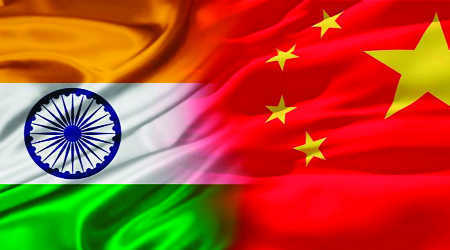
China wants to stick to the “right path” of bilateral ties with India, explore new areas for cooperation and ensure sound and steady development of the relationship, the Chinese Foreign Ministry said on Monday.Foreign Ministry spokesperson Hua Chunying’s remarks came during a media briefing as she replied to a question on a series of high-level meetings between the two countries.After last year’s stand-off in Doklam, India and China have stepped up dialogue at various levels to reset the ties.Hua said China’s ties with India had seen new progress and allround cooperation this year.“This year, under the guidance of the two leaders (Chinese President Xi Jinping and Prime Minister Narendra Modi), China and India relations have been developing with a sound momentum,” Hua said.“China attaches great importance to developing relations with India and we would like to work together to implement the consensus reached by leaders, stick to the right path of the bilateral ties, accumulate more positive energy, explore new areas for cooperation and ensure sound and steady development of bilateral ties,” she said.“We have seen close exchanges at all levels and new progress in allround cooperation,” Hua said without elaborating.On April 13, a meeting was held between National Security Adviser Ajit Doval and Yang Jiechi, Director of China’s Foreign Affairs Commission and member of the ruling Communist Party of China (CPC) in Shanghai.  Besides the meeting between Yang and Doval, the two countries “successfully” held the 11th Joint Economic Group meeting and the fifth Strategic Economic Dialogue (SED), she said.Hua said officials from the two foreign ministries also met. The two sides also held working mechanism meeting on border affairs and cross-border rivers, she said.“These interactions show that China and India share wide range of common interests and our bilateral cooperation holds great potential,” she said.External Affairs Minister Sushma Swaraj and Defence Minister Nirmala Sitharaman are also due to visit China on April 24 to take part in the meetings of the Shanghai Cooperation Organisation (SCO).Prime Minister Modi himself is scheduled to visit China in June to take part in the SCO summit in the Chinese city of Qingdao. PTI


Northern Army chief reviews security

Tribune News Service

Srinagar, April 5

Days after three separate counter-insurgency operations left 13 militants dead on a single day, the Northern Army Commander, Lt Gen D Anbu, on Tuesday reviewed the security situation in the Valley.Accompanied by Chinar Corps Commander, Lt Gen AK Bhatt, the Army Commander visited the hinterland formations in south Kashmir and was briefed by the commanders on ground with regard to operational preparedness, an Army spokesman said.“The Army Commander complimented the troops for their recent success and commended them for their dedication to duty and high standards of professionalism. He was appreciative of the measures and standard operating procedures instituted by the units and formations to meet the challenges by inimical elements,” the spokesman said.Lauding the excellent synergy amongst all security forces, the Army Commander exhorted all ranks to maintain a safe, secure and peaceful environment for the people of the Valley.


Vohra releases book on warfare

Jammu, April 6

Governor NN Vohra released ‘Information War-Disinformation Will Decide Future Wars’, a book written by veteran journalist Ramesh Bhan, at Raj Bhawan on Friday.The book expounds the manner in which information is being manipulated the world over to serve vested interests. Based on his journalistic experience in J&K, Afghanistan and Crimea, the author has reflected on how terrorism and insurgency can be fought effectively by using media.Complimenting Bhan, the Governor hoped that his writing would generate interest among the readers about the non-combat modes of warfare. He wished Bhan success in his future literary endeavours. —TNS


Lt Col Sandhu hiding in UP, claim Mohali cops May be staying in Kanpur or Gorakhpur

Tribune News Service

Mohali, April 1

The Mohali police claimed to have got a tip-off that Lt Col BS Sandhu (retd) might be staying in Uttar Pradesh.A senior official of the Mohali police said they got the tip-off that Sandhu could be staying in Kanpur or Gorakhpur.“He is not using his phone number, but some new number. We are trying to locate him,” said the official.Notably, the Mohali police have got Sandhu’s non-bailable arrest warrants from a court in Kharar on Saturday as he (Sandhu) failed to join police investigations in the case of murder of CTU employee Abhishek Guleria so far. Sandhu was nominated in the case on March 27.Meanwhile, four persons, Ramesh, Ramesh Chand, Dharampal and Davinder, who were also named in the case by the Mohali police on Saturday, have also gone underground, said the police. The foursome are said to be security guards at Forest Hill Resort, owned by Lt Col Sandhu, at Nayagaon.The police said these four persons were not found at their respective residences when the police party went there to summon them for investigation. Despite instructions, they did not turn up so far.As per the police, these four persons were involved in stuffing the body of the victim in a sack and then in a polythene bag before disposing it off at a deserted place along the Pinjore-Baddi road. The body was recovered by the police on March 24.It is to be noted that a four-member SIT has been formed to work out the case.Four persons named in FIR go undergroundFour persons, Ramesh, Ramesh Chand, Dharampal and Davinder, who were also named in the case by the Mohali police on Saturday, have also gone underground, said the police. The foursome are said to be security guards at Forest Hill Resort, owned by Lt Col Sandhu, at Nayagaon.


The road out of Doklam MK Bhadrakumar

Need radical new thinking to improve ties with China

The road out of Doklam

MK Bhadrakumar

The summer is at our doorstep. With June approaching, memory mixes with anxiety. It’s going to be one year since the Doklam faceoff began. One year is not a long time in the life of a nation but in last June a terrible beauty was born in the India-China relationship. Alarmist reports appeared lately regarding Chinese deployments. Timely clarification at the official level dissipated the scaremongering. Compared to the impetuosity of the past three-year period, a sense of proportion is discernible in the government’s approach to the relationship with China.The question that begs an answer, nonetheless, is what it was that we had hoped to gain by crossing the established border into Doklam last year? A range of explanations may be possible and, indeed, the two most-popular ones are: the security of Siliguri Corridor (‘chicken’s neck’) demanded it, and/or two, that as the provider of security for Bhutan, India was obliged to act. Both explanations are heavily laden with emotions and appeal to public imagination, but are intrinsically fragile and insufficient to explain the gravity of what happened.In the recent exchange between our ambassador to China Gautam Bambawale and Chinese foreign ministry spokesperson Hua Chunying, a third unspoken leitmotif appeared — Doklam as a template of the India-China border dispute. Hua unequivocally refuted Bambawale’s innuendo of Doklam being a segment of the “un-demarcated and un-delineated” India-China boundary, where “we are discussing where the boundary will lie”. In Bambawale’s words, “I can tell you very frankly… The Chinese military changed the status quo in the Doklam area and therefore India reacted to it. Ours was a reaction to the change in the status quo by the Chinese military.” He did not even mention Bhutan. But Hua differentiated Doklam from the India-China border dispute, and remarked that India must learn lessons from last year’s faceoff. India keeps strategic ambiguity as regards the 1890 pact between India, Sikkim and Tibet.Amidst the triumphalism last August following the denouement to the Doklam faceoff, this was what M Taylor Fravel, professor at MIT and expert on China’s boundaries, had written in War on the Rocks magazine on September 1, in an essay titled “Why India Did Not Win the Standoff with China”: “Ironically perhaps, India’s actions underscored to China the importance of enhancing its military position in the Doklam bowl. Before the standoff in June, China’s permanent presence in the area had been quite limited. China had maintained a road in the area for several decades, but did not garrison any forces. In contrast, India has maintained and developed a forward post at Doka La (Sikkim) adjacent to Doklam.“Now that India has chosen to confront China at Doklam, however, China may well seek to rectify this tactical imbalance of forces… If China does this, it would likely build facilities farther away from India’s position at Doka La, making it more challenging for India to intervene and block China next time. When India challenged China’s construction crews in June, it only had to move its forces a hundred metres from the existing border. In the future, India may be faced with the uncomfortable choice of deciding whether to risk much more to deny China a greater presence farther inside Doklam or to accept it. This will be a tough decision for any leader to make. Even if India won this round, it may not win the next one.”What an extraordinary reading of tea leaves! No matter the caricaturing by elements in our strategic community or incitement from abroad, what Fravel predicted has happened and it puts Delhi on the horns of a dilemma. The big question here is how far Bhutan is interested in India pushing the envelope? It appears that Bhutan’s border claim is historically flimsy and a massive amount of Tibetan historical land records attest to the Chinese claim. Curiously, Bhutan over-asserted its claim over Doklam only fairly recently in the late ’90s. Of course, the Bhutanese claim is (partially at least) not without some historical foundation, although Doklam as such used to be under the control of the Tibetan administration in Lhasa. Put differently, China cannot be expected to relent, given the access Doklam gives to the highly strategic Lumbi valley that leads to Lhasa. Above all, the cut-off point is that “not a single inch of our land will be or can be ceded from China” — as President Xi Jinping stated on the concluding day of the National People’s Congress in Beijing on March 20.In the circumstances, megaphone diplomacy serves no purpose and could even be counterproductive. Meanwhile, time may not work in India’s favour, either. In Bhutan itself, there is no evidence of fear from Chinese invasion or even encroachment from north. Do the concerns voiced by Ambassador Bambawale find echoes in Bhutan? There are no easy answers. Some recent reports by travellers have cited a growing feeling of awe and admiration among the Bhutanese people regarding China’s economic miracle. Such inchoate feelings can arouse nationalist sentiments in unexpected ways. The fact remains that the sharply rising trajectory of China-Nepal cooperation, especially the economic spin-off from the Belt and Road Initiative, is also poised to transform Nepal phenomenally in the coming decade. Bhutan will watch with interest Nepal’s transition to a new mode of production relations and what it could mean for development, social mobility and prosperity. Suffice to say, Delhi should anticipate that given the irresistible pulls of modernisation, the quotient of “happiness” in Bhutan may give way.When the region is changing so rapidly, there is need for a radical new thinking on our part instead of reacting to emergent situations with the advent of summer in the Himalayas. Fundamentally, we ought to figure out whether we want China as friend and partner or continue to regard it as rival and enemy against whom we should prepare for the decisive war eventually. The former Soviet Union made that strategic decision when Mikhail Gorbachev travelled to Beijing in 1989; and, the two countries’ quasi-alliance ensued. One possibility is to “re-invent” SAARC. We had conceived it as a vehicle of regional leadership. Perhaps, we should now turn it around as a dynamic vehicle for regional cooperation. Does China’s SAARC membership damage Indian interests, or, can it provide a window of opportunity? Much as the thought seems preposterous today, we can be open-minded and receptive. It is entirely conceivable that our core interests over Doklam can be safeguarded within a matrix of regional cooperation involving China.The writer is a former Ambassador


April 17 LoC fire: Soldier succumbs

April 17 LoC fire: Soldier succumbs

Jammu, April 21

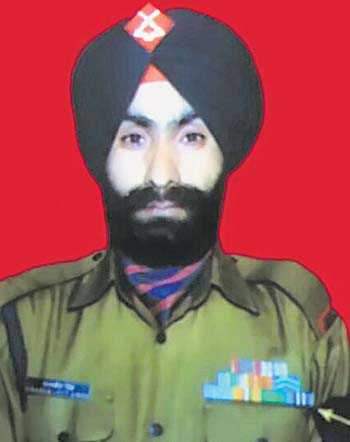
Havildar Charanjeet Singh, 42, grievously injured in the Sunderbani sector on April 17 during ceasefire violation by Pakistan troops, succumbed to his injuries on Friday. He was cremated with full military honours at his native village Kalsian in Nowshera sector on Saturday. Hundreds of people from Kalsian and adjoining villages paid their last respects to the soldier, who is survived by his wife Neelam Kumari. “Havildar Charanjeet Singh sustained bullet injuries, was evacuated and provided intensive medical care in military hospitals. Despite all efforts, the gallant soldier succumbed to his injuries in the early hours of Friday,” a defence spokesperson said. — TNS