Sanjha Morcha

Pak trips on free run : 37-nation Financial Action Task Force to probe terror funding byG Parthasarathy

Pak trips on free run
In Dock: Pakistan’s calculations have back-fired; it will have to be accountable.

G Parthasarathy

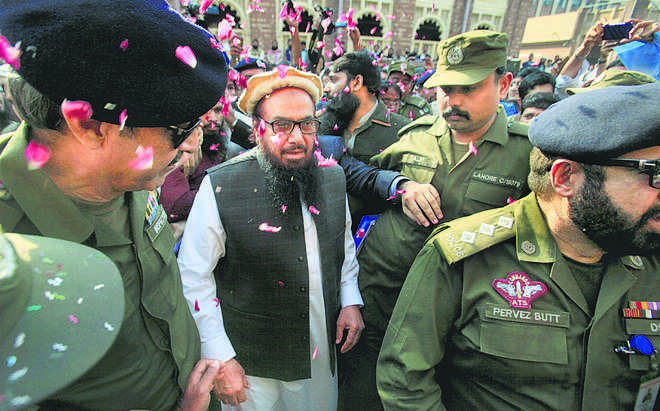
The Financial Action Task Force (FATF), set up in 1989 by the G7 countries, and with headquarters in Paris, acts as an “international watchdog” on issues of money laundering and financing of terrorism. It has 37 members, including all five permanent members of the Security Council, and countries with economic influence all across the world. Two regional organisations — the Gulf Cooperation and the European Commission — are members of the FATF. Saudi Arabia and Israel are observers. India became a full member of the FATF in June 2010. The FATF is empowered to ensure that financing of UN-designated terrorist organisations is blocked. It has the power to publicly name countries not abiding by its norms, making it difficult for them to source financial flows internationally.Pakistan is particularly vulnerable to pressures from this task force as the Afghan Taliban, Haqqani network, LeT and JeM — all internationally designated terrorist groups — operate from its soil. Pakistan has long claimed that it has done its best to prevent terrorism emanating from its soil. It has also averred that there is no firm evidence against the LeT and the JeM, even after these groups have publicly acknowledged that they were promoting terrorism in India. Pakistan has also rejected evidence like wireless transcripts of conversations of Jaish terrorists involved in the Pathankot airport and the vast evidence available internationally of the Lashkar role in the Mumbai 26/11 attack. The Americans and their allies have focused attention primarily on Pakistan support for the Haqqani network in Afghanistan. Pakistan has believed that sooner, rather than later, the Americans would cut their losses and withdraw from Afghanistan, leaving the country open for a Pakistan-backed Taliban takeover. President Donald Trump, however, made it clear that he was determined that the US would not “lose” in Afghanistan. He is augmenting the US troop presence and moving fast to strengthen the Afghan armed forces, including its air force. American economic assistance to Pakistan has been placed on hold. In addition, the US has mobilised its NATO allies to take a tougher line on Pakistan. The NATO allies are also expanding their deployments in Afghanistan. More recently, the US has initiated moves to get the task force to place Pakistan on its “grey list” at its next meeting in June.The American effort in the FATF on Pakistan funding of terrorist groups predictably ran into problems initially. Pakistan had mobilised support from China, the Gulf Cooperation Council led by Saudi Arabia, Turkey and quite evidently Russia to counter the American-led move. Islamabad banked on Russian support, given the bonhomie that Russian foreign minister Sergei Lavrov manifested when he invited his Pakistani counterpart Khawaja Asif to Moscow on the eve of the FATF meeting. Further, despite parliamentary opposition, Pakistan declared, just over a week before the FATF meeting, that it would be deploying additional troops in Saudi Arabia. It clearly expected Saudi support in the FATF after its decision was announced. The Lavrov bonhomie led the inexperienced Khawaja Asif to proclaim hastily and prematurely that Pakistan had succeeded in prevailing over moves to place it on the FATF “grey list” involving monitoring of its international financial flows. The Americans responded immediately to these developments. Saudi Arabia and the GCC fell in line with American demands for the FATF to act against Pakistan. European powers like the UK, Germany and France remained steadfast in their determination to corner Pakistan. Russia quietly receded to the background. Recognising that its support for Pakistan would leave it isolated in the FATF, where it was aspiring to become its vice-chairman at the forthcoming FATF session in June, Pakistan’s “all-weather friend” China pulled back its support for Pakistan. The only country that steadfastly continued supporting Pakistan was Turkey, whose egotistic President Recep Erdogan would certainly not win an international popularity contest today!Pakistan will now have to provide a detailed action plan on actions it proposes to take on curbing funding for UN-designated terrorist groups. It would then be placed on the FATF grey list, where its financial flows would be subject to intense international scrutiny. Pakistan would, thereafter, be placed on the FATF “black list” if it fails to present a credible and comprehensive action plan to the FATF by June. This would virtually end any prospect of it receiving adequate financial flows. There has been disappointment, anger and frustration in Pakistan at the FATF decision. Hardly anyone in Pakistan is prepared to publicly advise that it is time for Pakistan’s rogue army to end support on its soil to armed terrorist groups, acting against India and Afghanistan. While Pakistan recently claimed it had closed Lashkar offices, it was soon found that only the gates of these offices were closed, while routine activities continued inside.In these circumstances, India should urge members of the European Union and Japan to join the US and end providing concessional credits to Pakistan. Given its precarious foreign exchange position, Pakistan will inevitably have to go to the IMF for a bailout in a few months. Institutions like the IMF, World Bank and Asian Development Bank need to be persuaded to withhold providing concessional credits to Pakistan, even if it takes some token measures to claim it has acted against UN-designated terrorist outfits. India should urge that no concessional credits should be provided to Pakistan till it dismantles the infrastructure of terrorism on its soil irrevocably. China will not follow suit; but its “aid” for the China-Pakistan Economic Corridor will only increase Pakistan’s already heavy debt burden.The withdrawal of Chinese support in the FATF has shaken the Pakistan establishment’s belief that Chinese support to “contain India” has no limitations. China recognises that backing Pakistan unconditionally in the FATF would not only earn it the ire of the mercurial Donald Trump, but would also sully its image internationally. At the same time, this does not mean that there will be any change in China’s policies on issues like declaring Jaish chief Masood Azhar an international terrorist. Moreover, we should also clearly recognise that President Trump’s actions are primarily in response to Pakistan’s support for the Haqqani network in Afghanistan. They are not highly or significantly focused on Pakistan-sponsored terrorism on Indian soil. That is a battle that will have to be fought primarily by us. 

Army questions MoD official’s authority to decide JCO status

Had said they’re not covered under definition of officer

Ajay Banerjee

Tribune News Service

New Delhi, March 4

The Indian Army has given a strongly-worded reply to a letter written by an official of the Ministry of Defence (MoD) who had stated that Junior Commissioned Officers (JCOs) are “not gazetted officers”.The official, a Joint Secretary-cum-Chief Administrative Officer (JS & CAO) in the MoD, had said since “JCOs are not covered under the definition of officer”, they do not merit such a status while being posted in the Army Headquarters at South Block, New Delhi.The Army, in its reply to the JS & CAO, questioned his authority to decide on the status of JCOs. It has said: “The CAO officials have no competence or locus standi to comment/question the provisions of an Act of Parliament or the Defence Services Regulations.”In the letter, the Army, on a separate matter, has asked the CAO to stop issuing communications that do not form its charter. “Office of CAO is not mandated by government to deal with any personnel aspects involving combatants (the armed forces).”The JS & CAO is the cadre-controlling officer for Armed Forces Civilian Employees who number over 12,000. Sources point out that the civilian-employee cadre was set up for administrative management, not to issue policy letters on personnel matters of the forces.The Tribune had reported on February 26 how the JS & CAO had rejected the move to give “gazetted officer” status.On JCO issue, the Army in its latest letter pointed out that JCOs were accorded “Group-B” gazetted officer status. The Army Act, 1950, accords status of Group-B equivalent gazetted officers to JCOs. Section 151 of the Defence Service Regulations 1987 states JCOs are granted commission by the President.There are some 64,000 personnel of JCO rank or equivalent in the Indian Air Force and the Indian Navy. The JCOs are promoted from among jawans. In the forces, they hold pivotal positions.In January, the issue relating to rank parity — wrong equation of forces with civilian staff — was settled after Defence Minister Nirmala Sitharaman corrected the anomaly. The MoD had said: “The letter dated October 18, 2016, on the issue of equivalence between armed forces’ officers and Armed Forces Headquarters Civil Services (AFHQ) officers is withdrawn.” The matter of JCO’s getting their status was not linked to this.



Defence outsourced by Ajay Banerjee

Despite various govts going slow on hi-tech defence acquisitions, it now emerges that India is the largest weapons importer. This is ‘inglorious’ in the face of stridency over ‘desi’ production. And as we struggle, our neighbours find ways to forge ahead with new defence partners, a fact we can ignore to our peril

Ajay Banerjee in New DelhiBuying weapons to protect over 1.34 billion people and secure borders with seven nations — with a land frontier of over 15,000 km and a coastline extending to over 7,500 km — is a good idea. But the thought to be dependent on foreign defence supplies (India imports some 70 per cent of its equipment) is unsettling, self-defeating even. Accessing national data as to how we acquire the high-tech weapons and meet our defence needs could be a daunting task, given veils of secrecy. Yet an international resource on global security, the Stockholm International Peace Research Institute (SIPRI), regularly comes out with general figures indicating, among others, the scale to which our defence import has risen. On March 12, SIPRI released its data, reconfirming that India, yet again emerged as the biggest importer of weapons in the world. Clearly, there is a lack of ‘strategic autonomy’ ideally desired by a nuclear armed nation with the third largest armed forces.The SIPRI’s annual report ‘Trends in international arms transfers’ makes an assessment for a five-year block (2013-2017). It said: “India was the largest importer of major arms and accounted for 12 per cent of the global total.” SIPRI has been studying the conflict and arms sales for over 50 years. It compared this five-year block with the previous 2008-2012’s to conclude: “India’s imports increased by 24 per cent”. That means New Delhi was importing 24 per cent more military equipment, pointing at the sluggish ‘Make in India’ besides the failure to make its own cutting-edge weapons, equipment and war-fighting arsenal.For defence experts, that foreign component accretion over the decade is ‘inglorious.’ Amit Cowshish, former financial advisor, Ministry of Defence, says “It will keep on happening till India can have its own capacity to produce equipment.”Ambitious plans & realities

On March 22, the Ministry of Defence laid out a draft defence production policy. It is ambitious at its best as it talks about making India among the top five countries in aerospace and defence industry. It also talks about self-reliance in key technologies by 2025, and puts India on the exporter-track. It sets a target of Rs 1,70,000-crore ($26 billion approx) turnover in defence goods and services involving additional investment of nearly Rs 70,000 crore (US $10 billion approx). It looks at achieving exports of Rs 35,000 crore (US $5 billion approx) by 2025. Commodore C Uday Bhaskar (retd), now director, Society for Policy Studies, terms this plan as “incongruous,” saying “India is living in a make-believe world.”Domestic defence production for 2016-17 stands at Rs 55, 894 crore, up from the Rs 43,746 crore in 2013-14. Efforts, so far, to make a military-industrial base have remained sluggish, hampered by budgets and a lack of cutting-edge technology. Lt Gen KJ Singh (retd), a former Western Army Commander avers: “It appears everyone has good intentions, sadly, that is not translating into action.”Successes & ironies

There are a few, take a look:

  • Nuclear submarines of the Arihant class, made from scratch, in India; or the Scorpene class submarines made at Mazagon Docks Limited Mumbai.
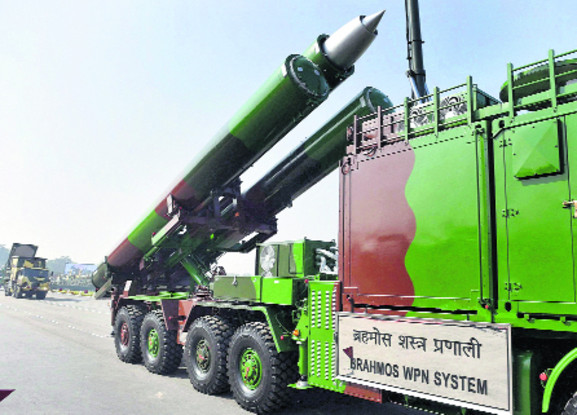
  • Supersonic BrahMos, Agni, Akash or the Prithvi missiles.
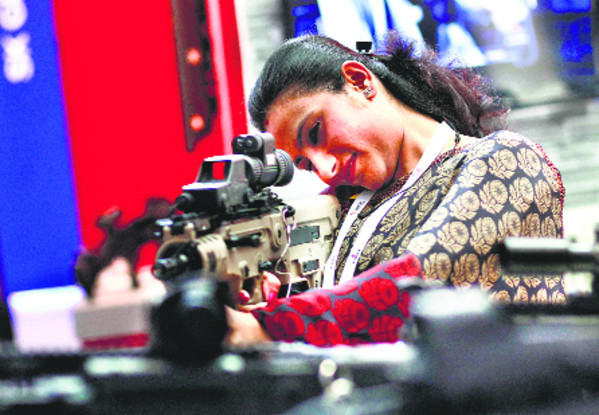
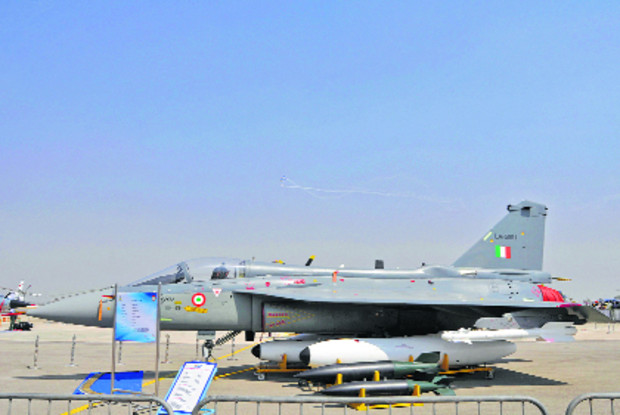
  • Strangely, the country is struggling to produce a good rifle. Some 11 lakh of various types are needed for which Indian private companies have been allowed to have a tie-up with foreign partners and put up their proposals. Light combat aircraft Tejas faces delays and slow production rates (Only 6-8 planes are produced per annum, the need is for 16-20).
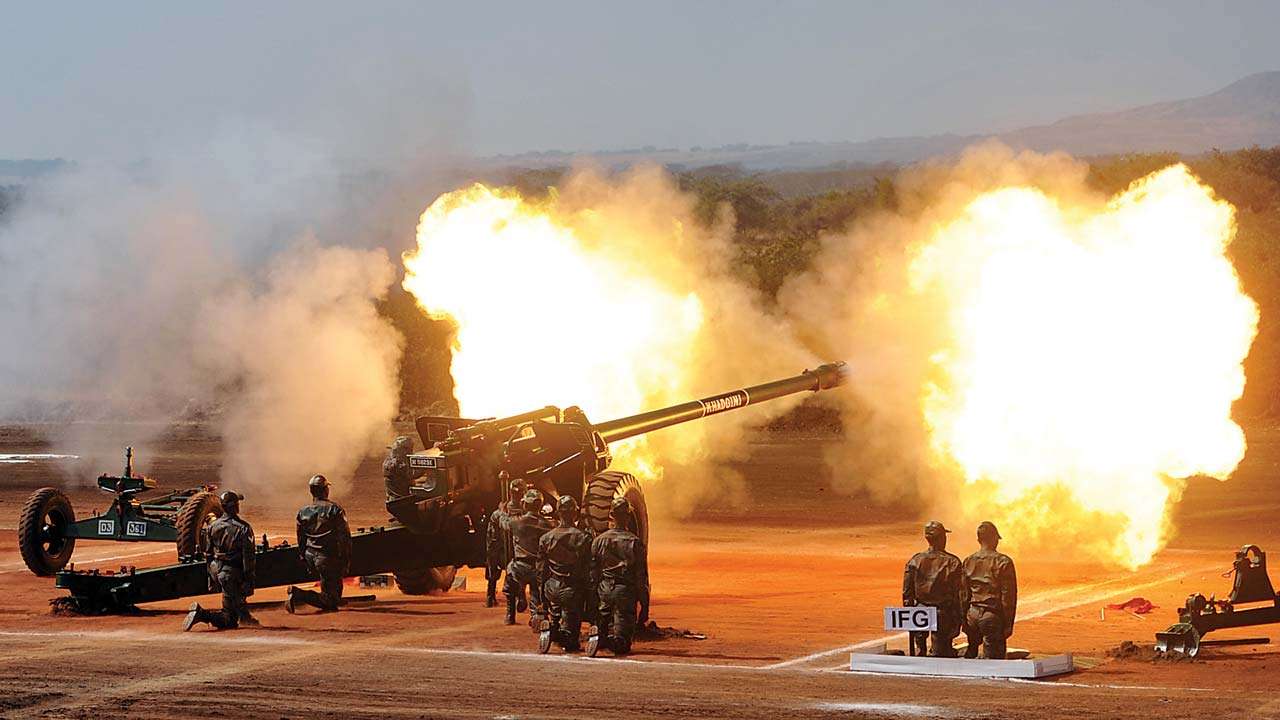
  • Artillery guns produced jointly by the Defence Research and Development Organization and private companies — Tata Power SED and Bharat Forge — have been a success.
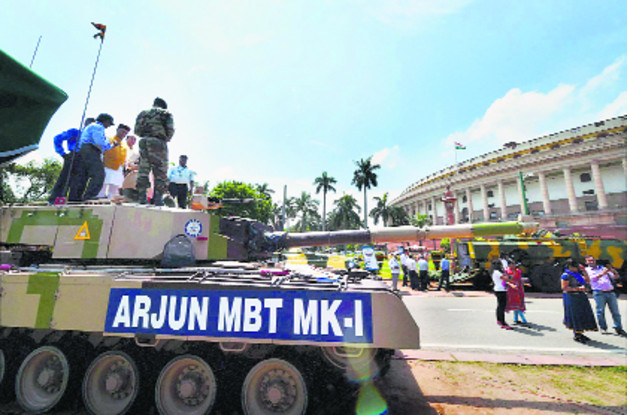
  • The next version of the Arjun tank needs modifications, but the delay is due to the Army frequently changing the requirements.
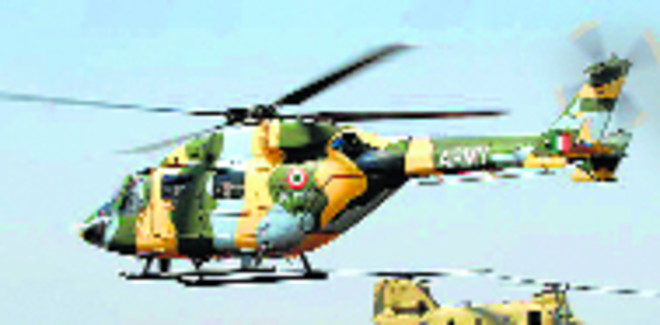
  • The Dhruv helicopter and its variants have finally been accepted as ‘superb’ machines.

Budget pains

In a report on March 13, a parliamentary panel said the defence budget for the year 2018-2019 was ‘inadequate’ and ‘barely enough’ to cater for inflation. Maj Gen BC Khanduri (retd), a BJP MP from Uttarakhand, heads the panel. “Capital budget allocation for the Army had dashed hopes as it was barely enough to cater to the rise in expenses on account of inflation, and did not even cater for the taxes,” the Vice Chief of the Army told the panel. For 2018-19, the Army projected a need for Rs 44,572 crore, it gor Rs 26,815 crore. The Navy wanted Rs 35,695 crore, but got only Rs 20,003 crore. The IAF is managing with Rs 35,770 crore against its need for Rs 77,694 crore. The Army today has 68 per cent of equipment in the ‘vintage category.’ Around 25 projects indentified under Make in India may be foreclosed due to inadequate budget, the report said. “For a country that seeks strategic autonomy, the tag for being the largest importer of weapons and equipment is a contradiction,” says Commodore Bhaskar. The government has lined up a mix of private-public sectors. The hint lies in the numbers and the expansion of the nine defence public sector undertakings (DPSUs). In the financial year ending March 31, 2017 these companies collectively made a profit of Rs 5,482 crore. A report of the parliamentary panel says “no budgetary support is being given to the DPSUs.” These nine companies are being modernized. “The best way to break the mould is to move away from the existing procedures of acquisition,” says Lt Gen KJ Singh Private sector potential

To give a hint at the potential, the hull of the nuclear submarines series is being made by L&T. Amit Cowshish, former financial advisor, Ministry of Defence, has a word of caution: “The new draft production policy merely talks about private and public participation. In reality it could take years for it to get rolling.”The Modi government has liberalized FDI and touted it as a major policy-shift to okay up to 49 per cent stake for foreign companies when partnering Indian companies. Now another tweak to the FDI is coming up. The Draft DPP-2018 says: “FDI regime in defence will be further liberalized. The FDI up to 74% under automatic route will be allowed in niche technology areas.”


India needs…

400fighter jets

1,700tanks

800helicopters

18 more


Indigenously produced

Tejas: HAL is making the first 40 Tejas. Upgraded 83 Tejas too will come. Another 201 Tejas Mark II are on the drawing board Artillery guns: The Dhanush gun is a copy of the Bofors gun, will go for final user trials in May. Both will fill the need for more than 2,700 guns over the next decadeCopters: The biggest success story. Forces need some 800 copters. Some 200, Advance Light Helicopters, the Dhruv, are flying Arjun Mark-II: Two regiments of Arjun tanks were inducted. The Army wanted 93 improvements. Arjun Mark II is an improved versionAircraft carrier Vikrant: It is set to be commissioned 2020. The making of the ship takes the country into an exclusive league of nationsBrahMos/Agni: The BrahMos is an Indo-Russian venture that adorns lead warships of the Navy. It’s deployed along Pak border. N-tipped Agni missiles have propelled India into the exclusive club of countries — US, UK, Russia, France & China


US rises in India as Russia looks at Pak

Ajay Banerjee

In 2013-17, Russia accounted for 62 per cent of India’s arms imports. India zeroed in on Sukhoi-30 MKI fighter jets, a sea-borne aircraft carrier, the INS Vikramaditya, and a few dozen Mi-17 V5 helicopters. Based on existing orders and weapons, Russia will remain, by far, the main supplier of major arms to India for the foreseeable future. The volume of Russian equipment was almost the same as it was in 2008-12.With India diversifying its sources to include the US since 2008, things have changed dramatically. The SIPRI report said: “Between 2008-12 and 2013-17 arms imports from the US increased by 557 per cent, making it India’s second largest arms supplier.” The US now accounts for 15 per cent of Indian supplies. This development is the aftermath of the India-US strategic partnership first signed in 2005 and renewed in 2015. In 2013-17 such supplies included the Boeing P8-I long-range maritime patrol aircraft, the C-130 strategic transport aircraft, C-17 heavy lift transporter and the Apache-64 combat helicopters. India’s arms imports from Israel also increased (by 285 per cent) between 2008-12 and 2013-17, making Israel the third largest supplier to India with 11 per cent share in the Indian market.China’s course

Since 2013 India replaced China as the top arms importer in the world. China, on the other hand, is now the fifth largest exporter selling its manufactured equipment to Pakistan and Bangladesh, among other countries. It now accounts for 5.7 per cent of all arms sold globally. China also remains an importer and is fourth on the global import list. Some 4 percent of all global sales go to China. Russia is its biggest supplier and has a share of 65 per cent in this. Russian supplies to Pak

The US is the biggest exporter and has a 34 percent share of all global exports while Russia has a 22 per cent share. A total of 35 per cent of all Russian exports go to India and 12 per cent to China. Another 10 per cent go to Vietnam. India and Vietnam are locked in separate boundary disputes with China.Interestingly, Russia has a new friend in Pakistan and supplied 5.6 per cent of weapons and equipment to India’s western neighbour. Russia is the third largest supplier to Pakistan, after China and US. This has happened in the past three years when Russia provided the Mi-series attack copters. Earlier Russia did not supply anything to Pakistan which is now an importer of 2.8 percent of all weapons sold globally. “Despite its continuing tensions with India and ongoing internal conflicts, Pakistan’s arms imports dipped by 36 per cent between 2008-12 and 2013-17,” said the report. Future machines

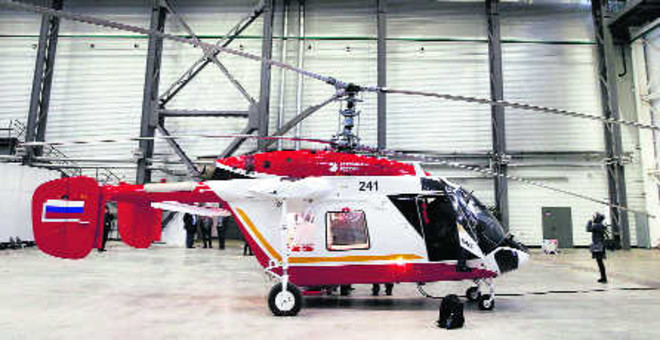
  • Kamov-226T: Russian Kamov-HAL to produce 200 of them for Rs 6,500 cr. These are meant for IAF, Army. The twin-engine Kamov will replace Cheetah/Chetak
  • Fighter jets: A fresh global tender coming, inviting military aviation firms to make fighter jets in India. New Delhi is looking for 115-120 jets to add to 36 Rafales from France
  • Future   (FICV): It is worth about Rs 60,000 cr. Private and PSU firms are in the race to make the 20-tonne tracked, amphibious and air transportable machine
  • Naval Utility Helicopters: A Rs 21,738-crore project. 16 copters to come in a flyaway condition. These copters carry radars, sensors and a lightweight anti-sub torpedo and Small arms: The MoD okays separate plans to procure over 11 lakh pieces. These include 6.22 lakh assault rifles, 4.43 lakh carbines, 6,000 sniper files and 41,000 LMGs are used for search, rescue, and communication
  • Submarines: Four global players have submitted bids for Rs 70,000-cr order for six subs. Russian, French, German and Swedish firms are in the race

Concerns of the Indian Army by Lt Gen Ata Hasnain

Indian Army

In 2005 the Indian Armed Forces very zealously adopted the concept of ‘transformation’, a term borrowed from the lexicon of the US Armed Forces. Essentially it meant ‘a very big change’; that change was essential in the sphere of war fighting due to the way various technologies, with information technology (IT) at the core, were rapidly demanding a move well beyond the military capabilities of the Cold War period.

Fresh from its then recent experience of ‘Operation Parakram’, which involved massive mobilisation against Pakistan, the Indian military attempted to explain to the political and bureaucratic authorities how it was looking at the future even as ‘transformation’ was underway in various countries. Its enthusiasm found few takers and support for its ambitious projects was halfhearted. Although the 11th and 12th Plans did cater for incremental manpower needs the wherewithal just could not materialise. ‘Transformation’ died a natural death around 2011, buried under the mountain of neglect, lack of perception and inability to financially support the change which was being sought.

It’s due to the history of this neglect that finally the Army’s Vice Chief, Lt Gen Sarath Chand was recently forced to inform the Parliamentary Committee on Defence Affairs on the lack of preparedness and severe glitches in the Army’s modernisation program, a position equally applicable to the Navy and the Air Force. Most reports on this important issue affecting India’s national security have focused on the details of the failure of financial backing and the inability to remove bureaucratic hurdles. However, a simple summary projected by most of these reports conveys the message without the attached details. In an adequately prepared war machine 30% of weapons and equipment should fall in the state of the art (SOA) category, 40% in current and 30% in vintage category. The existing state of the Indian Army brought to the notice of the Committee is 8% SOA, 24% current and 68% vintage category.

With existing and emerging threats arising out of China’s consistent efforts at domination of the continental and maritime domains, exchanges on the LoC, the possibility of collusion between China and Pakistan and sponsored terrorist actions which could cross the threshold of India’s tolerance, the possibility of armed standoff against both adversaries remains live. While most analysts agree that all out conventional war is still a remote contingency this cannot be used as a dictum for the state of the nation’s military preparedness which should never be sub optimum.

Unfortunately, the idea does not seem to find favour with those who control the purse strings, that being optimally armed, equipped, trained and motivated is half the battle and sends appropriate messages of deterrence or dissuasion, as the case may be. No doubt there are competing domains for the share of national resources but the element of risk that is involved in remaining underprepared in the military domain must overshadow all other considerations. The perceptions that emerge from the military leadership cannot be dismissed lightly and trust in its professional judgment is only prudent.

It needs to be recalled that in 1965 Pakistan’s adventurous plans were based on its perception that any delay in attempting to capture its claimed areas would be risky as the Indian military was reforming and equipping itself but was then not fully prepared for war. Assumptions of military weakness tempt adversaries.

The Army’s current leadership has unnecessarily been under fire for making public utterances from time to time. The Army Chief, Vice Chief and a few Army Commanders have expressed their frank opinion about perceptions of threats and preparedness. In earlier years, the Army leadership was content with transparently placing its observations and concerns to the government through its annual reports and theme papers; these were never made public and rarely acted upon. Providing answers to parliamentary questions still adhered to what the government wished to reveal. It is the annual presentation to the Parliamentary Committee which was always considered an appropriate forum to be realistically transparent. Much depended upon the members of the committees of the past, their level of understanding and perceptions about security affairs.

The present committee’s better grasp has obviously been the trigger for the current expression of concern. It too has realized that 1.49% of the GDP at Rs 2.79 lakh crore which forms the defence budget cannot hope to meet both the revenue and capital needs of the defence services. In strong words the Army Vice Chief stated, “The 2018-19 budget has dashed our hopes; the marginal increase hardly caters for inflation…allocation of Rs 21,338 crore for modernisation is insufficient even to cater for committed payment for 125 on-going schemes, emergency procurements, and 10 days worth of ammunition at intense rates”.

What is also revealing is that gaping holes in perimeter security of major army camps remain unaddressed as the much touted allotments for this are within the existing budget. Coupled with the huge expenditure on meeting the needs for response at Doklam, it is reliably learnt that the Army’s current transportation and some other budgets ran out of funds a couple of weeks ago, well before the end of the financial year.

What is going to be the result of this transparency? Will it help in better appreciation of the grave deficiency in defence capability and capacity which is becoming more and more apparent? What the Army needs to do is to continue speaking about this and let the public perception on the deficiency become more realistic. There are ways of being transparent without upsetting any rules. In functional democracies like ours its ultimately public perception which pushes governments to adhere to norms of as basic a requirement as national security.

The writer commanded the 15 Corps in Jammu & Kashmir. The views are personal


Mobile CSD unit at Bangana sought

Our Correspondent

Una, March 19

Ex-servicemen of the Bangana subsivision have raised their demand for a mobile unit of canteen stores department (CSD) at the subdivision headquarters. The demand was raised at the quarterly meeting of the district Sainik Welfare Board here.According to an official communique, a non-official member of the district-level committee of the Sainik Welfare Board said there were about 5,000 ex-servicemen and their families besides scores of other families of serving defence personnel in Bangana, who had to travel to the Una district headquarters or to Badsar in Hamirpur district for CSD facilities.The ex-servicemen have demanded that the mobile CSD unit visit Bangana at least twice a month so that the ex-servicemen and their families could purchase grocery and other items. Demands for a community building for ex-servicemen at the Una district headquarters and demarcation of land for a proposed Army cantonment in Gagret developmental block were also raised.Additional DC Kritika Kulhari, while presiding over the meeting, directed the officials concerned to take appropriate action with regards to the demands. She informed that the financial assistance for the marriage of daughters of ex-servicemen had been raised from Rs 16,000 to Rs 50,000, adding that during the last quarter, 33 such cases had been forwarded to the Director of Sainik Welfare.Their plea

  • There are about 5,000 ex-servicemen and their families in Bangana
  • They have to travel to the Una district headquarters or Badsar in Hamirpur district for CSD facilities
  • They have demanded that the mobile CSD unit should visit Bangana at least twice a month

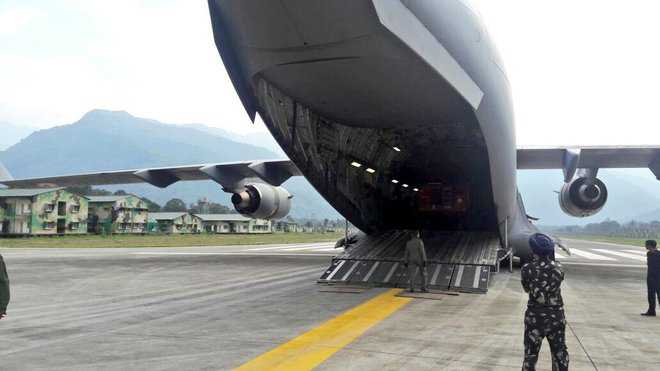
C17 lands on China border

C17 lands on China border
C-17 Globemaster at Tuting airfield in Arunachal Pradesh. — ANI
  • Sending a message to China, the IAF on Tuesday landed the C17 Globemaster, the biggest transport aircraft in its stable, at the advanced landing ground at Tuting in Upper Siang district of Arunachal Pradesh.
  • Describing the mission as historic, an IAF spokesman said the mammoth C17 Globemaster could execute this mission owing to the sublime flying skills of the pilots
  • After completion of the trial landing, the C17 also carried out an operational mission airlifting operational load into the austere airfield. TNS


Army gears up for e-warfare

Vijay Mohan

Tribune News Service

Chandigarh, March 7

After inducting ground-based electronic warfare (EW) systems over the past couple of decades, the Army now wants to take this battlefield domain into the skies. It has projected a requirement of aerial systems for reconnaissance, surveillance as well as countering hostile radio and cellular networks and satellite-based systems.According to the Technology Perspective and Capability Roadmap – 2018 document that was issued by the Ministry of Defence a few days ago, the Army has projected a requirement for three aerostat systems, seven heliborne EW systems and 10 EW payloads for remotely piloted aircraft.The document, the first edition of which was issued in 2013, identifies the requirements of the three services in various domains over the next decade and serves as a guide for the industry for planning or initiating technology development, partnerships and production arrangements.The Army’s requirement for the aforementioned aerial systems comes along with an additional requirement for 10 integrated EW systems that can be mounted on tracked or wheeled vehicles. The Air Force and the Navy too have projected requirements for different types of EW platforms to meet their operational needs.The broad parameters for the EW systems include the capability to deny effective use of electronic spectrum by the enemy, detect, monitor, and jam enemy cellular and satellite communication receivers, radars and GPS systems, carry out communication intelligence and electronic countermeasures, besides integrating photo-recce and image correlation for physical identification of targets. The IAF had inducted two aerostats over a decade ago and drawn up plans for further acquisitions, which are still hanging fire. An aerostat is an unpowered balloon tethered at a certain height above the ground and equipped with surveillance and communication equipment. It can remain deployed for a number of days at a stretch, scan a wide swath of area and is particularly effective for detecting low-flying or surface objects.Aerial EW systems that the Army is envisaging can also be used for counterterrorist operations and sub-conventional conflict situations besides conventional deployment.


Seeks aerial systems
  • Projects a requirement for three aerostat systems, seven heliborne electronic warfare (EW) systems and 10 EW payloads for remotely piloted aircraft
  • The objective is to deny effective use of electronic spectrum by the enemy, detect, monitor, and jam enemy cellular and satellite communication receivers, radars and GPS systems

ISI still providing covert support to Taliban: US media report

ISI still providing covert support to Taliban: US media report
The Pentagon said the US wanted Pakistan to take more steps against terrorism in the region. Reuters file

Washington, March 16

Pakistan’s intelligence agency ISI continues to covertly support the Taliban in the border region, a US media report on Friday claimed, naming specific neighbourhoods in the country that are being used as safe havens by the terrorists.The Washington Times’ investigative story alleged that Taliban terrorists from Afghanistan travelled freely to a Pakistani army garrison in Quetta where they met with military and Inter-Services Intelligence (ISI) officials.“We believe top Taliban leadership are operating from Pashtunabad, Gulistan and surrounding areas,” an unnamed intelligence source was quoted as saying by the daily.Killa Abdullah, a small border district about 44 miles from Quetta, is another area where the Taliban is working with the ISI. Within that district, an area known as Chaman that borders Afghanistan is a Taliban hub, where terrorists operate openly and are known to local residents as Talibs, it said.Taliban fighters have been spotted here along the road from and to Kuchlak “with automatic weapons either in motorbikes, or in four-by-four vehicles along with two to five companions,” the source said.The Washington Times said the ISI also conducted security patrols in facilitating Taliban transit along the main highway to Kuchlak, using a Toyota SUV that is owned by the ISI.Claiming that the ISI security is an open secret in the region, the daily said local police are not permitted to stop the Taliban from travelling from Afghanistan to Pakistan and the fighters refused requests at checkpoints for identification by simply stating they are Talibs.“These people freely travel in Quetta, Chaman and all surrounding areas. Civilian [police] forces cannot intervene because they work under ISI and military apparatus. The police are also powerless and are afraid for their own security,” American intelligence sources told the US daily.Guldara Baghicha, near Chaman city, which houses a Pakistani paramilitary garrison, is said to be a major residence for families of the Taliban. The ISI has banned the local police and Pakistan’s Frontier Corps from entering or patrolling that area.Kili Jahangir, in its neighbourhood, includes restricted zones because Taliban families live nearby, the daily said.The intelligence source further described Jungle Piralizia, south of Chaman, as a Taliban “resting place after their campaigns in Afghanistan against Western forces”.“The region has been scene of clashes between local police and Taliban fighters, who are known to retaliate against local police who try to arrest them, in one case blowing up a police vehicle and killing several policemen,” the daily said.“In such cases, the Taliban are arrested by local police then the ISI intervenes immediately and promptly releases them,” the daily said.Meanwhile, the Pentagon on Thursday said the US wanted Pakistan to take more steps against terrorism in the region.“The (Defence) Secretary has said there is more that Pakistan can do. And we look forward to them taking more steps to combat terrorism in the region,” chief Pentagon spokeswoman Dana White told reporters at her weekly news conference. PTI


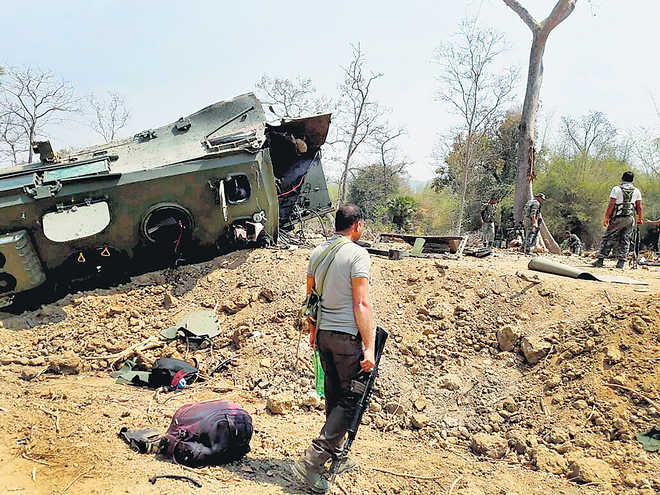
9 CRPF men die in Chhattisgarh blast Mine-protected vehicle blown up

9 CRPF men die in Chhattisgarh blast
Security personnel inspect the site of an IED blast where nine CRPF men were killed in Sukma district. PTI

Raipur/New Delhi, March 13

Nine Central Reserve Police Force (CRPF) personnel were killed and two injured after Maoists blew up their mine-protected vehicle (MPV) in Chhattisgarh’s Sukma, a year after a dozen jawans were killed in a similar ambush in the district. Officials said the incident took place around 12.30 pm along the 5-km under-construction Kistaram-Palodi road when the troops of CRPF’s 212th Battalion were out for an operation.(Follow The Tribune on Facebook; and Twitter @thetribunechd)Home Minister Rajnath Singh said the incident was “deeply distressing” and asked CRPF Director General RR Bhatnagar to rush to Chhattisgarh. Over 50 kgs of improvised explosive devices (IEDs), concealed under the track, were used in the blast. The armoured MPV went 10 feet into the air before crashing, officials said.Those killed have been identified as Assistant Sub-Inspector RKS Tomar, Head Constable Laxman and Constables Ajay K Yadav, Manoranjan Lanka, Jitendra Singh, Shobhit Sharma, Manoj Singh, Dharmendra Singh and Chandra HS. “The troops were going towards a new post in Palodi. Naxals were first spotted in the area at 8 am and the CoBRA teams retaliated and broke the ambush. However, when a convoy was crossing the area in the noon, the second mine-protected vehicle got caught in the blast,” the DG said. — PTI