Sanjha Morcha

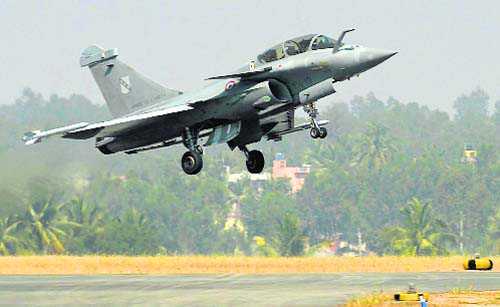
France pitches for another batch of 36 Rafale jets procurement by India

France pitches for another batch of 36 Rafale jets procurement by India
The issue of Rafale deal figures in the talks between Prime Minister Narendra Modi and French President Emmanuel Macron.

New Delhi, March 10

France on Saturday pitched for starting negotiations over procurement of another batch of 36 Rafale jets by India with French President Emmanuel Macron describing the fighter jet programme as a key aspect of the bilateral defence cooperation.Sources said there was a communication from the French government recently indicating its eagerness in making an announcement by the two sides favouring additional procurement of Rafale jets for the Indian Air Force.They said the issue of Rafale deal figured in the talks between Prime Minister Narendra Modi and Macron.”India had made a sovereign decision in this respect (Rafale fighter jet) and we are monitoring the progress in the field. We very much want to continue the programme.”It is a long-term contract which is mutually beneficial. I personally consider it as the heart of the strategic partnership,” Macron said in a statement to media after talks with Modi.India had signed a government-to-government deal with France in 2016 to buy 36 Rafale fighter jets at a cost of about the Rs 58,000 crore. The Congress has been demanding details of the deal, alleging that the deal negotiated under its rule was much cheaper than the contract signed by the Modi government.Officials said the French side pitched for procurement of another batch of 36 Rafale jets by India during the talks between French Defence Minister Florence Parly and her Indian counterpart Nirmala Sitharaman.In the meeting, Parly said extending the current deal will further bolster defence cooperation between the two countries, they said. The Indian side conveyed that no decision has been taken yet on the issue.The Indian Air Force has also been favouring procurement of more Rafale jets from France. It had communicated to India earlier too, seeking additional orders of Rafale jets.In the talks, Modi and Macron noted with satisfaction the “on-schedule” progress in the implementation of acquisition — related agreements, including the Rafale aircraft deal, a joint statement issued after Modi-Macron talks said.”They looked forward to continue their discussions to expand and deepen the ongoing defence manufacturing partnerships,” it said. – PTI


AFT: Outing with permission to be considered on duty

Vijay Mohan

Tribune News Service

Chandigarh, March 4

Ruling that a person who has gone to watch a movie after duty with due permission of the authorities will be considered as being on duty for the purpose of benefits in case of any mishap, if he meets with an accident, the Armed Forces Tribunal (AFT) has granted special family pension to the mother of an airman almost a decade after his death.Corporal Vishal Raj, who belonged to Pathankot, had died in a road accident in 2009 when the motorcycle on which he was travelling along with another airman met with an accident while they were returning to Kalaikunda Air Force Station in West Bengal after watching a film in a nearby town.The Ministry of Defence, however, refused to sanction special family pension that is applicable for armed forces personnel who die on duty on the grounds that his death was not attributable to military service. His mother, Tripta Devi, was sanctioned only ordinary pension.Thereafter, she approached the AFT, claiming that her son was on active military service and was not on leave at the time of accident. In her petition, she contended that before going for the movie, he had made the necessary entries in the records of his squadron and had properly booked-out of the sub-guard room. The ministry, on the other hand, argued that based upon the court of inquiry proceedings, he was not performing any military duty at the time of the accident and consequently his family was not entitled to the special pension.Drawing inference from past judgments on the issue by the high courts, the AFT and the relevant provisions of law, the tribunal’s Chandigarh Bench comprising Justice Mohammad Tahir and Lt Gen Munish Sibal held that in view of the facts and circumstances of the case, Vishal had sustained injuries while he was on duty and the injuries because of which he died, can be attributable to military service.The tribunal had directed the Ministry of Defence to calculate the special family pension and release it to Tripta Devi within three months. The arrears of the pension, however, have been restricted to three years preceding the date of filing the petition as she had moved the AFT after a lapse of seven years from the incident.Relief to airman’s kin AFT’s Chandigarh Bench allowed special family pension to the mother of an airman from Pathankot who died after sustaining injuries in an accident during his posting at Kalaikunda Air Force Station in West Bengal. The victim was returning after watching a film in a nearby town

.


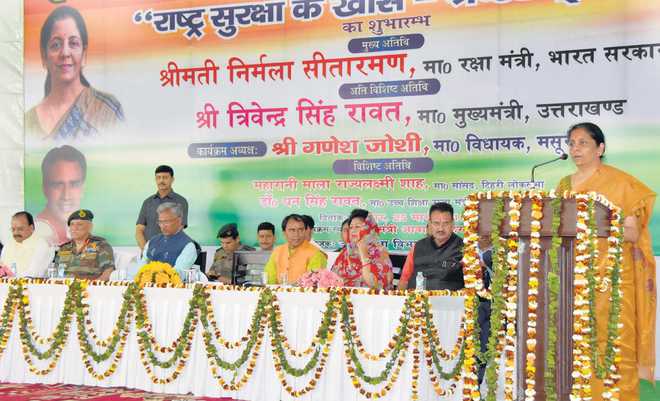
Modernisation of Army under way: Sitharaman

Modernisation of Army under way: Sitharaman

Tribune News Service

Dehradun, March 25

Union Defence Minister Nirmala Sitharaman said modernisation of Indian Army was under way. She credited Prime Minister Narendra Modi with the modernisation programme. The Defence Minister was here on Sunday to honour students of the state, who have been selected in Indian Military Academy and National Defence Academy in the recent years. “When you join the forces after competition of training at your respective academies, you will be proud to join a modernised Indian Army”, Sitharaman said addressing the gathering of successful students. She also asserted that the Army was fully prepared to deal with any situation. The minister recalled her visit to the Uttarakhand region during childhood days, pointing that the region was then known for Char Dham yatra. “But today Uttarakhand is also known as Veer Bhumi as a large number of youth from the state join defence forces these days”, she said. The minister also praised Col Ajay Kothiyal, Director, National Institute of Mountaineering, Uttarkashi, for his efforts towards motivating the state youth to join the armed forces.   Nirmala Sitharaman also handed over a cheque of Rs 50,000 each to the successful student of Uttarakhand, who have been selected in Indian Military Academy and National Defence Academy from 2014 to 2018. A total of 140 selected students were felicitated by the minister. She also honoured family members of Victoria Cross awardee Late Gabbar Singh Negi, Veer Chandra Singh Garhwali and other defence forces martyrs.Chief Minister Trivendra Singh Rawat said it was a matter of honour that Prime Minister had reposed faith in a daughter of the country by making Nirmala Sitharaman as defence minister of the country.Chief of Army Staff Gen Bipin Rawat, Uttarakhand Higher Education Minister Dhan Singh Rawat and Mussoorie BJP MLA Ganesh Joshi were among the prominent persons present on the occasion.


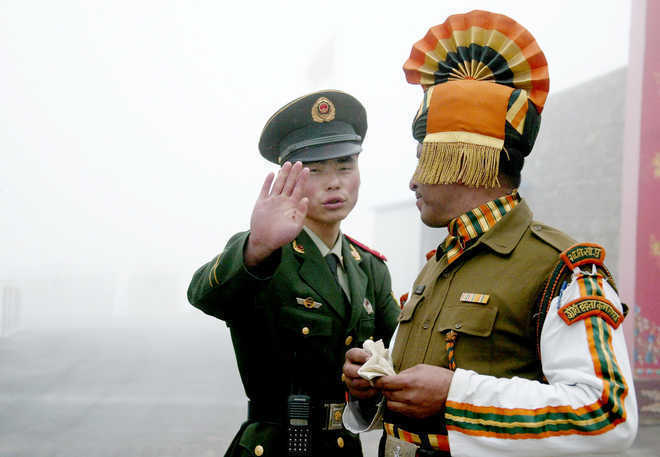
Status quo at Doklam, says Indian envoy

Status quo at Doklam, says Indian envoy

Beijing, March 24

“No change” has taken place at the Doklam standoff area after it was resolved last year, India’s envoy Gautam Bambawale said and blamed China squarely for the face-off, saying it happened because Beijing tried to alter the “status quo” which it should not have.The 73-day standoff ended on August 28 last year after China agreed to halt the road building activities at Doklam in Sikkim section.“No, I can tell you that in Doklam area, which we call close proximity or sometimes the face-off site, the area where there was close confrontation or close proximity between Indian and Chinese military troops, there is no change taking place today,” India’s Ambassador to China Bambawale said, reacting to reports of Chinese military stepping up infrastructure build-up in the area.The Chinese side may be putting more military barracks to put in more soldiers, but that is well behind the sensitive area, he said in an interview to Hong Kong-based South China Morning Post. — PTI


Russia at the crossroads MK Bhadrakumar Putin — a ‘villain’ abroad, ‘hero’ at home

Russia at the crossroads
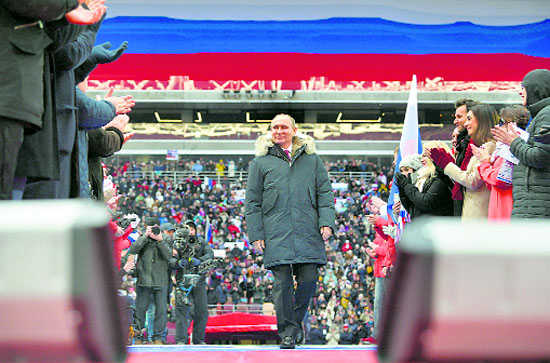
What next? As per Russian constitution, this will be Putin’s last six-year term.

MK Bhadrakumar

The Russian presidential elections on March 18 can be seen as the most transparent in the country’s “post-Soviet” history. But genuine political competition was still lacking and the electorate’s choices were limited. The leading candidate, Vladimir Putin, consistently enjoyed a popular rating above 80 per cent among the Russian people in the recent years and will walk away the winner. A December survey by the independent polling firm, Levada Center, estimated that 81 per cent adults approve of Putin as President, including 86 per cent Russians, 18 to 24 years old; meaning that most of the country supports Putin.What accounts for it? In a nutshell, over successive terms as Prime Minister and President, Putin has overseen an economic boom, military expansion and the country’s emergence as a major power on the world stage. Levels of poverty are significantly lower than before; most Russians enjoy a higher living standard; there is a sense of stability and national pride. During Putin’s first term as President, wages consistently grew 10 per cent annually while in his second term since 2012, although economic growth slowed down (what with the fall in income from oil exports and Western sanctions), disposable income still grew by 11 per cent between 2011 and 2014, and the Putin era has seen Russia’s consumer economy expand considerably. Today, more people own a car and there are more microwaves than households.  This was how an AFP dispatch from Moscow last week on the Russian elections captioned its story: ‘Putin Is a Villain Abroad, Hero At Home’. Curiously, Putin’s villainous reputation featuring on the cover of Western news magazines — variously as public enemy number one, an octopus, The Terminator, Hitler and Batman’s nemesis, The Joker — may even be a factor adding to his popularity among Russians. As one Russian put it to the AFP, “If they’re scared of you, it means they respect you.” For millions of Russians, Putin is the man who restored Moscow’s standing on the world stage following the humiliating collapse of the former Soviet Union. Nonetheless, challenging times lie ahead for the newly elected President. The high support ratings of Putin notwithstanding, ordinary Russians are anything but satisfied with their lives and pro-market economists are demanding radical structural reforms. In the international arena too, there are huge uncertainties facing the Russian diplomacy. Arguably, therefore, Sunday’s elections cannot be regarded as irrelevant to Russia’s trajectory. Like in India, social media has created a “horizontal society” in Russia, cutting across cultural and class lines, and the Internet remains free compared to the rest of the media.The yearning for change brings to mind the backdrop that provided momentum for Bernie Sanders in the US or Jeremy Corbyn in the UK — except that this is Russia where the channels for expression of social discontent and the political processes that can give it a sense of direction are rudimentary. Another Levada poll found that close to 90 per cent of Russians feel powerless to influence the future trajectory of their country and 60 per cent disavow any responsibility for what is happening around them. Simply put, while Putin remains a towering figure, the Russian political class, on the whole, carries an unsavoury reputation. Fundamentally, is the Russian elite willing or capable of change? There are rumours of internal rivalries, turf wars and trust deficit amongst the elite. These realities contradict the picture of stability, continuity and order that Russia projects even as a transition looms ahead — the Constitution stipulates that this will be Putin’s last six-year term. Suffice to say, the nationalistic rhetoric harping on Russia’s status as a great power may work less and less in the period ahead to subsume Everyman’s discontent with the hybrid system that Putin built on the basis of Russian nationalism, Soviet nostalgia and a striving for international respect.Russia regards itself as part of Europe in cultural, historical, economic and political terms. But Europe does not regard Russia as part of the liberal world order. An embittered Russia constantly runs down the liberal world order, pointing a finger at the inexorable decline and challenging the leadership role of the US, weakening of the European security system and disarray in European integration, rise of populist political doctrines and so on. Russia’s preference is that the essence of the liberal world order should be a system of international relations rather than about bona fide democracies.Indeed, the liberal world order tolerates the Indian or Chinese variants of democracy but holds Russia to an exacting, absolute standard. (Russians today enjoy freedoms of speech, assembly, religion, travel, politics, and the Press that the generations before 1989 never knew — and on a scale that is unthinkable in the more repressive single-party Communist state that is China.) China and India are having the cake and eat it too — making developmental leaps through globalisation while also preserving their political autonomy. Thus, within the BRICS grouping, while China and India join Russia to envisage the multipolar world as the bright future, they are perfectly at ease with the prevailing system as well, which gives them scope to get richer and stronger while also maintaining independent foreign policies.But then, China and India have largely avoided direct disputes with the West and do not strive to undermine the existing world order. Period. On the contrary, the Russian elite has too many hang-ups regarding the country’s great power status, which means that its integration into the liberal world order has to be on its terms. The result is, Russia is pining for the day when following the inevitable collapse of the US as superpower, the world order transforms as a balance of forces of individual countries and alliances, allowing the coexistence of various poles of power. Meanwhile, Russia’s golden moment lies in a serious confrontation breaking out between the West and China — or if the liberal world order excludes China too on account of political differences. The problem here is that hope does not make strategy. China won’t get into a collision course with the West — nor is the West seeking one. China leverages its tools of economic globalisation to moderate political differences with the West.What could be the directions of Putin’s foreign policy as he embarks on the new term? Basically, it will largely depend on the international environment and can be expected to be risk-evasive than risk-taking; willing to reach compromises but not via unilateral concessions or dilution of national interests; and, it will remain linked to domestic needs in the social, economic and technological spheres.The writer is a former ambassador



BHAGAT SINGH’S MUSEUM ‘Linking youth with martyrdom biggest challenge’

Aparna Banerji

Tribune News Service

Khatkar Kalan, March 22

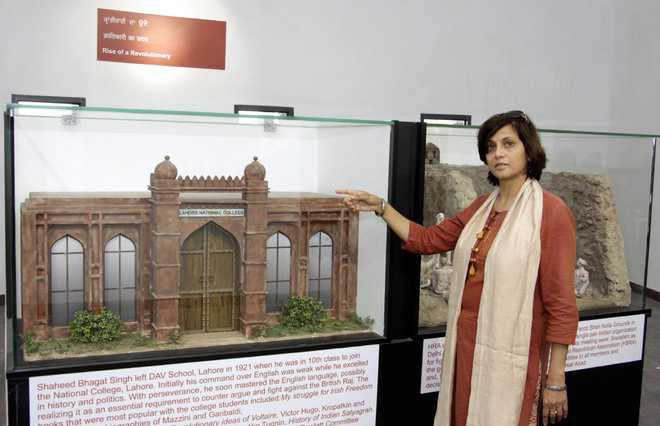
As a projector runs an interview of Bhagat Singh’s mother Vidyawati in one of the suave galleries of the newly-built martyrs’ museum at Khatkar Kalan, the museum architect Shikha Jain supervises the setting up of a few exhibits (one carries a horoscope of Bhagat Singh, another carries the belongings – clothes (trousers and a tie), an inkpot, a journal and a stopwatch of Bhagat Singh’s Uncle Ajit Singh) inside the empty glass cases of the museum to prep up the site for the big day tomorrow.With the museum–finally ready to give the public a glimpse of the Bhagat Singh, ahead of a big political event by the Congress near Bhagat Singh’s museum at Khatkar Kalan, a process which has taken nine years to come to fruition – Architect of the 30,000 sq feet space Shikha Jain speaks on her experiences:How did the plan for the museum take off?Lot of land was agricultural land which farmers gave to the government for this space. By the end of 2010 the complete drawing and landscape plan was complete for construction. Since it was initiated the centre so it would come in pockets. It was also decided which agency would execute the plan. It was the government agency. They tried the Mandi Baord but since that didn’t work out, finally Markfed pitched in for the project.Were you roped in by the state government?We were roped in by the Punjab government through an expression of interest. They had called for architects and museum designers and we had 40 plus projects on our hands already and the expertise to deal with such a sensitive project.How big was the challenge to envision an entirely empty space on the life and struggle of Bhagat Singh?The biggest challenge in envisioning the museum was that Bhagat Singh is a national legend. To do a museum on him, different sensibilities would have to be factored in. There are different communities who have associations with him, Who feel strongly about him. There are family members in Punjab and other people who strongly associate with him. To take a subject, on which everyone has an opinion and to really first look at historical actual life – what are the evidences available – that was the initial challenge. Since there was there is hardly any actual evidence and information available on him at one place.So you had little to begin with?To begin with we only had a few artefacts. His janampatri (horoscope), a few artificats – total 10 to 15 artifacts were the original ones which were in the initial museum. Rest of the family history is all in the texts. So we contacted all his family members, especially his nephew Prof. Jagmohan who has done a lot of research. We even did interviews of his mother’s driver and talked to him in the village.Whatever evidence we could find was gleaned in. Prof Malwinder Singh Waraich – and his publisher Harish Jain were also of great help. The actual collection had to be recreated from all these sources. With these – we recreated the actual strory line of his life from his birth to his execution.Was it tricky to work with only 10 to 15 artefacts in such a huge museum space?The museum space is 30,000 sq feet–it took us a total of one year to come up with the idea. We had a team of historians and curators. Things had to be curated and resourced time and again. Because sometimes his family members would not come. Then the construction of the building had to be very meticulous as per exhibits. We had to get even the gallery names checked by the historians. A committee was formed for this job. Representatives from the Supreme Court and the National Archives and people like Prof Chaman Lal, Harish Sharma, Malwinder Singh Waraich, Harish Jain and representatives of the Kuka Movement were all on panel.The next challenge was creating panels for the museum. Sorting out pictures and writings and deciding which ones to include. We sorted these out through various departments so it did take some time.Is any work left to be done?Even now we need to conserve some of the items properly – a conservator needs to work on it. We shall have in house curators and conservators at the museum. On the first floor there is a conservation lab. The museum is built as per international standards. There is a ramp going up to a conservation lab. There is strorage space as well. With time it will work as an international conservation and research space for Bhagat Singh. We have fixed displays and there is also a temporary gallery – any researchers can put up temporary exhibits there in the future. Additionally, an auditorium will show documentaries of Bhagat Singh and the freedom fighters.Is the process of acquiring artefacts and documents associated with Bhagat Singh complete?We are simultaneously also outlining the potential sources for future exhibitions and anyone with valuable contributions shall be welcome.So were you inspired by the persona of Bhagat Singh along the way?Definitely, it was very inspiring. Bhagat Singh is a national legend and brave soul it was a great blessing for country to have a figure like that. We were clear the museum should send out two messages clearly– it should inspire the youth of India –especially when we were working on panels. Youth and martyrdom were two main themes we wanted to focus on.What was the greatest difficulty you faced along the way?The managing of funds. The money was planned as per 2010 estimates but we fell short of that by 2018 with inflation and escalating costs. Landscaping work worth Rs 7 crore is still left. However, we had to make do with the original budget pan and we are glad things have worked out.The museum concentrates on Bhagat Singh alone and not Rajguru and Sukhdev. Was that a conscious decision?It was a policy decision. Because this is his ancestral home. The previous museum was only on Bhagat Singh hand the whole place and funding was clearly for Shaheed Bhagat Singh’s museum, so we decided to concentrate on him.However, there are three images as well as spaces reserved for Rajguru and Sukhdev as well in the execution gallery.


Maiden solo sortie by IAF first woman combat pilot

Maiden solo sortie by IAF first woman combat pilot
Flying Officer Bhawana Kanth

Vijay Mohan

Tribune News Service

Chandigarh, March 17

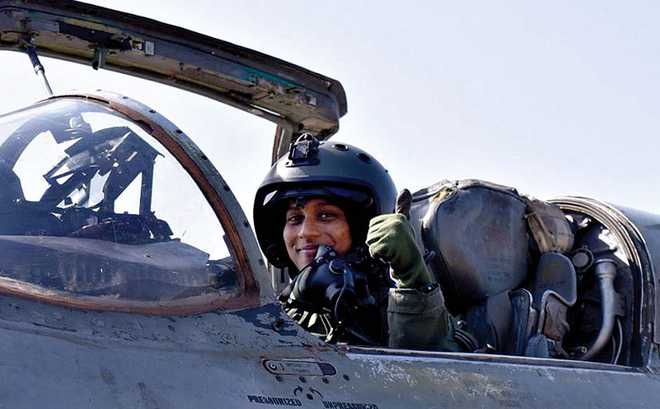
The country’s oldest airbase, Ambala, witnessed another landmark in the history of military aviation when the Air Force’s first woman combat pilot, Flying Officer Bhawana Kanth, flew her maiden solo sortie in a fighter aircraft from the base on Friday.Bhawana took off in a MiG-21 Bison belonging to the IAF’s No.3 Squadron, the Cobras, from Ambala, where she has been posted, at 2 pm and the sortie lasted about half an hour.(Follow The Tribune on Facebook; and Twitter @thetribunechd)She became the second woman combat pilot to fly a fighter solo. Flying Officer Avani Chauturvedi, posted with No. 23 Squadron, the Panthers, became the first to fly solo in a fighter from the Jamnagar airbase on February 22.An engineer, Bhawana is among the three pioneering women combat pilots in the IAF, the third being Flying Officer Mohana Singh. They were commissioned into the IAF in June, 2016, by the then Defence Minister, Manohar Parrikar, at the Air Force Academy in Dundigal near Hyderabad. They underwent training on the Hawk advanced trainer jets for about a year before moving on to fly the supersonic fighters.The Bisons are the last remaining variants of the venerable MiG-21 fighter that entered the IAF service in the early 1960s. 


Ex-Army man forced to live on rent, builder penalised

Consumer commission directs firm to refund Rs 29 lakh for not giving possession of flat in time

Ishrat S Banwait

Tribune News Service

Chandigarh, March 15

The State Consumer Commission has come down heavily on a builder for not giving the possession of a flat in time to an Army man, owing to which he was forced to live on a rented accommodation post retirement.The commission has directed Ansal Properties and Infrastructure Limited to refund the amount paid by Milap Chand, the Armyman, and to pay a fine of Rs 1.30 lakh.A complaint was filed by Milap Chand and his wife Sulochna Rani against the company, its two directors and managing directors. The complaint stated that while serving the Indian Army, Chand had planned to settle down near Chandigarh post retirement. He had booked a flat in ‘Golf Links II’ in Sector 116 of Mohali in July 2012. While the basic cost of the flat was Rs 42.33 lakh, Chand had initially paid Rs 29.59 lakh. The floor buyer agreement was signed in the same year and possession was to be given within three years, along with a grace period of six months. However, when Chand visited the site, no development had taken place. He was thus forced to take a house on rent after his retirement in 2015.In December 2016, the company sent an e-mail to Chand stating that the possession was delayed and they would pay the interest. Chand was asked to take possession of another flat, which he had agreed to. However, the company failed to hand over the possession of that flat as well. Chand visited the site in August 2015, then in March 2016 and again in July 2017, but no development had taken place at the project site. Chand then asked the company to refund his money several times, but in vain.The company had replied that Chand was not a “consumer” as he bought the property for commercial purposes. They said the complainant defaulted in payments regularly and willfully breached the terms and conditions. Stating that the possession time was tentative and no fixed time was promised, it also said that the commission had no jurisdiction in the case as the property was in Mohali.The commission observed, “Not mentioning the exact date of delivery of possession of the unit(s) in the buyer’s agreement is an unfair trade practice”. It thus ordered the builder to refund Rs 29.59 lakh to the complainants and pay Rs 1 lakh as fine for causing mental agony and physical harassment, along with Rs 30,000 as the cost of litigation.


Militancy sees sharp drift towards Islamism

Militancy sees sharp drift towards Islamism
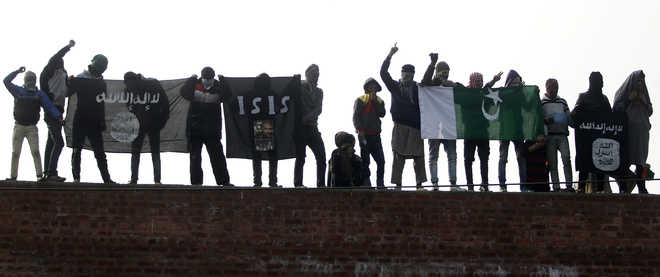
Masked youth hold ISIS and Pakistani flags during a protest in Srinagar. Tribune Photo: Amin War

Azhar Qadri

Tribune News Service

Srinagar, March 13

The three militants who were eliminated in Anantnag on Monday drew inspiration from the global Islamist movement, revealing the growing influence of radical Islamism in the region.Eisa Fazili, a young engineering student who joined militancy, first appeared in a video in September last year in which he quoted Abu Musab al-Zarqawi and Anwar al-Awlaki, two prominent ideologues of the global jihadist movements.In the months since then, the police kept chasing him as he escaped the dragnets. Fazili joined militant ranks in August last year and soon emerged as the face of a nascent and fledgling unit of the Islamic State, a militant organisation born out of the Al-Qaida in Iraq. Amaq, the media agency of the Islamic State, claimed responsibility for the attacks in which the police found the involvement of Fazili.Last month, the police identified him as one of the assailants in the attack on a policeman guarding separatist leader Fazal Haq Qureshi. The policeman was killed, his rifle snatched and the attack claimed by Amaq.Even as authorities remained tight-lipped about the presence of Islamic State militants in the region, police officials investigating the cases began joining the dots.The emerging links, more evident on social media sites where militants frequently share their pictures and statements, are opening a new form of insurgency that is rapidly evolving and drawing its inspiration from global jihadist movements.Fazili was killed in a pre-dawn counter-insurgency operation in south Kashmir’s Anantnag district on Monday along with two other militants. The police identified the second militant as Syed Owais and details shared on social media provided his other name as Abu Bara al-Kashmiri, hinting to a possibility that he was the militant who had recently appeared in a video where he announced the formation of the local unit of the Islamic State.The third militant killed in the operation has not been officially identified even as unverified claims on social media identified him as a resident of Hyderabad.A senior police official said the police were verifying these claims. “They were initially with the Tehreek-ul-Mujahideen but later claims were made by the Islamic State which are a point of investigation,” the official said.The official said the three militants were killed in a “swift operation”. Even as the police remain tight-lipped about the presence of the Islamic State-inspired militants in the region, the signs of their emergence are too obvious.The drift in the region’s insurgency towards global Islamism has also pitched it against the quarters harbouring pro-Pakistan agenda. Insurgency is undergoing a drastic evolution as the global jihadist narrative, promoted by the Al-Qaida-linked Zakir Musa and by militants like Fazili, is finding supporters across the region as evidenced by the changing slogans at funerals.At Fazili’s funeral on the city outskirts in Soura, the pro-Pakistan activists insisting on waving green flags clashed with the Islamists who were waving black flags – a reflection of the deepening fissures and ideological faultlines in the separatist camp.

Jihadist narrative

The drift in the region’s insurgency towards global Islamism has also pitched it against the quarters harbouring pro-Pakistan agenda. Insurgency is undergoing a drastic evolution as the global jihadist narrative, promoted by the Al-Qaida-linked Zakir Musa and by militants like Fazili, is finding supporters across the region as evidenced by the changing slogans at funerals.


Op to clear snow on Manali-Leh highway begins

MC Thakur

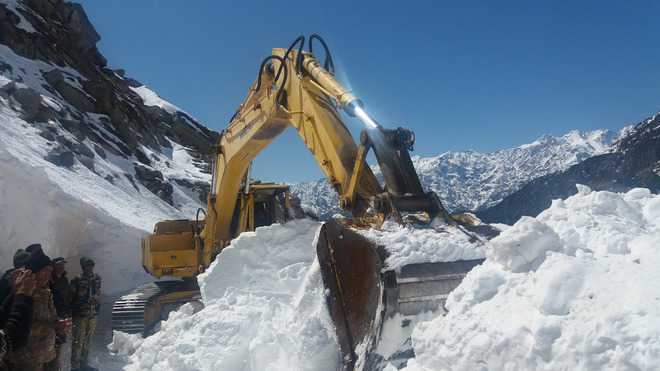
BEAS NULLAH (MANALI), MARCH 12Equipped with modern machinery and technically skilled officers and jawans, the Border Roads Organisation (BRO) today started snow-clearance operation on the Manali-Leh highway after organizing a puja near Beas Nullah, about 32 km from here.Colonel Arvind Kumar Awasthi, Commander, 38 Border Road Task Force (BRTF), said massive efforts were being made to open the Rohtang Pass, the gateway to Lahaul-Spiti, as early as possible provided the weather conditions remain favourable. Efforts were also being made to open the Manali- Leh highway from the other side of Rohtang Pass in the Lahaul valley, he added.He further said the early opening of the 13,050-ft-high Rohtang Pass for vehicular traffic will also bring great relief to the Lahaul-Spiti valley inhabitants. He said three snow-clearing teams had been deployed for opening of the 222-km Manali- Sarchu road. Snow cutters and other modern machines were being used besides the services of dedicated and well organized team work of officers and jawans.Awasthi said they had to cut through 10ft to 15ft of snow near Beas Nullah. Thickness of snow near Rohtang could be 30ft.The Commander said the first team from Manali was clearing snow near Beas Nullah towards Rohtang Pass, while the second team is clearing snow between Koksar and Rohtang Pass. The third team is moving from Darcha towards Baralacha Pass. Five snow cutters, six excavators, eight dozers and other machines have been deployed to execute the task.The Colonel said the work started after organizing a puja near Beas Nullah where all officers, jawans and machine operators prayed for their safety and favourable conditions. He has directed jawans to take their safety on priority. He further added that his prime goal was to open Manali-Rohtang-Keylong highway to bring relief to thousands of people of Lahaul valley.Meanwhile, SDM, Manali, Raman Gharsangi said two rescue posts had been established on either side of Rohtang Pass for the convenience of the people of Lahaul. He requested pedestrians to register themselves at both the posts before and after crossing the mighty Rohtang Pass. He also said that pedestrians should not risk their lives and should cross Rohtang only after ensuring that the weather was clear.